What would be insurrection, if Trump on January 6 was not insurrecting?

December 28, 2023

Consider the facts. What is required to be “insurrection?”
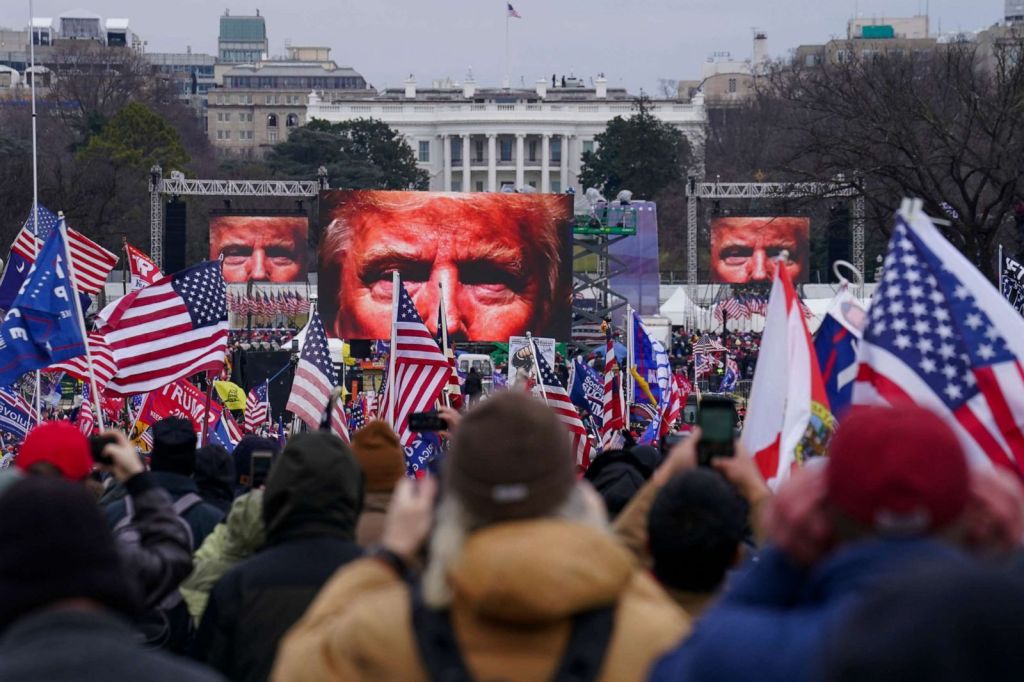
Trump images loom over crowd at Ellipse rally, as Trump incites them to attach the Capitol building and Congress, January 6, 2021. John Minchillo, AP
Trump’s image looms large over crowd assembled at the Ellipse, as Trump exhorts them to march on the U.S. Capitol and Congress, January 6, 202

Greg Sargent at Plumline posted a long series on X (Twitter) discussing just what then-President Trump’s actions should be considered, using evidence that heavily points towards Trump’s intent being insurrection.

It’s an important listing, a point-by-point discussion with facts we have, not what has been revealed in courts. The full thread is below, first level. There are links inside the thread you may wish to explore at “X.”

Read this thread. I would like to pose some hypothetical questions to insurrection-deniers: Is there anything Trump could have done that *would* have unambiguously constituted insurrection — anything that you’d acknowledge *does* require disqualifying him? 1/

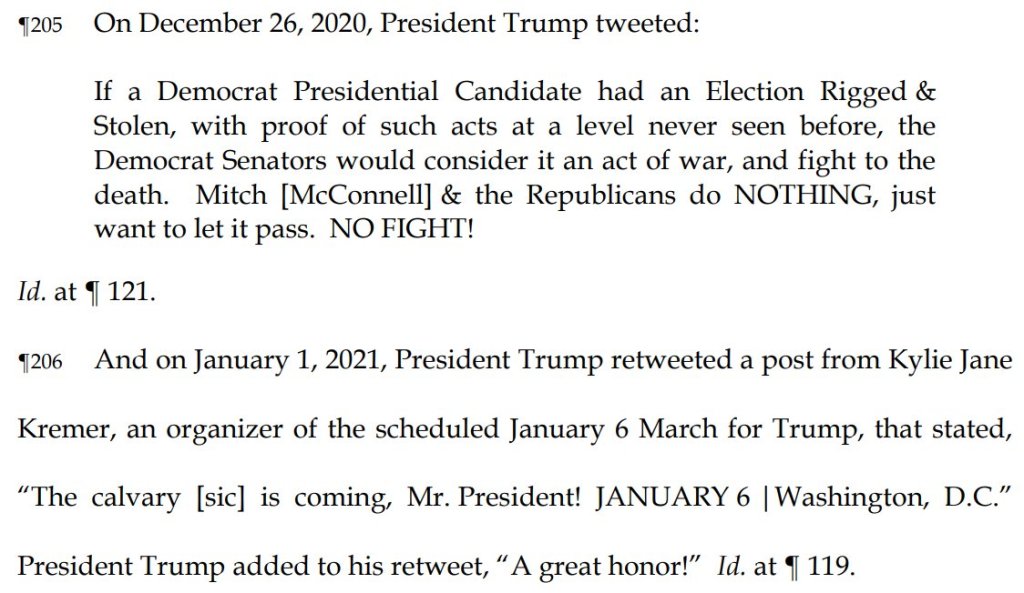
What if, in the runup to 1/6, Trump had explicitly told his supporters to descend on the Capitol to stop the VP and Congress from certifying the transfer of power *by any means necessary*? Well, here’s what he did do: 2/
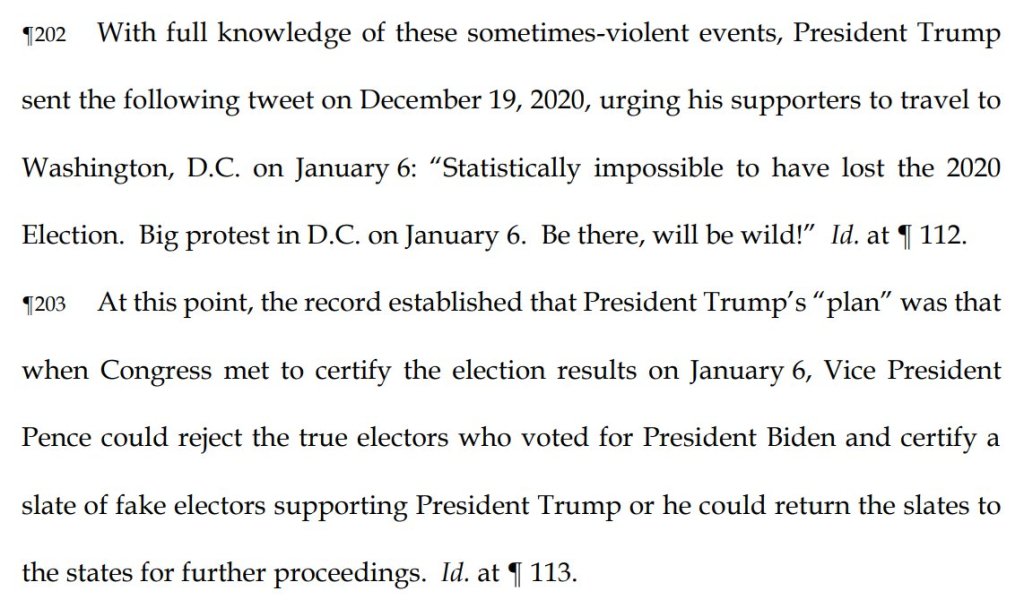
What if Trump had explicitly told top DOJ officials to fabricate evidence of widespread election fraud because he needed a pretext to justify his premeditated, illegal scheme to sabotage the transfer of power? Well, here’s what he did do: 3/

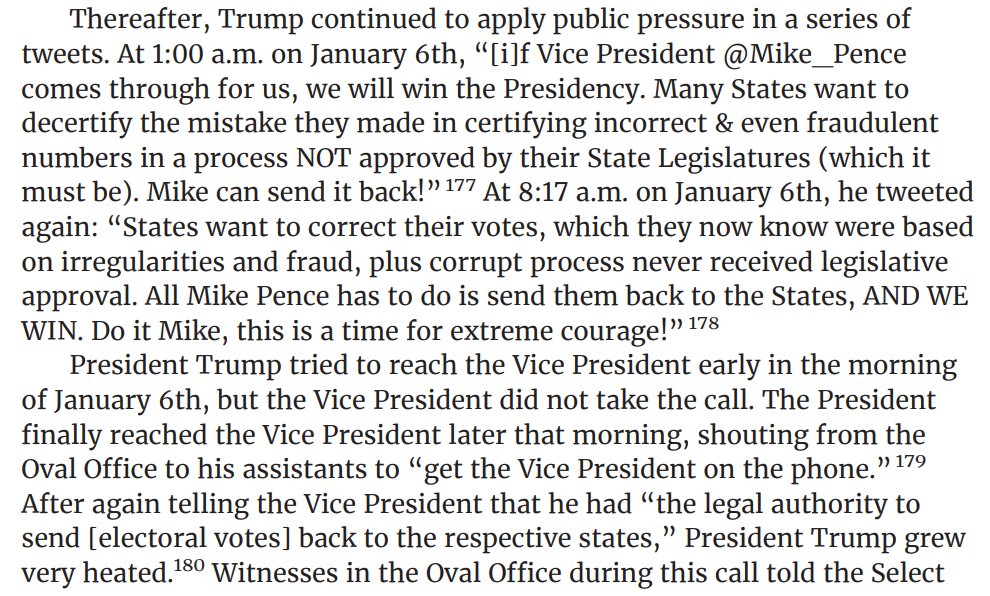
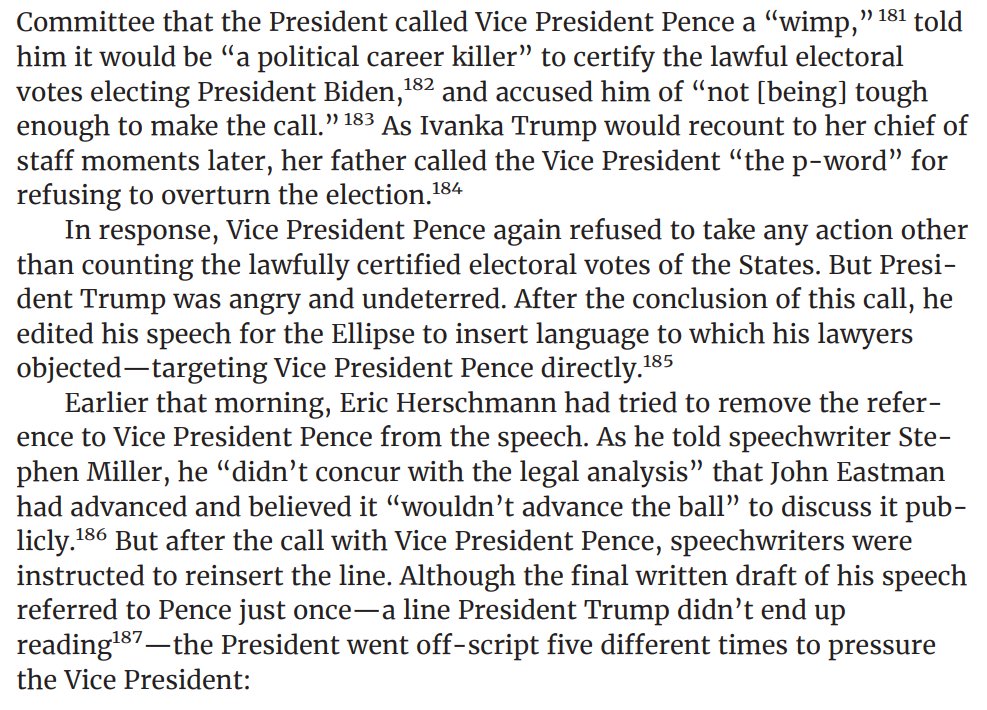
What if Trump had repeatedly and explicitly told his VP to ignore the law and abuse his authority to subvert the electoral count in keeping with his premeditated scheme to sabotage the transfer of power? Well, here’s what he did do: 4/
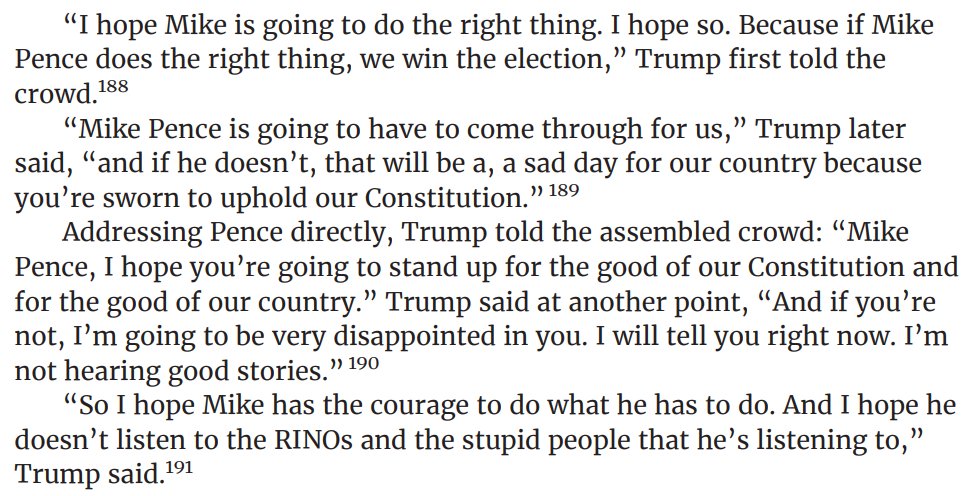
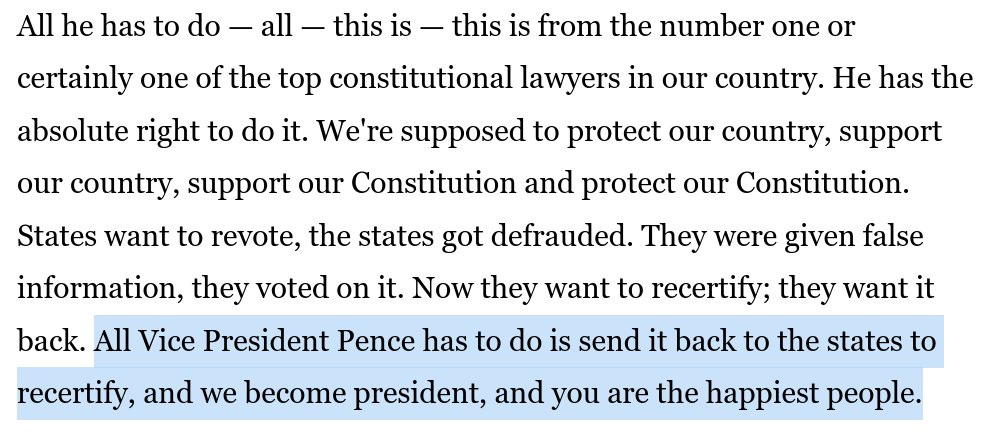
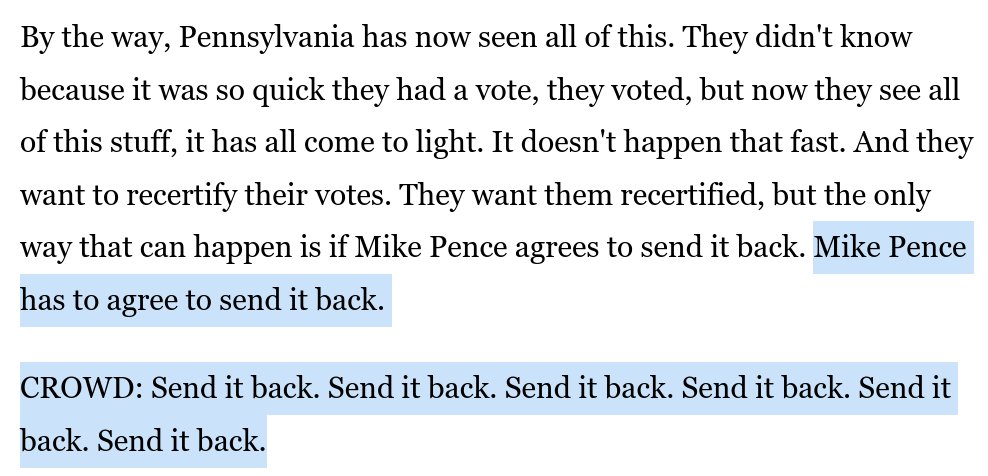
What if Trump, as he harangued the mob on 1/6, had explicitly told them to force Pence to scuttle the transfer of power, broadcasting a message to Pence that if he failed, he’d face the mob’s fury? Well, here’s what he did say: 5/
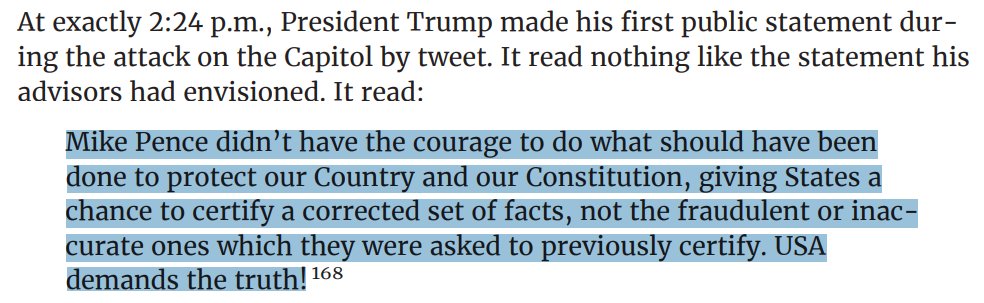
What if, while the mob attacked the Capitol, Trump had tweeted explicit instructions that the rioters should do whatever it takes to force Pence to sabotage the transfer of power? Well, here’s what Trump did tweet — again, *while* the mob was rampaging: 6/
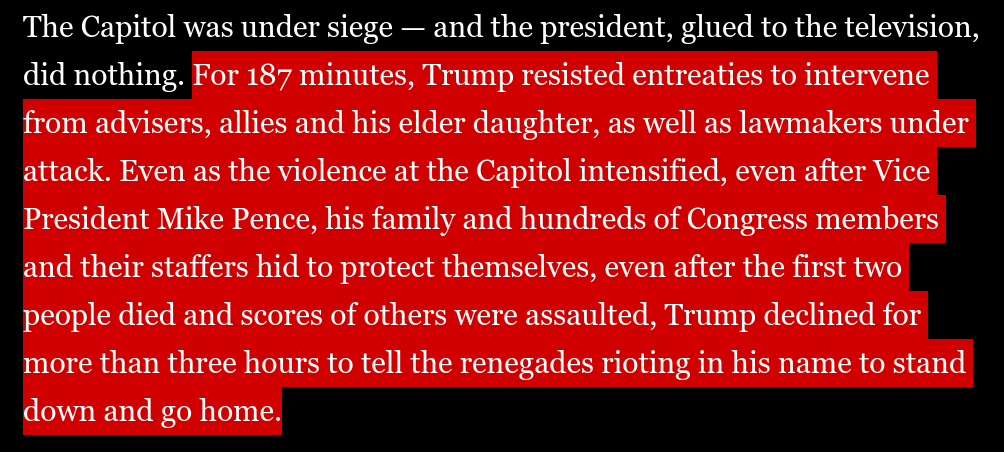
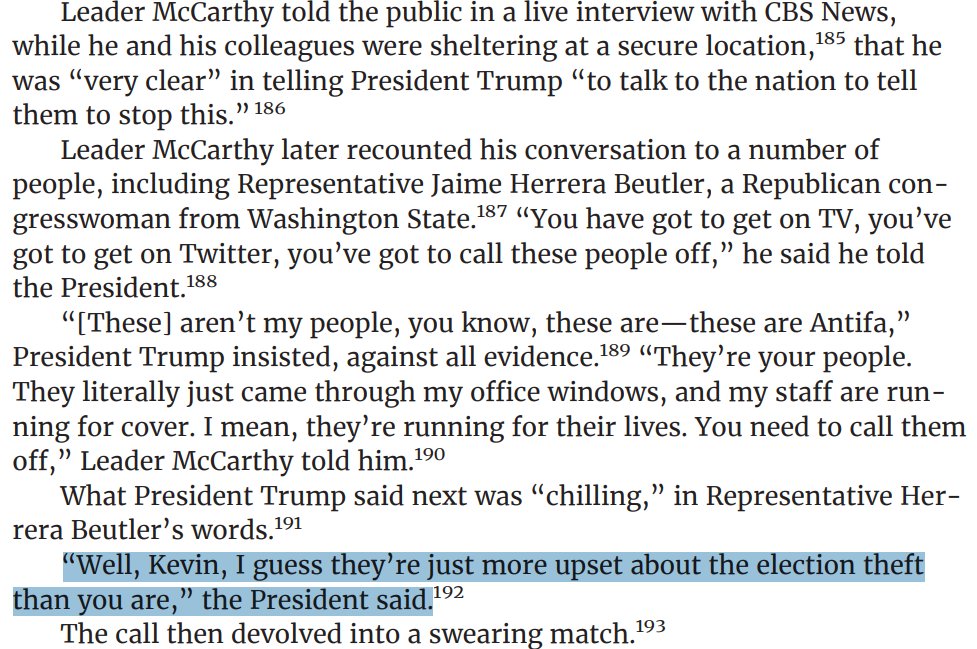
What if Trump, as people begged him to call off the mob, explicitly said no, because he wanted them to keep going, to intimidate the VP and Congress from certifying the transfer of power? Well, here’s what he did do: 7/
Would you really deny the sum total of those hypotheticals = insurrection? Doubtful. Yet the line between that and what Trump did do is functionally nonexistent. The case that his insurrection was ambiguous rests on a deliberately blinkered reading of uncontested facts. 8/

Here’s how the CO ruling defines the threshold for committing insurrection: “a concerted and public use of force or threat of force…to hinder or prevent the US government from taking the actions necessary to accomplish the peaceful transfer of power.” 9/
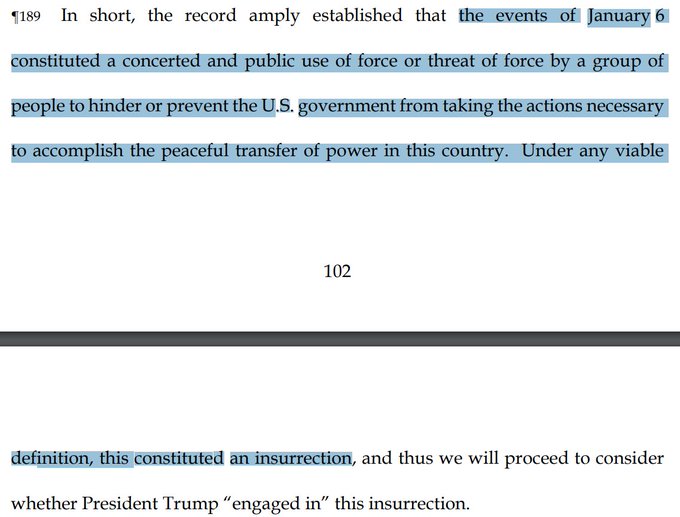
Insurrection-deniers should say (1) whether the CO ruling’s description of the threshold Q is a reasonable one; and if so, (2) whether Trump’s conduct meets it. If your answers are no, what *would* be disqualifying? Or is the claim that Disqualification is a dead letter? 10/

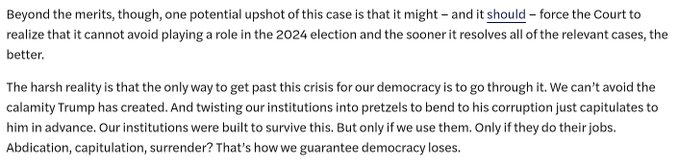
Yes, disqual could have severe consequences/enter new territory. But via

@ianbassin, if trying to end lawful constitutional democracy is not deemed disqualifying, it could also cross a Rubicon: 11/ https://protectdemocracy.org/work/trump-bal
One more point: As

@rparloff

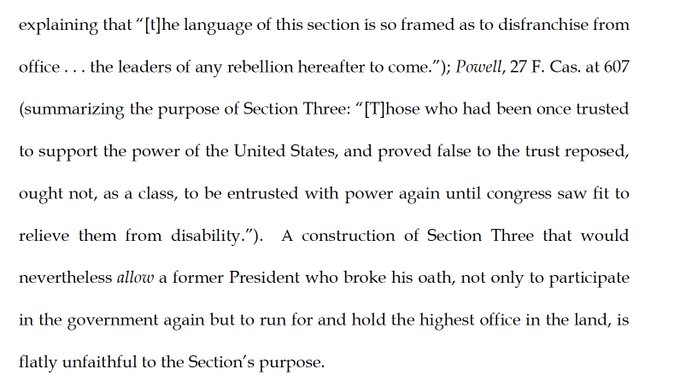
notes, the case for disqualification also rests on whether someone who so flagrantly broke their oath of office can be trusted to take the oath again. Read Parloff’s whole thread: 12/

Roger Parloff, @rparloff

“A construction of Section Three that would nevertheless allow a former President who broke his oath, not only to participate in the government again but to run for and hold the highest office in the land, is flatly unfaithful to the Section’s purpose.” /14
Any political discussion of this matter simply must include Trump’s current threats to *again* serially violate his oath of office and even to be a “dictator.” Are there consequences in green lighting all this? You need to weigh one set of consequences against the other. 13/13

This is a discussion for voters much more than a discussion for prosecutors and courts.

We do not need courts to tell us Trump is unqualified to be president. But we need to mark our ballots to reflect that judgment, as voters, to keep America great.


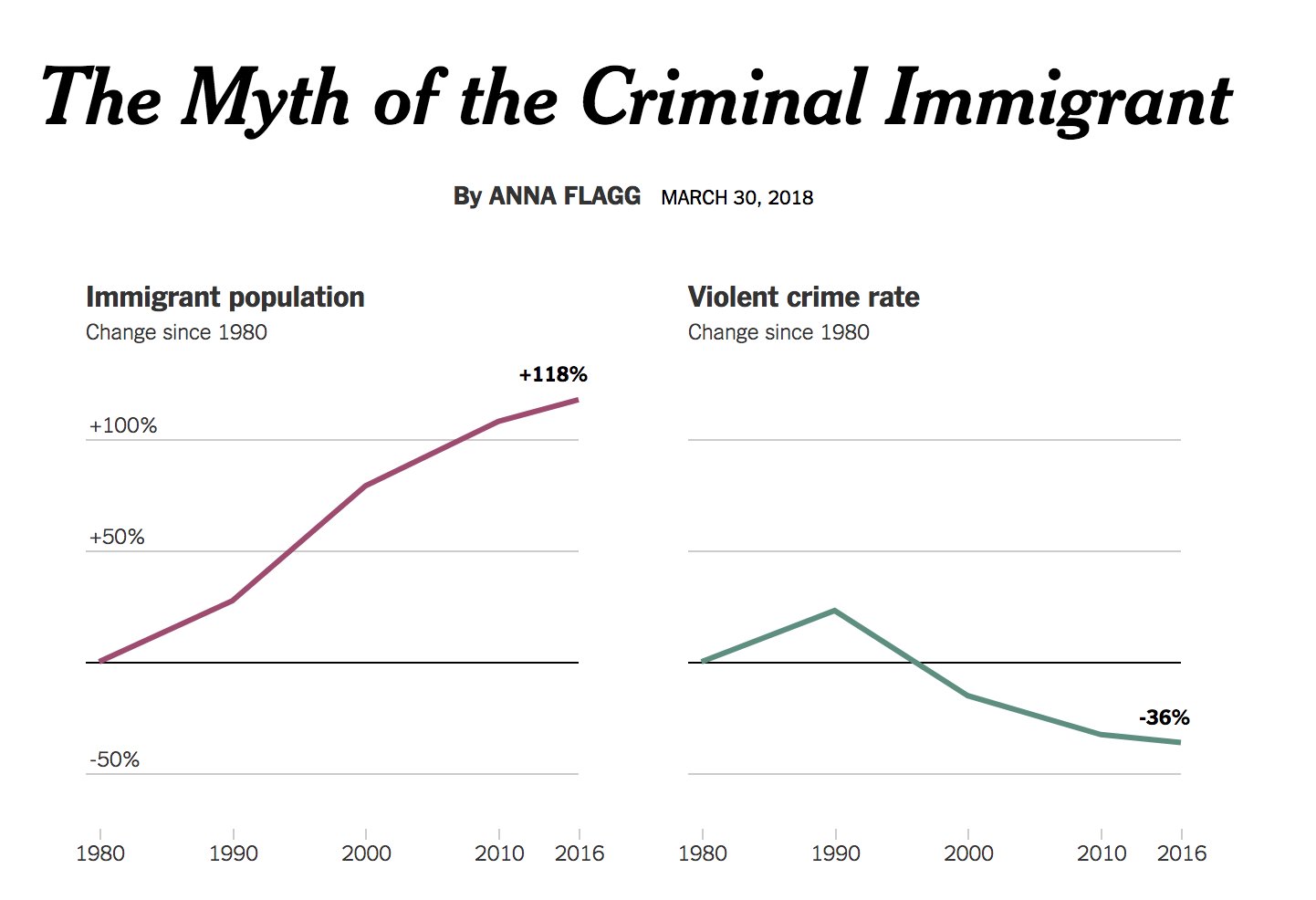
Myth of the criminal immigrant

March 30, 2018

Turns out the more immigrants the U.S. gets, the lower the crime rate.

Myth of the immigrant criminal in two charts DZjiVVXXUAAbHIl

What else are anti-immigrant advocates fibbing about?

Tip of the old scrub brush to Tyler Fisher (@tylrfishr).


Trump has played voters as chumps for 463 days; no taxes, but a fog of corruption and graft

September 22, 2016

Donald Trump has stiff-armed American voters on releasing his taxes for 463 days since he announced his candidacy. It’s a long-simmering scandal.

A sign for Arkansas Route 463. Rt 463 will carry a voter 20.59 miles from Payneway to Jonesboro, about 20.58 miles farther than Donald Trump's policies will carry America. Wikipedia image

A sign for Arkansas Route 463. Rt 463 will carry a voter 20.59 miles from Payneway to Jonesboro, about 20.58 miles farther than Donald Trump’s policies will carry America. Wikipedia image

Should we be concerned? Sure. Careful investigation by reporters such as David Fahrenthold at The Washington Post reveal uncomfortable, immoral and illegal shenanigans in transferring funds from Trump’s various foundations to cover Trump business fines and buy trophies for Trump properties, screwing charities out of much needed money.

Can Trump’s taxes show he’s not a grifter? Either way, America needs to know. The last national candidate who didn’t reveal his taxes was Maryland Gov. Spiro T. Agnew. It was later discovered he’d accepted bribes for issuing state contracts. In place of trial and prison, Agnew agreed to resign as Vice President. The entire affair tied up national government for many days, contributing to the fall of President Richard Nixon.

We cannot afford not to be sure Trump is not a crook. 

loads

463 was a powerful K-27 “Mudhen” locomotive for the old Denver & Rio Grande Railroad in Colorado, pulling loads that pushed America’s economy. Trump shouldn’t sully that image of 463. He should release his taxes today.

A Trump foundation gave $100,000 to Fisher House, a charity. Will Trump's tax returns reveal he illegally deducted this as a contribution from his own bank account? Is that why he won't release his taxes? Washington Post image

A Trump foundation gave $100,000 to Fisher House, a charity. Will Trump’s tax returns reveal he illegally deducted this as a contribution from his own bank account? Is that why he won’t release his taxes? Washington Post image

More: 

463 puts you at Madrid Plaza on the Madrid Intercity Buses. 463 puts you up Vote Feces Creek if you're a U.S. citizen trying to figure out just how corrupt Donald Trump really is.

463 puts you at Madrid Plaza on the Madrid Intercity Buses. 463 puts you up Vote Feces Creek if you’re a U.S. citizen trying to figure out just how corrupt Donald Trump really is.

Save

Save

Save


Dallas crime history: Deaths of Bonnie and Clyde, May 23, 1934

May 23, 2013

Bonnie Parker and Clyde Barrow, notorious bank-robbing outlaws from Oak Cliff, Texas, ran into a police ambush and were shot to death on May 23, 1934, in Bienville Parish, Louisiana.

Bonnie and Clyde in 1933 - Wikimedia

Bonnie and Clyde in 1933, about a year before their deaths – Wikimedia image

Though they wished to be buried together, her family protested. They are buried in separate cemeteries in Dallas. Bonnie is buried in the Crown Hill Cemetery off of Webb Chapel Road in Dallas (do not confuse with the Crown Hill Cemetery in Indianapolis). Clyde is buried in the Western Heights Cemetery off of Fort Worth Boulevard, in Oak Cliff (now a part of Dallas).

Borrowed originally with express permission from a Wayback Machine; expanded and edited here.

More:

Additional photo resources:

US Department of Justice, Division of Investig...

US Department of Justice, Division of Investigation identification order for Bonnie Parker and Clyde Barrow. Image via Wikipedia

Posse suffered deafness for hours after unleas...

“Posse members suffered deafness for hours after unleashing the thunderous fusillade” Wikipedia image

English: Photo of the grave of Clyde Barrow

The grave of Clyde Barrow – Wikipedia image

English: Photo of the grave of Bonnie Parker

The grave of Bonnie Parker – Wikipedia image

You should recall Faye Dunaway and Warren Beatty in their movie turn as Bonnie and Clyde.  But Serge Gainsborough and Brigitte Bardot, in French?  From 1968:


“It Takes Balls To Execute An Innocent Man”

August 4, 2011

Occasionally I stumble into a discussion of whether anywhere in the U.S. a government may have executed an innocent person.  Generally I note the horrible Texas case in which Texas fought for years for the point that a convicted murderer whose three allowed appeals had been exhausted should not be allowed to reopen his case simply because new evidence of his innocence had emerged.  In Herrera v. Collins (506 US 390, 1993), Texas won the right to not allow evidence of innocence to get a review of the case, and the man was executed.

Ladies and gentlemen I ask you:  Why would a state fight for the right to execute an innocent man, to the Supreme Court, if it did not intend to use that right?

The question rises more frequently these days as Texas Gov. Rick Perry steams toward announcing he will run for the presidency.

I point out that Herrera came down nearly eight years before Perry stumbled into the governor’s chair, his having been standing outside the door as Lieutenant Governor when George W. Bush persuaded the Supreme Court — most of the same justices — to stop both the popular vote and change the electoral vote to give him the presidency.  So we can’t blame that one on Perry.

But we can blame the execution of Todd Willingham on Rick Perry, even understanding that he was relying on what he assumed to be good evidence in his naturally uncurious waltz of destruction across Texas.   Perry could claim he got bad advice.  Though Texas’s governer really has little more than ceremonial power and some appointments, for someone like Perry it is a big job he can barely handle.  People would cut him slack on letting an innocent man die, convicted of a capital crime that as the evidence showed at the time probably did not occur, if he’d just confess it.

Instead, Perry engaged in a four-year campaign to cover up the affair — a cover up that is so far successful.

Jonathan Chait blogging at New Republic cites Politico and The New Yorker on the way to painting all Texans as morally bankrupt for allowing the coverup to go on — justifiably, I think.  While the newspapers cover the story, outrage does not rise from the drought-stricken populace.  New Republic’s blog explained the cover-up, and Texas’s blase attitude:

Alexander Burns and Maggie Haberman have a story for Politico about Rick Perry’s limitations as a general election candidate. It’s a really excellent piece on its own terms, but at the same time, it’s a bit of a parody of a Politico story in that it takes a vital moral question, drains it of all its moral significance, and presents it in purely electoral terms. The thesis of the piece is that Perry appeals to very conservative white southerners, but not to anybody else, making him a questionable choice to head the Republican ticket. The piece bears out that thesis pretty well. In the middle it includes a glancing reference to one episode of Perry’s gubernatorial tenure:

Perry would also have to answer for parts of his record that have either never been fully scrutinized in Texas, or that might be far more problematic before a national audience.

Veterans of Sen. Kay Bailey Hutchison’s unsuccessful 2010 primary challenge to Perry recalled being stunned at the way attacks bounced off the governor in a strongly conservative state gripped by tea party fever. Multiple former Hutchison advisers recalled asking a focus group about the charge that Perry may have presided over the execution of an innocent man – Cameron Todd Willingham – and got this response from a primary voter: “It takes balls to execute an innocent man.”

The Willingham case is just one episode in Perry’s gubernatorial tenure that could be revived against him in the very different context of a national race, potentially compromising him in a general election.

If you’re not familiar with this episode, David Grann wrote about in for the New Yorker in 2009 in what may be the single greatest piece of journalism I have ever read in my life. (I am biased, as David is a friend and former colleague.) The upshot is that Perry is essentially an accessory to murder. He executed an innocent man, displaying zero interest in the man’s innocence. When a commission subsequently investigated the episode, Perry fired its members.

I’m a Texan, and I’m appalled.  Dear Reader, what can a Texan do?  Please advise.

Surely the rest of America would be concerned and shocked, no?  We can excuse goofs in the histories of our presidential candidates.  Especially since Nixon, we should be doubly wary of those who work hard to cover up their errors, rather than learn from them.

By the way, in the latest action, the office of the Texas Attorney General issued a report on the duties of the commission established to investigate Texas justice to make it more fair — the commission whose members Perry fired when they got close to the Willingham case.  The report says that that Willingham case is water under the bridge, that the commission may not investigatet cases that predate the commission’s creation.

It’s a gross miscarriage of justice, and an attack on the democratic form of government which relies very much on continuous improvement of governmental processes, especially the due processes of criminal justice.


Dallas history: Deaths of Bonnie and Clyde, May 23, 1934

May 23, 2011

Bonnie Parker and Clyde Barrow, notorious bank-robbing outlaws from Oak Cliff, Texas, ran into a police ambush and were shot to death on May 23, 1934, in Bienville Parish, Louisiana.

Bonnie and Clyde in 1933 - Wikimedia

Bonnie and Clyde in 1933, about a year before their deaths - Wikimedia image

Though they wished to be buried together, her family protested. They are buried in separate cemeteries in Dallas. Bonnie is buried in the Crown Hill Cemetery off of Webb Chapel Road. Clyde is buried in the Western Heights Cemetery off of Fort Worth Boulevard, in Oak Cliff.

Borrowed with express permission from a Wayback Machine.