How to fight malaria – Kenya’s example

August 17, 2007

Kenya has cut malaria by nearly half. Without further comment from me, here’s the news story from Gulf Times, Doha, Qatar, and below that, from a few other sources:

Kenya nearly halves child deaths from malaria

Published: Friday, 17 August, 2007, 01:27 AM Doha Time

NAIROBI: Kenya announced yesterday that it almost halved malaria deaths among small children by using insecticidal nets (INTs), spurring the World Health Organisation (WHO) to advocate free nets for all as it tackles Africa’s deadliest disease.

Health Minister Charity Ngilu said distribution of 13.4mn INTs over the past five years among children and pregnant women had helped curtail infections, a key success against a disease threatening 40% of the world’s population.

“Childhood deaths have been reduced by 44% in high-risk districts, in-patient malaria cases and deaths are falling (and) there are reduced cases at the community level,” she said in a statement.

“For every 1,000 treated nets used, seven children who might have died of malaria are saved.”

Malaria kills 34,000 children under the age of five each year in Kenya, and threatens the lives of more than 25mn of its population of 34mn people, the ministry said.

Children sleeping under INTs in malaria risk areas are 44% less likely to die than those who are not, according to a survey carried out in four districts representing the country’s epidemiological pattern.

The government has distributed 12mn doses of artemisinin-based therapy (ACT), the latest surefire anti-malaria drug cocktail to replace the mono-therapies that had developed resistance.

In addition, some 824,600 houses in 16 epidemic-prone districts underwent indoor spraying this year.
The government and donors spent 4.7bn shillings ($70.2mn) for the campaign, yet the funds were not enough.

Ngilu said the government would freely provide 2mn treated nets annually to ward off mosquitoes at night when they are active, calling on donors to boost the blanket distribution.

“The impact we have seen and the lessons we have learnt through massively distributing INTs, rather than selectively marketing and selling them, will not only benefit Kenya’s children but all Africa’s children,” she said.

In a statement, the WHO said it had abandoned its earlier guideline of targeting only vulnerable groups – under fives and pregnant women – in favour of “making their protection immediate while achieving full coverage”.

“Recent studies have shown that by expanding the use of these nets to all people in targeted areas, increased coverage and enhanced protection can be achieved while protecting all community members.”

WHO chief Margaret Chan said that Kenya’s success “serves as a model that should be replicated throughout ‘malarious’ countries in Africa.”

“This data from Kenya ends the debate about how to deliver the long-lasting nets. No longer should the safety or well-being of your family be based upon whether you are rich or poor,” said WHO’s Global Malaria Programme director Arata Kochi.

Chan and Kochi were deriding the “social marketing” model widely backed by donors of distributing INTs by selling them at subsidised rates, even to vulnerable groups, and raising awareness of their importance.

Although supporting anti-malaria campaigns, public health watchers have chided British and US foreign development agencies for pushing for social marketing in the world’s poorest continent.

The WHO launched a global programme in 1955 to eradicate the disease that has frustrated attempts to create a vaccine owing to its constant mutations.

Using dichloro-diphenyl-trichloroethane (DDT), a powerful insecticide, and the drug chroloquine, the organisation managed to eradicated the disease in the West by the 1960s.

But the programme never got off the ground in the humid and low-lying tropics in sub-Saharan Africa where the disease persisted.

By 1969, the programme collapsed as financing withered in the face of rising poverty, political upheavals and surging opposition to DDT for misuse, not by anti-malaria campaigners, but farmers.

But Kochi said the Stockholm Convention on Persistent Organic Pollutants allowed the use of DDT in endemic countries for “public health only” and Uganda and Malawi were the only African nations keen on the chemical.

Malaria affects more than 1bn people worldwide and kills 1mn – mainly under age five – every year, the vast majority in sub-Saharan Africa. – AFP (Agence France Press) Read the rest of this entry »


DDT poisoning at the Wall Street Journal

August 17, 2007

The Wall Street Journals editorial page continues to exhibit signs of hysteria that can only be described as DDT poisoning. DDT has poisoned their view of what to do about malaria. (The article is now available by paid subscription.)

Malaria is a nasty disease that kills more than a million people every year. It is particularly brutal in attacking infants and pregnant women.

Malaria continues to rage because western nations with the resources to fight the disease spent their money on other things in the past 40 years, because the nations most affected lack the governmental adequacy or financial resources and willpower to mount effective campaigns against the disease, but mostly because malaria is a tough disease to fight.

Malaria is spread by several different species of mosquito, some of which have habits or constitutions which make mosquito eradication programs much less effective. Human malaria is really four different parasites, some of which have acquired resistance to the drugs used to fight it. The HIV/AIDS epidemics in tropical nations have not helped matters: What used to be minor cases of malaria now kill thousands who have compromised immune systems because of HIV/AIDS.

Hospitals in far too many nations are overwhelmed with malaria patients, and unable to provide care for many who could be saved. Most of those who die every year could live, with better distribution of health care, and with better prevention.

A few people have been afflicted with what can only be described as a different problem: DDT poisoning. Their views of malaria and what we need to do to fight the disease are poisoned by their anti-science political views. For at least five years there has been a nasty, persistent campaign to impugn “environmentalists” and Rachel Carson, claiming that DDT is the answer to all the world’s malaria woes. Though DDT has been available to fight malaria since 1946, these people complain that bans on spraying crops have discouraged the use of DDT against malaria, fatally.

Below the fold I’ll fisk the short piece from yesterday’s WSJ. It’s difficult to keep ahead of hoaxers, though — today they’ve got another call for DDT use, this time to fight West Nile Virus. Ironically, West Nile is most deadly against several species of bird, some of which are acutely subject to death by DDT.

Read the rest of this entry »


DDT’s disruption of hormone activities

August 12, 2007

Critics of Rachel Carson and sponsors of the anti-science, anti-environmentalist campaign to bring back DDT as a major killer, frequently misinform in very selective ways. For example, they like to mention DDT’s role in causing human cancers, because, they claim Rachel Carson was dead wrong about that link. Therefore, they say, DDT is a nice chemical and bans should be lifted.

In reality, carcinogenicity played a very small role in banning DDT. DDT was banned because it kills indiscriminately, killing beneficial insects along with the bad, killing untargeted species, like songbirds, along with the insect targets; and DDT was banned because once released into the wild, it is very long-lived, and its ultimate destructive effects cannot be known or controlled — though some harms, such as the devestation of America’s birds of prey, are extremely well documented.

Similarly, the anti-science crowd doesn’t like to talk about the third big area where DDT produces harms: Hormone disruption. In fact, Steven Milloy’s “100 things you should know about DDT” at the site that peddles junk science, JunkScience.com, does not even contain the word “hormone.”

They play down the fact that DDT and its by-products disrupt reproductive processes, and sometimes disrupt and deform reproductive organs, of nearly every animal it touches. They don’t want you to know about the hormonal effects of DDT and its breakdown products.

So, they never mention books like the National Academy of Sciences’ compilation of the harms of such chemicals, Hormonally Active Agents in the Environment.

Milloy will misquote the NAS when NAS mentions slightly the benefits of DDT; Milloy will not quote NAS when they cite the dangers of DDT. So this book on hormonally active agents, which mentions DDT specifically in 16 chapters for a total of 309 times, will never be mentioned in a discussion of DDT’s dangers — unless you bring it up.

Go see what the book says in the Executive Summary. If you debate the anti-Rachel Carson crowd, use this book frequently — they will have no answers.

And, Sen. Tom Coburn, are you listening? Since when do your constituents want you to defend a chemical which will ruin their farm animals, and especially the ducks they want to hunt? It’s time to quit trying to tarnish the memory of Rachel Carson, Sen. Coburn, and let that post office in Pennsylvania be named after her.


Original Documents: Long history of DDT trouble, from U.S. Fish and Wildlife Service, 1945 and later

August 12, 2007

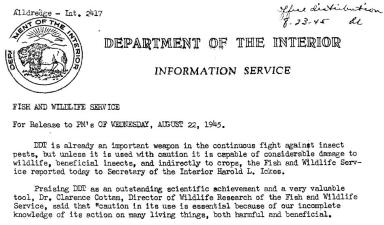
Header of FWS press release, Aug 22 1945

Archives of the U.S. Fish and Wildlife Service (FWS) reveal a long history of trouble with DDT, almost from the first uses of the chemical as an insecticide during World War II. You’ll find extensive links to historic press releases from FWS below the fold.

Critics of the various restrictions on DDT use often claim that DDT is a God-sent chemical that nearly eradicated malaria from the world (absolutely untrue) and which was banned only because of hysteria caused by Rachel Carson’s 1962 book, Silent Spring (untrue at both ends, hysteria and the power of Carson’s book). This is history revisionism at its worst, it is bogus history.

A careful study of the history of the use of DDT shows that scientists were concerned about its dangers from the first uses as a pesticide. The U.S. Fish and Wildlife Service reported dangers in a press release on August 22, 1945, just a week after the surrender of Japan ended World War II (VJ Day was August 15 in Tokyo, August 14 in Washington). In that release FWS noted the beneficial uses of DDT to fight insect and lice infestations that threatened troops and civilians with typhus and other diseases, but cautioned that such use should not become common, that more study was needed: Read the rest of this entry »


Fisking “Junk Science’s” campaign for DDT: Point #6

August 9, 2007

Another in a continuing series, showing the errors in JunkScience.com’s list of “100 things you should know about DDT.” (No, these are not in order.)

Steven Milloy and the ghost of entomologist J. Gordon Edwards listed this as point six in their list of “100 things you should know about DDT “[did Edwards really have anything to do with the list before he died?]:

6. “To only a few chemicals does man owe as great a debt as to DDT… In little more than two decades, DDT has prevented 500 million human deaths, due to malaria, that otherwise would have been inevitable.”

[National Academy of Sciences, Committee on Research in the Life Sciences of the Committee on Science and Public Policy. 1970. The Life Sciences; Recent Progress and Application to Human Affairs; The World of Biological Research; Requirements for the Future.]

In contrast to their citation for the Sweeney hearing record, which leads one away from the actual hearing record, for this citation, the publication actually exists, though it is no longer available in print. It’s available on-line, in an easily searchable format. [I urge you to check these sources out for yourself; I won’t jive you, but you should see for yourself how the critics of Rachel Carson and WHO distort the data — I think you’ll be concerned, if not outraged.] The quote, though troubled by the tell-tale ellipses of the science liar, is accurately stated so far as it goes.

The problems? It’s only part of the story as told in that publication.  The National Academy of Science calls for DDT to be replaced in that book; NAS is NOT calling for a rollback of any ban, nor is NAS defending DDT against the claims of harm.  The book documents and agrees with the harms Rachel Carson wrote about eight years earlier.

Cover of the electronic version of Life Sciences, the 1970 book looking to future needs in biology and agriculture.

Cover of the electronic version of Life Sciences, the 1970 book looking to future needs in biology and agriculture.

Milloy (and Edwards, he claims), are trying to make a case that the National Academy of Sciences, one of the more reputable and authoritative groups of distinguished scientists in the world, thinks that DDT is just dandy, in contrast to the views of Rachel Carson and environmentalists (who are always cast as stupid and venal in Milloy’s accounts) who asked that DDT use be reduced to save eagles, robins and other songbirds, fish, and other wildlife, and to keep DDT useful against malaria.

First, there is no way that a ban on DDT could have been responsible for 500 million deaths due to malaria.  Calculate it yourself, the mathematics are simply impossible: At about 1 million deaths per year, if we assume DDT could have prevented all of the deaths (which is not so), and had we assumed usage started in 1939 instead of 1946 (a spot of 7 years and 7 million deaths), we would have 69 million deaths prevented by 2008. As best I can determine, the 500 million death figure is a misreading from an early WHO report that noted about 500 million people are annually exposed to malaria, I’m guessing a bit at that conclusion — that’s the nicest way to attribute it to simple error and not malicious lie. It was 500 million exposures to malaria, not 500 million deaths. It’s unfortunate that this erroneous figure found its way into a publication of the NAS — I suppose it’s the proof that anyone can err.

Read the rest of this entry »


Brainwashing for politics and profit: Global warming denial

August 5, 2007

Newsweek cover, August 13, 2007

We are plagued by industries set up to deny reality. It’s impossible to discuss public policy without smashing into organizations set up specifically to question history and hard science, and plant seeds of doubt in the minds of the public about the way things really are. When my job was to fight them, with essentially no budget, as late as 1985 there was a well-funded lobby in Washington that cranked out weekly “news” and opinion columns for smaller and less discriminating news outlets like weekly papers and local television stations, extolling the virtues of tobacco and claiming that no scientist had any real evidence that smoking is unhealthy.

A lot of those disinformation artists have moved on — not to the Soviet Union, since it collapsed and took most its propaganda machine with it — to denial of reality on global warming, evolutionary biology, pesticides and chemicals, and a host of other issues.

Sharon Begley’s story in the August 13, 2007, Newsweek pulls back the veil on the well-funded industry that tries to plant doubt about the reality of global warming: “The Truth about Denial.” If this is news to you, that people get paid well to hoax the public, you really need to read the story:

If you think those who have long challenged the mainstream scientific findings about global warming recognize that the game is over, think again. Yes, 19 million people watched the “Live Earth” concerts last month, titans of corporate America are calling for laws mandating greenhouse cuts, “green” magazines fill newsstands, and the film based on Al Gore’s best-selling book, “An Inconvenient Truth,” won an Oscar. But outside Hollywood, Manhattan and other habitats of the chattering classes, the denial machine is running at full throttle—and continuing to shape both government policy and public opinion.

Since the late 1980s, this well-coordinated, well-funded campaign by contrarian scientists, free-market think tanks and industry has created a paralyzing fog of doubt around climate change. Through advertisements, op-eds, lobbying and media attention, greenhouse doubters (they hate being called deniers) argued first that the world is not warming; measurements indicating otherwise are flawed, they said. Then they claimed that any warming is natural, not caused by human activities. Now they contend that the looming warming will be minuscule and harmless. “They patterned what they did after the tobacco industry,” says former senator Tim Wirth, who spearheaded environmental issues as an under secretary of State in the Clinton administration. “Both figured, sow enough doubt, call the science uncertain and in dispute. That’s had a huge impact on both the public and Congress.”

Do these deniers affect public policy? Gullibles, political opponents, handmaidens of error, and even well-meaning suckers fall for spin on science, over and over again: On global warming (see this one, too), on DDT and malaria, teaching science in public schools, alternative medicine and preventive vaccines, and other issues including (who could make this up?) riding a bicycle.

No, I don’t have a solution.


Accuracy: A good bias (DDT again)

August 4, 2007

Jay Ambrose retired from editing newspapers, and now writes commentary for the Scripps News chain of papers. Because of his experience in editing, I was suprised to see his commentary from last week which takes broad, inaccurate swipes at environmental groups (here from the Evansville, Indiana, Courier & Press).

Ambrose is victim of the “DDT and Rachel Carson bad” hoax.

His column addresses bias in reporting, bias against Christians, which he claims he sees in reporting on issues of stem cell research, and bias “in favor” of environmentalists, which has resulted in a foolish reduction in the use of DDT. I don’t comment here on the stem cell controversy, though Ambrose’s cartoonish presentation of how federally-funded research works invites someone to correct its errors.

Relevant excerpts of Ambrose’s column appear below the fold, with my reply (which I have posted to the Scripps News editorial section, and in an earlier version, to the on-line version of the Evansville paper).

Read the rest of this entry »


Uganda expands controlled DDT use

July 30, 2007

Contrary to the scare stories from JunkScience.com and other politicos, Uganda is expanding their use of DDT on a controlled basis, to fight malaria — exactly as Environmental Defense and other U.S. environmental groups have urged.  The story doesn’t say whether the Bush administration has come on board, but one can hope.

From New Vision:

By Fred Ouma

THE Government is to start indoor spraying of DDT in January 2008, the Malaria Control Programme manager with the health ministry has said.

Dr. John Bosco Rwakimari, who did not disclose the cost of the exercise, on Wednesday told participants at the malaria conference at the Imperial Resort Beach, Entebbe that the Government had secured funds to buy the pesticide.

“We have seen impressive results in Kabale and Kanungu districts where the malaria prevalence has reduced from 30% to less than 4% and 45% to 4.7% respectively,” he affirmed.

“DDT should be here (in Uganda) at beginning of the year. We shall start with high malaria endemic districts of Apac, Lira, Kitgum, Amuru, Gulu, Pader, Mbale and Pallisa in accordance with WHO and Stockholm Convention guidelines,” he added.

Rwakimari affirmed that by the end of 2010, all areas considered prone to the epidemic would be covered.

Were there a worldwide ban on DDT use, how could this happen?


DDT out, eagles back in Michigan Upper Peninsula

July 30, 2007

Another story of the success of the restrictions on use of DDT:  The recovery of eagles in Michigan; from the Escanaba Daily Press.


Eagles at edge of Escanaba River


Spreading miasma on malaria

July 23, 2007

The Straight Dope has a motto: “Fighting ignorance since 1973. (It’s taking longer than we thought.)”

Alas, the motto could work as well for people who understand science, who understand chemistry and biology, and who urge sanity in discussions about DDT, malaria prevention and control, and Rachel Carson.

Photo from a 1950s science text, showing DDT spraying on crowded beach

DDT sprayed on a crowded beach -- photo from an unidentified 1950s publication. Caption in the photo: "This machine is spreading a kind of fog of DDT spray to see if it will kill the mosquitoes and other insects on the beach. Outdoors, the spray soon spreads and does not harm people."

The meme that “Rachel Carson caused millions of deaths” and prompted the disappearance of DDT is factually in error, but popular, and still spreading. It doesn’t help that there are well-funded groups that work hard to spread the disinformation.

As Ben Franklin noted, in a fair fight, truth wins. The difficulty is that the fight for truth about DDT and Rachel Carson has never been fair, and the anti-sense forces have a 25-year head start on wise people like Bug Girl, Deltoid, Rep. Jason Altmire of Pennsylvania, and even dunderheads like me.

How widespread is the damage? Well, how many editorial pieces were there slamming Rachel Carson, falsely, on the event of the 100th anniversary of her birth? Has Sen. Tom Coburn, R-Okla., lifted his holds on naming a post office for her?

The damage continues to spread.

For example, these blogs have fallen victim to the malaria/DDT/Rachel Carson hoax:

a. London Fog, ostensibly about government in London, Ontario, goes off half-cocked on DDT

b. Irrational Optimism, about a Georgian transplanted to Utah, picks up the misunderstandings of DDT

c. The Squamata Report, a general diatribe, accepts at face value all the falsehoods about DDT, especially those that cast scientists and environmentally-concerned politicians in a light where they can be ridiculed

d. PoliPundit.com — not the most bizarre view there, so of course it also accepts the false myths as good data

e. Boots and Sabers, sort of a frat party for young military guys, makes the gung-ho gonzo claim that it would have been worth it to sacrifice bald eagles because DDT could have saved African kids

d. Even Forbes Magazine’s blogs put out the faulty version of the story

e. Red State includes an artless and caustic piece here (repeated during what appears to be a brain power failure at PowerLine)

f. The famous column at the Wall Street Journal, marking a premature end of fact checking at that newspaper’s opinion columns

g. “Rachel Carson’s Genocide,” hysteria at a Ron Paul site misnamed Rational Review

h. Even Nobel Prize winning economists and distinguished federal judges get sucked into the vortex of specious information if they are not scrupulously careful — as Becker and Posner did here, and again here. (See final installment,too.)

And even while fighting ignorance and generally rebutting the wild claims about Rachel Carson, even Cecil Adams at Straight Dope gets suckered in by some of the myths. (In “moderate amounts,” DDT concentrates up to 10 million times in the wild, poisoning birds of prey and predator fishes, especially; DDT is deadly to mosquito-eating birds and bats, and pest-eating lizards; EPA’s hearings on DDT were overwhelmingly in favor of banning the substance — a court suit cited EPA for not moving fast enough to ban such a dangerous substance, and evidence in such trials is not made up; the cause of egg-shell thinning in birds is pretty solidly established to be DDT and its breakdown substances, only the exact process is not well understood; the international treaty against POPs has a specific out-clause for DDT to be used to prevent malaria; and so on).

So, there’s a lot of work to be done, and little time. Stay tuned.

Update: The Capital Times in Madison, Wisconsin, had a wonderful feature on the 1970 hearings in that state to ban DDT,[alternate URL here] and the subsequent success with the spectacular return of the bald eagle to local waterways. In comments, early in the process, the junk science about DDT and malaria appear. It’s everywhere.

P.S. — Here’s a reading for a lecture at Purdue University that neatly summarizes Carson’s life and work, accurately. (In fact, the entire lecture series, by Jules Janick, should prove interesting to people interested in horticulture.)


Collateral damage from magic bullets

July 22, 2007

In an earlier post I noted Norman Borlaug’s receiving the Congressional Gold Medal. In comments, Bernarda noted those who disagree with the claim that Borlaug’s Green Revolution was much of a benefit, or perhaps more accurately, those who note the problems that result from such advances — and there are many. Bernarda pointed to a BBC lecture from Vendana Shiva, detailing the problems that Punjab experienced as a result of governmental and society structures unable to deal with the changes required by high-yield crops: “Poverty and Globalisation.” It’s worth a read or a listen.
Similarly, in another BBC lecture in that series, Gro Harlem Bruntland details problems from “progress” that includes cutting the forests, in “Health and Population.” Relevant to other discussions here, she notes a rise in malaria due to deforestation, raising an issue that the junk science purveyors opposed to Rachel Carson’s honoring would like to ignore. Here is a small excerpt of her talk — note that deforestation is not a problem that more DDT can solve:

Gro Harlem Bruntland:  Recently, in Mozambique, I saw children with their eyes glazed with fever from a malaria that could have been prevented if their parents could afford bed nets. Deforestation had changed malaria from a nuisance to a curse in a matter of twenty years. 

Gro Harlem Brundtland, former Director General of the World Health Organization (WHO). Wikiquote image.

Gro Harlem Brundtland, former Director General of the World Health Organization (WHO). Wikiquote image.

More people are suffering from this killing and debilitating disease now than ever before, and deforestation, climate change and breakdowns in health services have caused the disease to spread to new areas and areas that have been malaria-free for decades, like in Europe.

In the Philippines, I have watched how beggars sit exhausted on the pavements convulsed with coughing. Tuberculosis, which we long believed had been brought under control by effective treatment, is on the rise again. Increasingly, we see forms of tuberculosis which are resistant to all but a very expensive cocktail of drugs.

I think that HIV/AIDS may be the most serious threat to face sub-Saharan Africa and other developing regions. space. Already, the AIDS epidemic is the leading cause of death in several African countries. AIDS has reversed the increases in life expectancy we have seen over the past thirty years. The social and economic devastation in countries that could lose a fifth of their productive populations is heart-rending.

I believe we are facing this alarming situation largely because of an outdated approach to development. Our theories have to catch up with what our ears and eyes are telling us – and fast.

There was a period in development thinking – not so long ago – when spending on public services, such as health and education, would have to wait. Good health was a luxury, only to be achieved when countries had developed a particular level of physical infrastructure and established a certain economic strength. The implicit assumption was that health was to do with consumption. Experience and research over the past few years have shown that such thinking was at best simplistic, and at worst plainly wrong.

I maintain that if people’s health improves, they make a real contribution to their nation’s prosperity. In my judgement, good health is not only an important concern for individuals, it plays a central role in achieving sustainable economic growth and an effective use of resources.

As in Europe at the end of the 19th and beginning of the 20th century, we have seen that developing countries which invest relatively more, and well, on health are likely to achieve higher economic growth.

In other words, malaria prevention grows on trees, or malaria grows with the cutting of trees.


Not reading for comprehension: Glenn Reynolds, National Geographic and DDT

July 17, 2007

It’s best to avoid the tabloids most of the time, but particularly its good not to rely on tabloids for good information for making policy.

Glenn Reynolds at Instapundit, often an internet tabloid, demonstrates these dangers, especially with regard to the hoax campaign against Rachel Carson and the World Health Organization.

In a post today, Instapundit said:

A REPORT ON MALARIA, from National Geographic.

And note this bit:

Soon after the program collapsed, mosquito control lost access to its crucial tool, DDT. The problem was overuse—not by malaria fighters but by farmers, especially cotton growers, trying to protect their crops. The spray was so cheap that many times the necessary doses were sometimes applied. The insecticide accumulated in the soil and tainted watercourses. Though nontoxic to humans, DDT harmed peregrine falcons, sea lions, and salmon. In 1962 Rachel Carson published Silent Spring, documenting this abuse and painting so damning a picture that the chemical was eventually outlawed by most of the world for agricultural use. Exceptions were made for malaria control, but DDT became nearly impossible to procure. “The ban on DDT,” says Gwadz of the National Institutes of Health, “may have killed 20 million children.”

Read the whole thing. [Emphasis from Instapundit.]

“Malaria: Stopping a Global Killer,” cover of National Geographic Magazine, July 2007. Test to see if your reading comprehension is better than Instapundit’s Glenn Reynolds!

Please do read the whole thing — what is emphasized is not what the brief snippet at Instapundit says at all. The National Geographic article, “Bedlam in the Blood,” gives details of the fight against malaria, including details about how difficult it is to beat. Among other things, the article talks about the medical difficulties and the political difficulties. The article emphasizes that there is not a panacea solution, including especially DDT.

But, that paragraph Reynolds quotes already carries that message. Did you miss it? Reynolds appears to have missed it big time. Here’s the paragraph again, with my emphasis for what you should understand about the difficulties

Soon after the program collapsed, mosquito control lost access to its crucial tool, DDT. The problem was overuse—not by malaria fighters but by farmers, especially cotton growers, trying to protect their crops. The spray was so cheap that many times the necessary doses were sometimes applied. The insecticide accumulated in the soil and tainted watercourses. Though nontoxic to humans, DDT harmed peregrine falcons, sea lions, and salmon, [especially predators of mosquitoes]. In 1962 Rachel Carson published Silent Spring, documenting this abuse and painting so damning a picture that the chemical was eventually outlawed by most of the world for agricultural use [years later]. Exceptions were made for malaria control, but DDT became nearly impossible to procure. “The ban on DDT,” says Gwadz of the National Institutes of Health, “may have killed 20 million children.”

In the critical area of Subsaharan Africa, governments were unable to put together programs to spray for mosquitoes and deliver pharmaceuticals to victims. Although DDT was largely ineffective against the mosquitoes that carried some forms of the disease in that area, the human institutions simply did not exist to make an eradication program work.

Instapundit puts the blame on Rachel Carson, as if the later restrictions on DDT were what she urged, and as if Carson could personally have saved the Belgian Congo, Rwanda, Rhodesia/Zimbabwe and other nations from revolutions that crippled governmental efficacy throughout Africa.

Read the entire article. Malaria eradication in the U.S. was made easier by the fact that the mosquitoes that carry the disease here tend to eschew humans for meals — they bite cattle instead (who have their own forms of malaria). The U.S. had money to put screens on windows, a medical establishment to treat malaria, and the less aggressive form of the malaria parasites.

Subsaharan Africa had none of those advantages. Reynolds suggests, and the Competitive Enterprise Institute says, all of that was Rachel Carson’s fault.

The power of a bad, wrong idea should not be underestimated. Malaria cannot be conquered today without a combination of better medical care, education, strong governmental agencies to carry out government malaria-fighting programs, and consistent work to prevent evolution of malaria parasites into tougher diseases, or malaria-carrying mosquitoes into pesticide-resistant weapons of disease dissemination.

If Reynolds were to actually read Silent Spring, he’d begin to understand the enormity of the problems, and he could become a tool to stop the spread of malaria, instead of a voice unwittingly calling for surrender.

DDT is not a panacea against malaria now. Insects are resistant, the parasites are resistant to medical treatment (and DDT never played a key role in that process), money is scarce for creating and distributing effective blocks to malaria infections, and political institutions to fight the disease are wobbly. None of that is Rachel Carson’s fault. Much of that information was carried in the warnings from Rachel Carson.

But, if you read the article, you understand that DDT never could have been effective against some of the worst forms of malaria. DDT was never a panacea against malaria.

You won’t learn that from tabloid journalism, which offers solutions to difficult problems which are, as Ronald Reagan described them, simple and easy, but also ineffective and wrong. Instapundit misleads with such reports.

Read the rest of this entry »


Cancer and DDT: Current information

July 13, 2007

Okay, this piece is biased, too — but they give references so you can check it out.


Update: War against science and Rachel Carson

July 11, 2007

Some links you should check out, in the continuing fight for reason against the bizarre campaign against the reputation of Rachel Carson, against the World Health Organization, and against fighting malaria, and for unwise use of DDT:

1.  Alan Dove, at Dove Docs, notes an entirely new way of thinking about immunity against malaria:  “A New Twist on Herd Immunity”

2.  Insight from Bug Girl:  “Scientists, media, and political activism;”  also check out her post on new research on mosquito bed nets.

3.   Deltoid posted several good pieces since last I linked; go here, and here.  Be ready:  Tinfoil hat brigade comes out in the comments to the first piece.


DDT: The problems the WHO/Rachel Carson critics don’t want you to know

July 10, 2007

The merry bands of hoaxsters at “JunkScience.com” and the Competitive Enterprise Institute hope you think DDT is a well-targeted, perfect solution to get rid of malaria. They ignore the devastating effects DDT has on birds, bats and other mammals (including humans), beneficial insects and fish. They don’t care about the difficulties in treating malaria in hospitals, which would continue or grow worse were DDT to be sprayed willy-nilly across the malaria-endemic world.

Cover, War on Insects

Plus, CEI is well-funded and has been hammering away on spreading the hoaxes for several years. You may have to dig hard to find the facts, such as the fact that the inventors of DDT as insecticide warned against over-use exactly as did Rachel Carson, (see the Dove Docs archives), or that the death of beneficial insects and beneficial animals can cause disasters, too — or did CEI tell you that DDT can cause your roof to cave in, in Borneo, and that they had to parachute cats in to prevent an epidemic of typhus, caused by DDT?

Read the rest of this entry »