Quote of the moment: Rachel Carson on DDT fish kills

July 9, 2007

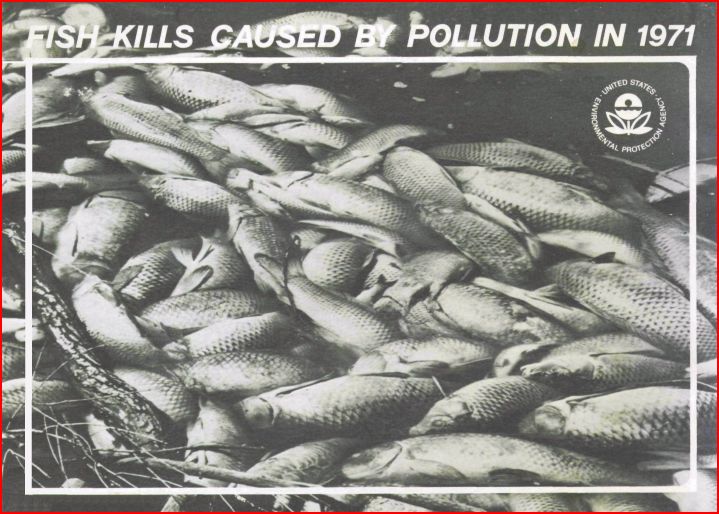
Cover of 1971 EPA publication, Fish Kills Caused By Pollution in 1971.

Cover of 1971 EPA publication, Fish Kills Caused By Pollution in 1971. According to the publication, in Texas, in 1971, 16 million fish died in just 6 pollution-caused incidents. (page 9 of the report).

One of the most spectacular fish kills of recent years occurred in the Colorado River below Austin, Texas, in 1961. Shortly after daylight on Sunday morning, January 15, dead fish appeared in the new Town Lake in Austin and in the river for a distance of about 5 miles below the lake. None had been seen the day before. On Monday there were reports of dead fish 50 miles downstream. . . . By January 21, fish were being killed 100 miles downstream. . . . During the last week of January the locks on the Intracoastal Waterway were closed to exclude the toxic waters from Matagorda Bay and divert them into the Gulf of Mexico.

. . . investigators in Austin noticed an odor associated with the insecticides. . . The manager of the (chemical) plant admitted that quantities of powdered insecticide had been washed into the storm sewer recently and, more significantly, he acknowledged that such disposal of insecticide spillage and residues had been common practice for the past 10 years.

. . . For 140 miles downstream from the lake the kill of fish must have been almost complete, for when seines were used later in an effort to discover whether any fish had escaped they came up empty. Dead fish of 27 species were observed, totaling about 1000 pounds to a mile of riverbank.

Rachel Carson, 1962, Silent Spring

Cribbed from the US Geological Survey site.


Nutshell: The case against the critics of Rachel Carson

July 9, 2007

Mothers who read Rachel Carson’s book asked supermarkets to stop carrying produce or other products laced with DDT, as a precaution against damage to their children. It’s appropriate that a mom’s blog would make the case against Carson’s critics so succinctly, so go read it.


Another reason why DDT use damages mosquito control: Bats

July 9, 2007

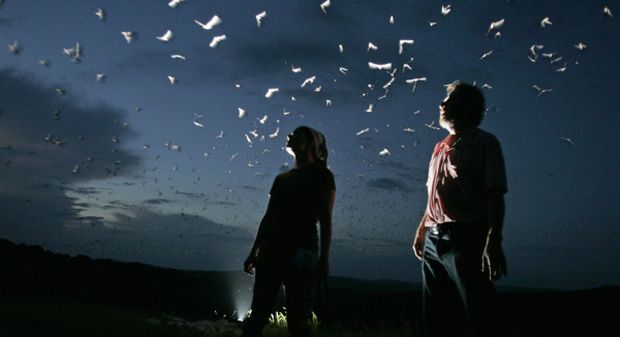
Erich Schlegel photo, bats leaving a cave near Frio, Texas, U of Tenn researchers look on

UTenn grad student Noa Davidai (L) and Prof Gary McCracken watch bats come out of Frio Cave

  • Photos by ERICH SCHLEGEL/DMN

University of Tennessee graduate student Noa Davidai (left) and professor Gary McCracken watch freetail bats emerge from the Frio Cave near Uvalde, Texas. They study the range and value of bats, such as insect control for farmers. And ‘fecal rain’? That enriches soil, Dr. McCracken says. (Dallas Morning News, July 9, 2007, p. 1)

It’s easy to understand. Look at the on-line Dictionary.com definition of the Mexican free-tailed bat, for example:

Mexican free-tailed bat

–noun

any of several small, insect-eating bats of the genus Tadarida, of Mexico and the southwestern U.S., inhabiting limestone caves: residual DDT has reduced most populations.

Dictionary.com Unabridged (v 1.1)
Based on the Random House Unabridged Dictionary, © Random House, Inc. 2006.

Was that difficult? It’s right there in the definition of the animal: DDT kills bats.

Bats eat mosquitoes, those things that carry malaria and other diseases. A Mexican free-tailed bat eats about 70% of its body weight in mosquitoes, every night.

This morning’s Dallas Morning News has a front page story, with great photo, on the value of bats in Texas, “Taking bats to the bank.”

Researchers have long known that bats in Texas caves dine on insect pests. But just how many bats there are and the value of their feeding had proved elusive until a five-year, $2.4 million National Science Foundation study by scientists from Boston University, the University of Tennessee, the U.S. Department of Agriculture and Texas Parks and Wildlife.

From sundown to sunup, the freetail bats consume a staggering 400 metric tons of insects a year in the Winter Garden, or 2 million pounds each night. They range over a radius of 75 miles and feed from ground level to 10,000 feet.

The bats help save $1.7 million annually by preventing crop damage and additional pesticide use in the eight-county Winter Garden, which produces $6 million in cotton each year, according to the report by the Boston University team.

“Most people think of bats as ugly or vile, but there is a real value they provide humankind,” said principal investigator Tom Kunz of Boston University. “The bats are a literal shield for this crop region. But until this project, no one developed a means to measure the specific economic value of bats to agriculture.”

From my experience with agriculture, that $1.7 million figure looks low, way low. Scientific studies like this tend to be very conservative, though, so we can say with great confidence that this is a floor figure.

DDT kills bats, and those bats who don’t die from eating DDT-laced insects often provide meals for predator birds, who then get a greater dose of the next-generation-killing chemical.

Studies have shown that the pesticide DDT often used by farmers in the 1950s and 1960s may also have led to the depletion of large numbers of Mexican free-tailed bats (Clark).The Carlsbad Caverns colony decreased steadily in size from nearly 20 million down to only a couple hundred thousand during the 1960s due to DDT use (Wilson 110).A study in 1974 documented levels of the toxin in fat stores the bats would accumulate before migration, and found that when those fat stores were metabolized during the long flight, DDT levels were high enough to kill many of the bats (Wilson 110).In addition, DDT ingested by mother bats was passed along to their young causing most of them to die before reaching maturity (Wilson 110).Clark’s follow up study in 2001 also showed levels of DDT in bat specimens from the 1950s and 1960s to be considerably higher than in specimens from later decades (Clark).These kinds of toxin levels would account for the dramatic decrease in the Carlsbad bat population.

All of this adds up to a conclusion that critics of Rachel Carson who make the wild claims that DDT is harmless, and that but for DDT mosquito control would have been achieved, and therefore malaria would be wiped out do not have a clue what they are talking about, and probably have some skullduggery in mind when they go after Rachel Carson. Ironically, overuse of DDT actually benefits mosquitoes in the U.S., killing the predators of mosquitoes and other crop and human pests, allowing the mosquitoes to breed and feed uninhibited.

In her book Silent Spring, Rachel Carson had noted a pesticide spill in Austin, Texas, which occurred in 1961 and virtually cleaned out all the fish in the Colorado River downstream — fish, of course, prey on mosquito larvae. DDT use in Texas, therefore, hammers mosquito abatement possibilities at both ends. Read the rest of this entry »


Waving the flag liberally

July 5, 2007

Carnival of the Liberals has a special July 4 edition, up at Zaius Nation. It’s the Flag Waving edition — go give it a look, especially since the carnival features a sideshow from this blog!


Inexplicable insanity about DDT and Rachel Carson

July 3, 2007

Sheesh! I thought Rep. Rob Bishop, R-Utah, and Sen. Tom Coburn, R-Okla., pretty much took the cake in fanatical ideas close to insanity in the calumny campaign against Rachel Carson. I may have erred.

Please understand, it is important that good people speak up for science, for political sanity, for reason and reality. There are forces of ignorance and evil who willingly fill the information vacuum with excrement, and who thereby pollute political discourse — if you don’t speak up.

Here: Send Sen. Tom Coburn a note, tell him you think he should come to his senses and stop blocking a bill giving a minor honor to Rachel Carson. He needs to do the Christian thing and stand up for truth, for health care, for honesty, you should tell him. Here’s his official message-leaving site.

No, he’s not answered me, either. Swamp him with mail. Or telephone his office: 202-224-5754 (Washington, D.C. office).


Fisking “Junk Science’s” campaign FOR the poison DDT, against Rachel Carson: Point #8, mosquito resistance to DDT

June 29, 2007

This is the second in a series of Fisks of “100 things you should know about DDT,” a grotesquely misleading list of factoids about DDT put up a site called JunkScience.com. While one would assume that such a site would be opposed, this particular site promotes junk science. I’m not taking the points in order.The “100 things” list is attributed to Steven Milloy, a guy who used to argue that tobacco use isn’t harmful, and who has engaged in other hoaxes such as the bizarre and false claim that Compact Fluorescent Lightbulbs (CFLs) can pose serious toxic hazards in your home (and therefore, you should continue to waste energy with less efficient bulbs); and to J. Gordon Edwards, a San Jose State University entomologist who, despite being a great entomologist, was a bit of a nut on some political things; Edwards assisted Lyndon Larouche’s group in their campaign against Rachel Carson before his death in 2004. (Did Edwards actually have a role in the development of this list?)

100 things you should know about DDT

Claim #8. Some mosquitoes became “resistant” to DDT. “There is persuasive evidence that antimalarial operations did not produce mosquito resistance to DDT. That crime, and in a very real sense it was a crime, can be laid to the intemperate and inappropriate use of DDT by farmers, especially cotton growers. They used the insecticide at levels that would accelerate, if not actually induce, the selection of a resistant population of mosquitoes.”

[Desowitz, RS. 1992. Malaria Capers, W.W. Norton & Company]

Cover of The Malaria Capers, by Robert S. Desowitz

Cover of The Malaria Capers, by Robert S. Desowitz

This was what Rachel Carson warned about. Indiscriminate use of DDT, such as broadcast application on crops to kill all insect, arthropod or other pests, would lead to mosquitoes and other dangerous insects developing resistance to the chemical. Of course, resistance developed as a result of overspraying of crops has exactly the same result, in the fight against malaria, as overuse in the fight against malaria.  Cover of The Malaria Capers, by Robert S. Desowitz

Worse, such overuse also killed predators of mosquitoes, especially birds. In an integrated pest management program, or in a well-balanced ecosystem, birds and other insect predators would eliminate a large number of mosquitoes, holding the population in check and preventing the spread of malaria. Unfortunately, when the predators are killed off, the mosquitoes have a population explosion, spreading their range, and spreading the diseases they carry.

Assuming Milloy quoted the book accurately, and assuming the book actually exists, this point says nothing in particular in favor of DDT; but it reaffirms the case Rachel Carson made in her 1962 book, Silent Spring. Contrary to suggestions from the campaign against Rachel Carson, she urged that we limit use of DDT to tasks like preventing malaria, around humans, to preserve the effectiveness of DDT and prevent overspraying.

And then, there is this: Milloy doesn’t bother to quote the first part of the paragraph he quotes, on page 214 of Malaria Capers. Here is what the paragraph actually says:

There were a number of reasons for the failure, not least that the anophaline vector mosquitoes were becoming resistant to the action of DDT both physiologically — they developed the enzymes to detoxify the insecticide — and behaviorally — instead of feeding and wall-resting, they changed in character to feed and then quickly bugger off to the great outdoors. [from this point, Milloy quotes correctly]

In other words, the DDT-based campaign against malaria failed because DDT failed; mosquitoes became resistant to it.  DDT’s declining ability to kill mosquitoes is one of the major reasons DDT use plunged after 1963, and continues to decline to no use at all.

To combat the dastardly campaign of calumny against Rachel Carson and science, you should also read: Deltoid, here, here and here, and the rest of his posts on the topic; Bug Girl, here, at least, and here, and the rest of her posts; denialism, here; and Rabett Run, here.

Save

Save


Cold, Clear and Deadly

June 28, 2007

Title of a book that documents and discusses the omnipresence of DDT and related pesticides in waters all over the world, even in places far from any known application, such as the Arctic and Antarctic.

Author Melvin J. Visser wrote a tribute to Rachel Carson at his blog, also called Cold, Clear and Deadly.

Cover of Cold, Clear and Deadly, by Melvin J. Visser.  Michigan State University Press

Cover of Cold, Clear and Deadly, by Melvin J. Visser. Michigan State University Press; at Thrift Books

More:


Fisking “Junk Science” and “100 things you should know about DDT”: A new project

June 27, 2007

Looking at the odd campaign against the reputation of Rachel Carson, conducted largely by a group of corporate-paid, political scalawags, one will eventually come across a site named JunkScience.com, which has as a motto, “All the junk that’s fit to debunk.”

One might be forgiven if one assumes that the site debunks junk science claims. But that does not appear to be it’s aim at all. On this page, for example, “100 things you should know about DDT,” the site perpetrates or perpetuates dozens of junk science claims against Rachel Carson, against public health, against government and against reason. The site promotes junk science, rather than debunking it!

For example, I had just read a chunk of history reminding me that our first Environmental Protection Agency Administrator, William Ruckelshaus, had been ordered by a federal court to review the pesticide certification for DDT, and had acted against DDT only after two different review panels recommended it be phased out, and states had already started bans of their own. At the time, in 1972, Ruckelshaus faced a heap of criticism for moving so slowly on the issue.

EPA history caption: Rachel Carson's Silent Spring led to banning DDT and other pesticides. [EPA iimage]

EPA history caption: Rachel Carson’s Silent Spring led to banning DDT and other pesticides. [EPA iimage]

How is this action described at JunkScience.com?

You wouldn’t quite recognize the events — and I doubt you could verify other oddities the JunkScience.com site claims:

17. Extensive hearings on DDT before an EPA administrative law judge occurred during 1971-1972. The EPA hearing examiner, Judge Edmund Sweeney, concluded that “DDT is not a carcinogenic hazard to man… DDT is not a mutagenic or teratogenic hazard to man… The use of DDT under the regulations involved here do not have a deleterious effect on freshwater fish, estuarine organisms, wild birds or other wildlife.”

[Sweeney, EM. 1972. EPA Hearing Examiner’s recommendations and findings concerning DDT hearings, April 25, 1972 (40 CFR 164.32, 113 pages). Summarized in Barrons (May 1, 1972) and Oregonian (April 26, 1972)]

18. Overruling the EPA hearing examiner, EPA administrator Ruckelshaus banned DDT in 1972. Ruckelshaus never attended a single hour of the seven months of EPA hearings on DDT. Ruckelshaus’ aides reported he did not even read the transcript of the EPA hearings on DDT.

[Santa Ana Register, April 25, 1972]

19. After reversing the EPA hearing examiner’s decision, Ruckelshaus refused to release materials upon which his ban was based. Ruckelshaus rebuffed USDA efforts to obtain those materials through the Freedom of Information Act, claiming that they were just “internal memos.” Scientists were therefore prevented from refuting the false allegations in the Ruckelshaus’ “Opinion and Order on DDT.”

I propose to Fisk much of the list of 100 claims against Carson (which is really a list over 100 items now), in a serial, spasmodic fashion. I’ll post my findings here, making them generally available to internet searches for information on Rachel Carson and DDT. Below the fold, I’ll start, with these three specious claims listed above.

Read the rest of this entry »


Didn’t know insanity is contagious: Sen. Tom Coburn

June 27, 2007

Several outbursts of insanity in Washington, D.C., lately make one wonder if there is some contagious disease that prompts these outbursts.

Although, I must admit, this outburst was before the Cheney/Snow claims that the nation’s chief executive and vice chief executive are not executive branch members.

In a flash of irony that shattered irony meters across libraries, laboratories and the research facilities in Oklahoma universities, Oklahoma’s U.S. Sen. Tom Coburn placed a hold on the bill to name a post office in honor of Rachel Carson, accusing Carson of “junk science.” What Coburn failed to say — or, God forbid, failed to notice — is that the criticisms of Carson are truly junk science.

In the Washington Post Coburn offered this inexplicable explanation:

In a statement on his Web site yesterday, Coburn (R) confirmed that he is holding up the bill. In the statement, he blames Carson for using “junk science” to turn public opinion against chemicals, including DDT, that could prevent the spread of insect-borne diseases such as malaria, which is spread by mosquitoes.

Coburn, whose Web site says he is a doctor specializing in family medicine, obstetrics and allergies, said in the statement that 1 million to 2 million people die of malaria every year.

“Carson was the author of the now-debunked ‘The Silent Spring,’ ” Coburn’s statement reads. “This book was the catalyst in the deadly worldwide stigmatization against insecticides, especially DDT.”

This issue is arcane enough that history aficionados reading may not be fully aware of the problems with Coburn’s claims. Let me explain.

First, Carson didn’t complain about insecticides, but instead pointed out that overuse of some insecticides is damaging to the environment, and ultimately frustrates their use as intended. As Carson pointed out, DDT was ceasing to be effective in the fight against malaria due to this overuse. In other words, Carson’s advocacy, if it was as effective as Coburn imagines, saved DDT as an effective tool in the fight against malaria. But Coburn blames her for the opposite. It’s as if he were treating a kid who fell out of a tree, and he blamed the broken arm on a cold virus, because the kid’s nose was running.

Second, DDT is a deadly killer. It’s not like DDT is perfectly harmless. Carson, using studies by insecticide manufacturers and entomologists accumulated over the previous 20 years, pointed out that broadcast use of DDT to protect cotton from boll weevils not only failed to protect the cotton, it also endangered humans. Overuse of any insecticide tends to drive evolution of resistance in the insects targeted, and this is exactly what happened, and what Carson reported. That’s not junk science in any form. It’s accurate, real science, that benefits humans.

Had Carson’s book not appeared when it did, it is quite possible, maybe even likely, that it would have been rendered completely useless against insects.

But even worse, animals don’t evolve resistance as quickly as insects can, and the levels of DDT and its daughter compounds were multiplied in living things as they were higher in a local food chain. DDT is absorbed into living tissues very effectively, so it does not remain floating about, say, in the water of a swamp where it is sprayed for mosquitoes. Instead it is absorbed by other insects, by plants, and then by the animals that consume those insects and plants, and then by the predators at the top of the food chains. Carson was way ahead of her time in understanding this relationship, but the science at the time supported her conclusions exactly, and every study done since then has reinforced Carson’s reporting of the scientific conclusions.

This was important because, as concentrated especially in birds, DDT and its daughters cause eggs to be non-viable, and it even changes the behaviors of birds in raising their young. DDT kills the next generation of birds. It is especially deadly against raptors at the top of the food chain — America’s symbol, the bald eagle, for example, was driven to the brink of extinction by DDT — but it also kills the songbirds which, in a well-balanced ecosystem, keep mosquito populations down and prevent the spread of mosquito-borne diseases like malaria or dengue fever.

So DDT use, as Sen. Coburn appears to defend it, would have left the world malaria and mosquito-ridden, exactly the opposite of his claims.

Third, Carson’s book has been verified in hundreds of studies. To call it “debunked” is either a total purchase of junk science, or a dastardly distortion of the the facts. Carson worried that DDT might be a cause of cancer, a carcinogen. Knowledge of carcinogens was so limited when she wrote that Congress and the medical establishment — two groups Coburn belongs to — endorsed the Delaney Clause to the Food and Drug Act in 1957, ordering that nothing that caused cancer be allowed as an additive in foods or food supplements. This seems almost naive today, when we know that some things, like selenium, are both essential nutrients and carcinogenic, and when we can detect vanishingly small traces of carcinogens in almost everything. Carson called our attention to potential dangers of DDT.

And, it turns out, she was mostly right about DDT and cancer. The good news is that DDT is not a potent carcinogen in humans that we know. Coburn appears to rest his entire case on a misunderstanding of that last sentence. Anti-Carson screeds tend to note that DDT has not been found to be a major cause of breast cancer in women. While true, that study leaves these facts: DDT is a known carcinogen in mammals (and we know of no carcinogen that affects other mammals that is not also a carcinogen for humans, who are mammals); DDT’s effects would be expected to show up in liver cancer, because DDT is a toxin and toxins damage the liver even as the organ does its job in cleaning the toxin out; DDT is a known toxin to human livers, causing liver damage leading to liver disease. Liver disease is a frequent precursor to liver cancer. We need more studies, but it is simply false to say that we know DDT is not a carcinogen. DDT is a carcinogen; the only thing we don’t know is how potent it is in humans.

So here we have Sen. Coburn, an MD in the Senate, a man who has the training of a scientist, a guy who used to practice medicine, helping people avoid things that harm or kill them, falling victim to junk science claims about Rachel Carson and her work, and DDT and what it does, and how it does it.

It ain’t the things we don’t know that get us into trouble, some wag once said: It’s the things we know that ain’t so.

Perhaps you could drop Dr. Coburn a letter, gently inform him of the facts, and ask that he release the hold on honoring Rachel Carson, winner of the Presidential Medal of Freedom, the woman who saved DDT from becoming a useless limb in the war against insect-borne disease? It would be the patriotic thing to do.


Rachel Carson’s honor defended

June 25, 2007

Bug Girl sleuthed around a bit, and found information from official sources that really demonstrates the critics of Rachel Carson are using Gillette Foamy to make us think “mad dog!”

DDT concentration in the food chain - USFWS

Chart from US Fish and Wildlife Service (USFWS) illustrates biomagnification, by which a minuscule dose of DDT to small plankton gets magnified a few million times by the time the top predators in the food chain get it.

So the evidence continues to pile up that Rachel Carson was simply a fine writer, a good scientist, and correct about DDT’s dangers.

Check out the Fish and Wildlife Service’s site, here; notice especially their structure of the site, to dispel the falsehoods.

FWS quotes Carson on DDT use:

In Audubon magazine she wrote, “We do not ask that all chemicals be abandoned. We ask moderation. We ask the use of other methods less harmful to our environment” (4). Countering claims that she was advocating a back-to-nature philosophy, she said, “We must have insect control. I do not favor turning nature over to insects. I favor the sparing, selective and intelligent use of chemicals. It is the indiscriminate, blanket spraying that I oppose” (5).

Evidence mounts that claims against Rachel Carson are sheer calumny. While the political motivations of this smear campaign are not clear, we don’t need to know for certain who is telling lies about a great American hero, or why. As Americans, as concerned citizens, as teachers and parents — as patriots — we only need to know that the claims against Rachel Carson are false.

And now it is our duty to call on Oklahoma’s Sen. Tom Coburn to stop the campaign against Carson. Coburn is the point man in the smear campaign right now: He has put a committee hold on the well-intentioned, justified bill to name a post office in her hometown after Rachel Carson. It is time for Tom Coburn to stand up and do the right thing for a great American. Sen. Coburn needs to lift his committee hold and allow committee action on this minor honor.

Other sources of note:

Bruce Watson, “Sounding the Alarm,” Smithsonian Magazine, September 2002. (Watson, Bruce. Sounding the alarm. Smithsonian, v. 33, Sept. 2002: 115-117.   AS30.S6)

“The Berry and the Poison,” about methyl bromide and its ban, Smithsonian Magazine, December 1997.


Rachel Carson’s friends chime in

June 19, 2007

Anti-environmental long-knives leave the impression that Rachel Carson knew little about science, and had a crabby disposition toward business and life in general.

Go read this: “Rachel Carson: I knew her when.

She was a poet and a scientist. You won’t learn anything about the controversy, really, other than the fact that Rachel Carson was a genuine woman, a very nice person. But it’s worth the read.

While you’re at Mort Reichek’s site, noodle around and see what else he’s got. He is a retired journalist with a lot to say. Pay attention. [New Jersey history and economics teachers: Do you realize what a resource you could have in this guy? Washington correspondent for Business Week? Hello!!???]

Update: Sadly, Mort passed on in 2011.  His blog remains up as a tribute to a great journalist and early blogger.


Setting the record straight on Rachel Carson, malaria and DDT

June 19, 2007

The contemptible campaign of hoax and calumny against the work and memory of Rachel Carson continues. You should read more at the sites I cite near the end of this post.

The key false claim of the Carson critics is that, but for the ban on DDT, millions of lives would have been saved over the past 30 years. Chief problem with the claim is that national bans on DDT all preserve DDT use for essential mosquito eradication, especially if there are no other tools to fight the disease. But other problems with the claim include the fact that DDT had stopped being highly effective by the late 1960s; eradication was a pipe dream, and mosquitoes developed resistance to DDT.

That doesn’t stop the critics. So, Dear Reader, when you read criticisms of Rachel Carson and hear the pseudo-science whine that Carson alone has condemned millions to death by malaria, I want you to keep in mind this question: If DDT were such an effective tool against malaria, why didn’t the World Health Organization fight to keep it? Why didn’t the manufacturers fight to keep it? Why would more than 150 nations, tens of thousands of scientists, tens of thousands of health workers, and conservative “I-told-you-so” skeptics who hate environmentalists, all simultaneously fall asleep?

The answer is, Dear Reader, they didn’t all fall asleep. DDT stopped being effective, and malaria fighters realized there were other problems — the parasites that the mosquitoes spread also became resistant to anti-malaria drugs, a bigger problem than DDT resistance. People and organizations who fight malaria did ask that use of DDT be preserved for spraying to fight malaria; but they didn’t defend it against bans on other use because those bans help the malaria fighters.

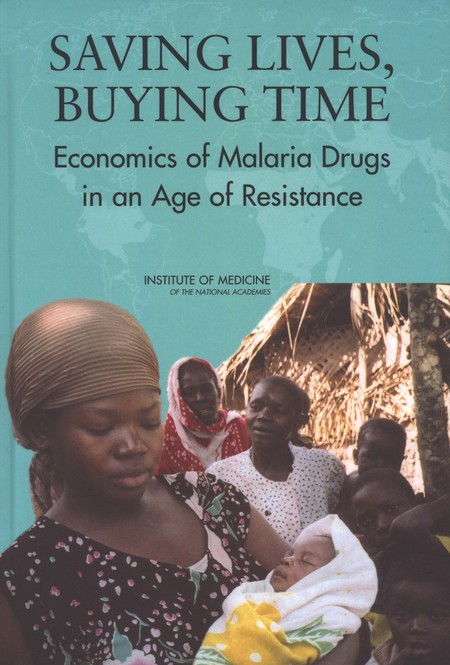
Cover of  Saving Lives, Buying Time: Economics of Malaria Drugs in an Age of Resistance (2004), from the National Academies Press

Cover of Saving Lives, Buying Time: Economics of Malaria Drugs in an Age of Resistance (2004), from the National Academies Press

Below the fold, I offer two quotes from Saving Lives, Buying Time: Economics of Malaria Drugs in an Age of Resistance (2004) Board on Global Health (BGH) (available from the National Academy of Sciences). You can see that DDT is not the golden-egg-laying goose, and that consequently Rachel Carson is not the mindless ogre she is made out to be in recent invectives.

Check out these sites:

Read the rest of this entry »


GOP war on science victim: Rachel Carson

May 14, 2007

Some people do things that are so stupid that one wonders how they manage to shave or put make-up on the next morning, having to look at their own face.

Mugshot of Utah Rep. Rob Bishop

Mugshot of Utah Rep. Rob Bishop

53 Republican representatives voted against naming the post office in Springdale, Pennsylvania, after Rachel Carson, the scientist who wrote Silent Spring, generally considered one of the most important or most influential scientists of the 20th century. No kidding. Springdale is Carson’s hometown.

2007 is the centennial of Carson’s birth — her birthday was May 27. (The bill, H.R. 1434, passed, 334-53.)

Why did the Wacky 53 vote against the honor for Carson, who got the Presidential Medal of Freedom in 1980? In an earnest ritual of voodoo science, they claim that bans on DDT kill millions, and that DDT is harmless. No, I’m not making this uphere’s the story from the Salt Lake Tribune, which covers territory represented by Rep. Rob Bishop and Rep. Chris Cannon, both R-Utah:

They contend that Carson’s actions – which led to a ban on the chemical DDT used to kill pests – actually has caused more deaths because of malaria and other diseases spread by insects. DDT, Carson wrote, was detrimental to the environment and to humans. Some scientists say DDT led to the California condor’s near-extinction.

Read the rest of this entry »