Oh, how things have changed! Birthday wishes for Alexander Hamilton, from 2012

January 11, 2018

I posted this back on January 11, 2012, a birthday note for Alexander Hamilton. In 2012, most Americans would have simply been puzzled by a request to tell them about the guy on the $10 bill.
Then stardom hit. Lin-Manuel Miranda, who in 2012 had just a couple of songs and an idea about a musical about Hamilton, finished the piece, produced it on Broadway, and set records for attendance and Tony awards, and generally raised Alexander Hamilton’s profile. Here is that post from 2012, with only editing for errors and time.

Today, January 11,  is Alexander Hamilton’s birthday — had he lived so long, he’d be 254 years old today! [260 years, in 2018 — probably]

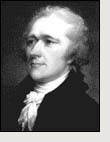
Alexander Hamilton on the U.S. ten dollar note - Guardian image

Alexander Hamilton on the U.S. ten dollar note – Guardian image

But of course, the bullet from Aaron Burr’s gun cut Hamilton’s life short, after the duel in Weehawken, New Jersey. Hamilton died of the wound on July 12, 1804. He was 47 years old.

Had Hamilton survived the duel, would he have been elected president? Some people think so. In any case, Hamilton’s wise management of the new nation’s finances, and his establishment of the idea that government should have a working bank, and that good government is a key to economic success of a nation, leave a great legacy for the nation, and the world.

Hamilton’s portrait adorns the U.S. $10 bill.

Read Hamilton’s biography from the U.S. National Archives’ feature on “America’s Founding Fathers/Charters of Freedom” exhibit:

Alexander Hamilton

Alexander Hamilton

Hamilton was born in 1757 on the island of Nevis, in the Leeward group, British West Indies. He was the illegitimate son of a common-law marriage between a poor itinerant Scottish merchant of aristocratic descent and an English-French Huguenot mother who was a planter’s daughter. In 1766, after the father had moved his family elsewhere in the Leewards to St. Croix in the Danish (now United States) Virgin Islands, he returned to St. Kitts while his wife and two sons remained on St. Croix.

The mother, who opened a small store to make ends meet, and a Presbyterian clergyman provided Hamilton with a basic education, and he learned to speak fluent French. About the time of his mother’s death in 1768, he became an apprentice clerk at Christiansted in a mercantile establishment, whose proprietor became one of his benefactors. Recognizing his ambition and superior intelligence, they raised a fund for his education.

In 1772, bearing letters of introduction, Hamilton traveled to New York City. Patrons he met there arranged for him to attend Barber’s Academy at Elizabethtown (present Elizabeth), NJ. During this time, he met and stayed for a while at the home of William Livingston, who would one day be a fellow signer of the Constitution. Late the next year, 1773, Hamilton entered King’s College (later Columbia College and University) in New York City, but the Revolution interrupted his studies.

Although not yet 20 years of age, in 1774-75 Hamilton wrote several widely read pro-Whig pamphlets. Right after the war broke out, he accepted an artillery captaincy and fought in the principal campaigns of 1776-77. In the latter year, winning the rank of lieutenant colonel, he joined the staff of General Washington as secretary and aide-de-camp and soon became his close confidant as well.

In 1780 Hamilton wed New Yorker Elizabeth Schuyler, whose family was rich and politically powerful; they were to have eight children. In 1781, after some disagreements with Washington, he took a command position under Lafayette in the Yorktown, VA, campaign (1781). He resigned his commission that November.

Hamilton then read law at Albany and quickly entered practice, but public service soon attracted him. He was elected to the Continental Congress in 1782-83. In the latter year, he established a law office in New York City. Because of his interest in strengthening the central government, he represented his state at the Annapolis Convention in 1786, where he urged the calling of the Constitutional Convention.

In 1787 Hamilton served in the legislature, which appointed him as a delegate to the convention. He played a surprisingly small part in the debates, apparently because he was frequently absent on legal business, his extreme nationalism put him at odds with most of the delegates, and he was frustrated by the conservative views of his two fellow delegates from New York. He did, however, sit on the Committee of Style, and he was the only one of the three delegates from his state who signed the finished document. Hamilton’s part in New York’s ratification the next year was substantial, though he felt the Constitution was deficient in many respects. Against determined opposition, he waged a strenuous and successful campaign, including collaboration with John Jay and James Madison in writing The Federalist. In 1787 Hamilton was again elected to the Continental Congress.

When the new government got under way in 1789, Hamilton won the position of Secretary of the Treasury. He began at once to place the nation’s disorganized finances on a sound footing. In a series of reports (1790-91), he presented a program not only to stabilize national finances but also to shape the future of the country as a powerful, industrial nation. He proposed establishment of a national bank, funding of the national debt, assumption of state war debts, and the encouragement of manufacturing.

Hamilton’s policies soon brought him into conflict with Jefferson and Madison. Their disputes with him over his pro-business economic program, sympathies for Great Britain, disdain for the common man, and opposition to the principles and excesses of the French revolution contributed to the formation of the first U.S. party system. It pitted Hamilton and the Federalists against Jefferson and Madison and the Democratic-Republicans.

During most of the Washington administration, Hamilton’s views usually prevailed with the President, especially after 1793 when Jefferson left the government. In 1795 family and financial needs forced Hamilton to resign from the Treasury Department and resume his law practice in New York City. Except for a stint as inspector-general of the Army (1798-1800) during the undeclared war with France, he never again held public office.

While gaining stature in the law, Hamilton continued to exert a powerful impact on New York and national politics. Always an opponent of fellow-Federalist John Adams, he sought to prevent his election to the presidency in 1796. When that failed, he continued to use his influence secretly within Adams’ cabinet. The bitterness between the two men became public knowledge in 1800 when Hamilton denounced Adams in a letter that was published through the efforts of the Democratic-Republicans.

In 1802 Hamilton and his family moved into The Grange, a country home he had built in a rural part of Manhattan not far north of New York City. But the expenses involved and investments in northern land speculations seriously strained his finances.

Meanwhile, when Jefferson and Aaron Burr tied in Presidential electoral votes in 1800, Hamilton threw valuable support to Jefferson. In 1804, when Burr sought the governorship of New York, Hamilton again managed to defeat him. That same year, Burr, taking offense at remarks he believed to have originated with Hamilton, challenged him to a duel, which took place at present Weehawken, NJ, on July 11. Mortally wounded, Hamilton died the next day. He was in his late forties at death. He was buried in Trinity Churchyard in New York City.

Image: Courtesy of The National Portrait Gallery, Smithsonian Institution
Post mostly borrowed, with express permission, from Mr. Darrell’s Wayback Machine.

Remember to watch for progress on “The Alexander Hamilton Mixtape,” a hip-hop version of Alexander Hamilton’s life by Lin-Manuel Miranda, seen here performing Aaron Burr’s soliloquey, at the White House.

More, added in 2018:

Poster for Lin-Manuel Miranda's musical play,

Poster for Lin-Manuel Miranda’s musical play, “Hamilton.” Wikipedia image.


December 31 is Bright Idea Day, anniversary of the Day the Lights Went On

December 31, 2017

Between Christmas and New Year’s Day, here at Millard Fillmore’s Bathtub we celebrate a variety of historically holy days.  December 31, by tradition, is Bright Idea Day, the anniversary of the day Thomas Edison demonstrated for the public a working light bulb, in 1879.

100,000 people gather in Times Square, New York City (surely not the 1 million predicted by NBC!) tonight, and millions more around the world, in festivities for the new year made possible by the work of Thomas Alva Edison.

Here it is, the invention that stole sleep from our grasp, made clubbing possible, and launched 50,000 cartoons about ideas:

The light bulb Thomas Edison demonstrated on December 31, 1879, at Menlo Park, New Jersey - Wikimedia image

The light bulb Thomas Edison demonstrated on December 31, 1879, at Menlo Park, New Jersey – Wikimedia image (GFDL)

The light bulb. It’s an incandescent bulb.

It wasn’t the first bulb. Edison a few months earlier devised a bulb that worked with a platinum filament. Platinum was too expensive for mass production, though — and Edison wanted mass production. So, with the cadre of great assistants at his Menlo Park laboratories, he struggled to find a good, inexpensive filament that would provide adequate life for the bulb. By late December 1879 they had settled on carbon filament.

Edison invited investors and the public to see the bulb demonstrated, on December 31, 1879.

Thomas Edison in 1878, the year before he demonstrated a workable electric light bulb. Library of Congress image

Thomas Edison in 1878, the year before he demonstrated a workable electric light bulb. CREDIT: Thomas Edison, head-and-shoulders portrait, facing left, 1880. Prints and Photographs Division, Library of Congress. Reproduction number LC-USZ62-98067

Edison’s successful bulb indicated changes in science, technology, invention, intellectual property and finance well beyond its use of electricity. For example:

  • Edison’s Menlo Park, New Jersey, offices and laboratory were financed with earlier successful inventions. It was a hive of inventive activity aimed to make practical inventions from advances in science. Edison was all about selling inventions and rights to manufacture devices. He always had an eye on the profit potential. His improvements on the telegraph would found his laboratory he thought, and he expected to sell the device to Western Union for $5,000 to $7,000. Instead of offering it to them at a price, however, he asked Western Union to bid on it. They bid $10,000, which Edison gratefully accepted, along with the lesson that he might do better letting the marketplace establish the price for his inventions. Other inventive labs followed Edison’s example, such as the famous Bell Labs, but few equalled his success, or had as much fun doing it.  (Economics teachers:  Need an example of the marketplace in action?)
  • While Edison had some financial weight to invest in the quest for a workable electric light, he also got financial support, $30,000 worth, from some of the finance giants of the day, including J. P. Morgan and the Vanderbilts who established the Edison Light Company.
  • Edison didn’t invent the light bulb — but his improvements on it made it commercial. “In addressing the question ‘Who invented the incandescent lamp?’ historians Robert Friedel and Paul Israel list 22 inventors of incandescent lamps prior to Joseph Wilson Swan and Thomas Edison. They conclude that Edison’s version was able to outstrip the others because of a combination of three factors: an effective incandescent material, a higher vacuum than others were able to achieve (by use of the Sprengel pump) and a high resistance lamp that made power distribution from a centralized source economically viable.”
  • Edison’s financial and business leadership acumen is partly attested to by the continuance of his organizations, today — General Electric, one of the world’s most successful companies over the past 40 years, traces its origins to Edison.

Look around yourself this evening, and you can find a score of ways that Edison’s invention and its descendants affect your life. One of the more musing effects is in cartooning, however. Today a glowing lightbulb is universally accepted as a nonverbal symbol for ideas and inventions. (See Mark Parisi’s series of lightbulb cartoons, “Off the Mark.”)

Even with modern, electricity-saving bulbs, the cartoon shorthand hangs on, as in this Mitra Farmand cartoon.

Fusilli has an idea, Mitra Farmand, Fuffernutter

Brilliant cartoon from Mitra Farmand, Fuffernutter (regrettably, we note this site is no longer there; but with some hope, we find a new site here)

Or see this wonderful animation, a video advertisement for United Airlines, by Joanna Quinn for Fallon — almost every frame has the symbolic lightbulb in it.

Electrification of America, and the consequent spread of electric lighting and electrical machines to make domestic and industrial life more productive, and the spread of great public works to enable these and other inventions to spread, were made possible by a people roughly united in advancing progress, what historians now call “the progressive agenda” and the great advances of the Progressive Era.

Could we get such agreement among workers, corporate bosses and many levels of government today? When we celebrate anniversaries, like the demonstration of the light bulb, we celebrate the united polity that made such things possible, too.

Gee, I wonder who were the dignitaries to whom Edison demonstrated the electric light on that New Years Eve, in 1879. Anyone know? We can safely wager that there were representatives of the Vanderbilts and Morgans there, families who invested in Edison as an inventor.

Other resources:

Patent drawing for Thomas Edison's successful electric lamp. Library of Congress

Thomas Edison’s electric lamp patent drawing and claim for the incandescent light bulb CREDIT: “New Jersey–The Wizard of Electricity–Thomas A. Edison’s System of Electric Illumination,” 1880. Prints and Photographs Division, Library of Congress. Reproduction Number LC-USZ62-97960.

Even More:

This is an encore post.

Yes, this is an encore post. Defeating ignorance takes patience and perseverance.


Scrooge’s 2017 Christmas gift: Trump policy reduced to three words

December 18, 2017

Oh, why bother with this BEFORE Christmas? It’s more salient now, looking at the new year, and wondering what is the fate of man and men, in the new year.

Roberto Innocenti, Scrooge on a dark staircase

Ebenezer Scrooge, up a dark staircase; “Darkness was cheap, and Scrooge liked it.” Illustration by Roberto Innocenti, via Pinterest.

It’s a Quote of the Moment (an encore post for the season, with a bit of context thrown in later), Trump’s platform, and life, edited down to just three words, in green:

Darkness is cheap,
and Scrooge liked it.

– Charles Dickens, A Christmas Carol, Stave 1

Isn’t that the entire GOP platform in three words? “Darkness is cheap.” Substitute “Trump” for “Scrooge,” you’ve got the picture.

I think of that line of Dickens’s often when  I read of the celebrations of calumny that pass as discourse in Republican politics these days. Although, with the 2008 renewing of Limbaugh’s contract, it may no longer be true that his particular brand of darkness is cheap. With the advent of Donald Trump’s insult politics, offending America’s allies and all American ethnic groups possible, with un-ironic calls to drop nuclear weapons, GOP politics is even darker than ever.

Cheap or not, darkness remains dark.

John Leach, Scrooge meets Ignorance and Want

Scrooge meets Ignorance and Want, the products of his stinginess (drawing by John Leech, 1809-1870)


Here is the sentence Dickens put before the quote, to add a little context; Scrooge was climbing a very large, very dark staircase.

Half-a-dozen gas-lamps out of the street wouldn’t have lighted the entry too well, so you may suppose that it was pretty dark with Scrooge’s dip.

Up Scrooge went, not caring a button for that. Darkness is cheap, and Scrooge liked it.

Speaking of darkness, a longer excerpt from a bit later in Dickens’s story, when the Ghost of Christmas Present ushers Scrooge to glimpse what is in the present, but what will be the future if Scrooge does not repent:

‘Forgive me if I am not justified in what I ask,’ said Scrooge, looking intently at the Spirit’s robe, ‘but I see something strange, and not belonging to yourself, protruding from your skirts. Is it a foot or a claw?’

‘It might be a claw, for the flesh there is upon it,’ was the Spirit’s sorrowful reply. ‘Look here.’

From the foldings of its robe, it brought two children; wretched, abject, frightful, hideous, miserable. They knelt down at its feet, and clung upon the outside of its garment.

‘Oh, Man! look here. Look, look, down here!’ exclaimed the Ghost.

They were a boy and girl. Yellow, meagre, ragged, scowling, wolfish; but prostrate, too, in their humility. Where graceful youth should have filled their features out, and touched them with its freshest tints, a stale and shrivelled hand, like that of age, had pinched, and twisted them, and pulled them into shreds. Where angels might have sat enthroned, devils lurked, and glared out menacing. No change, no degradation, no perversion of humanity, in any grade, through all the mysteries of wonderful creation, has monsters half so horrible and dread.

Scrooge started back, appalled. Having them shown to him in this way, he tried to say they were fine children, but the words choked themselves, rather than be parties to a lie of such enormous magnitude.

‘Spirit! are they yours?’ Scrooge could say no more.

‘They are Man’s,’ said the Spirit, looking down upon them. ‘And they cling to me, appealing from their fathers. This boy is Ignorance. This girl is Want. Beware them both, and all of their degree, but most of all beware this boy, for on his brow I see that written which is Doom, unless the writing be erased. Deny it!’ cried the Spirit, stretching out its hand towards the city. ‘Slander those who tell it ye! Admit it for your factious purposes, and make it worse. And bide the end!’

‘Have they no refuge or resource?’ cried Scrooge.

‘Are there no prisons?’ said the Spirit, turning on him for the last time with his own words. ‘Are there no workhouses?’ The bell struck twelve.

Scrooge looked about him for the Ghost, and saw it not. As the last stroke ceased to vibrate, he remembered the prediction of old Jacob Marley, and lifting up his eyes, beheld a solemn Phantom, draped and hooded, coming, like a mist along the ground, towards him.

A Christmas Carol, Stave 3

Think of 2014, 2015, and 2016, children abused in Central America and in the Middle East, fleeing as best they can, only to die, off the shores of Greece, on the southern deserts of the U.S., or be cast into incarceration after having achieved a nation whose very name promised them refuge, the United States. “Two children; wretched, abject, frightful, hideous, miserable,” Dickens described. Whose children? “Man’s.” Yours, and mine.

Christmas is a festival to celebrate light, what many Christians call “the light of the world?” If so, let us work to stamp out the darkness which the unrepentant Scrooge so dearly loved.

Darkness may be cheap, but it is not good.  Light a candle, and run into the darkness, spreading light. We need more light.

Hope you had a merry Christmas in 2016. Let us remember, as Tom and the late Ray Magliozzi always reminded us, the cheapskate pays more in the end, and usually along the way. Is Darkness cheap? Let us then eschew it as too costly for a moral nation, too costly for a moral people.

Is Donald Trump as smart as Ebenezer Scrooge? Is his heart as good as Scrooge’s heart?

More:

Yes, this is an encore post, mostly. Fighting ignorance is taking a lot longer than anyone thought.

Yes, this is an encore post, mostly. Fighting ignorance is taking a lot longer than anyone thought.

Save


How can we not allow undeveloped nations and the poor to use fossil fuel energy?

December 18, 2017

Greenpeace and Tcktcktck volunteers raise a wind turbine on the beach at dawn in Durban, South Africa. Microgrid News image

Greenpeace and Tcktcktck volunteers raise a wind turbine on the beach at dawn in Durban, South Africa. Microgrid News image

How can we not allow undeveloped nations to catch the first world with fossil fuel energy? Katharine Hayhoe explains at Global Weirding.

More: 


December 2: Millard Fillmore’s Guano Day! 2017 edition

December 2, 2017

Why December 2?

(You couldn’t make this stuff up if you were Monty Python.)

English: Millard Fillmore White House portrait

Millard Fillmore’s White House portrait, via Wikipedia

President Millard Fillmore, in the State of the Union Address, December 2, 1850

Peruvian guano has become so desirable an article to the agricultural interest of the United States that it is the duty of the Government to employ all the means properly in its power for the purpose of causing that article to be imported into the country at a reasonable price. Nothing will be omitted on my part toward accomplishing this desirable end. I am persuaded that in removing any restraints on this traffic the Peruvian Government will promote its own best interests, while it will afford a proof of a friendly disposition toward this country, which will be duly appreciated.

Did any other U.S. President spend so much time thinking about guano?  Did any president ever mention it in a State of the Union Address?  The curious case of Millard Fillmore, Seer, just grows.

Guano, or bird poop (and its relative, bat poop), contains phosphorus, which is an essential element for life.  Consequently, it turns out to be a key ingredient in effective agricultural fertilizers.  In international competition for supremacy in farming and farm exports, guano became a key resource to fight over, in the 19th century.

It’s almost safe to say the fights were economic; but guano did play a key role in wars in South America (see Andrew Leonard’s article, noted below).

Fillmore figured out that the substance had great importance, coupled that with the rather esoteric knowledge that sea birds tended to deposit guano in great abundance on certain islands, often unoccupied, and ordered the U.S. Navy to claim islands found to contain guano deposits that were not claimed by other nations.

By the American Civil War, the importance of phosphorus to the production of gun powder became an issue for the armies of the North and South.  Millard Fillmore had set the stage for the North to win an important advantage in gun powder production, just one of many that led to the defeat of the South.

It’s one more thing we should thank Millard Fillmore for doing. Our study of history should inform us that it is, indeed, important for politicians to understand the importance of guano.

Fillmore knew his guano.

Take a moment on December 2 to toast Millard Fillmore’s prescience, on Guano Day!

More:  

You can purchase Peruvian guano today, from Amazon, GrowOrganic.com, and other sources. It's roughly $15 per pound in the U.S.

You can purchase Peruvian guano today, from Amazon, GrowOrganic.com, and other sources. It’s roughly $15 per pound in the U.S.

This is an encore post.

Yes, this is an edited encore post. Defeating ignorance takes patience and perseverance.


No, Earth Day 2017 does not celebrate Lenin, who was anti-environmentalist – annual debunking of the annual Earth Day/Lenin hoax

April 22, 2017

This is mostly an encore post, repeated each year for April 22 and Earth Day — sad that it needs repeating; anti-environmentalists don’t appear to learn much, year to year.  (Yes, some of the links may be dated; if you find one not working, please let me know in comments.)

In 2017, we may need this post more, to put up with anti-science backlash to the March for Science.

You could write it off to pareidolia, once.

Like faces in clouds, some people claimed to see a link. The first Earth Day, on April 22, 1970, coincided with Lenin’s birthday. There was no link — Earth Day was scheduled for a spring Wednesday, when the greatest number of college students would be on campus.

Link to permanent Earth Day site, at EarthDay.org

Now, years later, with almost-annual repeats of the claim from the braying right wing, it’s just a cruel hoax.  It’s as much a hoax on the ill-informed of the right, as anyone else. Many of them believe it.

No, there’s no link between Earth Day and the birthday of V. I. Lenin:

One surefire way to tell an Earth Day post is done by an Earth Day denialist: They’ll note that the first Earth Day, on April 22, 1970, was an anniversary of the birth of Lenin.

Coincidentally, yes, Lenin was born on April 22, on the new style calendar; it was April 10 on the calendar when he was born — one might accurately note that Lenin’s mother always said he was born on April 10.

It’s a hoax. There is no meaning to the first Earth Day’s falling on Lenin’s birthday — Lenin was not prescient enough to plan his birthday to fall in the middle of Earth Week, a hundred years before Earth Week was even planned.

About.com explains why the idea of a link between Earth Day and Lenin is silly:

Does Earth Day Promote Communism?
Earth Day 1970 was initially conceived as a teach-in, modeled on the teach-ins used successfully by Vietnam War protesters to spread their message and generate support on U.S. college campuses. It is generally believed that April 22 was chosen for Earth Day because it was a Wednesday that fell between spring break and final exams—a day when a majority of college students would be able to participate.

U.S. Sen. Gaylord Nelson, the guy who dreamed up the nationwide teach-in that became Earth Day, once tried to put the whole “Earth Day as communist plot” idea into perspective.

“On any given day, a lot of both good and bad people were born,” Nelson said. “A person many consider the world’s first environmentalist, Saint Francis of Assisi, was born on April 22. So was Queen Isabella. More importantly, so was my Aunt Tillie.”

April 22 is also the birthday of J. Sterling Morton, the Nebraska newspaper editor who founded Arbor Day (a national holiday devoted to planting trees) on April 22, 1872, when Lenin was still in diapers. Maybe April 22 was chosen to honor Morton and nobody knew. Maybe environmentalists were trying to send a subliminal message to the national subconscious that would transform people into tree-planting zombies. One birthday “plot” seems just about as likely as the other. What’s the chance that one person in a thousand could tell you when either of these guys were born.

My guess is that only a few really wacko conservatives know that April 22 is Lenin’s birthday (was it ever celebrated in the Soviet Union?). No one else bothers to think about it, or say anything about it, nor especially, to celebrate it.

Certainly, the Soviet Union never celebrated Earth Day. Nor was Lenin any great friend of the environment.  He stood instead with the oil-drillers-without-clean-up, with the strip-miners-without-reclamation, with the dirty-smokestack guys.  You’d think someone with a bit of logic and a rudimentary knowledge of history could put that together.

Gaylord Nelson, Living Green image
Inventor of Earth Day teach-ins, former Wisconsin Governor and U.S. Senator Gaylord Nelson

The REAL founder of Earth Day, Wisconsin’s U.S. Sen. Gaylord Nelson, usually recognized as the founder and father of Earth Day, told how and why the organizers came to pick April 22:

Senator Nelson chose the date in order to maximize participation on college campuses for what he conceived as an “environmental teach-in.” He determined the week of April 19–25 was the best bet; it did not fall during exams or spring breaks, did not conflict with religious holidays such as Easter or Passover, and was late enough in spring to have decent weather. More students were likely to be in class, and there would be less competition with other mid-week events—so he chose Wednesday, April 22.

In his own words, Nelson spoke of what he was trying to do:

After President Kennedy’s [conservation] tour, I still hoped for some idea that would thrust the environment into the political mainstream. Six years would pass before the idea that became Earth Day occurred to me while on a conservation speaking tour out West in the summer of 1969. At the time, anti-Vietnam War demonstrations, called “teach-ins,” had spread to college campuses all across the nation. Suddenly, the idea occurred to me – why not organize a huge grassroots protest over what was happening to our environment?

I was satisfied that if we could tap into the environmental concerns of the general public and infuse the student anti-war energy into the environmental cause, we could generate a demonstration that would force this issue onto the political agenda. It was a big gamble, but worth a try.

At a conference in Seattle in September 1969, I announced that in the spring of 1970 there would be a nationwide grassroots demonstration on behalf of the environment and invited everyone to participate. The wire services carried the story from coast to coast. The response was electric. It took off like gangbusters. Telegrams, letters, and telephone inquiries poured in from all across the country. The American people finally had a forum to express its concern about what was happening to the land, rivers, lakes, and air – and they did so with spectacular exuberance. For the next four months, two members of my Senate staff, Linda Billings and John Heritage, managed Earth Day affairs out of my Senate office.

Five months before Earth Day, on Sunday, November 30, 1969, The New York Times carried a lengthy article by Gladwin Hill reporting on the astonishing proliferation of environmental events:

“Rising concern about the environmental crisis is sweeping the nation’s campuses with an intensity that may be on its way to eclipsing student discontent over the war in Vietnam…a national day of observance of environmental problems…is being planned for next spring…when a nationwide environmental ‘teach-in’…coordinated from the office of Senator Gaylord Nelson is planned….”

Nelson, a veteran of the U.S. armed services (Okinawa campaign), flag-waving ex-governor of Wisconsin (Sen. Joe McCarthy’s home state, but also the home of Aldo Leopold and birthplace of John Muir), was working to raise America’s consciousness and conscience about environmental issues.

Lenin on the environment? Think of the Aral Sea disaster, the horrible pollution from Soviet mines and mills, and the dreadful record of the Soviet Union on protecting any resource. Lenin believed in exploiting resources and leaving the spoils to rot in the sun, not conservation; in practice there was no environmental protection, but instead a war on nature, in the Soviet Union.

So, why are all these conservative denialists claiming, against history and politics, that Lenin’s birthday has anything to do with Earth Day?

Can you say “propaganda?” Can you say “political smear?”

2017 Resources and Good News:

2015 Resources and Good News:

2014 Resources and Good News:

2013 Resources and Good News:

Good information for 2012:

Good information from 2011:

Good information from 2010:

2014’s Wall of Shame:

2013 Wall of Shame:

Wall of Lenin’s Birthday Propaganda Shame from 2012:

Wall of Lenin’s Birthday Propaganda Shame from 2011:

Wall of Lenin’s Birthday Propaganda Shame from 2010:

Spread the word. Have you found someone spreading the hoax, claiming Earth Day honors Lenin instead? Give us the link in comments.

UAW’s March for Science banner
UAW's March for Science banner

Sa

Save


Scrooge’s 2016 Christmas gift to Donald Trump: His platform reduced to three words

December 30, 2016

Oh, why bother with this BEFORE Christmas? It’s more salient now, looking at the new year, and wondering what is the fate of man and men, in the new year.

Roberto Innocenti, Scrooge on a dark staircase

Ebenezer Scrooge, up a dark staircase; “Darkness was cheap, and Scrooge liked it.” Illustration by Roberto Innocenti, via Pinterest.

It’s a Quote of the Moment (an encore post for the season, with a bit of context thrown in later), Trump’s platform, and life, edited down to just three words, in green:

Darkness is cheap,
and Scrooge liked it.

– Charles Dickens, A Christmas Carol, Stave 1

Isn’t that the entire GOP platform in three words? “Darkness is cheap.”

I think of that line of Dickens’s often when  I read of the celebrations of calumny that pass as discourse in Republican politics these days. Although, with the 2008 renewing of Limbaugh’s contract, it may no longer be true that his particular brand of darkness is cheap. With the advent of Donald Trump’s insult politics, offending America’s allies and all American ethnic groups possible, with un-ironic calls to drop nuclear weapons, GOP politics is even darker than ever.

Cheap or not, darkness remains dark.

John Leach, Scrooge meets Ignorance and Want

Scrooge meets Ignorance and Want, the products of his stinginess (drawing by John Leech, 1809-1870)


Here is the sentence Dickens put before the quote, to add a little context; Scrooge was climbing a very large, very dark staircase.

Half-a-dozen gas-lamps out of the street wouldn’t have lighted the entry too well, so you may suppose that it was pretty dark with Scrooge’s dip.

Up Scrooge went, not caring a button for that. Darkness is cheap, and Scrooge liked it.

Speaking of darkness, a longer excerpt from a bit later in Dickens’s story, when the Ghost of Christmas Present ushers Scrooge to glimpse what is in the present, but what will be the future if Scrooge does not repent:

‘Forgive me if I am not justified in what I ask,’ said Scrooge, looking intently at the Spirit’s robe, ‘but I see something strange, and not belonging to yourself, protruding from your skirts. Is it a foot or a claw?’

‘It might be a claw, for the flesh there is upon it,’ was the Spirit’s sorrowful reply. ‘Look here.’

From the foldings of its robe, it brought two children; wretched, abject, frightful, hideous, miserable. They knelt down at its feet, and clung upon the outside of its garment.

‘Oh, Man! look here. Look, look, down here!’ exclaimed the Ghost.

They were a boy and girl. Yellow, meagre, ragged, scowling, wolfish; but prostrate, too, in their humility. Where graceful youth should have filled their features out, and touched them with its freshest tints, a stale and shrivelled hand, like that of age, had pinched, and twisted them, and pulled them into shreds. Where angels might have sat enthroned, devils lurked, and glared out menacing. No change, no degradation, no perversion of humanity, in any grade, through all the mysteries of wonderful creation, has monsters half so horrible and dread.

Scrooge started back, appalled. Having them shown to him in this way, he tried to say they were fine children, but the words choked themselves, rather than be parties to a lie of such enormous magnitude.

‘Spirit! are they yours?’ Scrooge could say no more.

‘They are Man’s,’ said the Spirit, looking down upon them. ‘And they cling to me, appealing from their fathers. This boy is Ignorance. This girl is Want. Beware them both, and all of their degree, but most of all beware this boy, for on his brow I see that written which is Doom, unless the writing be erased. Deny it!’ cried the Spirit, stretching out its hand towards the city. ‘Slander those who tell it ye! Admit it for your factious purposes, and make it worse. And bide the end!’

‘Have they no refuge or resource?’ cried Scrooge.

‘Are there no prisons?’ said the Spirit, turning on him for the last time with his own words. ‘Are there no workhouses?’ The bell struck twelve.

Scrooge looked about him for the Ghost, and saw it not. As the last stroke ceased to vibrate, he remembered the prediction of old Jacob Marley, and lifting up his eyes, beheld a solemn Phantom, draped and hooded, coming, like a mist along the ground, towards him.

A Christmas Carol, Stave 3

Think of 2014, 2015, and 2016, children abused in Central America and in the Middle East, fleeing as best they can, only to die, off the shores of Greece, on the southern deserts of the U.S., or be cast into incarceration after having achieved a nation whose very name promised them refuge, the United States. “Two children; wretched, abject, frightful, hideous, miserable,” Dickens described. Whose children? “Man’s.” Yours, and mine.

Christmas is a festival to celebrate light, what many Christians call “the light of the world?” If so, let us work to stamp out the darkness which the unrepentant Scrooge so dearly loved.

Darkness may be cheap, but it is not good.  Light a candle, and run into the darkness, spreading light. We need more light.

Hope you had a merry Christmas in 2016. Let us remember, as Tom and the late Ray Magliozzi always reminded us, the cheapskate pays more in the end, and usually along the way. Is Darkness cheap? Let us then eschew it as too costly for a moral nation, too costly for a moral people.

Is Donald Trump as smart as Ebenezer Scrooge? Is his heart as good as Scrooge’s heart?

More:

Yes, this is mostly an encore post. Fighting ignorance requires patience.

Yes, this is mostly an encore post. Fighting ignorance requires patience.

Save


December 2: Happy Guano Day! (Thank you, Millard Fillmore)

December 2, 2016

Why December 2?

(You couldn’t make this stuff up if you were Monty Python.)

English: Millard Fillmore White House portrait

Millard Fillmore’s White House portrait, via Wikipedia

President Millard Fillmore, in the State of the Union Address, December 2, 1850

Peruvian guano has become so desirable an article to the agricultural interest of the United States that it is the duty of the Government to employ all the means properly in its power for the purpose of causing that article to be imported into the country at a reasonable price. Nothing will be omitted on my part toward accomplishing this desirable end. I am persuaded that in removing any restraints on this traffic the Peruvian Government will promote its own best interests, while it will afford a proof of a friendly disposition toward this country, which will be duly appreciated.

Did any other U.S. President spend so much time thinking about guano?  Did any president ever mention it in a State of the Union Address?  The curious case of Millard Fillmore, Seer, just grows.

Guano, or bird poop (and its relative, bat poop), contains phosphorus, which is an essential element for life.  Consequently, it turns out to be a key ingredient in effective agricultural fertilizers.  In international competition for supremacy in farming and farm exports, guano became a key resource to fight over, in the 19th century.

It’s almost safe to say the fights were economic; but guano did play a key role in wars in South America (see Andrew Leonard’s article, noted below).

Fillmore figured out that the substance had great importance, coupled that with the rather esoteric knowledge that sea birds tended to deposit guano in great abundance on certain islands, often unoccupied, and ordered the U.S. Navy to claim islands found to contain guano deposits that were not claimed by other nations.

By the American Civil War, the importance of phosphorus to the production of gun powder became an issue for the armies of the North and South.  Millard Fillmore had set the stage for the North to win an important advantage in gun powder production, just one of many that led to the defeat of the South.

It’s one more thing we should thank Millard Fillmore for doing. Our study of history should inform us that it is, indeed, important for politicians to understand the importance of guano.

Fillmore knew his guano.

Take a moment on December 2 to toast Millard Fillmore’s prescience, on Guano Day!

More:  

Yes, this is mostly an encore post. Fighting ignorance requires patience.

Yes, this is mostly an encore post. Fighting ignorance requires patience.

Save

Save


July 15, 1848, economist Vilfredo Pareto born

July 15, 2016

Happy 80/20 Day!

Italian economist, engineer and political activist Vilfredo Pareto was born on July 15, 1848, in Paris, where his father had fled due to political difficulties.

Pareto should be more famous, for his explanation of the 80/20 rule, and for his contribution to making better things, the Pareto chart.  Many economic texts ignore his work almost completely.  Quality management texts ignore his life, too — generally mentioning the principles they borrow, but offering no explanation.

Vilifred Pareto, Wikipedia image

Vilfredo Pareto, Wikipedia image; why are there so few photographs of the man, who died in 1923?

His contributions, as accounted at Wikipedia:

A few economic rules are based on his work:

And now you, dear reader, having just skimmed the surface of the pool of information on Vilfredo Pareto, know more about the man than 99.99% of the rest of the people on the planet.  Welcome to the tip-top 0.01%.

A mystery I attribute to low readership: I’ve posted much of this information before. In several years, not once has anyone criticized these posts as supporting fascism, the most common mis-directed criticism of Pareto.

Resources:

Portrait drawing of Vilfredo Pareto, from one of the few photographs of the man available. Image at Alchetron. Artist?

Portrait drawing of Vilfredo Pareto, from one of the few photographs of the man available. Image at Alchetron, by Artigas at Deviant Art.


No, Earth Day 2016 does not celebrate Lenin, who was anti-environmentalist – annual debunking of the annual Earth Day/Lenin hoax

April 20, 2016

This is mostly an encore post, repeated each year for April 22 and Earth Day — sad that it needs repeating; anti-environmentalists don’t appear to learn much, year to year.  (Yes, some of the links may be dated; if you find one not working, please let me know in comments.)

You could write it off to pareidolia, once.

Like faces in clouds, some people claimed to see a link. The first Earth Day, on April 22, 1970, coincided with Lenin’s birthday. There was no link — Earth Day was scheduled for a spring Wednesday, when the greatest number of college students would be on campus.

Link to permanent Earth Day site, at EarthDay.org

Link to permanent Earth Day site, at EarthDay.org

Now, years later, with almost-annual repeats of the claim from the braying right wing, it’s just a cruel hoax.  It’s as much a hoax on the ill-informed of the right, as anyone else. Many of them believe it.

No, there’s no link between Earth Day and the birthday of V. I. Lenin:

One surefire way to tell an Earth Day post is done by an Earth Day denialist: They’ll note that the first Earth Day, on April 22, 1970, was an anniversary of the birth of Lenin.

Coincidentally, yes, Lenin was born on April 22, on the new style calendar; it was April 10 on the calendar when he was born — one might accurately note that Lenin’s mother always said he was born on April 10.

It’s a hoax. There is no meaning to the first Earth Day’s falling on Lenin’s birthday — Lenin was not prescient enough to plan his birthday to fall in the middle of Earth Week, a hundred years before Earth Week was even planned.

About.com explains why the idea of a link between Earth Day and Lenin is silly:

Does Earth Day Promote Communism?
Earth Day 1970 was initially conceived as a teach-in, modeled on the teach-ins used successfully by Vietnam War protesters to spread their message and generate support on U.S. college campuses. It is generally believed that April 22 was chosen for Earth Day because it was a Wednesday that fell between spring break and final exams—a day when a majority of college students would be able to participate.

U.S. Sen. Gaylord Nelson, the guy who dreamed up the nationwide teach-in that became Earth Day, once tried to put the whole “Earth Day as communist plot” idea into perspective.

“On any given day, a lot of both good and bad people were born,” Nelson said. “A person many consider the world’s first environmentalist, Saint Francis of Assisi, was born on April 22. So was Queen Isabella. More importantly, so was my Aunt Tillie.”

April 22 is also the birthday of J. Sterling Morton, the Nebraska newspaper editor who founded Arbor Day (a national holiday devoted to planting trees) on April 22, 1872, when Lenin was still in diapers. Maybe April 22 was chosen to honor Morton and nobody knew. Maybe environmentalists were trying to send a subliminal message to the national subconscious that would transform people into tree-planting zombies. One birthday “plot” seems just about as likely as the other. What’s the chance that one person in a thousand could tell you when either of these guys were born.

My guess is that only a few really wacko conservatives know that April 22 is Lenin’s birthday (was it ever celebrated in the Soviet Union?). No one else bothers to think about it, or say anything about it, nor especially, to celebrate it.

Certainly, the Soviet Union never celebrated Earth Day. Nor was Lenin any great friend of the environment.  He stood instead with the oil-drillers-without-clean-up, with the strip-miners-without-reclamation, with the dirty-smokestack guys.  You’d think someone with a bit of logic and a rudimentary knowledge of history could put that together.

Gaylord Nelson, Living Green image

Inventor of Earth Day teach-ins, former Wisconsin Governor and U.S. Senator Gaylord Nelson

The REAL founder of Earth Day, Wisconsin’s U.S. Sen. Gaylord Nelson, usually recognized as the founder and father of Earth Day, told how and why the organizers came to pick April 22:

Senator Nelson chose the date in order to maximize participation on college campuses for what he conceived as an “environmental teach-in.” He determined the week of April 19–25 was the best bet; it did not fall during exams or spring breaks, did not conflict with religious holidays such as Easter or Passover, and was late enough in spring to have decent weather. More students were likely to be in class, and there would be less competition with other mid-week events—so he chose Wednesday, April 22.

In his own words, Nelson spoke of what he was trying to do:

After President Kennedy’s [conservation] tour, I still hoped for some idea that would thrust the environment into the political mainstream. Six years would pass before the idea that became Earth Day occurred to me while on a conservation speaking tour out West in the summer of 1969. At the time, anti-Vietnam War demonstrations, called “teach-ins,” had spread to college campuses all across the nation. Suddenly, the idea occurred to me – why not organize a huge grassroots protest over what was happening to our environment?

I was satisfied that if we could tap into the environmental concerns of the general public and infuse the student anti-war energy into the environmental cause, we could generate a demonstration that would force this issue onto the political agenda. It was a big gamble, but worth a try.

At a conference in Seattle in September 1969, I announced that in the spring of 1970 there would be a nationwide grassroots demonstration on behalf of the environment and invited everyone to participate. The wire services carried the story from coast to coast. The response was electric. It took off like gangbusters. Telegrams, letters, and telephone inquiries poured in from all across the country. The American people finally had a forum to express its concern about what was happening to the land, rivers, lakes, and air – and they did so with spectacular exuberance. For the next four months, two members of my Senate staff, Linda Billings and John Heritage, managed Earth Day affairs out of my Senate office.

Five months before Earth Day, on Sunday, November 30, 1969, The New York Times carried a lengthy article by Gladwin Hill reporting on the astonishing proliferation of environmental events:

“Rising concern about the environmental crisis is sweeping the nation’s campuses with an intensity that may be on its way to eclipsing student discontent over the war in Vietnam…a national day of observance of environmental problems…is being planned for next spring…when a nationwide environmental ‘teach-in’…coordinated from the office of Senator Gaylord Nelson is planned….”

Nelson, a veteran of the U.S. armed services (Okinawa campaign), flag-waving ex-governor of Wisconsin (Sen. Joe McCarthy’s home state, but also the home of Aldo Leopold and birthplace of John Muir), was working to raise America’s consciousness and conscience about environmental issues.

Lenin on the environment? Think of the Aral Sea disaster, the horrible pollution from Soviet mines and mills, and the dreadful record of the Soviet Union on protecting any resource. Lenin believed in exploiting resources and leaving the spoils to rot in the sun, not conservation; in practice there was no environmental protection, but instead a war on nature, in the Soviet Union.

So, why are all these conservative denialists claiming, against history and politics, that Lenin’s birthday has anything to do with Earth Day?

Can you say “propaganda?” Can you say “political smear?”

2015 Resources and Good News:

2014 Resources and Good News:

2013 Resources and Good News:

Good information for 2012:

Good information from 2011:

Good information from 2010:

2014’s Wall of Shame:

2013 Wall of Shame:

Wall of Lenin’s Birthday Propaganda Shame from 2012:

Wall of Lenin’s Birthday Propaganda Shame from 2011:

Wall of Lenin’s Birthday Propaganda Shame from 2010:

Spread the word. Have you found someone spreading the hoax, claiming Earth Day honors Lenin instead? Give us the link in comments.


Democratic socialism’s darkest secret: More democracy than socialism

January 26, 2016

Fans of irony will find interesting this depiction of the of the greatest achievements in history of democratic socialism: The U.S. National Defense Highway System, better known as the Interstate Highway System.  Irony is that it is a key driver of the U.S. economy and has made possible great economic expansion that enriches capitalists greatly.

Fans of irony will find interesting this depiction of one of the greatest achievements in history of democratic socialism: The U.S. National Defense Highway System, better known as the Interstate Highway System. Irony is that it is a key driver of the U.S. economy and has made possible great economic expansion that enriches capitalists greatly. From the Online Atlas.

Stunning how some people will say Bernie Sanders makes sense in one breath, then when hearing he calls himself a socialist, claim Bernie is nuts and a threat to America.

Sanders’s supporters fight back, some. The phenomenon I describe is strongest among self-proclaimed extreme conservatives, and so is not such a huge issue in the primaries as it would be in the general election, if it is an issue at all.  A wise political strategist would not wait to confront the issue. It’s not an argument that can be answered with a bumper sticker.

Right wing publications take great pains to link any use of the word “socialism” with the now-repulsive violence of the Bolshevik Revolution and the autocratic nightmares of bureaucracy under the old Soviet-style government system, that even the Soviets abandoned. Right wingers don’t even pause to avoid saying socialism cares for people over corporations, in their blind striking out to smear anyone brave enough to take on the name.

We shouldn’t be surprised if Democrats generally defend the philosophy of democratic socialism from such demonizing.

This Tweet from one of Bernie’s guys offers to define democratic socialism rather as mother’s milk, apple pie and saluting the flag.

Is it correct? Does it persuade you?

http://twitter.com/IanMolony/status/690076734859919360

The poster says*:

Democratic Socialism

Of the People, By the People, For the People

A political ideology which balances a democratic political system alongside a socialist economic system, involving a combination of political democracy with social ownership fo the means of production, free-market capitalism in the form of business receiving reasonable profits for goods and services while at the same time providing fair compensation to labor with a shared responsibility for civil societal needs such, but not limited to, emergency services, military, publicly-owned utilities and services, and infrastructure in the form of maintenance and management of public roadways, providing water and waste-water treatment, public parks and recreation, resource management and wildlife conservation, public ports, airports, rail lines and interstates, and in providing programs within a publicly elected representatives state and federal government.

Were I advising the Sanders campaign, I’d advise that the language in that statement be made much more reader friendly, and formatted to aid reading. But in the main, it doesn’t differ much from the Wikipedia definition.  See if you can find any critical differences:

Democratic socialism is a political ideology advocating a democratic political system alongside a socialist economic system, involving a combination of political democracy with social ownership of the means of production. Although sometimes used synonymously with “socialism”, the adjective “democratic” is often added to distinguish itself from Leninist and Stalinist brand of socialism, which is widely viewed as being non-democratic. In all, democratic socialists don’t support single-party system and centralism.[1]

Democratic socialism is usually distinguished from both the Soviet model of centralized socialism and social democracy, where “social democracy” refers to support for political democracy, regulation of the capitalist economy, and a welfare state.[2] The distinction with the former is made on the basis of the authoritarian form of government and centralized economic system that emerged in the Soviet Union during the 20th century,[3] while the distinction with the latter is made in that democratic socialism is committed to systemic transformation of the economy while social democracy is not.[4] That is, whereas social democrats seek only to “humanize” capitalism through state intervention, democratic socialists see capitalism as being inherently incompatible with the democratic values of freedom, equality, and solidarity; and believe that the issues inherent to capitalism can only be solved by superseding private ownership with some form of social ownership. Ultimately democratic socialists believe that reforms aimed at addressing the economic contradictions of capitalism will only cause more problems to emerge elsewhere in the economy, so that capitalism can never be sufficiently “humanized” and must ultimately be replaced by socialism.[5][6]

Democratic socialism is not specifically revolutionary or reformist, as many types of democratic socialism can fall into either category, with some forms overlapping with social democracy.[7] Some forms of democratic socialism accept social democratic reformism to gradually convert the capitalist economy to a socialist one using the pre-existing political democracy, while other forms are revolutionary in their political orientation and advocate for the overthrow of the bourgeoisie and the capitalist economy.[8]

Few people want to debate what “democratic socialism” really means, chiefly because socialism is such a loaded word and concept. There are two camps, one which wants people to rationally look at cooperative activities of the world’s great democratic republics and smile at their virtues, and continue them, the Bernie Sanders camp. The other camp holds strictly to the philosophy expressed in Friedrich von Hayek’s cartoon of socialism in The Road To Serfdom**, which indicts authoritarianism, and makes an unevidenced claim that any move towards socialism inherently leads to dictatorship.

We should give Sanders and his supporters credit for trying to open discussion. But we should be ready with first aid kits when they discover it’s not an open door to discussion with conservatives, but a tempered glass window posing as a door — and administer to their contusions as they smash into it.

If you find a tempered discussion of modern democratic socialism anywhere, will you let us know?

In comments, let us know what you think even if you don’t find the perfect, tempered discussion.

Matt Wuerker's classic cartoon from the 2008 campaign, when Barack Obama was accused of socialism for proposing to increase health care coverage. Perhaps ironically, Obama's plan ended up with powerful capitalist institutions entrenched in it. Critics of socialism sill haven't noticed.

Matt Wuerker’s classic cartoon from the 2009 campaign for the Affordable Care Act, when Barack Obama was accused of socialism for proposing to increase health care coverage. Perhaps ironically, Obama’s plan ended up with powerful capitalist institutions entrenched in it. Critics of socialism sill haven’t noticed.

More:

_____________

* I list the text here to aid in indexing for search sites.

** Link is to the version at the Mises Institute, which is generally a biased source; in this case, their biases help to make sure the cartoon version presented is faithful to Hayek’s original; otherwise, discussion there on “democratic socialism” is probably fruitless.


Should teachers make videos for classroom use? Economics edition

January 15, 2016

Mary McGlasson teaches economics at Chandler-Gilbert Community College in Arizona.

She makes videos for use in class, and out of class, and by others, on key economic concepts. I’ve used her videos in economics with great results.

Recently she was recognized with a teaching excellence award; she wrote: “The kind folks at the League for Innovations at the Community College asked each Roueche Award recipient to create a 1-minute video, so here it is. Mine’s a bit of a fail, because it’s 1:25… hope they like it anyway!”

Good on Mary McGlasson.

You want to see the real stuff? It’s all there on McGlasson’s YouTube channel. Here are a couple of examples.

Scarcity and Choice

Resources

Congratulations to Mary McGlasson — and thanks! Economics teachers, go see what she’s got.

Can you do better? Can you adopt these methods for different subjects? Please try.


January 5, 1949: Truman launches the “Fair Deal”

January 5, 2016

Front page of the New York Times on January 6, 1949, with news of President Truman's State of the Union message. Oddly, via Conservapedia

Front page of the New York Times on January 6, 1949, with news of President Truman’s State of the Union message. Oddly, via Conservapedia

President Harry Truman delivered his State of the Union address to Congress on January 5, 1949, the first after he’d won election to the presidency in his own right (he succeeded to the presidency on the death of Franklin Roosevelt on April 12, 1945, remember).

Campaign button from the 1948 presidential campaign; on January 5, 1949, Truman presented a more detailed program backing the slogan, in his State of the Union Address

Campaign button from the 1948 presidential campaign; on January 5, 1949, Truman presented a more detailed program backing the slogan, in his State of the Union Address

Not a barn-burner of a speech, but an important one.  He appealed to history and the Square Deal of Teddy Roosevelt and the New Deal of Franklin Roosevelt; he appealed to Americans’ innate patriotism, and he appealed to a nation grateful to the soldiers who had defended freedom and democracy in World War II.  Truman called for a Fair Deal for all Americans, because they’d earned it, and it was the American thing to do.

This was barely eight weeks since Truman pulled out a stunning re-election win against the “do-nothing Congress.”  In many, many ways, the problems of 1949 look stunningly familiar to us today.  He spoke of the successes of the country in World War II, and the successes in business and finance since the war.  Truman said:

Reinforced by these policies, our private enterprise system has reached new heights of production. Since the boom year of 1929, while our population has increased by only 20 percent, our agricultural production has increased by 45 percent, and our industrial production has increased by 75 percent. We are turning out far more goods and more wealth per worker than we have ever done before.

This progress has confounded the gloomy prophets–at home and abroad who predicted the downfall of American capitalism. The people of the United States, going their own way, confident in their own powers, have achieved the greatest prosperity the world has even seen.

But, great as our progress has been, we still have a long way to go.

As we look around the country, many of our shortcomings stand out in bold relief.

We are suffering from excessively high prices.

Our production is still not large enough to satisfy our demands.

Our minimum wages are far too low.

Small business is losing ground to growing monopoly.

Our farmers still face an uncertain future. And too many of them lack the benefits of our modern civilization.

Some of our natural resources are still being wasted.

We are acutely short of electric power, although the means for developing such power are abundant.

Five million families are still living in slums and firetraps. Three million families share their homes with others.

Our health is far behind the progress of medical science. Proper medical care is so expensive that it is out of the reach of the great majority of our citizens.

Our schools, in many localities, are utterly inadequate.

Our democratic ideals are often thwarted by prejudice and intolerance.

Each of these shortcomings is also an opportunity-an opportunity for the Congress and the President to work for the good of the people.

Hello, boy howdy!  Prices aren’t so stifling as they were considered to be, then, and inflation is far from the plate of problems we face.

But the rest?

Perhaps we should look back to see what Congress, and the nation, did in 1949, as instructive to us in 2014.  Did Americans get a Fair Deal then?  Do they deserve one now?

From “Today in History” at American Memory, the Library of Congress:

On January 5, 1949, President Harry Truman used his State of the Union address to recommend measures including national health insurance, raising the minimum wage, strengthening the position of organized labor, and guaranteeing the civil rights of all Americans. Referencing the popular “New Deal” programs of his predecessor, Franklin Delano Roosevelt, Truman styled his reform package the “Fair Deal.”

A few months earlier the president’s career seemed over.  Political pundits of the time agreed that Truman needed a miracle to win his 1948 bid for reelection against the popular Republican governor from New York, Thomas E. Dewey. Adding to the incumbent’s troubles, a revived Progressive Party attempted to attract left-leaning Democrats, while segregationist “Dixiecrats” broke with the Democrats to run South Carolina Governor Strom Thurmond for president. Responding to the competition, Truman embarked on a campaign tour by train, delivering “whistle-stop” speeches to thousands of voters in small communities throughout the United States. This tactic proved effective, and President Truman was reelected by a slim margin. Still, the Chicago Daily Tribune was so confident of the president’s defeat it went to press with the November 3, 1948 headline “DEWEY DEFEATS TRUMAN.”

Truman had begun to push for Fair Deal-type legislation following the end of World War II in 1945. However, Congress resisted his plans for the extension of federal social and economic programs. Concerned about the transition from a wartime to a peacetime economy, lawmakers ultimately accepted the role of government in maintaining full employment and stabilizing the economy, but rejected Truman’s proposals for national health insurance, educational aid, and federally-supported housing programs. Even after Truman’s successful 1948 campaign, the mandate for expanded social programs remained weak. The minimum wage rose and social security coverage broadened, but few Fair Deal programs were enacted.

On July 26, 1948, President Harry Truman issued two executive orders. One instituted fair employment practices in the civilian agencies of the federal government; the other provided for “equality of treatment and opportunity in the armed services without regard to race, color, religion, or national origin.”

Gib Crockett cartoon on Truman's Fair Deal, 1949. May still be under copyright

Gib Crockett cartoon on Truman’s Fair Deal, 1949. May still be under copyright

We could use a Fair Deal for America today, in 2016. GOP wouldn’t stand for it, though.

More:

Yes, this is mostly an encore post. Fighting ignorance requires patience.

Yes, this is mostly an encore post. Fighting ignorance requires patience. Heaven knows this nation needs good news of great turnarounds in history.


December 31, 2015: Bright Idea Day, anniversary of the Day the Lights Went On

December 31, 2015

Between Christmas and New Year’s Day, here at Millard Fillmore’s Bathtub we celebrate a variety of historically holy days.  December 31, by tradition, is Bright Idea Day, the anniversary of the day Thomas Edison demonstrated for the public a working light bulb, in 1879.

100,000 people gather in Times Square, New York City (surely not the 1 million predicted by NBC!) tonight, and millions more around the world, in festivities for the new year made possible by the work of Thomas Alva Edison.

Here it is, the invention that stole sleep from our grasp, made clubbing possible, and launched 50,000 cartoons about ideas:

The light bulb Thomas Edison demonstrated on December 31, 1879, at Menlo Park, New Jersey - Wikimedia image

The light bulb Thomas Edison demonstrated on December 31, 1879, at Menlo Park, New Jersey – Wikimedia image (GFDL)

The light bulb. It’s an incandescent bulb.

It wasn’t the first bulb. Edison a few months earlier devised a bulb that worked with a platinum filament. Platinum was too expensive for mass production, though — and Edison wanted mass production. So, with the cadre of great assistants at his Menlo Park laboratories, he struggled to find a good, inexpensive filament that would provide adequate life for the bulb. By late December 1879 they had settled on carbon filament.

Edison invited investors and the public to see the bulb demonstrated, on December 31, 1879.

Thomas Edison in 1878, the year before he demonstrated a workable electric light bulb. Library of Congress image

Thomas Edison in 1878, the year before he demonstrated a workable electric light bulb. CREDIT: Thomas Edison, head-and-shoulders portrait, facing left, 1880. Prints and Photographs Division, Library of Congress. Reproduction number LC-USZ62-98067

Edison’s successful bulb indicated changes in science, technology, invention, intellectual property and finance well beyond its use of electricity. For example:

  • Edison’s Menlo Park, New Jersey, offices and laboratory were financed with earlier successful inventions. It was a hive of inventive activity aimed to make practical inventions from advances in science. Edison was all about selling inventions and rights to manufacture devices. He always had an eye on the profit potential. His improvements on the telegraph would found his laboratory he thought, and he expected to sell the device to Western Union for $5,000 to $7,000. Instead of offering it to them at a price, however, he asked Western Union to bid on it. They bid $10,000, which Edison gratefully accepted, along with the lesson that he might do better letting the marketplace establish the price for his inventions. Other inventive labs followed Edison’s example, such as the famous Bell Labs, but few equalled his success, or had as much fun doing it.  (Economics teachers:  Need an example of the marketplace in action?)
  • While Edison had some financial weight to invest in the quest for a workable electric light, he also got financial support, $30,000 worth, from some of the finance giants of the day, including J. P. Morgan and the Vanderbilts who established the Edison Light Company.
  • Edison didn’t invent the light bulb — but his improvements on it made it commercial. “In addressing the question ‘Who invented the incandescent lamp?’ historians Robert Friedel and Paul Israel list 22 inventors of incandescent lamps prior to Joseph Wilson Swan and Thomas Edison. They conclude that Edison’s version was able to outstrip the others because of a combination of three factors: an effective incandescent material, a higher vacuum than others were able to achieve (by use of the Sprengel pump) and a high resistance lamp that made power distribution from a centralized source economically viable.”
  • Edison’s financial and business leadership acumen is partly attested to by the continuance of his organizations, today — General Electric, one of the world’s most successful companies over the past 40 years, traces its origins to Edison.

Look around yourself this evening, and you can find a score of ways that Edison’s invention and its descendants affect your life. One of the more musing effects is in cartooning, however. Today a glowing lightbulb is universally accepted as a nonverbal symbol for ideas and inventions. (See Mark Parisi’s series of lightbulb cartoons, “Off the Mark.”)

Even with modern, electricity-saving bulbs, the cartoon shorthand hangs on, as in this Mitra Farmand cartoon.

Fusilli has an idea, Mitra Farmand, Fuffernutter

Brilliant cartoon from Mitra Farmand, Fuffernutter (regrettably, we note this site is no longer there; but with some hope, we find a new site here)

Or see this wonderful animation, a video advertisement for United Airlines, by Joanna Quinn for Fallon — almost every frame has the symbolic lightbulb in it.

Electrification of America, and the consequent spread of electric lighting and electrical machines to make domestic and industrial life more productive, and the spread of great public works to enable these and other inventions to spread, were made possible by a people roughly united in advancing progress, what historians now call “the progressive agenda” and the great advances of the Progressive Era.

Could we get such agreement among workers, corporate bosses and many levels of government today? When we celebrate anniversaries, like the demonstration of the light bulb, we celebrate the united polity that made such things possible, too.

Other resources:

Patent drawing for Thomas Edison's successful electric lamp. Library of Congress

Thomas Edison’s electric lamp patent drawing and claim for the incandescent light bulb CREDIT: “New Jersey–The Wizard of Electricity–Thomas A. Edison’s System of Electric Illumination,” 1880. Prints and Photographs Division, Library of Congress. Reproduction Number LC-USZ62-97960.

Yeah, this is mostly an encore post. ‘Tis the season for tradition, especially good, wise tradition.

Even More, in 2012 and 2013:


Learning economics on Christmas vacation: What’s a bank run?

December 25, 2015

In education we miss out on most information technological innovation. Textbooks were notoriously dull when books were the chief medium found in schools. Schools took 60 years to make progress in showing film. Television, which started out commercially as a great education tool — what was arguably the best orchestra in the U.S. used to play every Sunday on NBC way back when. Then video, then computers, then the internet and personal data devices penetrated modern life, but not yet schools.

So I am always pleased to hear after Christmas break the questions high school economics and history students came back to class with, especially after “having to watch” that hoary and venerable old movie, “It’s a Wonderful Life.” Frank Capra’s film cuts through the fog on some important history and economics issues.

Not that you find it used much in U.S. schools. What follows is a blog post I did for my U.S. history blog some years back, to answer some of those student questions.

New York -- a classic

George Bailey (played by actor Jimmy Stewart) works to deal with a run on the Bailey Savings & Loan Association in Bedford Falls, New York — a classic “run on the bank” — in the 1946 movie, “It’s a Wonderful Life,” by Frank Capra. Image from Warner Bros., via Our Values blog.

“What’s a bank run?”

Whenever we get to the Great Depression, somebody asks about bank runs. What is a “run on the bank?” Why would people suddenly rush to get their cash out of the bank? And why can’t the bank just pay it out?

Frank Capra showed and explained it best, probably, in his 1946 film, “It’s a Wonderful Life.” But first, my weak attempt:

Banks don’t keep all the money deposited there in the vault. Banks make money by loaning out to others the money put on deposit. The people who get the loans must pay interest on the loan, and that allows the bank to pay interest on the deposits people put there (precious little today — my first account paid 5.25% on my first $5.00 deposit; today you’re lucky to get 1%, and you have to have a sizable minimum, generally. But I digress . . .).

So, if you and a hundred other people each deposit $100 in the bank, the bank turns around and loans out as much as they can. Of the $10,000 deposited, say, they loan out $9,000 to the guy who lives next door to you, so he can put an addition on his house. He’ll pay it back, with interest.

But, that loan means that there is only $1,000 left in the vault. Generally a 10% “reserve” will cover all the cash transactions a bank makes in a day. That is, if they have 10% of their total assets sitting in the vault, making no new money for them, it is highly unlikely that in a normal day there will be a demand for more than about $1,000 of that $10,000 on deposit. (The actual reserve amounts vary; last time I looked, several months ago, the Federal Reserve Board required member banks to hold about 7% of their total assets in cash on hand.)

You can begin to see why a bank run is a problem. If, in one day, every depositor showed up and demanded their deposit, the bank couldn’t pay them all. This is a death sentence in the banking world, for a bank to be unable to meet obligations, and generally that would mean that the bank would be out of business. But of course, that’s rather unfair to the bank — they have their money (your money, really) loaned out to dozens of other people. When those loans come in, the bank will have the cash to pay.

A run on the bank puts a kink in those careful, conservative calculations of how much cash a bank needs to have on hand to cover all the transactions of a day.

Banks fear a run. That’s what killed banks in 1932 and 1933, in the last year of the Hoover administration. Even a good bank could be doomed by an unjustified run — no bank could repay all of its depositors, in cash, on any one day.

Roosevelt’s bank holiday, just a week after his inauguration, stopped the runs for that week. The Federal Deposit Insurance Corporation (FDIC) insured deposits, so that even were there a run on a bank, a depositor could get his or her money back. Those measures essentially stopped runs on banks for decades.

Frank Capra’s 1946 movie, “It’s a Wonderful Life,” tells the story of a man who manages a small town savings and loan association, which is similar to a bank in that it accepts deposits and loans money, but different from a bank in that it is chartered for the benefit of its depositors, or members, and not for a bank corporation. In fact, the antagonist in the film is the town banker, Potter, who does what he can to bring the savings and loan to ruin.

In one memorable scene, a rumor that the savings and loan is about to fail prompts dozens of the members to make a run — indeed, there is also a run on the bank at the same time. Jimmy Stewart explains to the members why he can’t pay everybody . . . but he also has an infusion of $2,000 cash he plans to cash for his honeymoon. This is what a bank run looks like, with a smart banker (savings and loan manager in this case) who can keep his organization going:

https://vimeo.com/37034368

This film clip is undoubtedly copyrighted by the current owners of the film’s intellectual property. I wish they would make it available for classroom use without heavy copyright fees, in the interest of the public.

It’s another case of a fictional film portraying history better than any history book, and economics, too. Licensing the film for classroom use costs more than teachers can pay — plus, in the dog-eat-teachers world of the War on Education, few administrators stand the use of fiction in history and economics classes. That’s before a teacher even gets to the issue of whether there is technical support to show the film.

Save
