A different view of Chile and Milton Friedman

November 25, 2006

Especially the last couple of paragraphs may give you a sobering double-take on what has been going on in the U.S. economically and politically — go read this commentary in the on-line Counterpunch. Author Greg Grandin has a different view of Friedman’s role in Chile’s economics than you will read almost anywhere else.

It especially contrasts with the view in Daniel Yergin’s television production, Commanding Heights (go to the site, click on Friedman’s name, go for the video on “Chicago Boys and Pinochet”).

Tip of the old scrub brush to Leiter Reports.


Champion of free markets, Milton Friedman

November 17, 2006

94-year old free market champion Milton Friedman died yesterday. Many great accountings for his career will be written, I’m sure — here is the New York Times notice.

Milton Friedman in 1964, NY Times photo

Milton Friedman in 1964 – New York Times photo

At the end of the 20th century, it certainly appeared that Friedman was more right than Keynes, and almost diametrically opposed to Marx. There are questions about whether free markets will be able to pull the former Soviet Union out of its economic woes, however, and we have run into a lot of questions about how to establish the free markets that guarantee political freedom in nations in Africa, Asia and South America.

Friedman was the greatest exponent of school vouchers in America, a view that I found had intellectual appeal but which, to me, fails to win any respect in actual practice, especially when the voucher programs hammer away at the foundations of public education (such as the public schools Friedman attended) by systematically choking off funding for public education.

I for one will miss his voice in these debates. It was a well-educated, gentle voice, tempered by reason and a lot of common sense. Free market economists grow almost abundant these days. There will never be another Friedman.

Update: Nice tributes and serious criticism. A friend uses an exercise in class requiring students to write obituaries for famous economists — Friedman’s death offers ample opportunities to collect real obits to use for examples. See some of the comments, such as:

Nothing about Friedman is up yet at The Becker-Posner Blog.  If they do anything at all on Friedman, it will be worth the read.


Adam Smith’s £20 of fame

November 2, 2006

Adam Smith will replace composer Edward Elgar on the twenty-pound note next spring, according to the Bank of England.

Adam Smith's pin factory example, in a drawing

Adam Smith’s pin factory will also be featured on the new twenty-pound note.

So Smith gets his twenty-pounds of fame, a slight twist on Andy Warhol’s observation that everybody would get 15 minutes of fame in the future.*

The story in the Times Online is actually a much better feature on Adam Smith than is available in most of the high school economics books today. A major failing of the texts: They do not feature stories on the economists who make economics tick. Advanced Placement texts are better, but still there is room for improvement. My experience in the classroom is that the lives of the economists provide inspiration and, quite often, quirky historical anchors that help students understand and recall key points of economics. For most high school economics students, such enrichment comes only with the teacher’s providing it apart from the texts and other state- or district-provided materials.

Read the rest of this entry »


Thinking about Hayek, thinking about economics

October 31, 2006

One of the law survey courses I’m teaching has had an economics unit added to the introduction to the course, which struck me as a good idea. However, I am not fanatically happy about the execution. In my search for links that accurately and dispassionately describe Marxism and modern free marketry, I came across this comment on Hayek and the application of his ideas to: Who the heck is Hayek?

There are several good places to get information on Hayek and free market stuff on the web — but where to find Marxism? Any ideas?


Free market failure: Electricity deregulation

October 24, 2006

Free markets generally outperform regulated markets — except sometimes.

Deregulation of electricity offered hope of lower electric bills for consumers in the south during the summer, and consumers in the north in the winter. A handful of states pushed through legislation that allows companies to compete in electric rates in a fashion similar to telephone competition: Different services on the same wires.

But electricity deregulation also cut loose the power generating foundation of electrical supply from the customer delivery services. Consequently, customer demand has not played as large a role in the creation of new electrical generation as anyone would have hoped. Many markets in the U.S. today face massive shortages of electrical generating capacity, not because of environmental concerns, but because the finances of deregulation discouraged power plant construction.

David Cay Johnston’s article in the New York Times yesterday details some of the problems: Read the rest of this entry »


Ken Lay conviction vacated; average joes pay penalty

October 22, 2006

Oh, the Justice Department promises to use civil cases to try to get back from Ken Lay’s estate some of the money he pirated, in order to compensate the little fishes who lost their retirement funds, college funds, houses and more in the Enron collapse.

But Ken Lay is still dead, and it is still true that he stole from the poor to pay the wealthy.  Quite apart from revenge, those who suffered most from Enron’s collapse wish Lay had lived.

Please note that, among many other things the current Republican Do-Nothing Congress left undone, Congress adjourned without passing a change in the law that would have allowed Lay’s victims to get compensation.  Congress’s adjournment let Ken Lay’s crimes go unpunished:

Prosecutors offered no counter-argument in the case, but had asked Lake to hold off on a ruling until next week so Congress could consider legislation from the Justice Department that changes federal law regarding the abatement of criminal convictions. Congress recessed for the elections without considering the proposal.

Arrgh, as Charlie Brown might say.


Texas Republicans urging Marxism be taught?

October 19, 2006

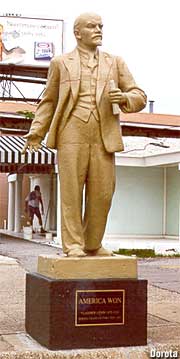
Lenin at Goff's Hamburgers, Dallas (2003)

Lenin does Dallas

No rational person would believe Texas Republicans would call for Marxist economics to be taught in Texas high schools, not even as a part of a “teach the controversy” movement.

The one-semester economics class does not lend itself to giving students backgrounds in economic models that compete with the consensus, free-market view, and even if it did, Marxism would be way down the list of what most Texans would think appropriate to teach. For illustration, consider that when the Soviet Union broke up, a Soviet-produced statute of Lenin was purchased by a Dallas hamburger magnate, placed outside one of his outlets with a plaque commemorating the Cold War, and noting: “America won.” (Alas, Goff’s is gone, as is the statue.)

So, either the Texas Republicans have gone non-rational, or they just were not thinking when they put in their party platform a requirement that alternative theories and their controversies be taught, in social studies.

Confused yet? Tony Whitson at Tony’s Curricublog explains:

But why is this provision regarding social studies tucked into the platform point on “Theories of Origins”? Apparently it reflects an agenda that includes teaching from a creationist standpoint not only in science, but in social studies and other subjects as well.

Someone who’s familiar with curriculum conflicts over recent years will recognize the entire education section of the platform as coming chapter and verse from Phyllis Schlafly’s Eagle Forum. The agenda they are pushing here is not something home-grown in Texas, but an agenda that we can expect to see being advanced all over the United States.

Well, Texas politics being what it is, the likelihood that a plank from any party’s platform could make it into law is a bit remote right now. And it seems clear that the intent was to go after science and evolution, not economics. Udall’s Law of Unintended Consequences says such efforts will produce unexpected and undesired results, and here we have a good case in point.

People are gearing up for fights on history and biology texts in Texas — economics, too? Ouch.


More on Nobel to Grameen Bank

October 18, 2006

The Peace Nobel pleased and surprised a lot of fans of Grameen Bank and Muhammad Yunus. Here is a post that poses an interesting and encouraging question, “Can a man make a difference in the world with just 27 dollars?” The post features several links to other comments.

How long before the backlash against microlending begins to be heard? Five, four, three, two . . .


Friedman’s irony: Public schools work

October 14, 2006

Much checking yet to do, but one ironic result show up in anecdote, at least. Milton Friedman’s advocacy for vouchers may not be borne out even in the economics Nobel winners. Edmund Phelps, it appears so far, attended public schools near Chicago, in Friedman’s back yard.

Milton Friedman, the eminent Nobel-winning economist from the University of Chicago, author with his wife Rose of the best-seller that fueled much of the intelligentsia of the Reagan movement, Free to Choose (which was made into a television series for PBS), has long been an advocate for vouchers from public schools. Friedman argues that a dose of competition would be good for public schools, and the ability of students to choose to take their voucher to another school would also be good for students.

My belief is that we do not have sufficient data to make predictions that any voucher system would be an improvement. Public education as an American institution is an outgrowth of communitarian spirit coupled with strong need and strong desire for better-educated people to drive the economy; this spirit and these needs provided demand for education which could not be filled by private enterprise. Public education is, in my opinion, already the market response to consumer demand.

But data are difficult to parse out — not much was collected in the U.S.’s western expansion, we may not be collecting the right data now. So we argue from anecdote. Friedman’s anecdote’s talk about good private schools. Other anecdotes note public school successes.

Richard Feynman’s autobiography, Surely You’re Joking, Mr. Feynman, covered his public school education in some detail, and it offered me some solid anecdotes for policy discussion when I was higher in government. Feynman won the Nobel in 1965 (Physics), was a genius, and also a product of the public schools. A quick survey of U.S. Nobelists shows most of them are also products of public schools. Since then I have watched with a one eye open the announcements of Nobels, wondering whether this trend will change in my lifetime.

So far, no change. The Nobel press packages and official biographies generally lack information about primary and secondary schools of winners. Digging is necessary. Phelps’ biographies are no exception. I finally got something close to an answer from a .pdf rendering of a chapter from The Makers of Modern Economics, Vol II, Arnold Heertje, ed. (1995, Edward Elgar Publishing Co., Aldershot, UK, and Brookfield, US), linked from Phelps’ biography page at Columbia.

Phelps was born in 1933, a Great Depression baby. Both of his parents lost their jobs ultimately. Although he was enrolled in a kindergarten for the gifted, there is no indication that he attended private schools.

If you have contrary and correcting information, please send it.

Friedman makes a good case, but it is a case that I find to be lacking in data. Even, perhaps especially, among the Nobel winners including economics, public school alumni win a disproportionate share of awards. There are all sorts of problems with the data to project trends, but there are few contrary data that I can find. Even with problems in data accounted for, public schools look good.

One problem is whether such data have any correlation at all to today’s public schooling. We may not know for 40 years whether the radical experimentation in standardized testing and other changes shepherded by the federal government will have any effect.


Private schools are a waste of money?

October 13, 2006

I’m pondering this interesting blog, with this provocative post: Stumbling and Mumbling.

Are private schools a waste of money?


More information on Edmund Phelps, Nobelist in economics

October 13, 2006

His Wikipedia entry is said to be small, but should grow soon:  Here is information on Edmund Phelps, who won the Nobel for economics late last week, with links to a lot more.

Producct of the public schools?  Does anyone know for sure?  He grew up in Evanston, Illinois.


Two Nobels in economics? Grameen Bank wins peace prize

October 13, 2006

Muhammad Yunus, photo by P. Rahman/Scanpix

MuhammadYunus and Grameen Bank share the Nobel Prize for Peace.

Wow. Just wow.

The Nobel Peace Prize for 2006

The Norwegian Nobel Committee has decided to award the Nobel Peace Prize for 2006, divided into two equal parts, to Muhammad Yunus and Grameen Bank for their efforts to create economic and social development from below. Lasting peace can not be achieved unless large population groups find ways in which to break out of poverty. Micro-credit is one such means. Development from below also serves to advance democracy and human rights.

Muhammad Yunus has shown himself to be a leader who has managed to translate visions into practical action for the benefit of millions of people, not only in Bangladesh, but also in many other countries. Loans to poor people without any financial security had appeared to be an impossible idea. From modest beginnings three decades ago, Yunus has, first and foremost through Grameen Bank, developed micro-credit into an ever more important instrument in the struggle against poverty. Grameen Bank has been a source of ideas and models for the many institutions in the field of micro-credit that have sprung up around the world.

Every single individual on earth has both the potential and the right to live a decent life. Across cultures and civilizations, Yunus and Grameen Bank have shown that even the poorest of the poor can work to bring about their own development.

Micro-credit has proved to be an important liberating force in societies where women in particular have to struggle against repressive social and economic conditions. Economic growth and political democracy can not achieve their full potential unless the female half of humanity participates on an equal footing with the male.

Yunus’s long-term vision is to eliminate poverty in the world. That vision can not be realised by means of micro-credit alone. But Muhammad Yunus and Grameen Bank have shown that, in the continuing efforts to achieve it, micro-credit must play a major part.

Oslo, 13 October 2006

It’s one thing to talk economics, another to go do it. Here’s to hoping this award will encourage others to act effectively to end poverty.

More coverage:


All-American Nobels: Economics, too

October 9, 2006

Edmund Phelps of Columbia got the Economics Nobel today.  Almost certainly the literature prize will not go to a U.S. candidate, nor the prize for peace.


Another view of economics

October 7, 2006

I would dearly love to have Michael Perelman’s views on teacher pay and teachers’ unions. Perelman is an economist at California State University at Chico who does not mince opinions. His blog is called Unsettling Economics.

He doesn’t post a lot. Maybe he should post more.


Education reform clips, and “new math” for vouchers

October 7, 2006

Interesting bunch of clips on education reform.

At Homeland Stupidity, a poster named Dana Hanley wonders if Bush is really proposing that we model our schools after China’s and India’s schools.

Hanley is direct:

There has been a 52% increase in spending on the key provision and an unprecedented amount of federal control taken over education. And all we have to show for it is trends that were evident before the act took effect? It isn’t worth the cost and it certainly isn’t worth the loss of our state’s rights in education.

Hanley writes strongly on the “qualified teacher” provisions of the “No Child Left Behind” Act, too. Read the rest of this entry »