Geography education vs. geography learning

January 29, 2010

Angst over the state of education never goes away:

Much more important is the way we seem to have turned away from the very idea of education that sustains a healthy, vibrant liberal democracy.  As I write this I am conscious of how unfashionable it sounds. However, there has been a steady erosion of the notion that education can and should fuel our individual ability to think critically about the world as we find it – which requires knowledge and understanding of how the world has come to be. We are swamped with a language of targets, skills and 21st century ‘learning to learn’, but have forgotten what it is that distinguishes learning (a word that now seems to carry huge weight and always deemed a good thing in itself, when clearly it is not) from education.  All worthwhile education is, in the end self-education, based on the student’s curiosity, their need to know and readiness to rise to the challenge of finding out. Indeed, offering challenge to young people is one way to motivate them – so different from today’s orthodoxy which says we should make learning accessible, bite-sized and achievable by all.

These guys write from England, however, and they write from the vantage point of teaching geography and having just published their book on how better to teach geography.

See their take on what geography teachers should be teaching about Haiti right now.


More schools jump on “no-recess” recess bandwagon

January 29, 2010

How long will the madness persist?

Via Lenore Skenazy at Free-Range Kids comes word that MommaLou has a meeting to find out why her kid’s school wants the kids to spend recess time engaged in something other than recess.

Excuse me?

They aim to “change the perception of recess from free time away from learning to a valuable learning experience that will teach them and will help them cope in all social settings and environments. When children view recess as “free time” they have a tendency to act in a less responsible manner and push the limits of irresponsible behavior. In order to change the perception of recess, children must see that its content is respected and valued.”

The absolute best memories I have of my childhood consisted of me and my sister on the loose in our backyard making mud pies and playing “lost kids”. When I was in college studying early childhood education, I spent countless hours in classrooms learning about how kids learn. Kids learn through play. They just need the resources. The tools. And time.

Well, yeah, that’s what recess is all about, isn’t it?

Kids need recess to stay healthy, the studies show. Recess keeps them healthy.  In my corporate consulting, we counseled managers to provide recess.  Creativity and corporate problem solving experts, like Dr. Perry W. Buffington, recommend business people take a recess and get away from work for a while when things get tense, or when problem solvers get dense.  In one session I watched with Buffington, one manager didn’t get it and kept coming up with all sorts of things to do to avoid taking a recess.  Buffington finally spelled it out for him:  Get away from the office; make sure that the activity is AWAY from the building . . .

Heck, do they have an “organizational health” survey at that school?  The teachers need recess for the kids, too.

Recall these resources from my earlier post:

Nota bene: Even just a little movement worksIt works for adults, too.

Resources:

  • PEDIATRICS Vol. 123 No. 2 February 2009, pp. 431-436 (doi:10.1542/peds.2007-2825) (subscription required for full text),  “School Recess and Group Classroom Behavior,” Romina M. Barros, MD, Ellen J. Silver, PhD and Ruth E. K. Stein, MD, Department of Pediatrics, Albert Einstein College of Medicine, Children’s Hospital at Montefiore and Rose F. Kennedy Center, Bronx, New York

    OBJECTIVES. This study examines the amount of recess that children 8 to 9 years of age receive in the United States and compares the group classroom behavior of children receiving daily recess with that of children not receiving daily recess.

  • See this year-old post at The Elementary Educator
  • Post in agreement from the venerable Trust for Public Lands, one of the best and best respected non-profits in America

Also, be sure to see this post from Ms. Cornelius at A Shrewdness of Apes.  If you’re having difficulty telling the difference between school and a prison — or if your school kid is having that difficulty, it’s time to act.

Cartoon - lawyers still get recess.  Andertoons

Via doxpop.com. See Andertoons.com, and buy it for your newsletter.


More good rap for the schoolroom: Keynes vs. Hayek

January 26, 2010

This is really good.

It’s a pretty good rundown of the fight between Keynes and Hayek, conducted mostly after Keynes’ death in economics classrooms and central banks world wide.

Watch it, and hope for more soon, at Econstories, the blog of the guys who created the thing, John Papola and Russ Roberts.

Resources:


iPhone apps for a three-year-old’s education? What hath Steve Jobs wrought?

January 22, 2010

You gotta admire the bravery of this guy, who came to fatherhood a little late (he claims), and struggles with the fatherliness expectations of a precocious child:

When my wife returned [from a vacation], we settled back into our routine, consisting of 1-2 days per week when we eat dinner out as a family. These events can also be challenging, as our daughter is one of those kids who just cannot sit still for anything. She seems well connected to her surroundings and engages with us and others, but she is perpetual motion personified. So imagine my surprise when the littlest tornado actually sat in her chair for an entire meal!

My wife’s new secret weapon was a series of iPhone apps created especially for toddlers that one of her California girlfriends had recommended. The most popular with our daughter is Letter Tracer, which works as the name suggests. So my daughter was occupied by learning to write her letters. The device and screen provided the engagement that pen and paper hadn’t, and she delighted at being able to successfully trace all the letters of the alphabet, smiling and exclaiming “Look Daddy, I did it!” each time she completed a new tracing. My daughter was having a blast learning how to write her letters, and her parents were enjoying not just her growth but a nice restaurant experience as well.

So, he got his daughter a de-activated iPhone.  Seriously.

I’d love to see what Checker Finn would have done in that situation, or Diane Ravitch, or even dear old B. F. Skinner.

Is three too young to get your own iPhone?

Go read the piece.  Patrick Hunt at The Apple Blog, “I Gave My Daughter an iPhone – Have I Created a Monster?”

The discussion is good, too.  Why can’t this guy be our tech director, in a district where getting technology is like asking for a French dictionary at Republican Party HQ?


Bill of Rights Institute cosponsors prize for National History Day

January 21, 2010

I get e-mail:

THE BILL OF RIGHTS INSTITUTE SPONSORS NATIONAL HISTORY DAY PRIZE
Students nationwide can compete for the Constitutional Rights in History prize

The Bill of Rights Institute announced their collaboration with National History Day (NHD) today. The Institute is sponsoring the Constitutional Rights in History prize, awarded to an outstanding entry in any category from both the senior and junior divisions which documents and analyzes how individuals have exercised their constitutional rights throughout American history.

The 2010 theme for National History Day is “Innovation In History: Impact and Change.” Students must demonstrate through their project how their chosen individual’s actions had an impact on history.

Each year more than half a million students, encouraged by thousands of teachers nationwide, participate in the NHD contest. Students choose historical topics related to a theme and conduct extensive primary and secondary research through libraries, archives, museums, oral history interviews and historic sites. The Bill of Rights Institute’s prize will be awarded at the National Finals held in June 2010 in College Park, Maryland.

For more information about History Day, go to http://www.nationalhistoryday.org/.

© 2010 Bill of Rights Institute
200 North Glebe Road, Ste 200
Arlington, VA 22203


Texas social studies standards: Beware the ides of January

January 15, 2010

News reports in Texas this morning said that several of the right-wing, gut-education-standards changes proposed to social studies standards had failed in voting on Thursday, January 14.  But, much more was to be done, and the SBOE adjourned early last night to continue voting today.

In a pattern familiar to education advocates in Texas, board member Don McLeroy (R-Pluto) today proposed a long series of amendments, apparently off-the-cuff, but probably written up in earlier strategy sessions.  These last-minute amendments tend to pass having missed any serious scrutiny.

Will he be able to ruin Texas education for the next decade?  I cannot follow the live webcasts; Steve Schafersman is working to stop the amendments, rather than merely blog about them.  We probably won’t know the extent of the damage for weeks.  McLeroy cherishes his role as a Port-au-Prince-style earthquake to Texas education. (Pure coincidence, I’m sure — Ed Brayton summarizes McLeroy’s politics today.)

Watch that space, and other news sources.  I may provide updates here, as I can get information.


Texas Navy supports honest history in Texas schools

January 15, 2010

John Mashey was too shy to raise the question in a thread, but he e-mailed me asking about the witness list for the hearing before the Texas State Board of Education on social studies standards:  “Texas Navy?” he asked.

Two witnesses listed their affiliation as “Texas Navy.” Edwin Greiner and Dick Brown, both admirals in the Texas Navy, were scheduled to testify early on Wednesday afternoon.

Now, a Nebraska or Utah Navy might not make a lot of sense, since both of those states are landlocked.  Texas needed a navy in the past, and at least twice, ships were commissioned and sailed for Texas, in 1835 and 1837.

In 1958, Texas Governor Price Daniel re-activated the Texas Navy with the purpose of “assuring the survival of Texas’ Naval history, boundaries, water resources, and for the civil defense of Texas.”  In 1973, the Texas Legislature authorized the charter of the Texas Navy Association, Inc., as the official body to oversee the operation of the Texas Navy.

Recruiting poster for Texas Navy

Click here to join the Texas Navy

You can join the Texas Navy.  Both the men listed on the witness list claim rank of Admiral, which is not a position one attains merely by joining — so we might conclude they have done something in the past to merit the promotion.

Consider joining.  Your membership will help preserve the history and tradition of the Texas Navy.  And — who knows? — you may want to testify to the Texas State Board of Education some day.  It looks like they’ll bump you to the first of the list, if you’re a member of the Texas Navy.

(Does anyone know what these Texas Navy officials told the SBOE?  Anyone have a copy of their testimony?  I’ll check with Steve Schafersman at Texas Citizens for Science to see if he knows . . .)


Social studies train wreck at Texas State Board of Education: Live! A Nation at Risk

January 13, 2010

Steve Schafersman will live blog the hearings on social studies standards before the Texas State Board of Education (SBOE) today, at Evo-Sphere.  Schafersman is president of Texas Citizens for Science, and a long-time activist for better education in Texas on all topics.

Rapid updates or live-blogging should be available at the blog of the Texas Freedom Network, TFN Insider.

It’s Item #6 on the SBOE agenda, with a title that tips off the trouble:

Item #6 — Public Hearing Regarding Proposed Revisions to 19 TAC Chapter 113, Texas Essential Knowledge and Skills for Social Studies, and Chapter 118, Texas Essential Knowledge and Skills for Economics with Emphasis on the Free Enterprise System and Its Benefits.

Schafersman e-mailed an introduction to the meeting:

Some say the Social Studies public testimony by the religious right, liberals, etc., then the SBOE debate, motions to amend, votes, etc. is a bigger circus than adopting the science standards. Judge for yourself. You can watch the entire circus, carnival, and sideshow on the webcast video at http://www.texasadm in.com/cgi- bin/tea.cgi

This is Texas democracy in action, when sullen and tight-lipped State Board members listen to public testifiers for 3 minutes each and profoundly ignore them since they already know what they are going to do. But I, at least, feel better after speaking so I don’t later feel responsible for the crappy amendments, changes, and policies that come out of this horrible Board because I did nothing. The proposed Social Studies standards written by the panels composed of teachers and professors are excellent (when have I heard this before), but the SBOE can’t wait to shamelessly impose their own Religious Right agenda on them.

You’ll recall that SBOE has at every possible turn disregarded the advice of famous and serious historians, respected free-market-advocating economists, geographers and educators on these standards.  Economists, for example, want Texas kids to learn about “capitalism,” since that’s what it’s called by economists and policy makers, and colleges.  SBOE thinks “capitalism” sounds too subversive, and wishes instead to require Texas kids to learn about “free enterprise” instead.

‘A rose by any other name’ you think, until you start thinking of how Texas kids do on standardized tests, college admission exams, and the punchline on the joke, about Texas kids being told not to study capitalism.  No siree, no capitalism in the fictional home of J. R. Ewing, never mind the real-life capitalists like T. Boone Pickens or H. Ross Perot (Jr. and Sr.).

In Dallas, the city prepares to name a street after Cesar Chavez, the great Hispanic union organizer and advocate for working Americans.  In Austin, SBOE works to strike all mentions of Chavez, because they dislike the politics of heroes of our ethnic minorities (soon to be a majority in Texas).  In Washington historians and policy-makers follow the legacy of Thurgood Marshall, the great civil rights attorney and first African-American to sit on the U.S. Supreme Court.  In Austin, SBOE thinks Marshall should be left out of history books.  Many of us suspect he’s anathema to the white right-wing in Austin:  A smart, successful and noble man of color.

Mel and Norma Gabler died years ago, but their history lingers in the halls of education policy in Austin.  It’s Shakespearean.

This is a massive battle.  David Barton worked for 30 years to gut history standards nationally to teach a history of America that never was, and as the official religionist appointee of the right-wing SBOE members, he stands on the brink of accomplishing much of the revisionism he’s advocated.  See the Texas Tribune story on the issue, “Hijacking History.”

Generally we shouldn’t negotiate with terrorists, Ronald Reagan said.  At the SBOE, we’ve put the terrorists in charge of history and economic curricula — if not the terrorist themselves, at least the terrorists’ camels’ noses.  Texas’s process has earned flashing red-light, claxon-sounding repeating of the words of Ronald Reagan’s Commission on Excellence in Education:  If a foreign nation did this to us, we’d consider it an act of war [excerpt below the fold].

Make no mistake about it.  SBOE’s goal is to roll back any of the reforms left from Reagan’s Commission’s work.  Our nation is more at risk from foreign competition than ever before.  SBOE plans to give away a bit more of our future to China, this week.

Our saving grace is the general incompetence of SBOE members to make significant reform in Texas’s wounded schools, reeling from unworkable and damaging requirements under the No Child Left Behind Act and a testing program that severely limits what can be taught in any social studies course other than those bastions of learning left in International Baccalaureate programs and Advanced Placement courses (estimates are that between 5% and 10% of Texas high school students can take one of those good courses).  Whatever silliness, craziness or lies SBOE orders to  be taught, it can’t be taught and tested well.  Inertia preventing change works to save America in this case.

In business, most CEOs at least appreciate the value of having good front-line employees who are the ones who really deliver the service or product and produce the profit of the enterprise (even if they don’t treat those employees so well as the employees deserve).  Education may be the last bastion of flogging the horse that should be pulling the cart instead.  In this case, having well-trained teachers in the classroom is the last hope for Texas, Texas parents and Texas students — and Texas’s economic future and future in liberty.  Teachers are the last defense of freedom in Texas.  Today SBOE will make another assault on the ramparts that protect the teachers in their work.

When will the French fleet arrive to lend aid?  Will it arrive at all?  And if it arrives, will Texas kids know better than to shoot at the ships?

Carol Haynes, who claims to have a doctorate in some discipline, told the board how to rewrite the standards to completely change the history of the civil rights movement in their last hearing on the topic.  According to Haynes, apparently, Dr. Martin Luther King, Jr., was opposed to civil rights and Barry Goldwater was in favor — the Board didn’t offer to correct her revisionism, but instead asked her to go beyond her three minutes in fawning acceptance. This appears to be SBOE’s approval of various Other Universe hypotheses offered by Star Trek, allowing any damned thing at all to be taught as history (except the right stuff).  Haynes is scheduled to testify again (#128), probably very late at night, but perhaps in time for the 10:00 p.m. Texas television news broadcasts.  Oy.

Excerpt from the Report of the Commission on Excellence in Education, A Nation at Risk, below the fold.
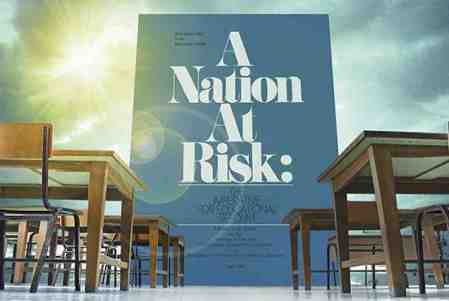
ae_summer2015mehta_opener-1100x736

Cover of A Nation at Risk: The Imperative for Educational Reform, the 1983 report that started the education reform mess. AFT graphic.

Stand up for your nation, it’s children and future; sound the alarm:

Add to FacebookAdd to NewsvineAdd to DiggAdd to Del.icio.usAdd to StumbleuponAdd to RedditAdd to BlinklistAdd to TwitterAdd to TechnoratiAdd to Furl


Read the rest of this entry »


Good education, or right-wing propaganda: War on Education battle in Austin, Texas

January 13, 2010

In a post titled “The Battle Joined,” the Texas Freedom Network repeated for us the press release from their Tuesday press conference at the Texas Education Agency, about the hearings on social studies standards, graduation requirements and other issues in Austin this week.

Watch that space (see also this explanatory piece) and this space, and your non-faux news outlets.

The Texas Freedom Network sent out the following press release after our press conference this morning at the Texas Education Agency:

The state’s leading religious liberties group today joined with clergy and scholars in calling on the State Board of Education to approve new curriculum standards that don’t undermine religious freedom in Texas social studies classrooms.

“Curriculum writers have drafted proposed standards that rightly acknowledge the influence of faith on the Founders and in our nation’s history,” Texas Freedom Network President Kathy Miller said today. “But those writers also respected religious freedom by rejecting political pressure to portray the United States as favoring one faith over all others. Doing otherwise would aid the teaching of bad history and promote something that is fundamentally un-American.”

Miller spoke in advance of a Wednesday public hearing on proposed new social studies curriculum standards. Teachers, academics and community members from around the state have spent the last year crafting the new standards. Publishers will use the standards to write new textbooks scheduled for adoption by Texas in 2011. The state board will debate the standards drafts on Thursday and has scheduled a final vote in March.

Derek Davis, dean of humanities and the graduate school and director of the Center for Religious Liberty at Mary Hardin-Baylor University, a Baptist institution in Belton, called on the board to respect the work of teachers and other experts who helped write the new standards.

“Religious liberty stands as one of our nation’s bedrock principles,” Davis said. “Yet it seems always under siege by those who fail to appreciate the astute thinking of the founding fathers that caused them to write into the Constitution the principle that guarantees religious liberty: the separation of church and state. This distinctly American value continues to set our nation apart from those embroiled in religious conflict in the rest of the world.”

Miller and Davis were joined at a press conference by the Rev. Marcus McFaul of Highland Park Baptist Church in Austin and Steven Green, a professor of law and of history and director of the Willamette Center for Religion at Willamette University in Salem, Oregon.

“The instruction of religious faith, discipleship, and a life of service and piety is the responsibility of each faith community, whether church, synagogue or mosque,” Rev. McFaul said. “It is the responsibility of parents and parishes, not public schools. We all note – as the curriculum writers did – the role and influence of religion in American history, but not to advance, promote or seek advantage for any particular religion’s point of view.”

The state board has revised curriculum standards for language arts and science over the past two years. In both cases the board either threw out or heavily revised standards crafted by curriculum writing teams that included teachers, curriculum specialists and academic experts. Last year, for example, creationists on the state board pushed through science standards that call into question long-established scientific evidence for evolution.

“This is not a good way to make sound education policy,” Miller said of the board’s habit of rejecting the work of teachers and experts. “It’s past time that state board members stop playing politics with the education of Texas children, respect the hard work teachers and other experts have put into writing standards, and acknowledge that experts – not politicians – know best what our children need to learn.”

Educate somebody else on this issue:

Add to FacebookAdd to NewsvineAdd to DiggAdd to Del.icio.usAdd to StumbleuponAdd to RedditAdd to BlinklistAdd to TwitterAdd to TechnoratiAdd to Furl


Schafersman’s testimony on social studies standards, to Texas SBOE

January 13, 2010

Dr. Steve Schafersman will testify on proposed new standards for social studies in Texas public schools, at a hearing before the Texas State Board of Education (SBOE) scheduled for today, January 13, 2009.

Schafersman is president of Texas Citizens for Science and its driving force.  He’ll also live blog much of the hearing at his blog, Evo-Sphere.  You should probably watch TFN Insider, the blog of the Texas Freedom Network, too.

Schafersman’s testimony was released in advance, and reprinted below.

Public Testimony of
Steven D. Schafersman

Texas State Board of Education Public Hearing
Austin
, Texas; Wednesday, 2009 January 13

I am grateful for the opportunity to address you about Social Studies standards for which I am testifying as a private citizen. Tomorrow you will begin your work to adopt the new Social Studies TEKS. I closely read and evaluated the proposed Grade 8 Social Studies, High School U. S. History, U. S. Government, World History, and World Geography standards and found them to be quite satisfactory. The standards were extremely comprehensive, balanced, fair-minded, and honest. The members of the panels who wrote them did an outstanding job and I was very impressed by their knowledge and professionalism. I urge that you adopt these Social Studies standards without change.

My experience with this Board leads me to suspect that some of you don’t want to adopt these excellent standards–written by social studies curriculum experts and teachers–without change. After all, these standards were written by experts and some of you feel obliged to stand up to the experts. Some of you may want to change some of the standards to correspond to your own political and religious beliefs, such as the mistaken notions that the United States is a Christian nation, that we do not have a secular government, or that separation of church and state is a myth. Some of you may want to add more unnecessary information about Christian documents or Christian history in America. If some of you do wish to make such changes, I request that you restrain yourselves. Please resist the temptation to engage in the same behavior some of you exhibited last year when you perverted the Science standards and embarrassed the citizens of Texas by engaging in pseudoscientific anti-intellectual behavior. While the Texas State Board of Education has a long and proud history of anti-intellectualism, the economic conditions today demand that we stop that practice and return to professionalism and respect for academic achievement so that our children have a future in which they will use their minds to make a living in intellectual pursuits and not their limbs in a service economy.

During the adoption of the science standards, some Board members amended the Biology and Earth and Space Science standards by engaging in fast talking, omitting pertinent information about what was being changed, offering bogus “compromises” that were not really fair compromises, and referring to “experts” who were in fact pseudoscientists and not real experts at all. I hope to not witness the same behavior tomorrow but I am pessimistic. Two pseudo-historians, David Barton and Peter Marshall, were appointed as “experts” and there is plenty of evidence available that demonstrates that these two gentlemen are preachers and polemicists for their radical agendas, not legitimate history experts.

I urge the rational and conservative Board members–whom I hope still make up a majority of this Board–to resist proposed radical amendments that attempt to insert bogus histories of American exceptionalism, America’s presumed Christian heritage as the source of our liberties and Constitutional principles, and other historical myths perpetrated by the American Religious Right. I urge you to vote No to such radical amendments, not Abstain or your radical opponents will gain the same advantage that they enjoyed during the amendment process for the Science standards, where they were delighted when some of you abstained or did not vote since that made it easier for them to obtain majorities which allowed them to win several amendments that made changes detrimental to science education. Unlike last year, when you were prevented from consulting your legitimate Science experts during debate, please consult your genuine Social Studies experts, Texas Professors Kracht, Hodges, and de la Teja. Please try to avoid the same mistakes with the Social Studies adoption process that occurred with the Science standards adoption, so no one will be able to accuse you of being anti-intellectual.


Texas social studies standards: Crisis is now

January 6, 2010

How bad is it?  Washington Monthly features a solid, long story on what is going on in Austin this week and next in Texas social studies standards.  I wish that outstanding publication had a much greater circulation.

Even in Minnesota, P. Z. Myers is concerned:  “Be afraid” he warns his readers.  In comments there, a guy named BlackWolf puts it bluntly:

Once, a guy in a schoolbook storage room was the killer.

Now, the books themselves are becoming dangerous.

You can help.  You can testify next week.  You can send comments.  The Texas Freedom Network can help you be heard.

Please let the State Board of Education know that Texas, and the nation, needs good social studies standards.  As we noted last month, it’s time to stand up for education and social studies:

Make Your Voice Heard at January Public Hearing

The process of revising social studies curriculum standards for Texas public schools is moving into a critical stage. And a public hearing the board has scheduled for January may be the only opportunity for you to speak out against the far right’s efforts to corrupt standards for history, government and other social studies classes.

The final drafts of the proposed standards prepared by writing teams made up of teachers, academics and other community members are reflective of mainstream academic scholarship in the various subject areas. It is clear that members of these writing teams largely resisted intense political pressure from far right, rejecting attempts to remove key civil rights figures and make other politically motivated revisions. (See the Background section at the bottom of this e-mail for a more detailed account of the politicization of this curriculum process.)

But as with science and language arts, far-right SBOE members are already plotting to undo the work of the writing teams of social studies.

Take Action

The State Board of Education so far has scheduled only one public hearing on the proposed standards. That hearing is likely to occur either on January 13 or January 14 in Austin.

If you are interested in speaking at the hearing, please click here. TFN will help you register to speak before the board and be an effective voice against efforts to politicize our children’s classrooms.

This may be the only opportunity the board provides for Texans to speak out on the proposed standards. If we are to prevent far-right SBOE members from turning social studies classrooms into tools for promoting political agendas, then it’s critical that the board hears from people like you! Click here to sign up for more information on how to testify in January.

___________________________________________________

Background on Social Studies Review Process to Date

Earlier this year, TFN exposed and derailed several attempts by the far right to hijack the social studies curriculum revision process. Members of the state board – or their appointees to review panels and writing teams – tried at various times to:

  • Remove civil rights champions like César Chávez and Thurgood Marshall from the standards, calling them poor examples of citizenship
  • Turn Joseph McCarthy – who discredited himself and dishonored Congress with his infamous Red-baiting smear campaign in the 1950s – into an American hero
  • Rewrite history and portray America’s Founders as intending to establish a Christian nation with laws based on a fundamentalist reading of the Bible

Members of the writing teams largely rejected these fringe ideas in the final drafts of the standards they submitted to the board. Chávez and Marshall remain in the curriculum. The American history standards do not whitewash the damaging history of McCarthyism. And under the proposed standards students would still learn that the Founders created a nation in which all people are free to worship – or not – as they choose without coercion or interference by government.

We must ensure that the board adopts curriculum standards that reflect mainstream academic scholarship in social studies. This is vitally important because the results of this decision will be reflected in the next generation of social studies textbooks around the country.

Click here to let TFN know you are willing to testify at the state board.


Texas Tribune and Texas State Board of Education

January 5, 2010

Have you found Texas Tribune yet?  It’s a new, on-line newspaper, and generally it’s terrific.

See their collection of stories already about the State Board of Education. The collection can substitute for at least one cup of coffee to get your blood flowing in the morning.


Global warming politics: ‘Blame the teachers first’

December 29, 2009

Note to teachers: They hate you out there global warming denial land.

Watt’s Up denizens ramble in a state of confusion about how the planet can be warming while local records fall in cold weather.  [Note to Anthony Watts:  Have you explained to your readers that seasons are not governed by CO2 levels, but instead by the tilt of the Earth?]

How to clear up the confusion? Blame it on the teachers.  No kidding.  Here’s the comment from “r”:

r (08:12:32) : [about 62 comments down]

Forget the main stream media. The real roots of this movement, strangely enough, are in grade school and collage teachers.

College teachers are out of touch with the real world. They live in the insulated bubble of academia. They go to school for so long, all they know is school. They never get any experience in the real world of any industry. Therefore, they preach the socialist agenda because it sounds good on paper. The young people they teach do not protest because they don’t know any better yet. Their parents continue to give money to these colleges because they have no idea what their children are actually learning.

Grade school teachers despite having increased course work on classroom management are not required to take many classes in science. They cannot teach science because they don’t understand it themselves. Global warming was introduced to my children through Scholastic Magazine given out at school. The magazine is used as part of the curriculum. The teachers never questioned it. The children were frightened by it and peer pressure keeps anyone from dissenting. The parents are learning about global warming from their children as in 1984.

In fact it is harder for me to protest the fraud of global warming at my own school than it is to protest in the media. I run the risk of alienating myself and my children at school.

If anybody would like to send my schools a note telling them to stop teaching the global warming fraud with reasons why, I would be grateful.

Here are the principal’s emails: Vince.DiGrandi@WappingersSchools.org
Tom.Stella@wappingersschools.org

Perhaps I can do the same for someone else.

Thanks in advance.

Here’s what I recommend:  Send an e-mail to the two people listed above, and congratulate them for offering real science to their students.  Tell them you’ve heard that there is a national campaign to stop them from teaching good science, and that you support them and hope the campaign fails.

Anyone who lies to his kids about science, about the environmental issues we face, about life in general, will indeed alienate themselves from their children, if the children are lucky.  “r” wishes his kids to be taught voodoo science.  Shame on him.

I wonder what “r” thinks of his own teachers.


While I was wrapping: Christmas science

December 25, 2009

Ohh, here’s fun:  Photographing fractals using Christmas ornaments, at Evil Mad Scientist Laboratories:

Fractals photographed in three Christmas tree ornaments, Evil Mad Scientist Laboratories

"Construct complex fractals out of light using a few shiny Christmas tree ornaments. Who says the holidays aren't exciting?"

All you need is a camera and some imagination — oh, and some Christmas ornaments. In this case, four silver ornaments ($5 at Target, the guy says), a piece of Scotch tape, and the colored lights.  The photo above comes from four ornaments, stacked.  Go see how he does it (lots of photos), and check out his Flickr stream.

While your kids ponder the pretty lights and stars on the Christmas tree, why not add a little science in?  According to Carlos Hotta, at  Brazillion Thoughts, “The Universe in a Christmas Tree”:

How about looking at the Christmas tree through the light of this knowledge? Here is some food for thought:

  • We know more planets beyond the solar system than there are Christmas balls on your tree. The current count is at 358 exoplanets, and growing;
  • If the planet was [shrunk] to the size of a Christmas ball, it would be the smoothest ball of the tree. The Mount Everest (8 km) or the Marianas Trenchr (11km) are small imperfections relative to the planet’s 12,000 km diameter. It’s an imperfection of less than 0,01%;
  • “Earth is not spherical, it’s an oblate spheroid”, some Grinch may say. Indeed, our planet wider in the equator, but even this deviation from a perfect sphere is of less than 0,04%;
  • If an 8 centimeters Christmas ball represented Earth and the nearest ball represented the nearest known exoplanet – Epsilon Eridani b, 10.5 light-years away – then the distance between them should be around 630,000 km. Almost twice the actual distance from Earth to the Moon. Epsilon Eridani b is quite far from here
  • Now, if the star at the top of the tree represented our Sun, 1,392,000 km in diameter, and the star at the top of your neighbor’s tree – say, 50 meters away – represented the nerest star system, Alpha Centauri at 4 light-years of distance; then the size of our Sun-star to be on the same scale it would have to be 0,74 micrometers large. From 1,4 million kilometers to more than 100 times smaller than the width of a hair, that’s how small the star should be for it to be in the same scale as the distance between it and the neighbor’s Christmas star.

There’s more — plus the original at 100 Nexos (in Portuguese).


Great news for biology teachers: Neil Shubin released illustrations from Inner Fish for your classroom use

December 25, 2009

Neil Shubin’s Your Inner Fish reads well, and it reveals evolution as easy to understand from a morphological view of life as revealed by fossils and modern animals.

Cover of Your Inner Fish, by Neil Shubin

Shubin released the illustrations from the book for teachers to use — a rather rare and great contribution to evolution.

Here’s where you can download the slides, at the Tiktaalik roseae website: Your Inner Fish: A Journey into the 3.5-Billion Year History of the Human Body – Teaching Tools.

Tip of the old scrub brush to Pharyngula, “Teaching Your Inner Fish.
