Newly found: Teaching Carnival #15

November 3, 2006

Blog post compilations known as “carnivals” continue to proliferate.

I stumbled into this one:  15th Teaching Carnival.  It’s hosted this time by New Kid on the Hallway.

Among other ways it differs from education carnivals, it has a distinct focus on grading and other details of teaching life, this time.


NOW they tell us: Education reform not working

November 2, 2006

Yesterday I wondered about the effect of next Tuesday’s elections on education and education reform.

Last night I discovered the Fordham Foundation published a new study showing that “half of states miss the bus on education reform.”

Say what? One week before the election?

Fordham Foundation’s President Chester E. Finn, Jr., was a high-ranking official in a Republican administration, true, but that was after working closely with Democrat Daniel Patrick Moynihan for years. I doubt the study was published with any intent to affect the election at all.

It’s well worth the reading, though.

A new report from the Thomas B. Fordham Foundation finds that just eight states can claim even moderate success over the past 15 years at boosting the percentage of their poor or minority students who are at or above proficient in reading, math or science.

The study also finds that most states making significant achievement gains-including California, Delaware, Florida, New York, Massachusetts, and Texas-are national leaders in education reform, indicating that solid standards, tough accountability, and greater school choice can yield better classroom results.

“Many state officials have claimed credit for gains in student achievement,” said Chester E. Finn, Jr., the Foundation’s president. “But this study casts doubt on many such claims. In reality, no state has made the kind of progress that’s required to close America’s vexing achievement gaps and help all children prepare for life in the 21st Century. Nor are most states making the bold reforms most likely to change this reality. Real leaders will study these data, then focus on what needs doing, not what’s been done.”

The Fordham Report 2006: How Well Are States Educating Our Neediest Children? appraises each state according to thirty indicators across three major categories: student achievement for low-income, African-American, and Hispanic students; achievement trends for these same groups over the last 10-15 years; and the state’s track record in implementing bold education reforms. (Click here for more information on the indicators and methodology http://www.edexcellence.net/doc/TFR06Methodology.pdf.) A table listing states’ performance in all three categories is at http://www.edexcellence.net/foundation/global/page.cfm?id=388#TFR06fullstategrades.

And, one week before this year’s election, it is not too early at all to start thinking about the next elections, and how to use the results of this report.


Adam Smith’s £20 of fame

November 2, 2006

Adam Smith will replace composer Edward Elgar on the twenty-pound note next spring, according to the Bank of England.

Adam Smith's pin factory example, in a drawing

Adam Smith’s pin factory will also be featured on the new twenty-pound note.

So Smith gets his twenty-pounds of fame, a slight twist on Andy Warhol’s observation that everybody would get 15 minutes of fame in the future.*

The story in the Times Online is actually a much better feature on Adam Smith than is available in most of the high school economics books today. A major failing of the texts: They do not feature stories on the economists who make economics tick. Advanced Placement texts are better, but still there is room for improvement. My experience in the classroom is that the lives of the economists provide inspiration and, quite often, quirky historical anchors that help students understand and recall key points of economics. For most high school economics students, such enrichment comes only with the teacher’s providing it apart from the texts and other state- or district-provided materials.

Read the rest of this entry »


Elections’ effects on education

November 1, 2006

Tuesday’s elections may have little effect in some places, like Massachusetts, but other places may see significant changes due to the changes in legislative personnel (see Texas, where the chairman of the Senate education committee has already been defeated, in the primaries), or due to bond issues or other education-related referenda.

I’ve been out educating, and I’m almost completely out of touch on just what is at stake, where. If you have an education issue pending in your state in one way or another, how about dropping a comment and letting us know?


Chalk it up to art in the name of science

October 26, 2006


Owl, by Chrys Rodrigue

You should read this post. It demonstrates why P. Z. Myers is one of the most-read bloggers in the world — he writes so well, on topics that are so dramatically interesting.

Myers tells an interesting vignette of a professor of gross anatomy who was a wizard of illustration in colored chalk.

Visuals, especially spectacular visuals in color, contribute to the ability of students to learn the material illustrated. Drawing is rapidly becoming a lost art, a victim of too-easy-to-use clipart and Bush’s dour view of education that excludes music, dancing, painting and drawing, anything that might distinguish us from lower animals or otherwise bring delight and insight into human existence (and other factors). How could PowerPoint seriously compare to live art in a classroom?


Presentations are always made better with specific, relevant illustrations. Most people are at least partly visual learners, with about four times as much information going through eyes on illustrations than going through ears hearing a lecture, or eyes reading text. I use a simple tree to illustrate the Constitution, its roots in the consent of the people, its three branches of government, and fruits of liberty and freedom. Students — whether budding lawyers, eager Boy Scouts, or complacent high school kids — get the point, and do well on the exams.

Myers’ tribute to Professor Snider is touching, informative, and inspiring. Where is Professor Snider today?


Free market failure: Electricity deregulation

October 24, 2006

Free markets generally outperform regulated markets — except sometimes.

Deregulation of electricity offered hope of lower electric bills for consumers in the south during the summer, and consumers in the north in the winter. A handful of states pushed through legislation that allows companies to compete in electric rates in a fashion similar to telephone competition: Different services on the same wires.

But electricity deregulation also cut loose the power generating foundation of electrical supply from the customer delivery services. Consequently, customer demand has not played as large a role in the creation of new electrical generation as anyone would have hoped. Many markets in the U.S. today face massive shortages of electrical generating capacity, not because of environmental concerns, but because the finances of deregulation discouraged power plant construction.

David Cay Johnston’s article in the New York Times yesterday details some of the problems: Read the rest of this entry »


Justice and the public schools: Nobel for Andy Fire

October 22, 2006

You know what? It’s not easy tracking down the elementary and high school records of Nobel winners! Most biographies of Nobelists skip from “born in the city of . . .” to “Ph.D. at . . . ” without noting elementary, junior high or high schools. I’ve noted before, I track this issue half-heartedly as a 30-second response to the claim that private schooling is vastly superior to public schooling. Can’t tell that from Nobel winners.

I know Andy Fire, the 2006 Nobel winner in Physiology or Medicine, attended public schools. From the op- editorial in the Daytona Beach, Florida, News-Journal, I know that Fire attended Hollenbeck Elementary School in Sunnyvale, California. I also know he was picked on by bullies. The full story is below the fold. Read the rest of this entry »


89th Carnival of Education

October 19, 2006

At Poor Starving College Student.


Texas Republicans urging Marxism be taught?

October 19, 2006

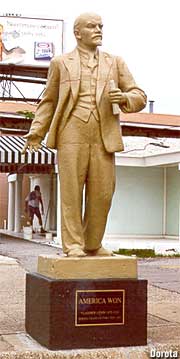
Lenin at Goff's Hamburgers, Dallas (2003)

Lenin does Dallas

No rational person would believe Texas Republicans would call for Marxist economics to be taught in Texas high schools, not even as a part of a “teach the controversy” movement.

The one-semester economics class does not lend itself to giving students backgrounds in economic models that compete with the consensus, free-market view, and even if it did, Marxism would be way down the list of what most Texans would think appropriate to teach. For illustration, consider that when the Soviet Union broke up, a Soviet-produced statute of Lenin was purchased by a Dallas hamburger magnate, placed outside one of his outlets with a plaque commemorating the Cold War, and noting: “America won.” (Alas, Goff’s is gone, as is the statue.)

So, either the Texas Republicans have gone non-rational, or they just were not thinking when they put in their party platform a requirement that alternative theories and their controversies be taught, in social studies.

Confused yet? Tony Whitson at Tony’s Curricublog explains:

But why is this provision regarding social studies tucked into the platform point on “Theories of Origins”? Apparently it reflects an agenda that includes teaching from a creationist standpoint not only in science, but in social studies and other subjects as well.

Someone who’s familiar with curriculum conflicts over recent years will recognize the entire education section of the platform as coming chapter and verse from Phyllis Schlafly’s Eagle Forum. The agenda they are pushing here is not something home-grown in Texas, but an agenda that we can expect to see being advanced all over the United States.

Well, Texas politics being what it is, the likelihood that a plank from any party’s platform could make it into law is a bit remote right now. And it seems clear that the intent was to go after science and evolution, not economics. Udall’s Law of Unintended Consequences says such efforts will produce unexpected and undesired results, and here we have a good case in point.

People are gearing up for fights on history and biology texts in Texas — economics, too? Ouch.


88th Carnival of Education

October 15, 2006

Week after week it just keeps getting better.  Here’s the latest Carnival of Education — there is something there for anyone interested at all in education.

There are many “carnivals” of various types in Blogtopia these days.  This one is among the best.  Plus, it’s on a very important topic.  You’d do well to go see what it’s got this week.


Nobels as a measure of education systems

October 14, 2006

Not so good a measure, most argue.

They’re right, of course. One need only look at the awards of Nobels in the past to people from nations where the education systems were not up to snuff to understand how wildly inaccurate such predictions can be.

Seed Magazine’s on-line version actually has an article discussing the issue: “Precious Medals.” The article concludes most rationally that the U.S.’s success at winning science Nobel Prizes does not in any way, shape or form indicate that we do NOT have a crisis in science education in the nation right now.  That’s good to remember.
By the way: Was Theodore Roosevelt the only man ever to win both the Congressional Medal of Honor, and a Nobel Prize? (He won the Congressional Medal for the “charge up San Juan Hill” in the Spanish-American War of 1898; he won the Nobel Prize for Peace for working out the treaty that ended the war between Japan and Russia, during his presidency (1901-1909)).


Friedman’s irony: Public schools work

October 14, 2006

Much checking yet to do, but one ironic result show up in anecdote, at least. Milton Friedman’s advocacy for vouchers may not be borne out even in the economics Nobel winners. Edmund Phelps, it appears so far, attended public schools near Chicago, in Friedman’s back yard.

Milton Friedman, the eminent Nobel-winning economist from the University of Chicago, author with his wife Rose of the best-seller that fueled much of the intelligentsia of the Reagan movement, Free to Choose (which was made into a television series for PBS), has long been an advocate for vouchers from public schools. Friedman argues that a dose of competition would be good for public schools, and the ability of students to choose to take their voucher to another school would also be good for students.

My belief is that we do not have sufficient data to make predictions that any voucher system would be an improvement. Public education as an American institution is an outgrowth of communitarian spirit coupled with strong need and strong desire for better-educated people to drive the economy; this spirit and these needs provided demand for education which could not be filled by private enterprise. Public education is, in my opinion, already the market response to consumer demand.

But data are difficult to parse out — not much was collected in the U.S.’s western expansion, we may not be collecting the right data now. So we argue from anecdote. Friedman’s anecdote’s talk about good private schools. Other anecdotes note public school successes.

Richard Feynman’s autobiography, Surely You’re Joking, Mr. Feynman, covered his public school education in some detail, and it offered me some solid anecdotes for policy discussion when I was higher in government. Feynman won the Nobel in 1965 (Physics), was a genius, and also a product of the public schools. A quick survey of U.S. Nobelists shows most of them are also products of public schools. Since then I have watched with a one eye open the announcements of Nobels, wondering whether this trend will change in my lifetime.

So far, no change. The Nobel press packages and official biographies generally lack information about primary and secondary schools of winners. Digging is necessary. Phelps’ biographies are no exception. I finally got something close to an answer from a .pdf rendering of a chapter from The Makers of Modern Economics, Vol II, Arnold Heertje, ed. (1995, Edward Elgar Publishing Co., Aldershot, UK, and Brookfield, US), linked from Phelps’ biography page at Columbia.

Phelps was born in 1933, a Great Depression baby. Both of his parents lost their jobs ultimately. Although he was enrolled in a kindergarten for the gifted, there is no indication that he attended private schools.

If you have contrary and correcting information, please send it.

Friedman makes a good case, but it is a case that I find to be lacking in data. Even, perhaps especially, among the Nobel winners including economics, public school alumni win a disproportionate share of awards. There are all sorts of problems with the data to project trends, but there are few contrary data that I can find. Even with problems in data accounted for, public schools look good.

One problem is whether such data have any correlation at all to today’s public schooling. We may not know for 40 years whether the radical experimentation in standardized testing and other changes shepherded by the federal government will have any effect.


Private schools are a waste of money?

October 13, 2006

I’m pondering this interesting blog, with this provocative post: Stumbling and Mumbling.

Are private schools a waste of money?


Hard Work (and cheating)

October 7, 2006

Good and careful consideration of cheating in school, especially with regard to different disciplines in college, in a post at Aude Sapere*. That post is well written, very thought provoking, and well worth the time one might spend on it. The figures are depressing, generally, but reflect a general view we hear from students too often — in an era when top government officials cheat to get what they want (think: why did we invade Iraq?), students often test to see whether we can detect their cheating, and to see what we’ll do about it.

The grand mystery to me is this: It’s generally more time consuming, and more difficult, to try to cheat, than it would be to learn the material well enough to pass my exams; why bother to cheat? The day that light dawns on a student is always a good day.

I am hopeful that part of the rise in confessed cheating is due to an increased sense of just what cheating is. Borrowing quote cards from a debate colleague is considered required sharing; using those same quote cards to put together a paper for another class — is that over the line? (I don’t regard it as cheating, but I’d be interested in hearing if you do.) Do today’s students consider that forbidden? Are today’s students more moral?

Short essays are a good way to get around most cheating, but short essays create grading nightmares that grow exponentially with the number of students.

What’s the solution?

Another blog takes a look at Florida legislation which, to me, is part of the cheating problem. Tony Whitson at AAACS Matters! calls for action against the Florida law which aims to avoid “interpretation” in teaching history, but which also dabbles in changing the facts of nature for biology study, and generally tends to politicize public school curriculum.

It seems to me that the Florida legislature is doing the same thing high school cheaters hope to do — when the facts are difficult or troubling, change them. High school kids can’t change certain facts of history that they do not want to bother to learn, but legislatures, with a great finger in the eye of history, learning and democracy, can try.

And, if presidents and state legislators can play fast and loose with the facts, why shouldn’t a high school student at least try to do the same? If our kids watch what we do, and not what we say, we may be in for several years of increased cheating.

    . .

* Aude sapere is Latin, a line from Kant; it means “dare to know.” I posted it over my classroom door for three years; only a few students ever asked about it. Each of them subsequently took up Kant’s challenge, either continuing their quest for knowledge in history or economics, or more often, taking up such a quest for the first time.


Nobel successes hide science education problems

October 6, 2006

U.S. scientists swept the Nobel prizes in science this year — in Medicine or Physiology, in Chemistry, and in Physics. I noted earlier that I suspected most Nobel winners this year would, again, be products of public schools. (I have not yet got biographies of each winner to confirm that.)

Beneath the successes at the top simmers a lot of pending gloom, however. P. Z. Myers at Pharyngula points to concerns among science educators about a huge gap between our top achievers and the rest of us. He cites an Associated Press story, and it in turn calls up the 2002 survey by the National Science Foundation that found woeful ignorance of basic science stuff among U.S. kids and adults.

Basic research and practical applications of science drove U.S. economic achievement through the end of the 19th century and through most of the 20th century. China and India far outpace the U.S. in producing new engineers today, however, and European research centers simply have greater scientific capacity in many areas, especially since the end of the plans for a U.S. superconducting supercollider particle accelerator, more than a decade ago.

Rhodes Scholar, former U.S. Senator, NBA and NCAA basketball all-star Bill Bradley once said that it’s easier to get to the number 1 position than it is to stay there. The ascendancy of the U.S. in science and engineering achievement occurred decades ago. Without serious, planned work to stay there, some other nation will take over the lead in each area of science, probably within the next 20 years — perhaps within the next decade.

I’ll try to find links, but my memory brings up a couple of studies that show that in 4th grade, U.S. kids are at the head of the pack in science achievement. By 8th grade, they start to fall behind the leaders. By 12th grade, U.S. kids are far behind almost all kids in other industrialized nations. Something we do wrong between 4th grade and 12th grade is sapping the competitive ability of the nation. We need to fix it.

Dr. Myers has some suggestions well worth considering.