Associated Press 1941 file photo of a small boat assisting in rescue of Pearl Harbor attack victims, near the U.S.S. West Virginia, as the ship burns.
Today is the 65th [67th] anniversary of Japan’s attack on the U.S.’s Pacific Fleet at Pearl Harbor, Hawaii.
Our local newspaper, The Dallas Morning News, has a front-page story on survivors of the attack, who have met every five years in reunion at Pearl Harbor. Today [2006] will be their last official reunion. The 18-year-olds who suffered the attack, many on their first trips away from home, are in their 80s now. Age makes future reunions impractical.
From the article:
“We’re like the dodo bird. We’re almost extinct,” said Middlesworth, now an 83-year-old retiree from Upland, Calif., but then – on Dec. 7, 1941 – an 18-year-old Marine on the USS San Francisco.
Nearly 500 survivors from across the nation were expected to make the trip to Hawaii, bringing with them 1,300 family members, numerous wheelchairs and too many haunting memories.
Memories of a shocking, two-hour aerial raid that destroyed or heavily damaged 21 ships and 320 aircraft, that killed 2,390 people and wounded 1,178 others, that plunged the United States into World War II and set in motion the events that led to atomic bombings of Hiroshima and Nagasaki.
“I suspect not many people have thought about this, but we’re witnessing history,” said Daniel Martinez, chief historian at the USS Arizona Memorial. “We are seeing the passing of a generation.”
Another article notes the work of retired history professor Ron Marcello from the University of North Texas, in Denton, in creating oral histories from more than 350 of the survivors. This is the sort of project that high school history students could do well, and from which they would learn, and from which the nation would benefit. If you have World War II veterans in your town, encourage the high school history classes to go interview the people. This opportunity will not be available forever.
There is much to be learned, Dr. Marcello said:
Dr. Marcello said that in doing the World War II history project, he learned several common themes among soldiers.
“When they get into battle, they don’t do it because of patriotism, love of country or any of that. It’s about survival, doing your job and not letting down your comrades,” he said. “I heard that over and over.”
Another theme among soldiers is the progression of their fear.
“When they first got into combat, their first thought is ‘It’s not going to happen to me.’ The next thought is ‘It might happen to me,’ and the last thought is ‘I’m living on borrowed time. I hope this is over soon,’ ” Dr. Marcello said.
Dr. Marcello said the collection started in the early 1960s. He took charge of it in 1968. Since Dr. Marcello has retired, Todd Moye has taken over as the director.
October 31 hosts several famous anniversaries. It is the anniversary of Nevada’s statehood (an October surprise by Lincoln for the 1864 campaign?). It is the anniversary of the cleaving of western, catholic Christianity, as the anniversary of Martin Luther’s tacking his 95 theses to the door of the church in Wittenburg, Germany in 1517, the formal start of the Reformation. Maybe the original Christian trick or treat.
U.S.S. Reuben James sinking, October 31, 1941 - National Archives photo
October 31 is also the anniversary of the sinking of the World War I era Clemson-class, four-stack destroyer, U.S.S. Reuben James, by a German U-boat. Woody Guthrie memorialized the sad event in the song, Reuben James, recorded by the Almanac Singers with PeteSeeger (see also here, and here), and later a hit for the Kingston Trio. The Reuben James was sunk on October 31, 1941 — over a month before the Japanese attack on Pearl Harbor. Details via Wikipedia (just to make you school librarians nervous):
This history figures into the current presidential campaign in a small way: One of the internet hoax letters complaining about Barack Obama claims that the U.S. entered World War II against Germany although the Germans had not fired a single round against the U.S. The 115 dead from the crew of 160 aboard the James testify to the inaccuracy of that claim, wholly apart from the treaty of mutual defense Germany and Japan were parties to, which required encouraged Germany to declare war upon any nation that went to war with Japan (see comments from Rocky, below). After the U.S. declaration of war on Japan, Germany declared war on the U.S., creating a state of war with Germany.
This history also reminds us that many Americans were loathe to enter World War II at all. By October 1941, Japan had been occupying parts of China for ten years, and the Rape of Nanking was four years old. The Battle of the Atlantic was in full swing, and the Battle of Britain was a year in the past, after a year of almost-nightly bombardment of England by Germany. Despite these assaults on friends and allies of the U.S., and the losses of U.S. ships and merchant marines, the U.S. had remained officially neutral.
Many Americans on the left thought the sinking of the Reuben James to be the sort of wake-up call that would push Germany-favoring Americans to reconsider, and people undecided to side with Britain. The political use of the incident didn’t have much time to work. Five weeks later Japan attacked Pearl Harbor, and by the end of 1941, the U.S. was at war with the Axis Powers.
Letter to the U.S. Navy asking the fate of friends aboard the U.S.S. Reuben James, November, 1941
Telegram informing his family of the death of Gene Guy Evans, of Norfolk, Virginia, lost in the torpedoing of the U.S.S. Reuben James
The Kingston Trio sings, as the names of the dead scroll:
Spread the word; friends don't allow friends to repeat history.
A smaller, less-highly regarded force of Athenians faced a larger, better trained, more experienced army of Persians. Sparta’s promised reinforcements had not yet arrived.
And yet the Greeks triumphed over the Persians at Marathon. How?
Two Greek generals followed the dictates of Santayana, whose ghost couldn’t exist because his corporeal existence was nearly 2,500 years in the future — they studied history, and they made plans to avoid the errors others had made in the past.
The two Athenian commanders, Callimachus and Miltiades (the latter having fought in the Persian army himself), used their knowledge of Persian battle tactics to turn the tide further in their favor. As the clatter of spears, swords and shields echoed through the valley, the Greeks had ensured that their best hoplites (heavily armed infantry) were on the flanks and that their ranks were thinned in the center. Persian battle doctrine dictated that their best troops, true Persians, fought in the center, while conscripts, pressed into service from tribute states, fought on the flanks. The Persian elite forces surged into the center of the fray, easily gaining the ascendancy. But this time it was a fatal mistake. The Persian conscripts whom the Hellenic hoplites faced on the flanks quickly broke into flight. The Greeks then made another crucial decision: Instead of pursuing their fleeing foes, they turned inward to aid their countrymen fighting in the center of the battle.
By then, the Persians were in a state of utter confusion. Their tactics had failed, their cavalry was absent and their archers were useless. Their more heavily armed and armored opponents, who could sense that victory was close, were attacking them from three sides and pushing them into the sea. The Persians fled back to their ships. Many of the Athenians, buoyed by their success, dragged several of the Persian vessels to shore, slaughtering those on board.
When the day was over, the Greeks had won one of history’s most famous victories, claiming to have killed about 6,400 Persians for the loss of only 192 Athenians. The Spartans eventually arrived, but only after the battle was long over. To assuage their disbelief in the Athenians’ victory, they toured the battlefield. To their amazement, they found the claim of victory was indeed true. The Athenians had defeated the most powerful empire in the Western world.
It was a great victory. The Athenians had been so certain of defeat, however, that they had made plans to burn Athens and have Athenians left behind commit suicide rather than be captured by the Persians. In order to prevent the plans from going through, they needed one more tremendous piece of history, and they called on their runner:
With time of the essence, the Athenians dispatched Pheidippides to inform Athens’ populace of their victory before the troops arrived. The tale goes that after running the 26 miles from Marathon to Athens, Pheidippides exclaimed: “Rejoice! We conquer!” then died from exhaustion. Whether true or not, that is the source of the modern-day marathon race; the distance of the modern race reflects the distance Pheidippides ran.
I opened world history this year asking how many had seen the movie “300.” It produced some excitement, which I was glad to see. Not enough students knew that it was based on a real battle. We recounted the story of the victories at Thermopylae and Salamis, and then told the story of the set up for that war, the Greek victory at Marathon. It was just after the Olympics closed — tying the battles to the last event of the Olympics, in honor of Pheidippides, made for a great class, for me. For the students? I hope so.
One of my intended learning points was that history is about the stories, not about memorizing dates and places. Stories, they like. Dates and places, not so much.
Another point: History is all around us, even when we play couch potato and just watch the Olympics.
I knew I’d scored when a student asked me after class whether I knew when this year’s marathon would be rebroadcast, so she could watch it.
Spread the word; friends don't allow friends to repeat history.
300 popped up on some channel last night, and we got a time delay recording to watch it, which I did, mostly. Interesting stylization. Cartoonish characterizations, which one should expect from a movie intended as homage to the graphic novel that directly spawned it.
A monument to Leonidas I - Inscription, "Molon Lave," which roughly translates to "Come and get it!"
Several sources dated the climax of the battle as August 11, 480 B.C. — 2488 years ago yesterday. (The battle is said to have occurred during the Olympics that year, too.)
World history classes dig through that period of history in the first semester. Teachers, it’s time to think about how we’re going to facilitate this history this year. As always, some bright student will wave a hand in the air and ask, “Mr. Darrell! How do they know what happened if no one survived, and nobody had their Sony videocorder?”
At least one other student in the course of the day will be surprised to discover the movie wasn’t a filmed-on-the-spot documentary. But apart from that, how do we knowthe events well enough to pin it down to one day? And, since the Greeks surely didn’t use the Gregorian calendar, since it wasn’t invented until the 18th century — how do we know the date?
The short answer is “Herodotus.” The longer answer may resonate better: This is one dramatic battle in a year-long fight for the history of the world. The Greeks were understandably and justifiably proud that they had turned back Xerxes’s armies and navy (The Battle of Salamis, a bit after Thermopylae). So, these events were preserved in poetry, in the chronicles, in song, in sculpture, and in every other medium available to the Greeks. Your AP English students will probably tell you the movie reminds them of The Iliad. There’s an entré for discussion.
Turning points in history: Had Xerxes succeeded in avenging his father’s, Darius’s, defeats, and subjugated the Greeks, history would be much different. The culture the Romans built on, the trading patterns from east to west and around the Mediterranean, the technologies, the myths, and the stories of the battles, would be different. (Remember, one of Darius’s defeats was at the Battle of Marathon, from which we get the modern marathon racing event, the traditional close of the modern Olympics.)
How do we know?
How do you handle that question? Tell us in comments, please.
Resources and commentary on Thermopylae, Leonidas, and the 300:
Controversy – all characters in the movie have cadrtoonish portrayals. Cartoonish bravery and valor is easy to explain away. Persians are portrayed bizarrely, in often-offensive caricatures. This would be a good time to remind students of the achievements of various Persian cultures, and those of Xerxes I himself.
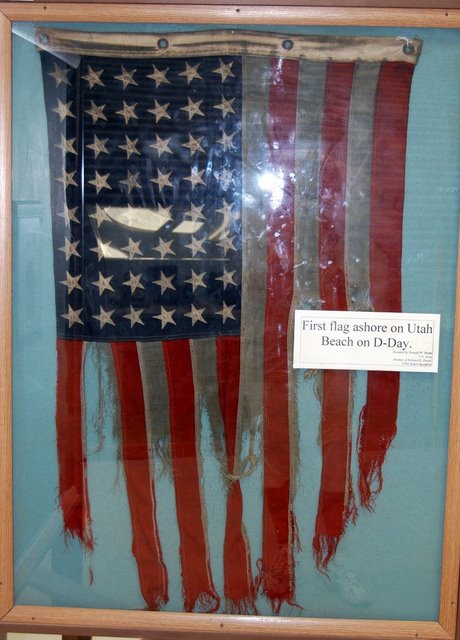
Today is the 64th anniversary of the Invasion of Normandy in World War II, a date generally called D-Day. No, you don’t have to fly your flag. This is not one of the days designated by Congress for flag-flying.
San Jacinto Day? April 21 is the anniversary of the Battle of San Jacinto, where Sam Houston and the Texian Army got the drop on Gen. Santa Anna and his much larger force, and in the course of a half-hour put the well-trained Mexican regulars on the run, and won Texas independence.
Unfortunately, it’s also a day most Texas students get smothered with reviews from their teachers for the Texas Assessment of Knowledge and Skills (TAKS), the state exam that had just ended last year on this date, and looms in the future this year. Instead of learning Texas history, Texas seventh graders spend this great day reviewing what educators are supposed to teach them. Nuts.
Raymond Jacobs died of natural causes at the age of 82 last week, his daughter told the Associated Press
Jacobs said he was present at the first flag raising, captured by a photographer for Leatherneck magazine. A later flag-raising, to put up a larger flag, was photographed by Joe Rosenthal, who won a Pulitzer Prize for the photo.
He is said to have returned to his unit by the time a more famous Associated Press photograph of a second flag-raising was taken later the same day.
Jacobs later fought in the Korean conflict in 1951 before retiring as a sergeant. He went on to work as a reporter, anchor and news director in local television in Oakland.
Eyewitnesses to the two World Wars dwindle in numbers. Historians and friends should be certain to capture their stories before they are gone.
Japan renamed the island Iwo To, its name prior to the war.
Spread the word; friends don't allow friends to repeat history.
This is an encore post, from a year ago. That was the last official reunion of the Pearl Harbor veterans, though I suspect a few will be there today, unofficially. New resources at the end of the post:
December 7, 2006 Associated Press 1941 file photo of a small boat assisting in rescue of Pearl Harbor attack victims, near the U.S.S. West Virginia, as the ship burns.
Today is the 65th anniversary of Japan’s attack on the U.S.’s Pacific Fleet at Pearl Harbor, Hawaii.
Our local newspaper, The Dallas Morning News, has a front-page story on survivors of the attack, who have met every five years in reunion at Pearl Harbor. Today will be their last official reunion. The 18-year-olds who suffered the attack, many on their first trips away from home, are in their 80s now. Age makes future reunions impractical.
From the article:
“We’re like the dodo bird. We’re almost extinct,” said Middlesworth, now an 83-year-old retiree from Upland, Calif., but then – on Dec. 7, 1941 – an 18-year-old Marine on the USS San Francisco.
Nearly 500 survivors from across the nation were expected to make the trip to Hawaii, bringing with them 1,300 family members, numerous wheelchairs and too many haunting memories.
Memories of a shocking, two-hour aerial raid that destroyed or heavily damaged 21 ships and 320 aircraft, that killed 2,390 people and wounded 1,178 others, that plunged the United States into World War II and set in motion the events that led to atomic bombings of Hiroshima and Nagasaki.
“I suspect not many people have thought about this, but we’re witnessing history,” said Daniel Martinez, chief historian at the USS Arizona Memorial. “We are seeing the passing of a generation.”
Another article notes the work of retired history professor Ron Marcello from the University of North Texas, in Denton, in creating oral histories from more than 350 of the survivors. This is the sort of project that high school history students could do well, and from which they would learn, and from which the nation would benefit. If you have World War II veterans in your town, encourage the high school history classes to go interview the people. This opportunity will not be available forever.
There is much to be learned, Dr. Marcello said:
Dr. Marcello said that in doing the World War II history project, he learned several common themes among soldiers.
“When they get into battle, they don’t do it because of patriotism, love of country or any of that. It’s about survival, doing your job and not letting down your comrades,” he said. “I heard that over and over.”
Another theme among soldiers is the progression of their fear.
“When they first got into combat, their first thought is ‘It’s not going to happen to me.’ The next thought is ‘It might happen to me,’ and the last thought is ‘I’m living on borrowed time. I hope this is over soon,’ ” Dr. Marcello said.
Dr. Marcello said the collection started in the early 1960s. He took charge of it in 1968. Since Dr. Marcello has retired, Todd Moye has taken over as the director.
Press release from Michigan Gov. Jennifer M. Granholm:
Flags to Fly Half-Staff Throughout Michigan on Friday in Honor of Pearl Harbor Day
LANSING – Governor Jennifer M. Granholm today encouraged Michigan citizens to observe Pearl Harbor Day on Friday, December 7, by lowering flags across the state to half-staff and remembering those who lost their lives in the attack on Pearl Harbor on December 7, 1941.
“On Pearl Harbor Day, we honor the lives lost in the attack 66 years ago and remember that we enjoy freedom thanks to their supreme sacrifices,” Granholm said. “This year, we also salute the men and women stationed around the world, including those fighting in Iraq and Afghanistan, who are defending and protecting our freedom today.”
In December 2005, Granholm signed Executive Order 2005-27 ordering the flag of the United States of America be flown half-staff on all state buildings and facilities throughout the state of Michigan on Pearl Harbor Day each December 7. Procedures for flag lowering, including on Pearl Harbor Day, were detailed by Governor Granholm in Executive Order 2006-10. The Legislature officially recognized the sacrifice of the servicemen and servicewomen who gave their lives at Pearl Harbor by enacting Public Act 157 of 2000, which declares that December 7 of each year be known as Pearl Harbor Day in the state.
On the morning of December 7, 1941, the Armed Forces of the United State of America stationed at Pearl Harbor, Hawaii, were attacked by the air and naval forces of Imperial Japan. The attack claimed the lives of 2,334 servicemen and servicewomen and wounded another 1,143.
When flown at half-staff or half-mast, the United States flag should be hoisted first to the peak for an instant and then lowered to the half-staff or half-mast position. The flag should again be raised to the peak before it is lowered for the day.
# # #
Michiganders, or anyone else, may subscribe to Flag Honors, the service notifying when flags in Michigan are to be flown half-staff. If you know of similar services for any other state, kindly make a note in comments.
Spread the word; friends don't allow friends to repeat history.
144 years ago today, Abraham Lincoln redefined the Declaration of Independence and the goals of the American Civil War, in a less-than-two-minute speech dedicating part of the battlefield at Gettysburg, Pennsylvania, as a cemetery and final resting place for soldiers who died in the fierce battle fought there the previous July 1 through 3.
Interesting news for 2007: More photos from the Library of Congress collection may contain images of Lincoln. The photo above, detail from a much larger photo, had been thought for years to be the only image of Lincoln from that day. The lore is that photographers, taking a break from former Massachusetts Sen. Edward Everett’ s more than two-hour oration, had expected Lincoln to go on for at least an hour. His short speech caught them totally off-guard, focusing their cameras or taking a break. Lincoln finished before any photographer got a lens open to capture images.
The plate lay unidentified in the Archives for some fifty-five years until in 1952, Josephine Cobb, Chief of the Still Pictures Branch, recognized Lincoln in the center of the detail, head bared and probably seated. To the immediate left (Lincoln’s right) is Lincoln’s bodyguard, Ward Hill Lamon, and to the far right (beyond the limits of the detail) is Governor Andrew G. Curtin of Pennsylvania. Cobb estimated that the photograph was taken about noontime, just after Lincoln arrived at the site and before Edward Everett’s arrival, and some three hours before Lincoln gave his now famous address.
To the complaints of students, I have required my junior U.S. history students to memorize the Gettysburg Address. In Irving I found a couple of students who had memorized it for a an elementary teacher years earlier, and who still could recite it. Others protested, until they learned the speech. This little act of memorization appears to me to instill confidence in the students that they can master history, once they get it done.
Edward Everett, the former Massachusetts senator and secretary of state, was regarded as the greatest orator of the time. A man of infinite grace, and a historian with some sense of events and what the nation was going through, Everett wrote to Lincoln the next day after their speeches:
“I should be glad, if I could flatter myself that I came as near the central idea of the occasion in two hours, as you did in two minutes.”
Walk with Lincoln in Gettysburg, an interestingly complete stroll through the history of the battle and the creation of the cemetery, and Lincoln’s address
◊ Waterberg – the first genocide of the 20th century. “Trail of bones.” Largely forgotten — or unknown — history of war in Africa in 1904. I’ll wager you didn’t know about it. It’s not in your world history book.
◊ History is Elementary is represented by a great post about camouflage in war, particularly World War I. This is a wonderful foundation for a lesson plan that deals with non-electronic technology — and as a sidelight, this is the sort of topic where the hunters among your students will be able to provide five or six examples of modern versions, with detailed explanations about the best places to use them. (You should read the post even if it’s out of your area; it’s a fascinating mashup of art, modern art, botany, zoology, psychology and war.)
Spectacular images of World War II historical sites are available at two websites every history or geography teacher should have bookmarked, and use frequently.
The first is D-Day spots, which features satellite photo/map hybrids, and dozens of Quicktime interactive panoramas of dozens of sites all along the beaches of Normandy.
The panoramic images are made up of digital photos, usually very high quality, which would be useful images even were they not part of the interactive, panoramic feature; see the image of the West Pointe du Hoc cliffs at right.
Many beach shots are there, of course — the panoramic images also include a few other sites around the beaches, and some of those images are spectacular all on their own, such as the interior of a local church, Sainte Mére-Eglise.
These landmarks feature many battlefield sites, and they offer interactive, Quicktime panoramas of some sites that are not so well known as they ought to be, such as the graveyard at Al Alamein in Egypt (see photo below). To U.S. audiences, some of these sites may be relatively unknown — it’s a good excuse to explore the sites and get more familiar with the European view of World War II.
This site also features photos of the war in the Pacific, with a series of photos from Hiroshima (see below), Nagasaki and Tokyo, but also including Pearl Harbor and Okinawa.
Integrating these sites into directed teaching should be easy, if you have a computer and projector. At the D-Day site, many of the panoramas are downloadable. For the Landmarks site, an active internet connection may be required.
Spread the word; friends don't allow friends to repeat history.
Or, until that account is unsuspended by the forces supporting Donald Trump: Follow @FillmoreWhite, the account of the Millard Fillmore White House Library
We've been soaking in the Bathtub for several months, long enough that some of the links we've used have gone to the Great Internet in the Sky.
If you find a dead link, please leave a comment to that post, and tell us what link has expired.
Thanks!
Retired teacher of law, economics, history, AP government, psychology and science. Former speechwriter, press guy and legislative aide in U.S. Senate. Former Department of Education. Former airline real estate, telecom towers, Big 6 (that old!) consultant. Lab and field research in air pollution control.
My blog, Millard Fillmore's Bathtub, is a continuing experiment to test how to use blogs to improve and speed up learning processes for students, perhaps by making some of the courses actually interesting. It is a blog for teachers, to see if we can use blogs. It is for people interested in social studies and social studies education, to see if we can learn to get it right. It's a blog for science fans, to promote good science and good science policy. It's a blog for people interested in good government and how to achieve it.
BS in Mass Communication, University of Utah
Graduate study in Rhetoric and Speech Communication, University of Arizona
JD from the National Law Center, George Washington University


 Posted by Ed Darrell




 Many beach shots are there, of course — the panoramic images also include a few other sites around the beaches, and some of those images are spectacular all on their own, such as the interior of a local church, Sainte Mére-Eglise.





 Millard Fillmore's Bathtub