Quote of the moment: Richard Feynman, science vs. public relations

January 7, 2008

Feynman speaking from the grave? You decide:

Feynman uses a glass of ice water to show the Challenger's O-ring problem, 1986

For a successful technology, reality must take precedence over public relations, for nature cannot be fooled.

Richard Feynman, in the Rogers Commission Report on the Space Shuttle Challenger Accident, appendix (1986)

Photo: Richard Feynman, at a hearing of the Rogers Commission, demonstrates with a glass of ice water and a piece of O-ring material, how cold makes the O-rings inflexible; photo credit unknown


    Quote of the moment: Newton, giants

    December 26, 2007

    Newton, by Sir Godfrey Kneller, 1689

    If I have seen further than others, it is because I have stood on the shoulders of giants.*

    Sir Isaac Newton (1642-1727), letter to Robert Hooke, February 5, 1675/1676. Newton was born on December 25 by the Julian Calendar, at a time when it mattered which calendar was used.


    [*] Newton’s giants: Nicolaus Copernicus, Giordano Bruno, Johannes Kepler, René Descartes. Bartlett’s 16th Edition phrases the letter to Hooke a little differently: “If I have seen further than (you and Descartes) it is by standing upon the shoulders of Giants.” Others attribute the quote much earlier; it was a saying of the times, it appears, and this is one of the most famous uses of it.


    Quote of the moment: Psalms 55.21

    December 21, 2007

    The words of his mouth were smoother than butter, but war was in his heart: his words were softer than oil, yet were they drawn swords.

    ◊ Psalm 55.21 (King James Version)

    His words were smoother
    than butter,
    and softer
    than olive oil.
    But hatred filled his heart,
    and he was ready to attack
    with a sword.

    ◊ Psalm 55.21 (Contemporary English Version)


    Quote of the moment: “A rising tide of mediocrity”

    December 21, 2007

    “Our nation is at risk. The educational foundations of our society are presently being eroded by a rising tide of mediocrity. If an unfriendly foreign power had attempted to impose on America the mediocre educational performance that exists today, we might well have viewed it as an act of war. We have, in effect, been committing an act of unthinking, unilateral educational disarmament. History is not kind to idlers.”

    Those warnings, grim and intentionally provocative, were issued last week by the 18-member National Commission on Excellence in Education in a 36-page report called A Nation at Risk: The Imperative for Educational Reform. Headed by University of Utah President David P. Gardner, the NCEE was set up 20 months ago by Secretary of Education Terrel Bell to examine U.S. educational quality.

    – Ellie McGrath, “To Stem ‘A Tide of Mediocrity,'” Time, May 9, 1983.


    Quote of the moment: Housman, “accuracy a duty” in history

    December 16, 2007

    Poet A. E. Housman, with a book - Bryn Mawr College photo


    Poet A. E. Housman in 1910, portrait photo by E. O. Hoppé

    . . . accuracy is a duty and not a virtue.

    A. E. Housman, English poet (1859-1936), Manilius (The Richards Press, 1930), p. xxii ll. 27 sqq


    Google the phrase “accuracy is a duty” plus Housman.* You will get several dozen hits.

    Historians are fond of citing it, though I suspect that few have actually read Housman’s version of the line. The idea is that historians should not get kudos for accuracy, because in their trade, accuracy is not a virtue, but instead is the baseline duty. Housman arrived at that conclusion in comparing versions of translations of Manilius, and he made the comment in the preface to fifth volume of his own translation of the works of Roman poet Marcus Manilius. Housman’s five volumes were published between 1903 and 1930.

    The full quote lacks the punch of the usual truncations, however. The Housman Society in Britain was kind to track down the precise quote and the citation.

    p. xxii ll. 27 sqq. I did not quote Brechart’s accuracy, because accuracy is a duty and not a virtue; but if I could have seen the shameful carelessness’ of Breiter and van Wageningen I should have said with emphasis, as I do now, that he was very accurate indeed.

    Admit it — like me you were probably unaware that Housman had ever translated Manilius. Perhaps you were unaware that Manilius existed (don’t ask me to recite anything he wrote).
    Historians have this further problem: Housman probably was talking about the accuracy of the translation, not accuracy in recording history.

    One more quote that has been dragooned into duty in fields unrelated to its usual use. Got a problem with that?

    The statement is good advice in every field I can think of.

    Update: Go see Elektratrig’s report of Housman’s send-up of Greek tragedy. Well worth the click, just for edification.

    *  And if you check it now, you’ll see the search is skewed by this very post; it’s the Heisenberg Principle of the internet.


    Quote of the moment: Wolfgang Pauli, “not even wrong.”

    December 14, 2007

    Wolfgang Pauli, before 1945 - Nobel Foundation photo
    Photograph of Wolfgang Pauli, circa 1929; photo from Nobel Foundation.

    That’s not right. It’s not even wrong.

    From Wikipedia:

    Wolfgang Pauli (1900-1958), as quoted by R. Peierls

    Peierls (1960) writes of Pauli, “… a friend showed him the paper of a young physicist which he suspected was not of great value but on which he wanted Pauli’s views. Pauli remarked sadly ‘That’s not right. It’s not even wrong'”.  (Peierls  R  (1960). “Wolfgang Ernst Pauli, 1900-1958”. Biographical memoirs of fellows of the Royal Society 5: 174-92. Royal Society (Great Britain))

    Pauli won the Nobel Prize in Physics in 1945:  “At this stage of the development of atomic theory, Wolfgang Pauli made a decisive contribution through his discovery in 1925 of a new law of Nature, the exclusion principle or Pauli principle. The 1945 Nobel Prize in Physics has been awarded to Pauli for this discovery.”


    Founders online, great interactive site

    December 12, 2007

    Our friends and benefactors at the Bill of Rights Institute put up a great branch of their site, Founders Online. A grant from the Shelby Cullom Davis Foundation made the project possible.

    Bill of Rights Institute logo

    Check it out:

    John Adams | Samuel Adams | Alexander Hamilton | Patrick Henry
    Thomas Jefferson | James Madison | GeorgeMason | Gouverneur Morris
    James Otis | Thomas Paine | George Washington | John Witherspoon

    This page should be a first stop for your students doing biographies on any of these people, and it should be a test review feature for your classes that they can do on the internet at home, or in class if you’re lucky enough to have access in your classroom.

    Good on-line sources are still too rare. This is stuff you can trust to be accurate and appropriate for your students. Send a note of thanks to the Bill of Rights Institute, and send your students to the site.

    Just in time for Bill of Rights Day, December 15 . . .


    Students rise to the challenge

    December 2, 2007

    Who will do something about global warming (weirding)?

    “We are the people we have been waiting for.”


    December 1, 1955: Rosa Parks sits down for freedom

    December 1, 2007

    Rosa Parks being fingerprinted, Library of Congress

    Rosa Parks: “Why do you push us around?”

    Officer: “I don’t know but the law is the law and you’re under arrest.”

    From Rosa Parks with Gregory J. Reed, Quiet Strength
    (Grand Rapids, MI: Zondervan Pub. House, 1994), page 23.

    Photo: Mrs. Parks being fingerprinted in Montgomery, Alabama; photo from New York World-Telegram & Sun Collection, Library of Congress

    Today in History at the Library of Congress states the simple facts:

    On the evening of December 1, 1955, Rosa Parks, an African American, was arrested for disobeying an Alabama law requiring black passengers to relinquish seats to white passengers when the bus was full. Blacks were also required to sit at the back of the bus. Her arrest sparked a 381-day boycott of the Montgomery bus system and led to a 1956 Supreme Court decision banning segregation on public transportation.

    Rosa Parks made a nearly perfect subject for a protest on racism. College-educated, trained in peaceful protest at the famous Highlander Folk School, Parks was known as a peaceful and respected person. The sight of such a proper woman being arrested and jailed would provide a schocking image to most Americans. Americans jolted awake.

    Often lost in the retelling of the story are the threads that tie together the events of the civil rights movement through the 1940s, 1950s and 1960s. As noted, Parks was a trained civil rights activist. Such training in peaceful and nonviolent protest provided a moral power to the movement probably unattainable any other way. Parks’ arrest was not planned, however. Parks wrote that as she sat on the bus, she was thinking of the tragedy of Emmet Till, the young African American man from Chicago, brutally murdered in Mississippi early in 1955. She was thinking that someone had to take a stand for civil rights, at about the time the bus driver told her to move to allow a white man to take her seat. To take a stand, she remained seated. [More below the fold] Read the rest of this entry »


    Whiskey and cigar day: Twain and Churchill

    November 30, 2007

    Mark Twain, afloat

    November 30 is the birthday of Mark Twain (1835), and Winston Churchill (1874).

    Twain had a comment on recent actions at the Texas Education Agency:

    In the first place God made idiots. This was for practice. Then He made School Boards.

    – Following the Equator; Pudd’nhead Wilson’s New Calendar

    The Nobel literature committees were slow; Twain did not win a Nobel in Literature; he died in 1910. Churchill did win, in 1953.

    Both men were aficianadoes of good whiskey and good cigars. Both men suffered from depression in old age.

    Both men made a living writing, early in their careers as newspaper correspondents. One waged wars of a kind the other campaigned against. Both were sustained by their hope for the human race, against overwhelming evidence that such hope was sadly misplaced.

    churchill-time-cover-man-of-the-year-1941.jpg

    Both endured fantastic failures that would have killed other people, and both rebounded.

    Both men are worth study.

    Twain, on prisons versus education: “Every time you stop a school, you will have to build a jail. What you gain at one end you lose at the other. It’s like feeding a dog on his own tail. It won’t fatten the dog.” – Speech, November 23, 1900

    Churchill on the evil men and nations do:

    “No One Would Do Such Things”

    “So now the Admiralty wireless whispers through the ether to the tall masts of ships, and captains pace their decks absorbed in thought. It is nothing. It is less than nothing. It is too foolish, too fantastic to be thought of in the twentieth century. Or is it fire and murder leaping out of the darkness at our throats, torpedoes ripping the bellies of half-awakened ships, a sunrise on a vanished naval supremacy, and an island well-guarded hitherto, at last defenceless? No, it is nothing. No one would do such things. Civilization has climbed above such perils. The interdependence of nations in trade and traffic, the sense of public law, the Hague Convention, Liberal principles, the Labour Party, high finance, Christian charity, common sense have rendered such nightmares impossible. Are you quite sure? It would be a pity to be wrong. Such a mistake could only be made once—once for all.”

    —1923, recalling the possibility of war between France and Germany after the Agadir Crisis of 1911, in The World Crisis,vol. 1, 1911-1914, pp. 48-49.

    Image of Twain aboard ship – origin unknown. Image of Winston S. Churchill, Time Magazine’s Man of the Year for 1941, copyright 1941 by Time Magazine.

    More on Mark Twain

    More on Winston Churchill

    Orson Welles, with Dick Cavett, on Churchill, his wit, humor and grace (tip of the old scrub brush to the Churchill Centre):


    Quote of the moment: Bohr on predictions, creationists on the death of evolution theory

    November 21, 2007

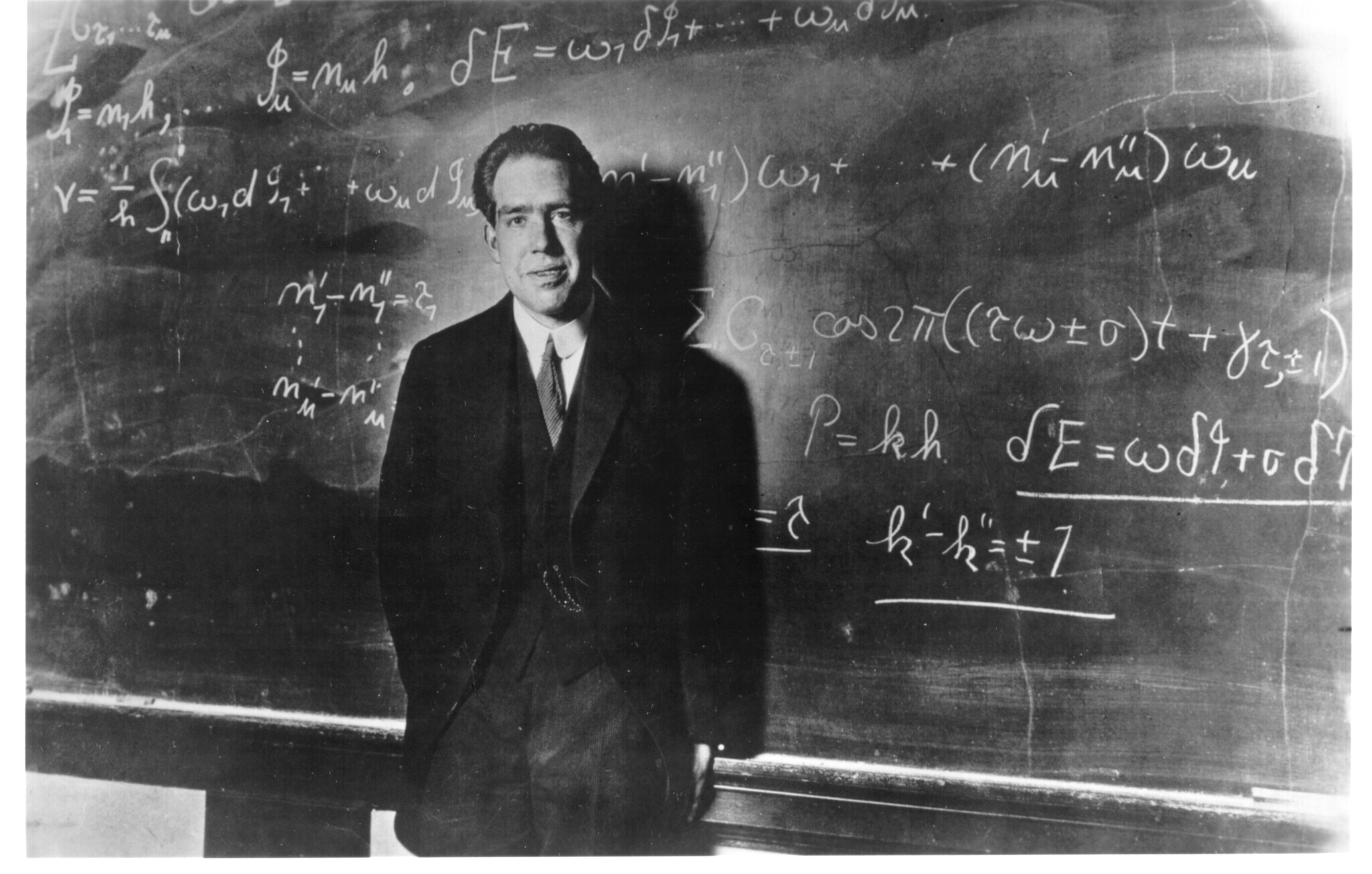
    Niels Bohr as a younger man, at a chalkboard.

    Niels Bohr, as a younger man, at the chalkboard. Atomic Archives

    It is difficult to predict, especially the future.

    • Niehls Bohr, Danish physicist, 1885-1962 – attributed by Mark Kac, Statistics, 1975. Other sources say it is a Danish pun (anybody here speak Danish?) famous in the Danish parliament in the 1930s.

    And as if in tribute to Bohr, Ed Brayton at Dispatches from the Culture Wars has a collection of creationist predictions that evolution theory will soon be dead — a series of predictions starting in 1904. Santayana’s Ghost urges you to read them, to avoid repeating history.


    “Why should I read Shakespeare? Why should I study history?”

    November 2, 2007

    David McCullough might answer that question this way:

    In conclusion I want to share a scene that took place on the last day of the year of 1776, Dec. 31. All the enlistments for the entire army were up. Every soldier, because of the system at the time, was free to go home as of the first day of January 1777. Washington called a large part of the troops out into formation. He appeared in front of these ragged men on his horse, and he urged them to reenlist. He said that if they would sign up for another six months, he’d give them a bonus of 10 dollars. It was an enormous amount then because that’s about what they were being paid for a month—if and when they could get paid. These were men who were desperate for pay of any kind. Their families were starving.

    The drums rolled, and he asked those who would stay on to step forward. The drums kept rolling, and nobody stepped forward. Washington turned and rode away from them. Then he stopped, and he turned back and rode up to them again. This is what we know he said:

    My brave fellows, you have done all I asked you to do, and more than could be reasonably expected, but your country is at stake, your wives, your houses, and all that you hold dear. You have worn yourselves out with fatigues and hardships, but we know not how to spare you. If you will consent to stay one month longer, you will render that service to the cause of liberty, and to your country, which you can probably never do under any other circumstance.3

    Again the drums rolled. This time the men began stepping forward. “God Almighty,” wrote Nathanael Greene, “inclined their hearts to listen to the proposal and they engaged anew.”4

    Now that is an amazing scene, to say the least, and it’s real. This wasn’t some contrivance of a screenwriter. However, I believe there is something very familiar about what Washington said to those troops. It was as if he was saying, “You are fortunate. You have a chance to serve your country in a way that nobody else is going to be able to, and everybody else is going to be jealous of you, and you will count this the most important decision and the most valuable service of your lives.” Now doesn’t that have a familiar ring? Isn’t it very like the speech of Henry V in Shakespeare’s play Henry V: “We few, we happy few, we band of brothers . . . And gentlemen in England now a-bed / Shall think themselves accursed they were not here”?5 Washington loved the theater; Washington loved Shakespeare. I can’t help but feel that he was greatly influenced.

    He was also greatly influenced, as they all were, by the classical ideals of the Romans and the Greeks. The history they read was the history of Greece and Rome. And while Washington and Knox and Greene, not being educated men, didn’t read Greek and Latin as Adams and Jefferson did, they knew the play Cato, and they knew about Cincinnatus. They knew that Cincinnatus had stepped forward to save his country in its hour of peril and then, after the war was over, returned to the farm. Washington, the political general, had never forgotten that Congress was boss. When the war was at last over, Washington, in one of the most important events in our entire history, turned back his command to Congress—a scene portrayed in a magnificent painting by John Trumbull that hangs in the rotunda of our national Capitol. When George III heard that George Washington might do this, he said that “if he does, he will be the greatest man in the world.”

    So what does this tell us? That the original decision of the Continental Congress was the wise one. They knew the man, they knew his character, and he lived up to his reputation.

    I hope very much that those of you who are studying history here will pursue it avidly, with diligence, with attention. I hope you do this not just because it will make you a better citizen, and it will; not just because you will learn a great deal about human nature and about cause and effect in your own lives, as well as the life of the nation, which you will; but as a source of strength, as an example of how to conduct yourself in difficult times—and we live in very difficult times, very uncertain times. But I hope you also find history to be a source of pleasure. Read history for pleasure as you would read a great novel or poetry or go to see a great play.

    And I hope when you read about the American Revolution and the reality of those people that you will never think of them again as just figures in a costume pageant or as gods. They were not perfect; they were imperfect—that’s what’s so miraculous. They rose to the occasion as very few generations ever have.

    David McCullough, from a speech delivered at Brigham Young University in Provo, Utah, on September 27, 2005, “The Glorious Cause of America.”

    Do your students know that speech from Henry V? Do your students know the story of Cincinnatus?

    Tip of the old scrub brush to Collecting My Thoughts.

    Quote of the moment: Washing hands of the matter

    September 23, 2007

    Ignaz Semmelweiss

    This is one of the classic stories of public health, an issue that most U.S. history and world history texts tend to ignore, to the detriment of the students and the classroom outcomes.

    This is the story as retold by Christopher Cerf and Victor Navasky in The Experts Speak:

    In the 1850s a Hungarian doctor and professor of obstetrics named Ignaz Semmelweis (pictured at left) ordered his interns at the Viennese Lying-in Hospital to wash their hands after performing autopsies and before examining new mothers. The death rate plummeted from 22 out of 200 to 2 out of 200, prompting the following reception from one of Europe’s most respected medical practitioners:

    “It may be that it [Semmelweis’ procedure] does contain a few good principles, but its scrupulous application has presented such difficulties that it would be necessary, in Paris for instance, to place in quarantine the personnel of a hospital during the great part of a year, and that, moreover, to obtain results that remain entirely problematical.”

    Dr. Charles Dubois (Parisian obstetrician), memo to the French Academy
    September 23, 1858

    Semmelweiss’ superiors shared Dubois’ opinion; when the Hungarian physician insisted on defending his theories, they forced him to resign his post on the faculty.

    Update, September 26, 2007: Stephen J. Dubner at the Freakonomics blog pointed to a video, to an essay by Semmelweis, and to a column he and Steven D. Levitt had done earlier on handwashing. Maybe things aren’t as good as we had hoped.


    Soon to be famous rejection: Harvard to Warren Buffett

    September 19, 2007

    A California woman donated $128 million to a Quaker boarding school.  Her fortune is the result of her father’s wise investment with one of his former students, Warren Buffett.

    Barbara Dodd Anderson made the gift to the George School in Bucks County, Pennsylvania.  She is the daughter of Buffett’s former professor at Columbia University’s graduate business program, David L. Dodd.  Dodd invested with Buffett, having been impressed with Buffett’s acumen as a student.

    But Buffett owed Dodd a lot, too.  It was Dodd who got Buffett into Columbia, after Harvard rejected him.  Here’s the gist of that part of the story, from the New York Times:

    In an interview, Mr. Buffett said Professor Dodd had turned his life around in 1950, when he graduated from the University of Nebraska and was applying to business school. Harvard rejected his application, and that August, well after Columbia’s application deadline, Mr. Buffett wrote to Professor Dodd, whom he admired as the author of a respected financial text.

    “Dear Professor Dodd, I thought you were dead, but now that I know that you’re alive, I’d like to come study with you,” Mr. Buffett said he wrote in his letter.

    “And he admitted me to Columbia!” Mr. Buffett said. “I would not be who I am today without David Dodd. If in response to my letter he’d said, ‘Sorry, its too late,’ I’d never be where I am.”

    “Harvard did me a big favor by turning me down,” he said. “But I haven’t made any contributions to them in thanks for that.”


    Quotes of the moment: Shoulders of giants

    September 8, 2007

    Famous quotations often get cited to the wrong famous person. ‘Somebody said something about standing on the shoulders of giants — who was it? Edison? Lincoln? Einstein? Jefferson?’ It may be possible someday to use Google or a similar service to track down the misquotes.

    The inspiration, perhaps

    A dwarf standing on the shoulders of a giant may see farther than a giant himself.

    Robert Burton (February 8, 1577-January 25, 1640), vicar of Oxford University, who wrote The Anatomy of Melancholy to ward off his own depressions

    The famous quote

    If I have seen further (than you and Descartes) it is by standing on the shoulders of Giants.

    Sir Isaac Newton, letter to Robert Hooke, February 5, 1675, Julian/February 15, 1676, Gregorian

    Other references: