Honoring James Madison in 2025, the go-to guy, for his birthday, March 16

March 17, 2025

James Madison, the fourth President of the United States, and the Father of the Constitution, was born March 16, 1751, in the Tidewater area of Virginia.

Is it sinful that we do not celebrate his birthday with a federal holiday, fireworks, picnics and speeches and concerts?

Maybe you could fly your flag.  If neighbors ask why, tell them you’re flying it for freedom on James Madison’s birthday.  They’ll say, “Oh,” and run off to Google Madison.  You will have struck a blow for the education that undergirds democracy.

Journalists honor Madison on his birthday, and through the week in which his birthday occurs, with tributes to the First Amendment which he wrote, and celebrations of Freedom of Information Laws and press freedoms, two issues dear to Madison’s heart.

There is much, much to celebrate about him.

A few years ago I was asked to talk about freedom to a group of freedom lovers in North Texas.  I chose to speak about James Madison’s remarkable, and too-often unremarked-upon life. Later, when I started this blog, I posted it here, with an introduction.  All of that is below, in honor of the birth of James Madison.

Did you know that Madison is the shortest man ever to have been president?  His stature is measured in freedom, not in feet and inches.

(Originally a post on July 31, 2006)

James Madison, 1783, by Charles Wilson Peale. Library of Congress collection

James Madison, 1783, miniature by Charles Wilson Peale. Madison would have been 32. Library of Congress collection

I don’t blame students when they tell me they “hate history.”  Heaven knows, they probably have been boringly taught boring stuff.

For example, history classes study the founding of the United States. Especially under the topical restrictions imposed by standardized testing, many kids will get a short-form version of history that leaves out some of the most interesting stuff.

Who could like that?

Worse, that sort of stuff does damage to the history and the people who made it, too.

James Madison gets short shrift in the current canon, in my opinion. Madison was the fourth president, sure, and many textbooks note his role in the convention at Philadelphia that wrote the Constitution in 1787. But I think Madison’s larger career, especially his advocacy for freedom from 1776 to his death, is overlooked.

Madison was the “essential man” in the founding of the nation, in many ways. He was able to collaborate with people as few others could, in order to get things done, including his work with George Mason on the Virginia Bill of Rights, with George Washington on the Constitution and national government structure, Thomas Jefferson on the structure and preservation of freedom, Alexander Hamilton on the Constitution and national bank, and James Monroe on continuing the American Revolution.

We need to look harder at the methods and philosophy, and life, of James Madison. This is an opinion I’ve held for a long time. Here I reproduce a “sermon” I delivered to the North Texas Church of Freethought in November 2001.

James Madison White House portrait, John Vanderlyn, 1816

James Madison’s official White House portrait, by John Vanderlyn in 1816; in the White House collection

I have left this exactly as it was delivered, though I would change a few things today, especially emphasizing more the key role George Washington played in pushing Madison to get the Constitution — a view I came to courtesy of the Bill of Rights Insitute and their outstanding, week-long seminar, Shaping the Constitution: A View from Mount Vernon 1783-1789. The Bill of Rights Institute provides outstanding training for teachers, and this particular session, at Washington’s home at Mount Vernon, Virginia, is well worth the time (check with the Institute to see whether it will be offered next year — and apply!). I am especially grateful to have had the opportunity to discuss these times and issues with outstanding scholars like Dr. Gordon Lloyd of Pepperdine University, Dr. Adam Tate of Morrow College, and Dr. Stuart Leibiger of LaSalle University, during my stay at Mount Vernon.

My presentation to the skeptics of North Texas centered around the theme of what a skeptic might give thanks for at Thanksgiving. (It is available on the web — a misspelling of my name in the program carried over to the web, which has provided me a source of amusement for several years.)

Here is the presentation:

Being Thankful For Religious Liberty

As Presented at the November, 2001 Sunday Service of The North Texas Church of Freethought

Historians rethink the past at least every generation, mining history for new insights or, at least, a new book. About the founders of this nation there has been a good deal of rethinking lately. David McCullough reminds us that John Adams really was a good guy, and that we shouldn’t think of him simply as the Federalist foil to Thomas Jefferson’s more democratic view of the world. Jefferson himself is greatly scrutinized, and perhaps out of favor — “American Sphinx,” Joseph Ellis calls him. The science of DNA testing shows that perhaps Jefferson had more to be quiet about than even he confessed in his journals. While Jefferson himself questioned his own weakness in his not freeing his slaves in his lifetime, historians and fans of Jefferson’s great writings wrestle with the likelihood of his relationship with one of his own slaves (the old Sally Hemings stories came back, and DNA indicates her children were fathered by a member of the Jefferson clan; some critics argue that Jefferson was a hypocrite, but that was Jefferson’s own criticism of himself; defenders point out that the affair most likely was consensual, but could not be openly acknowledged in Virginia at that time). Hamilton’s gift to America was a financial system capable of carrying a noble nation to great achievement, we are told – don’t think of him simply as the fellow Aaron Burr killed in a duel. Washington is recast as one of the earliest guerrilla fighters, and in one book as a typical gentleman who couldn’t control his expenses. Franklin becomes in recent books the “First American,” the model after which we are all made, somehow.

Of the major figures of these founding eras, James Madison is left out of the rethinking, at least for now. There has been no major biography of Madison for a decade or more, not since Ralph Ketcham’s book for the University of Virginia press. Madison has a role in Joseph Ellis’s Founding Brothers, but he shares his spotlight with Hamilton and Jefferson. I think this is an oversight. As we enter into the first Thanksgiving season of the 21st century, we would do well to take a look back at Madison’s life. Madison gives us a model of reason, and more important, a model of action coupled to reason. America’s founding is often depicted as a time of great thunder — if not the thunder of the lightning Ben Franklin experimented with, an experiment he parlayed into worldwide respect for Americans, it is the thunder of the pronouncements of Thomas Jefferson in the Declaration of Independence, or of George Washington, just generally thundering through history.

The use of a bolt of lightning as a symbol for this group is inspired, I think. I’m a great fan of Mark Twain, and when I see that bolt of electricity depicted I think of Twain’s observation:

“Thunder is good; thunder is impressive. But it is lightning that does the work.”

Thunder at the founding is impressive; where was the lightning?

I’d like to point out two themes that run through Madison’s life, or rather, two activities that we find him in time and again. Madison’s life was marked by periods of reflection, followed by action as a result of that reflection.

We don’t know a lot about Madison’s youth. He was the oldest son of a wealthy Virginia planter, growing up in the Orange County area of Tidewater Virginia. We know he was boarded out for schooling with good teachers – usually clergymen, but occasionally to someone with expertise in a particular subject – and we know that he won admission to Princeton to study under the Rev. John Witherspoon, a recent Presbyterian transplant from across the Atlantic. Madison broke with tradition a bit in attending an American rather than an English school. And after completing his course of study he remained at Princeton for another year to study theology directly under Witherspoon, with an eye toward becoming a preacher.

Witherspoon is often held up as an example of how religion influenced the founders, but he was much more of a rationalist than some would have us believe. He persuaded the young Madison that a career in law and politics would be a great service to the people of Virginia and America, and might be a higher calling. After a year of this reflection, Madison returned to Virginia and won election to local government.

In his role as a county official Madison traveled the area. He inspected the works of government, including the jails. He was surprised to find in jail in Virginia people accused of — gasp! — practicing adult baptism. In fact Baptists and Presbyterians were jailed on occasion, because the Anglican church was the state church of Virginia, and their practicing their faith was against the common law. This troubled Madison greatly, and it directed an important part of his work for the rest of his life. In January of 1774, Madison wrote about it to another prominent Virginian, William Bradford:

“Poverty and Luxury prevail among all sorts: Pride ignorance and Knavery among the Priesthood and Vice and Wickedness among the Laity. This is bad enough. But it is not the worst I have to tell you. That diabolical Hell conceived principle of persecution rages among some and to their eternal infamy the Clergy can furnish their Quota of Imps for such business. This vexes me the most of any thing whatever. There are at this time in the adjacent County not less than 5 or 6 well meaning men in close Gaol for publishing their religious Sentiments which in the main are very orthodox. I have neither patience to hear talk or think of any thing relative to this matter, for I have squabbled and scolded abused and ridiculed so long about it, to so little purpose that I am without common patience. So I leave you to pity me and pray for Liberty of Conscience to revive among us.”

By April, Madison’s views on the matter had been boiled down to the essences, and he wrote Bradford again more bluntly:

“Religious bondage shackles and debilitates the mind and unfits it for every noble enterprise.”

Madison must have done a fine job at his county duties, whatever they were, because in 1776 when Virginia was organizing its government to survive hostilities with England, Madison was elected to the legislative body.

Madison was 25, and still raw in Virginia politics. He was appointed to the committee headed by George Mason to review the laws and charter of the colony. Another who would serve on this committee when he was back from Philadelphia was Thomas Jefferson. George Mason was already a giant in Virginia politics, and by the time Madison got to Williamsburg, Mason had already completed much of the work on a bill of rights to undergird the new Virginia government. Madison noted that freedom of religion was not among the rights enumerated in Mason’s version — but it was too late, Mason said. The work was done.

Madison quietly went to work on Mason, in committee, over dinner, during social occasions — noting the great injustice of jailing people solely because of their beliefs, and urging to Mason that it did Virginia no good to keep these fathers from providing for their families.

Mason ultimately agreed to accept the amendment.

The pattern was set.

Perhaps a better example of this reflection and action cycle occurred nearly a decade later. By 1785 the war was over, independence was won, but the business of government continued. While serving as governor of Virginia, Thomas Jefferson had drafted about 150 proposals for laws, really a blueprint for a free government. About half of these proposals had been passed into law. By 1785, Jefferson was away from Virginia, representing the Confederation of colonies in Paris. Jefferson had provided several laws to disestablish religion in Virginia, and to separate out the functions of church and state. With Jefferson gone, however, his old nemesis Patrick Henry sought to roll back some of that work. Henry proposed to bring back state support for the clergy, for the stated purpose of promoting education. (Yes, this is the same battle we fight today for church and state separation.) After Jefferson’s troubled term as governor, Virginia turned again to Henry – Henry ultimately served six terms as governor. His proposal was set for a quick approval in the Virginia assembly. It was late in the term, and everyone wanted to get home.

Henry was, of course, a thundering orator of great note. Madison was a small man with a nervous speaking style, but a man who knew the issues better than anyone else in almost any room he could be in. Madison came up with an interesting proposal. Picking the religion for the state was serious stuff, he said. A state doesn’t want to pick the wrong religion, and get stuck with the wrong god, surely — and such weighty matters deserve widespread support and discussion, Madison said. His motion to delay Henry’s bill until the next session, in order to let the public know and approve, was agreed to handily.

You probably know the rest of this story. With a year for the state to reflect on the idea, Madison wrote up a petition on the issue, which he called a “Memorial and Remonstrance.” In the petition he laid out 15 reasons why separation of church and state was a superior form of government, concluding that in the previous 1,500 years, every marriage of church and state produced a lazy and corrupt church, and despotic government. Madison’s petition circulated everywhere, and away from Patrick Henry’s thundering orations, the people of Virginia chose Madison’s cool reason.

When the legislature reconvened in 1786, it rejected Henry’s proposal. But Madison’s petition had been so persuasive, the legislature also brought up a proposal Thomas Jefferson had made six years earlier, and passed into law the Virginia Statue for Religious Freedom.

This was a great victory for Madison, and for Virginia. He celebrated by convening a convention to settle disputes between Virginia and Maryland about navigation on the Chesapeake Bay. Having reflected on the nature of this issue — a dispute between colonies — Madison had sought advice from others having the same problems, such as New York and New Jersey. In that effort he got the support of a New Yorker working on the same problems, Alexander Hamilton. In the course of these discussions Madison thought it clear that the difficulty lay with the form of government that bound the colonies together under the Articles of Confederation. Hamilton agreed, and they got their respective states and conferences to agree to meet in Philadelphia in 1787 to try to fix those problems. [Since I first wrote this, I’ve learned that it was George Washington’s desire to get a federal government, to facilitate the settling of the Ohio River Valley where Washington had several thousands of acres to sell, that prompted him to push Madison into the Annapolis Convention, and who made the introduction between Madison and Washington’s old aide and friend, Alexander Hamilton; Madison’s work with Washington runs much deeper than I orignally saw.] James Madison, by Charles Wilson Peale, 1792; Gilcrease Museum
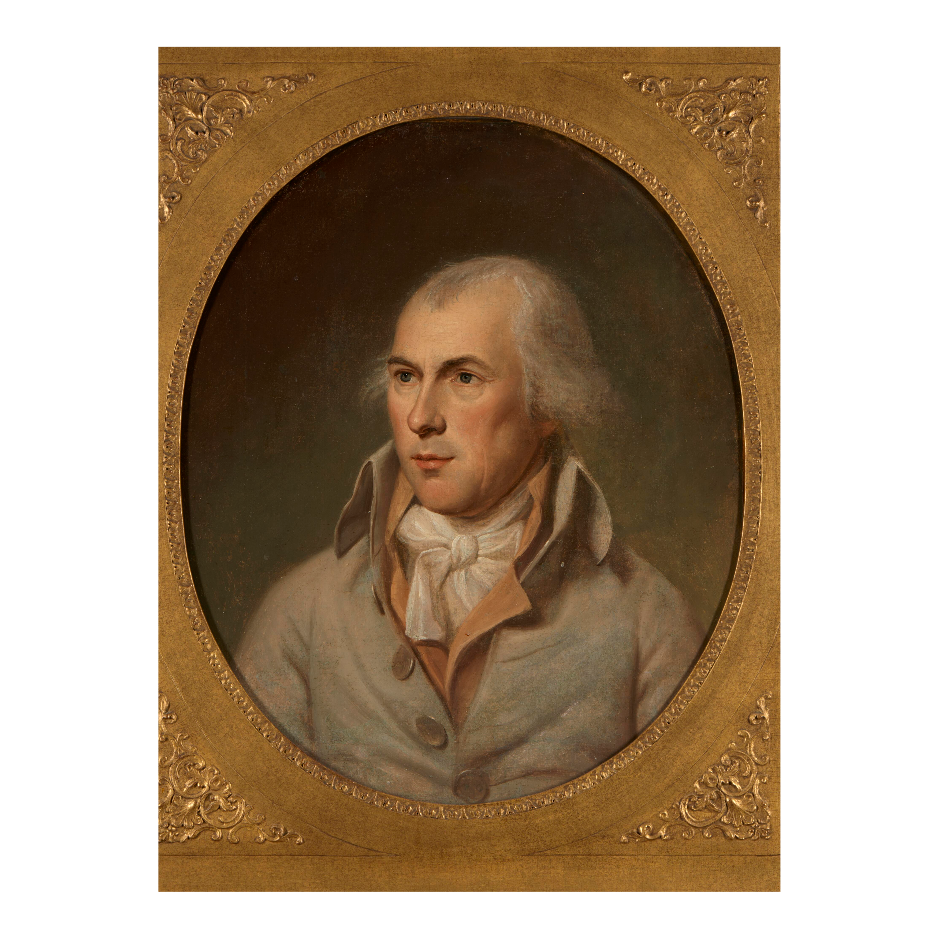
Amending the Articles of Confederation was a doomed effort, many thought. The colonies would go their separate ways, no longer bound by the need to hang together against the Parliament of England. Perhaps George Washington could have got a council together to propose a new system, but Washington had stayed out of these debates. Washington’s model for action was the Roman general Cincinnatus, who went from his plow to lead the Romans to victory, then returned to his farm, and finding his plow where he had left it, took it up again.

Madison invited Washington, and persuaded Washington to attend. Washington was elected president of the convention, and in retrospect that election guaranteed that whatever the convention produced, the colonies would pay attention to it.

You know that history, too. The convention quickly decided the Articles of Confederation were beyond repair. Instead, they wrote a new charter for a new form of government. The charter was based in part on Jefferson’s Virginia Plan, with lots of modifications. Because the Constitution resembles so much the blueprint that Jefferson had written, and because Jefferson was a great founder, many Americans believe Jefferson was a guiding light at that Philadelphia convention. It’s often good to reflect that Jefferson was in Paris the entire time. While America remembers the thunder of Washington’s presiding, Franklin’s timely contributions and Jefferson’s ideas, it was Madison who did the heavy lifting, who got Washington and Franklin to attend the meeting Madison had set up, and got Jefferson’s ideas presented and explained.

It was Madison who decided, in late August of 1787, that the convention could not hang together long enough to create a bill of rights, and instead got approval for the basic framework of the U.S. government. In Virginia a few months later, while Patrick Henry thundered against what he described as a power grab by a new government, it was Madison who assembled the coalitions that got the Constitution ratified by the Virginia ratifying convention. And when even Jefferson complained that a constitution was dangerous without a bill of rights, it was Madison who first calmed Jefferson, then promised that one of the first actions of the new government would be a bill of rights. He delivered on that promise as a Member of the House of Representatives in 1789.

It is difficult to appreciate just how deeply insinuated into the creation of America was James Madison. In big ways and small, he made America work. He took the lofty ideas of Jefferson, and made them into laws that are still on the books, unamended and unedited, more than 200 years later.

When the ratification battle was won, when Madison had won election to the House over Patrick Henry’s strong objection, partly by befriending the man Henry had picked to defeat Madison, James Monroe, Madison could have savored the moment and been assured a place in history.

James Madison in 1804, by Gilbert Stuart

James Madison in 1804, by Gilbert Stuart. Colonial Williamsburg Foundation, Williamsburg, Virginia. Gift of Mrs. George S. Robbins

That’s not what a lightning bolt does. Journeying to New York for the opening of the First Congress and the inauguration of Washington as president, Madison stopped off at Mount Vernon to visit with Washington, apparently at Washington’s request. In what was a few hours, really, Madison wrote Washington’s inaugural address. While there at Mount Vernon, Madison stumbled into a discussion by several others on their way to New York, wondering what high honorific to apply to the new president. “Excellency” was winning out over “Your highness,” until Washington turned to Madison for an opinion. Madison said the president should be called, simply, “Mr. President.” We still do.

Once in New York, Madison saw to the organizing of the Congress, then to the organizing of the inauguration. And upon hearing Washington’s inauguration address — which Madison had ghosted, remember — Congress appointed Madison to write the official Congressional response.

Years later, in Washington, Madison engineered the candidacy of Thomas Jefferson for president, and after Jefferson was elected, Madison had the dubious honor as Secretary of State of lending his name to the Supreme Court case that established the Supreme Court as the arbiter of what is Constitutional under our scheme of government, in Marbury v. Madison.

Wherever there was action needed to make this government work, it seemed, there was James Madison providing the spark.

James Madison was the lightning behind the thunder of the founding of America. We should be grateful that he lived when he did, where he did, for we all share the fruits of the freedoms he worked to obtain. And in this Thanksgiving season, let us look for appropriate ways to honor his work.

James Madison circa 1829-1839, portrait by Chester Harding. Montpelier House, image by Builly Hathorn

James Madison, 1829, portrait by Chester Harding. Montpelier House, Billy Hathorn. “In 1829, Madison came out of retirement to attend a convention for revising Virginia’s constitution. While there, he posed for this portrait by the Massachusetts painter Chester Harding.”

The Madisonian model of thoughtful reflection leading to action is one that is solidly established in psychological research. It is the model for leadership taught in business schools and military academies.

I would compare religious liberty to a mighty oak tree, under which we might seek shade on a hot summer day, from which we might draw wood for our fires to warm us in winter, or lumber to build great and strong buildings. That big oak we enjoy began its life long before ours. We enjoy its shade because someone earlier planted the seed. We enjoy our freedoms today because of men like James Madison.

How do we give thanks? As we pass around the turkey to our family, our friends, we would do well to reflect on the freedoms we enjoy, and how we got them.

Finally, remembering that someone had to plant those seeds, we need to ask: What seeds must we plant now for those who will come after us? We can demonstrate our being grateful for the actions of those who came before us by giving to those who come after us, something more to be grateful for. A life like Madison’s is a rarity. Improving on the freedoms he gave us might be difficult. Preserving those freedoms seems to me a solemn duty, however. Speaking out to defend those freedoms is an almost-tangible way to thank James Madison, and as fate would have it, there is plenty of material to speak out about. A postcard to your senators and representative giving your reasoned views on the re- introduction of the Istook Amendment might be timely now – with America’s attention turned overseas for a moment, people have adopted Patrick Henry’s tactic of trying to undo religious freedom during the distraction. I have had a lot of fun, and done some good I hope, in our local school system by asking our sons’ science and biology teachers what they plan to teach about evolution. Whatever they nervously answer — and they always nervously answer that question — I tell them that I want them to cover the topic fully and completely, and if they have any opposition to that I would be pleased to lend my name to a suit demanding it be done. We might take a moment of reflection to ponder our views about a proposed Texas “moment of silence” bill to be introduced, and then let our state representatives have our thoughts on the issue.

Do you need inspiration? Turn to James Madison’s writings. In laying out his 15-point defense of religious freedom in 1785, Madison wrote that separation of church and state is essential to our form of government:

“The preservation of a free Government requires not merely, that the metes and bounds which separate each department of power be invariably maintained; but more especially that neither of them be suffered to overleap the great Barrier which defends the rights of the people.”

How can we express our gratitude for such a foundation for religious liberty? Let loose a few lightning bolts, in remembrance of Madison.

Copyright © 2001 and 2006 by Ed Darrell. You may reproduce with attribution. Links added in May 2013. Edited in 2025..

More:


Flag etiquette for the 4th of July, 2021

July 4, 2021

Did you really need a reminder to fly your flag today? The elves and bookworms at Millard Fillmore’s Bathtub were hoping to get a whole weekend off . . .

A few questions came my way this morning at a gathering. So, this post from 14 years ago seems appropriate.

Every kid should learn this stuff by third grade, but it’s clear from what we see that they don’t.

Flag flying in front of U.S. Capitol (East side) LOC photo

So here’s a quick review of dos and don’ts for display and behavior toward the U.S. flag on this most flag-worthy of days, the 4th of July. With a few comments.

1. Fly your flag, from sunup to sundown. If you’re lucky enough to have a flagpole, run the flag up quickly. Retire it slowly at sunset. Then go see fireworks.

2. Display flags appropriately, if not flown from a staff. If suspended from a building or a wall, remember the blue field of stars should always be on its right — the “northwest corner” as you look at it. Do not display a flag flat.

3. Salute the flag as it opens the 4th of July parade. In a better world, there would be just one U.S. flag at the opening of the parade, and the entire crowd would rise as it passes them in a great patriotic, emotional wave — civilians with their hands over their hearts, hats off; people in uniform saluting appropriately with hats on. It’s likely that your local parade will not be so crisp. Other entries in the parade will have flags, and many will be displayed inappropriately. A true patriot might rise and salute each one — but that would look silly, perhaps even sillier than those sunshine patriots who display the flag inappropriately. Send them a nice letter this year, correcting their behavior. But don’t be obnoxious about it.

4. Do not display the flag from a car antenna, attached to a window of a car, or attached in the back of a truck. That’s against the Flag Code, which says a flag can only be displayed attached to the right front fender of a car, usually with a special attachment. This means that a lot of the National Guard entries in local parades will be wrongly done, according to the flag code. They defend the flag, and we should not make pests of ourselves about it. Write them a letter commending their patriotism. Enclose the Flag Code, and ask them to stick to it next time. Innocent children are watching.

5. Do not dishonor the flag by abusing it or throwing it on the ground. It’s become popular for a local merchant to buy a lot of little plastic flags and pass them out to parade goers. If there is an advertisement on the flag, that is another violation of the Flag Code. The flag should not be used for such commercial purposes. I have, several times, found piles of these flags on the ground, dumped by tired people who were passing them out, or dumped by parade goers who didn’t want to carry the things home. It doesn’t matter if it’s printed on cheap plastic, and made in China — it is our nation’s flag anyway. Honor it. If it is worn, dispose of it soberly, solemnly, and properly.

That’s probably enough for today. When the Flag Desecration Amendment passes — if it ever does — those parade float makers, National Guard soldiers, and merchants, can all be jailed, perhaps. Or punished in other ways.

Until that time, our best hope is to review the rules, obey them, and set examples for others.

Have a wonderful 4th of July! Fly the flag. Read the Declaration of Independence out loud. Love your family, hug them, and feed them well. That’s part of the Pursuit of Happiness that this day honors. It is your right, your unalienable right. Use it wisely, often and well.


Virginia’s Bicycle Woman

November 9, 2017

Caption at Raw Story: Juli Briskman flips off Pres. Donald Trump (copyright @b_smialowski/@AFP)

Caption at Raw Story: Juli Briskman flips off Pres. Donald Trump (copyright @b_smialowski/@AFP)

In ten years, will we regard this photo as iconic as the Tank Man in China?

Is this a photo of a brave citizen standing up to oppressive power?

Unlike Tank Man, whose name and fate remain unknown, the woman was fired from her job. We should track the story.

Or, is there a chance that, in a decade after President Trump is deposed by legal means, we will look back and regard this photo as a citizen bullying poor old Trump?

More:


Save

Save


January 16, 2017: Religious Freedom Day in the USA

January 16, 2017

Interesting timing in 2017, falling on the Martin Luther King, Jr., holiday:  January 16 is Religious Freedom Day in the U.S.  Not a holiday (sadly), Religious Freedom Day commemorates the heritage of religious freedom in the U.S.

Thomas Jefferson statue in Charlottesville, Virginia, by Computer Guy. CC license.

January 16 is the anniversary of the adoption of the Virginia Statute of Religious Freedom in 1786.  Thomas Jefferson drafted the law in 1779, in his work to create a body of new laws suitable for a new republic based on freedom.  After the Treaty of Paris ended the American Revolutionary War in 1783, the 13 independent states in America continued in a difficult federation.  Patrick Henry in Virginia proposed in 1785 to roll back part of the Virginia Bill of Rights, and reestablish government paychecks to the clergy — partly to fund educated people in towns who could organize schools  in their non-preaching hours, but partly to reestablish the church in government.  Fellow legislator James Madison managed to delay consideration of the bill, urging such important matters needed time to develop public support.

Madison had other ideas.  He composed a petition eventually signed by thousands of Virginians, the Memorial and Remonstrance, defending religious freedom and stating the necessity of separating church and state to preserve religious freedom.  When the legislature reconvened in 1786, Henry had moved on to another term as governor; the legislature rejected Henry’s proposal and instead took up the bill Jefferson proposed earlier, and passed it.

The Virginia Statute for Religious Freedom remains in effect, unaltered, today.  It is generally regarded as the best statement on separation of state and church in law.  Within a year Madison was shepherding the construction of a new charter for the 13 American states that would become the Constitution; and in 1789, Madison proposed a much-refined religious freedom amendment to the U.S. Constitution, which was ratified as the First Amendment in 1791.

Every January 16, we honor the work of defenders of religious freedom, Thomas Jefferson, James Madison, the Virginia Assembly, and all who work today to keep religious freedom alive.

President Barack Obama issued a proclamation for Religious Freedom Day:

RELIGIOUS FREEDOM DAY, 2017

– – – – – – –

BY THE PRESIDENT OF THE UNITED STATES OF AMERICA

A PROCLAMATION

Believing that “Almighty God hath created the mind free,” Thomas Jefferson authored the Virginia Statute for Religious Freedom after our young Nation declared its independence. This idea of religious liberty later became a foundation for the First Amendment, which begins by stating that “Congress shall make no law respecting an establishment of religion, or prohibiting the free exercise thereof…” On Religious Freedom Day, we rededicate ourselves to defending these fundamental principles, pay tribute to the many ways women and men of different religious and non-religious backgrounds have shaped America’s narrative, and resolve to continue forging a future in which all people are able to practice their faiths freely or not practice at all.

Religious freedom is a principle based not on shared ancestry, culture, ethnicity, or faith but on a shared commitment to liberty — and it lies at the very heart of who we are as Americans. As a Nation, our strength comes from our diversity, and we must be unified in our commitment to protecting the freedoms of conscience and religious belief and the freedom to live our lives according to them. Religious freedom safeguards religion, allowing us to flourish as one of the most religious countries on Earth, but it also strengthens our Nation as a whole. Brave men and women of faith have challenged our conscience and brought us closer to our founding ideals, from the abolition of slavery to the expansion of civil rights and workers’ rights. And throughout our history, faith communities have helped uphold these values by joining in efforts to help those in need — rallying in the face of tragedy and providing care or shelter in times of disaster.

As they built this country, our Founders understood that religion helps strengthen our Nation when it is not an extension of the State. And because our Government does not sponsor a religion — nor pressure anyone to practice a particular faith or any faith at all — we have a culture that aims to ensure people of all backgrounds and beliefs can freely and proudly worship without fear or coercion. Yet in 2015, nearly 20 percent of hate crime victims in America were targeted because of religious bias. That is unacceptable — and as Americans, we have an obligation to do better.

If we are to defend religious freedom, we must remember that when any religious group is targeted, we all have a responsibility to speak up. At times when some try to divide us along religious lines, it is imperative that we recall the common humanity we share — and reject a politics that seeks to manipulate, prejudice, or bias, and that targets people because of religion. Part of being American means guarding against bigotry and speaking out on behalf of others, no matter their background or belief — whether they are wearing a hijab or a baseball cap, a yarmulke or a cowboy hat.

Today, we must also remember those outside the United States who are persecuted for their faith or beliefs, including those who have lost their lives in attacks on sacred places. Religious liberty is more than a cornerstone of American life — it is a universal and inalienable right — and as members of a global community, we must strive to ensure that all people can enjoy that right in peace and security. That is why my Administration has worked with coalitions around the globe to end discrimination against religious minorities, protect vulnerable communities, and promote religious freedom for all. We have also worked to ensure that those who are persecuted for their religious beliefs can find safety and a new home in the United States and elsewhere.

America has changed a great deal since Thomas Jefferson first drafted the Virginia Statute for Religious Freedom, but religious liberty is a right we must never stop striving to uphold. Today, let us work to protect that precious right and ensure all people are able to go about their day in safety and with dignity — without living in fear of violence or intimidation — in our time and for generations to come.

NOW, THEREFORE, I, BARACK OBAMA, President of the United States of America, by virtue of the authority vested in me by the Constitution and the laws of the United States, do hereby proclaim January 16, 2017, as Religious Freedom Day. I call on all Americans to commemorate this day with events and activities that teach us about this critical foundation of our Nation’s liberty, and that show us how we can protect it for future generations at home and around the world.

IN WITNESS WHEREOF, I have hereunto set my hand this thirteenth day of January, in the year of our Lord two thousand seventeen, and of the Independence of the United States of America the two hundred and forty-first.

BARACK OBAMA

More: 


Muslims carrying special IDs challenge Trump to show his

November 22, 2015

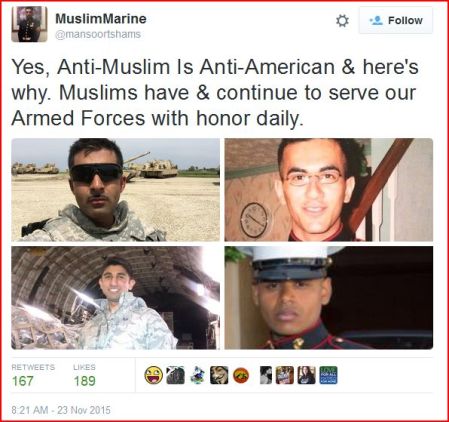
Tweet showing several Muslims serving in U.S. military, in response to calls for Muslims to get "special ID" or be tracked on a "special registry."

Tweet showing several Muslims serving in U.S. military, in response to calls for Muslims to get “special ID” or be tracked on a “special registry.”

Donald Trump keeps talking about a “registry” of Muslims, and forcing them to carry “special identification.”

Several Muslims have taken to Twitter and other social media to note they ALREADY DO carry special ID, and wondering, where is Trump’s?

According to Trump, he performed his military service at a special facility along the Hudson River, before he was 18 — pranking people.

Ouch.

See also:

https://twitter.com/intricateizzy/status/667461728372924416

And be sure you see this:


March 16, Freedoms Day 2015 – How to celebrate James Madison?

March 16, 2015

Celebrations of James Madison, who was born on March 16, 1751, fall to second tier, a paragraph if we’re lucky in your local newspaper’s “today in history” feature.

March 16 is not a holiday.  It’s not even a Flag Flying Day (though, if you left your flag up for March 15th’s anniversary of Maine’s statehood . . . no one would notice).

Secretary of State James Madison, who won Marb...

Secretary of State James Madison, who won Marbury v. Madison, but lost Judicial review. Photo: Wikipedia

Should we leave James Madison out of our celebrations of history with such vengeance?

Madison left a great legacy.  The question is, how to honor it, and him?

  • Madison is known popularly, especially for elementary school history studies (the few that are done anymore), as the Father of the Constitution.  It’s fitting:  Madison engaged in a great, good conspiracy with George Washington and Alexander Hamilton to get the convention to “amend” the Articles of Confederation and create a better, probably stronger, national government.  But Washington stayed behind the scenes, and pulled very few strings Madison didn’t tell him to pull. Hamilton’s support from New York was weak; while Hamilton played a hugely important role in getting the convention called, and in getting New York to ratify the Constitution with the creation of the Federalist Papers project, the day-to-day operation of the convention and direction of the political forces to make it work, fell to Madison.
  • Madison’s notes on the Philadelphia convention give us the best record of the then-secret proceedings. 

    English: James Madison, fourth president of th...

    Notice the error in this caption:  “James Madison, fourth president of the United States wrote the Constitution at his estate near Orange Virginia, called Montpelier. Pictured here after an extensive renovation.” Photo from Wikipedia.  (James Madison didn’t write the Constitution; it was hammered out in Philadelphia, not Montpelier; the patriot and rake Gouverneur Morris wrote out the final draft.)

  • Madison devised the scheme of getting conventions to ratify the Constitution, instead of colonial/state legislatures.  He had Patrick Henry in mind.  Henry opposed any centralized government for the colonies, to the point that he refused to attend the Philadelphia convention when he was appointed a delegate; by the end of the convention, Henry was off to another term as governor where he hoped to orchestrate the defeat of ratification of the constitution in the Virginia legislature.  Madison circumvented that path, but Henry still threw up every hurdle he could.  (Henry organized the anti-federalist forces in the Virginia Convention, and hoping to kill the Constitution, called it fatally flawed for having no bill of rights; when Madison’s organizing outflanked him, especially with a promised to get a bill of rights in the First Congress, Henry blocked Madison’s election to the U.S. Senate, and organized forces to stop his popular election to the U.S. House.  That failed, ultimately, and Madison pushed the legislative package that became the Bill of Rights).
  • Andrew Hamilton started writing a series of newspaper columns, with John Jay, to urge New York to ratify of the Constitution; but after Jay was beaten nearly to death by an anti-federalist mob, Hamilton invited Madison to step in and help.  Madison ended up writing more than Hamilton and Jay put together, in that collection now known as The Federalist Papers.
  • Madison backed down George Mason, and got the great defender of citizens’ rights to add religious freedom to the Virginia Bill of Rights, in 1776.  Religious freedom and freedom of conscience became a life-long crusade for Madison, perhaps moreso than for Thomas Jefferson.
  • A sort of protege of Thomas Jefferson, Madison pushed much of Jefferson’s democratic and bureaucratic reforms through the Virginia legislature, into law.  Especially, it was Madison who stoppped Patrick Henry’s plan to have Virginia put preachers on the payroll, and instead pass Jefferson’s Statute for Religious Freedom into law in 1786.
  • Madison wrote the best defense of American religious freedom in the Memorial and Remonstrance, a petition to the Virginia legislature to get Jefferson’s bill passed.
  • Madison sponsored and passed more Constitutional Amendments than anyone else in history.  We have 27 amendments to our Constitution.  Madison pushed through the first 10, now known as the Bill of Rights.  In the original package proposed out of Congress were a dozen amendments.  One of those became salient again in the late 20th century, and was finally ratified in 1992 — the 27th Amendment.  Madison is the author of 11 of the 27 amendments, including the first ten and the last one.
  • Yeah, James Madison was the defendant in Marbury v. Madison; he made history even when he didn’t do anything
  • Madison is the only president to face enemy gunfire while president, commanding troops on the frontlines during the British invasion of Washington in 1814.
  • Madison took over the creation of the University of Virginia when Jefferson’s death prevented his following through.
  • Madison’s record as an effective, law-passing legislator is rivaled only by Lyndon Johnson among the 43 people we’ve had as president.  Both were masters at get stuff done.
  • Madison is the ultimate go-to-guy for a partner In his lifetime, to the great benefit of his partners, he collaborated with George Washington to get the convention in Philadelphia; he collaborated with Ben Franklin to get Washington to be president of the Philadelphia convention, without which it could not have succeeded; he collaborated with Hamilton on the Constitution and again on the Federalist papers; he collaborated with Jefferson to secure religious freedom in 1776, 1786, and 1789; Madison collaborated with Jefferson to establish our party political system (perhaps somewhat unintentionally), and to get Jefferson elected president; Madison collaborated with Jefferson and Jay to make the Louisiana Purchase; Madison took James Monroe out of the Patrick Henry camp, and brought Monroe along to be a great federalist democrat, appointing Monroe Secretary of State in Madison’s administration, and then pushing Monroe to succeed him as president.  Also, Madison was a prize student of the great John Witherspoon at what is now Princeton; Witherspoon took Madison, studying for the clergy, and convinced him God had a greater calling for him than merely to a pulpit.

As the ultimate Second Man — when he wasn’t the First Man — Madison’s role in history should not be downplayed, not forgotten.

March 16 is Madison’s birthday (“new style”).

What would be fitting ways to celebrate Madison’s life and accomplishments, on his birthday?  Nothing done so far in the history of the Republic adequately honors this man and his accomplishments, nor begins to acknowledge the great debt every free person owes to his work.

Still, there are encouraging stirrings.

(Dolley Madison?  There are two topics for other, lengthy discussions — one on their marriage, and how they worked together; one on Dolley, a power in her own right.)

Previously, at Millard Fillmore’s Bathtub:

More:

Yes, this is mostly an encore post.  Fighting ignorance requires patience.

Yes, this is mostly an encore post. Fighting ignorance requires patience.


January 16 is Religious Freedom Day in the USA

January 16, 2015

Great timing in 2015:  January 16 is Religious Freedom Day in the U.S.  Not a holiday (sadly), Religious Freedom Day commemorates the heritage of religious freedom in the U.S.

Statue of Thomas Jefferson, author of the Virginia Statute for Religious Freedom, in Colonial Williamsburg, Va.

Statue of Thomas Jefferson, author of the Virginia Statute for Religious Freedom, in Colonial Williamsburg, Va.

January 16 is the anniversary of the adoption of the Virginia Statute of Religious Freedom in 1786.  Thomas Jefferson drafted the law in 1779, in his work to create a body of new laws suitable for a new republic based on freedom.  After the Treaty of Paris ended the American Revolutionary War in 1783, the 13 independent states in America continued in a difficult federation.  Patrick Henry in Virginia proposed in 1785 to roll back part of the Virginia Bill of Rights, and reestablish government paychecks to the clergy — partly to fund educated people in towns who could organize schools  in their non-preaching hours, but partly to reestablish the church in government.  Fellow legislator James Madison managed to delay consideration of the bill, urging such important matters needed time to develop public support.

Madison had other ideas.  He composed a petition eventually signed by thousands of Virginians, the Memorial and Remonstrance, defending religious freedom and stating the necessity of separating church and state to preserve religious freedom.  When the legislature reconvened in 1786, Henry had moved on to another term as governor; the legislature rejected Henry’s proposal and instead took up the bill Jefferson proposed earlier, and passed it.

The Virginia Statute for Religious Freedom remains in effect, unaltered, today.  It is generally regarded as the best statement on separation of state and church in law.  Within a year Madison was shepherding the construction of a new charter for the 13 American states that would become the Constitution; and in 1789, Madison proposed a much-refined religious freedom amendment to the U.S. Constitution, which was ratified as the First Amendment in 1791.

Every January 16, we honor the work of defenders of religious freedom, Thomas Jefferson, James Madison, the Virginia Assembly, and all who work today to keep religious freedom alive.

President Barack Obama issued a proclamation for Religious Freedom Day:

RELIGIOUS FREEDOM DAY, 2015

– – – – – – –

BY THE PRESIDENT OF THE UNITED STATES OF AMERICA

A PROCLAMATION

From many faiths and diverse beliefs, Americans are united by the ideals we cherish. Our shared values define who we are as a people and what we stand for as a Nation. With abiding resolve, generations of patriots have fought — through great conflict and fierce debate — to secure and defend these freedoms, irrevocably weaving them deep into the fabric of our society. Today, we celebrate an early milestone in the long history of one of our country’s fundamental liberties.

On January 16, 1786, the Virginia Statute for Religious Freedom was adopted. It was one of the first laws in our Nation to codify the right of every person to profess their opinions in matters of faith, and it declares that “no man shall be compelled to frequent or support any” religion. Drafted by Thomas Jefferson and guided through the Virginia legislature by James Madison, this historic legislation served as a model for the religious liberty protections enshrined in our Constitution.

The First Amendment prohibits the Government from establishing religion. It protects the right of every person to practice their faith how they choose, to change their faith, or to practice no faith at all, and to do so free from persecution and fear. This religious freedom allows faith to flourish, and our Union is stronger because a vast array of religious communities coexist peacefully with mutual respect for one another. Since the age of Jefferson and Madison, brave women and men of faith have challenged our conscience; today, our Nation continues to be shaped by people of every religion and of no religion, bringing us closer to our founding ideals. As heirs to this proud legacy of liberty, we must remain vigilant in our efforts to safeguard these freedoms.

We must also continue our work to protect religious freedom around the globe. Throughout the world, millions of individuals are subjected to discrimination, abuse, and sanctioned violence simply for exercising their religion or choosing not to claim a faith. Communities are being driven from their ancient homelands because of who they are or how they pray, and in conflict zones, mass displacement has become all too common.

In the face of these challenges, I am proud the United States continues to stand up for the rights of all people to practice their faiths in peace. Promoting religious freedom has always been a key objective of my Administration’s foreign policy because history shows that nations that uphold the rights of their people — including the freedom of religion — are ultimately more just, more peaceful, and more successful. In every country, individuals should be free to choose and live their faith based upon the persuasion of the mind — and of the heart and soul. Today, let us continue our work to protect this tradition and advance the cause of religious freedom worldwide.

NOW, THEREFORE, I, BARACK OBAMA, President of the United States of America, by virtue of the authority vested in me by the Constitution and the laws of the United States, do hereby proclaim January 16, 2015, as Religious Freedom Day. I call on all Americans to commemorate this day with events and activities that teach us about this critical foundation of our Nation’s liberty, and that show us how we can protect it for future generations at home and around the world.

IN WITNESS WHEREOF, I have hereunto set my hand this fifteenth day of January, in the year of our Lord two thousand fifteen, and of the Independence of the United States of America the two hundred and thirty-ninth.

BARACK OBAMA

More: 


Bill of Rights is location restricted?

August 20, 2014

MoveOn.org posted this photo on their Facebook page:

First Amendment Area?

First Amendment Area?

I presume (the post doesn’t say) this is a photo from Ferguson, Missouri. I presumed incorrectly.  It’s a sign from the Bundy Ranch standoff.

My first thought was, “Do they have a 2nd Amendment area?”  My second thought was, if we put up signs saying “2nd Amendment Area” will cops enforce it?

It’s probably a violation of prior restraint law, of course.  The sign is an indication of just how bizarre and sick things are in Ferguson, Missouri, at the moment.  It’s also an indication of how bizarre things were at Bundy Ranch.

Tip of the old scrub brush to Randy Creath.


“Some there are”: Antonin Scalia, rock music, and high school graduation in churches

June 17, 2014

Some there are—many, perhaps—who are offended by public displays of religion. Religion, they believe, is a personal matter; if it must be given external manifestation, that should not occur in public places where others may be offended. I can understand that attitude: It parallels my own toward the playing in public of rock music or Stravinsky. And I too am especially annoyed when the intrusion upon my inner peace occurs while I am part of a captive audience, as on a municipal bus or in the waiting room of a public agency.

Justice Antonin Scalia, dissenting to the Supreme Court’s denying to hear a case about high school graduations held in religious facilities, the denial of the writ of certiorari to Elmbrook vs. John Doe et al., 573 U.S. ______.

Justice Clarence Thomas joined Scalia in the dissent.

But, he argues, religion is protected by the First Amendment, our music choices are not.

Read the dissent (way down at the bottom).

Easter services at Elmbrook Church, in Brookfield, Wisconsin.

Easter services at Elmbrook Church, in Brookfield, Wisconsin.

I suppose to some, high school graduation ceremonies are a lot like being forced to listen to rap music at intersections.  To others, high school graduations may seem akin to religious experience.  Not sure either view means the ceremonies should be held in churches.

This case is 14 years in the justice system.

More:


Guns to protect against U.S. government? Constitution doesn’t protect that

May 16, 2014

Today, May 16, 2014, a group of yahoos promises 10 million armed Americans will descend on Washington to force changes in government, maybe depose the President, and have other yahoo fun squealing tires, drinking beer, and scaring good folks with the guns they wave.

They’ll be lucky to have a thousand people show up and politely decline to run afoul of the District of Columbia’s gun laws and the concomitant prison time.

If they stay out of jail, it won’t be because the Constitution protects them.

Yes, the Second Amendment says they have — and you and I have — a right to “keep and bear arms.”

Yahoos, true to their yahoo ways, really don’t read the Constitution thoroughly.  Otherwise, I suspect they’d be more circumspect.

Article III, Section 3, of the Constitution defines using those arms against the government, levying war against the U.S., as “treason.”

Treason against the United States, shall consist only in levying war against them, or in adhering to their enemies, giving them aid and comfort. No person shall be convicted of treason unless on the testimony of two witnesses to the same overt act, or on confession in open court.

Neither the First Amendment nor the Second Amendment excuses treason.

How will today turn out in Washington?  There may be some traffic tie-ups.  There always are. Anything out of the ordinary, though?  Not if citizens use common sense, and stick to the Constitution that protects their protests.

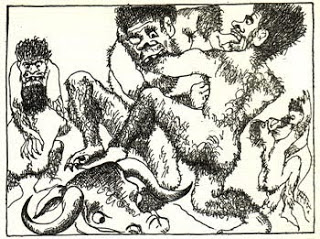
Yahoos, in one of their nicer portrayals from the 1947 edition of Gulliver's Travels.  Image from Wordmall.

Yahoos, in one of their nicer portrayals from the 1947 Crown edition of Gulliver’s Travels; drawing by Luis Quintanilla. Image from Wordmall.

Update:  As of Friday afternoon, the rally fizzled.  Organizers blamed the rain.  Proof that rain falls on the unjust, too?

More:


The mighty pen, revisited

October 30, 2013

Before we completely forget about October 29, and events that occurred on that day of the calendar, let’s pause for a moment to remember the introduction of the ballpoint pen.  We do this because the ballpoint pen was such a symbol of modernity after World War II.  And we do this because hand writing utensils seem to be losing fashion, as does handwriting itself.

Let’s not lose all the history.  I wrote this first back in 2006, commemorating the ballpoint.

2006 was the 100th anniversary of the Mont Blanc company, the company that made fountain pens a luxury item even while fountain pens were still the state of the art of pens.

A Reynolds rocket; this is claimed to be the first version of the ballpoint pen sold, on October 29, 1945, in Gimbel's Department Store in New York City.

A Reynolds rocket; this is claimed to be the first version of the ballpoint pen sold, on October 29, 1945, in Gimbel’s Department Store in New York City.

October 29 is the 68st anniversary (according to CBS “Sunday Morning”) or 69th anniversary (see Wikipedia) of the introduction of the ballpoint pen in the U.S., at Gimbel’s Department Store, in New York City. (I go with 1945.)  It was based on a design devised in 1938 by a journalist named László Bíró. Biro produced his pen in Europe, and then in Argentina. But in the U.S., a businessman named Reynolds set up the Reynolds International Pen Company and rushed to market in the U.S. a pen based on several Biros he had purchased in Buenos Aires.

On October 29, 1945 (or 1946), you could purchase a “Reynolds Rocket” at Gimbel’s for $12.50 — about $130 today, adjusted for inflation.

1946 Reynolds Rocket ballpoint pen, from the collection of James P. Reynolds

1946 Reynolds Rocket ballpoint pen, from the collection of James P. Reynolds

Today I continue my search for a ballpoint or rollerball that will write in green, reliably, for grading.  (Turns out red marks panic a lot of kids; some write in blue, so blue won’t work, nor will black; green is a great grading color.)

I use a Waterman Phileas ballpoint, a Cross Radiance fountain pen, a Cross Radiance rollerball (Radiance was discontinued about a year ago), a full set of Cross Century writing implements, a lot of Sanford Uniballs in various colors, and a lot of Pentel Hybrid K-178 gel-rollers, and some Pilot G-2 gel pens (though the green ink versions are unreliable). I also keep several Marvy calligraphic pens for signing things with a flourish. I have a box of $0.10 ballpoints in a briefcase for students who fail to bring a writing utensil.  (Since 2006, I’ve added a Cross pencil similar to the old Radiance design, and another Cross ballpoint in black (the Waterman is blue); the most reliable green-ink pen I’ve found is a Pilot Bravo, but they are tough to find these days in any color, and green is even togher; plus, they are bold-line instruments.)

Jefferson probably wrote the Declaration of Independence with quills he trimmed himself. Lincoln probably used a form of fountain pen to write the Gettysburg Address, but he had no writing utensil with him when he was assassinated at Ford’s Theatre on April 14, 1865. President Johnson made famous the practice of using many pens to sign important documents, such as the Civil Rights Act of 1964; he made gifts of the pens to people who supported the legislation and worked to get it made into law.

And, who said it? Brace yourself.

Beneath the rule of men entirely great,
The pen is mightier than the sword.

Edward Bulwer-Lytton, Baron Lytton, wrote that, in Richelieu, act II, scene ii, a play he wrote in 1839.

Yes, he is the same Bulwer-Lytton who wrote the novel Paul Clifford in 1840, whose opening line is, “It was a dark and stormy night.”

The first ballpoint pen was sold in the United States on October 29, 1945, a few weeks after the surrender of Japan that ended completely the hostilities of World War II.  It was a good year, and a good time to be writing.  Still is, today.

More:


Banned Books Week, September 22-28, at the University of Utah Bookstore

September 23, 2013

Banned Books Week special at the University of Utah

Banned Books Week special at the University of Utah

Nice mug!

More:


Banned Books Week is coming, September 22-28, 2013

September 18, 2013

Got a stack of banned books ready?

Banned Books Week is September 22-28 for 2013.

Banner for Banned Books Week 2013

So THAT’s what Lady Liberty holds in her left hand. (Reading the Declaration of Indpendence can still get you into trouble in a few places — mostly not in the U.S., but even in the U.S.)

We still have banned books?  Is that bad?

Consider, first, that on September 17, 2013, the Texas State Board of Education opened hearings on science textbooks to be “adopted” for Texas schoolsRadical elements of the SBOE furiously organized to stack rating panels with people who want to censor science, to stop the teaching of Darwin’s work on evolution.  (No, I’m not kidding.)

This comes in the middle of a rancorous fight in Texas over CSCOPE, a cooperative lesson-plan exchange set up by 800 Texas school districts to help teachers meet new Texas education standards adopted years ago (without new books!).  Critics labeled reading lists and any reading on religions other than Christianity “socialist” or “Marxist,” and complained that Texas social studies books do not slander Islam.

Then there is the flap over Persepolis, in Chicago.  With all the other trouble Chicago’s schools have several bluenoses worked to get this graphic “novel” banned (it’s not really a novel; it’s a memoir).  They complained about graphic violence in what is a comic book.  Persepolis tells the story of a young woman growing up in Iran during the Iranian Revolution.

The autobiographical graphic memoir Persepolis by Marjane Satrapi was pulled from Chicago classrooms this past May by Chicago Public Schools CEO Barbara Byrd-Bennett due to “inappropriate” graphic language and images, specifically, scenes of torture and rebellion. Parents, teachers, and First Amendment advocates protested the ban, and as a result — while still pulled from 7th grade — Persepolis is currently under review for use in grades 8-10. (For details, see CBLDF Rises to Defense of Persepolis.)

Persepolis is an important classroom tool for a number of reasons. First, it is a primary source detailing life in Iran during the Revolution and the Iran-Iraq War . Readers of all ages get a glimpse of what life is like under repressive regimes and relive this period in history from a different perspective. It also begs detailed discussion of the separation of church and state. Furthermore, this is a poignant coming-of-age story that all teens will be able to relate to and serves as a testament to the power of family, education, and sacrifice.

In America, textbooks get attacked for telling the truth about Islam and not claiming it is a violence-based faith; and supplemental reading gets attacked when it presents the violence the critics complain was left out of the texts.

We need to think this through.

What banned books have you read lately?

More:

Cover of "Persepolis"

Persepolis has been made into a movie.


Just stay quiet: Poster hoax about the Pledge of Allegiance

September 15, 2013

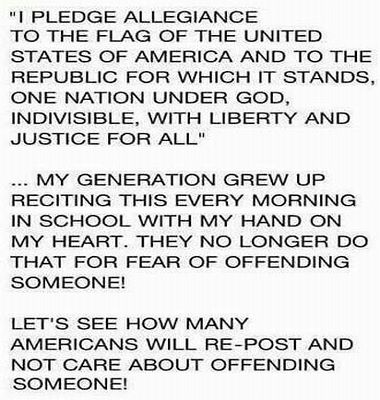
Anybody send this to you on Facebook (100 times, maybe?)

Hoax claims about the Pledge of Allegiance, found on Facebook and innumerable e-mails

Hoax claims about the Pledge of Allegiance, found on Facebook and innumerable e-mails

Clever, eh?  It repeats the McCarthy-era editing of the Pledge of Allegiance, and then comes up with this whopper:

. . . My generation grew up reciting this every morning in school, with my hand on my heart.  They no longer do that for fear of offending someone!

Let’s see how many Americans will re-post and not care about offending someone!

Not quite so long-lived as the Millard Fillmore Bathtub Hoax — which started in 1917 — but a lot more common these days.

Just as false.  Maybe more perniciously so.

Consider:

  1. Actually, 45 of our 50 states require the Pledge of Allegiance in public schools.  The five exceptions:  Iowa, Hawaii, Oklahoma, Vermont and Wyoming.  See any pattern there?
  2. None of the five states previously required the Pledge, and then stopped.
  3. None of the five states claim to not require the pledge in order to avoid offending anyone.  Oklahoma would be happy to offend people on such issues, most of the time.
  4. Reposting historically inaccurate claims, without fear of offending anyone, is no virtue.  It’s just silly.

The creator of that poster is probably well under the age of 50, and may have grown up with the hand-over-heart salute used after World War II.  That was not the original salute, and I’d imagine the author is wholly ignorant of the original and why it was changed.

Students pledging to the flag, 1899, 8th Division, Washington, D.C. Part of the Frances Benjamin Johnston 1890 - 1900 Washington, D.C., school survey.

Wikipedia image and caption: Students pledging to the flag, 1899, 8th Division, Washington, D.C. Part of the Frances Benjamin Johnston 1890 – 1900 Washington, D.C., school survey.

Wikipedia gives a concise history of the salute:

Swearing of the Pledge is accompanied by a salute. An early version of the salute, adopted in 1892, was known as the Bellamy salute. It started with the hand outstretched toward the flag, palm down, and ended with the palm up. Because of the similarity between the Bellamy salute and the Nazi salute, developed later, the United States Congress instituted the hand-over-the-heart gesture as the salute to be rendered by civilians during the Pledge of Allegiance and the national anthem in the United States, instead of the Bellamy salute. Removal of the Bellamy salute occurred on December 22, 1942, when Congress amended the Flag Code language first passed into law on June 22, 1942.

Students in an unnamed school in 1941, offering the Bellamy Salute for the Pledge of Allegiance.

Students in an unnamed school in 1941, offering the Bellamy Salute for the Pledge of Allegiance. Wikipedia image.

One might understand why the Bellamy Salute was changed, during war with Nazi Germany.

Arrogance and ignorance combine to form many different kinds of prejudices, all of them ugly.  The arrogant assumption that only “our generation” learned patriotism and that whatever goes on in schools today is not as good as it was “in our day,” regardless how many decades it’s been since the speaker was in a public school, compounds the ignorance of the fact that since 1980, forced patriotic exercises in schools have increased, not decreased.

Like much about our nation’s troubles, assumptions based on ignorance often are incorrect assumptions.  Consequently, they give rise to what is today clinically known as the Dunning Kruger Effect (or syndrome), so elegantly summed by by Bertrand Russell in the 1930s:

The trouble with the world is that the stupid are cocksure and the intelligent are full of doubt.

Humorously summed up by “Kin” Hubbard:

It isn’t what we don’t know that gives us trouble, it’s what we know that ain’t so.

Ignorance is a terrible disease, but one easily cured, by reading.  We can hope.

More:


Quote of the moment: James Madison, education, or farce and tragedy

August 31, 2013

James Madison Building, Library of Congress -- the official Madison Memorial

James Madison Building of the Library of Congress, the official James Madison Memorial for the nation

A popular Government, without popular information, or the means of acquiring it,
is but a Prologue to a Farce or a Tragedy; or perhaps both.
Knowledge will forever govern ignorance.

And a people who mean to be their own governours,
must arm themselves with the power which knowledge gives.

— James Madison in a letter to W. T. Barry, August 4, 1822

This is an encore post, partly.

Photo of inscription to the left (north) of the main entrance on Independence Ave., of the James Madison Building, Library of Congress, Washington, D.C.

Photo of inscription to the left (north) of the main entrance on Independence Ave., of the James Madison Building, Library of Congress, Washington, D.C.

More: