June 14, 2009
Historic irony: On Flag Day in 1943, the U.S. Supreme Court issued its decision in the case of West Virginia vs. Barnette.

Image 1 - Billy Gobitas explained why he would not salute the U.S. flag, November 5, 1935 - Library of Congress collection
The case started earlier, in 1935, when a 10-year-old student in West Virginia, sticking to his Jehovah’s Witness principles, refused to salute the U.S. flag in a state-required pledge of allegiance. From the Library of Congress:
“I do not salute the flag because I have promised to do the will of God,” wrote ten-year-old Billy Gobitas (1925-1989) to the Minersville, Pennsylvania, school board in 1935. His refusal, and that of his sister Lillian (age twelve), touched off one of several constitutional legal cases delineating the tension between the state’s authority to require respect for national symbols and an individual’s right to freedom of speech and religion.
The Gobitas children attended a public school which, as did most public schools at that time, required all students to salute and pledge allegiance to the flag of the United States. The Gobitas children were members of the Jehovah’s Witnesses, a church that in 1935 believed that the ceremonial saluting of a national flag was a form of idolatry, a violation of the commandment in Exodus 20:4-6 that “thou shalt not make unto thee any graven image, nor bow down to them. . . .” and forbidden as well by John 5:21 and Matthew 22:21. On 22 October 1935, Billy Gobitas acted on this belief and refused to participate in the daily flag and pledge ceremony. The next day Lillian Gobitas did the same. In this letter Billy Gobitas in his own hand explained his reasons to the school board, but on 6 November 1935, the directors of the Minersville School District voted to expel the two children for insubordination.
The Watch Tower Society of the Jehovah’s Witnesses sued on behalf of the children. The decisions of both the United States district court and court of appeals was in favor of the right of the children to refuse to salute. But in 1940 the United States Supreme Court by an eight-to-one vote reversed these lower court decisions and ruled that the government had the authority to compel respect for the flag as a key symbol of national unity. Minersville v. Gobitis [a printer’s error has enshrined a misspelling of the Gobitas name in legal records] was not, however, the last legal word on the subject. In 1943 the Supreme Court by a six-to-three vote in West Virginia State Board of Education v. Barnette, another case involving the Jehovah’s Witnesses, reconsidered its decision in Gobitis and held that the right of free speech guaranteed in the First Amendment to the Constitution denies the government the authority to compel the saluting of the American flag or the recitation of the pledge of allegiance.
There had been strong public reaction against the Gobitis decision, which had been written by Justice Felix Frankfurter (1882-1965). In the court term immediately following the decision, Frankfurter noted in his scrapbook that Justice William O. Douglas (1898-1980) told him that Justice Hugo LaFayette Black (1886-1971) had changed his mind about the Gobitis case. Frankfurter asked, “Has Hugo been re-reading the Constitution during the summer?” Douglas replied, “No–he has been reading the papers.”1 The Library’s William Gobitas Papers showcase the perspective of a litigant, whereas the abstract legal considerations raised by Gobitis and other cases are represented in the papers of numerous Supreme Court justices held by the Manuscript Division.
1. Quoted in H. N. Hirsch, The Enigma of Felix Frankfurter (New York: Basic Books, 1981), 152.
John E. Haynes and David Wigdor, Manuscript Division

Second page, Billy Gobitas's explanation of why he will not salute the U.S. flag: "I do not salute the flag not because I do not love my country but I love my country and I love God more and I must obey His commandments." - Library of Congress
Supreme Court justices do not often get a chance to reconsider their decisions. For example, overturning Plessy vs. Ferguson from 1896 took until 1954 in Brown v. Topeka Board of Education. In the flag salute/pledge of allegiance cases Justice Hugo Black had a change of mind, and when a similar case from West Virginia fell on the Court’s doorstep in 1943, the earlier Gobitis decision was reversed.
Writing for the majority, Justice Robert H. Jackson said:
If there is any fixed star in our constitutional constellation, it is that no official, high or petty, can prescribe what shall be orthodox in politics, nationalism, religion, or other matters of opinion, or force citizens to confess by word or act their faith therein. If there are any circumstances which permit an exception, they do not now occur to us.
Jehovah’s Witnesses, and all other Americans, thereby have the right to refuse to say what they and their faith consider to be a vain oath.
And that, boys and girls, is what the First Amendment means.
Resources:
Spread the word; friends don't allow friends to repeat history.
 10 Comments |
  Advanced Placement, DBQ sources, First Amendment, Historic documents, History, Religion, Religious Freedom | Tagged: Advanced Placement Government, DBQ sources, First Amendment, Flag Day, Historic documents, History, Pledge of Allegiance, Religion, Religious Freedom |
  Permalink
 Posted by Ed Darrell
May 10, 2009
Wired takes a different view of the California case in which an AP history teacher was found to have violated a student’s rights with comments about creationists — at least, different from the view I’ve articulated here. It’s worth a look — and it shows that this case needs to be evaluated more carefully and closely. Alexis Madrigal wrote at Wired’s website:
The teacher got into hot water because the creationism statement came outside the context of his AP European History class. In making the statement during a discussion of another teacher’s views on evolution, the court could not find any “legitimate secular purpose in [the] statement.”
However, Judge Selna found a second statement that Corbett made about creationism did not violate the student’s First Amendment rights, although it’s an equally pointed critique.
“Contrast that with creationists,” Corbett told his class. “They never try to disprove creationism. They’re all running around trying to prove it. That’s deduction. It’s not science. Scientifically, it’s nonsense.”
That statement was OK because it came in the context of a discussion of the history of ideas and religion. Thus, its primary purpose wasn’t just to express “affirmative disapproval” of religion, but rather to make the point that “generally accepted scientific principles do not logically lead to the theory of creationism.” One might expect that if creationism came up in the context of evolutionary biology, it would be similarly OK to say, “Scientifically, it’s nonsense.”
The nuanced decision prompted the judge to append an afterword. Selna explains his thinking a basic right is at issue, namely, “to be free of a government that directly expresses approval of religion.” Just as the government shouldn’t promote religion, he writes, the government shouldn’t actively disapprove of religion either.
It seems to me, still, that the instructor was well within legal bounds. For example, we would not ask a biology instructor to pay deference to the Christian Science view that disease is caused by falling away from God (sin), and not by germs, and consequently that prayer is effective therapy. As a pragmatic matter, Christian Scientists don’t demand that everybody else bow to their view; but in a legal suit, the evidence of Pasteur’s work and subsequent work on how microbes cause disease would trump any claim that Pasteur was “not religiously neutral.”
We still await word on whether the district and teacher will appeal the decision.
Spread the word; friends don't allow friends to repeat history.
2 Comments | Creationism, Education, Evolution, First Amendment, Science, Separation of church and state, Teachers, Teaching | Tagged: AP History, Creationism, Education, Evolution, First Amendment, Separation of church and state, Teaching | Permalink
Posted by Ed Darrell
May 2, 2009
I’ve gotta think about this case some more, but it’s not a good decision.
- From my view as an Advanced Placement teacher, and as a teacher of history, the judge is contradicting Settle v. Dickson in saying, essentially, the student may claim religious exemption to get out of doing the hard work of thinking.
- The judge’s ruling might fairly be said to call into question the entire issue of giving harder-studying high school kids college-level classes, if the serious issues in those classes may not be discussed.
- Claiming that creationism is the root of Christianity is rather dictating Christian beliefs to Christians, and in this case, offensive and incorrect beliefs (most Christian sects do not favor creationism, and only a minority of Christians hold such views, generally contrary to their sect’s theology). Can judges order people to believe something? Can a judge dictate to the many sects of Christianity one false and crazy thing they all must include in their creeds?
The case is C.F. vs. Capistrano United School District et. al. [Dr. James C. Corbett]. The Orange County Register has a story and links to the case decision, with the headline “High School Teacher found guilty of insulting Christians.”
The headline is troubling because it was a civil suit — no “guilty” verdict could be rendered under the law. But with a wacky decision like this, the reporter and copy desk must have been quite discombobulated, enough to let such a bizarre headline sneak by.
Will students flock to our AP classes now, hoping to be able to get out of the work by saying history offends their religion? Ooooh, we could hope!
It’s a very, very strange decision, insulting to scholars, academicians, historians and Christians. Go read it — what do you think?
Other resources:
- Hey, it’s an Orange County, California, newspaper — if you want high entertainment, check out the comments to the article (low information-to-rant quotient, though)
- Earlier articles from The Orange County Register, here, here, here, here, and here
- At Pharyngula, Dr. Myers notes the silliness of the decision, and dares the plaintiff to sue him
- View from The Sandwalk
- A lawyer’s take at Thoughts in a Haystack
Spread the word; friends don't allow friends to repeat history.
8 Comments | Accuracy, Advanced Placement, Creationism, First Amendment, Higher education, History, Religion | Tagged: Academics, Advanced Placement, Creationism, First Amendment, Religion, World history | Permalink
Posted by Ed Darrell
April 22, 2009
WJCT TV and FM in Jacksonville, Florida, has a televised discussion on evolution in the state science standards set for April 23. It’s set for 8 p.m. — Eastern Time, I’m guessing.
From the station’s blog (quoted entirely):

First Coast Forum – Schools, Science, and the State – Thursday, April 23rd at 8pm on 89.9 FM and WJCT TV
The Florida Board of Education recently revised its science standards to require the teaching of evolution. The state legislature has met twice since then, and both times lawmakers have proposed bills requiring a “critical analysis” of this scientific theory. The latest bill— sponsored by Jacksonville Senator Steven Wise—didn’t get far in this year’s session, but this controversial debate is likely to continue. Senator Wise says it’s important to expose students to other ideas such as intelligent design. Critics argue that challenging evolution could open a door for religious doctrine in science classes.
What should our students learn and who should decide? We’ll discuss these issues with local lawmakers, religious experts, teachers, and parents on our next First Coast Forum Schools, Science, and the State, April 23rd at 8pm only on WJCT.
Panelists:
- Steve Goyer – pastor representing OneJax
- Dr. Marianne Barnes, UNF Education Professor
- Stan Jordan, Duval County School Board, former state legislator
- Rachel Raneri, Duval County District School Advisory Council Chair
- David Campbell, Orange Park Ridgeview H.S. teacher
- Quinton White, JU
- Paul Hooker of the Presbytery of St. Augustine
Viewers can participate in First Coast Forum
Email questions and comments to firstcoastforum@wjct.org or by calling (904) 358-6347 during the program.
Spread the word; friends don't allow friends to repeat history.
Leave a Comment » | Creationism, Evolution, First Amendment, Free speech, Government, Intelligent Design, Religion, Science, State school boards, Television, Textbook Selection, Textbooks | Tagged: Creationism, Debate, Evolution, First Amendment, Florida, Government, Intelligent Design, Religion, Science, State Science Standards | Permalink
Posted by Ed Darrell
April 9, 2009
Why is this an issue again?
Here’s the encore post of the original 2006 post quoting Jefferson on the topic of religious freedom, and what it means.
Can we lay off Obama now? It’s no slam on America that he knows U.S. history better than most of us. It’s encouraging.
Spread the word; friends don't allow friends to repeat history.
34 Comments | America's founding, Barack Obama, Bill of Rights, Civil Rights, First Amendment, History, Religion, Religious Freedom, Thomas Jefferson | Tagged: Barack Obama, Bill of Rights, Christian nation, First Amendment, History, Religion, Religious Freedom, Thomas Jefferson | Permalink
Posted by Ed Darrell
March 19, 2009
Any Texas student who had hoped to get out of the one-minute silence exercise suffered a defeat on St. Patrick’s Day. A three-judge panel of the Fifth Circuit Court of Appeals sustained a Texas federal court’s ruling that the state-mandated moment of silence is legal.
Edith Brown Clement wrote the decision for the panel, in Croft vs. Texas (the link is to a .pdf of the decision).
David and Shannon Croft, as parents and next friends of their three minor children (collectively, the “Crofts”), bring suit against the governor of the state of Texas, Rick Perry (“Perry”), arguing that Texas Education Code § 25.082(d) is an unconstitutional establishment of religion. The district court granted summary judgment in favor of Perry, holding that § 25.082(d) had a secular legislative purpose and was not an establishment of religion. For the following reasons, we affirm.
* * * * * *
Conclusion
The Crofts have standing to challenge the 2003 Amendments. But the Amendments are constitutional and satisfy all three prongs of the Lemon analysis. There is no excessive entanglement, and the primary effect of the Amendments is not to advance religion. The most difficult prong—for this and for moment of silence statutes generally—is legislative purpose. But our review of legislative history is deferential, and such deference leads to an adequate secular purpose in this case. While we cannot allow a “sham” legislative purpose, we should generally defer to the stated legislative intent. Here, that intent was to promote patriotism and allow for a moment of quiet contemplation. These are valid secular purposes, and are not outweighed by limited legislative history showing that some legislators may have been motivated by religion. Because the 2003 Amendments survive the Lemon test, they are not an unconstitutional establishment of religion, and the judgment of the district court is AFFIRMED
We covered the original trial court decision here at the Bathtub.
Not much news coverage of the story, not so much as I would have thought (many Texas schools are on break this week). No firm word on whether the Crofts will appeal further. An Illinois case went the other way in January — enough conflict to get the Supreme Court involved? Difficult to say. The Illinois Legislature is working to undo the federal court decision, in Illinois.
Would it be a good case to cover in government? What do you think?
What should the students meditate on? A suggestion from the comments at the Dallas Morning News blogsite:
“May we please have a moment of science, for those poor souls that cannot understand evolution as God’s scientific method.”
Joseph Cassles
Spread the word; friends don't allow friends to repeat history.
3 Comments | Bill of Rights, First Amendment, History, Jurisprudence, Justice, Law, Religion, School prayer, Separation of church and state, U.S. Constitution | Tagged: Bill of Rights, Court Decision, History, Law, Moment of Silence, School prayer, Separation of church and state, U.S. Constitution | Permalink
Posted by Ed Darrell
January 21, 2009
Teachers are public employees (most of us). Should we blog about education and teaching?
Interestingly, there is a good case to be made that public employees have more First Amendment protection than private employees (should teachers in KIPP, charter and parochial schools blog?).
Larry Solum at Legal Theory highlights Paul Secunda’s article:
Paul M. Secunda (Marquette University – Law School) has posted Blogging While (Publicly) Employed: Some First Amendment Implications (University of Louisville Law Review, Vol. 47, No. 4, 2009) on SSRN.
I’ll wager most teachers are not common users of SSRN, so let’s steal Solum’s posting of the abstract of the article, too:
While private-sector employees do not have First Amendment free speech protection for their blogging activities relating to the workplace, public employees may enjoy some measure of protection depending on the nature of their blogging activity. The essential difference between these types of employment stems from the presence of state action in the public employment context. Although a government employee does not have the same protection from governmental speech infringement as citizens do under the First Amendment, a long line of cases under Pickering v. Bd. of Education have established a modicum of protection, especially when the public employee blogging is off-duty and the blog post does not concern work-related matters.
Describing the legal protection for such public employee bloggers is an important project as many employers recently have ratcheted up their efforts to limit or ban employee blogging activities while blogging by employees simultaneously continues to expand. It should therefore not be surprising that the act of being fired for blogging about one’s employer has even led to a term being coined: “dooced.” So the specific question that this essay addresses is: do dooced employees have any First Amendment protection in the workplace? But the larger issue examined by implication, and the one addressed by this Symposium, is the continuing impact of technology on First Amendment free speech rights at the beginning of the 21st Century.
This contribution to the Symposium proceeds in three parts. It first examines the predicament of private-sector employees who choose to blog about their workplaces. The second section then lays out the potential First Amendment free speech implications for public employees who engage in the same types of activities. Finally, the third section briefly considers a potential future trend in this context from Kentucky involving government employers banning employee access to all blogs while at work.
I’ve been wondering where are the cases of student blogs dealing with serious First Amendment issues. I think we’re overdue for more litigation in that area.
Spread the word; friends don't allow friends to repeat history.
4 Comments | First Amendment, Free press, Free speech, U.S. Constitution, Weblogs | Tagged: blogging, First Amendment, Free speech, Public Employees, Teachers | Permalink
Posted by Ed Darrell
October 14, 2008
Law professor Stanley Fish tackled the issues around teachers wearing campaign buttons in the classroom, at his blog with the New York Times.
Fish says teachers don’t have a free speech right to wear buttons supporting their favorite candidates.
My point is made for me by William Van Alstyne, past President of the AAUP and one of the world’s leading authorities on the first amendment. In a letter to current president Nelson, Van Alstyne corrects his view that faculty “have a first amendment right” to wear campaign buttons. “I have no doubt at all,” he declares, “that a university rule disallowing faculty members from exhibiting politically-partisan buttons in the classroom is not only not forbidden by the first amendment; rather, it is a perfectly well-justified policy that would easily be sustained against a faculty member who disregards the policy.”
Right! It’s no big deal. It’s a policy matter, not a moral or philosophical matter, and as long as the policy is reasonably related to the institution’s purposes, it raises no constitutional issues at all. On Oct. 10, the United Federation of Teachers filed suit to reverse the button ban, claiming that the free speech rights of teachers had been violated. If that’s their case, they’ll lose.
I think he’s right — check out his post, and tell us what you think.
Spread the word; friends don't allow friends to repeat history.
4 Comments | Campaigns, Citizenship, Civil Rights, Classroom management, First Amendment, Free speech, Freedom - Political, Politics, U.S. Constitution | Tagged: Classroom campaigning, Constitutional Rights, Election 2008, First Amendment, Free speech, Politics, Teachers | Permalink
Posted by Ed Darrell
October 10, 2008
This is where we are: Marylanders who exercised their rights guaranteed under the First Amendment, peacefully gathering to call for changes in law, were labeled “terrorists” by the Maryland State Police, and reported to federal databases that way.
Do you wonder why you get searched every time you fly? Remember that letter you wrote to your Congressman complaining about high taxes? Remember that phone conversation with your brother-in-law over whether either of you would serve in the military today, without the threat of a draft?
Remember that time you taught the Cub Scouts how to fold the flag?
All of these things used to thought of as patriotic participation in government by citizens. But not any more.
All of these things are protected under the First Amendment. But if you use those First Amendment rights, and you’re in Maryland, watch out.
The abuses of the system were discovered and exposed by the Maryland attorney general.
And if you don’t live in Maryland? That doesn’t make you safe. It only means your state’s attorney general has not investigated what the cops are doing.
Your vote on November 4 is important.
You can also vote in a poll at the Baltimore Sun, asking whether such surveillance is okay. (No, it’s not.)
Below the fold: The New York Times editorial on the issue. Also, the editorial from the Baltimore Sun.
Read the rest of this entry »
Spread the word; friends don't allow friends to repeat history.
Leave a Comment » | Civil Rights, Dissent, First Amendment, History, Politics, U.S. Constitution | Tagged: ACLU, Civil Rights, Dissent, First Amendment, History, Maryland, Police, Spying, Terrorism, U.S. Constitution | Permalink
Posted by Ed Darrell
October 1, 2008
As we ponder how to keep freedom in America in the middle of Banned Books Week, I worry about the dangers of vigilantes acting to effect a ban on a particular book, despite official actions.
How to fight these anti-reading, anti-American vigilantes? People in Lewiston, Maine, came up with the fantastic idea of simply buying more books.
Vigilantes sometimes check out the books they want to ban, and then simply don’t bring the book back to the library. If there’s no book on the shelf to be checked out, they reason, no one else can check it out. One such vigilante in Lewiston, an activist in favor of homophobia it appears, refused even a court order to return the book she wanted to ban, Robie Harris’s It’s Perfectly Normal.

Cover of Robie Harris's children's health book, It's Perfectly Normal
Jail time for the vigilante? Oh, the law would allow that. But instead, freedom fighters purchased four more copies of the book for the library.
Voting with ideas. What a concept!
Full text of the American Library Association press release, below the fold.
Read the rest of this entry »
Spread the word; friends don't allow friends to repeat history.
54 Comments | Banned Books, Books, Civil Rights, Education, First Amendment, Free press, Freedom - Political, Freedom of Information, Freedom of the Press, Human Rights, Libraries, literacy, Literature, Politics, U.S. Constitution | Tagged: Banned Books Week, Books, Education, First Amendment, freedom, Human Rights, Libraries, Media, Politics, Vigilantes | Permalink
Posted by Ed Darrell
September 16, 2008
It takes guts, but some Alaskans are protesting their governor’s campaign. They plan to use their First Amendment Rights while they can.
Description here, at the venerable Mudflats blog. Is it true that this protest against Palin was the largest political rally in Alaska, ever?
Photos of some truly original protest signs here, at Mamadance.
Spread the word; friends don't allow friends to repeat history.
1 Comment | Campaigns, Elections, First Amendment, History, Politics, Presidents | Tagged: Campaign, Elections, First Amendment, McCain 2008, Politics, Presidents, Sarah Palin | Permalink
Posted by Ed Darrell
September 4, 2008
Sometimes you have to wonder if people are really that stupid, or if they are acting stupid for nefarious purposes.
The inveterate trash purveyor, World Net Daily, carried a column with this headline: “Texas to teachers: Bible will be taught.“
It’s what you’d expect out of Texas, sort of, an order from the state to those darned secularists and atheists in the teaching biz, forcing them to teach the Bible to yearning-for-scripture chilluns.
But the story gets it almost exactly backwards: Texas’s Attorney General ruled that schools do NOT need to offer special electives in the Bible under a new state law.
And to the consternation of Bible thumpers everywhere, it appears that instead of Bible study, tough academic courses that may include serious literary and history criticism of scripture will fill the bill.
The post here at the Bathtub was headlined, “Texas AG rules: Bible classes not required.” In the Houston Chronicle, religionists got what might be their most favorable headline, “‘Bible bill’ for Texas schools up for interpretation,” though the body of the story made things pretty clear, I thought. The Fort Worth Star-Telegram was clear: “Texas Schools don’t have to offer Bible class, attorney general says.”
The staid, conservative Dallas Morning News said “Bible study class optional for Texas schools, attorney general says.” The Austin American-Statesman: “Bible course not mandated, but instruction is.”
The opinion, over the signature of Texas Attorney General Greg Abbot, includes this clue to reporters: ” . . . the Legislature did not mandate that this curriculum instruction be provided in independent courses.”
So, how did World Net Daily get a story almost completely perpendicular to the facts? Perhaps they hope that some hapless Texas school district superintendent or board member will read their story, and not the AG’s decision, and order a Bible class. Especially if that class is the academically-discount version suggested by WND, from National Council on Bible Curriculum in Public Schools in Greensboro, North Carolina, there is likely to be litigation — the school district will get sued and lose its shirt.
Who wins then? WND gets to report on the story and editorialize.
It’s interesting that at least two people who know better got suckered in, Ed Brayton and P. Z. Myers. If they can be fooled by WND, what school superintendent in Texas can be safe? Heaven knows what schools in other states might do.
You may want to check out:
Spread the word; friends don't allow friends to repeat history.
1 Comment | Bill of Rights, Education, Education quality, First Amendment, Law, News, Politics, Religion, Texas, Texas Education Agency (TEA), Texas Lege, Weblogs | Tagged: Bible courses, Education, First Amendment, Media, Politics, Religion, Texas | Permalink
Posted by Ed Darrell
August 30, 2008
We celebrate Banned Books Week September 27 through October 4 this year. Well, maybe it’s more accurate to say we celebrate the books that get banned, and the idea that freedom and liberty require that we not ban books.

Banned Books Week image from Tattered Cover Book Store in Denver
Banned Books Week has been noted every year since 1982 in a long-running campaign from the American Library Association. Why?
Because ideas matter. The right to express ideas, and the right to be able to read ideas, are at the foundation of our liberties.
Again in 2007, books most frequently targeted for banning include And Tango Makes Three, a delightful children’s story about two penguins taking care of an orphaned egg (too much like homosexuality), and Mark Twain’s powerful, essentially-American novel that makes the case against racism, The Adventures of Huckleberry Finn (ironically, because complainants claim to find the book racist).
People who ask that these books be pulled from the shelves often fail to recognize the irony — why should we ban a book about caring for orphans, or the book that makes the case against racism?
The Tattered Cover Book Store in Denver sponsors an annual Banned Books Week essay contest for Colorado teens, in conjunction with the Colorado Freedom of Expression Foundation.
How will your school and local public library commemorate Banned Books Week? Which banned books will you read, and urge others to read?
Which banned books are on your reading lists for classroom use? Does that strike a little too close to home? Then you need to get informed, and get active.
Spread the word; friends don't allow friends to repeat history.
3 Comments | Bill of Rights, Books, Censorship, Education, First Amendment, Free press, Free speech, Freedom of the Press, History, Libraries, Literature, Politics, Racism | Tagged: And Tango Makes Three, Banned Books Week, Books, First Amendment, Libraries, Mark Twain, Politics | Permalink
Posted by Ed Darrell
August 17, 2008
At American Creation, Tom Van Dyke looks at the questions paster Rick Warren asked Sen. John McCain and Sen. Barack Obama, with an eye to history.
George Washington probably would have flunked the test, had he been on the dais yesterday, Van Dyke notes.
Santayana’s Ghost shifts nervously.

"Washington Bible" - image from the Masonic Library and Museum
Spread the word; friends don't allow friends to repeat history.
Leave a Comment » | Elections, First Amendment, History, McCain 2008, Obama 2008, Politics, Religion, Santayana's ghost, Separation of church and state | Tagged: 2008 Election, Barack Obama, History, John McCain, Politics, Religion, Santayana's ghost, Separation of church and state | Permalink
Posted by Ed Darrell
July 31, 2008
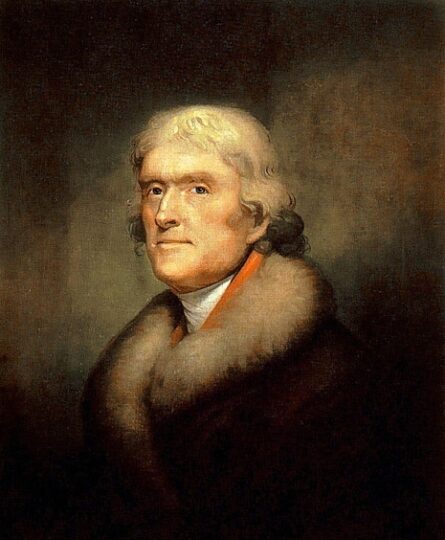

August 1, 2006
*
In his Autobiography Jefferson recounted the 1786 passage of the law he proposed in 1779 to secure religious freedom in Virginia, the Statute for Religious Freedom:
The bill for establishing religious freedom, the principles of which had, to a certain degree, been enacted before, I had drawn in all the latitude of reason and right. It still met with opposition; but, with some mutilations in the preamble, it was finally passed; and a singular proposition proved that its protection of opinion was meant to be universal. Where the preamble declares, that coercion is a departure from the plan of the holy author of our religion, an amendment was proposed, by inserting the word “Jesus Christ,” so that it should read, “a departure from the plan of Jesus Christ, the holy author of our religion;” the insertion was rejected by a great majority, in proof that they meant to comprehend, within the mantle of its protection, the Jew and the Gentile, the Christian and the Mahometan, the Hindoo, and the Infidel of every denomination.
Life and Selected Writings of Thomas Jefferson, Modern Library 1993 edition, pp. 45 and 46.
* Image is a photo of detail from a painting of Jefferson by Rembrandt Peale, courtesy of the New York Historical Society by way of the Library of Congress.
[Encore post from August 1, 2006]
Save
Save
Spread the word; friends don't allow friends to repeat history.
2 Comments | 1787, America's founding, Bill of Rights, Civil Rights, Famous quotes, First Amendment, History, Law, Quotes, Religion, Religious Freedom, U.S. Constitution | Tagged: Civil Rights, First Amendment, History, Law, Quotes, Religion, Thomas Jefferson, U.S. Constitution | Permalink
Posted by Ed Darrell





 Millard Fillmore's Bathtub