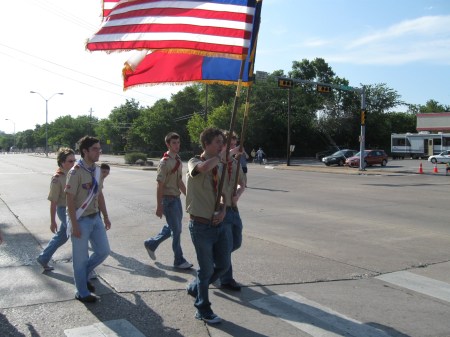
Scouts from Troop 355 and Pack 494 carry the colors in the Duncanville, Texas, 4th of July parade
Scouts from Troop 355 and Pack 494 carry the colors in the Duncanville, Texas, 4th of July parade
 Leave a Comment » |
  4th of July, Boy Scouts of America, Flag ceremony, Flag etiquette, Fly your flag today, History | Tagged: Boy Scouts of America, Duncanville Texas, Flag etiquette, July 4 |
  Permalink
 Posted by Ed Darrell
June 14th marks the anniversary of the resolution passed by the Second Continental Congress in 1777, adopting the Stars and Stripes as the national flag.
Fly your flag today. This is one of the score of dates upon which Congress suggests we fly our flags.

Flag Day 1916, parade in Washington, D.C. - employees of National Geographic Society march - photo by Gilbert Grosvenor
The photo above drips with history. Here’s the description from the National Geographic Society site:
One hundred and fifty National Geographic Society employees march in the Preparedness Parade on Flag Day, June 14, in 1916. With WWI underway in Europe and increasing tensions along the Mexican border, President Woodrow Wilson marched alongside 60,000 participants in the parade, just one event of many around the country intended to rededicate the American people to the ideals of the nation.
Not only the anniversary of the day the flag was adopted by Congress, Flag Day is also the anniversary of President Dwight Eisenhower’s controversial addition of the words “under God” to the Pledge of Allegiance in 1954.
(Text adapted from “:Culture: Allegiance to the Pledge?” June 2006, National Geographic magazine)
The first presidential declaration of Flag Day was 1916, by President Woodrow Wilson. Wilson won re-election the following November with his pledge to keep America out of World War I, but by April of 1917 he would ask for a declaration of war after Germany resumed torpedoing of U.S. ships. The photo shows an America dedicated to peace but closer to war than anyone imagined. Because the suffragettes supported Wilson so strongly, he returned the favor, supporting an amendment to the Constitution to grant women a Constitutional right to vote. The amendment passed Congress with Wilson’s support and was ratified by the states.
The flags of 1916 should have carried 48 stars. New Mexico and Arizona were the 47th and 48th states, Arizona joining the union in 1913. No new states would be added until Alaska and Hawaii in 1959. That 46-year period marked the longest time the U.S. had gone without adding states, until today. No new states have been added since Hawaii, more than 49 years ago. (U.S. history students: Have ever heard of an essay, “Manifest destiny fulfilled?”)
150 employees of the National Geographic Society marched, and as the proud CEO of any organization, Society founder Gilbert H. Grosvenor wanted a photo of his organization’s contribution to the parade. Notice that Grosvenor himself is the photographer.
I wonder if Woodrow Wilson took any photos that day, and where they might be hidden.
History of Flag Day from a larger perspective, from the Library of Congress:
Since 1916, when President Woodrow Wilson issued a presidential proclamation establishing a national Flag Day on June 14, Americans have commemorated the adoption of the Stars and Stripes by celebrating June 14 as Flag Day. Prior to 1916, many localities and a few states had been celebrating the day for years. Congressional legislation designating that date as the national Flag Day was signed into law by President Harry Truman in 1949; the legislation also called upon the president to issue a flag day proclamation every year.
According to legend, in 1776, George Washington commissioned Philadelphia seamstress Betsy Ross to create a flag for the new nation. Scholars debate this legend, but agree that Mrs. Ross most likely knew Washington and sewed flags. To date, there have been twenty-seven official versions of the flag, but the arrangement of the stars varied according to the flag-makers’ preferences until 1912 when President Taft standardized the then-new flag’s forty-eight stars into six rows of eight. The forty-nine-star flag (1959-60), as well as the fifty-star flag, also have standardized star patterns. The current version of the flag dates to July 4, 1960, after Hawaii became the fiftieth state on August 21, 1959.
Fly your flag with pride today.
Elmhurst Flag Day 1939, DuPage County Centennial - Posters From the WPA
Elmhurst flag day, June 18, 1939, Du Page County centennial / Beauparlant.
Chicago, Ill.: WPA Federal Art Project, 1939.
By the People, For the People: Posters from the WPA, 1936-1943
7 Comments | Flag ceremony, Flag etiquette, Fly your flag today, History, History images, World War I | Tagged: Flag Day, Flag etiquette, Fly your flag today, History | Permalink
Posted by Ed Darrell

Hoisting the flag at Guantanamo, Cuba, June 12, 1898. Edward H. Hart, photographer. Image from the American Memory Collection at the Library of Congress
Oh, it’s important in retrospect, no?
On June 10, 1898, U.S. Marines landed at Guantánamo Bay. For the next month, American troops fought a land war in Cuba that resulted in the end of Spanish colonial rule in the Western Hemisphere. Cuban rebels had gained the sympathy of the American public while the explosion and sinking of the U.S.S. Maine, widely blamed on the Spanish despite the absence of conclusive evidence, further boosted American nationalistic fervor.
On June 12, the area was secured and the flag posted.
1 Comment | 1898, Flag ceremony, foreign affairs, History, History images, Spanish American War, War | Tagged: 1898, Cuba, foreign affairs, Guantanamo Bay, History images, Spanish American War, U.S. Flag | Permalink
Posted by Ed Darrell
Please fly your flag today. 
Memorial Day, traditionally observed on May 30, now observed the last Monday in May, honors fallen veterans of wars. Traditionally, family members visit the cemetery where loved ones are interred and leave flowers on the grave.
On Memorial Day itself, flags on poles or masts should be flown at half-staff from sunrise to noon. At noon, flags should be raised to full-staff position.
When posting a flag at half-staff, the flag should be raised to the full-staff position first, with vigor, then slowly lowered to half-staff; when retiring a flag posted at half-staff, it should be raised to the full staff position first, with vigor, and then be slowly lowered. Some people attach black streamers to stationary flags, though this is not officially recognized by the U.S. Flag Code.
Got another week of school? Here’s a quiz about the history of Memorial Day that might make a warm-up, provided by Carolyn Abell writing in the Tifton (Georgia) Gazette:
1. Memorial Day was first officially proclaimed by a general officer. His name was: A. Robert E. Lee; B. John A. Logan; C. Douglas MacArthur D. George Washington.
2. The first state to officially recognize Memorial Day was A. Virginia; B. Rhode Island; C. New York; D. Georgia.
3. The use of poppies to commemorate Memorial Day started in A. 1870 B. 1915 C. 1948; D. 1967.
4. The original date of Memorial Day was A. May 30; B. July 4; C. May 28; D. Nov 11.
5. Which U.S. Senator has tried repeatedly to pass legislation that would restore the traditional day of Memorial Day observance? A. John McCain B. Ted Kennedy C. Saxby Chambliss D. Daniel Inouye.
The answers, again provided by the Tifton Gazette:
OK, now for the answers. General John Logan, national commander of the Grand Army of the Republic, proclaimed May 30, 1968 as Memorial Day in his General Order Number 11, issued on May 5, 1868. The purpose was to honor the dead from both sides in the War Between the States. Subsequently flowers were placed on the graves of both Union and Confederate soldiers in Arlington National Cemetery on May 30 of that year.
New York was the first state to officially recognize the Memorial Day, in 1873. Southern states, though paying tribute to their dead on separate dates, refused to use May 30 as the official date until after World War I, when the holiday was broadened to honor those who died in any war.
In 1915 a woman named Moina Michael, inspired by the poem, “In Flanders Fields,” (by Canadian Colonel John McRae) began wearing red poppies on Memorial Day to honor our nation’s war dead. The tradition grew and even spread to other countries. In 1922 the VFW became the first veterans’ organization to sell the poppies made by disabled veterans as a national effort to raise funds in support of programs for veterans and their dependents. In 1948 the US Post Office issued a red 3-cent stamp honoring Michael for her role in founding the national poppy movement.
As stated above, May 30 was the original Memorial Day. In 1971, with the passage of the national Holiday Act, Congress changed it so that Memorial Day would be celebrated on the last Monday of May. Some citizens feel that turning it into a “three-day weekend” has devalued the importance and significance of this special holiday. In fact, every time a new Congress has convened since 1989, Senator Daniel Inouye of Hawaii has introduced a bill to the Senate calling for the restoration of May 30th as the day to celebrate Memorial Day.
In his 1999 introductory remarks to the bill, Senator Inouye declared:
“Mr. President, in our effort to accommodate many Americans by making the last Monday in May, Memorial Day, we have lost sight of the significance of this day to our nation. Instead of using Memorial Day as a time to honor and reflect on the sacrifices made by Americans in combat, many Americans use the day as a celebration of the beginning of summer. My bill would restore Memorial Day to May 30 and authorize the flag to fly at half mast on that day.
In addition, this legislation would authorize the President to issue a proclamation designating Memorial Day and Veterans Day as days for prayer and ceremonies honoring American veterans. This legislation would help restore the recognition our veterans deserve for the sacrifices they have made on behalf of our nation.” (from the 1999 U.S. Congressional Record).

Other sources:
3 Comments | Citizenship, Flag ceremony, Flag etiquette, Fly your flag today, Heroes, History, Holidays, Patriotism, veterans, War | Tagged: Citizenship, Flag etiquette, Fly your flag today, Heroes, Memorial Day, Patriotism, veterans, War | Permalink
Posted by Ed Darrell
At The Firing Line.com, you can discuss all things firearms. But discussions on patriotic displays are “off topic.”
And, by the way, if you are curious about how to properly fold the Ohio state flag, or any other state flag, you’ll find links to the instructions courtesy of Millard Fillmore’s Bathtub, here.
There’s no requirement that a firearms site allow discussions of flag folding and flag display, but cutting off the discussion seems a little curt, to me.

Ohio and U.S. flags fly at a Cleveland courthouse. Photo by Gretchenaro, Scene in Cleveland
1 Comment | Flag ceremony, Flag etiquette, Patriotism, Politics, State flag | Tagged: Flag etiquette, Folding the Ohio flag, Patriotism, Politics | Permalink
Posted by Ed Darrell
With this blog’s occasional focus on flag etiquette and my concern for faux patriotism, I’ve been getting barbs all day on a story out of Clark County, Nevada (home of Las Vegas).
It’s a threefer of hatred, slamming President Obama, teachers, and public schools, all at once. Plus it is rather disrespectful of the U.S. flag.
The Clark County School District calls the story “bogus!!” with the exclamation points clear. Spokesmen for the district complain they’ve been fielding calls all day, none with details. Their check of the district’s schools turns up nothing.
The claim is that an elementary school student wants to drop out of school after being “forced” to say the Pledge of Allegiance to a picture of President Barack Obama backed by several U.S. flags.
Bloggers fume. “The gall!”
Press spokesmen for the district say they encourage parents to call any principal of any school in the district with any complaint. A survey of principals finds none who knew of such a complaint.
None of the bloggers bothered to check the facts, it appears. The story so far checks out to be a hoax. No one can name the school, no one can name the kid, no one can corroborate the story.

U.S.. Nevada and Clark County flags fly at Moapa Valley High School in the Clark County School District, Nevada. Wikipedia image
Students in Clark County schools say the Pledge of Allegiance every morning as a usual practice. School officials were unsure whether this is done by state law, district ordinance, or tradition. Through much of the 20th century, it was common for schools to have a picture of the sitting president in every classroom. That tradition fell to budget cuts years ago.
What motivates people to invent such stories? What motivates bloggers to spread stories without bothering to make the simplest check to see whether the story is accurate? One of the things that screams “Hoax!” in this story is the complete inaction of the student and parent. Were they worked up about it, why didn’t they bother to complain?
Here’s the wall of shame, bloggers who got suckered and repeated the story without bothering to check it out (isn’t it odd that they all seem to know exactly what photo of Obama was used, and they show it on their blogs, but they don’t know where it was used? Isn’t it odd that they use a color photo while saying it was projected on an overhead projector, which would turn that photo into gray and white mush?):
I’ll wager that’s just the tip of a very mean-spirited iceberg of calumny.
Update, January 30 – More hate-filled spreading of the story:
Still the gullible fall, on February 1:
Nearly responsible skepticism:
I spoke again with David Roddy at the Clark County School District offices. He confirmed that as of late this afternoon (January 30) no one had stepped forward to identify the school where the event is alleged to have occurred, nor the name of anyone involved, nor any other fact that could be corroborated to vouch for the accuracy of the story.
See “7 Signs of Bogus History.” Notice any of these characteristics in this story’s allegations?
Update, September 5, 2009: No evidence of this event has ever been produced outside of the original two anonymous blog posts. My investigation found no such incident in any school in or around Las Vegas, nor anywhere else. Pure hoax.
Don’t let others be misled; spread the word:


34 Comments | Barack Obama, Flag ceremony, Flag etiquette, Hoaxes, Pledge to the flag, President Obama, Teachers, Teaching, Urban Legend, War on Education | Tagged: Barack Obama, Bloggers, Flag etiquette, Hoaxes, Las Vegas, Pledge of Allegiance, Teachers, urban legends, US Flag | Permalink
Posted by Ed Darrell

The United States Armed Forces Color Guard presents the American flag and the different U.S. military service flags at the opening ceremony for the 55th Presidential Inauguration, "A Celebration of Freedom," near the Ellipse in Washington, D.C., Jan. 19, 2005. More than 5,000 service members will take part in the 55th Presidential Inauguration. Defense Dept. photo by U.S. Air Force Tech. Sgt. Tracy DeMarco
The law asks us to do it, but we only get the chance every four years.
Fly your flag today for the inauguration of the president, Barack Obama.
The flag flying today bears 50 stars, the 50th in honor of Obama’s birth state, Hawaii.
Today is one of those days we get to see the flag displayed with scrupulous attention paid to the proper methods of display. If you see a flag attached to an automobile, for example, it will probably be on a special attachment on the right front fender of the vehicle, as the Flag Code suggests. The free-for-all flag display methods of small town Fourth of July parades will be reined in. At least, we hope so.
Fly your flag today — you’ll be glad you did.
Resources:
1 Comment | Barack Obama, Flag ceremony, Flag etiquette, Fly your flag today, History, President Obama, Presidents | Tagged: Barack Obama, Flag etiquette, Fly your flag today, History, Inauguration | Permalink
Posted by Ed Darrell
Got another e-mail today, alleging that Illinois Sen. Barack Obama refuses to salute the U.S. flag or say the Pledge of Allegiance.
I was surprised to discover that the U.S. Senate has added the pledge to their opening exercises — new from when I staffed the Senate. But, what that means, with C-SPAN televising the proceedings, is that there is video evidence of Sen. Obama leading the pledge, if he does, when he substitutes for the presiding officer (the Vice President) in the Senate.
On June 21, 2007, for example, Obama presided over the Senate. See for yourself.
4 Comments | Campaigns, Flag ceremony, Flag etiquette, Hoaxes, Obama 2008, Pledge to the flag, Presidents | Tagged: Campaign 2008, Flag etiquette, Hoaxes, Obama, Pledge of Allegiance, US Flag | Permalink
Posted by Ed Darrell

Fireworks on the Mall, Washington, D.C.
July 4, 2006
Iwo Jima Memorial in the foreground; Washington Monument in background
1 Comment | Flag ceremony, Flag etiquette, Fly your flag today, Patriotism | Tagged: Flag etiquette, Fourth of July, Patriotism | Permalink
Posted by Ed Darrell
(Much of this is reprise from Memorial Day 2007)
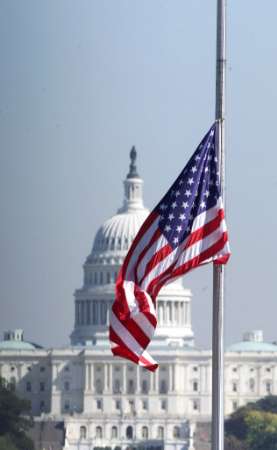
You may fly your flag the entire weekend. Please fly your flag today.
Memorial Day, traditionally observed on May 30, now observed the last Monday in May, is a day to honor fallen veterans of wars. Traditionally, family members visit the cemetery where loved ones are interred and leave flowers on the grave.
On Memorial Day itself, flags on poles or masts should be flown at half-staff from sunrise to noon. At noon, flags should be raised to full-staff position.
When posting a flag at half-staff, the flag should be raised to the full-staff position first, with vigor, then slowly lowered to half-staff; when retiring a flag posted at half-staff, it should be raised to the full staff position first, with vigor, and then be slowly lowered. Some people attach black streamers to stationary flags, though this is not officially recognized by the U.S. Flag Code.
Got another week of school? Here’s a quiz about the history of Memorial Day that might make a warm-up, provided by Carolyn Abell writing in the Tifton (Georgia) Gazette:
1. Memorial Day was first officially proclaimed by a general officer. His name was: A. Robert E. Lee; B. John A. Logan; C. Douglas MacArthur D. George Washington.
2. The first state to officially recognize Memorial Day was A. Virginia; B. Rhode Island; C. New York; D. Georgia.
3. The use of poppies to commemorate Memorial Day started in A. 1870 B. 1915 C. 1948; D. 1967.
4. The original date of Memorial Day was A. May 30; B. July 4; C. May 28; D. Nov 11.
5. Which U.S. Senator has tried repeatedly to pass legislation that would restore the traditional day of Memorial Day observance? A. John McCain B. Ted Kennedy C. Saxby Chambliss D. Daniel Inouye.
The answers, again provided by the Tifton Gazette:
OK, now for the answers. General John Logan, national commander of the Grand Army of the Republic, proclaimed May 30, 1968 as Memorial Day in his General Order Number 11, issued on May 5, 1868. The purpose was to honor the dead from both sides in the War Between the States. Subsequently flowers were placed on the graves of both Union and Confederate soldiers in Arlington National Cemetery on May 30 of that year.
New York was the first state to officially recognize the Memorial Day, in 1873. Southern states, though paying tribute to their dead on separate dates, refused to use May 30 as the official date until after World War I, when the holiday was broadened to honor those who died in any war.
In 1915 a woman named Moina Michael, inspired by the poem, “In Flanders Fields,” (by Canadian Colonel John McRae) began wearing red poppies on Memorial Day to honor our nation’s war dead. The tradition grew and even spread to other countries. In 1922 the VFW became the first veterans’ organization to sell the poppies made by disabled veterans as a national effort to raise funds in support of programs for veterans and their dependents. In 1948 the US Post Office issued a red 3-cent stamp honoring Michael for her role in founding the national poppy movement.
As stated above, May 30 was the original Memorial Day. In 1971, with the passage of the national Holiday Act, Congress changed it so that Memorial Day would be celebrated on the last Monday of May. Some citizens feel that turning it into a “three-day weekend” has devalued the importance and significance of this special holiday. In fact, every time a new Congress has convened since 1989, Senator Daniel Inouye of Hawaii has introduced a bill to the Senate calling for the restoration of May 30th as the day to celebrate Memorial Day.
In his 1999 introductory remarks to the bill, Senator Inouye declared:
“Mr. President, in our effort to accommodate many Americans by making the last Monday in May, Memorial Day, we have lost sight of the significance of this day to our nation. Instead of using Memorial Day as a time to honor and reflect on the sacrifices made by Americans in combat, many Americans use the day as a celebration of the beginning of summer. My bill would restore Memorial Day to May 30 and authorize the flag to fly at half mast on that day.
In addition, this legislation would authorize the President to issue a proclamation designating Memorial Day and Veterans Day as days for prayer and ceremonies honoring American veterans. This legislation would help restore the recognition our veterans deserve for the sacrifices they have made on behalf of our nation.” (from the 1999 U.S. Congressional Record).
Other sources:
4 Comments | Citizenship, Flag ceremony, Flag etiquette, Fly your flag today, Patriotism, veterans, War | Tagged: Flag etiquette, Fly your flag today, Life, Memorial Day, Patriotism | Permalink
Posted by Ed Darrell
Interesting. The hottest post on this blog today is the one I wrote about honoring Armed Forces Day — last year! The post for Armed Forces Day this year is up there, too.
One of the lessons of Vietnam is that we need to honor our soldiers who go to defend the nation, even when the wars may be of dubious origin. The dubious origins of war cannot be blamed on the soldiers, sailors and airmen who go to do their duty, and they are the ones who can redeem the nation from a disastrous foreign policy, if anyone can.
Love the serviceman, hate the war. Honor the soldier, work on the politicians to change the policy. It’s a workable arrangement that honors good people for doing noble service.
Remember: Memorial Day honors those who died in service to the country; Veterans Day honors the veterans who came back, having served. Armed Forces Day honors those who serve today.
Fly your flag today.
6 Comments | Afghanistan, Flag ceremony, Flag etiquette, Fly your flag today, Iraq, Lessons of history, Lessons of Vietnam, Patriotism, veterans | Tagged: Afghanistan, Armed Forces Day, Fly your flag today, Iraq, Lessons of Vietnam, veterans | Permalink
Posted by Ed Darrell
Raymond Jacobs died February 5 — he is thought to be the last surviving U.S. soldier pictured in the photos of the flag-raisings on Iwo Jima in 1945.
In the photo at right, Ray Jacobs is the radioman looking up; Associated Press photo
Raymond Jacobs died of natural causes at the age of 82 last week, his daughter told the Associated Press
Jacobs said he was present at the first flag raising, captured by a photographer for Leatherneck magazine. A later flag-raising, to put up a larger flag, was photographed by Joe Rosenthal, who won a Pulitzer Prize for the photo.
He is said to have returned to his unit by the time a more famous Associated Press photograph of a second flag-raising was taken later the same day.
Jacobs later fought in the Korean conflict in 1951 before retiring as a sergeant. He went on to work as a reporter, anchor and news director in local television in Oakland.
Eyewitnesses to the two World Wars dwindle in numbers. Historians and friends should be certain to capture their stories before they are gone.
Japan renamed the island Iwo To, its name prior to the war.
7 Comments | Famous Battles, Flag ceremony, Flag etiquette, Heroes, History, History images, Journalism, World War II | Tagged: Heroes, Iwo Jima, Media, Raymond Jacobs, US Flag, World War II | Permalink
Posted by Ed Darrell
Old hoaxes never die. Sometimes they don’t even fade away (making it certain that they are less honorable than any soldier).

Folding the flag by an Air Force color guard at Arlington National Cemetery; photo by Arlington National Cemetery
The right wing whine machine is working up a dudgeon because National Cemeteries now have a policy against use of a flag- and history-insulting script that ascribes all sorts of hoakum to the simple folding of the American flag at funerals — a ceremony which is touching and sobering when done as a military color guard does it in silence, as they are trained.
A blog named headsup explains most of the issues, with a few links, at “Keep opinion to self.”
Regular readers recognize the issue. Fillmore’s Bathtub explained how the discontinued ceremony butchered history, how some people clung to the old ceremony, and how the Air Force devised a more accurate ceremony to use if color guards are asked.
People who sow strife for a living never let facts get in the way of a good dudgeon.
Were this worthy of controversy, it should have been controversial months ago. The “folding ceremony” in contention was never official, and was rarely used. Do your own survey of veterans’ funerals to see; I have never heard of the ceremony actually used. We have the DFW National Cemetery within a few miles of our home. I regularly visit with veterans, and I have attended ceremonies myself. Don’t take my word for it.
Stick to the Flag Code and the Constitution, and no one will get hurt.
Michelle Malkin? Any other wacko commentators who don’t know the Flag Code? Get a clue. Remedial history is calling you. Please get off the soap boxes. Please quit using the U.S. flag to cover your gluteus maximii.
It’s time to stand up for accuracy, for real history, and for the law. Honor the flag by following the rules, not by dressing in it, or dragging it through the mud for ratings points.
Dishonor Roll:
Honor Roll:
2 Comments | Bogus history, Flag ceremony, Flag etiquette, History, U.S. Constitution, Voodoo history | Tagged: First Amendment, Flag ceremony, flag desecration, Flag etiquette, Politics, Religion, Voodoo history | Permalink
Posted by Ed Darrell
What’s wrong with this picture?

They didn’t mean to, but there it is: Flag displays not in accordance with the U.S. Flag Code at every turn — flag desecration! Or, as Power Line titles it, “A Minnesota 4th of July.” You can see the slide show here. I point out some Flag Code violations in a slide-by-slide list, after the fold.
No, I’m not calling for the Sheriff of Buncombe County, North Carolina, to dispatch his deputies to arrest everyone in Apple Valley, Minnesota, who participated in the 2004 4th of July Parade — not even if they are Ron Paul supporters (in 2004, who knew?). Heck, we’d need to do the same for Duncanville, Texas (I was there; I probably still have some photographs somewhere), and probably for Provo, Utah (“the nation’s biggest Freedom Day celebration”) and Prescott, Arizona, and 15,000 other towns in America where citizens turn out on the celebration for our Declaration of Independence and have a parade. Of course, most of those towns are not fettered with North Carolina’s outdated and uconstitutional flag desecration law, either.
Fact is, most people are not too familiar with the U.S. Flag Code, and in their attempts to have a good time and celebrate the good stuff in and of this nation, they sometimes do not hew to the Flag Code’s call.
Which means simply that we need to do a better job of educating citizens on how to respect their flag and display it respectfully; and it also means we shouldn’t get all worked up whenever someone screams “FLAG DESECRATION!” to alarm us and make us rally around George Bush (who, as we saw in the last post, needs some Flag Code education for himself).
To his credit, Scott Johnson at Power Line is not a huge backer of flag desecration amendments to the Constitution. Nor are the other two contributors at PowerLine, except for their frequent complaint that the First Amendment “protects flag burning and nude dancing” but not whatever it is they want to rant about at that moment.
But if these über patriots think all this Flag Code bustin’ is good patriotism, where does a deputy in Asheville, North Carolina, get off telling people they can’t use the flag in their protest? Isn’t that THE core value the flag stands for, that citizens can protest?
Or, is it really true that the Bush defenders have politicized the nation so badly that only some political statements are protected by the First Amendment? We, our people, fought King George III to win the right to speak our minds. We shouldn’t yield to anyone that right won with the blood of patriots.
6 Comments | 4th of July, Accuracy, Boy Scouts of America, Dissent, First Amendment, Flag ceremony, Flag etiquette, Girl Scouts, Patriotism | Permalink
Posted by Ed Darrell
See controversy here. The post below comes from the blog of the Dallas Morning News on religion, completely, from a post by religion writer Sam Hodges:
It’s a subject that’s generating heat within United Methodist circles. Here’s one pastor’s view, in a piece put out by the UMC News Service.
A UMNS Commentary
By the Rev. Clayton Childers*
As a staff member at the United Methodist Board of Church and Society, I am frequently asked questions that require me to go where “angels fear to tread.” Questions about displaying national flags in the church’s sanctuary take us into that treacherous terrain.
Many United Methodist churches maintain a tradition of placing the United States flag in the sanctuary, by the altar, within the chancel, or at another prominent location on the church grounds. I heard of one case in which the U.S. flag actually covered the altar itself. So we must ask: Is this an appropriate use of the national flag from both a Christian and United Methodist perspective?
6 Comments | Flag ceremony, Flag etiquette, Patriotism | Permalink
Posted by Ed Darrell
You are currently browsing the archives for the Flag ceremony category.


Ed Darrell on Texas's Colorado River


Come on in, the water's fine. Come often: Cleanliness is next to godliness.


 Millard Fillmore's Bathtub
