D-Day – fly your flag if you wish

June 6, 2007

Normandy landing, June 6, 1944, from an LST

D-Day landing taken by Chief Photographer’s Mate (CPHOM) Robert F. Sargent of the United States Coast Guard (USCG) Greatest Generation D-day landing

June 6, 2007, is the 63rd anniversary of D-Day, the massive invasion of Normandy by the U.S., Canada and Britain, Free France and Poland, to start the push toward final defeat of Germany in World War II (more formally known as the Battle of Normandy). Germany’s defeat would come ten months later.

The day is not formally listed by law as a day to fly the U.S. flag. Citizens may fly the flag on any day. Many veterans’ groups urge flying the flag today, especially in honor of the thousands who gave their lives in the invasion.

On the Allied side, 29,000 U.S. soldiers, 5,000 Canadian soldiers, 11,000 United Kingdom soldiers,  died between June 6 and August 25, 1944, the formal end of the battle.  France lost more than 12,000 civilians in the fight for freedom, too.

  • Photo: Assault landing One of the first waves at Omaha Beach as photographed by Robert F. Sargent. The U.S. Coast Guard caption identifies the unit as Company E, 16th Infantry, 1st Infantry Division.

Memorial Day 2007 – Fly your flag May 28

May 27, 2007

You may fly your flag the entire weekend.  Flag at half-staff at Fort McCoy

Memorial Day, traditionally observed on May 30, now observed the last Monday in May, is a day to honor fallen veterans of wars. Traditionally, family members visit the cemetery where loved ones are interred and leave flowers on the grave.

On Memorial Day itself, flags on poles or masts should be flown at half-staff from sunrise to noon.  At noon, flags should be raised to full-staff position.

When posting a flag at half-staff, the flag should be raised to the full-staff position first, with vigor, then slowly lowered to half-staff; when retiring a flag posted at half-staff, it should be raised to the full staff position first, with vigor, and then be slowly lowered.

Read the rest of this entry »


Honoring heroes: Armed Forces Day 2007

May 19, 2007

1951 poster for Armed Forces Day

May 19, 2007, is Armed Forces Day. Fly your U.S. and state flags today.

Great Irony: The Defense Department website for Armed Forces Day is not exactly up to date, and suffers from lack of attention (just try to find events in your area from the page set up to do just that).

Which only makes the point: We have to support our troops — heaven knows the current government isn’t going to. Write a letter to the troops; join an event run by your local American Legion or Veterans of Foreign Wars — or an event to support the troops in a way the American Legion and VFW don’t support, but which is okay, too. Fly your flag. Do the right thing to honor those we send into harm’s way, for little pay and not enough thanks. (That site is much better maintained than the Armed Forces Day site.)

History stuff for classrooms, below the fold. Read the rest of this entry »


Honor the Texas flag . . .

May 18, 2007

. . . by flying it correctly.

SPPDFT logo

What other state flag has a website dedicated to its proper display? S.P.P.D.F.T. is one more indication of the unique nature of Texas, and Texans.

The California flag, for example, is virtually impossible to get wrong. Where’s the fun in that?


Flags at half-staff yesterday, honoring policemen

May 16, 2007

From the Honolulu Advertiser:

Flags at half-staff today to mark ‘Peace Officers’ day
Advertiser Staff

Flags are flying at half-staff on state and county government buildings statewide because Gov. Linda Lingle has proclaimed today as “Peace Officers Memorial Day” in Hawai’i.

Lingle’s order is in conjunction with President Bush’s order that all U.S. flags be flown at half-staff today to honor the nation’s law enforcement officers. The governor also declared May 13-19 as “Police Week.”

Updated at 11:01 a.m., Tuesday, May 15, 2007

The rumor was that President Bush had ordered flags to half-staff for Jerry Falwell. Not so.

May 15 was Peace Officers Memorial Day, and President Bush ordered flags to be flown half-staff on that day. Police Week runs May 13-19.


Fiesta de Tejas #2 – Cinco de Mayo edition

May 6, 2007

Welcome back! The Midway here at the Fiesta offers eclecticism beyond your wildest expectations, all about Texas. No sonnets, no haiku, no limericks. No faux movie themes. Nothing but Texas posts.

This is an unintentional Cinco de Mayo edition. I’m late, and I apologize to everyone who dropped by on May 2 and was disappointed.

Cinco de Mayo celebrates one of the greatest victories of the U.S. Civil War, a battle fought by neither Confederate nor Union soldiers, nor even on U.S. soil — and a battle generally omitted from Civil War accounts in U.S. history books. On May 5, 1862, the loyal Army of Mexico defeated an invading army of French and French Foreign Legionnaires, using smarter battle tactics and superb discipline. Union Gen. Phillip Sheridan rushed arms to the Mexicans to complete the expulsion of the French. Mexican patriots in this way frustrated Napoleon III’s plans to supply the Confederate States of America, giving vital time to the Union forces to muster a large army and manufacture the weapons and other machines used to defeat the South. Here is a biased account from a group in San Marcos, Texas.

Such a history is politically incorrect in an age when people think U.S. citizens should stay in the U.S., Mexican citizens should stay in Mexico, and that our fates are not intertwined in North America as they were in the 1860s. Perhaps that is why the events celebrated by Cinco de Mayo are ignored, officially.

But such disputes are what history writing and discussion is all about.

What else might we learn, politically incorrect or otherwise, from a carnival of Texas history and Texana? Let’s see, in no particular order.

Texas stuff

P. M. Summer offers a straight ahead view of a classic Texas Stetson hat, at Pop’s! Hat! History, Texas, heritage, nostalgia and a twinge of eccentricity, all rolled into one.
P. M. Summers' Stetson, from his father.

Politics and law: The Lege is still in session, and unfortunately Molly Ivins has not risen that we know of. Making sense of the Texas Legislature is an art generally beyond my ken. Others make a good stab, though. Capitol Annex explains the odd bill proposed to make it legal for kids to show their religion in public schools. It’s an odd bill because it grants no new rights, nothing in it is not already legal under state and federal laws, unless there is a hidden clause for proselytizing. Can you find such a clause? The bill has been delayed — stay tuned to see whether it passes, and in what form.

Here’s another view of the bill from South Texas Chisme.

Over at Kissmybigbluebutt, we get the modern lowdown on another Texas tradition, the unconcealed carry. Check the date — there is no such thing as “May Fool’s,” right?

Grits for Breakfast found a bright spot at the Texas Youth Commission, the bunch that runs the “camps” for youth offenders where allegations of abuse have mushroomed in the past year, and which has been forced to release many kids. This is about the only bright spot in this long, sad saga (see this post, and follow links, from DallasSouthBlog, for example).

Education: TexasEd is a site by a Texas home schooler, but which spends a lot of time looking at education policy in Texas, generally — a good site during a legislative session, as demonstrated by this short post on attempts by private schools to get the state to pay for athletic championship series by private schools.

Run, Rick! Run! — Pink Dome found this photo of Texas Gov. Rick Perry. In the red shirt.

Preventing abuse of the Texas flag: It’s nice to discover another group concerned about flag etiquette. I’m pleased to refer questions about Texas flag etiquette to another blog — The Daily Flag. (I also note some history posts from this site, below.)

Real story, real immigrant, real lawyer: Dallas is a wilderness? Perhaps to an immigrant, it may appear unfriendly. Wilderness in the City featured a short story about a lawyer getting a favorable result in an immigration case. Check your stereotypes at the courtroom door.

SMU professors stood up for science, but the “conference” on intelligent design proceeded anyway. Texas physician and blogger Dr. Zach attended and reported on the events. This will figure into the textbook adoption process in Texas, for biology text books, mark my words. At Goosing the Antithesis, Dr. Zack covered the event in a series of posts: Michael Behe, Lee Strobel, Jay Richards, Stephen Meyer, Q&A session, and Dr. Zach’s final thoughts.

Texas defined, perhaps ambiguously: Georgia O’Keefe meets the Beverly Hillbillies, at Chatoyance. (I’m assuming the photo was taken in Texas.)

Texas history

Kay Bell is at it again at Don’t Mess With Taxes. Her San Jacinto Day post on April 21, “Texas Triumphant,” lays out the story of the battle that won Texas independence from Mexico — the Texians lost the Battle of the Alamo, remember, and then surrendered and were slaughtered at Goliad. San Jacinto was the place Sam Houston got the drop on Santa Anna and the larger force, the great Army of Mexico. It was the place, Kay might say, where “Don’t Mess With Texas” first got meaning. In past years, Texas seriously celebrated the day, before Texas high school history standards downplayed the Texas Revolution.

The Daily Flag has a series on the Battle of San Jacinto, with several photos of this year’s re-enactment. Here is the last of the series, with links to the others.

Is it fair to point to a podcast? Let’s see if anyone complains. Over at The Texana Review, Ed Blackburn has a podcast interview with William Keller, the director of the Houston History Project. This couples two of my favorite causes, local history, and pushing technology. If you haven’t listened to podcasts, it’s time to start — do it here and now. Especially if you’re a high school teacher of history, economics, geography, government or some other topic, you need to be using podcasts. No, not just listening to them — using them. What do you think all those iPods are for?

While you’re at The Texana Review, you may want to check out Blackburn’s podcasts on the history of the Texas Rangers, focusing on Joaquin Jackson’s book, One Ranger: A Memoir. Even 7th grade students can get interested in the history of the Rangers.

Kicks on Route 66: One of my favorite blogs is Route 66 News, because it’s well done, tightly focused on Route 66, current and informative. Not every post interests me, but I always find something. Here Route 66 News talks about a photo shoot at the famous Cadillac Ranch in West Texas, to promote seatbelt use in Texas — a photo shoot sent awry by a hungry llama. This is Texas — no, no one could make this stuff up if it weren’t true.

There were complaints (well, at least one) that we didn’t cover Janis Joplin enough in the last carnival. Well, I didn’t find much new out in blogdom this time, either — so I may as well include my own post here, noting the creation of a self-guided Janis Joplin tour of Port Arthur, Texas, her home town. Texas music continues to be under-covered by blogs. I’m probably missing some good ones, but there could be a lot more, especially with an eye to what could be used in a Texas history classroom. (Hint: Send me notes on good posts you find!)

And this one just under the wire: Tom Michael lives near that far west Texas town of Marfa, city of lights, so to speak, and near the some-might-think-oddly-named Texas city of Alpine. He’s been guest blogging on a blog out of North Carolina called MisterSugar, and he has a post that captures the Texas spirit amazingly well, showing Texas pride bordering on hubris, love of religion beyond the point of rationality, willingness to change, and just old Texas orneriness: “Texas.”

That’ll wrap it up for this edition of the Fiesta de Tejas!, a blog carnival of Texas history and Texana. Please send nominations for posts for the next Fiesta to me, or better, to the Blog Carnival site set up for the purpose: Nominate a blog post to the Fiesta de Tejas! (that’s http://blogcarnival.com/bc/submit_1298.html)

We still need a logo.

I’d be happy to turn hosting opportunities over to anyone who’d like to take a stab.

The next edition is planned for June 2, 2007, with entries due at midnight your time on May 31, 2007. Remember you may nominate the posts of others — please do!


Blog Carnival submission form - fiesta de tejas!


Technorati tags:
, .


Non-oxy morons: Adding God to the Texas Pledge

April 4, 2007

How did I miss this folderol?

By: Riddle H.B. No. 1034

A BILL TO BE ENTITLED
AN ACT
relating to the pledge of allegiance to the state flag.

BE IT ENACTED BY THE LEGISLATURE OF THE STATE OF TEXAS:
SECTION 1. Section 3100.101, Government Code, is amended to read as follows:
Sec. 3100.101. PLEDGE. The pledge of allegiance to the state flag is: “Honor the Texas flag; I pledge allegiance to thee, Texas, one state under God and indivisible.”
SECTION 2. This Act takes effect immediately if it receives a vote of two-thirds of all the members elected to each house, as provided by Section 39, Article III, Texas Constitution. If this Act does not receive the vote necessary for immediate effect, this Act takes effect September 1, 2007.

That’s right, kids! Texas, which complained of religious coercion in its Declaration of Independence from Mexico, now has a proposal to add “one state under God” to the Texas Pledge (where it now says “one and indivisible”).

It’s the sort of bill that generally gets bottled up and not acted on. Rep. Dianne Riddle, R-Houston, is playing to some constituency different from most Texans, but then, the entire lege has been doing that lately.

I don’t know what the status of the bill is. The bill was referred to the Committee on Culture, Recreation and Tourism in the House. A hearing on the bill was held on March 20, but so far the bill is still in committee. Alas, many yahoos have jumped on to cosponsor the bill.

Here’s a good analysis of how silly the proposal is, from Capitol Annex: “Legislation seeks to tamper with pledge.”

Tip of the old scrub brush to Prof. Howard Friedman at The Religion Clause.

More below the fold. Read the rest of this entry »


More state flag pledges: Mississippi, New Mexico, Oklahoma, South Dakota, Virginia

February 21, 2007

Mississippi state flag

I think these are the last five of the states to have official state pledges for their state flags. If I have missed any, please let me know.

Mississippi, from Wikipedia:

The pledge to the state flag (from Miss. Code Ann., Section 37-13-7(1972)) is:

“I salute the flag of Mississippi and the sovereign state for which it stands with pride in her history and achievements and with confidence in her future under the guidance of Almighty God.”

New Mexico Flag, image from Gov. RichardsonNew Mexico:

“I salute the flag of the State of New Mexico and the Zia symbol of perfect friendship among united cultures.”

Oklahoma flag

Oklahoma:

I salute the flag of the State of Oklahoma. Its symbols of peace unite all people.

House Concurrent Resolution No. 1034 was approved by the Oklahoma House of Representatives on April 22, by the Senate on May 18, and filed with the Secretary of State on May 19, 1982.

South Dakota:

South Dakota state flag, after 1992I pledge loyalty and support to the flag and State of South Dakota, land of sunshine, land of infinite variety.


Virginia:

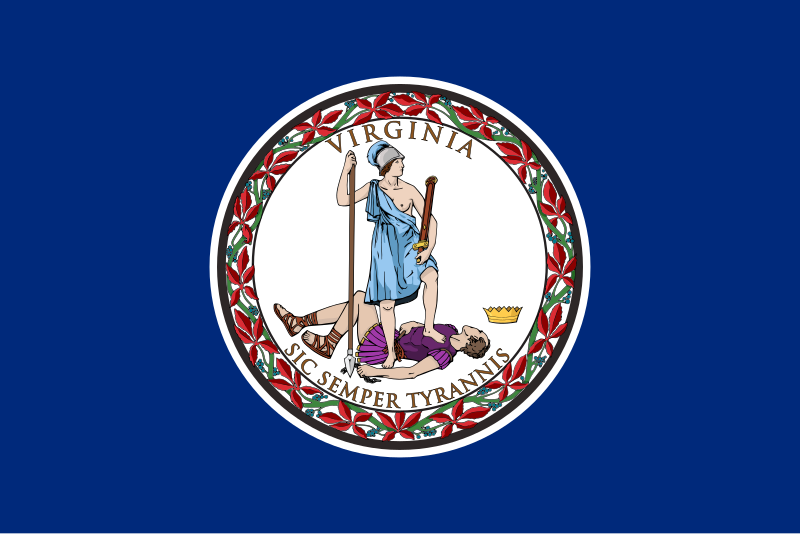
Virginia state flag

In 1954, the General Assembly adopted an official salute to the flag of Virginia which states:

“I salute the flag of Virginia, with reverence and patriotic devotion to the ‘Mother of States and Statesmen,’ which it represents—the ‘Old Dominion,’ where liberty and independence were born.”

See other related posts:


Flags at full staff at sundown; mourning for Ford ends

January 25, 2007

Flag at Gerald Solomon Saratoga National Cemetery

Sundown January 25 marks the end of the 30-day period of mourning for President Gerald Ford, during which flags in the United States are flown at half-staff.

Flags retired at sundown should be quickly hoisted to the peak of the staff, and then lowered soberly. If a flag is lighted or otherwise authorized for 24-hour display, it should be hoisted back to the peak of the staff at sundown.

Tomorrow, January 26, flags should be posted at full staff, as usual.

See also:


Congress’s flag etiquette book: Our Flag

January 14, 2007

A good guide to flag etiquette from the U.S. Congress is on-line now. Our Flag is a traditional publication Congress passes out in efforts to help education in history and patriotism (H.Doc 108-97).

Interest in proper etiquette for flag display increased recently — not enough by my calculation, but any increase is welcomed. Where is good information available?

This Congressionally-sponsored guide is basic and accurate. As a classroom resource or a piece of a Scout troop library, it’s a useful reference guide. It can be downloaded (it’s a .pdf), and printed out in color (56 pages).

The book includes many illustrations showing proper flag display.  It also covers the history of the U.S. flag in good enough detail to get through most high school reports, and it features illustrations of flags of each of the states.

Congress in the past provided many publications on such topics for general public consumption and use in classrooms, but has cut back on free distribution of printed information since the early 1980s.  One might be able to get a printed copy with a request to one’s local Member of the House of Representatives, or U.S. Senator.

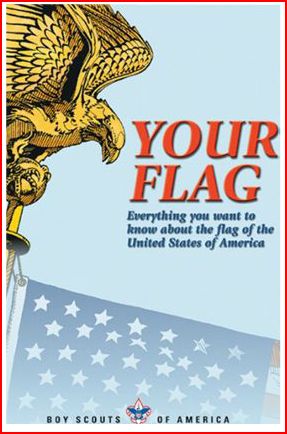
Boy Scouts of America version of the flag etiquette guide, Your Flag

Boy Scouts of America version of the flag etiquette guide, Your Flag

Another book I’ve found very useful is an official Boys Scouts of America publication of the almost the same name, Your Flag.  It’s a graphic-novel type of publication — cartoons for every point to be made.  It features deeper information on proper flag display.  The book can be purchased at any local Boy Scout Council supply shop, or any other shop that stocks Scout literature.  It can also be ordered from BSA’s national catalog, or online at Scoutstuff.org, for $7.9910.99plus shipping.  Every Scout troop should have one of these, and it is also very useful for classroom libraries, for history and civics.

In either publication, one learns that there are not many ways to display a flag properly from a vehicle — improper displays include decals on windows, bumper stickers, flying them from the radio antenna, or attaching them to a window pole to be battered in freeway-speed winds.

One might hope these books get much broader circulation.


Song for the Alaska flag

January 12, 2007

Still looking for a comprehensive — and accurate — list of states that have official pledges. The search is occasionally illuminating (as are all genuine quests for knowledge).

For example, I knew Alaska’s flag was designed by a student, Benny Benson. I had not realized that it was adopted in the Coolidge administration, though, and not much closer to statehood in 1959.

More, Alaska has a song to its flag. I suspect the song is sung less often than Texas’s pledge is made (well, Texas requires school kids to say the pledge every day). But it’s a bit more poetic, isn’t it?

Alaska flag, Wikimedia, by Dave Johnson

Alaska’s song to the flag is below the fold. A link to an MP3 recording of the song is available here. Read the rest of this entry »


State flag pledges: Alabama, too

January 11, 2007

Ralph Luker at Cliopatria (at History News Network) adds Alabama to the list of states with an official pledge to the state flag.

Alabama’s another one, Ed: “Flag of Alabama I salute thee. To thee I pledge my allegiance, my service, and my life.” And then I wash my mouth out with soap.

Yeah, that one’s a bit over the top, rather the shark-jumper of state flag pledges.

How many more are there? Alabama state flag


State flag pledges, present and accounted for

January 10, 2007

I am guilty. I made a bit of an assumption that state flag pledges are rare. There were none in Idaho, or Utah, where I attended public schools. Maryland made no fuss about one while we were there. In most conversations when the issue of a state pledge comes up, people tell their shock at discovering there was such a thing for Texas, and that Texans actually say it from time to time.

Only Georgia bothered to send in correcting information.

But a search of Google finally managed to strike something, having got just the right combination of terms. Below the fold are the state flag pledges for Arkansas, Kentucky, Louisiana, Ohio and South Dakota. I note that the years of adoption are recent — some sort of competition between state legislatures with too little to do? — which leads me to suspect that there may be more state pledges out there, but they are just showing up in the civics and history books.

How many more state pledges are out there? Got something to add? Read the rest of this entry »


Don’t forget Michigan’s pledge!

January 9, 2007

Michigan has a state pledge of allegiance, too:

 I pledge allegiance to the flag of Michigan, and to the state for which it stands, two beautiful peninsulas united by a bridge of steel, where equal opportunity and justice to all is our ideal.

Michigan’s law gives credit to the author, too:  Harold G. Coburn.  It’s in Act 175 of 1972.

Michigan State Flag, from Wikipedia


Flags at half-staff for President Ford, interest at full peak

January 9, 2007

For many years my colleagues in Scouting and I have mused at the great lack of interest in flag etiquette. We have collected dozens of cases of improper flag display, usually by people who were trying to honor the flag and nation, but who went about it contrary to good taste or the flag code, or both.

A couple of days after President Ford’s death I posted a short reminder of what the flag code calls for, with a photo of a flag flying at half-staff over the White House — a photo taken in 2004, after the death of Ronald Reagan, but the only one I could find at the time. That post is by now, far and away the most popular post on this blog since we started it up last July. For the past few days the number of visits to that post continued to grow.

I don’t know why the post is so popular. I hope people are getting from it a touch of flag etiquette — that would be fitting an proper especially as a result of the funeral of Gerald Ford, supreme nice guy and Eagle Scout. But there it is.

Today I found that the White House had included a photo of the White House flag at half-staff on December 26, 2006, in honor of Gerald Ford. Here it is:

White House flag at half-staff in honor of Gerald Ford, after his death

A reminder again: The flag should be hoisted quickly (as always), to the peak of the pole, and then be lowered solemnly to half-mast. When the flag is retired at the end of the day, it should be raised again to the peak, quickly, and then lowered solemnly.

See also: