Neil Kinnock gave this speech in Wales. It’s true everywhere Democrats run in the U.S. Wherever Kinnock said “Mrs. Thatcher,” replace it with “the Republican Party,” and it still fits, terribly, awesomely, and eye-openingly.
Once upon a time a Democrat was driven from a presidential race for quoting this speech. We need to quote it now, and mean it.
Here it is, from Mr. Kinnock’s own website.
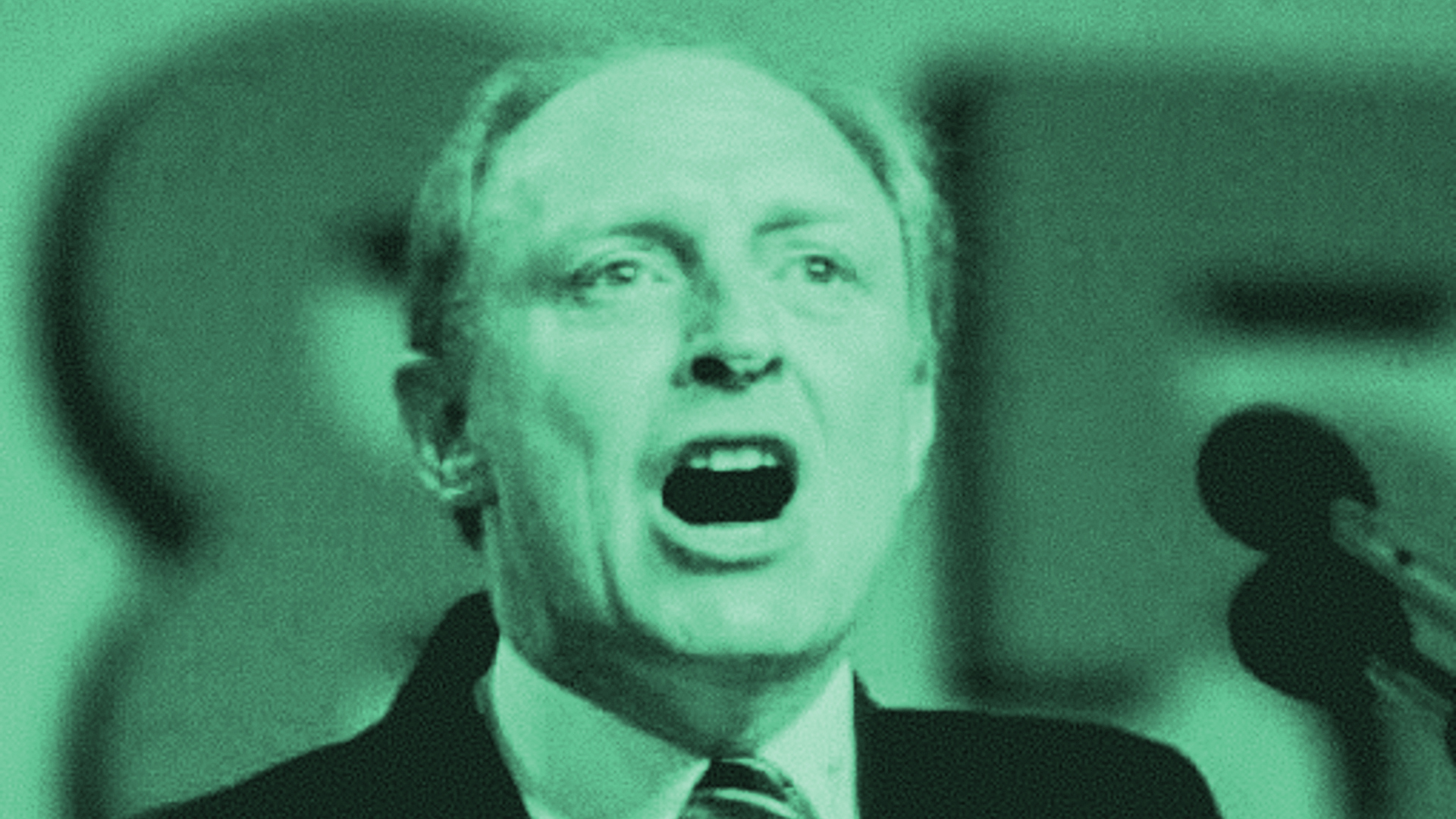
This is an edited version of Neil Kinnock’s speech to the Welsh Labour Party conference in Llandudno, May 15, 1987, in his first election as leader of the Labour Party.
We are democratic socialists. We care all the time. We don’t think it’s a soft sentiment, we don’t think it’s ‘wet’.
We think that care is the essence of strength.
And we believe that because we know that strength without care is savage and brutal and selfish.
Strength with care is compassion – the practical action that is needed to help people lift themselves to their full stature.
That’s real care – it is not soft or weak. It is tough and strong. But where do we get that strength to provide that care?
Do we wait for some stroke of good fortune, some benign giant, some socially conscious Samson to come along and pick up the wretched of the earth?
Of course we don’t.
We cooperate, we collect together, we coordinate so that everyone can contribute and everyone can benefit, everyone has responsibilities everyone has rights. That is how we put care into action. That is how we make the weak strong, that is how we lift the needy, that is how we make the sick whole, that is how we give talent the chance to flourish, that is how we turn the unemployed claimant into the working contributor.
We do it together. It is called collective strength, collective care. And its whole purpose is individual freedom.
When we speak of collective strength and collective freedom, collectively achieved, we are not fulfilling that nightmare that Mrs Thatcher tries to paint, and all her predecessors have tried to saddle us with.
We’re not talking about uniformity; we’re not talking about regimentation; we’re not talking about conformity -that’s their creed. The uniformity of the dole queue; the regimentation of the unemployed young and their compulsory work schemes. The conformity of people who will work in conditions, and take orders, and accept pay because of mass unemployment that they would laugh at in a free society with full employment.
That kind of freedom for the individual, that kind of liberty can’t be secured by most of the people for most of the time if they’re just left to themselves, isolated, stranded, with their whole life chances dependent upon luck!
Why am I the first Kinnock in a thousand generations to be able to get to university? Why is my wife, Glenys, the first woman in her family in a thousand generations to be able to get to university?
Was it because all our predecessors were ‘thick’? Did they lack talent – those people who could sing, and play, and recite and write poetry; those people who could make wonderful, beautiful things with their hands; those people who could dream dreams, see visions; those people who had such a sense of perception as to know in times so brutal, so oppressive, that they could win their way out of that by coming together?
Were those people not university material? Couldn’t they have knocked off all their A-levels in an afternoon?
But why didn’t they get it?
Was it because they were weak? Those people who could work eight hours underground and then come up and play football?
Weak? Those women who could survive eleven child bearings, were they weak? Those people who could stand with their backs and their legs straight and face the people who had control over their lives, the ones who owned their workplaces and tried to own them, and tell them, ‘No. I won’t take your orders.’ Were they weak?
Does anybody really think that they didn’t get what we had because they didn’t have the talent, or the strength, or the endurance, or the commitment?
Of course not. It was because there was no platform upon which they could stand; no arrangement for their neighbours to subscribe to their welfare; no method by which the communities could translate their desires for those individuals into provision for those individuals.
And now, Mrs Thatcher, by dint of privatisation, and means test, and deprivation, and division, wants to nudge us back into the situation where everybody can either stand on their own feet, or live on their knees.
She parades her visions and values, and we choose to contest them as people with roots in this country, with a future only in this country, with pride in this country. People who know that if we are to have and sustain real individual liberty in this country it requires the collective effort of the whole community.
I think of the youngsters I meet. Three, four, five years out of school. Never had a job. And they say to me “Do you think we’ll ever work?”
They live in a free country, but they do not feel free.
I think of the 55-year-old woman I meet who is waiting to go into hospital, her whole existence clouded by pain.
She lives in a free country, but she does not feel free.
I think of the young couple, two years married, living in Mam and Dad’s front room because they can’t get a home. They ask “Will we ever get a home of our own?”
They live in a free country, but they do not feel free.
And I think of the old couple who spend months of the winter afraid to turn up the heating, who stay at home because they are afraid to go out after dark, whose lives are turned into a crisis by the need to buy a new pair of shoes.
They live in a free country – indeed, they’re of the generation that fought for a free country but they do not feel free.
How can they and millions like them – have their individual freedom if there is not collective provision?
How can they have strength if they do not have care?
Now they cannot have either because they are locked out of being able to discharge responsibilities just as surely as they are locked out of being able to exercise rights.
They want to be able to use both.
They do not want feather-bedding, they want a foothold.
They do not want cotton-woolling, they want a chance to contribute.
That is the freedom they want.
That is the freedom we want them to have.
With a tip of the old scrub brush to Dave Weigel on Bluesky Social.


 Posted by Ed Darrell




 Millard Fillmore's Bathtub