How to start a hoax against a presidential candidate

June 29, 2008

Hoax complaints against presidential candidates are old ideas. In 1796, Alexander Hamilton paid newspaper editors to print stories saying Thomas Jefferson was atheist. It was a minor theme in that campaign, but after John Adams’ political fortunes foundered on the Alien and Sedition Acts, among other missteps, Hamilton stepped up the attacks in the election of 1800.

Jefferson’s great biographer, Dumas Malone, estimates that by election day, fully half the American electorate believed Jefferson was atheist. Jefferson made a perfect target for such a charge — staunch advocate of religious freedom, he thought it beneath the dignity of a politician to answer such charges at all, so he did not bother to deny them publicly. Ministers in New England told their congregations they would have to hide their Bibles because, as president, Jefferson would send troops to confiscate them.

In a warning to hoaxers, we might hope, Americans elected Jefferson anyway.

Such nefariousness plagues campaigns today, still. Boone Pickens, who helped fund the Swiftboat Veterans’ calumny against war hero John Kerry, has an offer to pay $1 million to anyone who can show the charges false. In a replay of Holocaust denial cases, Pickens refuses to accept any evidence to pay the award, last week turning away the affidavits of the men who were present at the events.

At the Bathtub, we’ve already sampled a crude and steady attempt to brand Hillary Clinton a Marxist with creative editing of a few of her speeches.

The assaults on Barack Obama are already the stuff of legend. The comic strip, “Doonesbury,” is running a story line with a volunteer for the internet rumor stopping part of the campaign, FighttheSmears.com. The smears are real.

Doonesbury strip 6-28-2008

Matthew Most of the Washington Post wrote a lengthy piece in yesterday’s paper, “An attack that came out of the ether,” on the research done by a woman at the Institute for Advanced Study in Princeton, New Jersey, on the origins of the internet hoax that Barack Obama is a Muslim — a rumor so potent that Georgetown University Prof. Edward Luttwak repeated it in a New York Times op-ed article, without the fact checkers catching it (the Times consulted five scholars of Islam who all agreed the foundation for the claim is incorrect).

Danielle Allen has tracked the rumor back to its sources, in a failed campaign against Obama in Illinois and a candidate who admittedly was looking for mud, and one constant sniper at FreeRepublic.com. It’s impressive sleuthing, and the article would be a good departure for study of how media affect campaigns in a government or civics class.

The “how to” list is really very short:

  • Pick an area of a candidate’s life that is not well known. As the Hamilton campaign against Jefferson demonstrates, it’s useful if the candidate does not feature the issue in official biographies, and more useful if the candidate doesn’t respond. Michael Dukakis let several issues slide in his campaign for the presidency, saying that he didn’t think the public would be misled. The public was waiting for a rebuttal.
  • It helps if there is a factoid that is accurate in the rumor. Obama’s father was Muslim. Most Americans were receptive to the false claim that in Islam, a child is considered Muslim unless there is a conversion. A part of the rumor claims Obama was never baptized Christian. Of course, no one has asked to see John McCain’s baptismal papers. One wonders whether a rumor about McCain’s not being born inside the U.S. could get similar traction among voters (McCain was born in Panama while his father was serving in the Panama Canal Zone in the Navy; children of U.S. citizens are automatically U.S. citizens regardless where they are born. The issue was litigated during Barry Goldwater’s candidacy in 1964, since Goldwater was born in Arizona before Arizona was a state.)

According to the Post story: [A] search showed that the first mention of the e-mail on the Internet had come more than a year earlier. A participant on the conservative Web site FreeRepublic.com posted a copy of the e-mail on Jan. 8, 2007, and added this line at the end: “Don’t know who the original author is, but this email should be sent out to family and friends.”

Allen discovered that theories about Obama’s religious background had circulated for many years on the Internet. And that the man who takes credit for posting the first article to assert that the Illinois senator was a Muslim is Andy Martin.

Martin, a former political opponent of Obama’s, is the publisher of an Internet newspaper who sends e-mails to his mailing list almost daily. He said in an interview that he first began questioning Obama’s religious background after hearing his famous keynote speech at the 2004 Democratic National Convention.

  • Repeat the claim, as often as possible, to audiences that are inflamed by it. No one would dare make such a claim before an audience of Democratic delegates from the Texas 23rd Senatorial District Democratic Convention, almost 80% of whom were black — at least not at the convention. However, flyers making the charge might show up on windows of cars parked during church services at Christian churches where delegates attend. A speaker at the Republican convention for the same district might not be hooted down. This rumor of Obama’s faith went to right-wing forums known for rumor hospitality, notably Free Republic. In forums at that site, rumors frequently appear to be judged on just how damaging they might be if true, not on their veracity.
  • Repeat the claim, even after denials.

The story is well worth reading. It can help educate us to how to avoid being victims of such rumors in the future.

Tip of the old scrub brush to e-mail correspondent MicahBrown.


Torturing children, the Constitution, and a teacher’s duty to protect children

June 23, 2008

This is the device Ohio teacher John Freshwater was using to shock students and brand them with crosses: A BD-10A high-frequency generator tester for leak detection, from Electro-Technic Products, Inc.:

   BD10ASV  OUTPUT: 10,000-50,000 volts at frequency of approx. 1/2 megahertz. Power 230 V, with a momentary ON/OFF switch

BD-10A high frequency generator tester leak detector, from Electro-Technic Products.  “BD10ASV OUTPUT: 10,000-50,000 volts at frequency of approx. 1/2 megahertz. Power 230 V, with a momentary ON/OFF switch”

As described at the company’s website:

  • Model BD-10A is the standard tester
  • Model BD-10AS features a momentary ON/OFF switch
  • OUTPUT: 10,000-50,000 volts at frequency of approx. 1/2 megahertz

The company also offers a line of instruments for teaching science — notably absent from that part of the catalog is this shocking device (literally).

Generally, this tester should not produce serious injury, even when misapplied. Standard middle school lab safety rules would suggest that it should never be used to “test” a human for leaks. Such voltages are designed to produce sparks. Sparks do not always behave as one expects, or hopes. High voltages may make cool looking sparks, but the effects of high voltage jolts differ from person to person. It may be harmful.

“We have instructions to warn people that it’s not a toy,” said Cuzelis, who owns Electro-Technic Products in Chicago. “If this device is directed for seconds (on the skin), that’s a clear misuse of the product.”

Cuzelis said he is not aware of anyone seriously hurt with the device and said that his company has never been sued for injuries.

What sort of lab safety rules did Freshwater have for other experiments?

If you discovered your child’s science teacher had this device, designed to produce high-voltage sparks to highlight holes in rubber and plastic liners of tanks, would you be concerned? If you know what should go on in a science class, you’d know there is probably little use for such a device in a classroom. It’s been described as a Tesla coil.

Tesla coils of extremely small voltages can be safe. They should be safe. But one occasionally finds a safety warning, such as this generalized note at Wikipedia:

Even lower power vacuum tube or solid state Tesla Coils can deliver RF currents that are capable of causing temporary internal tissue, nerve, or joint damage through Joule heating. In addition, an RF arc can carbonize flesh, causing a painful and dangerous bone-deep RF burn that may take months to heal. Because of these risks, knowledgeable experimenters avoid contact with streamers from all but the smallest systems. Professionals usually use other means of protection such as a Faraday cage or a chain mail suit to prevent dangerous currents from entering their body.

Freshwater was using a solid state Tesla coil, if I understand the news articles correctly. Knowing that these sparks can cause deep tissue and bone damage in extreme cases, I suspect that I would not allow students to experience shocks as a normal course of a science classroom, especially from an industrial device not designed with multiple safety escapes built in.

Freshwater had been zapping students for years.

Here is a classic photo of what a Tesla coil does, a much larger coil than that used by John Freshwater, and a photo not from any classroom; from Mega Volt:

Tesla coil in action, from Mike Tedesco

Tesla coil in action, from Mike Tedesco

There is nothing in the Ohio science standards to suggest regular use of a Tesla coil in contact with students performs any educational function.

I offer this background to suggest that the normal classroom procedures designed to ensure the safety of students were not well enforced in Freshwater’s classrooms, nor was there adequate attention paid to the material that should have been taught in the class.

The teacher, John Freshwater, has been dismissed by his local school board. Freshwater supporters argue that this is a case of religious discrimination, because Freshwater kept a Bible on his desk.

Among the complaints are that he burned crosses onto the arms of students with the high-voltage leak detector shown above. This gives an entirely new and ironic meaning to the phrase “cross to bear.”

Cafe Philos wrote the most succinct summary of the case I have found, “The Firing of John Freshwater.” Discussion at that site has been robust. Paul Sunstone included photos of one of the students’ arms showing injuries from the schocks. He also included links to news stories that will bring you up to date.

Amazingly, this misuse of an electrical device may not be the most controversial point. While you and I may think this physical abuse goes beyond the pale, Freshwater has defenders who claim he was just trying to instill Biblical morality in the kids, as if that would excuse any of these actions. Over at Cafe Philos, I’ve been trying to explain just why it is that Freshwater does not have a First Amendment right to teach religion in his science class. There is another commenter with the handle “Atheist” who acts for all the world like a sock puppet for anti-First Amendment forces, i.e., not exactly defending a rational atheist position.

Below the fold I reproduce one of my answers to questions Atheist posed. More resources at the end.

Read the rest of this entry »


Open thread, open comments

June 19, 2008

Several readers have dropped notes saying they couldn’t find a place to comment on something here, and they didn’t want to mess up a thread.  So, here’s a thread to put those comments in.  (Now watch:  Cat will get the typing fingers of everybody . . .)

And for those of you from the Christian blogs where comments are censored, other than editing out profanity and links to pornography, we generally don’t censor here.

Comments are open – discuss away!


Turkey opens up to WordPress blogs?

May 12, 2008

Last time we seriously checked in with Jim Gibbon it was for the haiku contest on research papers.

Comes this missive from Gibbon now, which suggests that the Adnan Oktar ban on WordPress blogs in Turkey was lifted as of May 3.  True?  Mr. Gibbon is in Turkey, I gather, which would put him in a position to know.

Was this a predictor of Oktar’s sentencing on May 9?

Hey, Turkey!  Welcome back!


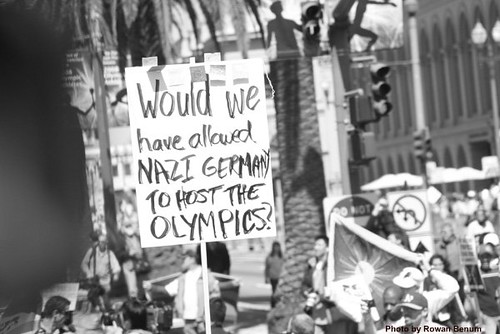
Olympic history FAIL!, or great PhotoShop

May 11, 2008

Ed Brayton found it.

Olympic torch relay protestor with really dumb sign

Do you think the sign maker was jesting? Or do you think the sign maker genuinely didn’t know? (See: 1936 Olympics in Berlin)

While we wait to see whether someone will confess to PhotoShopping this picture, we teachers might consider using this photo as a hook for a lesson on the differences between the rising totalitarian state of Nazi Germany in 1936, and the rising, increasingly economically free state of the People’s Democratic Republic of China today.

One more lesson plan for this year — it’s reusable next fall, with the added bonus then that by then you’ll have the headlines of the actual Olympics to add to the discussion.

Update: The photo is said to have been was taken by Rowan Benum at a California site (see Mr. Benum’s comment). Since it’s all the rage on conservative sites, where the history ignorance is condemned but the conservative bloggers can’t quite bring themselves to endorse the Communist Chinese, I strongly suspect wondered about a PhotoShop origin. The torch was run through San Francisco; there are few palms in San Francisco (Californians: Can you identify the location?).

Update 5-13-2008: The photographer kindly dropped by comments to note the authenticity of the photo. I agree, the Tibetan prayer flags suggest authenticity; would a hoaxer think of such details?

Discussion questions for the classroom:

Students should look at the photo, and read coverage of the torch relay, such as CNN’s story about the San Francisco relay where Mr. Benum took the photo. Students should have access to information about the International Olympic Committee and its organization, especially the tradition of Olympic Truce. The Charter of the Olympics is probably too long for practical classroom use, but Paragraph 2 can be copied for the students, or perhaps the full page of the “Fundamental Principles of Olympism”:

“Olympism is a philosophy of life, exalting and combining in a balanced whole the qualities of body, will and mind. Blending sport with culture and education, Olympism seeks to create a way of life based on the joy found in effort, the educational value of good example and respect for universal fundamental ethical principles.”
Olympic Charter, Fundamental principles, paragraph 2

There is a wealth of information for classroom use at the website of the IOC. If you’re particularly adventurous, or deep into this topic, check out the podcasts of Olympic history from amateur historian Eli Hunt.

Students should also have some information about Tibet, and the Dalai Lama and Tibet’s government in exile, about the history of Tibet and China’s actions since World War II. Students should have some history of the 1936 Olympics, and they should be familiar with the stories of Jesse Owens’ accomplishments there and his return to a segregated U.S. You may want to provide an article about the U.S. protest of the 1980 Olympics in Moscow, and the Soviet protest of the 1984 Olympics in Los Angeles, and other Cold War moments of Olympic tension.

  1. Since the International Olympics Committee (IOC) is an avowedly non-political international agency, is it fair or rational to protest the siting of an Olympics on political grounds?
  2. What do the protesters ask the IOC to do? What do the protesters ask others to do?
  3. Under international law, what are the rights and duties of the Peoples Republic of China (PRC)?
  4. Did the IOC ask anything of the government of the Peoples Republic of China of a political nature? Would such requests be fair, or rational?
  5. Other international organizations function in other nations where governments do not have good records on human rights, such as the Red Cross/Red Crescent, Scouting, UNICEF, and others (can you add to this list?). What considerations must such organizations give to local politics where human rights are at issue?
  6. Compare and contrast the issues surrounding the Beijing Olympics with issues surrounding the Myanmar relief efforts after Cyclone Nargis (2008).
  7. Look at other protests involving the Olympics, especially in 1980 and 1984. Did those protests achieve what the protesters had hoped? Does the success or failure of past protests augur well for current protests?
  8. The creator of the protest sign in the photograph appears to have not known about the 1936 Olympics, which were hosted in Berlin, then under the control of the Nazi government of Germany. The Olympics were sited in Berlin prior to the rise of the Nazi government. Does the protester’s ignorance of history affect the message of the sign? Does it reflect well on the cause the protester advocates?
  9. What other famous or notorious examples of ignorance of history can you find?
  10. Do you ever get embarrassed for the people captured in Jay Leno’s “Jaywalking” segments?
  11. Georges Santayana (1863-1952) famously said, “Those who cannot remember the past are condemned to repeat it.” Do you find that statement to be true? Does this affect the course of history? (Students may want to explore the history of invasions of Russia by Napoleon and Hitler, or the history of invasions of Afghanistan by Britain, the Soviet Union, and the U.S.)

James Madison’s birthday, March 16

March 15, 2008

James Madison, portrait from Whitehouse.gov, and Wikimedia

Freedom of Conscience Day?

James Madison’s birth day is March 16, Sunday. He was born in 1751, in Conway, King George County, Virginia.

Father of the Constitution, fourth President of the U.S., Great Collaborator, and life-long champion for religious freedom and freedom of speech, press and thought: How should we mark his birthday?


More but not enough freedom of speech in Turkey

January 26, 2008

Turkey changed its laws that completely forbade criticism of the government. Recent changes promoting freedom of conscience and speech do not change the fact that this blog, and a million others on WordPress, are still blocked in Turkey.

Remember the old Radio Free Europe? We need a Blog Free Turkey; a Blog Free China; a Blog Free Duncanville Independent School District.


Why give Holocaust denial a platform?

November 25, 2007

lipstadt-deborah-emory-u.png

Deborah Lipstadt asks the key question at her blog: Why should any honorable, noble agency give a platform to people who don’t respect the facts and who have a track record of distorting history?

The distinguished debating group, the Oxford Union, has invited history distorter David Irving to speak. He was invited to speak with representatives of the British National Party (BNP), a group not known for tolerance on racial and immigration issues. While there is value to getting a range of views on any issue, Prof. Lipstadt and many others among us think that inviting a known distorter to speak is practicing open-mindedness past the point of letting one’s brains fall out (what is the difference between “open mind” and “hole in the head?”).

You know this story and these characters, right, teachers of history? You should, since these people play important roles in the modern art of history, and in the discussion over what we know, and how we know it. These are issues of “what is truth,” that your students badger you about (rightfully, perhaps righteously).

American teachers of history need to be particularly alert to these issues, since Holocaust deniers have been so successful at placing their material on the internet in a fashion that makes it pop up early in any search on the Holocaust. Most searches on “Holocaust” will produce a majority of sites from Holocaust deniers. It is easy for unwary students to be led astray, into paths of racist harangues well-disguised as “fairness in history and speech.”

Prof. Lipstadt practices history at Emory University in Atlanta, where she is the Dorot Professor of Modern Jewish and Holocaust Studies. She chronicled much of the modern assault on history in her book, Denying the Holocaust, The Growing Assault on Truth and Memory (1994). In that book, she documented the work of British historian David Irving, much of which consists of questionable denial of events in the Holocaust.

Cover of Lipstadt's book, Denying the Holocaust

Cover of Deborah Lipstadt’s book, Denying the Holocaust, the Growing Assault on Truth and Memory

Irving sued her for libel in Britain in 2000, where it is not enough to establish the truth of the matter to mount a defense. In a stunning and welcomed rebuke to Holocaust denial and deniers, the judge ruled in her favor, and documented Irving’s distortions in his 350-page opinion.

While his claims are legal in England, in several places in Europe his denial of Holocaust events is not protected as free speech. Traveling in Austria in 2005, he was arrested and imprisoned for an earlier conviction under a law that makes it a crime to deny the events. Prof. Lipstadt opposed the Austrian court’s decision: “I am uncomfortable with imprisoning people for speech. Let him go and let him fade from everyone’s radar screens.”

The drama plays out again. Serious questioning of what happened is the front line of history. Denying what happened, however, wastes time and misleads honest citizens and even serious students, sometimes with bad effect. Santayana’s warning about not knowing history assumes that we learn accurate history, not a parody of it.

This event will raise false questions about censorship of Holocaust deniers, and the discussion is likely to confuse a lot of people, including your students. U.S. history courses in high school probably will not get to the Holocaust until next semester. This issue, now, is an opportunity for teachers to collect news stories that illuminate the practice of history for students. At least, we hope to illuminate, rather than snuff out the candles of knowledge.

Resources:

Save


Non-violence in action, today

September 6, 2007

Your kids don’t quite get the point of non-violent protest? The “Scarface” t-shirts outnumber “I Have A Dream” t-shirts on August 28? Do you wish you had some current examples of non-violent protest for classroom discussion?

Anti-Racist Action clown brigade hooting down a Nazi/KKK rally in Knoxville, TN

Nonviolent protest helped disrupt a rally of VNN Vanguard Nazi/KKK in Knoxville, Tennessee, last may — courtesy of the usual clowns. You know, the ARA (Anti-Racist Action) clown block. It’s a good example of using peace to combat violence and hate.

Ridicule and laughter proved tougher than hate. Cooler, too. From a story at Asheville Indymedia:

“White Power!” the Nazi’s shouted, “White Flour?” the clowns yelled back running in circles throwing flour in the air and raising separate letters which spelt “White Flour”.

“White Power!” the Nazi’s angrily shouted once more, “White flowers?” the clowns cheers and threw white flowers in the air and danced about merrily.

“White Power!” the Nazi’s tried once again in a doomed and somewhat funny attempt to clarify their message, “ohhhhhh!” the clowns yelled “Tight Shower!” and held a solar shower in the air and all tried to crowd under to get clean as per the Klan’s directions.

At this point several of the Nazi’s and Klan members began clutching their hearts as if they were about to have a heart attack. Their beady eyes bulged, and the veins in their tiny narrow foreheads beat in rage. One last time they screamed “White Power!”

The clown women thought they finally understood what the Klan was trying to say. “Ohhhhh…” the women clowns said. “Now we understand…”, “WIFE POWER!” they lifted the letters up in the air, grabbed the nearest male clowns and lifted them in their arms and ran about merrily chanting “WIFE POWER! WIFE POWER! WIFE POWER!”

Tip of the old scrub brush to Bug Girl’s Blog, and Neat-o-rama.


Bogus science palace puts blot on Memorial Day remembrances

May 27, 2007

There’s not much to add, beyond the three-quarters of a hundred entries in the one time Ken Ham’s Creation Museum blog carnival, hosted at Pharyngula by P. Z. Myers.

Those we honor on Memorial Day fought, and died, to preserve Ken Ham’s right to believe any fool thing he wants to believe.  That’s part of the ironic beauty of our Constitution and those who fight to defend it.

Having a right to believe any fool thing, and promoting fool ideas with $27 million given by people who expected one to tell the truth, are probably separate, different things.


Why we miss Molly Ivins

April 29, 2007

Molly Ivins’ ghost works overtime (link not safe for work, or school), but ghosts have reduced influence in the land of the living. Exactly how great a tragedy that Ivins died just as the Texas Lege was coming into session and the Bush Administration scandals began their geometric expansion, will never be fully comprehended.

But we can catch glimpses.

Would you believe Warren Chisum cutting off debate on a free speech bill? The Burnt Orange Report makes a commendable effort to channel Ivins, and it’s well worth the read. One of the reasons Texas produces great writers, and great humorists, is the simple fact that there are so many unbelievable stories happening in Texas all the time, stories so breathtaking in their inanity (usually) that the only rational response is laughter.

Chisum and his friends got an idea from somewhere that kids in Texas have a difficult time expressing their Christian faith.  Chisum, it appears, has not been in a Texas school room since at least 1900, or he’d know better — but he is a powerful legislator and so his particular flights from reality often end up written out as legislation.

It’s unusual, I know, that in a state where millions of kids don’t have a prayer of getting health care because they don’t have a prayer of getting health insurance, and where kids from poorer school districts have little more than a prayer of getting an equal education, the legislature focuses on the prayer part of the deficits, instead of fixing anything else fixable.

It’s not that the kids don’t pray — it’s that few in the state legislature listen.  The kids don’t need a bill to make it legal to do what they already do that is already legal; the kids need a bill that would make the Lege pay attention and do something about the problems.

Blogging has been limited lately; there is much to blog about.  Is there enough time to catch up?


Carnival catch-up

April 16, 2007

Uh-oh. Running behind.

One of the reasons I list various carnivals is to make sure I have a note of the good ones somewhere easy to find. Busy-ness in the last week just kept me away from the keyboard.

Carnivals you ought to check out:

Oekologie 4.1: Over at Behavioral Ecology. Lots on climate change, of course, and some very nice bird photos.

Carnival of the Godless at Neural Gourmet has a good run down of the Blog Against Theocracy, and complaints about it, too.

Carnival of the Liberals #36 is up at Truth in Politics. Well, that’s an obvious pairing. Free speech, the president and the Constitution, tyranny in the Middle East, and quite a bit more.

Carnival of Education #114 is back at The Education Wonks.  State legislatures may be wrapping up their sessions, but education issues are heating up.

Skeptics’ Circle #58 finds a hangout at Geek Counterpoint, with several posts that get at how we know what is true — good stuff for historians and economists to ponder.

This is as good a time as any to remind you that that Fiesta de Tejas! #2 is coming up on May 2 — deadline for  post nominations April 30.  You may e-mail entries to me (edarrellATsbcglobalDOTnet), or submit them at the Blog Carnival portal to the Fiesta.


Duty to speak out against intelligent design

April 5, 2007

[Note to SMU Physics students:  Glad to have you here!  While you’re here, stick around for a moment.  Check the blog’s list of articles on “intelligent design” or “evolution,” and you’ll see that the issue has moved a good deal since the flap at SMU.  Feel free to leave comments, too.  E.D.]

When sanity strikes public figures and public institutions, sometimes all one can do is sit back in wonder at how the universe runs.

Intelligent design advocates might begin to think that God (or the gods, or the little green men, as the Discovery Institute allows) has stacked the universe against them, at least in Texas. First, in 2003, with the Texas State Board of Education pregnant with 8 creationists among the 15 members, scientists in Texas applied quiet, gentle pressure and got some of the creationists to vote against requiring creationism in biology texts. Last week Lee Cullum, doyon of conservative commentators in Dallas society, alumnus of the late Dallas Herald and occasional opinion writer for the Dallas Morning News wrote a piece questioning whether intelligent design advocates had not overstepped propriety in their use of Southern Methodist University’s good neighborly intentions — a reversal of position for Cullum, and perhaps a bellwether for others with influence in the state. Plus, several of the faculty at SMU protested the pending intelligent design conference scheduled for the campus, though without endorsement from the university.

Discovery Institute spokesmen gave their usual demurrers, claiming that intelligent design advocates have First Amendment rights and accusing critics of being unfair and unholy, but never defending intelligent design itself.

So, I can imagine there were a lot of coffee-burned laps in Seattle (and at least one in Fort Worth) this morning when the Dallas Morning News‘ opinion section unfurled a hard stand against intelligent design, signed by a score of well-respected scientists of various faiths, from the SMU faculty.

They minced no words:

The organization behind the event, the Discovery Institute, is clear in its agenda: It states that what the SMU science faculty believes to be so useful (science) is a danger to conservative Christianity and should be replaced by its mystical world view.

We do not argue against the basic right to believe, worship and express oneself as one desires. [More, including the full text, below the fold.] Read the rest of this entry »


Intelligent design: Cromulence achieved

March 29, 2007

Editorial writer Rod Dreher of The Dallas Morning News reacted to the news that scientists at Southern Methodist University are protesting a conference on intelligent design in biology, scheduled to be held at the university April 13-14, with an opinion piece that calls for a defense of free speech, and compares the adherence of intelligent design to the adherence of Marxism at SMU

In other words, Dreher defends intelligent design as having finally achieved a high degree of cromulence:

What snots these academics be.

One might be foolish to disagree. Intelligent design is cromulent. The conference will embiggen the intellectual life of the university, regardless the shadow it casts across the light of reason.

More:


Want the facts? Go buy a newspaper

March 21, 2007

Truman showing incorrect headline

President Harry S Truman shows a headline from the Chicago Tribune, a headline incorrectly calling the previous day’s election for Truman’s opponent.

If textbook fights, school curricula litigation and constant internet sniping got you thinking the clash between science and religion is a tough problem to work on, you should look at the clash between news gathering organizations and their financiers who argue that economics says news should be dead.

Not all should be doom and gloom in the news biz. Tim J. McGuire, dean of the Cronkite School of Journalism at Arizona State University, argues that the delivery of the news still needs newspapers, and that newspaper economics show that profits can be produced by good, mainstream news outlets: “Writing off newspapers is premature, irresponsible.”

McGuire doesn’t ignore the bad news:

The circulation declines are undeniable. Some metropolitan newspapers have lost 10 percent of their circulation in the past three years. Classified revenues at some big newspapers are off by $50 million to $100 million in the same period. Layoffs and news-hole reductions are breathtaking. Short-sighted corporations are trying to cut their way to better profit margins.

He points to a different view:   Read the rest of this entry »