Japanese-American internment: Statesman-Journal web special

June 29, 2007

Looking for good sources on Japanese internment?

Editor & Publisher highlights the web version of a special series on Japanese internment during World War II, put together by the Statesman-Journal in Salem, Oregon. The series is featured in “Pauline’s Picks,” a feature by Pauline Millard showing off the best use of the web by old-line print publications.

Beyond Barbed Wire, photo by Salem Statesman-Journal

The Statesman-Journal’s web piece is “Beyond Barbed Wire,” featuring timelines, maps of the Tule Lake internment facility (closest to Oregon), stories about Japanese Americans in Oregon, especially in Salem, photos, video interviews, and a significant collection of original documents perfectly suited for document-based studies.

Texas kids test particularly badly in this part of U.S. history. Several districts ask U.S. history teachers and other social studies groups to shore up student knowledge in the area to overcome gaps pointed out in testing in the past three years, on the Texas Assessment of Knowledge and Skills (TAKS). In teacher training, I’ve noted a lot of Texas social studies teachers are a bit shaky on the history.

The Korematsu decision was drummed into my conscious working on civil rights issues at the Senate Labor and Human Resources Committee, and complemented by Constitutional Law (thank you, Mary Cheh) and other courses I was taking at the same time at George Washington University. It helped that Utah has a significant Japanese population and had “hosted” one of the internment camps; one of my tasks was to be sure committee Chairman Orrin Hatch was up on issues and concerns when he met with Japanese descendants in his constituencies in Utah. Hatch was a cosponsor of the bills to study the internment, and then to apologize to Japanese Americans affected, and pay reparations.
The internment was also a sore spot with my father, G. Paul Darrell, who witnessed the rounding up of American citizens in California. Many of those arrested were his friends, business associates and acquaintances. Those events formed a standard against which he measured almost all other claims of civil rights violations.

Because children were imprisoned with their parents, because a lot of teenagers were imprisoned, this chunk of American history strikes particular sympathetic chords with students of any conscience.  Dorothea Lange’s having photographed some of the events and places, as well as Ansel Adams and others, also leaves a rich pictorial history.

(I found this thanks to the RSS feed of headlines from Editor & Publisher at the Scholars & Rogues site.)


Sweep of Civilizations: BBC interactive map

June 28, 2007

The British Broadcasting Company (BBC) puts genius into their website — very often, it seems to me.

Go see this interactive map. It shows where civilizations or religions held sway, at a point in history you decide — and then projects forward to show how the group’s influence waxed and waned. Or plot two different groups, side-by-side.

Snapshot of Civilisations is a multi-dimensional picture of human history, where you’re in charge of the timeline.

It uses web technology to reveal the sweep of historical forces and the rise and fall of great empires and ideas over 5000 years in a way that no book could ever do.

And it does it your way. You can customise Civilisations to show you the things that interest you. The best way to understand Civilisations is to have a go.

Great bauble for world geography and world history courses — what sort of a warm-up exercise could you make with this, projecting it from your computer? What sort of homework could be made from this, for the kids to access on their own?

Gee, while you’re there, teachers: Take a look at the interactive quizzes on world religions — this could be a unit all to itself.  Hook up your computer, take the quizzes as a class, on that rainy day when you were supposed to go out to look at the school’s garden and you need a ten-minute, cultural filler that sticks to the state standards.  And look at this multifaith calendar.  You can use it for your daily “this day in history” feature; it’s useful for students doing projects on various religions.  Use some imagination.


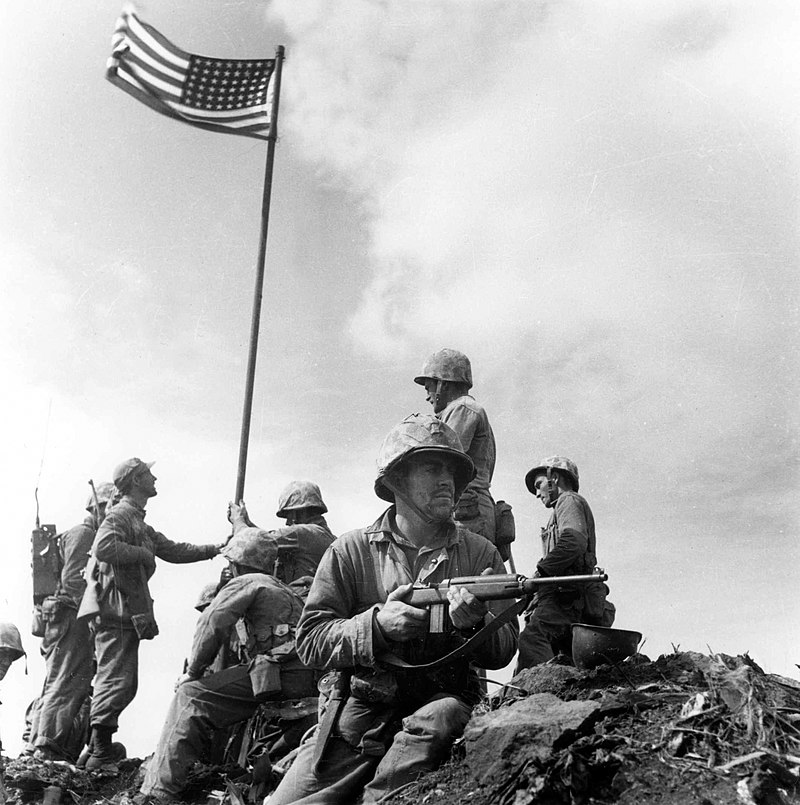
Charles Lindberg, first Iwo Jima flag raising

June 26, 2007

1st flag raising on Iwo Jima, photo by Sgt Lou Lowery, Leatherneck Magazine

First raising of the U.S. flag on Iwo Jima on February 23, 1945. Photo by Sgt. Lou Lowery, Leatherneck Magazine

This photo doesn’t look like the Joe Rosenthal photo that won the Pulitzer Prize, and then inspired the book and movie, Flags of Our Fathers?

It’s not the same photo. Different photographer. Different group of Marines.

This is the first flag raising on Mt. Suribachi, the highest point of the island that was known then as Iwo Jima. This shows the mean of Easy Company, including Charles Lindberg of Grand Forks, North Dakota, raising a flag they carried on a pipe they found. The photo was taken by Sgt. Lou Lowery of Leatherneck Magazine.

Charles Lindberg, one of the Marines in the photo, died this week. He was 86 years old.

In addition carrying a name made famous by that other guy, the pilot, few people believed him when he said his company raised the flag first on Iwo. He wasn’t in the Rosenthal photo. But Lindberg told the truth.

From his obituary on the Associated Press wire (in The Washington Post):

Three of the men in the first raising never saw their photos. They were among the more than 6,800 U.S. servicemen killed in the five-week battle for the island.

By Mr. Lindberg’s account, his commander ordered the first flag replaced and safeguarded because he worried someone would take it as a souvenir. Mr. Lindberg was back in combat when six men raised the second, larger flag about four hours later.

Rosenthal’s photo of the second flag-raising became one of the most enduring images of the war and the model for the U.S. Marine Corps memorial in Washington.

Rosenthal, who died last year, always denied accusations that he staged the photo, and he never claimed it depicted the first raising of a flag over the island.

Mr. Lindberg was shot through the arm March 1 and evacuated. After his discharge in 1946, Mr. Lindberg went home to Grand Forks, N.D. He moved to Richfield, Minn., in 1951 and became an electrician.

If you’re over 45, if you read James Brady’s Flags of Our Fathers, if you saw the Clint Eastwood movie version, or if you’re a fan of Johnny Cash’s Ballad of Ira Hayes, you know the stories of heroism and sorrow and tragedy that accompany Joe Rosenthal’s photo. As so often happens in history, there is a back story, a bit of a correction — and it has some of the same bittersweet flavors.

Lindberg was 24 years old when his company landed on Iwo Jima. That was 62 years ago. Those who were eyewitnesses are mostly gone. We need to seek out those few remaining, brave survivors, and let them tell what they remember, what they saw, how they felt and how they feel.  Of the twelve men who raised the two flags, Lindberg was the last survivor.  Three of the men from each group died in battle action after raising the flags.

Here’s to the memory of Charles Lindberg, a good American, a good soldier. Thank you, Mr. Lindberg.

Charles Lindberg in 1999, holding a copy of Sgt. Lou Lowery's photo of the first Iwo Jima flag raising Charles Lindberg holding the photo taken by Sgt. Lou Lowery of Leatherneck Magazine, of the first U.S. flag raising on Iwo Jima, by Easy Company. Lindberg is the soldier standing in back, on the right of the photo. Lowery’s photo was taken about four hours before the second flag raising, captured by Joe Rosenthal, which photo won the Pulitzer Prize. This photo of Lindberg, left, is from 1999, by Associated Press photographer Jackie Lorentz.

Lindberg’s citation for the Silver Star is below the fold.

Read the rest of this entry »


Quote of the Moment: William O. Douglas, 5th Amendment

June 23, 2007

Supreme Court Justice William O. Douglas

The Fifth Amendment is an old friend and a good friend. It is one of the great landmarks in man’s struggle to be free of tyranny, to be decent and civilized. It is our way of escape from the use of torture.

William O. Douglas, “An Almanac of Liberty,” 1954.

Douglas served longer on the Supreme Court than any other justice, from 1939 to 1975.


40 years of Loving — the changes we see

June 15, 2007

1968 propelled history in dramatic fashion, much of it tragic. History teachers might await the 40th anniversary stories of 1968’s events, knowing that the newspapers and television specials will provide much richer material than any textbook could hope for.

Was 1967 less momentous? Perhaps. But an anniversary this week only serves to highlight how the entire decade was a series of turning points for the United States. This week marks the 40th anniversary of the Supreme Court’s issuing the decision in Loving v. Virginia. The Lovings had been arrested, convicted and exiled from the state of Virginia for the crime of — brace yourself — getting married.

Richard and Mildred Loving, Bettman-Corbis Archive

Photo of Richard and Mildred Loving from Bettman-Corbis Archive.

You see, Virginia in those days prohibited marriage between a black person and a white person. So did 15 other states. In language that is quaint and archaic to all but Biblical literalist creationists, the trial judge said:

“Almighty God created the races white, black, yellow, malay and red, and he placed them on separate continents. And but for the interference with his arrangement there would be no cause for such marriages. The fact that he separated the races shows that he did not intend for the races to mix.”

The Lovings appealed their conviction. They appealed to the U.S. Supreme Court. And on June 12, 1967, the Supreme Court of the United States struck down laws that prohibit a person of one “race” from marrying a person of another. (I put “race” in quotes because, as we have since learned from DNA studies, there is just one race among us, the human race. Science verifies that the Supreme Court got it right, as did the Americans before them who wrote the laws upon which the Supreme Court’s decision was based.)

From 1958 to 1967 — nine years the case wended through the courts. Oral argument was had on April 10 — the decision coming down in just two months seems dramatically quick by today’s standards. This was one of the cases that angered so many Americans against the Court presided over by Chief Justice Earl Warren.

Ed Brayton at Dispatches from Culture Wars points to a statement from Mildred Loving on this anniversary. The statement is below the fold. Read the rest of this entry »


Looking up to Finland

May 30, 2007

Commenter Bernarda sent a link to a Washington Post story by Robert Kaiser about Finland, a nation who redesigned its education system with rather dramatic, beneficial results. Among other things, the Finns treat teachers as valuable members of society, with high pay, great support, and heavy training.

Finland is a leading example of the northern European view that a successful, competitive society should provide basic social services to all its citizens at affordable prices or at no cost at all. This isn’t controversial in Finland; it is taken for granted. For a patriotic American like me, the Finns present a difficult challenge: If we Americans are so rich and so smart, why can’t we treat our citizens as well as the Finns do?

Why not? Why can’t we treat our citizens as well as the Finns? Their system boosts their economy and leads to great social progress — which part of that do we not want?


Bogus science palace puts blot on Memorial Day remembrances

May 27, 2007

There’s not much to add, beyond the three-quarters of a hundred entries in the one time Ken Ham’s Creation Museum blog carnival, hosted at Pharyngula by P. Z. Myers.

Those we honor on Memorial Day fought, and died, to preserve Ken Ham’s right to believe any fool thing he wants to believe.  That’s part of the ironic beauty of our Constitution and those who fight to defend it.

Having a right to believe any fool thing, and promoting fool ideas with $27 million given by people who expected one to tell the truth, are probably separate, different things.


Honoring heroes: Armed Forces Day 2007

May 19, 2007

1951 poster for Armed Forces Day

May 19, 2007, is Armed Forces Day. Fly your U.S. and state flags today.

Great Irony: The Defense Department website for Armed Forces Day is not exactly up to date, and suffers from lack of attention (just try to find events in your area from the page set up to do just that).

Which only makes the point: We have to support our troops — heaven knows the current government isn’t going to. Write a letter to the troops; join an event run by your local American Legion or Veterans of Foreign Wars — or an event to support the troops in a way the American Legion and VFW don’t support, but which is okay, too. Fly your flag. Do the right thing to honor those we send into harm’s way, for little pay and not enough thanks. (That site is much better maintained than the Armed Forces Day site.)

History stuff for classrooms, below the fold. Read the rest of this entry »


Why we miss Molly Ivins

April 29, 2007

Molly Ivins’ ghost works overtime (link not safe for work, or school), but ghosts have reduced influence in the land of the living. Exactly how great a tragedy that Ivins died just as the Texas Lege was coming into session and the Bush Administration scandals began their geometric expansion, will never be fully comprehended.

But we can catch glimpses.

Would you believe Warren Chisum cutting off debate on a free speech bill? The Burnt Orange Report makes a commendable effort to channel Ivins, and it’s well worth the read. One of the reasons Texas produces great writers, and great humorists, is the simple fact that there are so many unbelievable stories happening in Texas all the time, stories so breathtaking in their inanity (usually) that the only rational response is laughter.

Chisum and his friends got an idea from somewhere that kids in Texas have a difficult time expressing their Christian faith.  Chisum, it appears, has not been in a Texas school room since at least 1900, or he’d know better — but he is a powerful legislator and so his particular flights from reality often end up written out as legislation.

It’s unusual, I know, that in a state where millions of kids don’t have a prayer of getting health care because they don’t have a prayer of getting health insurance, and where kids from poorer school districts have little more than a prayer of getting an equal education, the legislature focuses on the prayer part of the deficits, instead of fixing anything else fixable.

It’s not that the kids don’t pray — it’s that few in the state legislature listen.  The kids don’t need a bill to make it legal to do what they already do that is already legal; the kids need a bill that would make the Lege pay attention and do something about the problems.

Blogging has been limited lately; there is much to blog about.  Is there enough time to catch up?


John Reed at his typewriter

April 28, 2007

John Reed at his typewriter, Oregon Historical SocietyUndated photograph of John Reed (1880-1927) at this typewriter, from the Oregon Historical Society, “Oregon Biographies.”


National embarrassment, national tragedy

April 17, 2007

Celebrate the hero, please.

He survived the Holocaust, arrested by the Nazis and sent to a concentration camp to die — he survived, instead. He survived the Communists, refusing to bow to demands he join the Communist party in post-war Romania; though a good engineer, his career was short-circuited by his stand on principle. He finally escaped Romania in 1978, emigrated to Israel, and then took a sabbatical to teach engineering at Virginia Tech in Blacksburg, Virginia. And he stayed on.

Yesterday, on Holocaust Remembrance Day, Liviu Librescu used his own body to jam the doors into his classroom, yelled at his students to leave through the windows, and gave up his life to a depressed kid bent on murder. Prof. Librescu was 76 years old. He was the oldest victim, and a hero.

Survived the Nazis, survived the communists. Died to the excesses of the Second Amendment and a culture that seems to create enough disturbed people to make mass murder a serious problem, not a rare event. Librescu was already a hero. It’s embarrassing he had to rise to heroic actions to protect his students. It’s embarrassing to us that he died the victim of an act of senseless violence.

It’s a national embarrassment. Survived the Nazis. Survived the communists. Killed by an out-of-control student with a gun in the U.S.

It’s a national embarrassment. What are we going to do about it?


Carnival catch-up

April 16, 2007

Uh-oh. Running behind.

One of the reasons I list various carnivals is to make sure I have a note of the good ones somewhere easy to find. Busy-ness in the last week just kept me away from the keyboard.

Carnivals you ought to check out:

Oekologie 4.1: Over at Behavioral Ecology. Lots on climate change, of course, and some very nice bird photos.

Carnival of the Godless at Neural Gourmet has a good run down of the Blog Against Theocracy, and complaints about it, too.

Carnival of the Liberals #36 is up at Truth in Politics. Well, that’s an obvious pairing. Free speech, the president and the Constitution, tyranny in the Middle East, and quite a bit more.

Carnival of Education #114 is back at The Education Wonks.  State legislatures may be wrapping up their sessions, but education issues are heating up.

Skeptics’ Circle #58 finds a hangout at Geek Counterpoint, with several posts that get at how we know what is true — good stuff for historians and economists to ponder.

This is as good a time as any to remind you that that Fiesta de Tejas! #2 is coming up on May 2 — deadline for  post nominations April 30.  You may e-mail entries to me (edarrellATsbcglobalDOTnet), or submit them at the Blog Carnival portal to the Fiesta.


Have you spoken against intelligent design, or other dangerous superstition, today?

April 6, 2007

Imagine you live in Dallas, Texas, where it is generally assumed that one is Christian and that one attends church on Sunday, and Wednesday (so much so that school activities are not scheduled Wednesdays, because everyone is expected to be at church). Imagine that you teach science at a major Christian-affiliated institution in Dallas.

Now imagine that your institution is the site of a major conference extolling the virtues of superstition, specifically against a scientific theory that is the foundation and main supports for much of your work. Do you hunker down and hope no one notices, or do you speak up for science? Blog against theocracy logo, Statute of Liberty

20 professors at Southern Methodist University (SMU) signed an article on the opposite-editorial page of the Dallas Morning News, yesterday, calling out intelligent design and its advocates. (I mentioned it in this post, here.) They will most likely take a stand that there is no reason to “debate” intelligent design advocates, since the debate venue is stacked, the debate audience is stacked, and that intelligent design has not paid its dues to be admitted to the college of the sciences.

But I wish they would take a further stand: I wish the Christians among them would call on the advocates of intelligent design to repent, to stop asking people to turn away from science, to stop spreading false stories about science, to stop making false claims. Read the rest of this entry »


History Carnival 51, from a different view

April 4, 2007

A Don’s Life hosts History Carnival 51, which is fun and informative if only because blog author Mary Beard offers a slightly different view of things, being several time zones and an ocean away from America.

This carnival features several entries related to the Battle of Thermopylae, especially surrounding the release of the Film “300,” and several entries pondering the history of slavery, coming just at the end of the commemoration of the end of slavery in the British Empire.  Both of these topics offer good material for enrichment for AP world history classes, and good information for anyone else wishing to avoid repeats of the errors of history.


Tuskegee Airmen medal ceremony set for March 29

March 23, 2007

Tuskegee Airmen in Europe, Library of Congress photo

Congress voted to award the Congressional Gold Medal of Honor to the Tuskegee Airmen as a group. The ceremony is set for Washington, D.C., in the Capitol Rotunda, for March 29, 2007.

This is another great story of Americans, otherwise held down in their daily life, who rise to meet a monstrous challenge. They not only met the challenge but achieved a degree of triumph beyond what anyone had hoped. The story is a natural segue to the post World War II civil rights movement, and it fits nicely into studies of the war or studies of civil rights. News items around the time of the ceremony should update the history of the Tuskegee Airmen and provide good photos for classroom presentations.

“It’s sort of an open validation of the Tuskegee Airmen, that we fought stereotypes, overcame them and prevailed,” said Roscoe Brown, an 85-year-old Riverdale, N.Y., resident who graduated from the Tuskegee program in 1944. “This is the ultimate when your nation recognizes you.”

The gold medal, equivalent to the Presidential Medal of Freedom, is awarded to individuals or groups for singular acts of exceptional service and for lifetime achievement. The Tuskegee fliers will join a distinguished group of recipients that includes George Washington, Winston Churchill, Rosa Parks, the Wright brothers and former Secretary of State Colin Powell.

Rep. Charles Rangel, D-N.Y., and Sen. Carl Levin, D-Mich., introduced identical bills in the House of Representatives and the Senate in 2005 to give the airmen the congressional medal. The Senate bill passed in October 2005 and the House followed in February 2006. President Bush signed the bill into law last April.

It is also a story of racism and bureaucratic bungling delaying appropriate recognition to heroes for 60 years.

Lee Archer, 87, of New Rochelle, is America’s first black flying ace.

“It shows the country is trying to right an old wrong,” Archer said. “I never thought we would get it, but we would have done it without any recognition … . My family is very excited. I am, too.”

Of the 994 black aviators who got their training at the Tuskegee Institute in Alabama beginning in 1942, fewer than 385 are still alive. On March 4, Edgar L. Bolden, 85, who trained at Tuskegee and flew P-47s, died in Portland, Ore.

More information:

Tip of the old scrub brush to Resist Racism.