June 11, 2007

Whatever you can do, or dream you can do, begin it. Boldness has genius, power, and magic in it!
Johann Wolfgang von Goethe
- Note from The Yale Book of Quotations, Fred R. Shapiro, ed. (Yale 2006): “Attributed in William Hutchinson Murray, The Scottish Himalayan Expedition (1951). Widely attributed to Goethe, following Murray, but in fact appears to be at best a paraphrase of a line from Goethe’s Faust: “Now at last let me see some deeds!”
Spread the word; friends don't allow friends to repeat history.
 Leave a Comment » |
  Accuracy, Famous quotes, Good Quotes, Leadership |
  Permalink
 Posted by Ed Darrell
June 9, 2007

Soldiers, Sailors, and Airmen of the Allied Expeditionary Force: You are about to embark upon the Great Crusade, toward which we have striven these many months. The eyes of the world are upon you.
Order of the Day, 6 June, 1944 (some sources list this as issued 2 June)
Spread the word; friends don't allow friends to repeat history.
11 Comments | D-Day, Dwight Eisenhower, Famous Battles, Famous quotes, Good Quotes, History, Presidents, World War II | Tagged: D-Day, Dwight Eisenhower, Famous Battles, Famous quotes, History, Presidents, World War II | Permalink
Posted by Ed Darrell
May 29, 2007
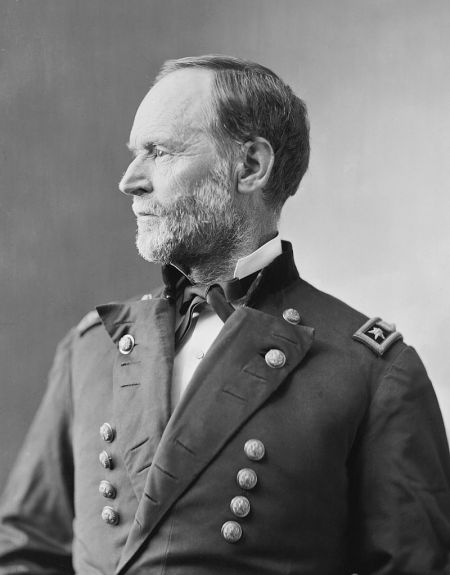
“There is many a boy here today who looks on war as all glory, but, boys, it is all hell.” – Gen. William Tecumseh Sherman,
from an address to the graduating class of the Michigan Military Academy, June 19, 1879, known as his “War is hell” speech (Wikipedia entry on Sherman).
(Query: Does anyone have an electronic link to the full text of Sherman’s address that day? Or, do you know where it might be found, even in hard copy?)
David Parker quoted the prayer out of Mark Twain’s disturbing story, “The War Prayer.” Go there for a discussion on what Twain meant, and just how much opposed to war he was.
For a deeper context, and a Jeff Danziger cartoon that will make you stand up and think, see the original post of this quote.
Spread the word; friends don't allow friends to repeat history.
5 Comments | Author query, Famous quotes, Good Quotes, Quotes, War | Permalink
Posted by Ed Darrell
May 23, 2007
It’s a delightful story I’ve heard dozens of times, and retold a few times myself: Abraham Lincoln faced with some thorny issue that could be settled by a twist of language, or a slight abuse of power, asks his questioner how many legs would a dog have, if we called the dog’s tail, a leg. “Five,” the questioner responds confident in his mathematical ability to do simple addition.

Sunrise at the Lincoln Memorial. National Park Service photo.
“No,” Lincoln says. “Calling a dog’s tail a leg, doesn’t make it a leg.”
But there is always the doubt: Is the story accurate? Is this just another of the dozens of quotes that are misattributed to Lincoln in order to lend credence to them?
I have a source for the quote: Reminiscences of Abraham Lincoln by distinguished men of his time / collected and edited by Allen Thorndike Rice (1853-1889). New York: Harper & Brothers Publishers, 1909. This story is found on page 242. Remarkably, the book is still available in an edition from the University of Michigan Press. More convenient for us, the University of Michigan has the entire text on-line, in the Collected Works of Abraham Lincoln, an on-line source whose whole text is searchable.
However, Lincoln does not tell the story about a dog — he uses a calf. Read the rest of this entry »
Spread the word; friends don't allow friends to repeat history.
46 Comments | Abraham Lincoln, Accuracy, Famous quotes, Good Quotes, History, On-line education, Quotes | Tagged: Abraham Lincoln, Accuracy, Aphorisms, Famous quotes, History, On-line education, Quotes | Permalink
Posted by Ed Darrell
May 12, 2007

Labor is prior to, and independent of,capital. Capital is only the fruit of labor, and could not have existed if labor had not first existed. Labor is the superior of capital, and deserves much the higher consideration.
Lincoln in the Annual Message to Congress, December 3, 1861
The photograph shows Lincoln as president-elect; it is one of a series taken on February 23, 1861; from The History Place.
Spread the word; friends don't allow friends to repeat history.
Leave a Comment » | Abraham Lincoln, Economics, Famous quotes, Free market economics, Good Quotes, History, Labor and unions, Presidents, Quotes | Permalink
Posted by Ed Darrell
April 25, 2007
What did Darwin say about natural selection and humans? Creationists frequently claim Darwin as an advocate of eugenics. Here, below is the section from Descent of Man that they usually quote; and below the fold is the entire quote in its greater context, in which Darwin is shown as an anti-eugenics advocate, at least for humans. 
Darwin died 125 years ago, on April 19, 1882.
I borrowed the text from one of the on-line full-text versions of the book. This excerpt is from Chapter 5, “On the Development of the Intellectual and Moral Faculties During Primeval and Civilised Times,” one of the chapters most frequently cited and most often misquoted out of Darwin’s works. Note Darwin’s rather extensive citing to other works of research to support his arguments:
In regard to the moral qualities, some elimination of the worst dispositions is always in progress even in the most civilised nations. Malefactors are executed, or imprisoned for long periods, so that they cannot freely transmit their bad qualities. Melancholic and insane persons are confined, or commit suicide. Violent and quarrelsome men often come to a bloody end. The restless who will not follow any steady occupation–and this relic of barbarism is a great check to civilisation (17. ‘Hereditary Genius,’ 1870, p. 347.)–emigrate to newly-settled countries; where they prove useful pioneers. Intemperance is so highly destructive, that the expectation of life of the intemperate, at the age of thirty for instance, is only 13.8 years; whilst for the rural labourers of England at the same age it is 40.59 years. (18. E. Ray Lankester, ‘Comparative Longevity,’ 1870, p. 115. The table of the intemperate is from Neison’s ‘Vital Statistics.’ In regard to profligacy, see Dr. Farr, ‘Influence of Marriage on Mortality,’ ‘Nat. Assoc. for the Promotion of Social Science,’ 1858.) Profligate women bear few children, and profligate men rarely marry; both suffer from disease. In the breeding of domestic animals, the elimination of those individuals, though few in number, which are in any marked manner inferior, is by no means an unimportant element towards success. This especially holds good with injurious characters which tend to reappear through reversion, such as blackness in sheep; and with mankind some of the worst dispositions, which occasionally without any assignable cause make their appearance in families, may perhaps be reversions to a savage state, from which we are not removed by very many generations. This view seems indeed recognised in the common expression that such men are the black sheep of the family. Read the rest of this entry »
Spread the word; friends don't allow friends to repeat history.
1 Comment | Charles Darwin, Darwin, Evolution, Famous quotes, Good Quotes | Tagged: Charles Darwin, Eugenics, Evolution, Famous quotes, Morality | Permalink
Posted by Ed Darrell
April 12, 2007
Listen: Billy Pilgrim has come unstuck in time.
— Kurt Vonnegut, opening of chapter 2 of Slaughterhouse Five, the start of the Billy Pilgrim story.
Spread the word; friends don't allow friends to repeat history.
Leave a Comment » | Books, Good Quotes, War, World War II | Permalink
Posted by Ed Darrell
April 11, 2007

Churchill speaking at the Albert Hall in London, 1944, at an American Thanksgiving Celebration. Churchill Centre image
Never give in, never give in, never, never, never, never — in nothing, great or small, large or petty — never give in except to convictions of honour and good sense!
Winston S. Churchill, address to the boys of Harrow School, October 29, 1941.
Spread the word; friends don't allow friends to repeat history.
6 Comments | Famous quotes, Good Quotes, Leadership, Quotes, Winston Churchill | Tagged: Famous quotes, Great Speeches, History, Leadership, Quotes, Winston Churchill, World War II | Permalink
Posted by Ed Darrell
April 9, 2007
 Let us never negotiate out of fear, but let us never fear to negotiate.
John Fitzgerald Kennedy, in his Inaugural Address, January 20, 1961
Photo from Associated Press (and Time Magazine)
Spread the word; friends don't allow friends to repeat history.
Leave a Comment » | Cold War, Democracy, Famous quotes, Good Quotes, Leadership, Presidents, Quotes | Permalink
Posted by Ed Darrell
March 29, 2007
What’s the Constitution between friends?
–Timothy J. Campbell (1840-1904), Attributed, circa 1885
A little more below the fold? Certainly. Read the rest of this entry »
Spread the word; friends don't allow friends to repeat history.
2 Comments | Bad Quotes, Famous quotes, Good Quotes, Patriotism, Politics, Presidents, Quotes, U.S. Constitution | Permalink
Posted by Ed Darrell
March 15, 2007
About the capitalist states, it doesn’t depend on you whether or not we exist. If you don’t like us, don’t accept our invitations, and don’t invite us to come and see you. Whether you like it or not, history is on our side. We will bury you.*
Nikita Sergeyevich Khruschev (1894-1971); reported statement at a reception for Wladyslaw Gomulka at the Polish Embassy, Moscow, November 18, 1956

Soviet Premier Nikita Khruschev enjoying a hot dog in Des Moines, Iowa, during his 1959 tour of the U.S. (Photo from American Meat Institute, National Hot Dog & Sausage Council, http://www.hot-dog.org)
* The exact phrasing of the last line is debatable. As Bartlett’s Familiar Quotations, 16th Edition has it, “Neither the original nor the translation of the last two sentences appeared in either Pravda or the New York Times, which carried the rest of the text. Another possible translation of the last sentence is: We shall be present at your funeral, i.e., we shall outlive you; but the above is the familiar version.”
Spread the word; friends don't allow friends to repeat history.
3 Comments | Cold War, Famous quotes, Free market economics, Freedom - Economic, Freedom - Political, Good Quotes, History, Politics, Quotes, Socialism | Permalink
Posted by Ed Darrell
March 13, 2007
For my own part I would as soon be descended from that heroic little monkey, who braved his dreaded enemy in order to save the life of his keeper, or from that old baboon, who, descending from the mountains, carried away in triumph his young comrade from a crowd of astonished dogs — as from a savage who delights to torture his enemies, offers up bloody sacrifices, practices infanticide without remorse, treats his wives like slaves, knows no decency, and is haunted by the grossest superstitions.
– Charles R. Darwin,
The Descent of Man, 1871, ch. 6
Spread the word; friends don't allow friends to repeat history.
Leave a Comment » | Darwin, Evolution, Good Quotes, History, Quotes | Tagged: Altruism, Darwin, Evolution, Famous quotes, History, Quotes | Permalink
Posted by Ed Darrell
February 27, 2007
Michael King, writing in the Austin Chronicle (a weekly newspaper, as I recall), December 24, 2004:
A moment of nondenominational silence for longtime Christian fundamentalist textbook critic Mel Gabler, who died Sunday in Longview at 89. Gabler and his wife, Norma, had long been fixtures at State Board of Education textbook review hearings, although in recent years age and declining health had lessened their participation. The Longview News-Journal reported that Gabler “emphasized accuracy and a Christian perspective in examining school children’s books,” but it would be more true to say that the Gablers and their “Education Research Analysts” never let the former get in the way of the latter. Gabler was notorious for his attacks on any positive mention of evolution in biology textbooks, insisting that “special creation” get equal time and that the textbooks record “what’s wrong” with evolutionary theory. His reviews did indeed reveal factual errors in the textbooks – but his moralistic Pecksniffery is reflected best in statements like this, on mathematics texts: “When a student reads in a math book that there are no absolutes, suddenly every value he’s been taught is destroyed. And the next thing you know, the student turns to crime and drugs.” May he take it up with the Master Mathematician. – M.K.
Tip of the old scrub brush to . . . drat! From whom did I get this link?
Spread the word; friends don't allow friends to repeat history.
1 Comment | Freedom - Political, Good Quotes, Religious Freedom, State school boards, Texas, Textbook Selection, Textbooks | Permalink
Posted by Ed Darrell
January 24, 2007
Franklin Delano Roosevelt delivered the State of the Union speech for 1941 on January 6. Eleven months and one day later, Japan attacked the U.S. Pacific Fleet at Pearl Harbor, Territory of Hawaii. I have been fascinated by Roosevelt’s clear statement of the freedoms he thought worth fighting for, especially considering that most Americans at that moment did not consider it desirable or probable that the U.S. would get involved in the war that raged across the Pacific and Atlantic.

Franklin Roosevelt and Winston Churchill, August 9, 1941; aboard the U.S.S. Augusta, in the Atlantic. Library of Congress.
Here is an excerpt of the speech, the final few paragraphs:
I have called for personal sacrifice, and I am assured of the willingness of almost all Americans to respond to that call. A part of the sacrifice means the payment of more money in taxes. In my budget message I will recommend that a greater portion of this great defense program be paid for from taxation than we are paying for today. No person should try, or be allowed to get rich out of the program, and the principle of tax payments in accordance with ability to pay should be constantly before our eyes to guide our legislation.
If the Congress maintains these principles the voters, putting patriotism ahead of pocketbooks, will give you their applause. Read the rest of this entry »
Spread the word; friends don't allow friends to repeat history.
11 Comments | 1941-1945, Accuracy, Famous quotes, Franklin Roosevelt, Free speech, Freedom - Economic, Freedom - Political, Good Quotes, History, Lesson plans, Presidents, Quotes, Religious Freedom, World War II | Permalink
Posted by Ed Darrell
January 22, 2007
April, or Valentine’s Day worthy? 
Charles Darwin to Emma Darwin, April, 1858:
Moor Park
The weather is quite delicious. Yesterday, after writing to you, I strolled a little beyond the glade for an hour and a half, and enjoyed myself — the fresh yet dark green of the grand Scotch firs, the brown of the catkins of the old birches, with their white stems, and a fringe of distant green from the larches, made an excessively pretty view. At last I fell fast asleep on the grass, and awoke with a chorus of birds singing around me, and squirrels running up the trees, and some woodpeckers laughing, and it was as pleasant and rural a scene as ever I saw, and I did not care one penny how any of the beasts or birds had been formed.
Francis Darwin, The Life of Charles Darwin (Senate 1995), p. 184.
Spread the word; friends don't allow friends to repeat history.
Leave a Comment » | Darwin, Evolution, Good Quotes, Natural history, Quotes | Permalink
Posted by Ed Darrell





 Millard Fillmore's Bathtub