Can carbon dioxide be classed as a pollutant?

June 10, 2009

From Compound Interest

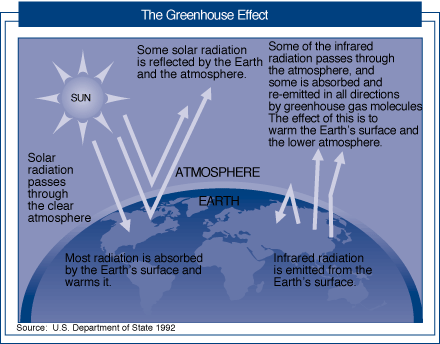
U.S. Department of State slide explaining the greenhouse effect, 1992. National Archives.

U.S. Department of State slide explaining the greenhouse effect, 1992. National Archives.

Sure.  Too much oxygen to a newborn baby can cause blindness; oxygen in that case is a pollutant.  Certainly, if an essential gas like oxygen can be classed as a pollutant, since too much carbon dioxide can be deadly as an acute poison, it’s fair to class it as a pollutant when it appears where it should not appear, or when it appears in concentrations too great to be safe for what we need it to do, or when it is destructive.

The tougher question is, can Congress do anything about it?

Arguments about whether carbon dioxide is a pollutant distract and detract from, and delay the critical arguments about how to act to mitigate harmful effects of climate change and how to prevent the most disastrous effects, if possible.

Barry Rabe teaches at the University of Michigan and studies policies of government on climate change, and the policy making of government on climate change.

Take a look at some of his work, under the title, “Can Congress Govern the Climate?”

Full report in pdf, here: “Can Congress Govern the Climate?” Or download 0423climatechange_rabe

Common atmospheric pollutants, from Compound Interest. CO2 is a pollutant

Common atmospheric pollutants, from Compound Interest. CO2 is a pollutant

See also:

Tip of the old scrub brush to U Town Blog.

Help cut through the fog of disinformation:


Add to FacebookAdd to NewsvineAdd to DiggAdd to Del.icio.usAdd to StumbleuponAdd to RedditAdd to BlinklistAdd to TwitterAdd to TechnoratiAdd to Furl


Fixing education at the top

June 9, 2009

No, Harold Levy doesn’t get it all right.  He’s a former chancellor of schools in New York City, so even if he did manage to get most what he says right, there would be enough people on the other side of some issue to say he did not, that if I compliment him too effusively, someone will say I’m wrong.

Among the greater products of the United States of America — and Canada, let’s face it — is the grand array of nearly 4,000 colleges and universities that set the pace for education in the world.  Our greatest export is education, the idea that education almost by itself can solve many great and vexing issues, the idea that education is a great democratic institution, and the education systems themselves, the methods of education used no matter how little backed by research.

Higher education makes up the better part of what we get right.

In an opposite-editorial page piece in the New York Times today Levy proposes some significant but eminently doable changes in how we work education in high schools and colleges.  Maybe surprising to some, he has good things to say about the University of Phoenix and their $278 million advertising campaign, about high-pressure tactics to reduce truants, and about the GI Bill.


Is Texas the state most vulnerable to global climate change?

June 6, 2009

John Mashey occasionally graces these pages with his comments — a cool, reasoned head on hot issues like global warming/global climate change, despite his history in computers or maybe because of it (which would put the lie to the idea that computer programming explains why so many computer programmers are wacky intelligent design advocates).

Mashey offered a comment over at RealClimate on a post about hoaxer and science parodist Christopher Monckton — a comment you ought to read if  you think about Texas ever, and especially if you like the place.  It’s comment #413 on that Gigantor blog.

Monckton wrote a letter to the New York Times and attached to it a graph.  The graph, it turns out, probably would need to be classified in the fiction section of a library or book store, were it a book.  Much discussion occurs, absent any appearance by Monckton himself who does not defend his graphs by pointing to sources that might back what his graphs say, usually.

In short, the post and the extensive comments shed light on the problems of veracity which plague so many who deny either that warming is occurring, or that air pollution from humans might have anything to do with it, or that humans might actually be able to do anything to mitigate the changes or the damage, or that humans ought to act on the topic at all.

So I’ve stolen Mashey’s comment lock, stock and barrel, to give it a little more needed highlight.

If you follow environmental issues much, you probably know Count Christopher Monckton as a man full of braggadocio and bad information on climate.  He is known to have worked hard to hoodwink the U.S. Congress with his claims of expertise and policy legitimacy, claiming to be a member of the House of Lords though he is not (some climate change deniers in Congress appear to have fallen for the tale).  He pops up at denialist conferences, accuses scientists of peddling false information, and he is a shameless self-promoter.

After much discussion, Mashey turned his attention to claims that Texans don’t know better than Monckton, and other things; Mashey notes that denialists cite Monckton’s performance at a conservative political show in Texas, instead having paid attention to real climate scientists who were meeting just up the road, for free:

AGW’s impact depends on where you live
OR
Texas is Not Scotland, even when a Scottish peer visits

1) SCOTLAND
Viscount Monckton lives in the highlands of Scotland (Carie, Rannoch, 57degN, about the same as Juneau, AK, but warmer from Gulf Stream.)

a) SEA LEVEL, STORMS
Most of Scotland (esp the highlands) is well above sea level, and in any case, from Post-Glacial Rebound, it’s going up. [Not true of Southern England.]

b) PRECIPITATION
Scotland gets lots of regular precipitation. From that, he likely gets ~1690mm or more rainfall/year, noticeably more than Seattle or Vancouver.

Scotland has complex, variable weather systems, with more rain in West than in East, but has frequent precipitation all year.

c) TEMPERATURE
Scotland’s climate would likely be better with substantial warming. See UK Met Office on Scotland, which one might compare with NASA GISS Global Annual Mean Surface Air Temperature Change. Scotland average maximum temperatures are 18-19C in the summer, i.e., in most places it might occasionally get up to 70F, although of course it varies by geography. +3C is no big deal. The record maximum was 32.9C (91F), set in 2003. Maybe there is yet a good future for air-conditioning/cooling vendors.

If one does a simple linear regression on both sets of annual data, one finds that SLOPE(Scotland) = .0071C/year, SLOPE(world) = .0057C/year, i.e., Scotland is warming slightly faster than the world as a whole.

d) AGRICULTURE
The combination of b) and c) is, most likely *good* for agriculture in Scotland. There is plenty of rain, and higher temperatures mean less snow and a longer growing season. Great!

In addition, the British geoscientist/vineyard archaeologist Richard Selley thinks that while it may be too hot for good vineyards in Southern England by 2080, it will be fine for some areas of Scotland.
Future Loch Ness Vineyard: great!

e) OIL+GAS, ENERGY
Fossil fuel production (North Sea oil&gas) is very important to the Scotland economy. Wikipedia claims oil-related employment is 100,000 (out of total population of about 5M).

Scotland has not always been ecstatic to be part of the UK.

2) TEXAS
The Viscount Monckton spoke for Young Conservatives of Texas, April 28 @ Texas A&M, which of course has a credible Atmospheric Sciences Department. Of course, many of them were unable to hear the Viscount because they were in Austin at CLIMATE CHANGE Impacts on TEXAS WATER, whose proceedings are online. See especially Gerald North on Global Warming and TX Water.

Monckton delivered his message: “no worries, no problems” which might well fit Scotland just fine, at least through his normal life expectancy.

The message was delivered to Texans typically in their 20s, many of whom would expect to see 2060 or 2070, and whose future children, and certainly grandchildren, might well see 2100.

Texas is rather different from Scotland, although with one similarity (oil+gas).

a) SEA LEVEL, STORMS

Texas has a long, low coastline in major hurricane territory.
Brownsville, TX to Port Arthur is a 450-mile drive, with coastal towns like Corpus Christi, Galveston, and Port Arthur listed at 7 feet elevations. The center of Houston is higher, but some the TX coast has subsidence issues, not PGR helping it rise. The Houston Ship Canal and massive amounts of infrastructure are very near sea level. More people live in the Houston metropolitan area + rest of the TX coast than in all of Scotland.

Of course, while North Sea storms can be serious, they are not hurricanes. IF it turns out that the intensity distribution of hurricanes shifts higher, it’s not good, since in the short term (but likely not the long term), storm surge is worse than sea level rise.

Hurricane Rita (2005) and Hurricane Ike (2008) both did serious damage, but in some sense, both “missed” Houston. (Rita turned North, and hit as a Category 3; Ike was down to Category 2 before hitting Galveston).

Scotland: no problem
TX: problems already

b) RAINFALL
Texas is very complex meteorologically, and of course, it’s big, but as seen in the conference mentioned above (start with North’s presentation), one might say:

– The Western and Southern parts may well share in the Hadley-Expansion-induced loss of rain, i.e., longer and stronger droughts, in common with NM, AZ, and Southern CA. Many towns are dependent on water in rivers that come from the center of the state, like the Brazos.

– The NorthEast part will likely get more rain. [North’s comment about I35 versus I45 indicates uncertainty in the models.]

– Rain is likely to be more intense when it happens, but droughts will be more difficult.

Extreme weather in TX already causes high insurance costs, here, or here.

Scotland: no problem
Texas: problems.

c) TEMPERATURE

Texas A&M is ~31degN, rather nearer the Equator than 57degN.
Wikipedia has a temperature chart. It is rather warmer in TX, but is also more given to extremes.

Scotland: +3C would be dandy,
Texas: +3C not so dandy.

d) AGRICULTURE
Between b) and c), less water in dry places, more water in wet places, more variations in water, and higher temperatures (hence worse evaporation/precipitation difference) are not good news for TX agriculture, or so says Bruce McCarl, Professor of Agricultural Economics at TAMU.

For audiences unfamiliar with Texas A&M, the “A” originally stood for Agriculture, and people are called Aggies. One might assume that agricultural research is valued.
Politically, “Aggie-land” would not be considered a hotspot of hyper-liberal folks prone to becoming climate “alarmists”.

Scotland: warmer, great! Wine!
Texas: serious stress.

d) OIL+GAS, ENERGY
Here, there is more similarity: fossil fuels are economically important.

On the other hand, Scotland was settled long before the use of petroleum, and while places like the highlands are very sparse, cities like Edinburgh and Glasgow are relatively dense, and many villages are quite walkable. Warmer temperatures mean *lower* heating costs.

Texas has naturally developed in a very different style, and with forthcoming Peak Oil, this may be relevant. In 2006, according to EIA, Texas was #1 in energy consumption, 5th per-capita (after AK, WY, LA, ND) and uses 2X/capita of states like NY or CA. Some of that is inherent in different climate and industry.

Sprawling development in a state with water problems, subject to dangerous weather extremes, and already seriously-dependent on air-conditioning, may end being expensive for the residents.

Scotland: makes money from fossil energy, but it was mostly built without it. Warmer temperatures reduce energy use.
Texas: already uses ~2.5-3X higher energy/capita, compared to Scotland. Warmer temperatures likely raise energy use.

3. SUMMARY

Gerald North’s talk ended by asking:
“Is Texas the most vulnerable state?”

That sounds like an expert on trains, hearing one coming in the distance, standing on the tracks amidst a bunch of kids, trying to get them off the tracks before there’s blood everywhere.

On the other side, someone safely away from tracks keeps telling the kids that experts are wrong, there is no danger, so they can play there as long as they like.
You will be well informed if you also read Mashey’s comments at #120 and #132.


Texas Senate rejects creationist’s nomination

May 28, 2009

A victory in a war that should not be.

Texas Freedom Network carries the news (4:43 p.m. Central) that the Texas State Senate voted 19-11 in favor of Gov. Rick Perry’s nominee to head the State Board of Education, Don McLeroy, a wedge politician who represents the Beaumont area on the board of 15 commissioners.  Fortunately for Texas, the nomination needed 20 votes for approval.

Difficulty arises because there is not a candidate on the horizon from among the board’s members who probably has Perry’s favor and who is not a creationist, wedge politician.  Technically, Perry could reappoint McLeroy, some observers think, and he could occupy the seat until the next regular session of the Senate in two years.

It’s a story about a road that goes on forever and the bad politics never end.

Press release from TFN below the fold.

Read the rest of this entry »


10 things about Judge Sonia Sotomayor

May 27, 2009

Those people over at MoveOn.org move quickly:

Ten Things To Know About Judge Sonia Sotomayor

  1. Judge Sotomayor would bring more federal judicial experience to the bench than any Supreme Court justice in 100 years. Over her three-decade career, she has served in a wide variety of legal roles, including as a prosecutor, litigator, and judge.
  2. Judge Sotomayor is a trailblazer. She was the first Latina to serve on the Court of Appeals for the Second Circuit and was the youngest member of the court when appointed to the District Court for the Southern District of New York. If confirmed, she will be the first Hispanic to sit on the U.S. Supreme Court.
  3. While on the bench, Judge Sotomayor has consistently protected the rights of working Americans, ruling in favor of health benefits and fair wages for workers in several cases.
  4. Judge Sotomayor has shown strong support for First Amendment rights, including in cases of religious expression and the rights to assembly and free speech.
  5. Judge Sotomayor has a strong record on civil rights cases, ruling for plaintiffs who had been discriminated against based on disability, sex and race.
  6. Judge Sotomayor embodies the American dream. Born to Puerto Rican parents, she grew up in a South Bronx housing project and was raised from age nine by a single mother, excelling in school and working her way to graduate summa cum laude from Princeton University and to become an editor of the Law Journal at Yale Law School.
  7. In 1995, Judge Sotomayor “saved baseball” when she stopped the owners from illegally changing their bargaining agreement with the players, thereby ending the longest professional sports walk-out in history.
  8. Judge Sotomayor ruled in favor of the environment in a case of protecting aquatic life in the vicinity of power plants in 2007, a decision that was overturned by the Roberts Supreme Court.
  9. In 1992, Judge Sotomayor was confirmed by the Senate without opposition after being appointed to the bench by George H.W. Bush.
  10. Judge Sotomayor is a widely respected legal figure, having been described as “…an outstanding colleague with a keen legal mind,” “highly qualified for any position in which wisdom, intelligence, collegiality and good character would be assets,” and “a role model of aspiration, discipline, commitment, intellectual prowess and integrity.”

Sources for each of the 10 things:

1. White House Statement, May 26, 2009.
http://www.moveon.org/r?r=51451&id=16226-5763840-nrcJckx&t=1

2. White House Statement, May 26, 2009.
http://www.moveon.org/r?r=51451&id=16226-5763840-nrcJckx&t=2

3. Cases: Archie v. Grand Cent. Partnership, 997 F. Supp. 504 (S.D.N.Y. 1998) and Marcella v. Capital Dist. Physicians’ Health Plan, Inc., 293 F.3d 42 (2d Cir. 2002).

4. Cases: Flamer v. White Plains, 841 F. Supp. 1365 (S.D.N.Y. 1993), Ford v. McGinnis, 352 F.3d 382 (2d Cir. 2003), and Campos v. Coughlin, 854 F. Supp. 194 (S.D.N.Y. 1994).

5a. “Sotomayor’s Notable Court Opinions and Articles,” The New York Times, May 26, 2009.
http://www.moveon.org/r?r=51454&id=16226-5763840-nrcJckx&t=3

5b. Cases: Bartlett v. N.Y. State Board, 970 F. Supp. 1094 (S.D.N.Y. 1997), Greenbaum v. Svenska Hendelsbanken, 67 F.Supp.2d 228 (S.D.N.Y. 1999), Raniola v. Bratton, 243 F.3d 610 (2d Cir. 2001), and Gant v. Wallingford Board of Education, 195 F.3d 134 (2d Cir. 1999).

6. “Sonia Sotomayor: 10 Things You Should Know,” The Huffington Post, May 26, 2009.
http://www.moveon.org/r?r=51452&id=16226-5763840-nrcJckx&t=4

7. “How Sotomayor ‘Saved’ Baseball,” Time, May 26, 2009.
http://www.moveon.org/r?r=51455&id=16226-5763840-nrcJckx&t=5

8. “Sotomayor’s resume, record on notable cases,” CNN, May 26, 2009.
http://www.moveon.org/r?r=51453&id=16226-5763840-nrcJckx&t=6

9. “Sotomayor’s resume, record on notable cases,” CNN, May 26, 2009.
http://www.moveon.org/r?r=51453&id=16226-5763840-nrcJckx&t=7

10a. Judge Richard C. Wesley, a George W. Bush appointee to the Second Circuit.
http://www.moveon.org/r?r=51451&id=16226-5763840-nrcJckx&t=8

10b. “Sotomayor is Highly Qualified,” The Wall Street Journal, May 9, 2009.
http://www.moveon.org/r?r=51456&id=16226-5763840-nrcJckx&t=9

10c. Honorary Degree Citation, Pace University School of Law, 2003 Commencement.

  • Judge Sotomayor is a widely respected legal figure, having been described as “…an outstanding colleague with a keen legal mind,” “highly qualified for any position in which wisdom, intelligence, collegiality and good character would be assets,” and “a role model of aspiration, discipline, commitment, intellectual prowess and integrity.”ere are the sources for the ten statements:

  • Congratulations, graduates! You got hired! (Want to think about joining the union?)

    May 25, 2009

    No more comment necessary.

    Tip of the old scrub brush to  . . . ramblings of the last American jedi . . .


    McLeroy’s appointment in trouble in the Texas lege?

    April 23, 2009

    Another casualty of my real life crises, trying to keep readers informed about education policy in Texas has suffered here in the Bathtub.  My apologies.

    The good news is that Don McLeroy’s attempts to eviscerate public school curricula have gotten some attention in the Texas Lege (as Molly Ivins called it). Gov. Rick Perry appointed McLeroy to a full term as chair of the State Board of Education (SBOE), but that appointment needs approval by the Texas Senate.  The hearing (if you can call it that) was scheduled for yesterday, and when it actually occurred it became obvious that the senators noticed McLeroy is a one-man wrecking crew, apparently drunk, and loose in the state’s china cabinet.

    Will there be more good news, that the Senate can rein in McLeroy?

    Steve Schafersman, president of Texas Citizens for Science, has a very complete story on the events at his blog at the Houston Chronicle site, Evosphere.  Steve’s piece includes links to several other writings that fully describe the troubled waters that have become the SBOE.

    Schafersman points to an article in the Austin American-Statesman by Kate Alexander, which suggests there’s a chance that McLeroy’s nomination might actually be rejected.  The Lege leans so far to the right that the right shoulders of their suit coats are scraped by the pavement, but even the legislators understand that snubbing the economists of Texas A&M and every Spanish-speaking Texan is something your mother would not approve of, and shouldn’t be the normal business of an official state agency like the SBOE.  (Austin American-Statesman — another of the great daily newspapers in America, still doing outstanding reporting despite staff cutbacks).

    Legislators are rightly concerned about the simple incompetence SBOE demonstrates on every subject, not just science, and the general atmosphere of unnecessary bickering McLeroy has fostered.  In the latest, but mostly unreported move, SBOE stopped the review of social studies standards by experts and expert teachers in Texas.  Among the chief complaints is that the economics team recommended calling capitalism “capitalism.”  McLeroy is unhappy with using the appropriate term to describe America’s economic system.

    Is it possible to get much more divorced from reality than that, and still keep one’s driving and hunting licenses?

    Schafersman has one paragraph that sums up the situation rather well:

    Alexander writes: “Shapleigh said there is a perception that McLeroy is using the chairmanship of the State Board of Education as a bully pulpit for promoting his religious point-of-view and pushing it into the public arena.” McLeroy disingenuously denies this, claiming the fight is over different “educational philosophies,” and “that is the source of the controversy, not his religious views.” While that may be true of some actions, such as forcing a traditional English Language Arts curriculum unwanted by ELA professionals on the state and illegally throwing out a mathematics textbook, in most cases the Fundamentalist Protestant Christian religious beliefs of McLeroy and his six cronies on the State Board were definitely behind their actions. These include the adoption of flawed, damaged science standards, the explicit attacks on evolution, the fossil record, and ancient geological ages of the Earth and universe, adoption of a flawed and inadequate Bible curriculum that will permit unscholarly and unscientific Bible instruction, and the frequent threats to publishers–which is a form of extortion that publishers come to expect–to reject their textbooks if they don’t contain sufficient anti-scientific information against evolution and in favor of Intelligent Design Creationism. McLeroy tried to censor textbooks previously in 2003 by threatening publishers, but failed.

    What happens if the Senate rejects Perry’s nomination of McLeroy?  McLeroy would remain a member of SBOE.  Who, or whether, Perry would appoint to replace McLeroy has not been discussed.  Do any of the current members have the respect of a majority of the board, enough to do the job?  Is anyone on the board capable of administering the group when religious fanatics appear so hell bent on shattering foundations of public education?

    Don’t get hopes up.  Rejecting McLeroy’s nomination might be the rational thing to do, but it might push Perry to even deeper acts of irrationality in appointing a new chair, difficult though it may be to imagine that.

    Stay tuned.

    Resources:


    Evolution and state science standards in Florida

    April 22, 2009

    WJCT TV and FM in Jacksonville, Florida, has a televised discussion on evolution in the state science standards set for April 23.  It’s set for 8 p.m. — Eastern Time, I’m guessing.

    From the station’s blog (quoted entirely):

    tri-brand-logo4

    First Coast Forum – Schools, Science, and the State  – Thursday, April 23rd at 8pm on 89.9 FM and WJCT TV

    The Florida Board of Education recently revised its science standards to require the teaching of evolution. The state legislature has met twice since then, and both times lawmakers have proposed bills requiring a “critical analysis” of this scientific theory. The latest bill— sponsored by Jacksonville Senator Steven Wise—didn’t get far in this year’s session, but this controversial debate is likely to continue. Senator Wise says it’s important to expose students to other ideas such as intelligent design. Critics argue that challenging evolution could open a door for religious doctrine in science classes.

    What should our students learn and who should decide? We’ll discuss these issues with local lawmakers, religious experts, teachers, and parents on our next First Coast Forum Schools, Science, and the State, April 23rd at 8pm only on WJCT.

    Panelists:

    • Steve Goyer – pastor representing OneJax
    • Dr. Marianne Barnes, UNF Education Professor
    • Stan Jordan, Duval County School Board, former state legislator
    • Rachel Raneri, Duval County District School Advisory Council Chair
    • David Campbell, Orange Park Ridgeview H.S. teacher
    • Quinton White, JU
    • Paul Hooker of the Presbytery of St. Augustine

    Viewers can participate in First Coast Forum
    Email questions and comments to firstcoastforum@wjct.org or by calling (904) 358-6347 during the program.


    Happy birthday, Orrin Hatch

    March 22, 2009

    Dear Orrin,

    We know how old you are really, but we won’t divulge.

    U.S. Sen. Orrin G. Hatch, R-Utah

    U.S. Sen. Orrin G. Hatch, R-Utah

    When we were campaigning in 1976, I don’t think anyone thought you’d be there in 2009, still.  Sen. Reed Smoot served Utah for one day shy of 30 years.  No one else from Utah has come close to your 32 years of service, and it will be a long time before any other challenges your longevity.

    Not bad for the first office you ever got elected to.

    Kathryn and I wish you all the best on your birthday.

    And we’ll be pleased to set  you straight any time you want.

    Sincerely,

    Ed

    Read the rest of this entry »


    How do you know it’s as bad as it is?

    March 20, 2009

    My father lived through the Great Depression.  That was what we noted whenever he cheered when somebody got a job with the Post Office.  “It’s a steady job,” he’d say.  “The Post Office doesn’t lay people off.  They have good health care, and a pension.”

    That was then.  My father died in 1988.

    This is now.

    Yeah, it’s that bad.


    Supreme Court tryouts

    March 20, 2009

    Elena Kagan took the oath of office to be the nation’s top lawyer, the Solicitor General, last Friday.  The Associated Press is running a story (here from the Sacramento Bee) on whether this is a tryout for the Supreme Court itself, “Obama could make top high court lawyer a justice.”  (Isn’t that a tortured headline?)

    Three justices may want to retire soon:  Justice John Paul Stevens is 88 years old.  Justice Ruth Bader Ginsburg is 76, and back on the court in record time after surgery for pancreatic cancer.  Justice David Souter is third oldest, at 69.

    So, this AP story could be a good article for use in government classes.  Consider these questions:

    • Is Solicitor General a stepping stone to the Supreme Court’s bench?
    • What is the role of the Solicitor General?
    • How important is Supreme Court experience, or experience in other courtrooms, to success in arguing before the Supreme Court?
    • What are some of the top cases before the Supreme Court this term, and what are the potential and likely results of these appeals?
    • What is the role of the U.S. Senate in selection of federal judges, and especially in the selection of Supreme Court justices?
    • Kagan clerked for Justice Thurgood Marshall.  What do law clerks do for justices?  What does her clerking suggest for Kagan’s advocacy of Voting Rights Act issues, since she worked with Justice Thurgood Marshall?

    Resources:


    One view to 1600 Pennsylvania Avenue

    March 10, 2009

    1600 Pennsylvania Avenue.  It sounds like a number Fred Waring’s Glenn Miller’s band could shout out at the end of instrumental verses.  It’s the street address of the White House, not so secretly, and to most fans or other followers of politics, it carries great symbolism.

    So a professor at the University of Akron thought it would be a good name for a blog.  It is. The blog is a very good compilation of sources and intriguing commentary.

    This item caught my eye yesterday — the least tawdry dealing with this issue I’ve seen in a long time, though some of the portraits pointed to are more impressionistic than history.  The listing alone reveals a lot.  It’s incomplete, of course.  This is the one post probably not suitable for 8th grade U.S. history; it’s already come up in my government classes this year.

    Check out the stuff in the widgets — the link to the current WhiteHouse.gov feed is a good idea, cool, and by its mere existence, an indicator of the influence of technology on politics.

    I’m curious to know how one might use this blog in the classroom.  Got ideas?


    Declaration and Constitution – sources

    February 26, 2009

    Cross posted from Mr. Darrell’s Wayback Machine, with permission, with minor edits.

    Everybody needs to have a copy of the Declaration of Independence and  U.S. Constitution close at hand.

    Original rought draft of the Declaration of Independence written out in longhand by Thomas Jefferson, featuring emendations by Benjamin Franklin and John Adams - Library of Congress Manuscripts Division

    Original rough draft of the Declaration of Independence written out in longhand by Thomas Jefferson, featuring “emendations” by Benjamin Franklin and John Adams – Library of Congress Manuscripts Division

    Too often I’ve been in classes where textbooks didn’t have them, though in some cases the course clearly required it (especially irritating in high school texts, but not unheard of in college texts).  The two documents are covered in depth in the requirements for Texas 10th grade social studies (world history), but not in the texts.

    Both documents provide a foundation for analysis of events following, through the 19th and 20th centuries.

    Where is the student of world history to find them?

    Here:

    Declaration of Independence

    Constitution of the United States of America

    Rotunda of the National Archives in Washington, D.C., where the Declaration and Constitution are kept on display - National Archives photo

    Rotunda of the National Archives in Washington, D.C., where the Declaration and Constitution are kept on display – National Archives photo


    Texas legislators get the message: Creationism hurts science and jobs

    February 14, 2009

    On Darwin’s birthday, two Texas legislators wrote about the stakes in the tussle between creationists on the one side, and educators, scientists and economic development on the other, in the Houston Chronicle.

    Somebody gets it!  Will Gov. Rick Perry and SBOE Chairman Don McLeroy get the message?  McLeroy was reappointed as chairman a week ago — but the appointment must be approved by the State Senate.  Is a fight possible?

    State Board of Education must be held accountable

    By STATE SEN. RODNEY ELLIS and STATE REP. PATRICK M. ROSE
    Copyright 2009 Houston Chronicle

    [Can a newspaper copyright the words of public servants doing their jobs?]

    Feb. 12, 2009, 12:14AM

    As scientists and educators across Texas and the nation mark the 200th birthday of Charles Darwin with calls for a renewed commitment to science education, the State Board of Education continues to engage in narrow theological debate about the validity of evolution. If Texas schoolchildren are to succeed in the 21st Century economy, the SBOE must focus less on internal philosophical differences and more on improving science instruction.

    Last month, the board once again got bogged down in a bitter dispute over this issue. Members tentatively approved new science curriculum standards that protect teaching of evolution in one area, while creationists succeeded in watering it down elsewhere. Sadly, it was just the latest battle in the “culture war” being fought by a board that decides what more than 4.7 million Texas children learn in their public schools.

    Families should be the primary educators on matters of faith, not our public schools. Regardless of board members’ personal beliefs on creationism and evolution, science classrooms are not the place for resolving such disagreements about faith. Those classrooms should focus on science.

    Despite one’s personal stance on evolution, its teaching is critical to the study of all the biological sciences.

    Scientists from our state’s universities have expressed this to the board, and have warned that watering down science education would undermine biotechnology, medical and other industries that are crucial to our state’s future.

    Last session, the Legislature committed to investing $3 billion over the next 10 years in making Texas the global leader in cancer research and finding cures. This historic investment is certain to bring economic and academic opportunities to our state.

    Sadly, even as our state takes one step forward, the SBOE moves us two steps back by continuing to support a diminished standard for science education. Texas’ credibility and its investment in research and technology are placed at risk by these ongoing, unproductive debates.

    This is a critical issue and a critical time. Study after study has demonstrated that states which do well in science education have the brightest long-term economic future. According to Gov. Rick Perry’s Select Commission on Higher Education and Global Competitiveness, despite improved scores in math and reading, Texas’ students continue to lag alarmingly behind other states in science proficiency.

    The National Assessment of Education Progress revealed that only 23 percent of Texas 8th graders achieved proficiency in science, compared with 41 percent of students in the top-performing states — the states with which we compete for jobs.

    Yet the board continues to undermine high-quality science instruction, allowing our students to slip further behind.

    To ensure that the SBOE works as it should, we have filed legislation to place the board under periodic review by the Sunset Advisory Commission and hold them accountable for their performance, just as we do the Texas Education Agency and other state agencies.

    The decisions of the SBOE not only impact millions of young lives on a daily basis, but impact the economic progress of our state as well.

    For these reasons and many others, the public has a right to full disclosure and oversight.

    The board has escaped such scrutiny for far too long. The disregard for educators, instructional experts and scientists can’t continue. It’s time to take a closer look at the operations and policies of the State Board of Education.

    Our state, and especially our kids, deserve better.

    Ellis represents the Houston area and parts of Fort Bend County; Rose represents Blanco, Caldwell and Hays counties.

    Thank you, Houston Chronicle.

    Resources:


    Gov. Perry to Texas, biologists, educators, students, Hispanics, and parents: “Drop Dead”

    February 7, 2009

    That hissing sound you hear is hope leaking out of Texas scientists, educators and students.  Those trucks you hear are the moving trucks of science-based industries, leaving Texas for California (!), Massachusetts, Utah, New York, Florida and other states where science is taught well in public schools and assumed to be an educational priority.

    In his year as chairman of the Texas State Board of Education, Don McLeroy has sown strife and discord among board members, professional staff, and educators across Texas.  He insulted Texas Hispanics and did his best to eliminate Hispanic heritage from Texas literature studies.  He repeatedly dismissed the advice of legally-required advisory committees of teachers and educators.  He insulted top scientists who offered advice on science education, and he ignored education experts in the development of curricula and standards for Texas public schools.  He promises a religious crusade to gut biology education in Texas.

    On Friday, Texas Gov. Rick Perry reappointed McLeroy as chairman of SBOE, to a term that ends on February 1, 2011.

    The Texas Senate must confirm.

    Resources:
