Belated: Happy Anniversary, Chuck Yeager!

October 20, 2007

Panorama of the Mountains noted the 60th anniversary of the first known faster-than-sound flight by a human — October 14, 1947. Test pilot and all-around good guy Chuck Yeager did it.

Bell X-1, on display at National Air and Space Museum

This is a great post-World War II, Cold War story of technology that should pique interest in the time and the events for many students. For a 90 minute class, a solid lesson plan could be developed around the science and technology of the flight (yes, even in history — this is key stuff in the development of economics, too). The physics of sound, a brief history of flight and aircraft, the reasons for post-war development of such technologies, the political situation: There are a dozen hooks to get into the topic. Fair use would cover showing a clip from “The Right Stuff” about the flight, and there are some dramatic clips there. (The movie is 3 hours and 13 minutes; great stuff in a format too long for classroom use. Is there any possibility your kids would read the Tom Wolfe book?)

When will someone – the Air Force? NASA? an aircraft company? — put together a DVD with authorized film clips from the newsreels and the movie, and suggested warm ups and quiz questions?

Back in the bad old days one of my elementary school teachers did an entire morning on the speed of sound, aircraft engineering, and the history of faster-than-sound flight. I learned the accurate way to measure the distance to lightning by counting seconds to the thunder (it’s about a mile for every 5 seconds, not a mile for every second, as our school-yard lore had it).

  • Image at right: Brig. Gen. Charles E. Yeager today, with image of Bell X-1; U.S. Air Force imageChuck Yeager, collage with Bell X-1

This program, to fly at the speed of sound, at what is now Edwards Air Force Base changed the way science of flight is done in the U.S. Yeager led the group of Air Force pilots who proved that military pilots could do the testing of aircraft; the project proved the value of conducting research with experimental aircraft on military time. The methods developed for testing, evaluating, redesigning and retesting are still used today. The drive for safety for the pilots also grew out of these early efforts at supersonic flight.

Yeager’s flight came when technology was cool, not just for the virtual reality role playing games (RPGs), which were still decades in the future, but because it was new, interesting, and it opened a world of possibilities. We all wanted to fly airplanes, especially small, fast airplanes. Read the rest of this entry »


Italian WWI vet dies

October 11, 2007


From the on-line Wall Street Journal’s “Evening Wrap”:

Italian World War I Veteran Dies — The world lost one of its few remaining veterans of World War I last Friday when Justin Tuveri died in the French resort town of St. Tropez . Born Giustino Tuveri on the island of Sardinia in 1898, Mr. Tuveri was a member of the Sassari Brigade, a Sardinian infantry unit known as the “Dimonios” — alternately translated as “demons” or “red devils” — which suffered 15,000 casualties in fighting against Austro-Hungarian and German forces in mountainous northeastern Italy. According to the French daily Le Monde, Mr. Tuveri’s was shot twice in the back during a battle with German forces four months after he joined the service. And he told reporters that doctors removed the bullets from his body without anesthesia. After he recuperated from his wounds, he emigrated to France where he had an active life, including driving until the age of 98. The French Defense ministry says there are only two French veterans of the Great War alive. There are three left in the U.S., according to U.S. Department of Veterans Affairs spokesman Jim Benson. The youngest, at 106 years old, is Frank Buckles of Charles Town, W. Va., who lied his way into the army because he was underage. He served as the grand marshal of the National Memorial Day Parade in Washington, D.C. this past May.


–The Associated Press contributed to this report.


2007 Nobel Prizes in Physics – Giant magnetoresistance

October 9, 2007

The Nobel Committees are working overtime to frustrate my predictions this year.

Two Europeans won the Nobel Prize in Physics. Albert Fert, Unité Mixte de Physique CNRS/THALES, Université Paris-Sud, Orsay, France, and Peter Grünberg, Forschungszentrum Jülich, Germany, won for the discovery of “giant magnetoresistance.”

It’s called one of the first real applications of nanotechnology. Here’s an explanation from IBM’s website, of how the discovery affects new hard drive technologies. This is the basic technology for the working of your hard drive.

Go see the press release from the Nobel Foundation. Video of the announcement ceremony should be available here, later today.

Score so far this year: Five awards, one person schooled in the U.S, by Quaker schools, not public schools. My predictions that the awards go to U.S. citizens schooled in the public schools are not doing well, so far this year. Is the trend over already?


50 years after Little Rock: Lesson plans

September 27, 2007

Tolerance.org features a solid lesson plan on what the nation should have learned from the events in Little Rock, Arkansas, in 1957 — when nine African American students challenged segregation and sought to enroll at Little Rock’s Central High School. It’s timely — the actual anniversary is this month. This is a key point for Texas’s U.S. history standards:

September 2007 – This month, our nation marks the 50th anniversary of the Little Rock Nine’s attempt to integrate schools. Have we really learned how to break down barriers?

This lesson plan is excerpted from the 2007-2008 Mix It Up Planner. Learn more about national Mix It Up at Lunch Day, to be held on Nov. 13, 2007!

Objectives:

  • Students will draw conclusions about boundary crossing from history and literature.
  • Students will identify boundaries in their classroom or school, cross those boundaries, report back and reflect on what they learned.

Tolerance.org carries several lesson plans teachers will find useful.


Science history slips away: Ralph Alpher and Big Bang

September 20, 2007

Looking for something else in an old newspaper, I came across a small obituary for Ralph Alpher. Alpher died August 12, 2007, in Austin, Texas, at the home of his son, Dr. Victor S. Alpher.

Ralph Alpher, physicist who co-hypothesized the Big Bang

Ralph Alpher, physicist who co-hypothesized the Big Bang

Ralph Alpher gave us the Big Bang. We let him slip away, almost unnoticed. Odds are you don’t recall ever hearing of Alpher. Here’s your mnemonic: The alphabet paper.

In 1948, as a graduate student under George Gamow at the George Washington University, Alpher and Robert Herman of Johns Hopkins laid the groundwork for what would become Big Bang theory, calculating how matter could arise in the Universe. Gamow, exhibiting the sense of humor for which physicists are famous, listed the authors of the paper as Alpher, Bethe, Gamow and Herman — a play on the Greek alphabet’s first three letters (alpha, beta, gamma), and a joke invoking the name of the great physicist Hans Bethe. Bethe liked the joke, consulted on the paper, and the theory of Big Bang was published.

Ralph Alpher, in Florida, 2006; Alpher home page

The name “Big Bang” was applied a few years later; Sir Frederick Hoyle and his colleagues favored a “steady state” universe, and at the time both hypotheses could accurately predict most of what was observed, and neither could be disproven. Hoyle, hoping to poke ridicule at the competing hypothesis, belittled it as “a big bang.” The name stuck. The name misleads the unwary; the theory posits a rapid expansion at the beginning of the universe and time, but not an explosion, per se.

Alpher wrote the mathematical model; the model predicted Big Bang, and specifically, it predicted the cosmic background radiation that would have been left over; it was this background radiation, the “echo” of Big Bang, that Arno Penzias and Robert Wilson stumbled across in 1965. Robert H. Dicke had invested several years in trying to discover this signature, and had to explain to Penzias and Wilson what they had found. Penzias and Wilson won the Nobel Prize for their discovery; Dicke, Alpher, Herman and Gamow, did not get Nobel Prizes. This is generally regarded as one of the great miscarriages of justice in Nobel Prize awards, not that Penzias and Wilson did not deserve an award, but that the chief theorists and the man who unveiled the discovery were overlooked.

This is another story of rejection leading to great discovery; it is also a rather sad story of a momentous achievement, mostly overlooked through the years.

Alpher was the son of Jewish émigrés from the Russian pogroms. His high school achievements merited a scholarship to the Massachusetts Institute of Technology, in 1937. MIT had a rule at the time that scholarship recipients could not work outside the school. Alpher assisted his father in building houses in the Washington, D.C. area; the family had little money, and Alpher would be unable to pay room and board without working. Discussions with MIT broke down — the offer of a scholarship was withdrawn, according to most accounts when MIT discovered he was a Jew. As so many great people of the post World War II era, he enrolled at the George Washington University.

At GWU, Alpher found Gamow as a mentor, and much of the rest is history.

The New York Times:

The paper reported Dr. Alpher’s calculations on how, as the initial universe cooled, the remaining particles combined to form all the chemical elements in the world. This elemental radiation and matter he dubbed ylem, for the Greek term defining the chaos out of which the world was born.

The research also offered an explanation for the varying abundances of the known elements. It yielded the estimate that there should be 10 atoms of hydrogen for every one atom of helium in the universe, as astronomers have observed.

Months later, Dr. Alpher collaborated with Robert Herman of the Applied Physics Laboratory at Johns Hopkins University on a paper predicting that the explosive moment of creation would have released radiation that should still be echoing through space as radio waves. Astronomers, perhaps thinking it impossible to detect any residual radiation or still doubting the Big Bang theory, did not bother to search.

The Alpher-Bethe-Gamow paper, or αβγ paper, as explained by the American Institute of Physics:

When Alpher and Gamow prepared a paper on the subject, Gamow mischievously added the name of the noted nuclear physicist Hans Bethe to the list of authors so it would be called the “Alpher-Bethe-Gamow paper,” mimicking the “alpha-beta-gamma” of the first letters of the Greek alphabet. Unknown to Gamow, Bethe was a reviewer for the journal to which Gamow submitted the article. Bethe took it in good humor, later explaining, “I felt at the time that it was rather a nice joke, and that the paper had a chance of being correct, so that I did not mind my name being added to it.” Gamow also urged Herman to change his name to Delter to match delta, the next letter in the Greek alphabet. Despite Herman’s refusal, in a paper in a major scientific journal Gamow referred to “the neutron-capture theory…developed by Alpher, Bethe, Gamow and Delter.” Not least among his notable characteristics was his sense of humor.

Alpher continued in this work for a time, but joined General Electric’s labs in the 1950s. When he retired from GE, in 1986 he joined the faculty at Union College in Schenectady, New York, and taught there until 2004.

Alpher was largely overlooked for awards even while his theory was big news in astronomy and physics for the last 40 years of the 20th century. I regret that I was wholly unaware he was in Austin; how many other great contributors to science and history live among us, unrecognized, uncelebrated, and their stories unrecorded?

Alpher, Herman and Gamow - and the famous Cointreau bottle

Photo caption from AIP: A 1949 composite picture with Robert Herman on the left, Ralph Alpher on the right, and George Gamow in the center, as the genie coming out of the bottle of “Ylem,” the initial cosmic mixture of protons, neutrons, and electrons from which the elements supposedly were formed. [The Cointreau bottle from which the three drank a toast upon the acceptance of the paper, is now in the collection of the Smithsonian Institution.]

Alpher was an Eagle Scout. I wonder whether anyone has a history of his time in Scouting?

While the Nobel Prize eluded Alpher, he collected a host of other prestigious awards and honors. Earlier this year, President Bush announced that Alpher had been awarded the National Medal of Science, which is administered by the National Science Foundation and is the highest honor for science.

. . . [T]he citation reads in part:

“For his unprecedented work in the areas of nucleosynthesis, for the prediction that universe expansion leaves behind background radiation, and for providing the model for the Big Bang theory.”

Note from George Gamow, on confirmation of Big Bang Gamow’s humor again on display — an undated note from Gamow upon the confirmation of the Big Bang, with a punny reference to Steady State backer Sir Frederick Hoyle. Image from the American Institute for Physics.

Online sources for Ralph Alpher:

More:

Help others hear the echo:

Add to FacebookAdd to NewsvineAdd to DiggAdd to Del.icio.usAdd to StumbleuponAdd to RedditAdd to BlinklistAdd to TwitterAdd to TechnoratiAdd to Furl


Pete Seeger: Standing taller than his critics

September 10, 2007

Some people can’t let go of the past, and like the greedy chimpanzee who grasps the rice in the jar, and then is trapped when he cannot pull out his fist nor will he give up his prize to save his freedom, they trap themselves out of a good life.

Like this fellow, whose father’s dislike of an old political position of Pete Seeger kept them both from a good concert. He appears to agree with his father, though, thinking that somehow Seeger is responsible for the evils of Stalinism, and complaining that Seeger was tardy in making note of the fact that Stalin was evil. And Instapundit’s Glenn Reynolds agrees, profanely, and inaccurately, as I’ll explain below the fold. But heed this warning: I’m explaining at length.

Get a life, people! Pete Seeger did.

Read the rest of this entry »


American hero: Jack Goldsmith

September 7, 2007

Jack Goldsmith, Harvard U photoJack Goldsmith. This book, when you read it, will explain why he is a hero. Goldsmith is the guy who pulled back the memorandum from the U.S. Justice Department that authorized illegal torture.

There is hope for America so long as good men will do the right thing, quietly, out of the spotlight, and then move on without seeking credit. Watch Moyers’ interview with Goldsmith.

It’s revealing that his pictorial muse, guardian, taunter and inspiration was Elliot Richardson.


Baltimore Scout collects, makes history

September 7, 2007

How about having your students work with the Library of Congress on a history project?

The Veterans History Project encourages people to contribute oral histories of veterans, a project that I think has some wonderful possibilities. Below the fold, read about Tim Mantegna, a Baltimore teen who collected histories as part of his Eagle project. This fall he enters the University of Maryland – Baltimore County to study political science, as an Eagle Scout.  (Also see this story:  “Iraq Veterans Record Their Stories”)

Read the rest of this entry »


Barbara Jordan and Lyndon Johnson: An oral history

September 2, 2007

Barbara Jordan’s voice was distinctive, and commanding. “The voice of God,” Molly Ivins called it. After Jordan’s death, Francis X. Cline wrote what might be an even higher tribute, saying her voice was “as though Winston Churchill had been reincarnated as a black woman from Texas.” She spoke in complete paragraphs, usually, with words that seemed selected carefully to fit exactly the ideas she presented.

Barbara Jordan at the Johnson White House, prior to 1972 -- with Andy Biemiller, John Doar - LBJ Library photo

How delightful, then, to read (and perhaps to actually hear) Barbara Jordan describe her fear of stammering in her first meeting with President Lyndon Johnson. The LBJ Library in Austin has a series of oral histories, including this one:

I went up to what I now know was the Cabinet Room. There were other people assembled, people who were active in the civil rights movement. We sat and waited around a table for the President and the Vice President, Hubert Humphrey, to arrive. Well, as I sat there really at the far end of the table, I still said to myself, “Now, Lyndon Johnson probably doesn’t know who I am or what I am about, and my name probably just slipped in somehow and got into that [list].” So the President came in, everybody stood up. He sat down, we all sat down, and we started to discuss this legislation, fair housing legislation. And the conversation was going around the table. The President would call on first one person for a reaction and then another person for a reaction. Then he stopped and he looked at my end of the table, he said, “Barbara, what do you think?” Well, I just . . . in the first place, I’m telling you, I didn’t know the President knew me, and here he’s looking down here saying “Barbara” and then saying, “What do you think?” So that was my first exchange with Lyndon Johnson. I’m startled. I got myself organized, of course, not so that I wouldn’t stammer, since it is not my habit to stammer when talking, and I gave a response and then this conversation ensued.

That was my first contact personally with Lyndon Johnson.

The glories of oral histories. How can you use this in the classroom?

Read the rest of this entry »


Feynman, on the inconceivable nature of nature

August 27, 2007

NOVA had a couple of good programs on Richard Feynman that I wish I had — it had never occurred to me to look at YouTube to see what people might have uploaded.

I ran into this one:

Richard Feynman struck my consciousness with the publication of his quite humorous autobiography, Surely You’re Joking, Mr. Feynman. I thought it was a wonderful book, full of good character portraits of scientists as I saw them in my undergraduate days, only more famous ones. He followed that with What Do You Care What Other People Think?

By then, of course, Feynman was one of my heroes. His stories are useful in dozens of situations — his story of joining the samba bands in Rio testify to the joy of living, and the need for doing new things. Brazil was also the place he confronted the dangers of rote learning, when students could work equations perfectly for examples in the book — which they had memorized — but they couldn’t understand real world applications, such as describing how the sunlight coming off the ocean at Ipanema was so beautiful.

Feynman wrote about creationism, and about the dangers of voodoo science, in his now-famous essay on “Cargo cult science” — it’s so famous one has difficulty tracking down the facts to confirm the story.

Feynman’s stories of his wife, and her illness, and his love for her, were also great inspirations. Romance always gets me.

I failed to track him closely enough. During the run of the President’s Commission on Americans Outdoors, we had the misfortune of having scheduled a hearing in Orlando on January 30 (or maybe 29), 1986. We had hoped that the coincidental launch of the Space Shuttle Challenger on January 28 might boost our press response. Of course, the Challenger exploded. Our hearing went on as planned (we had a tough schedule to meet). The disaster affected our staff a lot, those who were in Florida, and the rest of us in Washington where many of us had been on the phone to Florida when the disaster occurred.

Feynman’s appointment to the commission studying the disaster was a brilliant move, I thought. Our schedule, unfortunately, kept me tied up on almost every day the Challenger commission met. So I never did walk the three blocks down the street to meet Feynman, thinking there would be other opportunities. He was already fatally ill. He died on February 15, 1988. I missed a chance of a lifetime.

We still have Feynman’s writings. We read the book aloud to our kids when they were younger. James, our youngest and a senior this year, read Surely You’re Joking again this summer, sort of a warmup to AP physics and his search for a college.

And we still have audio and video. Remembering Feynman makes even the most avidly atheist hope for an afterlife, just to get a chance to hear Feynman explain what life was really all about, and how the universe really works.

Other notes:

Tip of the old scrub brush to Charismatic Megafauna.


Military history carnival

August 18, 2007

American Presidents, which is a great blog for history and economics teachers and students anyway, hosts the Military History Carnival.

Got a lot of carnival catch up to do. This one should help you focus on polishing lesson plans and getting ideas for student projets.

Tenth century soap opera? It’s a true story. Great background — is this the sort of story that might interest women more?

Waterberg – the first genocide of the 20th century. “Trail of bones.” Largely forgotten — or unknown — history of war in Africa in 1904. I’ll wager you didn’t know about it. It’s not in your world history book.

What do you know about African troops fighting in Europe in World War I? This post, “Forgotten soldiers of the Great War,” is guaranteed to make World War I more relevant to your African-related students.

Are you really prepared to explain the significance of the Battle of Shiloh?

◊ The school’s network went down and took your PowerPoint presentation on the Spanish Armada. What to do? Here’s some help — the PowerPoint slides you’re missing, perhaps.

◊ History is Elementary is represented by a great post about camouflage in war, particularly World War I. This is a wonderful foundation for a lesson plan that deals with non-electronic technology — and as a sidelight, this is the sort of topic where the hunters among your students will be able to provide five or six examples of modern versions, with detailed explanations about the best places to use them. (You should read the post even if it’s out of your area; it’s a fascinating mashup of art, modern art, botany, zoology, psychology and war.)

There is a magnanimous link to the Bathtub’s post on panoramic photos of World War II sites.

And a lot more. Go see.


Typewriter of the moment: Faulkner, again

August 15, 2007

The previous photo showed Faulkner himself using the machine.

It was a desktop machine. This color shot shows Faulkner’s portable typewriter, a different machine from the one in the publicity still from 1954.

William Faulkner's typewriter, displayed at his home in Oxford, Mississippi; photo by Gary Bridgman

Photographer Gary Bridgman provided a thorough history and explanation, at the Wikipedia Media site, which I quote completely and directly — bless him for the story:

The “Faulkner portable”: American novelist William Faulkner’s (1897-1962) Underwood Universal Portable typewriter, resting on a tiny desk his stepson helped him build. This space at Rowan Oak, the author’s home, was part of the back porch until Faulkner spent part of a Random House advance to enclose it in 1952, long after he had written his seminal Compson and Sartoris family novels. He insisted that this room not be called his “study.” According to biographer Joseph Blotner, “he did not study in it, so there was no sense in calling it that. It was the ‘office,’ the traditional name for the room in the plantation houses where the business was transacted.” As to the typewriter itself, Underwood introduced its Universal Portable in the mid-1930s among a full line of portables such as Champion, Noiseless Portable and Junior. Faulkner had a habit of buying used portables locally, wearing them out, then trading them in on more used portables. This Underwood was one of at least three typewriters in Faulkner’s possession at the time of his death (the University of Virginia has one, too). So, this is no more “the” typewriter any more than those square carpenter’s pencils next to it are “the” pencils. Had Faulkner lived a few more years, this machine would have met the same fate as the rest. Still, the room has a resonance. BOOK magazine was publishing an article of mine on “Yoknapatourism,” and thinking (mistakenly) that the editors hadn’t already selected a photographer, I returned to Oxford on a rainy October afternoon to make my own pictures for submission. The travel piece was eventually illustrated with sunny-day brochure shots, but I was happy to keep this one for myself. There was no direct lighting within the office, so I let the film take its time, soaking up faint incandescent glow from the library and main hallway, which neatly balanced the cloudy daylight. I used the camera’s timer so my hand wouldn’t jostle the tripod, and I even backed out of the room–in part to let the scarce light do its work and, I think, because I wanted Faulkner’s office truly vacant.

Trivia: the book next to the typewriter is the 1939 edition of Writer’s Market. Thanks to Bill Griffith, curator of Rowan Oak, for letting me past the Lucite wall and to Milly Moorhead West for lending me the tripod. – Gary Bridgman

Photo by Gary Bridgman, southsideartgallery.com.


Jefferson, economics and history

August 15, 2007

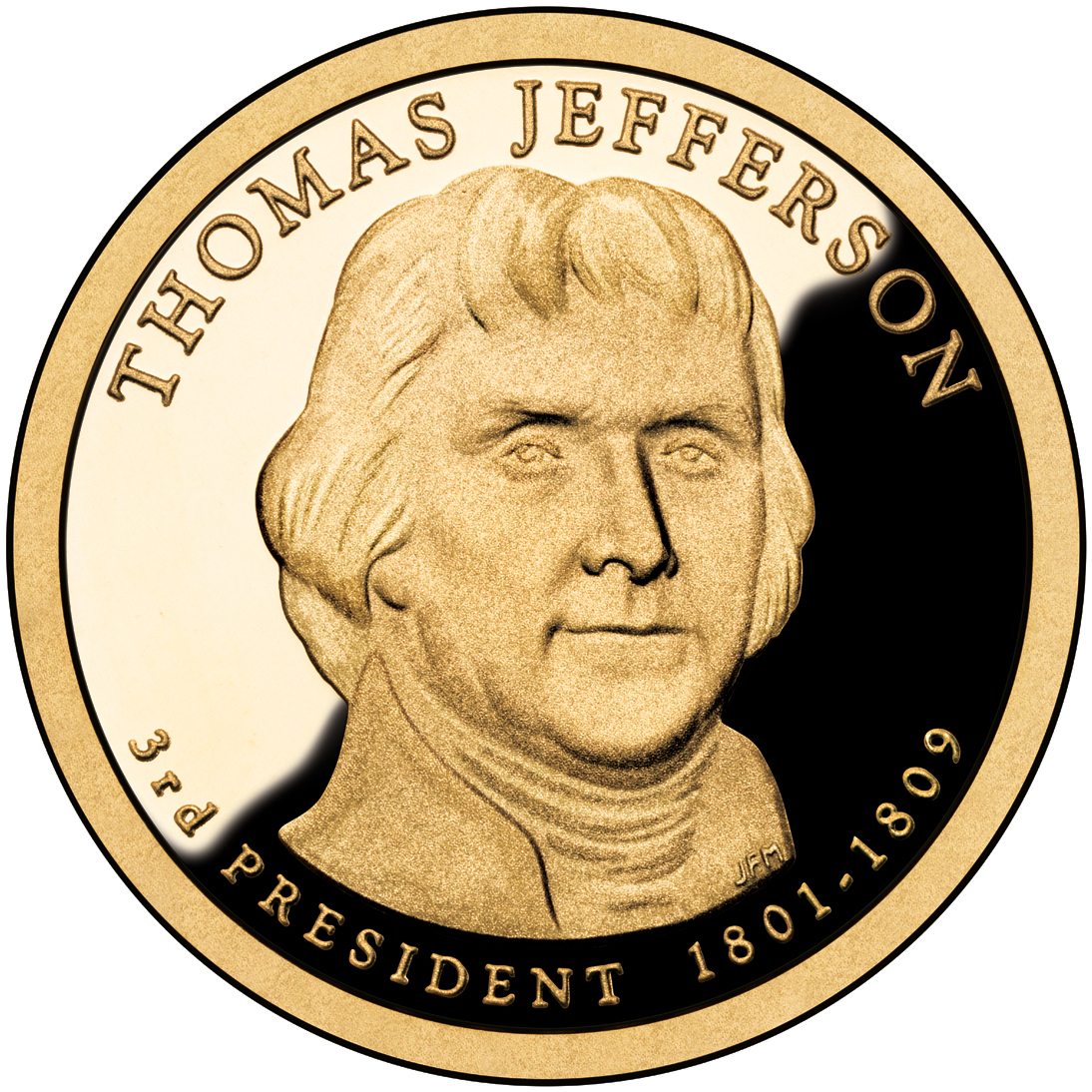
Jefferson dollars will be unveiled today in a ceremony at the Jefferson Memorial in Washington, D.C. They officially go into circulation tomorrow, August 16, 2007.

Jefferson dollar; U.S. Mint image via Associated Press

Jefferson dollars are the third in a series commemorating U.S. presidents. The series started with Washington and will proceed, three new coins a year, through all the presidents. (Quick: What’s the cheapest amount you can invest to get dollars representing all 43 administrations? Don’t forget Grover Cleveland’s anomaly . . .)

The Associated Press story notes three things of interest:

History: Fewer than a third of Americans know Jefferson was the third president. They did better with Washington as the first president. I had a few scary moments last year covering a Texas history course when kids kept answering either “George Washington” or “Abraham Lincoln” to the questions, “Who was the the Father of Texas?” (Stephen F. Austin) and “Who was the first president of the Republic of Texas?” (Sam Houston).

Economics: The vending machine industry loses about $1 billion each year when dollar bills jam in the machine’s vending mechanism. The U.S. Mint and vending machine operators hope the dollar coins catch on and help reduce those losses.

Dollar coins are unpopular: This is another in a series of efforts to “wean” people from paper dollars to coins — remember the Sacagawea dollar? The Eisenhower dollar? The Susan B. Anthony dollar? Just last week I got an Eisenhower dollar in change from our local Starbucks — they had mistakenly put it in the coin drawer for quarters. You can get dollar coins in change at the U.S. Post Office, but not at many other places. Our local post office occasionally sneaks a Euro into the dollar change mechanism. Bonus!

The Washington Post story carried more details of the poll, conducted by the Gallup organization for the U.S. Mint: Read the rest of this entry »


Henry F. Phillips — when do we celebrate?

August 10, 2007

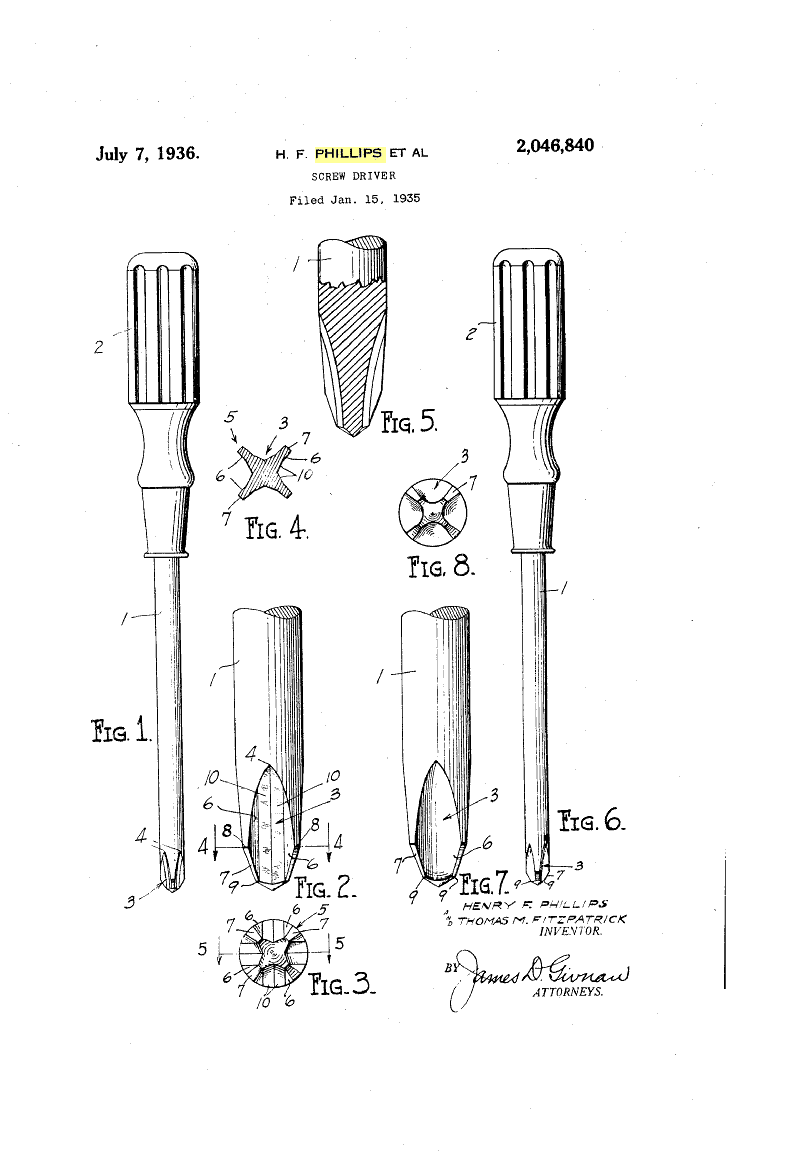
Herny Phillips' patent for the Phillips screw and screwdriver (Google Patents)

Patent drawings for the Phillips screw and screwdriver, 1936

Only Crook in Town was alerted to the work of Henry F. Phillips by an alert and helpful librarian (well — aren’t they all?). She worries –January 15 is Martin Luther King, Jr., Day, and July 7 is the middle of the summer — what day would be appropriate to celebrate the invention and patenting of the Phillips Screwdriver? (If image above does not display, click the thumbnail picture at the end of the post.)

Ah, history teachers, you noticed that the drawing comes from Google’s files of patent applications. And now you wonder: What other wonderful illustrations can we legally rip off to use in class? Wonderful question — what do you find?

The Phillips screwdriver came along in time for World War II and the mass assembly of aircraft, and aircraft instrument panels. The Phillips screw head helped aircraft assemblers keep from scratching the black metal of the rest of the panel while securing instruments into the forms.

Read the rest of this entry »


Serious indictment of media fetishes . . .

August 8, 2007

 . . . that will drive the “mainstream media (MSM)” critics to distraction.  Are we sure it’s a good idea to let Rupert Murdoch own the Wall Street Journal?

Orcinus tells conservative commentators to grow up:

Remember the fuss over Jet Pilot Action Figure Bush’s “package”? Damn fool didn’t loosen his straps before getting out of the jet. Nobody else on the deck had his crotch trussed up like a Christmas goose; and to them, he looked like a rookie idiot. But Chris Matthews practically had an orgasm on-air while watching him prance and strut.) The fact that so many mainstream and conservative media guys are suckered by this posturing shows that they don’t really have a clue about what a Real Man looks like — though, somewhere deep down inside, they’re pretty sure they don’t qualify. That’s why they’re so easily wowed by men who can put on the costume and make it look good.

But they’re even more easily cowed by men who can actually fill the boots. John Kerry. John McCain. Colin Powell. Bill Clinton. (You don’t have to agree with their politics; but nobody can say these men haven’t comfortably worn the full measure of male power and responsibility for some critical stretch of their lives.) Like little boys, the media guys are so awed by the outward forms of masculinity that they eagerly make a fetish out of them; but they also actively fear and resent men who display the authentic internal goods that make an honest-to-God man. These guys’ very presence incites such a strong sense of personal inadequacy that the Boys On The Bus can only resort to attacking them in ways that are openly calculated to feminize them — that is, to bring them down to their own level. He look French. He’s whipped by his powerful wife. He’s preoccupied with his hair. Translation: This guy has more balls and more maturity than we do — and we need to take him down before everybody figures out how inadequate that makes us feel.

And this:

 . . . the first rule of real macho was that those who possess it never need to prove it to anyone. If you have to prove it or put it out on display, you don’t have it in the first place. And if you are intimidated by seeing it in others, you aren’t even in the ballpark. The truth of that should come home to all of us every time we hear an MSM or conservative talking head going on in breathless awe about some public figure’s “manhood,” or asking leering, creepy questions about other people’s sex lives.

In a time when we need thought leaders who can help us sort out the issues and navigate the national crisis, we’ve got a media staffed by sniggering, leering first-graders who exhibit every regressive intellectual, moral, emotional, and sexual characteristic of right-wing authoritarian followers. It’s time to clean house — and to demand new media voices who aren’t in business to make fun of the grownups, or shamed by people who show the attributes of true maturity and power. It’s time to send the scared little boys home, and put some authentic adults in charge.