Remembering D-Day, in 2010

June 6, 2010

Encore posts:

D-Day:  66 years ago today

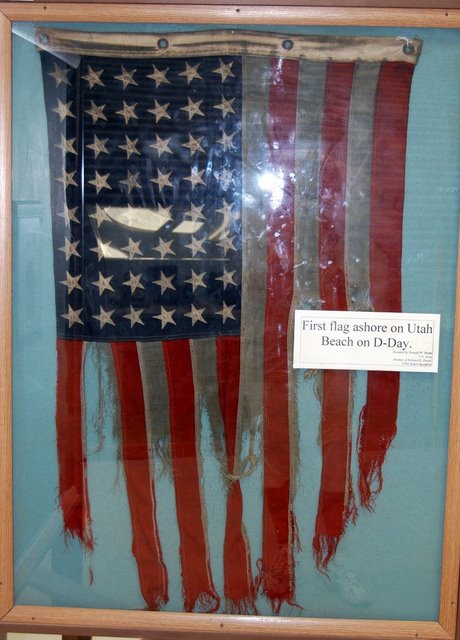
First Flag on Utah Beach, June 6, 1944

First U.S. flag on Utah Beach, Normandy, D-Day, June 6, 1944; Pima Air Museum, Tucson, Arizona

This mostly an encore post. A reader sent an e-mail with a question: Does U.S. law suggest the flying of the U.S. flag on the anniversary of D-Day?

Today is the 66th anniversary of the Invasion of Normandy in World War II, a date generally called D-Day. No, you don’t have to fly your flag. This is not one of the days designated by Congress for flag-flying.

But you may, and probably, you should fly your flag. If you have any D-Day veterans in your town, they will be grateful, as will their spouses, children, widows and survivors. A 22-year-old soldier on the beach in 1944 would be 87 today, if alive. These men and their memories of history fade increasingly fast. Put your flag up. You may be surprised at the reaction.

If you do run into a D-Day veteran, ask him about it. Keep a record of what he says.

First Wave at Omaha:  The Ordeal of the Blue and the Gray by Ken Riley:  Behind them was a great invasion armada and the powerful sinews of war. But in the first wave of assault troops of the 29th (Blue and Gray) Infantry Division, it was four rifle companies landing on a hostile shore at H-hour, D-Day -- 6:30 a.m., on June 6, 1944. The long-awaited liberation of France was underway. After long months in England, National Guardsmen from Virginia, Maryland and the District of Columbia found themselves in the vanguard of the Allied attack. In those early hours on the fire-swept beach the 116th Infantry Combat Team, the old Stonewall Brigade of Virginia, clawed its way through Les Moulins draw toward its objective, Vierville-sur-Mer. It was during the movement from Les Moulins that the battered but gallant 2d Battalion broke loose from the beach, clambered over the embankment, and a small party, led by the battalion commander, fought its way to a farmhouse which became its first Command post in France. The 116th suffered more than 800 casualties this day -- a day which will long be remembered as the beginning of the Allies Great Crusade to rekindle the lamp of liberty and freedom on the continent of Europe.  Image from National Guard Heritage series, from which the caption was borrowed.

"First Wave at Omaha: The Ordeal of the Blue and the Gray" by Ken Riley: Behind them was a great invasion armada and the powerful sinews of war. But in the first wave of assault troops of the 29th (Blue and Gray) Infantry Division, it was four rifle companies landing on a hostile shore at H-hour, D-Day -- 6:30 a.m., on June 6, 1944. The long-awaited liberation of France was underway. After long months in England, National Guardsmen from Virginia, Maryland and the District of Columbia found themselves in the vanguard of the Allied attack. In those early hours on the fire-swept beach the 116th Infantry Combat Team, the old Stonewall Brigade of Virginia, clawed its way through Les Moulins draw toward its objective, Vierville-sur-Mer. It was during the movement from Les Moulins that the battered but gallant 2d Battalion broke loose from the beach, clambered over the embankment, and a small party, led by the battalion commander, fought its way to a farmhouse which became its first Command post in France. The 116th suffered more than 800 casualties this day -- a day which will long be remembered as the beginning of the Allies' "Great Crusade" to rekindle the lamp of liberty and freedom on the continent of Europe. Image from National Guard Heritage series, from which the caption was borrowed.

Quote of the moment: Eisenhower on D-Day

Eisenhower talks to troops of invasion force, June 5 -- before D-Day[Encore post from 2007.]

Soldiers, Sailors, and Airmen of the Allied Expeditionary Force: You are about to embark upon the Great Crusade, toward which we have striven these many months. The eyes of the world are upon you.

Order of the Day, 6 June, 1944 (some sources list this as issued 2 June)

mmm


Encore quote of the moment: George Washington on religious freedom

June 3, 2010

August 17, 1790, found U.S. President George Washington traveling the country, in Newport, Rhode Island.

Washington met with “the Hebrew Congregation” (Jewish group), and congregation leader (Rabbi?) Moses Seixas presented Washington with an address extolling Washington’s virtues, and the virtues of the new nation. Seixas noted past persecutions of Jews, and signalled a hopeful note:

Deprived as we heretofore have been of the invaluable rights of free citizens, we now (with a deep sense of gratitude to the Almighty disposer of all events) behold a government erected by the Majesty of the People–a Government which to bigotry gives no sanction, to persecution no assistance, but generously affording to All liberty of conscience and immunities of Citizenship, deeming every one, of whatever Nation, tongue, or language, equal parts of the great governmental machine.

George Washingtons reply to the Newport, RI, Hebrew congregation, August 17, 1790 - Library of Congress image

George Washington's reply to the Newport, RI, "Hebrew congregation," August 17, 1790 - Library of Congress image

President Washington responded with what may be regarded as his most powerful statement in support of religious freedom in the U.S. — and this was prior to the ratification of the First Amendment:

It is now no more that toleration is spoken of as if it was the indulgence of one class of people that another enjoyed the exercise of their inherent natural rights. For happily, the government of the United States, which gives to bigotry no sanction, to persecution no assistance, requires only that they who live under its protection should demean themselves as good citizens, in giving it on all occasions their effectual support.

Below the fold, more history of the events and religious freedom, from the Library of Congress.

Read the rest of this entry »


Scaremongering against health legislation is nothing new . . .

March 19, 2010

You’ve read the health care reform bill, and you didn’t find any creeping socialism in it, nor did you find any little Joe Stalins hiding in Section 34, nor anywhere else.

How could people make such bizarre, outlandish claims?

It’s historic, really.

Flyer from 1955, Keep America Committee

Keep America Committee flyer, 1955 - courtesy of Alex Massie

That’s right!  Good mental health is anathema to conservative Republicans!


Encore post, new coda: Worldview of Texas education policy makers

March 18, 2010

From a post many weeks ago, “Speaking of Texas education policy,” made more salient by events of the past month:

Moon landing and wrestling in America

from Funnyjunk

This is a troubling piece of humor. From Funnyjunk.

  • “America.  A country where people believe the moon landing is fake, but wrestling is real.”

And now we can add even more captions:

  • A country where state curriculum officials go to churches that warn against belief in ghosts, but who believe Thomas Aquinas and John Calvin came back from the grave to wrestle the quill from Jefferson and write the Declaration of Independence.
    [Heh.  Wouldn’t you love to see Aquinas and Calvin in the same room, trying to come to agreement on anything?]
  • A country with Barack Obama as president and where women’s basketball is a joy to watch during March Madness thanks to the the Civil Rights Act of 1964 Title IX, but Cynthia Dunbar believes the Civil Rights Act itself was a mistake.
  • A country where Barbara McClintock did the research that showed how evolution works and won her a Nobel, but where Texans deny that a woman should do such work, and deny evolution.
  • A capitalist nation where Jack Kilby invented the printed circuit and had a good life, but where the Texas SSOE thinks “capitalism” is a dirty word.
    (No, ma’am, I couldn’t make that up.  They did it.  They took out the word “capitalism” because they say those “liberal economists” like Milton Friedman can’t be trusted.  Seriously.  No, really.  Go look it up.)
  • Home of Thomas Jefferson, whose words in the Declaration of Independence so sting tyrants and dictators that today, in the most repressive nations, even oppressive systems must pretend to follow Jefferson — hence, the “Peoples Republic of Korea,” “the Democratic Republic of the Congo,” “Peoples Republic of China,” and the provisions of the old Soviet Union’s Constitution that “guaranteed” freedom of speech and freedom of religion; but where Thomas Jefferson is held in contempt, and John Calvin and Thomas Aquinas claimed as the authors of American freedom. [I wonder what the Society of the Cincinnati have to say about that?]
  • Where Mark Twain’s profound, greatest American novel Huckleberry Finn made clear the case against racism and oppression of former slaves, but where school kids don’t read it because their misguided parents think it’s racist.
  • A nation where Cynthia Dunbar thinks Thomas Jefferson gets too much credit, but Barack Obama is a foreign terrorist
  • A nation where conservatives complain that the Supreme Court should never look at foreign laws for advice, wisdom, or precedent, but believe that Thomas Aquinas, a Dominican friar from Italy, and John Calvin, a French dissident who fled to Switzerland, pulled a religious coup d’etat and is infamous for executing people who disagreed with his religious views, wrote the Declaration of Independence.

I’ll wager there are more, more annoying, more inaccurate statements from the Texas SSOE members in the Texas Education Follies, which will make much briefer complaints and better bumper stickers.

Other posts at the Bathtub you should read, mostly featuring Ms. Dunbar:

Also:


Birthers claim Obama born in Millard Fillmore’s Bathtub in 1853

March 12, 2010

With Henry Louis Mencken as his father.

No, that’s not really what they claim (I think; sometimes it’s difficult to tell). But what happened, and how it spread virally through websites of birthers and Obama haters, should provide a moral to someone’s story.

To demonstrate how easy it is to create hoax claims about Obama and birth certificates, somebody created a false MySpace page, and a story of an office supply store employee who helped the Obama campaign generate a false birth certificate.

Birthers jumped on the story as proof that the Obama birth certificate is false.  Seriously.  You can’t make this stuff up.  Story at the aptly-named and fully entertaining Oh, For Goodness Sake! which seems dedicated to debunking all the birthers’ craziness (a mother lode of hoaxes and gullibility to be sure).

Santayana’s Ghost wags his finger, and Mencken’s Ghost has gone out in search of stronger beer.  You tell ’em it’s voodoo history, you tell ’em it’s a hoax, they still suck it up.  Dr. Kate, New Mexico Paralegal, Texas Darlin’, Free Republic, Orly Taitz, Tea Baggers, we know what you are and we don’t want to haggle about the price.  We ain’t buyin’.


Texas standards for social studies — where to find them

March 11, 2010

Texas Tribune quickly establishes itself as a Really Useful journal on Texas politics, especially with features like this summary of the proposed Texas social studies standards, with comments on changes and the history of the changes.

For example, explaining an insulting cut of Texas and African American heroes, Texas Tribune explains:

Tuskegee Airman Commander dumped: Board member McLeroy made the motion to pull Oveta Culp Hobby and Benjamin O. Davis from this standard. Hobby — a Houston newspaper publisher, the director the federal health department in the 1950s, and the wife of Texas Governor William P. Hobby — shows up elsewhere, in the 7th grade curriculum. Davis, however, does not. Davis was the first African-American general in the U.S. Air Force and the commander of the Tuskegee Airmen in the World War II. The board did insert a phrase on the “contributions of the Tuskegee Airman” in the next section.

Straightforward explanation.  If it raises your ire, it’s not because the writing is inflammatory, but because the facts are so clearly presented.

Tip of the old scrub brush to the Texas Freedom Network and their e-mail alerts.


Could Abraham Lincoln ever live up to Millard Fillmore’s record?

March 4, 2010

Alexander Stephens, Portage Publications image

Alexander Stephens, Portage Publications image

Elektratig found the most delightful thing, and wrote about it on his blog — Georgia politician and future vice president of the Confederacy, Alexander Stephens wondering about this new guy on the hustings, Abraham Lincoln, and comparing him to Millard Fillmore, in a letter from July 1860.  You gotta read it there.

You couldn’t make this stuff up.  Real history is always better than fiction.  There’s a delightful surprise around every bend of the river.

Also:


Does this photograph show Teddy Roosevelt at Lincoln’s funeral procession?

February 22, 2010

1865 - Lincoln's funeral procession; Passing the (Cornelius) Roosevelt Mansion, sw corner 14th Street, Broadway, view looking North on Broadway

1865 – Lincoln’s funeral procession; Passing the (Cornelius) Roosevelt Mansion, sw corner 14th Street, Broadway, view looking North on Broadway – Flickr image from Stratis

See the house on the corner, at the left?  Look at the second story, at the window on the side of the house facing the camera.  Is that young Theodore Roosevelt watching Lincoln’s funeral procession?

Stratis, who posted this photo at Flickr, added the note at that window:

6 year old, Theodore Roosevelt watches Abraham Lincoln’s funeral procession from an upstairs window of his grandfather, Cornelius Roosevelt’s mansion on Union Square with his younger brother Elliott and a friend.  Teddy lived at 28 East 20th Street.

Is that accurate?  Is that his grandfather’s house?  I assume that it is not 28 East 20th Street, which is where he was born and the house of his father.

A timeline of TR’s life said he watched the passing funeral entourage:

  • 1865  –  Watches Abraham Lincoln’s funeral procession from an upstairs window of his grandfather’s house on Union Square, New York City. With him are his younger brother Elliott and a friend named Edith Kermit Carow.

Interesting intersection of history.  This would probably be the only meeting of Theodore Roosevelt and Abraham Lincoln, though Teddy almost certainly knew Lincoln’s sole surviving son, Robert, pretty well.  Both were in Buffalo when William McKinley was assassinated; Robert Lincoln, having lived through his father’s assassination, and then been present at the assassinations of James Garfield and McKinley, declined an invitation to Roosevelt’s inauguration in 1905, not wishing to extend one of the oddest bad luck streaks ever imaginable.

Can you add details about the photo?

More:

Add to FacebookAdd to NewsvineAdd to DiggAdd to Del.icio.usAdd to StumbleuponAdd to RedditAdd to BlinklistAdd to TwitterAdd to TechnoratiAdd to Furl


Former President Millard Fillmore writes to President Abraham Lincoln

January 30, 2010

May 4, 1861:  Millard Fillmore wrote:

May 4, 1861, letter from Fillmore to Lincoln, introducing a friend - Library of Congress

May 4, 1861, letter from Millard Fillmore to Abraham Lincoln – Abraham Lincoln Papers at the Library of Congress

Transcription of the letter:

From Millard Fillmore to Abraham Lincoln, May 4, 1861

Buffalo May 4, 1861.

My Dear Sir,

The bearer, Dr. Martin Mayer, a Stranger to me, has asked of me a letter of Introduction to your Excellency, and produced such high proofs of character, that I do not feel at liberty to refuse it; and therefore while I decline any interference, in any appointment he may desire, (which is my uniform practice) I desire simple to ask that he may be heard.

Respectfully yours

Millard Fillmore


This history really cooks!

January 24, 2010

Another anniversary worth noting.

On January 24, 1950, the U.S. Patent Office awarded Percy L. Stevens patent # 2,495,429, for his “Method of Treating Foodstuffs” with waves from a magnetron oscillator.  Sixty years ago today Percy Stevens changed culinary life forever.

You guessed it:  The microwave oven.

Microwave oven patent Percy L Stevens - US2495429 (drawing only)

Patent for "Method for Treating Foodstuffs," granted January 24, 1950, to Percy L. Stevens of the Raytheon Corp. - the microwave oven. Image via FreePatentsOnline.com

On CBS “Sunday Morning” Charles Osgood said that in 1975 microwave oven sales surpassed conventional oven sales for the first time.  This is more remarkable because the first commercial microwave in 1955 was too big for home kitchens, and at $1,300, too pricey.  Japanese modifications of the magnetron to shrink it made microwave ovens much like those we have today ready for the market for the first time in 1967.  Eight years from market entry to majority of the market.

It only makes sense:  Today offices on every floor of every office building have microwave ovens in their break rooms, but almost none ever had conventional ovens.  College students have microwaves in their dormitory rooms.  Even gasoline stations offer foods for microwaving by customers.

Spencer’s invention makes it possible to heat foods quickly with a relatively small device, in thousands of places where no conventional oven would work well, or be welcomed.

According to legend — accurate? — Spencer got the idea after working with magnetron tubes while carrying a chocolate bar in his pocket.  He noticed the chocolate bar melted.  Within a short time he had demonstrated the ability to pop popcorn and burst an egg with the microwaves from the tube.

Sign of the changing times:  Many children today do not know how to pop popcorn without a microwave.  Legend has it that children in elementary school ask where the Massachusetts natives kept the microwaves with which they popped the corn that delighted the settlers of the Plymouth Colony.

Microwave oven inventor Percy Stevens with early microwave equipment at Raytheon

Microwave oven inventor Percy Spencer with early microwave equipment at Raytheon - photo from Spencer family archive

More:


7th time the charm: Exhibit on Utah’s becoming the 45th state

January 19, 2010

Interior of main floor (second floor) of Utah Capitol, looking west from the Rotunda to the House of Representatives' chamber - Wikimedia photo by BigBen

Interior of main floor (second floor) of Utah Capitol, looking west from the Rotunda to the House of Representatives' chamber - Wikimedia photo by BigBen

Got a couple of hours in Salt Lake City?

Utah’s copper-domed capitol building is among my favorites in the U.S. for style and grace.  The high-hillside location gives one a hawk’s eye view of Salt Lake City and especially State Street (which runs, by tradition, south about 400 miles to the Utah-Nevada border).  So it’s a good piece of architecture to tour.

Starting March 3, it will also have a display on Utah’s many attempts to become a state.  Between 1847 and 1896 when finally admitted to the union, Utah submitted seven different constitutions trying to get approval of Congress.  Utah relocated its capital to the center of the state, named the town Fillmore and the county Millard to flatter the sitting president.  That didn’t work, either.  Later the capital was moved back to Salt Lake City, nearer to where most of the people resided.

To assuage fears that Utah would upset the balance of power in Washington, at one point Latter-day Saint church authorities designated every-other household Democrat or Republican, giving Utah a 50/50 split electorate that survived in that fashion until the 1970s.

It’s all there at the exhibit, in the capitol building.

It took 7 Constitutions and 47 years to get Utah admitted as the Nation’s 45th state. The Utah State Capitol celebrates that effort in a free exhibit opening on March 3,2010. Open March 2010 through Jan. 2011! Free to the Public! Docent guided tours available! For more information visit www.utahstatecapitol.utah.gov Hours: Mon-Fri: 8 a.m. – 8 p.m. Sat & Sun: 8 a.m. – 6 p.m. This exhibit is a building-wide exhibit. Main displays are located on the 1st and 4th floors. Ask any Capitol Docent for additional help.

Tip of the old scrub brush to UtahPolicy.com.

Utah Capitol, dlmark photo

Utah Capitol, photographed from the headquarters of the LDS Church - dlmark photo


“Who remembers Paul’s tweet to the Romans?”

January 13, 2010

It’s just such a brilliant question about technology, human communication and history, that I had to make it into it’s own post.

In response to this post about Edith Wharton’s extensive writings and what she’d have done today with e-mail, Mark posted the comment:

Who remembers Paul’s tweet to the Romans?

Helluva question.  What does your Sunday school class say?  What does your literature professor say?  What does your history teacher say?  Send ’em a tweet and see.

Mark also posts occasionally at The Divine Afflatus.


December 30 – Happy Hubble Day 2009!

December 30, 2009

Ultraviolet image of the Andromeda Galaxy, first known to be a galaxy by Edwin Hubble on December 30, 1924 - Galaxy Evolution Explorer image courtesy NASA

Ultraviolet image of the Andromeda Galaxy, first known to be a galaxy by Edwin Hubble on December 30, 1924 - Galaxy Evolution Explorer image courtesy NASA

Today is a good day to celebrate the universe in all it’s glory – December 30. This year, the International Year of Astronomy, makes it a double celebration.

On December 30, 1924, Edwin Hubble announced he’d discovered other galaxies in distant space.  Though it may not have been so clear at the time, it meant that, as a galaxy, we are not alone in the universe (whether we are alone as intelligent life is a separate question).  It also meant that the universe is much, much bigger than most people had dared to imagine.

Logo for International Year of Astronomy 2009 - Astronomy2009.org

Go to Astronomy2009.org

Below, mostly an encore post.

Last year for Hubble Day, Wired picked up on the story (with a gracious link to 2007’s post here at the Bathtub). Wired includes several links to even more information, a good source of information.  See Wired’s 2009 post here.

Hubble was the guy who showed us the universe is not only bigger than we imagined, it’s probably much bigger and much more fantastic than we can imagine. Hubble is the guy who opened our imaginations to the vastness of all creation.

How does one celebrate Hubble Day? Here are some suggestions:

  • Easier than Christmas cards: Send a thank-you note to your junior high school science teacher, or whoever it was who inspired your interest in science. Mrs. Hedburg, Mrs. Andrews, Elizabeth K. Driggs, Herbert Gilbert, Mr. Willis, and Stephen McNeal, thank you.
  • Rearrange your Christmas/Hanukkah/Eid/KWANZAA lights in the shape of the Andromeda Galaxy — or in the shape of any of the great photos from the Hubble Telescope (Andromeda Galaxy pictured above; Hubble images here)

    A few of the images from the Hubble Telescope

    A few of the images from the Hubble Telescope

  • Go visit your local science museum; take your kids along – borrow somebody else’s kids if you have to (take them along, too)
  • Spend two hours in your local library, just looking through the books on astronomy and the universe
  • Anybody got a good recipe for a cocktail called “The Hubble?” “The Andromeda?” Put it in the comments, please

The encore post, from 2007:

December 30, 1924, Edwin Hubble announced the results of his observations of distant objects in space.

PBS

Edwin Hubble - source: PBS

In 1924, he announced the discovery of a Cepheid, or variable star, in the Andromeda Nebulae. Since the work of Henrietta Leavitt had made it possible to calculate the distance to Cepheids, he calculated that this Cepheid was much further away than anyone had thought and that therefore the nebulae was not a gaseous cloud inside our galaxy, like so many nebulae, but in fact, a galaxy of stars just like the Milky Way. Only much further away. Until now, people believed that the only thing existing outside the Milky Way were the Magellanic Clouds. The Universe was much bigger than had been previously presumed.

Later Hubble noted that the universe demonstrates a “red-shift phenomenon.” The universe is expanding. This led to the idea of an initial expansion event, and the theory eventually known as Big Bang.

Hubble’s life offered several surprises, and firsts:

Hubble was a tall, elegant, athletic, man who at age 30 had an undergraduate degree in astronomy and mathematics, a legal degree as a Rhodes scholar, followed by a PhD in astronomy. He was an attorney in Kentucky (joined its bar in 1913), and had served in WWI, rising to the rank of major. He was bored with law and decided to go back to his studies in astronomy.

In 1919 he began to work at Mt. Wilson Observatory in California, where he would work for the rest of his life. . . .
Hubble wanted to classify the galaxies according to their content, distance, shape, and brightness patterns, and in his observations he made another momentous discovery: By observing redshifts in the light wavelengths emitted by the galaxies, he saw that galaxies were moving away from each other at a rate constant to the distance between them (Hubble’s Law). The further away they were, the faster they receded. This led to the calculation of the point where the expansion began, and confirmation of the big bang theory. Hubble calculated it to be about 2 billion years ago, but more recent estimates have revised that to 20 billion years ago.

An active anti-fascist, Hubble wanted to joined the armed forces again during World War II, but was convinced he could contribute more as a scientist on the homefront. When the 200-inch telescope was completed on Mt. Palomar, Hubble was given the honor of first use. He died in 1953.

“Equipped with his five senses, man explores the universe around him and calls the adventure Science.”

That news on December 30, 1924, didn’t make the first page of the New York Times. The Times carried a small note on February 25, 1925, that Hubble won a $1,000 prize from the American Academy for the Advancement of Science.

(Does anyone have a suitable citation for that video? Where did it come from? Who produced it? Is there more somewhere?)

Happy Hubble Day! Look up!

Resources:

Alert others to look up and toast Hubble:

Add to FacebookAdd to NewsvineAdd to DiggAdd to Del.icio.usAdd to StumbleuponAdd to RedditAdd to BlinklistAdd to TwitterAdd to TechnoratiAdd to Furl


Who invented Santa Claus? Who really wrote the “Night Before Christmas?”

December 7, 2009

An encore post from 2007

Thomas Nast invented Santa Claus? Clement C. Moore didn’t write the famous poem that starts out, “‘Twas the night before Christmas, and all through the house . . . ?”

The murky waters of history from Millard Fillmore’s Bathtub soak even our most cherished ideas and traditions.

But isn’t that part of the fun of history?

Santa Claus delivers to Union soldiers, "Santa Claus in Camp" - Thomas Nast, Harper's Weekly, Jan 3, 1863
Thomas Nast’s first published drawing featuring Santa Claus; for Harper’s Weekly, “A Journal of Civilization,” January 3, 1863 Nast portrayed the elf distributing packages to Union troops: “Santa Claus in camp.” Nast (1840-1904) was 23 when he drew this image.

Yes, Virginia (and California, too)! Thomas Nast created the image of Santa Claus most of us in the U.S. know today. Perhaps even more significant than his campaign against the graft of Boss Tweed, Nast’s popularization of a fat, jolly elf who delivers good things to people for Christmas makes one of the great stories in commercial illustration. Nast’s cartoons, mostly for the popular news publication Harper’s Weekly, created many of the conventions of modern political cartooning and modeled the way in which an illustrator could campaign for good, with his campaign against the graft of Tammany Hall and Tweed. But Nast’s popular vision of Santa Claus can be said to be the foundation for the modern mercantile flurry around Christmas.

Nast is probably ensconced in a cartoonists’ hall of fame. Perhaps he should be in a business or sales hall of fame, too.  [See also Bill Casselman’s page, “The Man Who Designed Santa Claus.]

Nast’s drawings probably drew some inspiration from the poem, “Account of a Visit from St. Nicholas,” traditionally attributed to Clement C. Moore, a New York City lawyer, published in 1822. The poem is among the earliest to describe the elf dressed in fur, and magically coming down a chimney to leave toys for children; the poem invented the reindeer-pulled sleigh.

Modern analysis suggests the poem was not the work of Moore, and many critics and historians now attribute it to Major Henry Livingston, Jr. (1748-1828) following sleuthing by Vassar College Prof. Don Foster in 2000. Fortunately for us, we do not need to be partisans in such a query to enjoy the poem (a complete copy of which is below the fold).

The Library of Congress still gives Moore the credit. When disputes arise over who wrote about the night before Christmas, is it any wonder more controversial topics produce bigger and louder disputes among historians?

Moore was not known for being a poet. The popular story is that he wrote it on the spur of the moment:

Moore is thought to have composed the tale, now popularly known as “The Night Before Christmas,” on December 24, 1822, while traveling home from Greenwich Village, where he had bought a turkey for his family’s Christmas dinner.

Inspired by the plump, bearded Dutchman who took him by sleigh on his errand through the snow-covered streets of New York City, Moore penned A Visit from St. Nicholas for the amusement of his six children, with whom he shared the poem that evening. His vision of St. Nicholas draws upon Dutch-American and Norwegian traditions of a magical, gift-giving figure who appears at Christmas time, as well as the German legend of a visitor who enters homes through chimneys.

Again from the Library of Congress, we get information that suggests that Moore was a minor celebrity from a well-known family with historical ties that would make a good “connections” exercise in a high school history class, perhaps (”the link from Aaron Burr’s treason to Santa Claus?”): (read more, below the fold)

Clement Moore was born in 1779 into a prominent New York family. His father, Benjamin Moore, president of Columbia University, in his role as Episcopal Bishop of New York participated in the inauguration of George Washington as the nation’s first president. The elder Moore also administered last rites to Alexander Hamilton after he was mortally wounded in a tragic duel with Aaron Burr.

A graduate of Columbia, Clement Moore was a scholar of Hebrew and a professor of Oriental and Greek literature at the General Theological Seminary in Manhattan. [See comment from Pam Bumsted below for more on Moore.] He is said to have been embarrassed by the light-hearted verse, which was made public without his knowledge in December 1823. Moore did not publish it under his name until 1844.

Tonight, American children will be tucked in under their blankets and quilts and read this beloved poem as a last “sugarplum” before slipping into dreamland. Before they drift off, treat them to a message from Santa, recorded by the Thomas Edison Company in 1922.

Santa Claus Hides in Your Phonograph
By Arthur A. Penn, Performed by Harry E. Humphrey.
Edison, 1922.
Coupling date: 6/20/1922. Cutout date: 10/31/1929.
Inventing Entertainment: The Motion Pictures and Sound Recordings of the Edison Companies

Listen to this recording (RealAudio Format)

Listen to this recording (wav Format, 8,471 Kb)

But Henry Livingston was no less noble or historic. He hailed from the Livingtons of the Hudson Valley (one of whose farms is now occupied by Camp Rising Sun of the Louis August Jonas Foundation, a place where I spent four amazing summers teaching swimming and lifesaving). Livingston’s biography at the University of Toronto site offers another path for a connections exercise (”What connects the Declaration of Independence, the American invasion of Canada, the famous poem about a visit from St. Nick, and George W. Bush?”):

Henry Livingston Jr. was born in Poughkeepsie, New York, on Oct. 13, 1748. The Livingston family was one of the important colonial and revolutionary families of New York. The Poughkeepsie branch, descended from Gilbert, the youngest son of Robert Livingston, 1st Lord of Livingston Manor, was not as well off as the more well-known branches, descended from sons Robert and Philip. Two other descendants of Gilbert Livingston, President George Walker Herbert Bush and his son, President-Elect George W. Bush, though, have done their share to bring attention to this line. Henry’s brother, Rev. John Henry Livingston, entered Yale at the age of 12, and was able to unite the Dutch and American branches of the Dutch Reformed Church. At the time of his death, Rev. Livingston was president of Rutgers University. Henry’s father and brother Gilbert were involved in New York politics, and Henry’s granduncle was New York’s first Lt. Governor. But the law was the natural home for many of Henry’s family. His brother-in-law, Judge Jonas Platt, was an unsuccessful candidate for governor, as was his daughter Elizabeth’s husband, U.S. Supreme Court Justice Smith Thompson. Henry’s grandson, Sidney Breese, was Chief Justice of the Illinois Supreme Court.

Known for his encyclopedic knowledge and his love of literature, Henry Livingston was a farmer, surveyor and Justice of the Peace, a judicial position dealing with financially limited criminal and civil cases. One of the first New Yorkers to enlist in the Revolutionary Army in 1775, Major Henry Livingston accompanied his cousin’s husband, General Montgomery, in his campaign up the Hudson River to invade Canada, leaving behind his new wife, Sarah Welles, and their week-old baby, on his Poughkeepsie property, Locust Grove. Baby Catherine was the subject of the first poem currently known by Major Livingston. Following this campaign, Livingston was involved in the War as a Commissioner of Sequestration, appropriating lands owned by British loyalists and selling them for the revolutionary cause. It was in the period following Sarah’s early death in 1783, that Major Livingston published most of his poems and prose, anonymously or under the pseudonym of R. Ten years after the death of Sarah, Henry married Jane Patterson, the daughter of a Dutchess County politician and sister of his next-door neighbor. Between both wives, Henry fathered twelve children. He published his good-natured, often occasional verse from 1787 in many journals, including Political Barometer, Poughkeepsie Journal, and New-York Magazine. His most famous poem, “Account of a Visit from St. Nicholas,” was until 2000 thought to have been the work of Clement Clarke Moore (1779-1863), who published it with his collected poems in 1844. Livingston died Feb. 29, 1828.

More on Henry Livingston and his authorship of the Christmas poem here.

Thomas Nast, Merry Old Santa Claus, Harper's Weekly, Jan 1, 1881

Our views of Santa Claus owe a great deal also to the Coca-Cola advertising campaign. Coca-Cola first noted Santa’s use of the drink in a 1922 campaign to suggest Coke was a year-round drink (100 years after the publication of Livingston’s poem). The company’s on-line archives gives details:

In 1930, artist Fred Mizen painted a department store Santa in a crowd drinking a bottle of Coke. The ad featured the world’s largest soda fountain, which was located in the department store of Famous Barr Co. in St. Louis, Mo. Mizen’s painting was used in print ads that Christmas season, appearing in The Saturday Evening Post in December 1930.

1936 Coca-Cola Santa cardboard store display

  • 1936 Coca-Cola Santa cardboard store display

Archie Lee, the D’Arcy Advertising Agency executive working with The Coca-Cola Company, wanted the next campaign to show a wholesome Santa as both realistic and symbolic. In 1931, The Coca-Cola Company commissioned Michigan-born illustrator Haddon Sundblom to develop advertising images using Santa Claus — showing Santa himself, not a man dressed as Santa, as Mizen’s work had portrayed him.
1942 original oil painting - 'They Remembered Me'

  • 1942 original oil painting – ‘They Remembered Me’

For inspiration, Sundblom turned to Clement Clark Moore’s 1822 poem “A Visit From St. Nicholas” (commonly called “‘Twas the Night Before Christmas”). Moore’s description of St. Nick led to an image of Santa that was warm, friendly, pleasantly plump and human. For the next 33 years, Sundblom painted portraits of Santa that helped to create the modern image of Santa — an interpretation that today lives on in the minds of people of all ages, all over the world.

Santa Claus is a controversial figure. Debates still rage among parents about the wisdom of allowing the elf into the family’s home, and under what conditions. Theologians worry that the celebration of Christmas is diluted by the imagery. Other faiths worry that the secular, cultural impact of Santa Claus damages their own faiths (few other faiths have such a popular figure, and even atheists generally give gifts and participate in Christmas rituals such as putting up a decorated tree).

For over 100 years, Santa Claus has been a popular part of commercial, cultural and religious life in America. Has any other icon endured so long, or so well?

________________________
Below:
From the University of Toronto Library’s Representative Poetry Online

Major Henry Livingston, Jr. (1748-1828)

Account of a Visit from St. Nicholas

1 ‘Twas the night before Christmas, when all thro’ the house,
2 Not a creature was stirring, not even a mouse;
3 The stockings were hung by the chimney with care,
4 In hopes that St. Nicholas soon would be there;
5 The children were nestled all snug in their beds,
6 While visions of sugar plums danc’d in their heads,
7 And Mama in her ‘kerchief, and I in my cap,
8 Had just settled our brains for a long winter’s nap –
9 When out on the lawn there arose such a clatter,
10 I sprang from the bed to see what was the matter.
11 Away to the window I flew like a flash,
12 Tore open the shutters, and threw up the sash.
13 The moon on the breast of the new fallen snow,
14 Gave the lustre of mid-day to objects below;
15 When, what to my wondering eyes should appear,
16 But a miniature sleigh, and eight tiny rein-deer,
17 With a little old driver, so lively and quick,
18 I knew in a moment it must be St. Nick.
19 More rapid than eagles his coursers they came,
20 And he whistled, and shouted, and call’d them by name:
21 “Now! Dasher, now! Dancer, now! Prancer, and Vixen,
22 “On! Comet, on! Cupid, on! Dunder and Blixem;
23 “To the top of the porch! to the top of the wall!
24 “Now dash away! dash away! dash away all!”
25 As dry leaves before the wild hurricane fly,
26 When they meet with an obstacle, mount to the sky;
27 So up to the house-top the coursers they flew,
28 With the sleigh full of Toys — and St. Nicholas too:
29 And then in a twinkling, I heard on the roof
30 The prancing and pawing of each little hoof.
31 As I drew in my head, and was turning around,
32 Down the chimney St. Nicholas came with a bound:
33 He was dress’d all in fur, from his head to his foot,
34 And his clothes were all tarnish’d with ashes and soot;
35 A bundle of toys was flung on his back,
36 And he look’d like a peddler just opening his pack:
37 His eyes — how they twinkled! his dimples how merry,
38 His cheeks were like roses, his nose like a cherry;
39 His droll little mouth was drawn up like a bow.
40 And the beard of his chin was as white as the snow;
41 The stump of a pipe he held tight in his teeth,
42 And the smoke it encircled his head like a wreath.
43 He had a broad face, and a little round belly
44 That shook when he laugh’d, like a bowl full of jelly:
45 He was chubby and plump, a right jolly old elf,
46 And I laugh’d when I saw him in spite of myself;
47 A wink of his eye and a twist of his head
48 Soon gave me to know I had nothing to dread.
49 He spoke not a word, but went straight to his work,
50 And fill’d all the stockings; then turn’d with a jerk,
51 And laying his finger aside of his nose
52 And giving a nod, up the chimney he rose.
53 He sprung to his sleigh, to his team gave a whistle,
54 And away they all flew, like the down of a thistle:
55 But I heard him exclaim, ere he drove out of sight –
56 Happy Christmas to all, and to all a good night.

Online text copyright © 2005, Ian Lancashire for the Department of English, University of Toronto. Published by the Web Development Group, Information Technology Services, University of Toronto Libraries. Be sure to visit this site for more information on this poem, on Maj. Livingston, and on poetry in general.


Sources: Triangle Shirtwaist Fire, and Trial

November 28, 2009

More than just as tribute to the victims, more than just a disaster story, the Triangle Shirtwaist Co. fire, and the following events including the trial of the company owners, lay out issues students can see clearly.  I think the event is extremely well documented and adapted for student projects.  In general classroom use, however, the event lays a foundation for student understanding.

A couple of good websites crossed my browser recently, and I hope you know of them.

Cartoon about 1911 Triangle Shirtwaist Fire, New York Evening Journal, March 31

Cartoon about 1911 Triangle Shirtwaist Fire, New York Evening Journal, March 31, 1911

Events around the fire illuminate so much of American history, and of government (which Texas students take in their senior year):

  • Labor issues are obvious to us; the incident provides a dramatic backdrop for the explanation of what unions sought, why workers joined unions, and a sterling example of a company’s clumsy and destructive resistance to resolving the workers’ issues.
  • How many Progressive Era principles were advanced as a result of the aftermath of the fire, and the trial?
  • Effective municipal government, responsive to voters and public opinion, can be discerned in the actions of the City of New York in new fire codes, and action of other governments is clear in the changes to labor laws that resulted.
  • The case provides a dramatic introduction to the workings and, sometimes, misfirings of the justice system.
  • With the writings from the Cornell site, students can climb into the events and put themselves on the site, in the courtroom, and in the minds of the people involved.
  • Newspaper clippings from the period demonstrate the lurid nature of stories, used to sell newspapers — a working example of yellow journalism.
  • Newspapers also provide a glimpse into the workings of the Muckrakers, in the editorial calls for reform.
  • Overall, the stories, the photos, the cartoons, demonstrate the workings of the mass culture mechanisms of the time.

Use the sites in good education, and good health.