Making history class interesting: A lesson plan

September 12, 2007

Getting kids to dive into history can be a chore — but a chore well worth the effort.

Here’s what it might look like, if the kids dive in:

ON the kind of humid summer day that sends visitors to Washington running for cool cover, not even free air-conditioning could lure more than a trickle of tourists into the art museums lining the National Mall.

But 35 miles south at the National Museum of the Marine Corps near Quantico, Va., visitors in a virtual boot camp tested their mettle against drill instructors and their marksmanship on an M-16 laser-rifle range.

Up the Potomac at Mount Vernon, crowds spilled onto a four-acre replica of George Washington’s working farm, while inside the Revolutionary War Theater the rumble of cannons and the cold prick of snow falling overhead lent verisimilitude to the re-enactment of his troops crossing the Delaware River.

And at the International Spy Museum in downtown Washington, visitors with $16 advance tickets snaked out the door as they waited their turn to practice fantasy espionage, complete with assumed identities, pen cameras, shoe phones and the kind of super-spy cars Q might have dreamed up for 007.

Admit it. Learning about history has rarely been so much fun.

You’re not close to Quantico, nor to Washington, D.C.?  How about you get your kids to invent a museum.

The New York Times collaborates with Columbia University’s Bank Street College of Education to produce lesson plans based on stories from the Times, every week day.

You may subscribe to get a lesson plan to your e-mail box every dayOr you can track them down at the Times’ website.

Below the fold, without editing, I list the lesson plan sent out September 10, as an example.  Sounds like a good day in class, to me.

Read the rest of this entry »


Millard Fillmore at the National Portrait Gallery

September 11, 2007

Part of the Smithsonian Museums, the National Portrait Gallery remains one of my favorite museums in Washington. It is off the Mall, tucked away at Eighth and F Streets, NW, D.C., (above the Gallery Place-Chinatown Metrorail station – Red, Yellow and Green lines). Free admission, great art, but far enough out of the way to almost guarantee no crowds.

If you Google “National Portrait Gallery,” you also get the gallery of the same name in London, which is not part of the Smithsonian. Another great gallery, but don’t confuse the two.

My continuing search for images of Millard Fillmore turned up this one at the NPG:

Millard Fillmore at the NPG, unnamed artist, circa 1840

The artist is unknown. It’s oil on canvas, and rather a specialty of the NPG — it’s not the official White House portrait. Some of the portraits of presidents come with cheeky commentary or history, since they are not the official portraits usually approved by the president in question himself.

Fillmore’s portrait by an unidentified artist dates from about the time he retired from the House of Representatives in the early 1840s. In the years following, he devoted himself to reconciling the growing differences among fellow Whigs in his native New York State a task for which this hulking and amiable politician was well suited.

“Hulking?”

Check out the other president’s portraits for a usually different view (Lyndon Johnson hated the portrait the NPG has of him, and Richard Nixon never looked better, nor Thomas Jefferson younger); see what else is there that you might use in the classroom.

The NPG has the added advantage of being a short walk from Washington’s China Town, where we used to dine happily at a restaurant named Szechuan, when such cuisine was rather new in the U.S. Several eateries in the area feature dim sum on Sunday mornings, for those days one would rather commune with good friends over delectable tidbits and a good Sunday newspaper, instead of sitting in a pew. Debra Winstead, a former colleague from the University of Arizona, introduced me to the joy of dim sum in D.C. a few years ago.

Good art, good food, good friends. No wonder Washington is such a livable city these days.


Baltimore Scout collects, makes history

September 7, 2007

How about having your students work with the Library of Congress on a history project?

The Veterans History Project encourages people to contribute oral histories of veterans, a project that I think has some wonderful possibilities. Below the fold, read about Tim Mantegna, a Baltimore teen who collected histories as part of his Eagle project. This fall he enters the University of Maryland – Baltimore County to study political science, as an Eagle Scout.  (Also see this story:  “Iraq Veterans Record Their Stories”)

Read the rest of this entry »


Barbara Jordan and Lyndon Johnson: An oral history

September 2, 2007

Barbara Jordan’s voice was distinctive, and commanding. “The voice of God,” Molly Ivins called it. After Jordan’s death, Francis X. Cline wrote what might be an even higher tribute, saying her voice was “as though Winston Churchill had been reincarnated as a black woman from Texas.” She spoke in complete paragraphs, usually, with words that seemed selected carefully to fit exactly the ideas she presented.

Barbara Jordan at the Johnson White House, prior to 1972 -- with Andy Biemiller, John Doar - LBJ Library photo

How delightful, then, to read (and perhaps to actually hear) Barbara Jordan describe her fear of stammering in her first meeting with President Lyndon Johnson. The LBJ Library in Austin has a series of oral histories, including this one:

I went up to what I now know was the Cabinet Room. There were other people assembled, people who were active in the civil rights movement. We sat and waited around a table for the President and the Vice President, Hubert Humphrey, to arrive. Well, as I sat there really at the far end of the table, I still said to myself, “Now, Lyndon Johnson probably doesn’t know who I am or what I am about, and my name probably just slipped in somehow and got into that [list].” So the President came in, everybody stood up. He sat down, we all sat down, and we started to discuss this legislation, fair housing legislation. And the conversation was going around the table. The President would call on first one person for a reaction and then another person for a reaction. Then he stopped and he looked at my end of the table, he said, “Barbara, what do you think?” Well, I just . . . in the first place, I’m telling you, I didn’t know the President knew me, and here he’s looking down here saying “Barbara” and then saying, “What do you think?” So that was my first exchange with Lyndon Johnson. I’m startled. I got myself organized, of course, not so that I wouldn’t stammer, since it is not my habit to stammer when talking, and I gave a response and then this conversation ensued.

That was my first contact personally with Lyndon Johnson.

The glories of oral histories. How can you use this in the classroom?

Read the rest of this entry »


Teachers’ planning: On-line sources for everything

August 24, 2007

Digital History.

Maybe not absolutely everything. But you can mine this source, the veins are rich and deep.

This is a list of sources from Digital History, a site maintained by the University of Houston. I’ve mentioned it in the past, I think — I’ve used it a lot. For example, it has a list of history museums throughout the U.S., with websites and links. It lists the sites of history journals. It lists the sites of electronic history journals.

You’ve got your lesson plans mapped out, most of them done. You’ve got the data sheets for the students to fill out, you’ve got the first week’s bell ringers all prepared. The syllabi are all resting snug in their boxes, just waiting for students, those sly little foxes.

You’re ready.

Take a minute, take a deep breath; now, go browse the Digital History resources. See what other possibilities there are.


Recognize this? It’s famous

August 22, 2007

Inside the ------------ - NSF photoWhat in the world is that? Put your guesses in comments.

(Update:  Answer here.)


The story is the thing; tell the story in history

July 15, 2007

Son James and I spent July 4 in Taos, New Mexico, where we were working with Habitat for Humanity building homes (a project of the youth group at the church we attend, First Christian Church (Disciples of Christ) of Duncanville, Texas). We took that day off, saw Transformers, looked at the sights in Taos, and drove to Eagle Nest Lake to see fireworks.

Lincoln reading to son, Tad; LOC photo

At some point through the week I was discussing with others the stories that make history memorable, in my view, and we discovered that few others on the trip knew the story of the deaths of both John Adams and Thomas Jefferson on July 4, 1826, the 50th anniversary of the signing of the Declaration of Independence. It’s a story that is generally glossed over in U.S. history texts, but one that I make room for in U.S. history courses. My experience is that once kids get the story, that these two great men from such radically different backgrounds became great friends, then in presidential politics, great enemies, and then were reconciled, and then died on the exactly the same day which commemorated the event that both made them famous and that they made famous, kids don’t forget the story.

The story of their friendship is powerful and can be accompanied by readings from their letters in their later life (DBQ opportunity, teachers!). Generally, the story gets told in response to a question from a student. If I do it well, there will be sniffles from the class when we get to the part about Jefferson’s near-coma, awakening to ask whether it is the 4th of July, and then dying, and Adams’ death a few hours later, saying in error that “Jefferson still survives” (which is good that some students choke up, because it always gets me).

The story offers several mnemonic opportunities: 1826, the 50th year after the Declaration (1776); the presidencies of Adams and Jefferson, following one another; the fact that Adams and Jefferson were on the committee to write the Declaration, and that Adams nominated Jefferson as the better writer; the order of the terms of the presidency; the bitter politics at the end of Washington’s presidency (kids get interested in conflict, and the founding seems more vital to them when the controversies rear up); the reverence for law; Adams’ and Jefferson’s service as foreign ambassadors; and so on.

Once I’d told the story, others got the point. The story illustrates Mark Twain’s point about how much more difficult it is to write fiction. Fiction must stick with possibilities, Twain noted, while reality isn’t so constrained. If you wrote a screenplay with two heroes like Adams and Jefferson, and then had them die on the same day within a few hours of each other, hundreds of miles apart, you’d be criticized for being unrealistic. But it happened in history. It’s a true story, better than any lipsticked version Parson Weems could ever invent.

Study of history should never be a drudging trudge to memorize dates. The stories are what count, they are the things people remember. The stories tell people why history is important, and what mistakes to avoid, to satisfy Santayana’s ghost.

Such stories, especially about the founding of America, make history come alive and, often, grab students by the throat and make it memorable for them.  History is Elementary carries a nice story with the same message, though using Washington’s surprise attack on the Hessians from Trenton.  Teachers in need of such stories might do well to pick up a copy of David McCullough’s 1776, or Joseph Ellis’s Founding Brothers.

What other stories are there?  Well, the story about the scar on James Madison’s nose, and how it led to the cementing of the American Revolution (James Monroe, by the way, also died on July 4 — but in 1831).  The story of Lincoln’s trip to New Orleans; the story of Teddy Roosevelt’s capture of Mike Finnegan and two other outlaws, in the Dakotas; the story of Calvin Coolidge’s son’s death; the story of Robert Lincoln’s brushes with presidential assassinations; the story of the Civil War beginning in one man’s back-40 acres, and ending in his parlor; the story as Stephen Ambrose tells it of three men pinned down on a beach in Normandy on D-Day, and deciding the best course of action was to move forward to win the war; American history is rife with bizarre coincidences and seemingly minor events that go on to have great consequences.

I love to hear the story, especially told well.  Well told stories help students learn and retain history, and, I’ll wager, they boost the scores on standardized tests.


History Carnival catch up

July 11, 2007

How far behind am I on noting the Carnival of History?
History Carnival logo

Number 54 is at Historianess.

Number 53 is at American Presidents Blog.

History teachers, “off” for the summer, can use these assemblages for inspiration for lesson plans in world history, U.S. history, and state history courses, at a minimum. Serious readers will note deep themes suitable for summer consideration at the beach before we get back to the serious business of improving the world, in the fall, perhaps before Gen. Petraeus makes his report.

It’s summer. History is still serious.


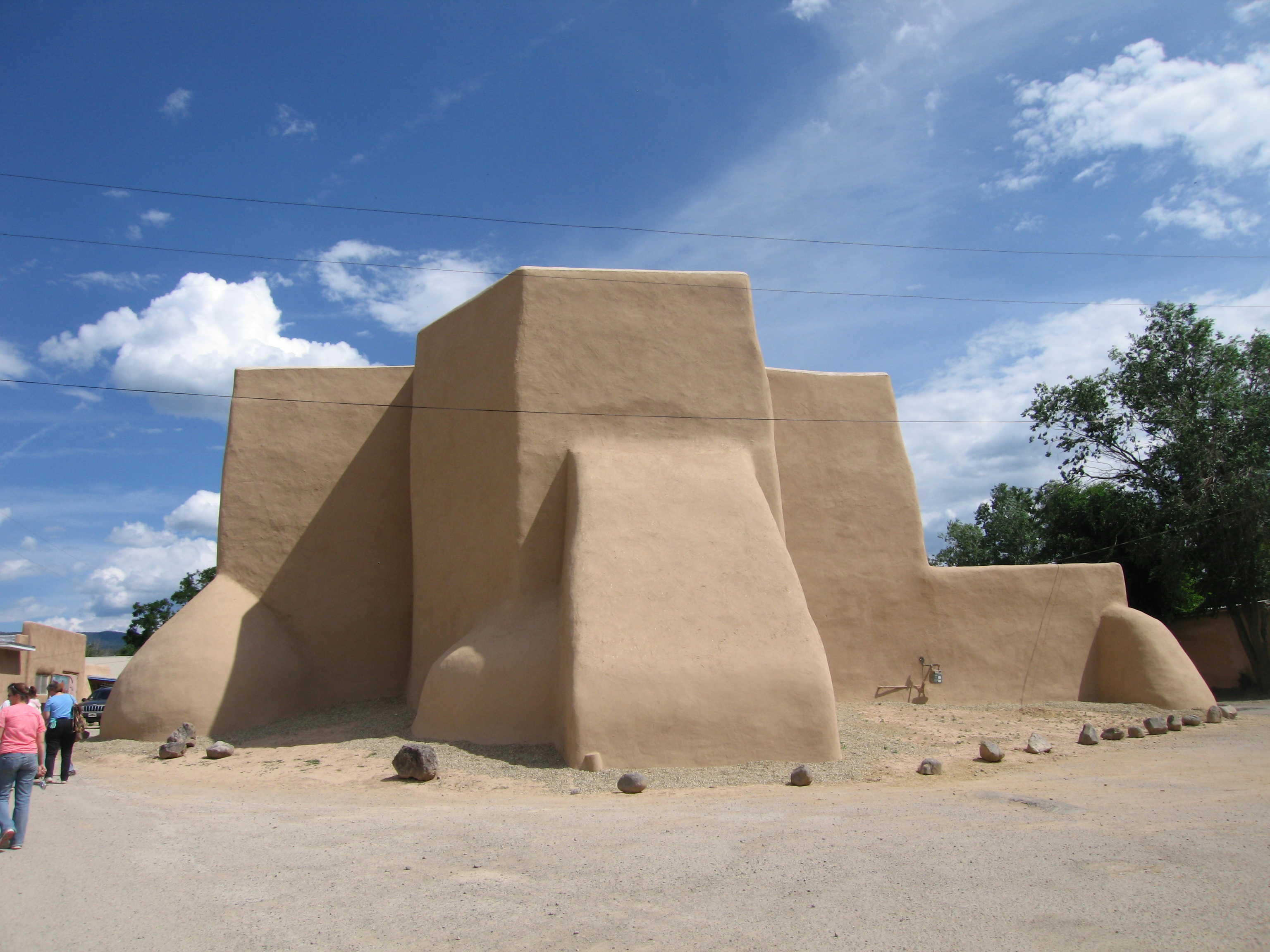
Image of the moment: San Francisco de Asis without Adams or O’Keefe

July 6, 2007

Neither Ansel Adams nor Georgia O’Keefe noted the power lines, or the gas meter.

They must be recent additions.

The essential beauty of the church remains.

1549-san-francisco-de-asis-church-in-taos-july-5-2007.jpg

The original adobe construction of the church was completed in 1772 — four years prior to the Declaration of Independence. It is built in the shape of a cross, but structural weaknesses required the addition of buttresses, shown in the photograph — also of adobe.

A bad photograph of the church is almost impossible.

The interior is cool on a hot afternoon. Adobe construction offers significant advantages, even in the 21st century. The church hosts an active congregation, without air conditioning.

Photo: Copyright 2007, Ed Darrell; you may reproduce for educational or non-profit use, so long as attribution is attached. Attribution must be attached.

Welcome, visitors!  Please leave a comment, at least tell why you visited, and where you’re from.  Thank you.


Fire on the Cutty Sark, to Mary Tyler Moore

May 23, 2007

Everything is connected.

Unaware that the Cutty Sark still existed, the news of the fire on the most famous of the clipper ships caught me by surprise.

Fire on the Cutty Sark

Our U.S. history texts these days mention the clippers, but little more. This wonderful chunk of history, showing great invention in the capture of wind power, and great romance of the sea, falls by the wayside.

Were a teacher so inclined, she might introduce some of that romance and admiration of invention with a bit more than two minutes spent on clipper ships.

For starters, what does “cutty sark” mean? Antiquarian’s Attic provides links to the news of the fire and enough background to make any teacher sound like an aficianado in just a few minutes. “Cutty sark” means a short shift, a very short skirt or dress — it’s from a poem, “Tam O’Shanter” by Robert Burns.

Her cutty sark, o’ Paisley harn,
That while a lassie she had worn,
In longitude tho’ sorely scanty,
It was her best, and she was vauntie.

Hey, who knew there was a poem that gave the name to the hat favored by U.S. Sen. Sam Hayakawa, and the hat which played such a prominent role in the opening sequence of The Mary Tyler Moore Show?

Tam O'Shanter in opening sequence of Mary Tyler Moore showConnections can get a bit out of hand, no?

I digress. Back to Cutty Sark.

Progress in transportation, particularly in speed, makes a solid unit of study in 8th and 11th grade history in Texas, fitting neatly in the advances in technology and how such advances push history along. Particularly with the defense of the America‘s Cup this year putting a spotlight on speed sailing and sailing history, there should be a lot of supplemental material to provide good lesson plan hooks to make a day’s diversion into clipper ships well worth the time.

Perhaps your class would like to contribute to the restoration of the Cutty Sark? Remember it was pennies from U.S. school kids that saved Old Ironsides, after Oliver Wendell Holmes, Sr., wrote a poem in tribute to her. See also the Ballad of Mad Jack.

Did you hear how Mad Jack saved “Old Ironsides” too,
From the scrapheap of flagships too old to renew,
At sixty-five years he inspected each shroud,
And promised the Navy he’d make her stand proud.
He collected the finest ship-riggers around,
From Boston, New Bedford, and Old Portsmouth Town,
He rigged her and jigged her and made her stand tall,
Then he sailed her around the world once and for all.

  • Ballad of Mad Jack by Steve Romanoff, performed by Schooner Fare, 1981

American Civil War in 4 minutes

May 23, 2007

Citations get lost on the internet. Not only do people send copies of e-mails to everyone on their list, not only is there spam beyond all measure, but good stuff gets stripped of attribution. Someone sends you a good poem, or a genuinely funny story — and if you want more of the same, you’re completely at sea about where to look. Author? That information got stripped away several forwardings earlier.

“Must be Lincoln, Einstein, or Jefferson,” some wag says, and the piece is misattributed ever after.

A fellow posted this interesting film on YouTube — The Civil War in Four Minutes. One second of the film equals one week of the war. It’s a fascinating pictorial map presentation, with a lot of information packed into 240 seconds.

Who did it? Are there others like it? How do we get the rights for classroom use?

YouTube can be likened to grave robbers who invade Egyptian royal tombs — they bring important material to light, but the context is lost, and perhaps the meaning.

Can you help track down the creator of this film? This film was created for the Abraham Lincoln Presidential Library and Museum in Springfield, Illinois. (Now — how can we get legal copies?)

Update, June 15, 2007: Every YouTube version of the video has been pulled — probably a copyright thing. In the interim, I’ve checked with the Abraham Lincoln Presidential Library and Museum to see if it is available. One person said there is discussion for making it available in the next two years. Ain’t that the way? Why not strike while the iron is hot and sell it now? Somebody, please wake me if it’s ever released.

Update, October 4, 2007: ABLPLM explains the creation of the movie. Nice shot of the screen, still not available for classrooms. Alas.

Update December 20, 2007: If that one doesn’t work, try this one for a while:

Vodpod videos no longer available. from www.idkwtf.com posted with vodpod


History Carnival 51, from a different view

April 4, 2007

A Don’s Life hosts History Carnival 51, which is fun and informative if only because blog author Mary Beard offers a slightly different view of things, being several time zones and an ocean away from America.

This carnival features several entries related to the Battle of Thermopylae, especially surrounding the release of the Film “300,” and several entries pondering the history of slavery, coming just at the end of the commemoration of the end of slavery in the British Empire.  Both of these topics offer good material for enrichment for AP world history classes, and good information for anyone else wishing to avoid repeats of the errors of history.


Yee Haw! The first Fiesta de Tejas! is on the web! 2007 Wildflower edition

April 2, 2007

Bluebonnet from Ft. Worth Army Corps of Engineers

No apologies, but thanks to Bob Wills, of course, whose holler that the “Texas Playboys are on the air!” should be an inspiration to everybody. Bob Wills and the Texas Playboys at Casa Mana, California, 1943

Just what in the world is Fiesta de Tejas!? This is the inaugural — and we hope, not last — edition of a monthly collection of weblog postings about Texas history, Texas geography, Texana and other things Texas. We’re finding our way as we go, much as pioneers got to Texas first, and only then began to realize that they didn’t know exactly where they were, and that they didn’t know exactly what they had.

This is a carnival of Texas blogs. Texas is big, vigorous, and in need of exploration on the World Wide Web. My hope is to bring together sources on Texas history, politics, economics, arts, geography and sciences, in a place that promotes the general dissemination of knowledge about the state. My hope is that teachers of 7th grade Texas history will find a lot here to supplement and improve their teaching of the course, that teachers of history and geography in other places will also find material to enrich their own teaching about Texas, that students will find information to make their projects and papers into rewarding explorations of Texas’ unique persona.

I dubbed it a fiesta, because “carnival” seems too commonplace a term for a place where people can buy macaroni in the shape of the state. I used the older form of the word, “Tejas,” both to reflect the historical focus, and to avoid confusion and copyright issues with established things called Fiesta of Texas. “Tejas” is the original, probably Caddoan word meaning “friend” that Spanish explorers misunderstood to mean the name of the people and the place, and whose spelling quickly metamorphosed into Texas with an “x.”

Texas is the second largest state in the United States, physically (next to Alaska) and in population (next to California). Texas occupies a unique place in U.S. history and lore, and it deserves its own history carnival.

Getting this one off the ground has not been a cakewalk, however, not by any stretch. Inspired by other state historians’ efforts, particularly those of Georgia (thank you, David), I have been unhappily surprised by a dearth of self-nominated entries by Texas historians. I am hopeful this is a momentary hiccough, and that Texas historians will step across this particularly line in the sand to expose their unique writings about their unique state. (And thank you, too, Clio Bluestocking, and ElementaryHistoryTeacher, whose contributions are noted below.)

Still, there is plenty to see. So let’s get to it.

The bluebonnets bloom along Interstate Highway 20, which stretches across Texas from Louisiana to an intersection with Interstate 10 a hundred miles or so east of El Paso. They probably started blooming two weeks ago farther south, but this is the season of Texas wildflowers, which will run in full glory well into June in most of the state. The photo at the top of this post shows bluebonnets (Lupinis texensis) from Ft. Worth, in an Army Corps of Engineers tract. More photos of Texas wildflowers come to us from an Austin gardener who blogs about “Hill Country Wildflowers” at Digging. The drought hampered blooms in 2006; rains in 2007 helped much of the state’s wildflowers, though we’re still underwatered.

Texas wildflowers used to be mowed down by highway maintenance crews. First Lady Ladybird Johnson took on a campaign to protect and promote wildflowers during her husband’s presidency, however, and now Texas and many other states actively promote wildflowers. Texas A&M University and other institutions support and promote wildflower planting, and the Ladybird Johnson Wildflower Center resides near Austin, leading research and promotion of wildflowers worldwide.

North Dakota poet Mark Phillips writes about that West Texas plague, tumbleweeds (Salsola kali), in his poem, “Rootless!”. I defy you to say this isn’t Texas. [I also defy you to make that link work to get to that poem; here, try this link.]

Spring stirs the wild animals of Texas, too — including skunks. The Nature Writers of Texas tell us about skunk romance.

Hey, where’s the history? Start here: Georgians are so fired up not to be outdone by a Texas history carnival, that they even swipe Texas history to blog about! Elementaryhistoryteacher explains Georgia’s contributions to the Texas Revolution, at Georgia On My Mind. See her exposition of “A Few Good Men.” And then note her follow-up, explaining one more Texas debt to Georgia, “A Georgian Gave the Lone Star to Texas.”

“Honoring Texas History Is Nothing To Be Ashamed Of,” at DallasBlog — a contribution from Texas’ 27th Land Commissioner, Jerry Patterson. Don’t stop there — go to Patterson’s agency’s site, and notice the dozens of historic Texas maps available for sale — at least one specific to your Texas town or county: General Land Office (GLO) maps.

Texas is proud of being big, different, and Texas. Millard Fillmore’s Bathtub earlier discussed the Texas Pledge to the Texas flag — mainly a political blog, A Capitol Annex warns us all, “Don’t Mess With the Texas Pledge.” Texas homeschooler Sprittibee informs us of “Six Flags and Texas snobbery.

Word didn’t get out to some of us of the educator persuasion, but March was Texas History Month. Abilene Reporter-News columnist Glenn Dromgoole gave quick reviews of recent books about Texas history.

The Top Shelf, a blog by a Texas school district’s director of library services, gives a substantial list of on-line Texas history resources selected by Michelle Davidson Ungarait at the Texas Education Agency, in “March is Texas History Month.”

Mug Shots features a coffee mug created for Texas’ sesquicentennial in 1986, featuring historic comic strips relating Texas history. Whew! A lot of commemorating there — one post of several commemorating Texas History Month. Texas Sesquicentennial Mug, from Mug Shots

This is Texas Music says farewell to the band Cooder Graw, who called it quits early this year. It’s a short post, with doorways to a lot more about music. Texas music is an enormous topic, much bigger than most people appreciate. Just how deep? Consider this tribute piece, and alert to a new CD from, Texas musician Joe Ely, from Nikkeiview, by Gil Asakawa. Texas’ diversity in influences, perspectives and admirers fairly drips from that one.

While Texas officially celebrates diversity in music, in other arts, and in business, diversity is not greatly celebrated in all corners of Texas, nor is it accurate that diversity was always celebrated. Texas history recounts many cases where disputes were chiefly between people of different ethnic or racial groups. How should that history be handled in classrooms, in boardrooms, and in government? An interview with an author raises that question, and offers resources for study, at the History News Network, in an article by Rick Schenkman:

Elliot Jaspin, a winner of the Pulitzer Prize (1979), is the author of the just-published book, Buried in the Bitter Waters: The Hidden History of Racial Cleansing in America (Basic Books), the March HNN Book of the Month.

Serious thought is given also to the divide between religious and secular in America, using our Hollywood view of Texas as a jumping off point and traipsing through the misconceptions about the trial of John T. Scopes (who lived much of his post-trial life as a petroleum geologist in Houston, Texas), at Adventus, “Return to Never Was.”

Another Texas-flavored mug from Mug Shots.

History is politics, and politics is history, in some parts of Texas all of the time, and in all of Texas part of the time. Do you remember the Digger Barnes character in the old “Dallas” television series? He was fiction. The fictional Digger Barnes can hold no candle to the real Ben Barnes, however, and the political blog, Burnt Orange Report, carried a two-part series (Part I, Part II) explaining the importance of Barnes and covering much of his history, starting in February. Another Texas political blog, Rick Perry vs. the World, interviewed Barnes — part I, here.

Kay Bell at Don’t Mess With Taxes reprints a letter from Bum Phillips about what it means to be from Texas, and in Texas. [Catch the subtle pun on a common Texas slogan? I didn’t, at first . . .)

Texas is rich in science and natural history. Monkeys In the News notes the recent description of ancient primates, near Laredo. (Thanks to Dear Kitty for that one.)

Texas is rich in food, too. Hey, I have to get one of my own posts in here, don’t I? 2007 is the 100th anniversary of the founding of the dairy processor in Brenham, Texas, that produces Bluebell Ice Cream, among the best ice creams in the world. You can read it here, “Blue Bell Ice Cream, a tastier part of Texas History.”

If you don’t want ice cream? As Davy Crockett told Tennessee, you may just go to hell — I’m going to Texas. Any fan of ice cream would say the same.A mug from the Bob Bullock Museum, with a famous Davy Crockett quote.

A parting shot, from Mug Shots.

The gates are open for submissions to the next Fiesta de Tejas! scheduled for May 2, 2007. You may e-mail entries to me at edarrell AT sbcglobal DOT net, or take advantage of the Blog Carnival listing, which will create a back-up copy of your entry for us. We need a logo, something appropriate to Texas. Also, if you would like to host a future session of the Fiesta, please drop me a note. These things work better with different eyes and ears working on them from time to time.

If you found something of value here, let me know in comments. And then, spread the word that the carnival is up and running. Yeeeeee haaawwww!


Last call for Texas history carnival, Fiesta de Tejas!

March 31, 2007

Today’s the last day to nominate your post, or another’s post, for the inaugural (and we hope not last) Fiesta de Tejas! blog carnival of Texas history and other things Texan.

Texas relief map from geology.comSend the good stuff! You can send it through the Blog Carnival entry site for Fiesta de Tejas! (which is a good idea, since it saves copies), found here, or send it to me directly at edarrell AT sbcglobal DOT net.

Map image: Texas relief map from Geology.com


Happy Birthday, Chester Nimitz!

February 18, 2007

Fleet Admiral Chester W. Nimitz, USN Oil on canvas, 46.5

Fleet Admiral Chester W. Nimitz, USN Oil on canvas, 46.5″ x 30″, by Adrian Lamb, 1960. via Wikipedia

Chester William Nimitz was born on 24 February 1885, near a quaint hotel in Fredericksburg, Texas built by his grandfather, Charles Nimitz, a retired sea captain.” (Courtesy of the Naval Historical Center).

In honor of his birthday, the Nimitz Museum in Fredericksburg reopens after a three-year renovation, on Sunday, February 25, 2007. The museum is formally known as the National Museum of the Pacific War.

The ceremony begins at 1:30, Sunday February 25 at the museum. Keynote speaker is retired General Michael Hagee, 33rd commandant of the Marine Corps. Others responsible for seeing the renovations to fruition will also be in attendance. You’re invited, too.

Nimitz was Commander in Chief, Pacific Fleet and Pacific Ocean Areas, during World War II. When he accepted the surrender of Japan aboard the U.S.S. Missouri in Tokyo Bay in 1945, he was the first to hold the newly-created rank of Fleet Admiral. Read the rest of this entry »