I keep forgetting.
Millard Fillmore’s Bathtub was born in 2006. That was three years after my first great forays into education policy in Texas, working to make sure science stayed in the science books — and probably about a decade after I started explaining evolution to creationists, patiently at first, and then with a great deal of snark, on the internet. A lot of that discussion, and some good posts, died when AOL pulled the plug on archiving discussion threads (the schmucks!).
Another sign of AOL’s doom, perhaps.
From time to time I run into an earnest creationist, and rather than re-explain, I start looking for my old explanations here at this blog . . . and then I remember. The explanations largely do not exist here.
Heck, 2006 was even after the decision in the Dover, Pennsylvania case, Kitzmiller v. Dover Area School District. (Read the decision in the case here, key documents and a chronology, here at the venerable TalkOrigins.)
We saw an uptick in creationist activity recently, in 2012, continuing into 2013. We’ve seen eruptions of ignorance, blind faith and malice, sometimes, that warrant having explanations of evolution around. So, even though it’s repeating stuff from elsewhere, even though this discussion should have been over by 50 years ago, here we are trying to establish a trail of information explaining why evolution is hard science, and needs to be taught in public schools (and all other schools, too), and why creationism and its mutant clone “intelligent design” are not science, but are instead religious beliefs that have no place in school science classes (nor any classes, IMHO).
There are good sites living in the tubes of the ‘net these days that didn’t exist even nine years ago — but creationists won’t find them quickly or willingly, and they will dismiss them if they do find them at all. You can find good stuff there, and I highly recommend writings on evolution at these sites:
- The home site for the National Center for Science Education, the nation’s leading advocacy group for science education in primary and secondary schools. MacArthur “genius grant” winner Eugenie Scott is executive director of this group.
- The Panda’s Thumb, a brilliant group blog that features at various times some of the best science explainers on the planet today, and often the best scientists, too.
- P. Z. Myers’s Pharyngula (with lots of other strayings into other areas where idiots threaten rationality)
- Larry Moran’s Sandwalk (with straying into other areas)
- Jerry Coyne’s Why Evolution is True (again, with lots of straying)
- The Sensuous Curmugeon is dedicated to debunking intelligent design with facts almost tempered with snark; facts used to good effect
- No doubt I’ve left off some great blogs that readers may remind me of, and I’ll add later
- Among non-blog sites, Understanding Evolution at Berkeley is one of my favorites for non-college level stuff
- PBS’s site for the series from a few years back, “Evolution”
- NOVA’s site on evolution, featuring several of their related programs
- Nature magazine’s Focus on Human Origins, collection of key papers in human evolution, out from behind their paywall
- Evolution page at the site for the Natural History Museum, in London — an excellent site
Recently I provided a brief correction to a post I fell across in some search or other, at a blog by a guy named Daniel Lovett. He urged that we reject science with regard to evolution. I responded, and he responded at a greater length. I had hoped to point him quickly so something I’d written here, and found I hadn’t written it here.
These issues are simmering even in Texas again; I want to create a record. Here’s a step.
Three points need to be made to the neo-creationists:
- Evolution is not a faith, it’s based in science and observations of nature. Consequently, one does not “believe” in evolution; one follows the evidence. The old creationist snark that “it takes more faith to believe evolution than to be a Christian” is only a statement that one refuses to look at or acknowledge evidence, how evidence works. It is a confession that one is biased against evidence in reality.
- Creationism cannot be found in scripture, nor in most Christian tradition. Creationism is a mostly-American invention falling out of a rather new form of scriptural interpretation called “literalism” which refuses to recognize scripture as documents written by humans about human history. Creationism starts with an assumption, contrary to tradition and scripture, that God dictated much of the Bible. In this way it confuses Moslem and Mormon doctrine with traditional Christian doctrine. This is a long discussion that will only be touched on here even if it seems long. Creationism claims incorrect authorship of scripture, inaccurately claims only one creation story is told, and assumes as Christian doctrine that the age of the Earth is of importance to the faith, and that contrary to scripture’s claims, one can determine how old the Earth is by following one family tree in the Bible. Or maybe another family tree. Serious students of the Bible know that at no place is there anything close to a statement that says, “God created in the Earth in a rush, in six days of slap-dash whim, and one must ignore science in order to be Christian.”
- Noah’s flood, if it occurred at all, was regional, and not worldwide; assuming a greater cataclysm should not be a point of faith, when it requires one to deny physical reality.
With those preliminaries out of the way, I can answer Mr. Lovett’s arguments specifically, I think. I stumbled into his blog, and I provided a very brief response to a post of his that makes several erroneous claims about science, about evolution and Christianity, and concludes that creationism is superior to evolution, scientifically. Mr. Lovett responded, and called me “friend.”
Dear Friend Daniel, you wrote:
I am of the opinion that the Bible is true and accurate in every respect, scientific and otherwise. It can be trusted because Jesus can be trusted. Though I don’t pretend to know “how” God accomplished the creation in 6 days, I know that he did because he revealed that to us (see my other blog post: http://daniellovett.wordpress.com/2011/10/11/creation-science-oxymoron/).
Let’s be clear that the credibility of Jesus is not on the line here. Jesus didn’t write any of the books we know as “the Bible” today. So far as we know, Jesus wrote nothing that survives, no text at all. Could Jesus write? We don’t know.
So, for all of those reasons which tell us Jesus had nothing to do with the authoring of the Bible, especially the Old Testament, but also the New Testament, putting trust in Jesus has nothing to do with scientific accuracy in the Bible. If you’re trusting the Bible because you trust Jesus, you’re projecting where projection is not logically required, and where the faith doesn’t ask it.
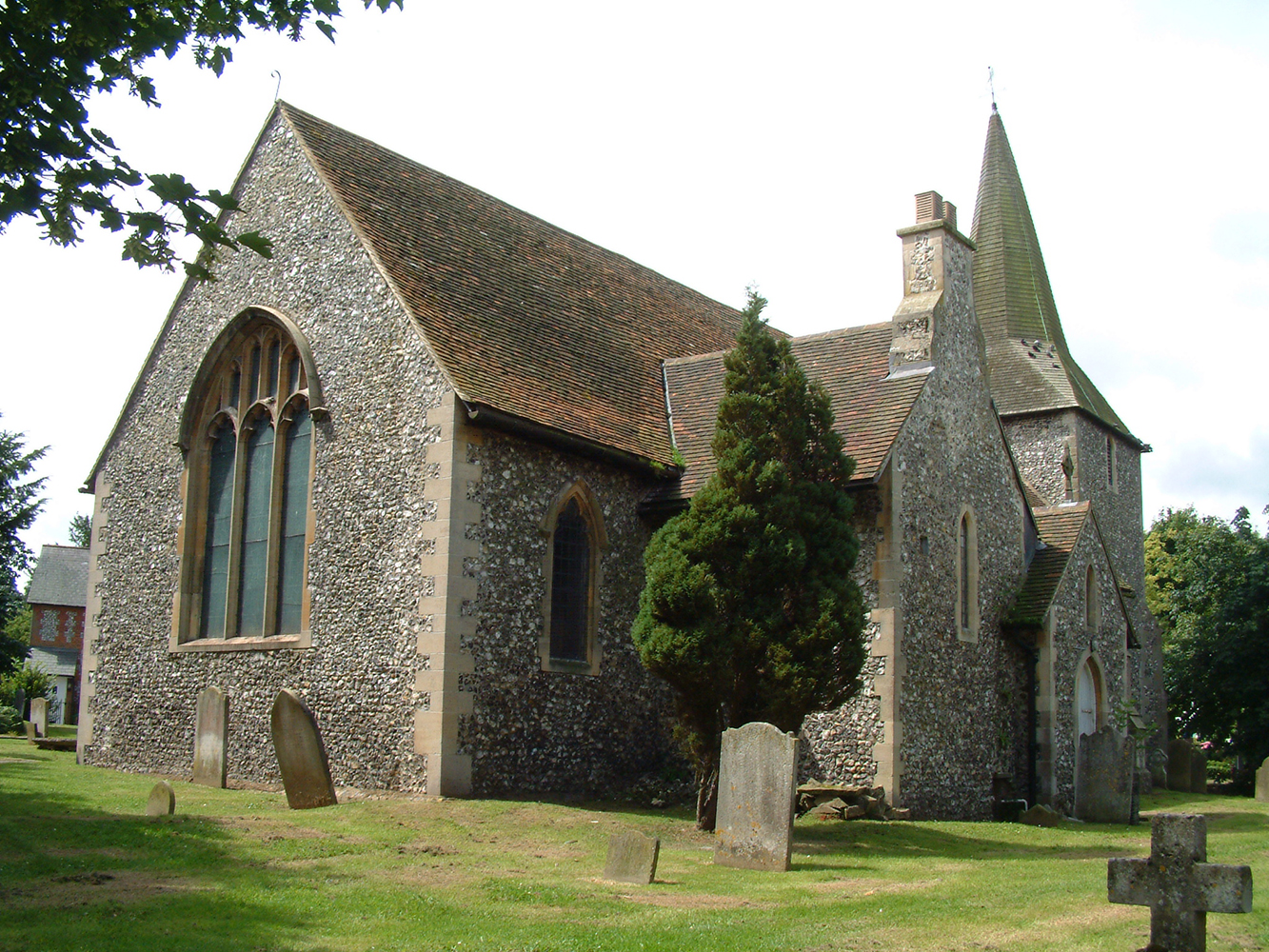
If the evidence is there, no faith is required. Faith is what we use to substitute for evidence, for things we cannot prove in any rational fashion. In the picture: St. Mary’s Church, the Episcopal Church in Downe where Darwin’s family attended, and several are buried.
While you say “I don’t pretend to know ‘how’ God accomplished the creation in 6 days,” you assume God worked in a fast slap-dash fashion, and your entire post is dedicated to denying that God could have used natural processes of chemistry, physics and biology. So you do pretend to know how God did it; and you make pretense to knowing that all of science is in error, for theological reasons that escape me. For Jesus to be right about philosophy, or sin, or any other topic expounded on in Christian scripture, it is not necessary that science be in error.
As with Jesus not being the author of scripture, so we know — in Christian tradition — that God is not the author of scripture, either. The earliest books we know were written by Jews; the first five books of the modern canon, in both Judaism and most sects of Christianity, we attribute to Moses by tradition, but by the words of the books themselves not to God. In those books we find the clear command from God to Moses and the Jews to ‘write it down’ with regard to their history and laws. Nowhere, according to scripture, does God say, “This is what to write down.” Nowhere does God say, “Here is what I have written.” The Old Testament was not written by God, was not dictated by God, nor is it the biography of God.
In a few places in those texts is there a claim that God revealed the when and why of creation. In no place is there a claim God revealed the how of creation. There are several places where various, different and frequently conflicting creation stories are told, however. We get the history of creation, though, perhaps like Billy Pilgrim it is “unstuck in time.” Creation occurred sometime before each story is told — but how long before is never a topic of scripture. Depending on the version of the Bible one chooses, especially Catholic versus Protestant, there are four to eight different creation stories in scripture. In Genesis 1 and 2, we find two different, often contradictory creation stories. In Job, we find a story that is wholly different from both of the Genesis stories — and this is the one that is said by the author to be from God’s lips, explaining to Job what happened at the beginning when God wrestled a dragon to see who would have control of the Earth — no six day creation at all, no day of rest, no Eden, no Adam and Eve.
How can you “know” God revealed something when scripture doesn’t support that claim? Do you claim to be a prophet?
Wholly apart from what you don’t know about science, I fear you’re unfamiliar with scripture, or you’re hiding those parts that simply do not support your own beliefs. If the Bible is “true in every respect,” one should respect it; I don’t think you do. How can you be said to respect scripture, when you ignore all the other creation stories, and the actual instructions of scripture as you do?
Daniel Lovett wrote:
So why do we believe Jesus or the word of God? Short answer: Because Jesus has been proven to be the Son of God and the Messiah, having fulfilled over 300 prophecies, lived a sinless life, worked miracles (all of which went unquestioned – people could have verified the facts by interviewing eyewitnesses), and finally the clincher – he rose from the dead.
I see. You believe that you are correct, not for any rational reason, but because you believe what you believe. Faith is a powerful quality; its exercise can be a bold act of tenacity, or a foolish act of stubbornness. We need to take care when resting on faith, that which can be fact checked, lest we become the poster child of the Dunning Kruger Effect.
We don’t need to contradict your claim that the Bible is correct, but instead we might observe that at no place does the Bible claim to provide a literal and scientifically accurate story of creation. Your trust in the Bible may be well placed. Your claim that it presents a creation story in scientific accuracy, however, is not correct on the Bible’s own terms.
You have stretched the Bible to cover material it does not claim to cover, to make claims it does not claim to make. At no point does the Bible, read as a complete collection, deny evolution, nor an old Earth, nor physics, nor chemistry.

Title page of James Ussher’s Annales veteris testamenti, a prima mundi origine — the text upon which 6-day creationism is based. No, it’s not in scripture. (Photo: Wikipedia)
For example, at no place does the Bible claim that the Earth is young. That conclusion was misapprehended through a misreading of the work of an Irish bishop, in the 17th century. Bishop James Ussher, who passed for a geologist in his day. Studying nature was believed to be a rather divine calling for people who claimed faith in God in that time. Learning about nature was learning about God’s creation from a testament unsullied by mistranslation, church politics, or language difficulties. Nature provided a solid, irrefutably correct second testament of God, and direct from God with God’s fingerprints on it. In short, Ussher, and Darwin 200 years later, studied nature because of their belief that God was the creating force behind it.
Isn’t it ironic that, today, you reject the traditional Christian view of nature and its study, and instead adopt a more Pharisaic stance, that scripture written by men trumps God’s own creation?
Lovett wrote:
Jesus believed in creation:
“Haven’t you read,” he replied, “that at the beginning the Creator ‘made them male and female,’” Matthew 19:4
Now I grow concerned. You say you put your faith in the Bible, but then you cite this passage as somehow evidence that Jesus disputed Darwin and geology and cosmology and biology.
Jesus was talking about divorce. How in the world could you have missed the plain meaning of that passage, and how could you have confused it to say anything about science, and the science of creation of the planet? In context, it’s clear Jesus was rebuking the Pharisees for their clinging too strongly to scripture and not paying attention to reality; but at no point does Jesus pause and say, “By the way, the Earth was created in 6 days just a few thousand years ago.” Jesus mentions a shorthand version of biological observation (I say shorthand because he ignores species with no gender, species with gender other that male and female, transgender, misgender, and species with more than two genders — if he’s relying on biology being accurate here, this passage would nullify all Abramic faith-based questioning of homosexual rights, since God also made them Adam and Steve, and Alice and Eve; but by now I’m digressing). Jesus says mating is from God, and men shouldn’t create laws to undo it.
Jesus talks about divorce, and how it’s not part of the plan. He says nothing against Darwin, and in fact appears to be relying on Darwin-style science, what we actually see in nature, to ground his argument against divorce.
I find it interesting that Jesus does not appeal solely to scripture here, but instead to nature. If we stick to the words recorded, and the events, we get Jesus denying the religious laws of the day and saying, ‘Hey, Pharisees, haven’t you noticed that in nature things pair off; in humans, people naturally pair off in opposite-gender couples most of the time? That’s an indication of God’s plan. Divorce isn’t a key value of God’s scheme of marriage. Don’t muck it up with a misinterpretation of scripture.’ You appeal to scripture, as the Pharisees did, to deny nature, where Jesus based his argument. Plus, you do that on a topic that was nowhere mentioned in those 12 verses.
Let’s check the text.
In the King James version (so the fundies won’t squawk about mistranslations from Jesus’s English):
Matthew 19
King James Version (KJV)
19 And it came to pass, that when Jesus had finished these sayings, he departed from Galilee, and came into the coasts of Judaea beyond Jordan;
2 And great multitudes followed him; and he healed them there.
3 The Pharisees also came unto him, tempting him, and saying unto him, Is it lawful for a man to put away his wife for every cause?
4 And he answered and said unto them, Have ye not read, that he which made them at the beginning made them male and female,
5 And said, For this cause shall a man leave father and mother, and shall cleave to his wife: and they twain shall be one flesh?
6 Wherefore they are no more twain, but one flesh. What therefore God hath joined together, let not man put asunder.
7 They say unto him, Why did Moses then command to give a writing of divorcement, and to put her away?
8 He saith unto them, Moses because of the hardness of your hearts suffered you to put away your wives: but from the beginning it was not so.
9 And I say unto you, Whosoever shall put away his wife, except it be for fornication, and shall marry another, committeth adultery: and whoso marrieth her which is put away doth commit adultery.
10 His disciples say unto him, If the case of the man be so with his wife, it is not good to marry.
11 But he said unto them, All men cannot receive this saying, save they to whom it is given.
12 For there are some eunuchs, which were so born from their mother’s womb: and there are some eunuchs, which were made eunuchs of men: and there be eunuchs, which have made themselves eunuchs for the kingdom of heaven’s sake. He that is able to receive it, let him receive it.
Indirectly, Jesus bases his argument on creation; you stretch that to say He was putting his faith in creation, something that Jesus does not say there. Then you stretch that farther to suggest it means He also believed in creationism. We can fairly deduce a belief in the existence of creation and some natural order; but it’s adding much to the text, to claim that passage contradicts science. I find that an unfair and unholy twisting of scripture.
At no place is there anything close to “Darwin goofed.” At no place is there a testament from Jesus to the short slap-dash creation you insist.
Lovett said:
He also believed in the flood:
‘Just as it was in the days of Noah, so also will it be in the days of the Son of Man.People were eating, drinking, marrying and being given in marriage up to the day Noah entered the Ark. Then the Flood came and destroyed them all.’ Luke 17:26–27
Again, I think you ignore what Jesus intended, and instead try to stretch a small part to say something else.
During the time Christians believe that Jesus lived and ministered, one of the divisions in Judaism broke over the issue of whether there is an afterlife, and what will be the signs of the Messiah’s coming, and later, of the end of the Earth. Again, Pharisees try to hold Jesus to scripture, and again Jesus suggests different interpretations. Notice that, again, neither side is talking about how the Earth as we know it was created. That’s your add-on.
Again, from the King James Version, much of that chapter of Luke:
20 And when he was demanded of the Pharisees, when the kingdom of God should come, he answered them and said, The kingdom of God cometh not with observation:
21 Neither shall they say, Lo here! or, lo there! for, behold, the kingdom of God is within you.
22 And he said unto the disciples, The days will come, when ye shall desire to see one of the days of the Son of man, and ye shall not see it.
23 And they shall say to you, See here; or, see there: go not after them, nor follow them.
24 For as the lightning, that lighteneth out of the one part under heaven, shineth unto the other part under heaven; so shall also the Son of man be in his day.
25 But first must he suffer many things, and be rejected of this generation.
26 And as it was in the days of Noe, so shall it be also in the days of the Son of man.
27 They did eat, they drank, they married wives, they were given in marriage, until the day that Noah entered into the ark, and the flood came, and destroyed them all.
28 Likewise also as it was in the days of Lot; they did eat, they drank, they bought, they sold, they planted, they builded;
29 But the same day that Lot went out of Sodom it rained fire and brimstone from heaven, and destroyed them all.
30 Even thus shall it be in the day when the Son of man is revealed.
31 In that day, he which shall be upon the housetop, and his stuff in the house, let him not come down to take it away: and he that is in the field, let him likewise not return back.
32 Remember Lot’s wife.
33 Whosoever shall seek to save his life shall lose it; and whosoever shall lose his life shall preserve it.
34 I tell you, in that night there shall be two men in one bed; the one shall be taken, and the other shall be left.
35 Two women shall be grinding together; the one shall be taken, and the other left.
36 Two men shall be in the field; the one shall be taken, and the other left.
37 And they answered and said unto him, Where, Lord? And he said unto them, Wheresoever the body is, thither will the eagles be gathered together.
Jesus is reported to have referred to a flood here, the flood of Noah. As we noted earlier, Jesus is not the author of scripture, particularly not the author of the scriptures of the Pentateuch, in which the story of Noah is found.
But he’s not talking about whether a flood actually occurred. Jesus uses literary allusion here. Jews had their scriptures (not yet bound into the Torah), and observant and non-observant Jews, including especially the Pharisees, would have been familiar with the story of the flood of Noah. When challenged about which side of the dispute he was on with regard to afterlife, Jesus didn’t fall into the trap. He said, just like in the story of Noah when most people had no clue about the pending disaster, no one can know when “the Kingdom of God” will come (let alone exactly what that means).
So Jesus wasn’t saying, “By the way, the whole world was covered by a flood that can be pinpointed in time.” Jesus was saying, “You Pharisees know the story of Noah; here’s an analogy: The Kingdom of God will come when people don’t expect it, and they will be caught by surprise, as in the story of Noah people were caught by surprise by the flood.”
Critically, Jesus nowhere claims that the story is wholly, scientifically accurate.
Which is good, because that would make Jesus out to be a liar — and in your schema, where your faith seems to rest on whether Jesus is trustworthy in all things, that would destroy the basis of your faith, right?
I think perhaps you don’t understand what Christians mean by “faith.” That colors your reasoning, and it clouds your understanding of scripture, and it completely fogs your view of science. We call it faith because we don’t have the evidence to back it up.
If we did have the evidence, none of us could be anything more than agnostics — the agnostic position is that belief will come when the evidence is sufficient. Christians believe, despite that lack of evidence. We call the process a “leap of faith.” We call it “stepping out on the word of God.” It’s risky. It takes faith, which is why we call it that. (Jews and Muslims also make such leaps.)
It must be faith, because the evidence is not there — as the Bible occasionally acknowledges (see 2 Corinthians 4.18, or Hebrews 11.1; faith is in the things “unseen,” as they are eternal).
Built around the story of the flood of Noah, there is a trap a lot of people of faith fall into, a false dichotomy that, if divinely inspired, surely was intended by evil forces to turn otherwise faithful people away from knowledge and science. I fear you’ve fallen into it.
Daniel said:
So to cling to a belief that Creation or the Flood is not true is to say that Jesus was a liar.
Quite to the contrary, to claim that Jesus said creationism is true, or that Jesus vouched for the historicity of Noah’s flood, is false. Jesus didn’t intend that, as we can see from the context, and stretching his meaning to topics way beyond what Jesus was discussing puts us in the uncomfortable and unholy position of adding words to scripture that are not there.
[Hmmm. There’s supposed to be a brief explanation of the science that disproves the idea of a worldwide flood as many creationists believe the Bible describes . . . pending. Maybe later.]
Sorry if I offended you by saying your religion has blinded you, but my position is that a Godless scientific world view is a religion. An unbiased look at science will always reveal the Designer. The scandal of the Gospel is that this Designer then became the man Jesus who died for your sin and rebellion and to restore you to your loving heavenly Father. I pray you find him.
your friend Daniel
Then what is a godful scientific position? As creationists are too often wrongly happy to remind us, many scientists of the past were faithful, often good Christians. Darwin, for example, studied for the clergy, and stuck with the church to his death.
Claiming that science is godless, or Godless, is a biased and inaccurate view of science, and as we have seen here, a biased and inaccurate view of Christian religion, too.
Scripture tells us that regardless how the universe, matter, stars, galaxies, planets and life were created, God is behind it. The scandal of creationism is the denying that God can be behind what the universe shows us to be true and accurate. Jesus died for your sin and rebellion, too, Daniel — even your rebellion against God’s creation and the science that explains how and why it works. You can’t find God if you refuse to look.
More:
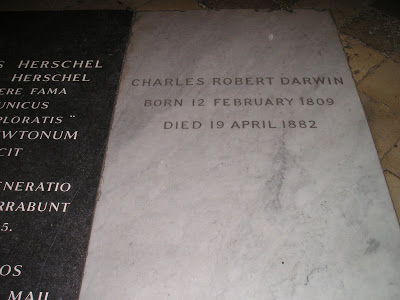
The grave of Charles Darwin, in the Nave of the Collegiate Chapel at Westminster Abbey. Darwin is interred near Sir Isaac Newton. Bishop James Ussher is interred in the St. Paul’s Chapel, a few dozen yards away. Photo from Laurence Moran’s The Sandwalk Blog

The grave of Charles Darwin, in the Nave of the Collegiate Chapel at Westminster Abbey. Darwin is interred near Sir Isaac Newton. Bishop James Ussher is interred in the St. Paul’s Chapel, a few dozen yards away. Photo via Graveyard Database.
(Yeah, this one’s kicked around in the draft file for a long, long time.)
Save
Spread the word; friends don't allow friends to repeat history.


 Posted by Ed Darrell