Burt Folsom’s blog distorts history of DDT

October 13, 2011

I hadn’t thought Burt Folsom, author of FDR Goes to War, much of an ideologue, but a post at his blog makes me wonder about whether he is so grossly inaccurate on other things, too.

The post, written by Anita Folsom, said:

Fast-forward to the post-World War II period. In 1962, Rachel Carson published her best-selling text, Silent Spring, in which she protested the effects of pesticides on the environment.  Ten years later, DDT was banned.

Thomas Sowell points out that such bans, while passed with the best of intentions, have unleashed growth in the numbers of mosquitoes and a huge recurrence of malaria in parts of the world where it had been under control. The same is true of modern pesticides in the U.S. today.  One reason for the rise in the incidence of bedbugs, which bite humans and  spread disease, is that the federal government has banned the use of chemicals that were effective against such insects.

The issue is one of balance.  While it is every citizen’s responsibility to take an interest in a clean environment, it is also a responsibility to avoid over-zealous regulators who cause harm by banning useful chemicals.  Perhaps what is needed is a substance that will cause bureaucrats to leave citizens alone, both immediately and in the future.

Perhaps the trouble comes from relying on Thomas Sowell as a source here — on DDT and Rachel Carson, Sowell appears to be  just making up false stuff.

Thomas Sowell has come unstuck in history, at least with regard to DDT and malaria.

Thomas Sowell has come unstuck in history, at least with regard to DDT and malaria.

First, the “DDT ban” mentioned here was by U.S. EPA.  Consequently, it applies ONLY to the U.S., and not to any nation where malaria is a problem.

Second, the order banning DDT in the U.S. restricted the ban to agricultural use on agricultural crops, almost solely cotton at the time.  DDT use to fight malaria would still be legal in the U.S.

Third, the order banning DDT use in the U.S. specifically exempted manufacture of DDT — so in effect, the order more than doubled the amount of DDT available to fight malaria mosquitoes because all U.S. production was dedicated to export, specifically to allow DDT to be used to fight malaria.

Fourth, and probably most critically, it is simply false that malaria resurged when DDT was banned.  By 1972, malaria infections were about 500 million annually, worldwide.  Malaria deaths were about 2 million.  Even without U.S. spraying DDT on cotton crops in Texas and Arkansas, and to be honest, without a lot of DDT use except in indoor residual spraying as promoted by the World Health Organization (WHO), malaria infections have been reduced by 50%, to about 250 million annually — and malaria deaths were reduced by more than 50%, to fewer than 900,000 annually, worldwide.  WHO estimates more than 700,000 African children were saved from malaria deaths in the decade from 2001 through 2010.

Malaria deaths and malaria infections decreased after DDT was banned in the U.S., and continue to decline.

dsc4436-nosmile-300x200

Burt and Anita Folsom should have checked Sowell’s claims on DDT, rather than accepting them as gospel.

Fifth, while it is true that reports generally claim that DDT limited bedbug infestations in the 1960s, the truth is that bedbugs became immune to DDT in the 1950s, and DDT is perfectly useless against almost all populations of the beasties today, and since 1960, 51 years ago.  Also, the evolution to be immune to DDT primed bedbugs to evolve resistance to other pesticides very quickly.  DDT didn’t stop bedbugs, and lack of DDT didn’t contribute to bedbug infestations after 1960.

(Maybe worst, and odder, 111 people have been injured by pesticides used to control bedbugs, one fatally, in the past ten years.  Which is worse?)

Sixth, bedbugs do not spread disease, at least not so far as is known to medical and entomological science.

Sowell’s claims endorsed by Folsom are exactly wrong, 180-degrees different from the truth.  Sowell and Folsom are victims of the DDT Good/Rachel Carson Bad Hoaxes.

Since malaria has been so dramatically reduced since the U.S. banned the use of DDT, perhaps Rachel Carson should be given full credit for every life saved.  It’s important to remember that Carson herself did not suggest that DDT be banned, but instead warned that unless DDT use were restricted, mosquitoes and bedbugs would evolve resistance and immunity to it.  DDT use was not restricted enough, soon enough, and both of those pests developed resistance and immunity to DDT.

Ms. Folsom urges restraint in regulation, she says, because over-enthusiastic banning of DDT brought harm.  Since her premise is exactly wrong, would she like to correct the piece to urge more regulation of the reasonable kind that EPA demonstrated?  That would be just.

Good sources of information on malaria, DDT, and Rachel Carson and EPA:

Africa had a surplus of DDT from 1970s through 1990s, creating a massive toxic cleanup problem for today. This FAO photograph shows

Africa had a surplus of DDT from 1970s through 1990s, creating a massive toxic cleanup problem for today. This FAO photograph shows “TN before: 40 tonnes of 50 year old DDT were found in Menzel Bourguiba Hospital, TN.” DDT was not used because it was largely ineffective; but had any nation wished to use it, there was plenty to use.

Save


Annals of Global Warming: Arctic ice at second lowest level ever measured

October 12, 2011

Two years ago warming denialists claimed the Earth is actually cooling, and they predicted dramatic cooling by late 2010.

Instead, warming continues, overcoming the temporary mediation caused by increased particulate and sulfate emissions from coal burned in uncontrolled fashion in China, as evidence by things like the continued shrinking of Arctic ice below 20th century averages.  See this press release from NASA:

RELEASE : 11-337 – October 4, 2011

 Arctic Sea Ice Continues Decline, Hits Second-Lowest Level

WASHINGTON — Last month the extent of sea ice covering the Arctic Ocean declined to the second-lowest extent on record. Satellite data from NASA and the NASA-supported National Snow and Ice Data Center (NSIDC) at the University of Colorado in Boulder showed that the summertime sea ice cover narrowly avoided a new record low.

The Arctic ice cap grows each winter as the sun sets for several months and shrinks each summer as the sun rises higher in the northern sky. Each year the Arctic sea ice reaches its annual minimum extent in September. It hit a record low in 2007.

The near-record ice-melt followed higher-than-average summer temperatures, but without the unusual weather conditions that contributed to the extreme melt of 2007. “Atmospheric and oceanic conditions were not as conducive to ice loss this year, but the melt still neared 2007 levels,” said NSIDC scientist Walt Meier. “This probably reflects loss of multiyear ice in the Beaufort and Chukchi seas as well as other factors that are making the ice more vulnerable.”

Joey Comiso, senior scientist at NASA’s Goddard Space Flight Center in Greenbelt, Md., said the continued low minimum sea ice levels fits into the large-scale decline pattern that scientists have watched unfold over the past three decades.

“The sea ice is not only declining, the pace of the decline is becoming more drastic,” Comiso said. “The older, thicker ice is declining faster than the rest, making for a more vulnerable perennial ice cover.”

While the sea ice extent did not dip below the 2007 record, the sea ice area as measured by the microwave radiometer on NASA’s Aqua satellite did drop slightly lower than 2007 levels for about 10 days in early September, Comiso said. Sea ice “area” differs from extent in that it equals the actual surface area covered by ice, while extent includes any area where ice covers at least 15 percent of the ocean.

Arctic sea ice extent on Sept. 9, the lowest point this year, was 4.33 million square kilometers (1.67 million square miles). Averaged over the month of September, ice extent was 4.61 million square kilometers (1.78 million square miles). This places 2011 as the second lowest ice extent both for the daily minimum extent and the monthly average. Ice extent was 2.43 million square kilometers (938,000 square miles) below the 1979 to 2000 average.

This summer’s low ice extent continued the downward trend seen over the last 30 years, which scientists attribute largely to warming temperatures caused by climate change. Data show that Arctic sea ice has been declining both in extent and thickness. Since 1979, September Arctic sea ice extent has declined by 12 percent per decade.

“The oldest and thickest ice in the Arctic continues to decline, especially in the Beaufort Sea and the Canada Basin,” NSIDC scientist Julienne Stroeve said. “This appears to be an important driver for the low sea ice conditions over the past few summers.”

Climate models have suggested that the Arctic could lose almost all of its summer ice cover by 2100, but in recent years, ice extent has declined faster than the models predicted.

NASA monitors and studies changing sea ice conditions in both the Arctic and Antarctic with a variety of spaceborne and airborne research capabilities. This month NASA resumes Operation IceBridge, a multi-year series of flights over sea ice and ice sheets at both poles. This fall’s campaign will be based out of Punta Arenas, Chile, and make flights over Antarctica.  NASA also continues work toward launching ICESat-2 in 2016, which will continue its predecessor’s crucial laser altimetry observations of ice cover from space.

To see a NASA data visualization of the 2011 Arctic sea ice minimum as measured by the Advanced Microwave Scanning Radiometer – Earth Observing System (AMSR-E) on Aqua, visit:

http://www.nasa.gov/topics/earth/features/2011-ice-min.html  [I have changed the link to one that works for me.]

Here is that visualization, presented by Cryosphere Program Manager, Tom Wagner:

On Sept. 9th, 2011, Arctic sea ice most likely hit its minimum extent for the year. On Sept. 20th, NASA’s Cryosphere Program Manager, Tom Wagner, shared his perspectives on the ice with television audiences across the country.

On the top of the world, a pulsing, shifting body of ice has profound effects on the weather and climate of the rest of the planet. Every winter as temperatures dip, sea ice freezes out of cold Arctic Ocean waters, and every summer the extent of that ice shrinks as warm ocean temperatures eat it away. Ice cover throughout the year can affect polar ecosystems, world-wide ocean currents, and even the heat budget of the Earth.

During the last 30 years we’ve been monitoring the ice with satellites, there has been a consistent downward trend, with less and less ice making it through the summer. The thickness of that ice has also diminished. In 2011 Arctic sea ice extent was its second smallest on record, opening up the fabled Northwest Passages and setting the stage for more years like this in the future. In this video, NASA’s Cryosphere Program Manager, Tom Wagner, shares his perspectives on the 2011 sea ice minimum.

More data and animation versions here, at Goddard Multimedia.


Typewriter of the moment: Walter Cronkite

October 9, 2011

Walter Cronkite at his office typewriter:

Walter Cronkite at his typewriter, in his office

Walter Cronkite at his typewriter, in his office - from The Typewriter blog

Pipe rack to his left, on the shelf above; full set of the Encyclopedia Britannica to his right (probably a 1960s set); A lot of books, some dealing with space exploration, among his favorite topics; models of the X-15 and early versions of the Space Shuttle; award from the Boy Scouts to his right, where he can see it easily.

When was this photo taken?  1970s?  Earlier?  Maybe someone who follows Dixie Cups could date the cup to Cronkite’s left.

This is probably the same office, redecorated, and stripped down to move – and with a different typewriter (a Smith-Corona electric?):

Walter Cronkite in his office just before his final newscast, 1981; SF Chronicle "file photo"

Caption from the San Francisco Chronicle website: "In this March 6, 1981 file photo, Walter Cronkite talks on the phone at his office, prior to his final newscast as CBS anchorman in New York City. Behind him is a framed Mickey Mouse cartoon and his Emmy award. Famed CBS News anchor Walter Cronkite, known as the 'most trusted man in America' has died, Friday, July 17, 2009. He was 92."


“Typewriter in the 21st Century” – film needs your help

October 9, 2011

Heck, they haven’t even finished shooting — but this four minutes suggests the great film that may result from the “Typewriter in the 21st Century” project.

Christopher Lockett and Gary Nicholson hope to raise $20,000 to finance the completion of this movie.  You may contribute at Kickstarter.

I hope they’ll include Walter Cronkite’s typewriters.


Prohibition — in 6 hours, by Ken Burns

October 2, 2011

Starts tonight on KERA, our local PBS affiliate.  A key part of history, especially for the political winds of 2011.

Should I require classes to watch it?

Part 1 runs tonight at 7:00 p.m. and the repeats at about 8:30 p.m. (if I’m reading this schedule correctly, and KERA has done this before with programs they expect to be very popular).

Part 2 is scheduled for Monday at 7:00, and Part 3 for Tuesday at 7:00 — with repeats to follow both nights.


Saroyan, gone 30 years

September 28, 2011

Time fills up with anniversaries, if we remember history long enough.

Today is This year marks the 30th anniversary of William Saroyan’s death (on May 18).  A few hits on my post about his typewriter made me aware of the date.

There’s a nice tribute by Tom Vartabedian to the legacy of Saroyan, a man who loved books and who understood the value of knowledge, literature, a library, and what it means to be Armenian, at the Armenian Weekly.

An interesting guy, with interesting stories most often about one of our planet’s more interesting groups of people.  In 1936 Saroyan wrote about the resiliency and vibrancy of Armenians, in Inhale and Exhale.  One quote can be purchased from the William Saroyan Society on a poster:

I should like to see any power of the world destroy this race, this small tribe of unimportant people, whose wars have all been fought and lost, whose structures have crumbled, literature is unread, music is unheard, and prayers are no more answered. Go ahead, destroy Armenia. See if you can do it. Send them into the desert without bread or water. Burn their homes and churches. Then see if they will not laugh, sing and pray again. For when two of them meet anywhere in the world, see if they will not create a New Armenia.

30 years since he passed?  Really?


Strike a blow for freedom and the Constitution: Read a banned book!

September 26, 2011

John Maunu reminded me this week is Banned Books Week.  Details from the American Library Association:

Banned Books Week 2011

September 24−October 1, 2011

Banned Books Week (BBW) is an annual event celebrating the freedom to read and the importance of the First Amendment.  Held during the last week of September, Banned Books Week highlights the benefits of free and open access to information while drawing attention to the harms of censorship by spotlighting actual or attempted bannings of books across the United States.

Intellectual freedom—the freedom to access information and express ideas, even if the information and ideas might be considered unorthodox or unpopular—provides the foundation for Banned Books Week.  BBW stresses the importance of ensuring the availability of unorthodox or unpopular viewpoints for all who wish to read and access them.

The books featured during Banned Books Week have been targets of attempted bannings.  Fortunately, while some books were banned or restricted, in a majority of cases the books were not banned, all thanks to the efforts of librarians, teachers, booksellers, and members of the community to retain the books in the library collections.  Imagine how many more books might be challenged—and possibly banned or restricted—if librarians, teachers, and booksellers across the country did not use Banned Books Week each year to teach the importance of our First Amendment rights and the power of literature, and to draw attention to the danger that exists when restraints are imposed on the availability of information in a free society.

Banned Books Week is sponsored by the American Booksellers Association; American Booksellers Foundation for Free Expression; the American Library Association; American Society of Journalists and Authors; Association of American Publishers; and the National Association of College Stores.  It is endorsed by the Center for the Book in the Library of Congress. In 2011, the Comic Book Legal Defense Fund; National Coalition Against Censorship; National Council of Teachers of English; and PEN American Center also signed on as sponsors.

For more information on getting involved with Banned Books Week: Celebrating the Freedom to Read, please see Calendar of Events, Ideas and Resources, and the new Banned Books Week site. You can also contact the ALA Office for Intellectual Freedom at 1-800-545-2433, ext. 4220, or bbw@ala.org.


Quote of the moment: Mike Mansfield

September 20, 2011

Senate Majority Leader Mike Mansfield, D-Montana

Senate Majority Leader Mike Mansfield, D-Montana; oil on canvas by Aaron Shikler, 1978 - Wikimedia image

Mike Mansfield was born on March 16, 1903.  Best boss I ever had.

Robert A. Nowlan’s Born This Day attributed this quote to Mansfield:

After all, even a politician is human.

Laconic as he was, Mansfield didn’t say anything more meaty than that?

Read about Mansfield at the Bathtub, here.  Mansfield died on October 5, 2001.


Shakespeare: Still viral after all these years

September 19, 2011

A little sketch in her notebook, an off-the-top-of-her-head list of common phrases.  Common today, but originating with William Shakespeare.

Becky's tumblr image:  Things we say that we owe to Shakepspeare

Becky's quick summary of some of the best-known phrases we use everyday, invented by Shakespeare. From Becky, age 20, in London.

Becky’s quick work caught a lot of eyes.  One of NPR’s blogs brought it to my attention.  English teachers, take notice (maybe someone at your school has a large format printer, and can make for you a poster . . .)

Someone could write a book explaining the original Shakespeare meaning of these phrases, the play, the context, and the value in the story. (Perhaps it’s already been done.)  It’s really quite stunning to consider how many phrases trace back to the Bard — surely he did not originate each and every one.  But Shakespeare’s works are rivaled perhaps only by scriptures in producing so many common phrases and aphorisms.

Is this graphic design of a sort that would meet with approval from Edward Tufte and his followers?


For Kathryn: A purring cheetah

September 16, 2011

Kathryn loves the purr of a cat.  A purring kitty can be one of the most pacifying and satisfying things to listen to on Earth.

We’ve often wondered about the purrs of big kitties.  I mean, big cats.  Heida Biddle tramps the world in search of such adventures as petting a cheetah, but found this video on YouTube, this grand purr, for Kathryn:

I sense a trip to a cheetah reserve in our future.


Sausage makers? Or U.S. Congress? Do you want to see how they do it?

September 15, 2011

How does a bill become law?

Charts in government and civics texts always amuse me for what they leave out — mostly the political machinations.  Anyone who worked or works in the halls of Congress knows the process is never so clean as Bismarck pretended with his old, misattributed bon mot (actually John Godfrey Saxe, not Bismarck) (and would Bismarck be chagrined at my using a French phrase to describe his words?).

At In Custodia Legis, the blog of the law librarians at the Library of Congress, I stumbled across this post featuring a photograph of a chart hanging in a committee room on the House side.  Wouldn’t it be nice to have a copy of that available to teachers?

Andrew Weber wrote the post.

Sometimes the legislative process is a little more confusing than I’m Just a Bill.  As Margaret mentioned in The Curious History of the 2011 Debt Ceiling Legislation earlier this week, sometimes the legislative process takes interesting turns.  Christine also blogged about the unique situation of vehicle bills.  The poster below details the various status steps legislation can take, including Introductory, Committee, Discharge, Calendar, Floor, Conference, and Presidential Steps.

For tips on THOMAS that can relate to the legislative process, you can subscribe to the RSS feed or via email alert.  There is also a glossary in THOMAS to help.

Is the poster available?  I asked, and got this response from Mr. Weber:

This is what it says at the bottom right of the poster:

Committee on House Administration
Wayne L. Hays, Chairman
Prepared by House Information Systems Staff
Frank B. Ryan, Director

Also, on the bottom left it has a date:

Current as of November 1974

Wayne Hayes, the meanest man in the House according to Bud Shuster?  November 1974?  This was pre-scandal Hayes (Democrat of Ohio), just barely post-Nixon Washington. [

If you can find a link to this chart that makes the wording and details legible, or if you happen to find it and can photograph it so we can read it, will you let us know here?


September 14: President McKinley died, 1901

September 14, 2011

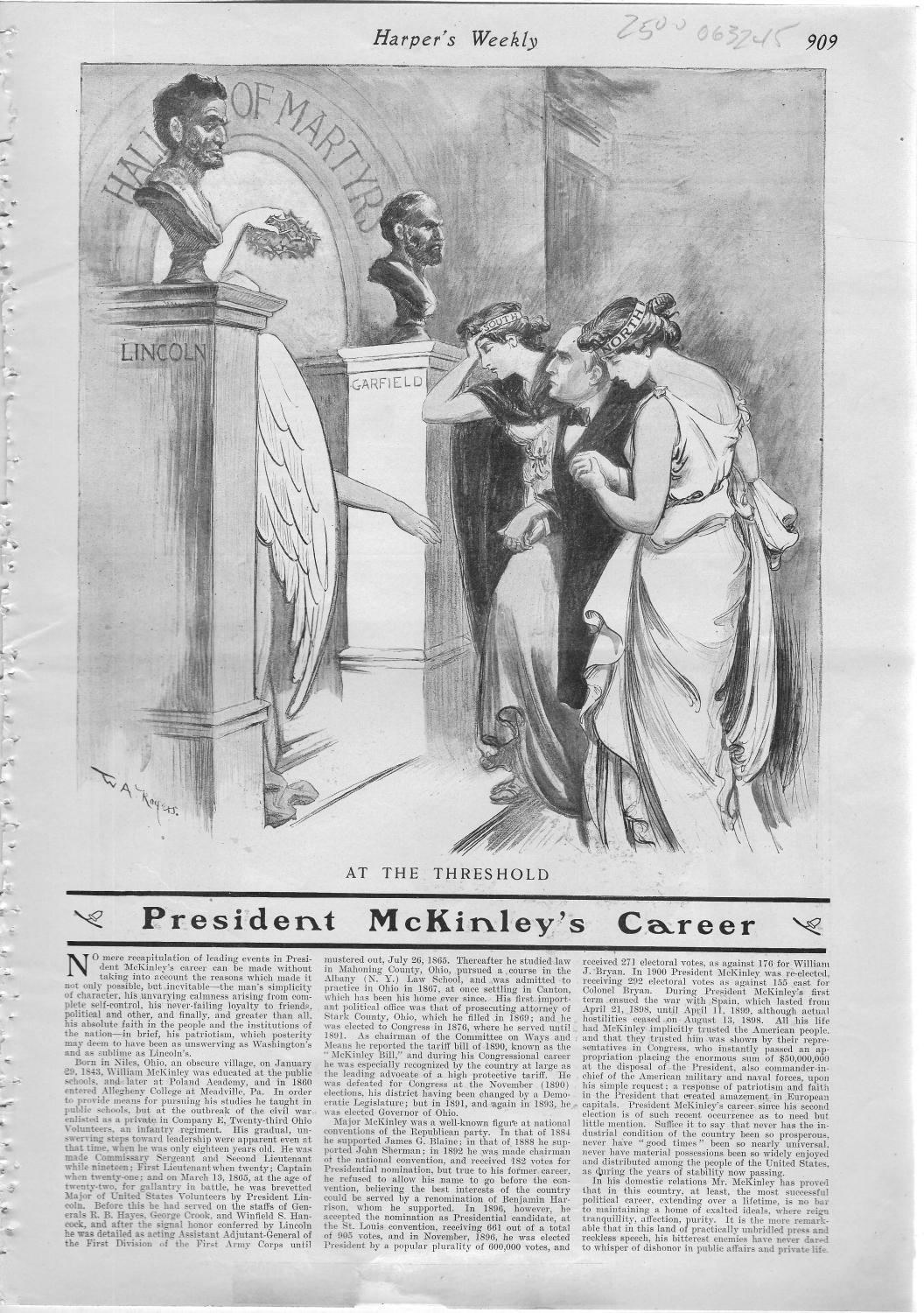
Image from Harper’s Magazine, September 14, 1901 -= McKinley “At the Threshold” of Martyrs’ Hall

Teachers should be mining the “On This Day” feature at the New York Times, which usually features an historic cartoon or illustration from an antique Harper’s Weekly. It is a favorite feature, to me.

Yesterday, it featured the illustration from Harper’s upon the death of President William McKinley, on September 14, 1901.

At the Threshold

Artist: William Allen Rogers

his post-dated cartoon was published as President William McKinley lay dying from an assassin’s bullet. He had been shot on September 6, 1901, by anarchist Leon Czolgosz (pronounced chol-gosh) at the Pan-American Exposition in Buffalo, New York. The president died on September 14. Here, McKinley is led to the Hall of Martyrs by grief-stricken personifications of the North and South. Between pillars topped by busts of the two previously slain presidents, Abraham Lincoln and James Garfield, the angel of death prepares to place a laurel wreath of honor upon McKinley’s head. (Images related to Garfield’s assassination also showed a reconciled North and South.)

There is much more at the Times site.

Robert Lincoln, the son of Abraham Lincoln, was present when McKinley was shot. Accounts I have read but not confirmed say that Robert Lincoln had been invited to attend Ford’s Theatre with his father and mother, the night his father was shot. As a member of President James Garfield’s cabinet, Robert Lincoln had been awaiting Garfield’s arrival at Union Station in Washington, D.C., when Garfield was shot.

And as a visitor in Buffalo, Robert Lincoln had as a matter of respect lined up to shake President William McKinley’s hand.

Astounding if true. Four U.S. presidents have been assassinated. Robert Lincoln was close to the first, the assassination of his father, and present for the next two. Where can we confirm that story?

McKinley’s death catapulted the do-gooder, Theodore Roosevelt, into the presidency, probably to the great chagrin of corrupt Republican politicians who had hoped that by getting him nominated to the vice presidency they could get him out of New York politics.

The rest is history.

(This is an encore post.)

Image is available for purchase at AbeBooks.


Free copy of the U.S. Statistical Abstract

September 13, 2011

Government, economics and U.S. history teachers:

You may get a free copy of the 2011 U.S. Statistical Abstract, on CD.

Available January 2011

On the CD-ROM version are Excel spreadsheet files for each of the individual tables.

In many cases the files contain more detailed information than is found in the book. Also, in some cases the Excel files contain more recent and revised data that were released by the source after publication of the printed version of the Abstract. You will also find the same Adobe Acrobat files for each section which you find on this web site.

Additional information
While supplies last, single copy FREE (one per customer) by calling Customer Services at 1-800-923-8282.


September 11 – fly your flag today, half-staff if you can

September 11, 2011

Americans are urged to fly flags today, at half-staff, in honor of patriots and those who died in the attacks on the U.S. on September 11, 2001.

According to Cornell University’s Legal Information Institute, the law says:

TITLE 36 > Subtitle I > Part A > CHAPTER 1> § 144

§ 144. Patriot Day

How Current is This?

(a) Designation.— September 11 is Patriot Day.

(b) Proclamation.— The President is requested to issue each year a proclamation calling on—
(1) State and local governments and the people of the United States to observe Patriot Day with appropriate programs and activities;

(2) all departments, agencies, and instrumentalities of the United States and interested organizations and individuals to display the flag of the United States at halfstaff on Patriot Day in honor of the individuals who lost their lives as a result of the terrorist attacks against the United States that occurred on September 11, 2001; and

(3) the people of the United States to observe a moment of silence on Patriot Day in honor of the individuals who lost their lives as a result of the terrorist attacks against the United States that occurred on September 11, 2001.

Patriot Day formerly occurred earlier in the year; information on flag flying has not been added to the Flag Code portions of U.S. law, and consequently this news gets missed.

Fly your flag today, at half-staff. Remember when flying a flag at half-staff, it is first raised to full staff, then slowly lowered to the half-staff position. When the flag is retired at the end of the day, it should again be crisply raised to the full-staff position before being lowered.

A flag attached to a pole that does not allow a half-staff position should be posted as usual.

A National Day of Service

Also, September 11 is also designated as a national day of service, under the Edward M. Kennedy Serve America Act, Public Law 111-13 (April 21, 2009). The Corporation for National and Community Service is charged with encouraging appropriate service in honor of the day and in honor of those who died.

National Day of Service and Remembrance

Date(s): September 11, 2010

Location: National

Event URL: http://911day.org/

Description
On April 21, 2009, President Barack Obama signed legislation that for the first time officially established September 11 as a federally recognized National Day of Service and Remembrance.

By pledging to volunteer, perform good deeds, or engage in other forms of charitable service during the week of 9/11, you and your organization will help rekindle the remarkable spirit of unity, service and compassion shared by so many in the immediate aftermath of the attacks. And you’ll help create a fitting, enduring and historic legacy in the name of those lost and injured on 9/11, and in tribute to the 9/11 first responders, rescue and recovery workers, and volunteers, and our brave military personnel who continue to serve to this day.

Check in your own community to find opportunities for service projects.


Channeling Monty Python: “The border between India and Pakistan is closed for the day”

September 7, 2011

BBC map showing location of Wagah and Punjab

BBC map showing location of Wagah and Punjab, divided between Pakistan and India, south of Kashmir

Written accounts cannot possibly do justice to the ceremonies that mark the daily close of business at the border between India and Pakistan.  I had understood it was quite a good show, rivaling the changing of the guard at Buckingham Palace.

But, you don’t expect Monty Python to break out at these affairs, do you? Here’s a video of the ceremony as it was conducted prior to July 2010, I believe, which I found at Wimp.com.  It’s a video clip from BBC Worldwide, narrated by comedian Sanjeev Bhaskar.

Vodpod videos no longer available.

(If that one doesn’t work, try this one — a bit lower quality video):

(Or, here’s a shorter, YouTube version of Baskar’s film.)

Where in the world is this?  It’s in a town and area called Wagah, in Punjab, divided between India and Pakistan since the 1947 independence of those nations (links to Wikipedia left in for your convenience).

Wagah (Punjabi: ਵਾਘਾ, Hindi: वाघा, Urdu: واہگہ) is the only road border crossing between India and Pakistan[1], and lies on the Grand Trunk Road between the cities of Amritsar, India and Lahore, Pakistan. Wagah itself is a village through which the controversial Radcliffe Line was drawn. The village was divided by independence in 1947. Today, the eastern half of the village remains in the Republic of India while the western half is in Pakistan.

While both nations and local residents fully recognize the silliness, it also stands as a symbol of the deep divisions between the two nations.

The Wagah border, often called the “Berlin wall of Asia”,[2] is a ceremonial border on the India–Pakistan Border where each evening there is a retreat ceremony called ‘lowering of the flags’,[3] which has been held since 1959.[4] At that time there is an energetic parade by the Border Security Force (B.S.F) of India and the Pakistan Rangers soldiers. It may appear slightly aggressive and even hostile to foreigners but in fact the paraders are imitating the pride and anger of a Cockerel.[1][5][6] Troops of each country put on a show in their uniforms with their colorful turbans.[7] Border officials from the two countries sometimes walk over to the offices on the other side for day to day affairs. The happenings at this border post have been a barometer of the India-Pakistan relations over the years.[1]

Did someone say “Pythonesque?”

Here’s Michael Palin narrating another view of the ceremony for one of his BBC enterprises, Himalaya with Michael Palin:

Would you be surprised to hear that local people refer to this as “the dance of the roosters?”

Events at this crossing reflect some minor easing of tension between the two nations in the last decade, and in 2010 both nations announced they would tone down the retreat ceremonies. Surely some scholar has analyzed this retreat ceremony and its history, to determine whether it helped ease the tension, or increased the conflict between the two nations.  Could soldiers who participate in such goings-on actually shoot at each other?

Has anyone got a more recent viewing of the ceremony?

How will you explain this to your sophomore world history class?  Is there anything sillier than humans in conflict?

Video via VodPod.

An astonished tip of the old scrub brush to Judith Shields.

More: