Once the Senate opposition to making Juneteenth a federal holiday, the bill moved rapidly through the Senate where it was approved on unanimous consent, and the House of Representatives, where it passed overwhelmingly, with 14 nay votes out of 335 Members.
President Joe Biden signed it into law today, on June 17. Can the federal government move fast enough to actually honor the holiday this year?
This new law inserts Juneteenth in the law governing when flags should be flown for holidays and commemorations — so we might assume without looking too much deeper, we should fly the U.S. flag on Friday, June 18, when the federal holiday is celebrated with a day off, and on Saturday, June 19, the actual date of Juneteenth.
Fly your flag Friday and Saturday, for Juneteenth, noting triumphs of freedom over slavery, accurate information over destructive propaganda, and a great advance in human rights for the world.
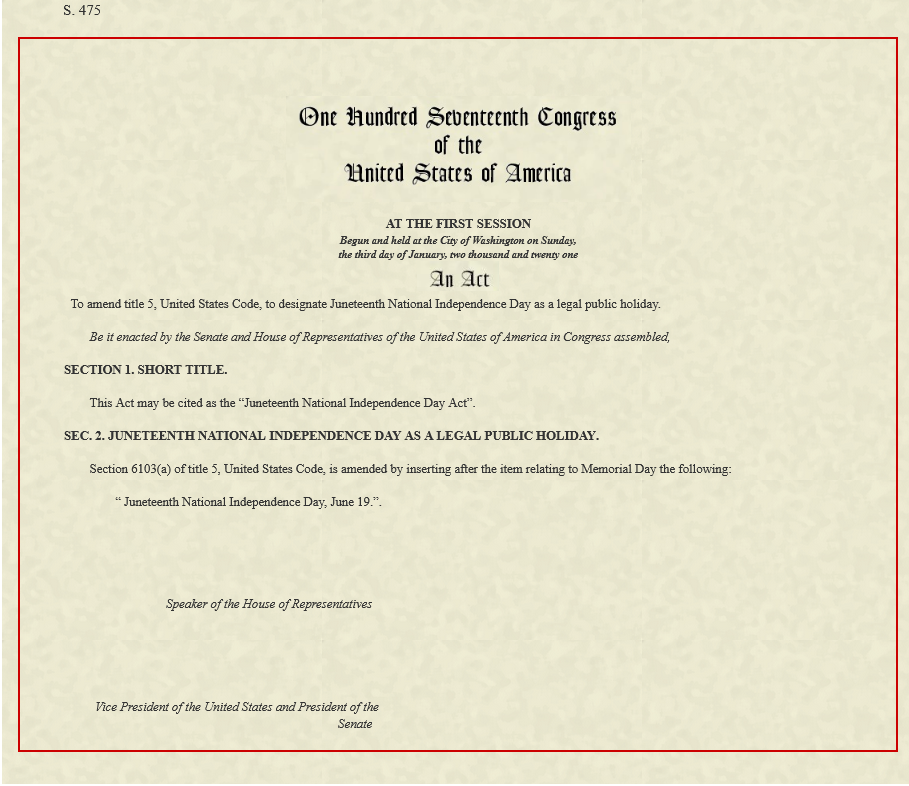
Text of the law making Juneteenth a federal holiday; enrolled version from the U.S. Senate.
Juneteenth, celebrated on June 19, is the name given to emancipation day by African-Americans in Texas. On that day in 1865 Union Major General Gordon Granger read General Order #3 to the people of Galveston. General Order #3 stated “The people of Texas are informed that, in accordance with a proclamation from the Executive of the United States, all slaves are free. This involves an absolute equality of personal rights and rights of property between former masters and slaves, and the connection heretofore existing between them becomes that between employer and hired labor. The freedmen are advised to remain quietly at their present homes and work for wages. They are informed that they will not be allowed to collect at military posts and that they will not be supported in idleness either there or elsewhere.”
Large celebrations on June 19 began in 1866 and continued regularly into the early 20th century. The African-Americans treated this day like the Fourth of July and the celebrations contained similar events. In the early days, the celebration included a prayer service, speakers with inspirational messages, reading of the emancipation proclamation, stories from former slaves, food, red soda water, games, rodeos and dances.
The celebration of June 19 as emancipation day spread from Texas to the neighboring states of Louisiana, Arkansas and Oklahoma. It has also appeared in Alabama, Florida, and California as African-American Texans migrated.
In many parts of Texas, ex-slaves purchased land, or “emancipation grounds,” for the Juneteenth gathering. Examples include: Emancipation Park in Houston, purchased in 1872; what is now Booker T. Washington Park in Mexia; and Emancipation park in East Austin.
Celebration of Juneteenth declined during World War II but revived in 1950 at the Texas State Fair Grounds in Dallas. Interest and participation fell away during the late 1950’s and 1960’s as attention focused on expansion of freedom for African-Americans. In the 1970’s Juneteenth revived in some communities. For example, in Austin the Juneteenth celebration returned in 1976 after a 25 year hiatus. House Bill no.1016 passed in the 66th legislature, regular session, declared June 19, “Emancipation Day in Texas,” a legal state holiday effective January 1, 1980. Since that time, the celebration of Juneteenth continues across the state of Texas with parades, picnics and dancing.
Texas State Library Reference Services 3/95
Celebrations across Texas started last Saturday, and will continue for another three or four days, I gather. Thought it’s an official State of Texas holiday, few people take it off. So celebrations are scheduled when they can be.
Citations get lost on the internet. Not only do people send copies of e-mails to everyone on their list, not only is there spam beyond all measure, but good stuff gets stripped of attribution. Someone sends you a good poem, or a genuinely funny story — and if you want more of the same, you’re completely at sea about where to look. Author? That information got stripped away several forwardings earlier.
“Must be Lincoln, Einstein, or Jefferson,” some wag says, and the piece is misattributed ever after.
A fellow posted this interesting film on YouTube — The Civil War in Four Minutes. One second of the film equals one week of the war. It’s a fascinating pictorial map presentation, with a lot of information packed into 240 seconds.
Who did it? Are there others like it? How do we get the rights for classroom use?
YouTube can be likened to grave robbers who invade Egyptian royal tombs — they bring important material to light, but the context is lost, and perhaps the meaning.
Update, June 15, 2007: Every YouTube version of the video has been pulled — probably a copyright thing. In the interim, I’ve checked with the Abraham Lincoln Presidential Library and Museum to see if it is available. One person said there is discussion for making it available in the next two years. Ain’t that the way? Why not strike while the iron is hot and sell it now? Somebody, please wake me if it’s ever released.
Or, until that account is unsuspended by the forces supporting Donald Trump: Follow @FillmoreWhite, the account of the Millard Fillmore White House Library
We've been soaking in the Bathtub for several months, long enough that some of the links we've used have gone to the Great Internet in the Sky.
If you find a dead link, please leave a comment to that post, and tell us what link has expired.
Thanks!
Retired teacher of law, economics, history, AP government, psychology and science. Former speechwriter, press guy and legislative aide in U.S. Senate. Former Department of Education. Former airline real estate, telecom towers, Big 6 (that old!) consultant. Lab and field research in air pollution control.
My blog, Millard Fillmore's Bathtub, is a continuing experiment to test how to use blogs to improve and speed up learning processes for students, perhaps by making some of the courses actually interesting. It is a blog for teachers, to see if we can use blogs. It is for people interested in social studies and social studies education, to see if we can learn to get it right. It's a blog for science fans, to promote good science and good science policy. It's a blog for people interested in good government and how to achieve it.
BS in Mass Communication, University of Utah
Graduate study in Rhetoric and Speech Communication, University of Arizona
JD from the National Law Center, George Washington University
