The story is the thing; tell the story in history

July 15, 2007

Son James and I spent July 4 in Taos, New Mexico, where we were working with Habitat for Humanity building homes (a project of the youth group at the church we attend, First Christian Church (Disciples of Christ) of Duncanville, Texas). We took that day off, saw Transformers, looked at the sights in Taos, and drove to Eagle Nest Lake to see fireworks.

Lincoln reading to son, Tad; LOC photo

At some point through the week I was discussing with others the stories that make history memorable, in my view, and we discovered that few others on the trip knew the story of the deaths of both John Adams and Thomas Jefferson on July 4, 1826, the 50th anniversary of the signing of the Declaration of Independence. It’s a story that is generally glossed over in U.S. history texts, but one that I make room for in U.S. history courses. My experience is that once kids get the story, that these two great men from such radically different backgrounds became great friends, then in presidential politics, great enemies, and then were reconciled, and then died on the exactly the same day which commemorated the event that both made them famous and that they made famous, kids don’t forget the story.

The story of their friendship is powerful and can be accompanied by readings from their letters in their later life (DBQ opportunity, teachers!). Generally, the story gets told in response to a question from a student. If I do it well, there will be sniffles from the class when we get to the part about Jefferson’s near-coma, awakening to ask whether it is the 4th of July, and then dying, and Adams’ death a few hours later, saying in error that “Jefferson still survives” (which is good that some students choke up, because it always gets me).

The story offers several mnemonic opportunities: 1826, the 50th year after the Declaration (1776); the presidencies of Adams and Jefferson, following one another; the fact that Adams and Jefferson were on the committee to write the Declaration, and that Adams nominated Jefferson as the better writer; the order of the terms of the presidency; the bitter politics at the end of Washington’s presidency (kids get interested in conflict, and the founding seems more vital to them when the controversies rear up); the reverence for law; Adams’ and Jefferson’s service as foreign ambassadors; and so on.

Once I’d told the story, others got the point. The story illustrates Mark Twain’s point about how much more difficult it is to write fiction. Fiction must stick with possibilities, Twain noted, while reality isn’t so constrained. If you wrote a screenplay with two heroes like Adams and Jefferson, and then had them die on the same day within a few hours of each other, hundreds of miles apart, you’d be criticized for being unrealistic. But it happened in history. It’s a true story, better than any lipsticked version Parson Weems could ever invent.

Study of history should never be a drudging trudge to memorize dates. The stories are what count, they are the things people remember. The stories tell people why history is important, and what mistakes to avoid, to satisfy Santayana’s ghost.

Such stories, especially about the founding of America, make history come alive and, often, grab students by the throat and make it memorable for them.  History is Elementary carries a nice story with the same message, though using Washington’s surprise attack on the Hessians from Trenton.  Teachers in need of such stories might do well to pick up a copy of David McCullough’s 1776, or Joseph Ellis’s Founding Brothers.

What other stories are there?  Well, the story about the scar on James Madison’s nose, and how it led to the cementing of the American Revolution (James Monroe, by the way, also died on July 4 — but in 1831).  The story of Lincoln’s trip to New Orleans; the story of Teddy Roosevelt’s capture of Mike Finnegan and two other outlaws, in the Dakotas; the story of Calvin Coolidge’s son’s death; the story of Robert Lincoln’s brushes with presidential assassinations; the story of the Civil War beginning in one man’s back-40 acres, and ending in his parlor; the story as Stephen Ambrose tells it of three men pinned down on a beach in Normandy on D-Day, and deciding the best course of action was to move forward to win the war; American history is rife with bizarre coincidences and seemingly minor events that go on to have great consequences.

I love to hear the story, especially told well.  Well told stories help students learn and retain history, and, I’ll wager, they boost the scores on standardized tests.


Economist magazine goes free

July 12, 2007

Good news for economics teachers.

The venerable London-based magazine, The Economist, now provides content for the current issue, on-line, for free. After a time the content goes behind the proprietary wall, much like the New York Times. But for a week, at least, you can get the latest from this premium publication.

If you’re really into the magazine, you can sign up for the Economist screensaver, which will give you access to their compilation of economic statistics for the world, and quick access to the current issue.

The Economist, cover, July 12, 2007

I find the charts and articles each week provide a plethora of warm-up possibilities, project backup, or supplementary information to bring economics to life for students. It’s one of the more expensive magazines available, though, and I do wish they had significant discounts for educators or classroom use.


History Carnival catch up

July 11, 2007

How far behind am I on noting the Carnival of History?
History Carnival logo

Number 54 is at Historianess.

Number 53 is at American Presidents Blog.

History teachers, “off” for the summer, can use these assemblages for inspiration for lesson plans in world history, U.S. history, and state history courses, at a minimum. Serious readers will note deep themes suitable for summer consideration at the beach before we get back to the serious business of improving the world, in the fall, perhaps before Gen. Petraeus makes his report.

It’s summer. History is still serious.


DDT: The problems the WHO/Rachel Carson critics don’t want you to know

July 10, 2007

The merry bands of hoaxsters at “JunkScience.com” and the Competitive Enterprise Institute hope you think DDT is a well-targeted, perfect solution to get rid of malaria. They ignore the devastating effects DDT has on birds, bats and other mammals (including humans), beneficial insects and fish. They don’t care about the difficulties in treating malaria in hospitals, which would continue or grow worse were DDT to be sprayed willy-nilly across the malaria-endemic world.

Cover, War on Insects

Plus, CEI is well-funded and has been hammering away on spreading the hoaxes for several years. You may have to dig hard to find the facts, such as the fact that the inventors of DDT as insecticide warned against over-use exactly as did Rachel Carson, (see the Dove Docs archives), or that the death of beneficial insects and beneficial animals can cause disasters, too — or did CEI tell you that DDT can cause your roof to cave in, in Borneo, and that they had to parachute cats in to prevent an epidemic of typhus, caused by DDT?

Read the rest of this entry »


Put Ezra Pound in your classroom

July 5, 2007

This is very, very encouraging.

Ezra Pound in 1971, in Italy

Here’s what eSchool News says about the archive:

July 1, 2007—Thanks to an online audio archive developed by professors at the University of Pennsylvania, recordings of Ezra Pound or William Carlos Williams can take their places on students’ iPods alongside tunes from Better than Ezra or Carlos Santana. Recordings of these two poets’ works are now available free of charge through PennSound, which features about 200 writers and more than 10,000 recordings contributed by poets, fans, and scholars worldwide. The two-year-old site recently acquired rare readings by Pound, some previously unknown. Hearing any poet “makes the poems easier to move into, in some cases,” said Tree Swenson, director of the Academy of American Poets in New York. “Our ears are less logical than our eyes, somehow.” Pound in particular, she said, “is a perfect example of a poet whose tone and phrasing is so distinctive.” While many web sites stream poetry readings, they require an active internet connection. With PennSound, files are downloadable in MP3 format and can be played offline and on portable devices such as iPods, said Charles Bernstein, an English professor and the site’s co-director.

http://writing.upenn.edu/pennsound

Wow. Ezra Pound may not have a lot of usage in high school classes, but the PennSound site features a lot of commentary by highly-qualified students of literature, and poets. There are good readings of classics by good readers, where the authors were long-dead before audio recording was invented — such as John Richetti reading Pope and Swift.

I think the material is not perfectly catalogued. Go look around the site to see what you can find.

This is wonderfully promising.

And, if you’re looking for poetry read aloud, check out The Poetry Foundation, too:  PoetryFoundation.org.  That site features the complete text to one of my favorite poems from contemporary poets, “The Shirt,” by the late Jane Kenyon.  Her husband, the poet Donald Hall, provided a reading of it for NPR once upon a time (here’s another reading by Hall of the same poem) (Here’s more on Hall as the nation’s Poet Laureate).

Poets reading poetry is often wonderful — take twice daily, repeat for the rest of your life.


Maps of lost worlds: Caddoland

June 29, 2007

Caddoland collage, UT-Austin, Texas Beyond History (Click on thumbnail for a larger view of this Caddoland Collage)

Caddos, Anadarkoes, Tawaconies, Southern Delawares — so many Native American tribes disappear from U.S. history books, and from U.S. history. These histories should be better preserved and better taught.

Texas history texts mention the Caddo Tribe, but largely ignore what must have been a significant cultural empire, if not an empire that left large stone monuments. Teaching this material in Texas history classes frustrates me, and probably others. Student projects on the Caddos are frequently limited in what they cover, generally come up with the same three or four factoids and illustrations.

The Caddo Tribe lived in an area spanning five modern states, Louisiana, Texas, Arkansas, Oklahoma, and eventually Missouri. Here is an interactive map that offers more information and useful photos of Caddoland than I have found in any other source: The Caddo Map Tool.

Basic map of Caddoland

This is just an image of the tool — click on the image above and it will link to the actual site. One of the things that excites me about this map is its interactive features, especially the map that carries links to photos that show just what the local environment looks like.

Read the rest of this entry »


Resources for new teachers, change provocateurs

June 22, 2007

New teachers, especially teachers from alternative certification programs, have all sorts of stories about people who observe and supervise their training and work.

There is the guy whose district bought laptops for every high school student and insisted teachers use the computers daily, but whose principal refused to look at the on-line courses he had developed to meet the district’s guidelines (and whom the principal subsequently rated down for not having the lesson plans the principal refused to look at).  There is the drama coach whose supervisor complained the students shouldn’t have been out of school for the state competition, which they won.  There is the mathematician from the telecommunications industry whose supervisor didn’t know geometry, or algebra, or calculus, and insisted the teacher should be offering multiplication table timed quizzes to advanced math classes.  The guy whose principal thought history documentaries selected from the school’s libraries were just Hollywood movies, and therefore inappropriate for history classes.

More than enough horror stories to go around.

One teacher tells a few horror stories from his student teaching days, but tells us he went on to get his school’s distinguished alumnus award.  And so, he shares some of his best material, here:  Horace Mann Educated Financial Solutions, “Reach Every Child.”

Go make change.

Tip of the old scrub brush to Car Family, which is really the same guy.


In a world of electronics, why we still learn the map and compass

June 22, 2007

Why do we bother to teach map reading still, since “everyone” has a GPS?

Wholly apart from plotting the Sweet Tea Line, there is this: Batteries die. Wonderful post at the secret life of a teacher.

While you’re there, gander at his proposals for Alaska’s death-defying fishercrabmen, and a response, and a redirect. When I read it, I thought it had to be the result of a classroom exercise. What could your kids design, if you gave them a dangerous situation somewhere in the world affecting some culture, and asked them to come up with a solution?


Applied geography: The Sweet Tea Line

June 20, 2007

Here is a great exercise in applied geography: “The Sweet Tea Line” at Neatorama, with a link to Eight Over Five with a wonderful set of interactive maps — though, if you go to the Eight Over Five site, you don’t find any link to this particular map (can anyone explain?).

One of the maps of the Sweet Tea Line from 8 over 5 One of the maps from Eight Over Five, using data to determine the Sweet Tea Line.

What about regional variations in food, language, customs or commerce in your state? I remember discovering that “regular coffee” in western Massachusetts meant coffee with a lot of cream and sugar. Not so at Boston’s Logan Airport. Where is the line? What about the lines of where a soft drink is “a pop,” versus “a soda pop,” versus “a coke,” versus “a soda?” Read the rest of this entry »


Applied history: Rescuing DaVinci

June 14, 2007

Ran into a website from a Dallas guy who is a practicing historian of a sort. A former oil man, he is involved in preserving and telling the story of the guys who rescued priceless works of art from the Nazis, the Monuments Men.

Monuments men, four survivors in D.C. to be honored

Robert Edsel’s blog is here; the site for his book, Rescuing DaVinci, is here.

Dallas-area world history and U.S. history teachers — have you called this guy to see if he’ll come visit your school?

  • Edsel’s caption for this photo: “Monuments Men Bernard Taper, James Reeds, Harry Ettlinger, and Horace Apgar being formally recognized for their efforts during World War II” [in Washington, D.C., on June 6, 2007]

Text of Mr. Edsel’s remarks below the fold.

Read the rest of this entry »


Typewriter of the moment: Jack Kerouac

June 6, 2007

Jack Kerouac's typewriter, in Lowell, MA - Beat Museum on Wheels

Jack Kerouac’s typewriter, on display in Lowell, Massachusetts. Kerouac attended Lowell High School, and Lowell hosts an annual festival to Kerouac. Photo from the on-line photos of the Beat Museum on Wheels (image downloaded and linked on June 6, 2007)

Kerouac appears in almost all U.S. history texts for high schools, and is to cover the post-World War II poetry mentioned in the Texas Essential Knowledge and Skills (TEKS).

Poet and author Jack Kerouac was the “King of the Beats.” The Beats were a group of poets and authors who gave rise and verse to the “Beat Generation.” The word “beat” is short for “beatitude.” Not only do most high school kids struggle with this character from U.S. history — in what should be a very fun section — many high school teachers have only vague understanding of the whole Beat movement. Read the rest of this entry »


How it’s done right

June 1, 2007

If I need a lift, I go here. It’s how school should be — probably all the way through.

I don’t know the details of how or why this class is set up the way it is, but day after day they do things that other people use as textbook examples of what a good classroom ought to be doing, sometimes. And they do it day, after day, after day.

Carnival of Education, are you paying attention?

Wow.

I wager right now that these kids will be the top performers on the standardized tests for at least the next five years, in their classrooms and schools. The Living Classroom weblog is a valuable chronicle for how to provide quality education.

Somebody should step up with the money to track how these kids do, especially against their contemporaries. Alas, this is exactly the sort of information that will be lost, due to “lack of funding.” Fortunately, one of the women involved in the classroom made the chronicles, and shared them.

Side note: Looking at the photos, ask yourself, “Does our town offer these types of recreational facilities for use?” Washington has traditionally led the nation in setting aside land for public recreational use — this class has taken full advantage of being in a town that had the foresight to put up public art and public beaches, and other public parks and places. There is a lesson here for city planners, and for mayors and city councils who wonder how they might support their schools, run by other governmental entities.

Dandelion, class activitiy for The Living Classroom


Who is reporting from National History Day?

May 30, 2007

Are you planning to be at the National History Day festivities in Maryland, June 10 through 14?

Did any of your kids put an entry into the National History Day Contest?

It may not be a national spelling bee, but I hope it gets some news coverage. If nothing else, go check out the collections of lesson plans and resources that come out of this competition.


Playing with maps

May 30, 2007

Okay, geography teachers — you’ve got a whole summer to figure out how to make geography fun and the most rewarding class your kids will take next year.

By then, Delta and Dawn the whales will be out of the Sacramento River (heck, they’re probably under the Golden Gate as I write this), so this map from the Sacramento Bee won’t be anything of great interest.  I found it via Google Maps Mania, though — and that site promises to provide a barrage of wonderful and bizarre maps.  Surely there will be other maps.  How about this post about street views of major cities?  If you have a live internet connection and a projector, you can show this stuff in real time.

Or, if you’re studying global warming, you can use this map to show what disappears if the ocean rises 1 meter, or 14 meters (from the post, “50 Things You Can Do With Google Maps“) Especially if your city is near the ocean, you can have your kids print these maps out and write a story about what it’s like to watch the ocean take back the land they grew up with.  (I wish the map would allow one to drop the level of the ocean, too — a lot more what ifs, and a lot more opportunities to discuss things like the migration of humans to America 37,000 years ago . . .)

I really liked this one:  What’s on the other side of the world?  In my childhood, more than once we set out to dig a hole to China.  Of course, had we gone straight through the Earth, we’d probably have found the Indian Ocean.   It’s a silly application — just the sort of thing that gets a class talking about and playing with maps, looking at the globe, and making the associations that qualify as “critical thinking” at test time.

If you can’t make a warmup, discussion or project out of the materials you find at that site, you need a Margarita (if you’re in Texas; perhaps a beer if you’re in Ontario, Canada).

Go have fun.


Global warming effects: More nasty bugs

May 1, 2007

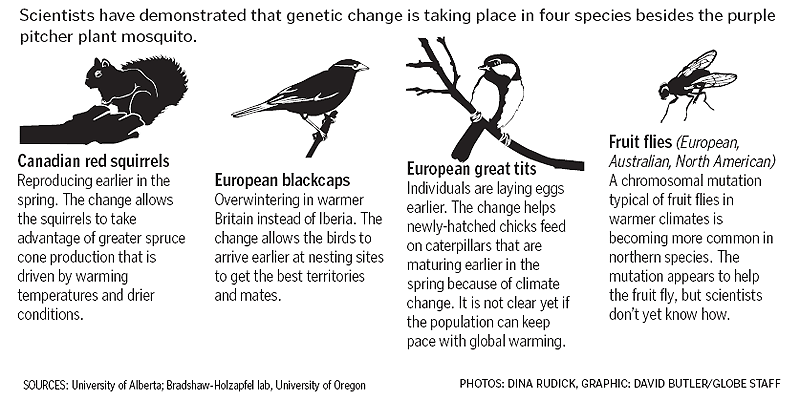
This news can fit into curricula in several ways, in several courses: Insects have already evolved in response to climate shifts due to global warming.

The Boston Globe has a series on global warming, and a recent article detailed how mosquitoes on the Maine frontier have already changed their breeding seasons in response to warming weather.

A mosquito that can barely fly is one of only five known species that scientists say have already evolved because of global warming. The unobtrusive mosquito’s story illustrates a sobering consequence of climate change: The species best suited to adapting may not be the ones people want to survive.

Such news enhances biology studies of genetics and insects, geography studies of climate, animal dispersal patterns and disease and pest ranges (a subject more technically known as biogeography), and the articles lend urgency to studies of how governments react to natural crises, a topic suitable for government classes, economics, and U.S. and world history.

Global Warming illustration Click on the thumbnail to see four examples of genetic change credited to global warming. (Graphic by David Butler of the Boston Globe staff.) Read the rest of this entry »