Quote of the moment: Edward Albee on democracies, and hope for the future

March 14, 2011

Playwright Edward Albee - Albee Foundation photo

Playwright Edward Albee - Albee Foundation photo

[On the slashing of arts education funding:] It’s especially discouraging when you live in a democracy where anything good is possible, if only we have the courage to deal with it.

— Edward Albee, playwright, Diane Rehm Show (WAMU-FM/NPR), March 14, 2011 (49:50 in)


Phillis Wheatley: Poem for Presidents Day

February 21, 2011

From the Poem-a-Day folks at the American Academy of Poets:

His Excellency General Washington
by Phillis Wheatley

George Washington

George Washington, as he appears on the one dollar bill.


Celestial choir! enthron’d in realms of light,
Columbia’s scenes of glorious toils I write.
While freedom’s cause her anxious breast alarms,
She flashes dreadful in refulgent arms.
See mother earth her offspring’s fate bemoan,
And nations gaze at scenes before unknown!
See the bright beams of heaven’s revolving light
Involved in sorrows and the veil of night!

The Goddess comes, she moves divinely fair,
Olive and laurel binds Her golden hair:
Wherever shines this native of the skies,
Unnumber’d charms and recent graces rise.

Muse! Bow propitious while my pen relates
How pour her armies through a thousand gates,
As when Eolus heaven’s fair face deforms,
Enwrapp’d in tempest and a night of storms;
Astonish’d ocean feels the wild uproar,
The refluent surges beat the sounding shore;
Or think as leaves in Autumn’s golden reign,
Such, and so many, moves the warrior’s train.
In bright array they seek the work of war,
Where high unfurl’d the ensign waves in air.
Shall I to Washington their praise recite?
Enough thou know’st them in the fields of fight.
Thee, first in peace and honors—we demand
The grace and glory of thy martial band.
Fam’d for thy valour, for thy virtues more,
Hear every tongue thy guardian aid implore!

One century scarce perform’d its destined round,
When Gallic powers Columbia’s fury found;
And so may you, whoever dares disgrace
The land of freedom’s heaven-defended race!
Fix’d are the eyes of nations on the scales,
For in their hopes Columbia’s arm prevails.
Anon Britannia droops the pensive head,
While round increase the rising hills of dead.
Ah! Cruel blindness to Columbia’s state!
Lament thy thirst of boundless power too late.

Proceed, great chief, with virtue on thy side,
Thy ev’ry action let the Goddess guide.
A crown, a mansion, and a throne that shine,
With gold unfading, WASHINGTON! Be thine.

American Poet Phyllis Wheatley, detail from the Boston Women's Memorial on Commonwealth Ave.

American Poet Phillis Wheatley, detail from the Boston Women’s Memorial on Commonwealth Ave.

Who was the inspiring woman, Phillis Wheatley? Read her biography at the Academy of American Poets site.

Phillis Wheatley was the first black poet in America to publish a book. She was born around 1753 in West Africa and brought to New England in 1761, where John Wheatley of Boston purchased her as a gift for his wife. Although they brought her into the household as a slave, the Wheatleys took a great interest in Phillis’s education. Many biographers have pointed to her precocity; Wheatley learned to read and write English by the age of nine, and she became familiar with Latin, Greek, the Bible, and selected classics at an early age. She began writing poetry at thirteen, modeling her work on the English poets of the time, particularly John Milton, Thomas Gray, and Alexander Pope. Her poem “On the Death of the Rev. Mr. George Whitefield” was published as a broadside in cities such as Boston, New York, and Philadelphia and garnered Wheatley national acclaim. This poem was also printed in London. Over the next few years, she would print a number of broadsides elegizing prominent English and colonial leaders.

More, at the AAP site.


Quote of the moment: Thoreau explains, this, too, is heaven

January 26, 2011

Walden Pond frozen over, Winter 2005 - Wikimedia image

Walden Pond frozen over, Winter 2005 - Wikimedia image by Bikeable

Every winter the liquid and trembling surface of the pond, which was so sensitive to every breath, and reflected every light and shadow, becomes solid to the depth of a foot or a foot and a half so that it will support the heaviest teams, and perchance the snow covers it to an equal depth, and it is not to be distinguished from any level field. Like the marmots in the surrounding hills, it closes its eyelids and becomes dormant for three months or more.  Standing on the snow-covered plain, as if in a pasture amid the hills, I cut my way first through a foot of snow, and then a foot of ice, and open a window under my feet, where, kneeling to drink, I look down into the quiet parlor of the fishes, pervaded by a softened light as through a window of ground glass, with its bright sanded floor the same as in summer; there a perennial waveless serenity reigns as in the amber twilight sky, corresponding to the cool and even temperament of the inhabitants. Heaven is under our feet as well as over our heads.

Henry David Thoreau, Walden, or Life in the Woods, “The Pond in Winter,” 1899, pp 296-297.

Thanks to Inward/Outward, a project of the Church of the Saviour community.

Special tip of the old scrub brush to Bill Longman, who sent me the e-mail today.


Poem-a-Day: William Cullen Bryant, “A Song for New Year’s Eve”

December 31, 2010

Poem-a-Day from the Academy of American Poets (you don’t subscribe?):

Poet William Cullen BryantCullen

Poet William Cullen BryantCullen

A Song for New Year’s Eve

by William Cullen Bryant

Stay yet, my friends, a moment stay—
Stay till the good old year,
So long companion of our way,
Shakes hands, and leaves us here.
Oh stay, oh stay,
One little hour, and then away.

The year, whose hopes were high and strong,
Has now no hopes to wake;
Yet one hour more of jest and song
For his familiar sake.
Oh stay, oh stay,
One mirthful hour, and then away.

The kindly year, his liberal hands
Have lavished all his store.
And shall we turn from where he stands,
Because he gives no more?
Oh stay, oh stay,
One grateful hour, and then away.

Days brightly came and calmly went,
While yet he was our guest;
How cheerfully the week was spent!
How sweet the seventh day’s rest!
Oh stay, oh stay,
One golden hour, and then away.

Dear friends were with us, some who sleep
Beneath the coffin-lid:
What pleasant memories we keep
Of all they said and did!
Oh stay, oh stay,
One tender hour, and then away.

Even while we sing, he smiles his last,
And leaves our sphere behind.
The good old year is with the past;
Oh be the new as kind!
Oh stay, oh stay,
One parting strain, and then away.

More:


Typewriter of the moment: William Saroyan

December 19, 2010

William Saroyan's typewriter, photo from the Bancroft Library, University of Caliornia - Berkeley

William Saroyan's typewriter, displayed at the Saroyan Museum at his home in San Francisco - photo from the Bancroft Library, University of California; Berkeley

William Saroyan’s niece, Jacqueline Kazarian, recently gifted the Bancroft Library with a significant part of the archives of Saroyan’s work.  The press release on the gift included a photo of Saroyan’s Fox typewriter, which is displayed at the Saroyan museum in San Francisco.

Saroyan came from an Armenian American family, born in Fresno, California in 1908.  His writings illuminated the experience of Californians and Armenian Americans, especially during the Great Depression.

In many ways Saroyan’s work symbolizes the uniqueness of the Armenian community in America, especially California.  [You still out there, Ben Davidian?]   Wikipedia strikes the right tone:

Saroyan’s stories celebrated optimism in the midst of the trials and tribulations of the Depression. Several of Saroyan’s works were drawn from his own experiences, although his approach to autobiographical fact contained a fair bit of poetic license.

His advice to a young writer was: “Try to learn to breathe deeply; really to taste food when you eat, and when you sleep really to sleep. Try as much as possible to be wholly alive with all your might, and when you laugh, laugh like hell.” Saroyan endeavored to create a prose style full of zest for life and seemingly impressionistic, that came to be called “Saroyanesque”.

The complete May 19, 2010,  press release from the University of California is below.

a sketch "from a Turkish admirer," a photo of the author in his youth, and a framed sketch of Saroyan

The Bancroft Library's new archival material on William Saroyan includes (left to right) a sketch "from a Turkish admirer," a photo of the author in his youth, and a framed drawing of Saroyan with a passage of his writing on Armenia. (Images courtesy of the Bancroft Library)

The Bancroft Library accepts gift of William Saroyan archives

By Kathleen Maclay, Media Relations | 19 May 2010

William Saroyan

William Saroyan (Photo courtesy of The Bancroft Library)

BERKELEY — The Bancroft Library at the University of California, Berkeley, has received a spectacular gift of hundreds of books, drawings, correspondence and other personal communications to and from one of America’s best-known writers, the Armenian-American author and playwright William Saroyan.

The rich collection includes approximately 48 cartons with 1,200 books and other archival materials assembled by his niece, Jacqueline Kazarian, of San Francisco, who also is the founder of the William Saroyan Literary Foundation International. A celebration of the gift is set for noon on Friday (May 21) at The Faculty Club on campus.

“UC Berkeley is such an incredible place of learning and growing and intellectual exploration,” said Kazarian, who earned degrees in communication and decorative arts at UC Berkeley in the early 1950s. “I know that my uncle wanted his library, manuscripts and galleys to go to Berkeley. Students will be inspired by the collection.”

Apart from this gift, The Bancroft Library already retains significant holdings of Saroyan’s work that it collected over the course of his life and career, and it continues to add to that collection. Most of the latest materials come from Saroyan’s home on San Francisco’s 15th Avenue that is now a Saroyan museum directed by Kazarian. Those materials were supplemented by Kazarian’s extensive personal collection, as well as by items of Saroyan’s that she acquired through a prominent Boston archivist and via a Saroyan friend.

“Jacqueline Kazarian’s new gift is the largest and most substantial augmentation to the Saroyan collections at Bancroft that we have ever received,” said Peter Hanff, Bancroft’s deputy director.

The author’s classic manual typewriter, as displayed at his San Francisco home

The author’s classic Fox manual typewriter, as displayed at his San Francisco home. (Photo courtesy of The Bancroft Library)

Saroyan, born in Fresno, Calif., in 1908, drew extensively on his Armenian-American heritage and childhood experiences for his books, plays and short stories. Much of his writing was considered impressionistic and reflected a hearty optimism often hard to find during the gritty Great Depression. He died in 1981 at the age of 72, with his niece at his side.When Story magazine editors Martha Foley and Whit Burnett printed Saroyan’s “The Daring Young Man on the Flying Trapeze” in 1934, it was an immediate success, triggering Saroyan’s fame and standing as one of his many literary achievements.

“Uncle Bill’s writing revolutionized the short story,” said Kazarian, adding that she has always found his work “almost spiritual and fable-like.”

His five-act play, “The Time of Your Life,” is the only American play to have won both the New York Drama Critics’ Circle Award and the Pulitzer Prize. Saroyan’s work as a screenwriter with Hollywood director Louis B. Mayer on the film “The Human Comedy” won an Academy Award in 1943, and Saroyan later wrote a widely acclaimed book with the same title.

Kazarian’s gift to The Bancroft Library includes multiple first editions of Saroyan’s works, such as “The Daring Young Man on the Flying Trapeze,” “My Name is Aram” (1940), “The Human Comedy” and “Obituaries” (1979), and many materials personally inscribed by the writer. Also among the new items according to Steven Black, the head of acquisitions for Bancroft, are letters, telegrams and notes written by Saroyan to relatives and others close to him, mostly during the 1930s and 1940s.

antiquarian book dealer Peter Howard of Berkeley, shown here poring through Saroyan materials

Antiquarian book dealer Peter Howard of Berkeley, poring through Saroyan materials. (Photo courtesy of The Bancroft Library)

“He personalized a lot of what passed through his hands,” Black said, noting that much of the material features marginalia reflecting Saroyan’s thoughts and interests.

There also is a copy of Henry Miller’s “Aller Retour New York,” an 80-page journal about a 1935 visit by Miller to New York City and his journey aboard a Dutch ship back to Europe. It is inscribed by Miller to Saroyan.

And a Saroyan scrapbook in the collection contains press announcements about the Pulitzer Prize for his book, “The Time of Your Life.” He scoffed at the award, contending that the arts should not be judged by commerce.

The new Bancroft collection also contains a pre-publication proof of “Burnt Norton,” the first poem of T.S. Eliot’s “Four Quartets,” which Black said the publisher may have given to Saroyan “when he crossed the pond” on a trip from his temporary home in France to England.

There also is a wide range of magazines, including issues of Horizon and the Partisan Review, a leading publication of the Anglo-American intelligentsia during the 1930s and ’40s, Black said.

The first major deposit at The Bancroft Library of Saroyan’s papers was recorded in October 1980, and the library agreed to organize the collection and give Saroyan a general description and an index. After Saroyan died in 1981, the Saroyan Foundation paid the library to continue assembling the papers for official archives, which the foundation ultimately decided to place at Stanford University. That happened in 1996.

William Saroyan's niece, Jacqueline Kazarian, surveys materials at his San Francisco home

William Saroyan's niece, Jacqueline Kazarian, surveys materials in his home. (Photo courtesy of The Bancroft Library)

Kazarian’s donation is in honor of Berkeley antiquarian book dealer Peter Howard, who has provided appraisal assistance to Bancroft on Saroyan materials and other collections for decades. While director of The Bancroft Library, the late James D. Hart also developed strong professional and personal ties to Saroyan over the years, according to Kazarian and Black.

“Now, the Saroyan family materials come to a place that Saroyan himself would have been happy to see accepting them,” Black said, noting that Bancroft is proud to have so much of Saroyan’s “intellectual remains” to be able to share with the public.

Scheduled to speak about the acquisition at Friday’s event are Jacqueline Kazarian; David Calonne, vice president of education for the Saroyan Literary Foundation International and a Saroyan scholar; San Francisco novelist Herbert Gold; theater director Val Hendrickson reading Saroyan’s short story, “Common Prayer,” and the credo to “The Time of Your Life”; and Charles Faulhaber, director of The Bancroft Library.

UC Berkeley already is home to an Armenian Studies Program, which is focused on contemporary Armenian history, politics, language and culture. And Bancroft, a rich, special collections library containing historical and literary documents and other materials relating to California, the West, Mexico and Latin America, is known for its strong collections on California writers, including Jack London, Robinson Jeffers, Bret Harte, Frank Norris and others.

More information about The Bancroft Library is online. Bancroft is celebrating its 150th anniversary this year.

More:

William Saroyan commemorative stamps from the U.S., and U.S.S.R.

On commemorative stamps issued in both the U.S. and the U.S.S.R., Saroyan wears the Armenian-style moustache he wore through most of his later life. For a stamp to honor a man in both the U.S. and the Soviet Union was extremely rare -- maybe unique.


Typewriter of the moment: Harlan Ellison and his Olympia SG3

December 12, 2010

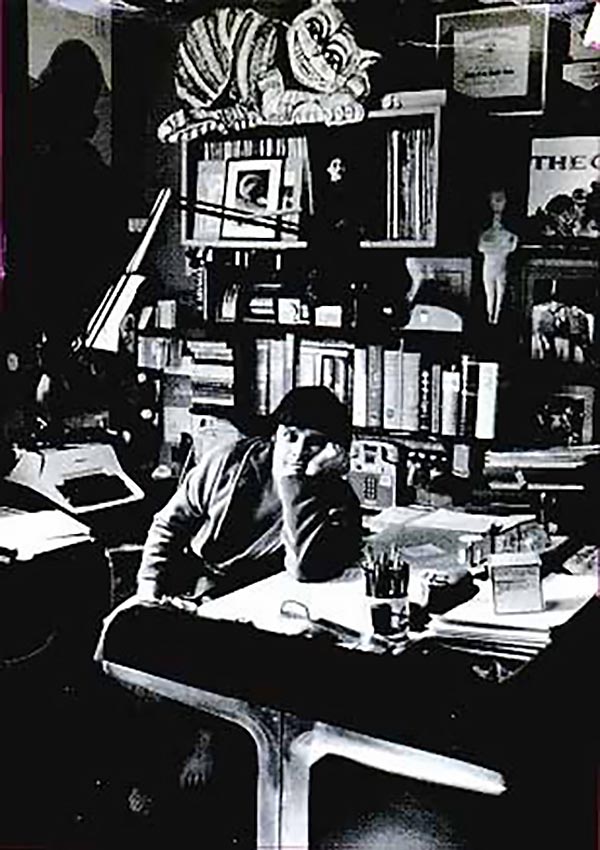
Harlan Ellison, his Olympia SG3, and other stuff - photo credit to MAX KATZ and KAREN FRIEDRICH
Harlan Ellison and his typewriter.  According to Richard Polt, the machine pictured is probably the Olympia SG3. Photo credit to Max Katz and Karen Friedrich.

Writers and their tools, in their workspaces.  We could probably date this photo by the stuff in Ellison’s office — the Cheshire Cat cutout?  Wasn’t that from an Edward Gorey-illustrated version of the Alice in Wonderland story?  What year was that?  The telephone on the wall, the desk scissors design . . . none of those fall into any expertise I have.  Someone else will have to date it.  My TinEye search didn’t shed any useful light.

I found the photo at Richard Polt’s fun site at Xavier University, The Classic Typewriter Page.  Polt is clearly working toward a MacArthur Foundation genius grant with this material.  Well, he would be, were I a judge.  (Who should get credit for the photo?  I don’t know — can you help identify who gets credit? See comment from Mr. Ellison:  ” . . .  image was captured for my 1974 STORY collection, APPROACHING OBLIVION, by MAX KATZ and KAREN FRIEDRICH.”  Credit for the photo gleefully acknowledged here.)

Oh, by the way, stay tuned:  Ellison is trying to sell his first typewriter.  That is a topic worthy of its own post.

Tip of the old scrub brush to the unfortunately moribund The Wit of the Staircase.


Whiskey and Cigar Day, 2010: Mark Twain and Winston Churchill

November 30, 2010

Mark Twain, afloat

November 30 is the birthday of Mark Twain (1835), and Winston Churchill (1874).

Twain had a comment on the Texas Education Agency and State Board of Education:

In the first place God made idiots. This was for practice. Then He made School Boards.

– Following the Equator; Pudd’nhead Wilson’s New Calendar

The Nobel literature committees were slow; Twain did not win a Nobel in Literature; he died in 1910. Churchill did win, in 1953.

Both men were aficionados of good whiskey and good cigars. Both men suffered from depression in old age.

Both men made a living writing, early in their careers as newspaper correspondents. One waged wars of a kind the other campaigned against. Both were sustained by their hope for the human race, against overwhelming evidence that such hope was sadly misplaced.

churchill-time-cover-man-of-the-year-1941.jpg

Both endured fantastic failures that would have killed other people, and both rebounded.

Each possessed a great facility with words, and wit, and frequently said or wrote things that people like to remember and repeat again.

Both of them rank near the top of the list of people to whom almost any quote will be attributed if the quote is witty and the speaker can’t remember, or doesn’t know, who actually said it.

Both men are worth study.  And wouldn’t you really love to have had them over to dinner?

Twain, on prisons versus education:

Every time you stop a school, you will have to build a jail. What you gain at one end you lose at the other. It’s like feeding a dog on his own tail. It won’t fatten the dog.” – Speech, November 23, 1900

Churchill on the evil men and nations do:

“No One Would Do Such Things”

“So now the Admiralty wireless whispers through the ether to the tall masts of ships, and captains pace their decks absorbed in thought. It is nothing. It is less than nothing. It is too foolish, too fantastic to be thought of in the twentieth century. Or is it fire and murder leaping out of the darkness at our throats, torpedoes ripping the bellies of half-awakened ships, a sunrise on a vanished naval supremacy, and an island well-guarded hitherto, at last defenceless? No, it is nothing. No one would do such things. Civilization has climbed above such perils. The interdependence of nations in trade and traffic, the sense of public law, the Hague Convention, Liberal principles, the Labour Party, high finance, Christian charity, common sense have rendered such nightmares impossible. Are you quite sure? It would be a pity to be wrong. Such a mistake could only be made once—once for all.”

—1923, recalling the possibility of war between France and Germany after the Agadir Crisis of 1911, in The World Crisis,vol. 1, 1911-1914, pp. 48-49.

Image of Twain aboard ship – origin unknown. Image of Winston S. Churchill, Time Magazine’s Man of the Year for 1941, copyright 1941 by Time Magazine.

More on Mark Twain

More on Winston Churchill

Orson Welles, with Dick Cavett, on Churchill, his wit, humor and grace (tip of the old scrub brush to the Churchill Centre):

Yeah, mostly this is an encore post from past years.


Quote of the moment: Lewis Carroll on Republican politics, climate skeptics, DDT advocates and creationism

October 26, 2010

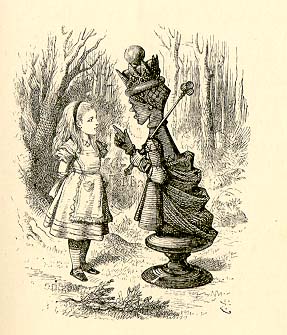
Alice and the Red Queen

Alice and the Red Queen – illustration by Sir John Tenniel

Alice laughed: “There’s no use trying,” she said; “one can’t believe impossible things.”

“I daresay you haven’t had much practice,” said the Queen. “When I was younger, I always did it for half an hour a day. Why, sometimes I’ve believed as many as six impossible things before breakfast.”

Charles Lutwidge Dodgson, writing under the name Lewis Carroll,
Alice in Wonderland, 1866

[Yes, the illustration is from Through the Looking Glass, 1871]


Quote of the moment: Hamilton, on taxes and the Constitution, Federalist #30

October 16, 2010

They claim to be constitutionalists, and they claim to want to uphold the U.S. Constitution.  But here’s an excerpt from Federalist #30, in which Alexander Hamilton explains why it is necessary for a federal government to tax, and sometimes to tax heavily.

Alexander Hamilton

Alexander Hamilton: "Money is, with propriety, considered as the vital principle of the body politic; as that which sustains its life and motion, and enables it to perform its most essential functions."

This is the U.S. Constitution and the “Founding Fathers” the Tea Partiers hope you will never see, and this is the Constitution and Founders they work hard to hide (some highlights added):

IT HAS been already observed that the federal government ought to possess the power of providing for the support of the national forces; in which proposition was intended to be included the expense of raising troops, of building and equipping fleets, and all other expenses in any wise connected with military arrangements and operations. But these are not the only objects to which the jurisdiction of the Union, in respect to revenue, must necessarily be empowered to extend. It must embrace a provision for the support of the national civil list; for the payment of the national debts contracted, or that may be contracted; and, in general, for all those matters which will call for disbursements out of the national treasury. The conclusion is, that there must be interwoven, in the frame of the government, a general power of taxation, in one shape or another.

Money is, with propriety, considered as the vital principle of the body politic; as that which sustains its life and motion, and enables it to perform its most essential functions. A complete power, therefore, to procure a regular and adequate supply of it, as far as the resources of the community will permit, may be regarded as an indispensable ingredient in every constitution. From a deficiency in this particular, one of two evils must ensue; either the people must be subjected to continual plunder, as a substitute for a more eligible mode of supplying the public wants, or the government must sink into a fatal atrophy, and, in a short course of time, perish.

In the Ottoman or Turkish empire, the sovereign, though in other respects absolute master of the lives and fortunes of his subjects, has no right to impose a new tax. The consequence is that he permits the bashaws or governors of provinces to pillage the people without mercy; and, in turn, squeezes out of them the sums of which he stands in need, to satisfy his own exigencies and those of the state. In America, from a like cause, the government of the Union has gradually dwindled into a state of decay, approaching nearly to annihilation. Who can doubt, that the happiness of the people in both countries would be promoted by competent authorities in the proper hands, to provide the revenues which the necessities of the public might require?

The present Confederation, feeble as it is intended to repose in the United States, an unlimited power of providing for the pecuniary wants of the Union. But proceeding upon an erroneous principle, it has been done in such a manner as entirely to have frustrated the intention. Congress, by the articles which compose that compact (as has already been stated), are authorized to ascertain and call for any sums of money necessary, in their judgment, to the service of the United States; and their requisitions, if conformable to the rule of apportionment, are in every constitutional sense obligatory upon the States. These have no right to question the propriety of the demand; no discretion beyond that of devising the ways and means of furnishing the sums demanded. But though this be strictly and truly the case; though the assumption of such a right would be an infringement of the articles of Union; though it may seldom or never have been avowedly claimed, yet in practice it has been constantly exercised, and would continue to be so, as long as the revenues of the Confederacy should remain dependent on the intermediate agency of its members. What the consequences of this system have been, is within the knowledge of every man the least conversant in our public affairs, and has been amply unfolded in different parts of these inquiries. It is this which has chiefly contributed to reduce us to a situation, which affords ample cause both of mortification to ourselves, and of triumph to our enemies.

What remedy can there be for this situation, but in a change of the system which has produced it in a change of the fallacious and delusive system of quotas and requisitions? What substitute can there be imagined for this ignis fatuus in finance, but that of permitting the national government to raise its own revenues by the ordinary methods of taxation authorized in every well-ordered constitution of civil government? Ingenious men may declaim with plausibility on any subject; but no human ingenuity can point out any other expedient to rescue us from the inconveniences and embarrassments naturally resulting from defective supplies of the public treasury.

More

IT HAS been already observed that the federal government ought to possess the power of providing for the support of the national forces; in which proposition was intended to be included the expense of raising troops, of building and equipping fleets, and all other expenses in any wise connected with military arrangements and operations. But these are not the only objects to which the jurisdiction of the Union, in respect to revenue, must necessarily be empowered to extend. It must embrace a provision for the support of the national civil list; for the payment of the national debts contracted, or that may be contracted; and, in general, for all those matters which will call for disbursements out of the national treasury. The conclusion is, that there must be interwoven, in the frame of the government, a general power of taxation, in one shape or another.Money is, with propriety, considered as the vital principle of the body politic; as that which sustains its life and motion, and enables it to perform its most essential functions. A complete power, therefore, to procure a regular and adequate supply of it, as far as the resources of the community will permit, may be regarded as an indispensable ingredient in every constitution. From a deficiency in this particular, one of two evils must ensue; either the people must be subjected to continual plunder, as a substitute for a more eligible mode of supplying the public wants, or the government must sink into a fatal atrophy, and, in a short course of time, perish.

In the Ottoman or Turkish empire, the sovereign, though in other respects absolute master of the lives and fortunes of his subjects, has no right to impose a new tax. The consequence is that he permits the bashaws or governors of provinces to pillage the people without mercy; and, in turn, squeezes out of them the sums of which he stands in need, to satisfy his own exigencies and those of the state. In America, from a like cause, the government of the Union has gradually dwindled into a state of decay, approaching nearly to annihilation. Who can doubt, that the happiness of the people in both countries would be promoted by competent authorities in the proper hands, to provide the revenues which the necessities of the public might require?

The present Confederation, feeble as it is intended to repose in the United States, an unlimited power of providing for the pecuniary wants of the Union. But proceeding upon an erroneous principle, it has been done in such a manner as entirely to have frustrated the intention. Congress, by the articles which compose that compact (as has already been stated), are authorized to ascertain and call for any sums of money necessary, in their judgment, to the service of the United States; and their requisitions, if conformable to the rule of apportionment, are in every constitutional sense obligatory upon the States. These have no right to question the propriety of the demand; no discretion beyond that of devising the ways and means of furnishing the sums demanded. But though this be strictly and truly the case; though the assumption of such a right would be an infringement of the articles of Union; though it may seldom or never have been avowedly claimed, yet in practice it has been constantly exercised, and would continue to be so, as long as the revenues of the Confederacy should remain dependent on the intermediate agency of its members. What the consequences of this system have been, is within the knowledge of every man the least conversant in our public affairs, and has been amply unfolded in different parts of these inquiries. It is this which has chiefly contributed to reduce us to a situation, which affords ample cause both of mortification to ourselves, and of triumph to our enemies.

What remedy can there be for this situation, but in a change of the system which has produced it in a change of the fallacious and delusive system of quotas and requisitions? What substitute can there be imagined for this ignis fatuus in finance, but that of permitting the national government to raise its own revenues by the ordinary methods of taxation authorized in every well-ordered constitution of civil government? Ingenious men may declaim with plausibility on any subject; but no human ingenuity can point out any other expedient to rescue us from the inconveniences and embarrassments naturally resulting from defective supplies of the public treasury.


Read a book for International Literacy Day, September 8

September 8, 2010

I almost never remember on time:  September 8 is International Literacy Day, a day designated by the United Nations to celebrate literacy.  International Literacy Day logo 2010

From the Dag Hammerskjöld Library:

Literacy is a cause for celebration since there are now close to four billion literate people in the world. However, literacy for all – children, youth and adults – is still an unaccomplished goal and an ever moving target. A combination of ambitious goals, insufficient and parallel efforts, inadequate resources and strategies, and continued underestimation of the magnitude and complexity of the task accounts for this unmet goal. Lessons learnt over recent decades show that meeting the goal of universal literacy calls not only for more effective efforts but also for renewed political will and for doing things differently at all levels – locally, nationally and internationally.

In its resolution A/RES/56/116, the General Assembly proclaimed the ten year period beginning 1 January 2003 the United Nations Literacy Decade. In resolution A/RES/57/166, the Assembly welcomed the International Plan of Action for the Decade and decided that Unesco should take a coordinating role in activities undertaken at the international level within the framework of the Decade.

Sources listed by the Dag Hammerskjöld Library:

Links to UN and UN System sites:

Unesco

United Nations

UNICEF

United Nations Development Programme

World Bank Group

Additional resources:

The additional resources links on this page are provided for information purposes only and do not necessarily represent an endorsement by the United Nations.

Asia-Pacific Literacy Database

Center for Literacy Studies

Commonwealth of Learning

Education International

International Reading Association
—   International Literacy Day

Literacy Online

Proliteracy Worldwide

SIL International – Literacy

StoryPlus Foundation

Even more resources:

It’s fascinating to me that activities on International Literacy Day seem to be noted in out-of-the-way U.S. newspapers, and even there not much.  Do Americans care about literacy, really?

I half expect the Texas State Board of Education to pass a resolution condeming literacy, since the UN worries about it.


Typewriter of the moment: Ayn Rand

July 15, 2010

Ayn Rand at her typewriter

Ayn Rand at her typewriter

Ayn Rand at her typewriter, in an undated photo (do you know the date?).

Contrary to a popular myth, Rand did not take her name from the typewriter.  From the website of the Ayn Rand Institute:

What is the origin of “Rand”?

[From ARI’s monthly newsletter Impact, 06/2000]
“Ayn Rand, born Alisa Rosenbaum, based her professional first name on a Finnish one [see above]. The source of her last name, however, has been a mystery.

“Although its origin is still uncertain, recent biographical research by Drs. Allan Gotthelf and Michael Berliner has eliminated one possible source. An oft-repeated story claims that Ayn Rand took her last name from her Remington Rand typewriter while she was living in Chicago in 1926. This is false and we would like to put the error to rest.

“While still in Russia, c. 1925, and long before Remington-Rand typewriters were produced, Alisa Rosenbaum had adopted the name ‘Rand.’ Letters written in 1926 from Ayn Rand’s family in Russia already refer to the name ‘Rand.’ These were sent from Russia before Ayn Rand had communicated from America. The Remington and Rand companies did not merge until 1927; ‘Rand’ did not appear on their (or any) typewriters until the early 1930s.

“One lead to the actual source of the name comes from Ayn Rand herself. In 1936, she told the New York Evening Post that ‘Rand is an abbreviation of my Russian surname.’ Originally, we thought that this was a red herring in order to protect her family from the Soviet authorities.

“In 1997 Dr. Berliner noted an interesting coincidence when looking at a copy of Miss Rand’s 1924 university diploma. On the diploma was the name Rosenbaum in the Cyrillic alphabet:

The last three letters clearly look like the Roman letters ‘ayn.’ Richard Ralston then noticed that by covering those letters—and dropping out the second and fourth letters—what remains bears a strong resemblance to the Roman letters ‘Rand.’

“Although far from certain, it appears that the quote in the New York Evening Post may not have been a decoy.”

Her most often used typewriter was a Remington, I’ve read (but can’t find a reference now that I need it).  So far as I have found, however, typewriters were always manufactured under the “Remington” marque, and never as “Remington-Rand.”  Contrary to the implications from the ARI, Remington typewriters were produced from Reconstruction times (circa 1870), originally by the Remington Arms company.  Typewriter manufacturing was spun off from the arms producer in 1886; that company merged with Rand, forming Remington-Rand in 1927.


Quote of the moment: William Faulkner, on the passing of the past

June 24, 2010

William Faulkner, with dogs

William Faulkner, with dogs

The past is never dead.  It’s not even past.

— William Faulkner’s character Gavin Stevens, Requiem for a Nun, 1951

Tip of the old scrub brush to Michael Sacasas at The Frailest Thing

See also:


Dan Valentine – Lorelei call of the epistolary

June 11, 2010

By Dan Valentine

Another in the “Dan Valentine – Where are you?” series

I took a couple of days off from writing a piece or three here to ponder what I’m doing. What am I writing? A one-man show, a musical, first draft of a novel or an autobiography, scribblings for therapy, etc. Gods knows! I now believe She does.

I’m writing an “epistolary”.

Theodore Von Holst Frontispiece to Mary Shelley, Frankenstein published by Colburn and Bentley, London 1831 - Tate Gallery image

Theodore Von Holst - Frontispiece to Mary Shelley, Frankenstein - published by Colburn and Bentley, London 1831 - Tate Gallery image

Wikipedia: … a piece written as a series of documents. Letters, diary entries, newspaper clippings.

Mary Shelley used the epistolary form for her novel “Frankenstein”.

Bram Stoker used the form for “Dracula”, and is compiled entirely of letters, diary entries, newspaper clippings, telegrams, ship’s logs and the like.

Frankenstein and Dracula. Both of ‘em horror stories. Both of ‘em epistolaries. (So, too, have the last year or so of my life, in large part. Sounds like a match made in heaven or hell.)

So, the answer is: I’m writing an epistolary. Pieces written for this website, comments from readers, e-mails, Facebook messages, lyrics, notes for novels, sit-coms, plays, etc. – hoping some day down the road it will all come together and make some sort of sense.

I’m calling it: “Dan Valentine–where are you?” (Don’t ask me how I came up with it, it just hit me in the middle of the night. It has a ring to it! And it says it all.

Thanks for the title, Ed.

My sister, Valerie, sent me a message through Facebook a few weeks ago. She wrote: “Danny, I know you like adventure but why Mexico?”

I “do” like an adventure! I’ve followed the call of the Lorelei most all my life.

Wikipedia: Lorelei is the name of one the beautiful Rhine maidens who, according to legend, sat upon a rock and lured sailors from passing ships to their doom with her alluring singing, much like the Sirens of ancient Greek myth.

I’ve been lured many times by her call.

As a result, all my cargo is strewn along the shores of a dump site outside Houston somewhere, seagulls peeking at a poem or two, I wrote, and giving his or her editorial comment with a plop of poop!

A few follow the Siren’s call. Most don’t. They have homes, careers, possessions, families, friends. But all, I’m sure, have heard her call … in the middle of the night; at a business conference; on the shore of a beach, sunning …

Why Mexico? ‘Cuz I don’t have the funds or fare to get myself to Katmandu!

COME WITH ME, SAID SHE
(c) 2010 Daniel Valentine

COME WITH ME, SAID SHE,
And we will stick decals on our suitcases
From enchanted lands and places,
Fabled and far-flung.

COME WITH ME, SAID SHE,
And we will barter with those selling vases,
Tapestries, silks, beads, and laces–
Tarry there among.

And, though, he wanted to,
Said he, I’ve crucial work to do–
Faxes, stacked, to sort and shuffle;
Packets, filled with things and stuff, ‘ll
Never get to if I come with you.

COME WITH ME, SAID SHE,
And we will climb steps to stone Buddha faces,
Mingle with the many races,
Glean the native tongue.

And, though, he wanted to,
Said he, I’ve vital work to do–
Post-it notes with folks to dial;
Piles of files, a mile high, ‘ll
Never get to if I come with you.

So, one day without compass,
GPS device, or chart,
With little but a carry-
On, her passport, and his heart–
And oh yes! That little black dress!–
She kissed him sweetly, waved goodbye.
He watched her plane depart.

Come to me, wrote she,
Upon a postcard of some isle oasis,
Signed: With love, with lipstick traces.
P.S.: While you’re young.

And, though, he wanted to,
Wrote he, I’ve urgent work to do–
Snakes in suits to slew in battle
For a corner office that ‘ll
Never sit in if I come to you.

Now, with that corner office
Overlooking Broad and Wall,
Though, happy and now married
With three kids, a dog, and all–
And oh yes! That Park Ave. address!–
He oftentimes, in dark of night,
Will hear the Siren call:

Come to me, says she,
To Katmandu where, just a few short paces,
Gurus chant in temple spaces,
Golden gongs are rung.

Come to me!
Come to me!
Come to me!
Come to me!

Sunset in Katmandu - RMI Guides photo

Sunset in Katmandu - RMI Guides photo


Typewriter of the moment: Wallace Stegner

June 4, 2010

Wallace Stegner and his typewriter - KUED image

Wallace Stegner and his typewriter – KUED image (via What Fresh Hell Is This?)

Wallace Stegner's books, KUED imageI’ve lived with Wallace Stegner’s work since I first got to the University of Utah.  Stegner was the biographer of Bernard DeVoto, whose works I read in a couple of different classes.

More important, Stegner wrote about the West and wild spaces and places, and how to save them — and why they should be saved.

Salt Lake City’s and the University of Utah’s KUED produced a program on Stegner in 2009 — he graduated from and taught at Utah — a film that wasn’t broadcast on KERA here in Dallas, so far as I can find..

In conjunction with the University of Utah, KUED is honoring alumni Wallace Stegner – the “Dean” of western writers. WALLACE STEGNER, a biographical film portrait, celebrates the 2009 centennial of his birth. Wallace Stegner was an acclaimed writer, conservationist, and teacher. He became one of America’s greatest writers. His books include the Pulitzer Prize-winning “Angle of Repose” and “Beyond the Hundredth Meridian.” His “The Wilderness Letter” became the conscience of the conservation movement. Wallace Stegner mentored a generation’s greatest writers including Ken Kesey, Edward Abbey, and Larry McMurtry. Former Supreme Court Justice Sandra Day O’Connor was a student.

It’s difficult to tell from the photo, but his typewriter here looks a lot like a Royal.

Have you seen the film?

More:


Towel Day 2010

May 25, 2010

After the train wreck in the Star Chamber of the Texas State Soviet of Education last week, I’m glad to have my towel.

How big a towel would it take to fix the McLeroy Massacre?

Remember the words of Douglas Adams, wherever he is:  “Don’t panic.”

More:

Towel Day display, 2010

Towel Day display, 2010 - from http://wxpython.org/blog/about-42/

So long!  And, thanks for the fish!