Concord Hymn, read by Bill Clinton

April 19, 2010

What came after Paul Revere’s ride?  The Battle of Lexington, and the Battle of Concord.

Longfellow’s poem, “Paul Revere’s Ride,” was written in 1860, 23 years after Emerson wrote “The Concord Hymn” for the dedication of the monument to the Minutemen at Concord Bridge.


Quote of the moment: Charles Darwin and the tangled bank

March 20, 2010

A tangled bank, near Sandwalk, Darwin's walking path near his home at Downe House - image by GrrlScientist

A tangled bank, near Sandwalk, Darwin’s walking path near his home at Downe House – image by GrrlScientist

The final paragraph of Darwin’s On the Origin of Species By Means of Natural Selection:

It is interesting to contemplate a tangled bank, clothed with many plants of many kinds, with birds singing on the bushes, with various insects flitting about, and with worms crawling through the damp earth, and to reflect that these elaborately constructed forms, so different from each other, and dependent upon each other in so complex a manner, have all been produced by laws acting around us. These laws, taken in the largest sense, being Growth with reproduction; Inheritance which is almost implied by reproduction; Variability from the indirect and direct action of the conditions of life, and from use and disuse; a Ratio of Increase so high as to lead to a Struggle for Life, and as a consequence to Natural Selection, entailing Divergence of Character and the Extinction of less improved forms. Thus, from the war of nature, from famine and death, the most exalted object which we are capable of conceiving, namely, the production of the higher animals, directly follows. There is grandeur in this view of life, with its several powers, having been originally breathed by the Creator into a few forms or into one; and that, whilst this planet has gone circling on according to the fixed law of gravity, from so simple a beginning endless forms most beautiful and most wonderful have been, and are being evolved.

More:


Hope in Texas: McLeroy voted off of state school board

March 3, 2010

Two earthquakes ravage American nations, tsunamis, freakishly large snowstorms, still trouble in Iraq and Afghanistan, Iran in turmoil and ruled by some sort of crazy, North Koreans still starve so the nation can make a nuclear sabre to rattle.

Good news?

Texas State Board of Education member Don McLeroy lost a primary election challenge to attorney Tom Ratliff, representing the area around Beaumont, Texas. The news is that McLeroy is out — notice that the Texas Tribune doesn’t name the winner until the seventh paragraph.

Another prominent, but much more reasonable Republican member of the SBOE also lost:  Geraldine “Tincy” Miller, in Dallas.  Miller was so expected to win that race that almost no one was watching, and little is in public about the winner of the race.

Election results from Tuesday’s primary election in Texas mean that the State Board of Education will change dramatically.  It would be almost impossible for any of the changes to be bad ones.  McLeroy led the anti-evolution force on the board.  McLeroy was the ringleader to gut and racialize English standards earlier, and he’s been the point man in the attempt to gut and de-secularize social studies standards.

Board member Cynthia Dunbar, another “social conservative,” did not run for re-election.

In the governor’s race, anti-education, anti-science Gov. Rick Perry won big over the state’s popular Republican U.S. Sen. Kay Hutchison. Third place in that race went to the Teabagger candidate.

No Teabagger won any race in Texas.

It’s not that Texas has suddenly gained reason.  The dissension on the SBOE, demonstrated by the Texas Senate’s rejection of McLeroy’s renomination to be chairman of the body, just got to be too much.  Texans like their crazies to be sane enough to get things done, and not so noisily crazy as to attract attention to the state’s shared insanity.

Sunlight cast on the actions of the board, especially by groups like the Texas Freedom Network, informed Texans.  And now the people of Texas have spoken.

More:

Add to FacebookAdd to NewsvineAdd to DiggAdd to Del.icio.usAdd to StumbleuponAdd to RedditAdd to BlinklistAdd to TwitterAdd to TechnoratiAdd to Furl


Quote of the moment: Martin Niemöller, “. . . I did not speak out . . .”

February 26, 2010

First they came for the communists, and I did not speak out—because I was not a communist;
Then they came for the trade unionists, and I did not speak out—because I was not a trade unionist;
Then they came for the Jews, and I did not speak out—because I was not a Jew;
Then they came for me—and there was no one left to speak out for me.

— Pastor Martin Niemöller

Martin Niemoller on a postage stamp, painted by Gerd Aretz in 1992 - Wikipedia

German theologian and Lutheran Pastor Martin Niemöller on a postage stamp, painted by Gerd Aretz in 1992 – Wikipedia

It’s spring, and school curricula turn to the Holocaust, in English, in world history, and in U.S. history.

Martin Niemöller’s poem registers powerfully for most people — often people do not remember exactly who said it.  I have seen it attributed to Deitrich Bonhoeffer (who worked with Niemöller in opposing some Nazi programs), Albert Einstein, Reinhold Niebuhr, Albert Schweitzer, Elie Wiesel, and an “anonymous inmate in a concentration camp.”

Niemöller and his actions generate controversy — did he ever act forcefully enough?  Did his actions atone for his earlier inactions?  Could anything ever atone for not having seen through Hitler and opposing Naziism from the start?  For those discussion reasons, I think it’s important to keep the poem attributed to Niemöller.  The facts of his life, his times, and his creation of this poem, go beyond anything anyone could make up.  The real story sheds light.

Resources:

Save

Save


Typewriter of the moment: L. Frank Baum, in 1899

February 7, 2010

L. Frank Baum, the author of The Wizard of Oz and other stories, at work at his typewriter in 1899, the year before his first Oz book was published.

L. Frank Baum at his typewriter in 1899

L. Frank Baum at his typewriter in 1899. Where?

Bonus: I found the photograph illustrating an essay by Kennesaw State University historian David B. Parker in the Bluegrass Express, a reprint of his 1994 article in The Journal of the Georgia Association of Historians, on the claim that The Wizard of Oz was written as a populist parable.

Every history teacher ought to read that article.

http://thebluegrassspecial.com/archive/2009/october2009/ozpoppycockoct09.php


Typewriter of the moment: Sylvia Plath

February 5, 2010

Sylvia Plath at her typewriter

Sylvia Plath, author and poet, at her typewriter - photographer unknown to me

Is it a Royal typewriter?  Why is it so many photos of people at typewriters show them outdoors — and will there be many pictures of authors at their computers, let alone at their computers outdoors?

Mystery solved?  Update December 30, 2011 — looking at the photo of Rob’s Hermes, in comments below, it sure looks to me that Plath’s machine is a Hermes.


Edith Wharton on Facebook: What a horrible thought!

January 3, 2010

Nancy Sharon Colllins, reporting after her recent work at the Harry Ransom Center at the University of Texas, including reading some original letters and other writings of Edith Wharton, wonders what would be the effect on history and literary studies, had Edith Wharton used Facebook instead of keeping her journal and writing copious numbers of letters.

And that got me thinking: What if Edith Wharton had Facebooked? Had she lived in our time and communicated digitally, I wonder what her literature would be like. Looking at five days of cursive writing and personal letters made me realize that her compulsion to jot down her thoughts was no different than ours today when we tweet about what we had for lunch or share some fab link we just discovered. The difference between a letter written longhand and a Facebook post is that one takes a little bit longer (and leaves a more lasting trace), but the purpose is the same. Whether we live on a grand, Whartonian scale or a quieter, more ordinary one, we feel more significant when we share intimacies about ourselves with others.

There’s a good warm-up and/or journaling exercise in there for literature teachers.


Chet Raymo on Rachel Carson

December 20, 2009

Sad fact:  More people read and believe as a matter of faith the sour, misanthropic and pro-obfuscation sites about Rachel Carson than read either Silent Spring or Linda Lear’s excellent biography of the woman.

Chet Raymo is reading Lear’s book, and has comments.  Fans of science writing will recognize Raymo’s name.

More:


Quote of the moment: Mark Twain, a majority of fools

December 7, 2009

Illustration from The Adventures of Huckleberry Finn, 1884 edition - the King, "Travelling by Rail" - Wikimedia

Illustration from The Adventures of Huckleberry Finn, 1884 edition - the King, "Travelling by Rail" - Wikimedia. (The "King" is being tarred, feathered, and "ridden out of town on a rail.")

Well, the king he talked him blind; so at last he give in, and said all right, but said he believed it was blamed foolishness to stay, and that doctor hanging over them.

But the king says: “Cuss the doctor! What do we k’yer for HIM? Hain’t we got all the fools in town on our side? And ain’t that a big enough majority in any town?”

Mark Twain, The Adventures of Huckleberry Finn, Chapter XXVI


Quote of the moment: Eric Blair (George Orwell) on lies becoming history

October 25, 2009

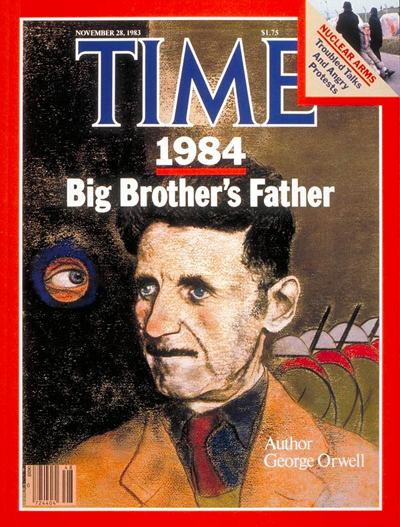
George Orwell (Eric Blair) on cover of Time Magazine, Novmber 28, 1983

George Orwell (Eric Blair) on cover of Time Magazine, Novmber 28, 1983

And if all others accepted the lie which the Party imposed—if all records told the same tale—then the lie passed into history and became truth. ‘Who controls the past’ ran the Party slogan, ‘controls the future: who controls the present controls the past.’

— George Orwell, 1984

Tip of the old scrub brush to Kate at The Urban Primate

If Big Brother is watching, why not let him watch all of us? Spread the word:

Add to FacebookAdd to NewsvineAdd to DiggAdd to Del.icio.usAdd to StumbleuponAdd to RedditAdd to BlinklistAdd to TwitterAdd to TechnoratiAdd to Furl


Ten typewriters of the moment

October 3, 2009

Stacy Conradt writes about ten authors and their typewriters, at Mental Floss.  Some we’ve seen here at the Bathtub, some we haven’t:  Steinbeck, Hemingway, Kerouac, David Sedaris, Mark Twain, John Updike, George Orwell, Hunter S. Thompson, David McCullough, P. J. O’Rourke.


Quote of the moment: Victor Hugo, telescope vs. microscope

September 23, 2009

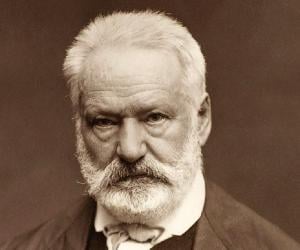
Victor Hugo

Victor Hugo

Where the telescope ends, the microscope begins. Which of the two has a grander view?

— Victor Hugo, Les Miserables, St. Denis, bk. III, ch. 3


Ideas are incombustible: Banned Books Week 2009

September 22, 2009

Banned Books Week 2009 is set for September 26 through October 3.

Which banned book will you read just to poke the eye of the censors, and to wave the flag of freedom and liberty?

Ellen Hopkins wrote several controversial books, including Burned which is out of favor in Pocatello, Idaho, close to my birthplace.*  She has written a Banned Books Week Manifesto, which she recites in the video.  You can read an interview with Ms. Hopkins at the site of the National Coalition Against Censorship (NCAC).

___________________

*  Does Millard Fillmore’s Bathtub have any readers in Pocatello?  Pocatello readers:  Do you know of anyplace you can get a copy of Burned to read, in Pocatello?

Banned Books Week resources:

Encourage others to read banned books, too:

Add to FacebookAdd to NewsvineAdd to DiggAdd to Del.icio.usAdd to StumbleuponAdd to RedditAdd to BlinklistAdd to TwitterAdd to TechnoratiAdd to Furl


2009 Poets Forum – October 15 – 17, in New York City

August 3, 2009

This sounds like fun, actually.  I wonder if they offer Continuing Education Units?

Shouldn’t schools make sure all English teachers get to make this pilgrimage at least once every four years?  Principals, are you listening?

Poets Forum Update:
New Events and More Participants Announced for 2009
Discounted passes available for a limited time at poets.org/poetsforum

Participants include Frank Bidart, Rita Dove, Lyn Hejinian,Edward Hirsch, Haryette Mullen, Sharon Olds, Ron Padgett, Carl Phillips, Robert Pinsky, Kay Ryan, Gerald Stern, Susan Stewart, Jean Valentine, Ellen Bryant Voigt, and many more.

The Academy of American Poets invites you to join us in New York City for the annual Poets Forum, a series of events exploring the landscape of contemporary poetry in America.

This year’s Poets Forum includes new talks and discussions with an array of distinguished poets, readings, publication parties, and an expanded selection of literary walking tours, led by poets, through Manhattan and Brooklyn.

“In only three years, the Poets Forum has become the poetry event of the fall, as poets (and fans of poetry) of all aesthetics celebrate and learn about what they all have in a common: a desire to give life itself a shape through language.”
– Carl Phillips

Poets Forum Reading
Thursday, October 15
7 p.m.
Join us for an unforgettable evening as some of the most acclaimed poets of our day come together on one stage to read from their latest work. Featured readers include Frank Bidart, Rita Dove, Lyn Hejinian, Edward Hirsch, Sharon Olds, Ron Padgett, Carl Phillips, Robert Pinsky, Kay Ryan, Gerald Stern, Susan Stewart, and Ellen Bryant Voigt.
The Times Center
242 West 41st Street

Poetry Walking Tours
Friday, October 16
10:30 a.m. & 2 p.m.
Take a trip down the same streets traversed by Walt Whitman, Marianne Moore, E. E. Cummings, Langston Hughes, George Oppen, and countless other poets. Walking tours will explore the literary history of Brooklyn, Harlem, the Museum of Modern Art, the West Village, and SoHo. Tour guides include poets Anselm Berrigan, Jordan Davis, Bob Holman, Katy Lederer, Greg Pardlo, Tom Thompson, and Mónica de la Torre.
Meeting locations throughout New York City.
TOURS ARE RESERVED FOR ALL-EVENTS PASS HOLDERS ONLY

NEW: Poets & Place Talk
Friday, October 16
2 p.m.
“Show Me Your Environment, and I Will Tell You Who You Are”:  Place, Pathos, and the Problems of Identity
David Baker discusses the relationship between poets and their environment.
Philoctetes Center
247 East 82nd Street
Co-sponsored by the Philoctetes Center
RESERVED FOR ALL-EVENTS PASS HOLDERS ONLY

Poets Awards Ceremony Friday, October 15 7 p.m. Celebrate contemporary poetry and recipients of the premier collection of awards for poetry in the United States. The night will include readings and presentations by Linda Gregg, Jennifer K. Sweeney, J. Michael Martinez, Harryette Mullen, James Richardson, Avi Sharon, Jean Valentine, and many others. A reception will follow.
Tishman Auditorium
The New School
66 West 12th Street
Co-sponsored by the New School Creative Writing Program

Poets Forum Discussions Saturday, October 17 10 a.m. – 4 p.m. 6 Sessions Examine the issues central to contemporary poetry as we present a day of engaging and intimate conversations with some of the most renowned poets of our time, including Frank Bidart, Rita Dove, Lyn Hejinian, Edward Hirsch, Harryette Mullen, Sharon Olds, Ron Padgett, Carl Phillips, Robert Pinsky, Kay Ryan, Gerald Stern, Susan Stewart, Jean Valentine, Ellen Bryant Voigt and other special guests.
Tishman Auditorium
The New School
66 West 12th Street
Co-sponsored by The New School Creative Writing Program

“This public forum on American Poetry is the first of its kind for our brave, wild world of poesy. We will leave no stone unturned to address all the voices and all the thoughts that beset, overwhelm, confuse, delight, and alarm us.”
– Gerald Stern

American Poet Publication Party
Saturday, October 17
7 p.m.
Reading and reception for the new fall issue of American Poet, the journal of the Academy of American Poets. Noelle Kocot, Robert Polito, and Brian Teare will read from their work. Ico Art and Music Gallery
606 West 26th Street (at 11th Avenue)
Co-sponsored by the Ico Gallery

Ticket Information
All-Events Pass: $85 before Sept 15 / $110 after
Saturday-Only Tickets: $60
Students (with current ID): Student rates are available by by phone.
Contact: Jennifer Kronovet, (212) 274-0343, ext.10.

Purchase tickets online at poets.org/poetsforum or by phone,(212) 274-0343, ext.10.

All times are subject to change. Contact Jennifer Kronovet at jkronovet@poets.org with further questions.
Academy of American Poets
584 Broadway, Suite 604
New York, NY 10012

212-274-0343


Typewriter of the moment: Hemingway’s, at Key West

June 18, 2009

The man wrote, wherever he was.

Hemingways typewriter at Key West, Florida - Stefan Möding, copyright

Hemingway's typewriter at Key West, Florida - Stefan Möding, copyright

Ernest Hemingway often wrote standing up at his typewriter.  Obviously, here in Key West, he wrote sitting down.  At every home, it appears, he had a typewriter.

In Key West, early on in an apartment near the Ford dealership, where they awaited the delivery of the Ford purchased for Hemingway and his wife Pauline, by Pauline’s Uncle Gus, Hemingway wrote most of A Farewell to Arms, published in 1929.

The house was purchased later.  I can’t tell — some say he used here a Royal Quiet DeLuxe.

Pauline and Hemingway divorced in 1939.

In Key West, visit the Ernest Hemingway Home and Museum.