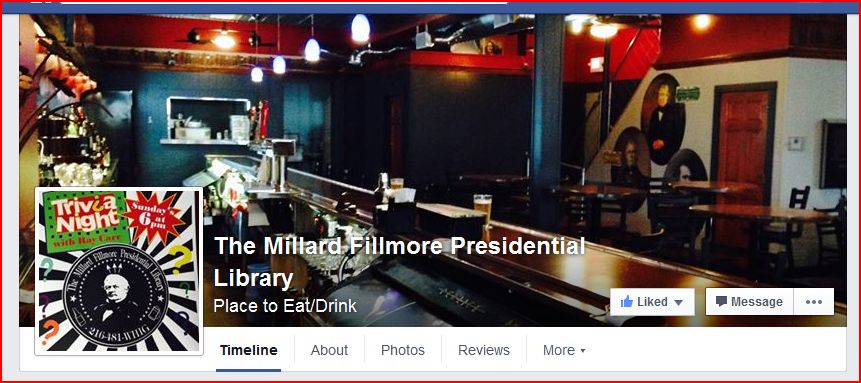
Any special activities at the Millard Fillmore Presidential Library for January 7?

January 7, 2016

The Ladies of Mount Vernon maintain George Washington’s home and a couple of farms, and now have an extensive center for teachers, in addition to an extensive library on Washington.

In Springfield, Illinois, a private foundation established the Abraham Lincoln Presidential Library and Museum.

Neither is part of the National Archives (NARA) presidential libraries programs. NARA operates libraries for Hoover, FDR, Truman, Eisenhower, Kennedy, Johnson, Nixon, Ford, Carter, Reagan, George H. W. Bush, Clinton, George Bush, and NARA will operate the Obama library from the start.

Other presidents are left out in the cold, mostly. There are informal facilities for Teddy Roosevelt, James Garfield, and Woodrow Wilson.

On Millard Fillmore’s birthday, January 7, I am happy to report there is a Millard Fillmore Presidential Library, too.

For some reason, it’s in Cleveland, Ohio.

Photo of the interior of the Millard Fillmore Presidential Library, in Cleveland, Ohio. Motto something like, "This ain't the LBJ Library."

Photo of the interior of the Millard Fillmore Presidential Library, in Cleveland, Ohio. From Facebook page. Motto something like, “This ain’t the LBJ Library.”

A promising place for scholarship on our 13th president, perhaps. Photos of Fillmore, previously unknown, have been published by this establishment.

The new Millard Fillmore Presidential Library casts new light on the 13th president's talents and methods of relaxation.

The new Millard Fillmore Presidential Library casts new light on the 13th president’s talents and methods of relaxation.

Finally, a place to properly celebrate Millard Fillmore’s 216th birthday anniversary, today!


1943 War Department film, “Welcome to Britain”

February 8, 2014

Reader and veteran librarian Judy Crook sent a Tweet alerting us to a recent release from the U.S. National Archives, “A Welcome to Britain, 1943.”

It’s a fascinating little film, if 38 minutes is still “little.”

Yes, that’s Burgess Meredith playing the soldier. I haven’t confirmed whether he was actually enlisted, but he often played soldiers or people at war — in 1945, playing war reporter Ernie Pyle, for example. In the 1950s, the House Committee on Unamerican Activities (HUAC) claimed Meredith had consorted too closely with communists, and he was blacklisted for years including a seven-year drought of work.

When this film was made, the Soviet Union was an ally of Britain and the United States.  How times change.

This is a training film made by the War Department (later renamed “Defense Department”), to acquaint U.S. soldiers with what they would confront in Britain.  Why did soldiers need such training?  You can guess, perhaps.   258

Teachers, can you use this film in history class?  Is the discussion on civil rights, about 20 minutes at 25:30 in, instructive in the history of the time?

From the National Archives’s description on YouTube:

Published on Feb 5, 2014

Creator(s): Department of Defense.~. Armed Forces Radio and Television Service. (1954 – ) (Most Recent)

Series : Information and Education Films, compiled 1943 – 1969
Record Group 330: Records of the Office of the Secretary of Defense, 1921 – 2008

Access Restriction(s): Unrestricted
Use Restriction(s): Restricted – Possibly
Note: Some or all of this material may be restricted by copyright or other intellectual property restrictions.

Scope & Content: This film introduced soldiers to Britain and told them what to expect, how to behave and how not to behave in Britain during World War II. It includes footage of military cameramen and black soldiers.

Contact(s): National Archives at College Park – Motion Pictures (RD-DC-M), National Archives at College Park, 8601 Adelphi Road, College Park, MD 20740-6001
Phone: [omitted here]

National Archives Identifier: 7460305
Local Identifier: 330-IEF-7

http://research.archives.gov/descript…

What else hides in the vaults of the Archives?


The Presidential Library that isn’t a Presidential Library

March 9, 2013

Campaign poster showing William McKinley holdi...

Campaign poster showing William McKinley holding U.S. flag and standing on gold coin “sound money”, held up by group of men, in front of ships “commerce” and factories “civilization”. (Photo credit: Wikipedia)

Things you learn looking for documents:  The U.S. National Archives now manages the presidential libraries and museums — except for one:  The William McKinley Memorial Library and Museum.

President William McKinley Memorial Library and Museum, in Niles, Ohio.

President William McKinley Memorial Library and Museum, in Niles, Ohio. McKinley was born in Niles. Photo from the LIbrary’s website.

To be more accurate and fair, National Archives manages the documents for the presidential libraries starting with Herbert Hoover, though there are usually special arrangements with each of the libraries.

Separately, the Ladies of Mount Vernon Association manages the research facilities at Mount Vernon, Virginia,  (and the rest of the grounds) associated with George Washington, and the Abraham Lincoln Presidential Library and Museum in Springfield, Illinois, is operated by a separate foundation, too.  The Teddy Roosevelt Center at Dickinson State University in North Dakota stands apart from the National Archives system, too (much TR material can be found at Harvard, too).

The idea of a specific library to hold papers from a president’s term is a mid-20th century idea.  Franklin Roosevelt and Herbert Hoover were the first, with the idea coming about the same time.  Private foundations built and operated them until after the Nixon library, and since then Congress authorized the National Archives to get into the act and coordinate the work, and then made the links official, for libraries from here on out.

For presidents prior to Hoover, papers generally became the property of the outgoing president.  Collection was spotty.  The idea of library dedicated to one president is such a good one, though, that private groups have gone back to set them up for Washington and Lincoln.

And McKinley.

Modern texts don’t show well the high regard McKinley had from Americans before he was assassinated.  Within a few years after his death, the people of Ohio and his birthplace, in Niles, got Congress to approve a memorial.  Eventually the local library moved into the memorial building.

The National McKinley Birthplace Memorial Association was incorporated by a special Act of Congress on March 4, 1911.  The purpose of the Association was to erect a suitable structure marking the birthplace of President William McKinley, the 25th President of the United States. The result was the National McKinley Birthplace Memorial.

McKinley was born in the city of Niles, Ohio on January 29, 1843. The city donated the site for the Memorial which consisted of an entire city square. The architects were McKim, Mead & White of New York and the erection of the Memorial was done by John H. Parker Company, also of New York. Groundbreaking began in 1915 with the corner stone being laid on November 20, 1915.

The building was dedicated on October 5, 1917.

The cost was more than half a million dollars, all of which was donated by the American public.

The 232 foot by 136 foot by 38 foot monument is constructed of Georgian marble with two lateral wings–
one wing houses the public library called the McKinley Memorial Library, and the other wing houses the
McKinley Museum and an auditorium. The Museum contains artifacts of the life and presidency of McKinley.

In the center of the Memorial is a Court of   Honor supported by 28 imposing columns. It features a heroic statue of McKinley sculptured by John Massey-Rhind. Surrounding the statue are busts and tablets dedicated to the members of    McKinley’s cabinet and other prominent men who were closely associated with him.  These bronze busts, mounted on marble pedestals, weigh between 800 and 1100 pounds each.

As a presidential library, the McKinley Memorial Library in Niles is unique.  While it does not offer the vast research resources of the National Archives, it does offer a memorial from the people of Ohio and the U.S., a more down-home look at  reverence for presidents and the keeping of the history of our heroes.

Memorial to President William McKinley in Niles, Ohio

The memorial to President McKinley in Niles. Photo from the McKinley Memorial Library and Museum.

The “official” list of other presidential libraries and museums in the National Archives’ network, listed at the American Presidency Project at the University of California – Santa Barbara:

Herbert Hoover Presidential Library and Museum
Herbert Hoover Presidential Library Association
Franklin D. Roosevelt Library and Digital Archives
Harry S. Truman Library and Museum
The Dwight D. Eisenhower Library
John F. Kennedy Library and Museum
Lyndon Baines Johnson Library and Museum
Richard Nixon Library and Museum
Richard Nixon Library Foundation
Gerald R. Ford Library and Museum
Jimmy Carter Library
Ronald Reagan Presidential Foundation and Library
George Bush Presidential Library and Museum
William J. Clinton Presidential Library and Museum
Clinton Presidential Center
George W. Bush Presidential Library
George W. Bush Presidential Center

More:


Getting a more complete picture of Herbert Hoover: His dog liked him

February 6, 2013

Not sure how to file this.  Should it go under “Things we didn’t know about Herbert Hoover,” or “Hoover the mensch,” or “Some campaign photo ops never change?”

This is a campaign photo from 1928, Herbert Hoover and his dog, King Tut:

Herbert Hoover and dog, King Tut, in 1928 campaign photo

Campaign photo from 1928, of Republican candidate Herbert Hoover and his dog, King Tut. Image from Hoover Presidential Library and Museum, National Archives.

Tip of the old scrub brush to The Hoover Blackboard, a blog of the Hoover Library.

More:

Hoover Library

Herbert Hoover was Secretary of Commerce in the Harding and Coolidge administrations. What else don’t we remember about Hoover, most of the time? Hoover Library display, photo by akasped.


Teacher and student resources for Hispanic Heritage Month, from the cultural agencies of the federal government

September 16, 2012

Resources listed at the Hispanic Heritage Month site:

September 15 to October 15 is National Hispanic Heritage Month 2012

The Library of Congress, National Archives and Records Administration, National Endowment for the Humanities, National Gallery of Art, National Park Service, Smithsonian Institution and United States Holocaust Memorial Museum join in paying tribute to the generations of Hispanic Americans who have positively influenced and enriched our nation and society.

Read More »

Children of the Plumed Serpent: the Legacy of Quetzalcoatl in Ancient Mexico

 Pectoral with Calendrical Notations (AD 700–1300), Children of the Plumed Serpent exhibit


Unknown, Pectoral with Calendrical Notations (AD 700–1300), gold, 4 ½ x 1/16 in (11.5 x 2 cm), 3.93 ounces (112 grams), Museuo de las Culturas de Oaxaca. Photo © Instituto Nacional de Antropologia e Historia (CONACULTA-INAH-MEX), from the exhibition Children of the Plumed Serpent: The Legacy of Quetzalcoatl in Ancient Mexico at the Los Angeles County Museum of Art, Los Angeles, California.
Courtesy, Los Angeles County Museum of Art. http://www.lacma.org

The culture-hero and deity, Quetzalcoatl was believed to be the human incarnation of the spiritual forces of wind and rain. Quetzalcoatl was typically portrayed in art as a plumed serpent. This exhibition was organized by the Los Angeles County Museum of Art and made possible by the National Endowment for the Humanities.

More about the exhibition »

Department of Interior’s American Latino Heritage Initiative

Department of Interior's American Latino Heritage InitiativeNumerous projects are being undertaken to increase the opportunities for historic places associated with American Latino history to be documented, preserved, and interpreted and for the public to better understand and appreciate the role of American Latinos in the development of the United States.

Status of current projects »

U.S. National Archives on Flickr

Eloy District, Pinal County, Arizona. Mexican irrigator. He came from Mexico 12 years ago...11/1940 - Library of Congress image

Sample of works available at the Flickr site:  Original Caption:  “Eloy District, Pinal County, Arizona. Mexican irrigator. He came from Mexico 12 years ago, works the year round on this large-scale farm. These fields are being prepared for flax; have never had a crop before.”
U.S. National Archives’ Local Identifier: 83-G-44021
From:: Photographic Prints Documenting Programs and Activities of the Bureau of Agricultural Economics and Predecessor Agencies, compiled ca. 1922 – ca. 1947, documenting the period ca. 1911 – ca. 1947
Created By:: Department of Agriculture. Bureau of Agricultural Economics. Division of Economic Information. (ca. 1922 – ca. 1953)
Production Date: 11/1940

Photos from the U.S. National Archives that relate to Hispanic Heritage on the photosharing site Flickr.

View the Images

Hispanic American Veterans

Staff Sgt. Ernesto E. Gallego, Gulfport, MS; World War II Veteran - Stories from the Veterans Project, Library of Congress image

Portrait of World War II veteran, Staff Sgt. Ernesto E. Gallego in bomber jacket, inscribed “To the sweetest girl I know…Ernest.” Gulfport, Mississippi; Stories from the Veterans Project, Library of Congress

Asked to serve their country in time of war, Hispanic Americans displayed courage and valor in the face of adversity. Familiar with discrimination back home, many saw their service as affirming the ideals of democracy. In this presentation, the Veterans History Project recounts their inspirational stories.

Read More about Hispanic American Veterans »

Teaching Hispanic Heritage

paintingPut the power of primary sources to work in the classroom. Browse lesson plans, student activities, collection guides and research aids from:

The Library of Congress

National Archives Experience — DocsTeach

National Archives — Teacher’s Resources

National Endowment for the Humanities

National Gallery of Art

National Park Service

Smithsonian Institution