May 27, 2007
There’s not much to add, beyond the three-quarters of a hundred entries in the one time Ken Ham’s Creation Museum blog carnival, hosted at Pharyngula by P. Z. Myers.
Those we honor on Memorial Day fought, and died, to preserve Ken Ham’s right to believe any fool thing he wants to believe. That’s part of the ironic beauty of our Constitution and those who fight to defend it.
Having a right to believe any fool thing, and promoting fool ideas with $27 million given by people who expected one to tell the truth, are probably separate, different things.
Spread the word; friends don't allow friends to repeat history.
 Leave a Comment » |
  Accuracy, Bill of Rights, Bogus history, Creationism, Education, Evolution, Free speech, Freedom - Political, History Revisionism, Hoaxes, Natural history, Science, Voodoo history, Voodoo science |
  Permalink
 Posted by Ed Darrell
May 25, 2007
The museum is a monument to the failure of education.
o Bob Park, “What’s New,” May 25, 2007
[See full quote below the fold]
Read the rest of this entry »
Spread the word; friends don't allow friends to repeat history.
Leave a Comment » | Bogus history, Creationism, Natural history, Science, Science and faith, Voodoo history | Permalink
Posted by Ed Darrell
May 24, 2007
From today’s Christian Science Monitor, a story about Ken Ham’s Creation Museum in Petersburg, Kentucky:
The $27 million museum set on 50 acres opens on Memorial Day, and [Answers in Genesis] AiG hopes for 250,000 visitors a year. Mr. Ham, a former science teacher in Australia, is direct about the museum’s purpose: to restore the Bible to its “rightful authority” in society.
And, later in the article:
No one has a handle on the scope of creationism’s influence, says [Ronald] Numbers, author of “The Creationists.” “Intelligent design” (which disputes aspects of evolution but accepts that the universe is billions of years old) has been more in the news recently. But AiG, simply one group in the creationism fold, is clearly doing well. The museum has 8,500 charter members, [Mark] Looy says [AIG’s p.r. guy], and is all paid for – by donations averaging $100.
Now, I admit to having had difficulty with calculus in college. But even using a calculator to make sure my in-the-head numbers were right, 8,500 members multiplied by an average contribution of $100 equals $850,000. That’s considerably less than the $27 million advertised at the top of the article.
There’s a gap of more than $26 million in those figures. Where did the extra $26 million come from?
Is that where the money missing from Iraq went? Is Judge Crater in one of the displays? Is their claim of a 6,000-year-old Earth also off by a factor of at least 27?
Just askin’.
Spread the word; friends don't allow friends to repeat history.
Leave a Comment » | Bogus history, Creationism, Natural history, Voodoo history, Voodoo science | Permalink
Posted by Ed Darrell
May 23, 2007

Today is the 300th birthday of Linnaeus, aka Carl Linnaeus, Carolus Linnaeus, Carl von Linné, Carl Linné, etc. etc. Oh, heck, just call him Carl. Happy birthday, Carl!
At Panda’s Thumb.
Spread the word; friends don't allow friends to repeat history.
Leave a Comment » | Evolution, Heroes, History, Natural history, Science | Permalink
Posted by Ed Darrell
May 12, 2007
You want a memorial to Ray Charles, in your yard? 
American Forests will sell you a live oak tree propagated from the live oak Charles knew as a youth at his school, in St. Augustine, Florida. It’s part of their “Famous Trees” program.
We looked at a lot of famous trees, including Austin, Texas’s Treaty Oak, and the Wye Oak in Maryland, for our son’s Eagle Scout project at the Dallas-Fort Worth National Cemetery, but utlimately found nothing exactly fitting. A school could have quite a forest of trees from Thomas Jefferson, George Washington, Dwight Eisenhower, Theodore Roosevelt, and now, Ray Charles.
Most trees are about $40.00. Will your PTA finance your planting a grove of historic trees at your school?
 The Wye Oak, in its glory (prior to June 2002). Photo from Jeff Krueger’s Historic Trees Project, accessed May 12, 2007.
Spread the word; friends don't allow friends to repeat history.
Leave a Comment » | History, Natural history, Pedagogy, Presidents | Permalink
Posted by Ed Darrell
May 12, 2007
Hundreds of thousands, perhaps millions, of trees have died in spring storms this year, from dramatically powerful wind bursts, tornadoes, or drowning or uprooting in floods. We lost only a small branch from our greatest red oak, but locally we lost hundred-year-old eastern red cedars, sizable live oaks, and dozens of hackberries (good riddance in most cases there!).
P. Z. Myers lost a massive branch from an even more massive weeping willow, up in Morris, Minnesota. In fear of the entire tree crashing down, with some sadness Myers had the tree removed. Willows are pretty trees in full health, but they are generally soft wood and a mess to have in an average yard. That the Myers willow grew so large is probably rare among willows. We should mourn such losses.
Trees are great things, providing us with shade and cooler microclimates in the summer, windbreaks, beauty in autumn and winter, sinks for our pollution, habitat for birds, etc., etc. I couldn’t help but think of Myers’ tree when I stumbled on this children’s book Regarding the Trees: A splintered saga rooted in secrets. The cover shows what must be a willow, under which a hundred people enjoy a grand party (click the image for a larger view from Amazon.com). 
This book and others by the same author and illustrator, the Klises, offer fine mysteries for elementary level readers to solve. They look like fun.

Spread the word; friends don't allow friends to repeat history.
Leave a Comment » | Armenian genocide, Books, Environmental protection, Libraries, Natural history, Newspapers, Pedagogy, Religious Freedom | Permalink
Posted by Ed Darrell
May 1, 2007
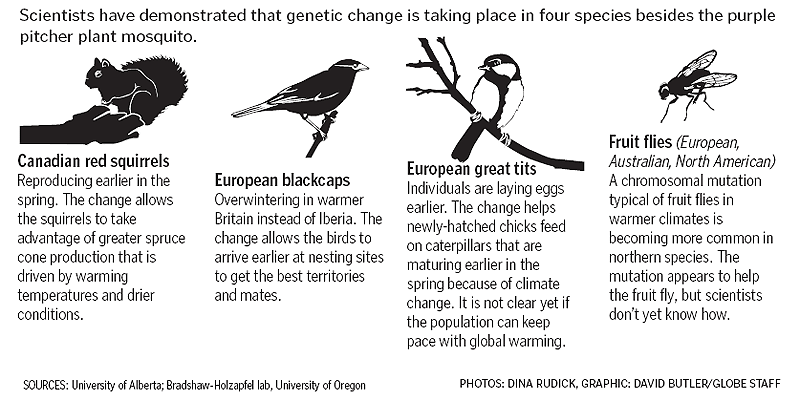
This news can fit into curricula in several ways, in several courses: Insects have already evolved in response to climate shifts due to global warming.
The Boston Globe has a series on global warming, and a recent article detailed how mosquitoes on the Maine frontier have already changed their breeding seasons in response to warming weather.
A mosquito that can barely fly is one of only five known species that scientists say have already evolved because of global warming. The unobtrusive mosquito’s story illustrates a sobering consequence of climate change: The species best suited to adapting may not be the ones people want to survive.
Such news enhances biology studies of genetics and insects, geography studies of climate, animal dispersal patterns and disease and pest ranges (a subject more technically known as biogeography), and the articles lend urgency to studies of how governments react to natural crises, a topic suitable for government classes, economics, and U.S. and world history.
 Click on the thumbnail to see four examples of genetic change credited to global warming. (Graphic by David Butler of the Boston Globe staff.) Read the rest of this entry »
Spread the word; friends don't allow friends to repeat history.
1 Comment | Current History, Disasters, Economics, Education, Environmental protection, Evolution, Geography - Physical, Geography - Political, History, Lesson plans, Natural history, Politics, Science, Teaching, Travel | Permalink
Posted by Ed Darrell
April 20, 2007
It’s almost over for this year, but the lesson plans at the site for National Environmental Education Week don’t have to be done in April only. Texas will have a new beefed up science requirement kick in, in a couple of years. Until then, however, this is a good set of ideas, even for social studies, especially if no other class is delivering the material well.
Environmental protection weaves science — biology, chemistry, geology, meteorology, and more — with applied social studies, especially history, economics and government, to make changes. For younger students studies of recycling can be a lot of fun and give students something to take with them for the rest of the life. Similarly, a study of migratory birds and the policy issues related to them (tall buildings, cellular communications towers, oil well sumps, lights in cities, hunting and the Treaty of 1948, etc., etc.) offers a lot of ways to get kids interested, if not excited, about these so-called dry topics. An advanced class in high school might analyze the Supreme Court decisions that brought down the price of shipping of recycled metals, making recycling economically feasible.
Whatever you do, don’t despair: International Migratory Bird Day is just a couple of weeks away. Birding is one of the more fun areas one can use in discussions of climate change and global warming; the Roger Tory Peterson Institute of Natural History points the way to good resources.
Spread the word; friends don't allow friends to repeat history.
Leave a Comment » | Citizenship, Economics, Geography - Physical, Geography - Political, Government, History, Lesson plans, Natural history, Science | Permalink
Posted by Ed Darrell
April 17, 2007
A few hours ago I posted a notice on satellite studies of the uplifting of a part of the Yellowstone Caldera, and I suggested some (weak) links to how to use it in the classroom. In passing I noted that the volcanic rock site southwest of Yellowstone, the Craters of the Moon National Monument, had been used to show astronauts what the Moon would be like when they landed Apollo missions there.
Yellowstone and especially its volcanic features also provided dramatic insights to the origins of life on Earth, especially the rise of life in hot water. These findings advanced the science we now call astrobiology, or the search for life on other planets.
This evening I stumbled across an interesting feature: A full text of a classic 1978 book on thermophilic life in Yellowstone, explaining in greater detail the research conducted there and its significance in astrobiology and evolution. Thomas D. Brock’s book, Thermophilic microorganisms and life at high temperatures (Springer-Verlag, New York, 1978; 465 pages) is just sitting there, online, for anyone to read. 
In this book there is more real science to this one tiny facet of the study of the evolution of life than there is in the entirety of the intelligent design political movement.
I wonder what other gems there may be in that digital collection at the University of Wisconsin.
Below the fold: The frontispiece. Read the rest of this entry »
Spread the word; friends don't allow friends to repeat history.
1 Comment | Books, Darwin, Education, Evolution, Geography - Physical, History, Intelligent Design, Natural history, On-line learning, Public libraries, Science, Space exploration | Permalink
Posted by Ed Darrell
April 5, 2007
[Note to SMU Physics students: Glad to have you here! While you’re here, stick around for a moment. Check the blog’s list of articles on “intelligent design” or “evolution,” and you’ll see that the issue has moved a good deal since the flap at SMU. Feel free to leave comments, too. E.D.]
When sanity strikes public figures and public institutions, sometimes all one can do is sit back in wonder at how the universe runs.
Intelligent design advocates might begin to think that God (or the gods, or the little green men, as the Discovery Institute allows) has stacked the universe against them, at least in Texas. First, in 2003, with the Texas State Board of Education pregnant with 8 creationists among the 15 members, scientists in Texas applied quiet, gentle pressure and got some of the creationists to vote against requiring creationism in biology texts. Last week Lee Cullum, doyon of conservative commentators in Dallas society, alumnus of the late Dallas Herald and occasional opinion writer for the Dallas Morning News wrote a piece questioning whether intelligent design advocates had not overstepped propriety in their use of Southern Methodist University’s good neighborly intentions — a reversal of position for Cullum, and perhaps a bellwether for others with influence in the state. Plus, several of the faculty at SMU protested the pending intelligent design conference scheduled for the campus, though without endorsement from the university.
Discovery Institute spokesmen gave their usual demurrers, claiming that intelligent design advocates have First Amendment rights and accusing critics of being unfair and unholy, but never defending intelligent design itself.
So, I can imagine there were a lot of coffee-burned laps in Seattle (and at least one in Fort Worth) this morning when the Dallas Morning News‘ opinion section unfurled a hard stand against intelligent design, signed by a score of well-respected scientists of various faiths, from the SMU faculty.
They minced no words:
The organization behind the event, the Discovery Institute, is clear in its agenda: It states that what the SMU science faculty believes to be so useful (science) is a danger to conservative Christianity and should be replaced by its mystical world view.
We do not argue against the basic right to believe, worship and express oneself as one desires. [More, including the full text, below the fold.] Read the rest of this entry »
Spread the word; friends don't allow friends to repeat history.
4 Comments | Darwin, Ethics, First Amendment, Free speech, Intelligent Design, Natural history, Politics, Science, Science and faith, Voodoo science | Permalink
Posted by Ed Darrell
March 24, 2007

What fairy story, what tale from the Arabian Nights of the jinns, is a hundredth part as wonderful as this true fairy story of simians! It is so much more heartening, too, than the tales we invent. A universe capable of giving birth to many such accidents is — blind or not — a good world to live in, a promising universe. . . . We once thought we lived on God’s footstool; it may be a throne.
Clarence Day (1874-1935), This Simian World (1920), XIX
More from that chapter, below the fold
Read the rest of this entry »
Spread the word; friends don't allow friends to repeat history.
Leave a Comment » | Evolution, History, Natural history, Quotes, Science | Tagged: Evolution, Famous quotes, Natural history, Quotes, Science | Permalink
Posted by Ed Darrell
March 20, 2007

Soil erosion in Virginia, photo by W. C. Lowdermilk “Figure 15. — A formerly productive field in Virginia that has been cut to pieces by gully erosion. About 50 million acres of good farm land in the United States have been ruined for further practical cultivation by similar types of erosion.”
From Conquest of the Land through 7,000 Years, by W. C. Lowdermilk, its first director, a soil conservation publication of the U.S. Soil Conservation Service, first issued in about 1939:
When in Palestine in 1939, I pondered the problems of the use of the land through the ages. I wondered if Moses, when he was inspired to deliver the Ten Commandments to the Israelites in the Desert to establish man’s relationship to his Creator and his fellow men — if Moses had foreseen what was to become of the Promised Land after 3,000 years and what was to become of hundreds of millions of acres of once good lands such as I have seen in China, Korea, North Africa, the Near East, and in our own fair land of America — if Moses had foreseen what suicidal agriculture would do to the land of the holy earth — might not have been inspired to deliver another Commandment to establish man’s relation to the earth and to complete man’s trinity of responsibilities to his Creator, to his fellow men, and to the holy earth.
When invited to broadcast a talk on soil conservation in Jerusalem in June 1939, I gave for the first time what has been called an “Eleventh Commandment,” as follows: Thou shalt inherit the Holy Earth as a faithful steward, conserving its resources and productivity from generation to generation. Thou shalt safeguard thy fields from soil erosion, thy living waters from drying up, thy forests from desolation, and protect thy hills from overgrazing by thy herds, that thy descendants may have abundance forever. If any shall fail in this stewardship of the land, thy fruitful fields shall become sterile stony ground and wasting gullies, and thy descendants shall decrease and live in poverty or perish from off the face of the earth.
Spread the word; friends don't allow friends to repeat history.
Leave a Comment » | Conservation, Dust Bowl, Environmental protection, Ethics, Geography - Physical, Geography - Political, History, Natural history, New Deal | Tagged: Conservation, Dust Bowl, Environmental protection, geography, History, New Deal, W. C. Lowdermilk | Permalink
Posted by Ed Darrell
March 1, 2007
You are a social scientist? You do not pay adequate attention to trees, in my view (with a few exceptions). History is not only made with treaties signed under great trees, but history is made when forests move (ask Macbeth), or when orchards and forests are planted. Economics would be nowhere without a building to do the economics in, and that building most likely owes much of its structure to trees — as does our entire economy (checked lumber prices lately?). Don’t get me started on agriculture.
And then there are those trees that inspire (Isaac Newton, Joyce Kilmer), and those that simply give us beauty.
You have many good reasons to check out this compilation of posts, a web carnival, all about trees: Festival of the Trees #9. If you check carefully, you’ll even find some history involving Thomas Jefferson there.
Spread the word; friends don't allow friends to repeat history.
Leave a Comment » | History, Natural history, Thomas Jefferson, Weblogs | Permalink
Posted by Ed Darrell
February 27, 2007
You just can’t write parody of creationists and creationism. A retired physician, Tennessee state senator is demanding the Tennessee State Department of Education provide the answers to questions left hanging by the trial of John T. Scopes in 1925. Read about it in the Nashville Post, in an article by Ken Whitehouse.
It appears as though the state senator, Raymond Finney, either failed Tennessee history, or just doesn’t pay attention to excellent advice and warnings from George Santayana.
Update, February 28, 2007: Perhaps Sen. Finney should check out this comment at the blog Sola Fide.
Tip of the old scrub brush to P. Z. Myers at Pharyngula.
Spread the word; friends don't allow friends to repeat history.
3 Comments | Creationism, Education, History, Humor, Intelligent Design, Natural history, No Child Left Behind Act, Public education, Science and faith, State school boards, Voodoo science | Permalink
Posted by Ed Darrell
February 21, 2007
For a decade of my life I was deeply involved in the fight to get compensation for downwind victims (most from Utah) of the fallout from U.S. atomic bomb tests at the Nevada Test Site. In the course of that time I saw a variety of amazing fibs told by the government — hoaxes that injured and killed people. I grew to respect those whistleblowers who had the guts and patriotism to cry foul on the hoaxes.
Leroy Lee died about a month ago in Santa, Idaho. He was a seasonal government worker, a timber stand examiner — a tree counter. As low guy on the totem pole, it was not his job to take the global view. Still, he noted that there were fewer growing trees in the forests than the U.S. Forest Service claimed, and much more cleared land, too, clearcut.
The Forest Service was lying to Congress about millions of dollars of harvests on public lands. Lee blew the whistle. Officials had hoaxed up on paper, forests that didn’t exist, in 15 of the west’s National Forests.
It wasn’t a big scandal as scandals go, but the Kootenai National Forest still works to straighten things out, mostly in litigation. Most hoaxes are exposed by honest, hard-working people like Leroy Lee. They are heroes of our republic. Many of them remain unsung, like Lee.
In his “day job,” Lee taught physics, chemistry and biology at St. Maries High School, St. Maries, Idaho.
More information:
- Lowbagger.org, “Scientist who unearthed ‘phantom forest’ scandal dies”
- Spokane, Washington, Spokesman-Review, “Forest Activist, Leroy Lee, 50, Dies.“
- Demarcated Landscapes, “Update, Leroy Lee Ceremony” and “Leroy Lee, 1956-2007“
Spread the word; friends don't allow friends to repeat history.
Leave a Comment » | Business Ethics, Environmental protection, Ethics, Freedom - Political, Hoaxes, Natural history, Patriotism, Science, Teaching | Permalink
Posted by Ed Darrell




 Millard Fillmore's Bathtub
