One more time: Intelligent design is a pig that still doesn’t fly

July 26, 2012

Gee, I think I first posted this more than a year before the Pennsylvania decision.  In any case, the subject has come up once again in another forum:  Why don’t we teach intelligent design as an “alternative” idea in public school science classes?  The answer is, simply, ID is not science.  It’s not an alternative hypothesis, it’s a chunk of minority cult religious dogma.
Most bad science claims recirculate year after year, until they are simply educated out of existence in the public mind.  We can hope intelligent design falls into that category.  But we might worry that modern creationism, begun as a backlash to the anti-Soviet, National Defense Education Act‘s effects on beefing up science teaching in American schools, survives.
Picture from Flying Pig Brewery, Seattle, Washington
Image: Flying Pig Brewing Co., Everett, Washington

[From 2006 and 2007]:

We’re talking past each other now over at Right Reason, on a thread that started out lamenting Baylor’s initial decision to deny Dr. Francis Beckwith tenure last year, but quickly changed once news got out that Beckwith’s appeal of the decision was successful.

I noted that Beckwith’s getting tenure denies ID advocates of an argument that Beckwith is being persecuted for his ID views (wholly apart from the fact that there is zero indication his views on this issue had anything to do with his tenure discussions). Of course, I was wrong there — ID advocates have since continued to claim persecution where none exists. Never let the facts get in the way of a creationism rant, is the first rule of creationism.

Discussion has since turned to the legality of teaching intelligent design in a public school science class. This is well settled law — it’s not legal, not so long as there remains no undisproven science to back ID or any other form of creationism.

Background: The Supreme Court affirmed the law in a 1987 case from Louisiana, Edwards v. Aguillard (482 U.S. 578), affirming a district court’s grant of summary judgment against a state law requiring schools to teach creationism whenever evolution was covered in the curriculum. Summary judgment was issued by the district court because the issues were not materially different from those in an earlier case in Arkansas, McLean vs. Arkansas (529 F. Supp. 1255, 1266 (ED Ark. 1982)). There the court held, after trial, that there is no science in creationism that would allow it to be discussed as science in a classroom, and further that creationism is based in scripture and the advocates of creationism have religious reasons only to make such laws. (During depositions, each creationism advocate was asked, under oath, whether they knew of research that supports creationism; each answered “no.” Then they were asked where creationism comes from, and each answered that it comes from scripture. It is often noted how the testimony changes from creationists, when under oath.)

Especially after the Arkansas trial, it was clear that in order to get creationism into the textbooks, creationists would have to hit the laboratories and the field to do some science to back their claims. Oddly, they have staunchly avoided doing any such work, instead claiming victimhood, usually on religious grounds. To the extent ID differs from all other forms of creationism, the applicability of the law to ID was affirmed late last year in the Pennsylvania case, Kitzmiller v. Dover. (Please go read that case!)

Read the rest of this entry »


Religious liberty in America: July 21, 1591, baptism of Anne Marbury (Hutchinson)

July 21, 2012

Do we overlook her because she was female?  Do we overlook her because she stands for religious freedom?  Either way, Anne Marbury Hutchinson gets the cold shoulder from most U.S. history texts used in high schools.

She was a woman to celebrate, and the Library of Congress explains why in detail:

Anne Marbury Hutchinson

Although her exact birth date is uncertain, on July 20, 1591, the infant Anne Marbury was baptized in Alford, Lincolnshire, England.1 The first female religious leader among North America’s early European settlers, Anne Marbury Hutchinson was the daughter of an outspoken clergyman silenced for criticizing the Church of England. Better educated than most men of the day, she spent her youth immersed in her father’s library.

At twenty-one, Anne Marbury married William Hutchinson and began bearing the first of their fourteen children. The Hutchinsons became adherents of the preaching and teachings of John Cotton, a Puritan minister who left England for America. In 1634, the Hutchinson family followed Cotton to New England, where religious and political authority overlapped.

The General Laws and Liberties of the Massachusetts Colony: Revised and Reprinted [right page]      The General Laws and Liberties of the Massachusetts Colony: Revised and Reprinted [left page]
The General Laws and Liberties of the Massachusetts Colony:
Revised and Reprinted,
Cambridge, Massachusetts: Samuel Green, 1672.
Religion and the Founding of the American Republic, Section I. Part 1
Many criminal laws in the early New England colonies were based on the Bible, especially the Old Testament. Often called “Bible Commonwealths,” the New England colonies sought guidance from the scriptures in regulating the lives of their citizens.

Serving as a skilled herbalist and midwife in the Massachusetts Bay Colony, Anne Hutchinson began meeting with other women for prayer and religious discussion. Her charisma and intelligence soon also drew men, including ministers and magistrates, to her gatherings, where she developed an emphasis on the individual’s relationship with God, stressing personal revelation over institutionalized observances and absolute reliance on God’s grace rather than on good works as the means to salvation. Hutchinson’s views challenged religious orthodoxy, while her growing power as a female spiritual leader threatened established gender roles.

Mary Dyer
Mary Dyer Led to Execution on Boston Common,
Color Engraving,
Nineteenth Century.
Courtesy of The Granger Collection.
Religion and the Founding of the American Republic, Section I. Part 2
Like Anne Hutchinson, Mary Dyer was banished from Massachusetts. Eventually, she was hanged for challenging Puritan orthodoxy.

Called for a civil trial before the General Court of Massachusetts in November 1637, Hutchinson ably defended herself against charges that she had defamed the colony’s ministers and as a woman had dared to teach men. Her extensive knowledge of Scripture, her eloquence, and her intelligence allowed Hutchinson to debate with more skill than her accusers. Yet because Hutchinson claimed direct revelation
from God and argued that “laws, commands, rules, and edicts are for those who have not the light which makes plain the pathway,” she was convicted and banished from the colony, a sentence confirmed along with formal excommunication in the ecclesiastical trial that followed.

Refusing to recant, Hutchinson accepted exile and in 1638 migrated with her family to Roger Williams’ new colony of Rhode Island, where she helped found the town of Portsmouth. After her husband died in 1642, Hutchinson moved to Dutch territory near Long Island Sound (an area now known as Co-op City, along New York’s Hutchinson River Parkway, which is named for Anne Hutchinson). There in 1643 Hutchinson and all but one of her younger children were killed by Siwanoy Indians, possibly with the encouragement of Puritan authorities. “Proud Jezebel has at last been cast down,” was the supposed comment of Hutchinson’s nemesis, Massachusetts Governor John Winthrop.

Learn more about early America in American Memory:

More:


Does Jesus care if anyone says “Merry Christmas?”

December 23, 2011

I get e-mail from Sara Maxwell, alerting me to the blog post by Dave Hershey.

Ouch.

Let Dave tell it; first he used a Fox video, to show what he’s talking about:

(via Stuff Christian Culture Likes)

What would Jesus say if he came to your house and had coffee with you?

That is the question asked at around 1:10 into this video.  It is a decent question.  What would Jesus say?

*“I miss hearing you say Merry Christmas”

*”And if anyone wants to sue you and take your shirt, hand over your coat as well. If anyone forces you to go one mile, go with them two miles.Give to the one who asks you, and do not turn away from the one who wants to borrow from you.”

*”I  tell you, love your enemies and pray for those who persecute you”

*“Do not store up for yourselves treasures on earth, where moths and vermin destroy, and where thieves break in and steal. But store up for yourselves treasures in heaven, where moths and vermin do not destroy, and where thieves do not break in and steal. For where your treasure is, there your heart will be also.”

*“Whoever wants to be my disciple must deny themselves and take up their cross and follow me.”

*“The Spirit of the Lord is on me, because he has anointed me to proclaim good news to the poor. He has sent me to proclaim freedom for the prisoners and recovery of sight for the blind, to set the oppressed free, to proclaim the year of the Lord’s favor.” 

*“You still lack one thing. Sell everything you have and give to the poor, and you will have treasure in heaven. Then come, follow me.” 

*Isaiah was right when he prophesied about you:“‘These people honor me with their lips, but their hearts are far from me. They worship me in vain; their teachings are merely human rules.’ 

What would Jesus say to us?

Hint: all but the first choice are things Jesus actually did say to people (Matthew 5:41-42, 44; 6:19-21; 16:24; Luke 4:18-19; 18:21; Matthew 15:17-19).

When I read the gospels, I find Jesus’ words incredibly challenging.  What he calls people to do is uncomfortable, to say the least.  I am sure in the face of our insistence that people say “Merry Christmas” and our offense when people do not that he would challenge us Christians to sell our stuff or love our enemies or something we frankly would rather not do.

The ladies in the video say they are offended that people do not say Merry Christmas.  Offended?  By that?

Maybe we Christians should get offended by things that actually matter, things that are horrendous evils happening right now in the world, things like global poverty, human trafficking and modern-day slavery and so many others.

Maybe if instead of wasting money on billboards urging people to say “Merry Christmas” we used that money to help those who are really suffering, people would actually care to hear more about Jesus.

The prophet Amos also probably doesn’t care if you say “Merry Christmas”.  I’ll end with his powerful words (Amos 5):

21 “I hate, I despise your religious festivals; 
   your assemblies are a stench to me. 
22 Even though you bring me burnt offerings and grain offerings, 
   I will not accept them. 
Though you bring choice fellowship offerings, 
   I will have no regard for them. 
23 Away with the noise of your songs! 
   I will not listen to the music of your harps. 
24 But let justice roll on like a river, 
   righteousness like a never-failing stream!

Have a good Christmas/Hanukkah/Solstice/KWANZAA/Festivus, anyway.


Religious freedom for students in public schools — what is the law?

December 7, 2011


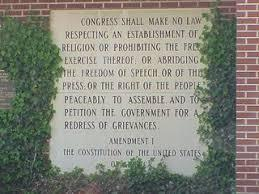
It's engraved in stone. The First Amendment, at the entrance to the Bremen Public Library in Bremen, Indiana. The Bremen Public Library serves the citizens of German Township in Marshall County, Indiana. Photo from Bremen Library.

It’s engraved in stone. The First Amendment, at the entrance to the Bremen Public Library in Bremen, Indiana. The Bremen Public Library serves the citizens of German Township in Marshall County, Indiana. Photo from Bremen Library.


President Clinton directed the Secretary of Education and the Attorney General to inform  each school district in America about the law on religious freedom in public schools.  This was the law in 2000 when Clinton left office, and it still is the law.  This statement is still accurate. [And if that site stays weird or doesn’t work for you, check it out here at the 5th Circuit U.S. Court of Appeals.]

UNITED STATES DEPARTMENT OF EDUCATION
THE SECRETARY


“…Schools do more than train children’s minds. They also help to nurture their souls by reinforcing the values they learn at home and in their communities. I believe that one of the best ways we can help out schools to do this is by supporting students’ rights to voluntarily practice their religious beliefs, including prayer in schools…. For more than 200 years, the First Amendment has protected our religious freedom and allowed many faiths to flourish in our homes, in our work place and in our schools. Clearly understood and sensibly applied, it works.”

President Clinton
May 30, 1998


Dear American Educator,

Almost three years ago, President Clinton directed me, as U.S. Secretary of Education, in consultation with the Attorney General, to provide every public school district in America with a statement of principles addressing the extent to which religious expression and activity are permitted in our public schools. In accordance with the President’s directive, I sent every school superintendent in the country guidelines on Religious Expression in Public Schools in August of 1995.

The purpose of promulgating these presidential guidelines was to end much of the confusion regarding religious expression in our nation’s public schools that had developed over more than thirty years since the U.S. Supreme Court decision in 1962 regarding state sponsored school prayer. I believe that these guidelines have helped school officials, teachers, students and parents find a new common ground on the important issue of religious freedom consistent with constitutional requirements.

In July of 1996, for example, the Saint Louis School Board adopted a district wide policy using these guidelines. While the school district had previously allowed certain religious activities, it had never spelled them out before, resulting in a lawsuit over the right of a student to pray before lunch in the cafeteria. The creation of a clearly defined policy using the guidelines allowed the school board and the family of the student to arrive at a mutually satisfactory settlement.

In a case decided last year in a United States District Court in Alabama, (Chandler v. James) involving student initiated prayer at school related events, the court instructed the DeKalb County School District to maintain for circulation in the library of each school a copy of the presidential guidelines.

The great advantage of the presidential guidelines, however, is that they allow school districts to avoid contentious disputes by developing a common understanding among students, teachers, parents and the broader community that the First Amendment does in fact provide ample room for religious expression by students while at the same time maintaining freedom from government sponsored religion.

The development and use of these presidential guidelines were not and are not isolated activities. Rather, these guidelines are part of an ongoing and growing effort by educators and America’s religious community to find a new common ground. In April of 1995, for example, thirty-five religious groups issued “Religion in the Public Schools: A Joint Statement of Current Law” that the Department drew from in developing its own guidelines. Following the release of the presidential guidelines, the National PTA and the Freedom Forum jointly published in 1996 “A Parent’s Guide to Religion in the Public Schools” which put the guidelines into an easily understandable question and answer format.

In the last two years, I have held three religious-education summits to inform faith communities and educators about the guidelines and to encourage continued dialogue and cooperation within constitutional limits. Many religious communities have contacted local schools and school systems to offer their assistance because of the clarity provided by the guidelines. The United Methodist Church has provided reading tutors to many schools, and Hadassah and the Women’s League for Conservative Judaism have both been extremely active in providing local schools with support for summer reading programs.

The guidelines we are releasing today are the same as originally issued in 1995, except that changes have been made in the sections on religious excusals and student garb to reflect the Supreme Court decision in Boerne v. Flores declaring the Religious Freedom Restoration Act unconstitutional as applied to actions of state and local governments.

These guidelines continue to reflect two basic and equally important obligations imposed on public school officials by the First Amendment. First, schools may not forbid students acting on their own from expressing their personal religious views or beliefs solely because they are of a religious nature. Schools may not discriminate against private religious expression by students, but must instead give students the same right to engage in religious activity and discussion as they have to engage in other comparable activity. Generally, this means that students may pray in a nondisruptive manner during the school day when they are not engaged in school activities and instruction, subject to the same rules of order that apply to other student speech.

At the same time, schools may not endorse religious activity or doctrine, nor may they coerce participation in religious activity. Among other things, of course, school administrators and teachers may not organize or encourage prayer exercises in the classroom. Teachers, coaches and other school officials who act as advisors to student groups must remain mindful that they cannot engage in or lead the religious activities of students.

And the right of religious expression in school does not include the right to have a “captive audience” listen, or to compel other students to participate. School officials should not permit student religious speech to turn into religious harassment aimed at a student or a small group of students. Students do not have the right to make repeated invitations to other students to participate in religious activity in the face of a request to stop.

The statement of principles set forth below derives from the First Amendment. Implementation of these principles, of course, will depend on specific factual contexts and will require careful consideration in particular cases.

In issuing these revised guidelines I encourage every school district to make sure that principals, teachers, students and parents are familiar with their content. To that end I offer three suggestions:

First, school districts should use these guidelines to revise or develop their own district wide policy regarding religious expression. In developing such a policy, school officials can engage parents, teachers, the various faith communities and the broader community in a positive dialogue to define a common ground that gives all parties the assurance that when questions do arise regarding religious expression the community is well prepared to apply these guidelines to specific cases. The Davis County School District in Farmington, Utah,is an example of a school district that has taken the affirmative step of developing such a policy.

At a time of increasing religious diversity in our country such a proactive step can help school districts create a framework of civility that reaffirms and strengthens the community consensus regarding religious liberty. School districts that do not make the effort to develop their own policy may find themselves unprepared for the intensity of the debate that can engage a community when positions harden around a live controversy involving religious expression in public schools.

Second, I encourage principals and administrators to take the additional step of making sure that teachers, so often on the front line of any dispute regarding religious expression, are fully informed about the guidelines. The Gwinnett County School system in Georgia, for example, begins every school year with workshops for teachers that include the distribution of these presidential guidelines. Our nation’s schools of education can also do their part by ensuring that prospective teachers are knowledgeable about religious expression in the classroom.

Third, I encourage schools to actively take steps to inform parents and students about religious expression in school using these guidelines. The Carter County School District in Elizabethton, Tennessee, included the subject of religious expression in a character education program that it developed in the fall of 1997. This effort included sending home to every parent a copy of the “Parent’s Guide to Religion in the Public Schools.”

Help is available for those school districts that seek to develop policies on religious expression. I have enclosed a list of associations and groups that can provide information to school districts and parents who seek to learn more about religious expression in our nation’s public schools.

In addition, citizens can turn to the U.S. Department of Education web site (http://www.ed.gov) for information about the guidelines and other activities of the Department that support the growing effort of educators and religious communities to support the education of our nation’s children.

Finally, I encourage teachers and principals to see the First Amendment as something more than a piece of dry, old parchment locked away in the national attic gathering dust. It is a vital living principle, a call to action, and a demand that each generation reaffirm its connection to the basic idea that is America — that we are a free people who protect our freedoms by respecting the freedom of others who differ from us.

Our history as a nation reflects the history of the Puritan, the Quaker, the Baptist, the Catholic, the Jew and many others fleeing persecution to find religious freedom in America. The United States remains the most successful experiment in religious freedom that the world has ever known because the First Amendment uniquely balances freedom of private religious belief and expression with freedom from state-imposed religious expression.

Public schools can neither foster religion nor preclude it. Our public schools must treat religion with fairness and respect and vigorously protect religious expression as well as the freedom of conscience of all other students. In so doing our public schools reaffirm the First Amendment and enrich the lives of their students.

I encourage you to share this information widely and in the most appropriate manner with your school community. Please accept my sincere thanks for your continuing work on behalf of all of America’s children.

Sincerely,


Richard W. Riley
U.S. Secretary of Education


RELIGIOUS EXPRESSION IN PUBLIC SCHOOLS

Student prayer and religious discussion: The Establishment Clause of the First Amendment does not prohibit purely private religious speech by students. Students therefore have the same right to engage in individual or group prayer and religious discussion during the school day as they do to engage in other comparable activity. For example, students may read their Bibles or other scriptures, say grace before meals, and pray before tests to the same extent they may engage in comparable nondisruptive activities. Local school authorities possess substantial discretion to impose rules of order and other pedagogical restrictions on student activities, but they may not structure or administer such rules to discriminate against religious activity or speech.

Generally, students may pray in a nondisruptive manner when not engaged in school activities or instruction, and subject to the rules that normally pertain in the applicable setting. Specifically, students in informal settings, such as cafeterias and hallways, may pray and discuss their religious views with each other, subject to the same rules of order as apply to other student activities and speech. Students may also speak to, and attempt to persuade, their peers about religious topics just as they do with regard to political topics. School officials, however, should intercede to stop student speech that constitutes harassment aimed at a student or a group of students.

Students may also participate in before or after school events with religious content, such as “see you at the flag pole” gatherings, on the same terms as they may participate in other noncurriculum activities on school premises. School officials may neither discourage nor encourage participation in such an event.

The right to engage in voluntary prayer or religious discussion free from discrimination does not include the right to have a captive audience listen, or to compel other students to participate. Teachers and school administrators should ensure that no student is in any way coerced to participate in religious activity.

Graduation prayer and baccalaureates: Under current Supreme Court decisions, school officials may not mandate or organize prayer at graduation, nor organize religious baccalaureate ceremonies. If a school generally opens its facilities to private groups, it must make its facilities available on the same terms to organizers of privately sponsored religious baccalaureate services. A school may not extend preferential treatment to baccalaureate ceremonies and may in some instances be obliged to disclaim official endorsement of such ceremonies.

Official neutrality regarding religious activity: Teachers and school administrators, when acting in those capacities, are representatives of the state and are prohibited by the establishment clause from soliciting or encouraging religious activity, and from participating in such activity with students. Teachers and administrators also are prohibited from discouraging activity because of its religious content, and from soliciting or encouraging antireligious activity.

Teaching about religion: Public schools may not provide religious instruction, but they may teach about religion, including the Bible or other scripture: the history of religion, comparative religion, the Bible (or other scripture)-as-literature, and the role of religion in the history of the United States and other countries all are permissible public school subjects. Similarly, it is permissible to consider religious influences on art, music, literature, and social studies. Although public schools may teach about religious holidays, including their religious aspects, and may celebrate the secular aspects of holidays, schools may not observe holidays as religious events or promote such observance by students.

Student assignments: Students may express their beliefs about religion in the form of homework, artwork, and other written and oral assignments free of discrimination based on the religious content of their submissions. Such home and classroom work should be judged by ordinary academic standards of substance and relevance, and against other legitimate pedagogical concerns identified by the school.

Religious literature: Students have a right to distribute religious literature to their schoolmates on the same terms as they are permitted to distribute other literature that is unrelated to school curriculum or activities. Schools may impose the same reasonable time, place, and manner or other constitutional restrictions on distribution of religious literature as they do on nonschool literature generally, but they may not single out religious literature for special regulation.

Religious excusals: Subject to applicable State laws, schools enjoy substantial discretion to excuse individual students from lessons that are objectionable to the student or the students’ parents on religious or other conscientious grounds. However, students generally do not have a Federal right to be excused from lessons that may be inconsistent with their religious beliefs or practices. School officials may neither encourage nor discourage students from availing themselves of an excusal option.

Released time: Subject to applicable State laws, schools have the discretion to dismiss students to off-premises religious instruction, provided that schools do not encourage or discourage participation or penalize those who do not attend. Schools may not allow religious instruction by outsiders on school premises during the school day.

Teaching values: Though schools must be neutral with respect to religion, they may play an active role with respect to teaching civic values and virtue, and the moral code that holds us together as a community. The fact that some of these values are held also by religions does not make it unlawful to teach them in school.

Student garb: Schools enjoy substantial discretion in adopting policies relating to student dress and school uniforms. Students generally have no Federal right to be exempted from religiously-neutral and generally applicable school dress rules based on their religious beliefs or practices; however, schools may not single out religious attire in general, or attire of a particular religion, for prohibition or regulation. Students may display religious messages on items of clothing to the same extent that they are permitted to display other comparable messages. Religious messages may not be singled out for suppression, but rather are subject to the same rules as generally apply to comparable messages.

THE EQUAL ACCESS ACT

The Equal Access Act is designed to ensure that, consistent with the First Amendment, student religious activities are accorded the same access to public school facilities as are student secular activities. Based on decisions of the Federal courts, as well as its interpretations of the Act, the Department of Justice has advised that the Act should be interpreted as providing, among other things, that:

General provisions: Student religious groups at public secondary schools have the same right of access to school facilities as is enjoyed by other comparable student groups. Under the Equal Access Act, a school receiving Federal funds that allows one or more student noncurriculum-related clubs to meet on its premises during noninstructional time may not refuse access to student religious groups.

Prayer services and worship exercises covered: A meeting, as defined and protected by the Equal Access Act, may include a prayer service, Bible reading, or other worship exercise.

Equal access to means of publicizing meetings: A school receiving Federal funds must allow student groups meeting under the Act to use the school media — including the public address system, the school newspaper, and the school bulletin board — to announce their meetings on the same terms as other noncurriculum-related student groups are allowed to use the school media. Any policy concerning the use of school media must be applied to all noncurriculum-related student groups in a nondiscriminatory matter. Schools, however, may inform students that certain groups are not school sponsored.

Lunch-time and recess covered: A school creates a limited open forum under the Equal Access Act, triggering equal access rights for religious groups, when it allows students to meet during their lunch periods or other noninstructional time during the school day, as well as when it allows students to meet before and after the school day.

Revised May 1998


List of organizations that can answer questions on religious expression in public schools

Religious Action Center of Reform Judaism
Name: Rabbi David Saperstein
Address: 2027 Massachusetts Ave., NW, Washington, DC 20036
Phone: (202) 387-2800
Fax: (202) 667-9070
Web site: http://www.rj.org/rac/
American Association of School Administrators
Name: Andrew Rotherham
Address: 1801 N. Moore St., Arlington, VA 22209
Phone: (703) 528-0700
Fax: (703) 528-2146
Web site: http://www.aasa.org
American Jewish Congress
Name: Marc Stern
Address: 15 East 84th Street, New York, NY 10028
Phone: (212) 360-1545
Fax: (212) 861-7056
National PTA
Name: Maribeth Oakes
Address: 1090 Vermont Ave., NW, Suite 1200, Washington, DC 20005
Phone: (202) 289-6790
Fax: (202) 289-6791
Web site: http://www.pta.org
Christian Legal Society
Name: Steven McFarland
Address: 4208 Evergreen Lane, #222, Annandale, VA 22003
Phone: (703) 642-1070
Fax: (703) 642-1075
Web site: http://www.clsnet.com
National Association of Evangelicals
Name: Forest Montgomery
Address: 1023 15th Street, NW #500, Washington, DC 20005
Phone: (202) 789-1011
Fax: (202) 842-0392
Web site: http://www.nae.net
National School Boards Association
Name: Laurie Westley
Address: 1680 Duke Street, Alexandria, VA 22314
Phone: (703) 838-6703
Fax: (703) 548-5613
Web site: http://www.nsba.org
Freedom Forum
Name: Charles Haynes
Address: 1101 Wilson Blvd, Arlington, VA 22209
Phone: (703) 528-0800
Fax: (703) 284-2879
Web site: http://www.freedomforum.org

-###-


Rick Perry promises war on homosexuals and religious freedom

December 7, 2011

Is there any other way to read this?

Perry imagines a “war on religion,” based on his bigoted, anti-liberty views and some gross disinformation about what the rules are for kids praying in school.

What are the odds that, if elected, Perry would say, “Oops, I was wrong; I won’t do what that ad suggests?”

Perry’s offensive and erroneous text:

I’m not ashamed to admit that I’m a Christian, but you don’t need to be in the pew every Sunday to know there’s something wrong in this country when gays can serve openly in the military but our kids can’t openly celebrate Christmas or pray in school.
As President, I’ll end Obama’s war on religion. And I’ll fight against liberal attacks on our religious heritage.
Faith made America strong. It can make her strong again.
I’m Rick Perry and I approve this message.

I’ll take Barney Frank over Rick Perry any day.  Barney Frank is twice the man Rick Perry is, especially in standing up for the Constitution and freedom for all Americans.

I’ll take Barbara Jordan over Rick Perry.  She was twice the person Rick Perry is.  It seems to me that Perry plays with fire when he makes an ad that targets genuine Texas heroes like Jordan.

Perry professes to be a Methodist; does he have the guts to leave the church if he disagrees with its positions so much?

Is Perry going negative just because he’s losing, or is it really going to be that dirty a campaign?  This man shouldn’t be governor of Texas, and he has no business running for president.

More:

Hey, Slacktivist, thanks for the link.


Friends of science and evolution: Testify next week in the Texas textbook process?

July 14, 2011

I get important e-mail from the Texas Freedom Network; they’re asking for help next week to fight creationism and other forms of buncombe popular in Texas:

Science and the SBOE: One Week to Go

Next week, the Texas State Board of Education will take a critical vote on science in our public schools. We need people like you to make sure the vote is in favor of sound, well-established science.

Up for board consideration are science instructional materials submitted by a number of publishers and vendors who want their product used in Texas classrooms. Even before the board meets, far-right groups have been hard at work trying to ensure materials approved by the board attack and diminish evolutionary science and include the junk science of “intelligent design”/creationism.

The attacks include one from a little-know firm out of New Mexico, International Databases, which submitted instructional materials rife with creationist propaganda.

It gets worse. Far-right SBOE members last month appointed creationists with questionable scientific credentials to teams tasked with reviewing the materials and making recommendations to the board.

And new board chair Barbara Cargill upped the stakes when in a speech just last week she framed the debate over science as a “spiritual battle.”

The board will hold just ONE public hearing on the science materials. Your participation is crucial.

It is critical that you act now by clicking here to express your interest in testifying before the board on July 21.

Please note: The deadline to sign up to testify is 5 p.m. Monday.

We must insist that the SBOE keep junk science – including “intelligent design”/creationism – out of our children’s classrooms. The board must approve only instructional materials that are accurate, that are in line with sound and well-established science, and that will prepare Texas children to succeed in college and the jobs of the 21st century.

Texas Freedom Network advances a mainstream agenda of religious freedom and individual liberties to counter the radical right. www.tfn.org | www.tfninsider.org | General: tfn@tfn.org
Tell a friend to subscribe to TFN News Clips, Alerts or Rapid Response Teams. Subscribers may choose the issue areas that interest them. To change your TFN subscription preferences – or to unsubscribe – click here.
Copyright 2010, Texas Freedom Network

Trying to carve out time here.  Can you help?

Hearings will be most interesting.  Support for the Texas State Board of Education actually comes, often, from the Texas Education Agency (TEA).  TEA this week laid off just under 200 workers, to deal with the 36% budget chopping done to the agency by the Texas Lege.  Word comes this week that curriculum directors at TEA were let go, including the director of science curriculum.

It’s rather like the first 20 weeks of World War II in the Pacific, with the aggressors advancing on almost all fronts against science.  When is our Battle of Midway?

Information, resources: 


How to find “separation of church and state” in the Constitution

December 27, 2010

It’s been at least 20 years since I first heard the old canard of an argument that “there’s no separation of church and state in the Constitution.”  I think I first heard it attributed to David Barton, which would make sense, since he doesn’t understand the Constitution, but neither does he fear sharing his misunderstandings.

It was an incorrect statement then, and it’s been incorrect since September 1787.  Separation of state and church is woven throughout the Constitution, part of the warp and woof.

Recently, latter-day Constitution ignorami repeat the old canard.

Toles cartoon on dangers of marrying church and state

Toles cartoon on dangers of marrying church and state

I was surprised to discover I’ve not posted this before on this blog.  So here’s a slightly-edited version of a response I gave many months ago to someone who made that silly claim, a basic description that I developed years ago to explain the issue, in speeches by members of the Senate Subcommittee on the Constitution:

Separation of church and state: It’s in the Constitution.

I don’t play a constitutional lawyer on television, I am one*, but it seems to me anyone can read the Constitution and see. One can see especially if one understands that the Constitution sets up a limited government, as Madison described, one that can do only what is delegated to it. The Constitution is a short document.

Where should you look to find separation of church and state in the Constitution?

First, look in the Preamble.  It is made clear that the document is a compact between citizens: “We the people . . . do ordain and establish this Constitution . . .” The usual role of God ordaining (in some western nations) is altered, intentionally. It is not God who establishes this government, but you and I, together. From the first words of the Constitution, there is separation of church and state.  The power of our government grows out of a secular compact between you and me, and 308 million other residents of the nation.   We have a government created by consent of the governed, as the Declaration of Independence said a just government should be.  It is not a government created by the will of God directly (though some, including the Mormons, argue it is divinely inspired).  We have no divine right kings or other monarchs under the Constitution.  The government is not the grantor of rights from God, but is instead the protector of the rights of citizens, whatever the source of the rights and whatever the rights.

Second, look in the key parts of the document itself.  Start with Article 1 The legislative branch is given no role in religion; neither is any religion given any role in the legislature. In Article 2, the executive branch gets no role in religion, and religion gets no role in the executive branch. In Article 3, the judicial branch gets no role in religion, and religion gets no role in the judicial branch. In Article 4, the people get a guarantee of a republican form of government in the states, but the states get no role in religion, and religion gets no role in state government. This is, by design of the founders, a perfect separation of church and state.

Third, in Article 6, the convention wrote the hard and fast rule that no religious test can be used for any office in government, federal, state or local, means that no official will have a formal, governmental role in religion, and no religion can insist on a role in any official’s duties.

Fourth, Amendment 1 closes the door to weasling around it: Congress is prohibited from even considering any legislation that might grant a new bureaucracy or a new power to get around the other bans on state and church marriage, plus the peoples’ rights in religion are enumerated.

Fifth: In 1801 the Baptists (!) in Danbury, Connecticut, grew concerned that Connecticut would act to infringe on their church services, or teachings, or right to exist. So they wrote to President Jefferson. Jefferson responded with an official declaration of government policy on what the First Amendment and Constitution mean in such cases. Jefferson carefully constructed the form of the device as well as the content with his Attorney General, Levi Lincoln, to be sure that it would state what the law was. This “letter” is the proclamation. It’s an official statement of the U.S. government, collected in the president’s official papers and not in his personal papers. Make no mistake: Jefferson’s letter to the Danbury Baptists was an official act, an official statement of the law of the United States. Jefferson intended it to assuage the Baptists in Danbury, to inform and warn the Connecticut legislatures, and to be a touchstone to which future Americans could turn for information. It was only fitting and proper for the Supreme Court to use the letter in this capacity as it has done several times.

Sixth: The phrase, “separation of church and state” dates back another 100 years and more, to the founding of Rhode Island. It is the religion/state facet of the idea of government by consent of the governed without interference from religious entities, expressed so well in the Mayflower Compact, in the first paragraphs of the Declaration of Independence, and carried through in the Constitution (see especially the Preamble, above).

No, the phrase “separation of church and state” never appears in the Constitution. The principles of separation of church and state are part of the warp and woof, and history, of the document, however. The law is clear, the law was clear, the law has always been clear, and denying the Constitution says what it says, won’t change it or make it go away.  You could just as easily point out that the word “democracy” or “democratic” never appears in the document, though we rely on democratic mechanisms and institutions to make it work.  You could point out that nowhere does it say that our national government is a republic, though it is.  The Constitution doesn’t say “checks and balances,” nor does it say “federalism.”  The Constitution doesn’t mention political parties.  The Constitution was written before the advent of broadcasting, and makes no mention of radio nor television, nor of the internet — but the First Amendment freedoms apply there anyway.  The Constitution doesn’t say “privacy,” though it protects your right to privacy.

You won’t find “separation of church and state” as a phrase in the Constitution.  If you read it, you’ll find that the concept of the separation of state and church can’t be taken out of the document, either — it’s a fundamental principle of our government.

More, and Resources:

__________

*  A non-practicing one.  We have way more than 50,000 lawyers in Texas.  That’s enough trouble for one lifetime.  Someone has to look out for the welfare of the world.


Christmas greetings, unapproved by Dallas First Baptist Grinchlist

December 23, 2010

This video does NOT have the seal of approval from Dallas First Baptist Church.  Also, the composer of the song was Jewish.  Reasoning Person discretion advised:

A 2007 post on YouTube, with these details:

Sung by The Drifters. Cartoon by Joshua Held.
Featuring Bill Pinkney on lead bass and Clyde McPhatter on tenor.
An animated Christmas Card, and a homage to a great song, a great band, and a great Holiday.

More me on: http://www.joshuaheld.com

Tip of the old scrub brush to Oh,  For Goodness Sake.

__________

Some guy, Melvin Rose,  posted this comment on a Dallas Morning News blog about First Baptist’s Grinchiness:

Pastor Jeffress, Dallas's Chief Grinch

Pastor Jeffress, in his deepest Grinch voice, orders the Whos in Whoville to toe the Christmas line. If you're not "religiously correct," you'd better watch out!

Imagine if a guy had a really primo parking space at the mall, right by the door, and you were circling round and round looking for a space, and he said to you, “Happy Holidays! I’m leaving. Would you like my space?”

Who amongst us, no matter what flavor of religion they choose, would turn the guy down?

Two people complained about it. I kid you not.

It’s not the War on Christmas we need to worry about — it’s the War for Fundamentalist Correctness that threatens us more.


Fifth column in the War on Christmas

December 22, 2010

War on Christmas?  There are those who complain that failing to put “Christ” into every missive during this season is, somehow, a threat to Christianity and western culture.

War on Christmas comic book

From Yoism.com

Here in Dallas, First Baptist Church, the big one downtown, put up a site tracking businesses (GrinchAlert.com) they deem not sufficiently saved, who manifest their imagined antipathy to Christianity by failing to say “Merry Christmas” at every turn.  Some businesses substitute what these busy-body Baptists regard as near pagan rite:  “Happy Holidays!”  (Sample complaints:  “No Christmas Tree, No mangerscene” (sic); “Excessive use of ‘holiday’, no mention of Christmas. With a name like American Airlines, come on.”)

You may roll your eyes now.

Renowned preacher Fred Craddock, in a column in Christian Century, inadvertently reports that it is the self-appointed defenders of overweening Christian-ness themselves who do damage to the cause of Christianity. Everybody is so busy having Christmas, they forget about the Christian tradition, the necessity of Advent.  “Forget Advent,” they appear to say, “Have a ‘Merry Christmas,’ or else!”   Craddock’s words come here through the bulletin of the Church of the Saviour:

Inward/Outward from Church of the Saviour

We Wait

Fred Craddock

Every year for four weeks we wait. Ours is not a passive waiting; we wonder as we wait. We wait in the heavy joy of repentance, which cleanses us to be ready to receive the One Who Comes. We renew baptismal vows. We encourage one another in order to be a community of fresh expectancy.

And we pray, “O Come, O Come, Emmanuel” and “Come, O Long Expected Jesus.” At times we fuss at God: “How long, O Lord? How long will you tarry?”

Our generation is impatient. Advent lasts too long. Nasty notes are passed to the choirmaster: “We don’t know these Advent songs. Why don’t we sing some carols?” Everybody is already having Christmas except the church.

Source: The Christian Century (Dec. 14 2010)


Ohio news: No creationist right to burn crosses on junior high science students

December 1, 2010

Oops!  Update and correction, from NCSE, applies equally here:

Update and correction (December 1, 2010): The case is apparently not officially settled after all. What was approved was not the overall proposed settlement, but the terms of the settlement as it concerns Zachary Dennis (a minor) — the “James Doe” of the suit — and it was approved not by the judge presiding over the case, Gregory L. Frost of the Federal District Court for the Southern District of Ohio, but by Licking County Probate Judge Robert Hoover, acting in his role as Juvenile Court Judge for the county. The settlement still needs to be approved by Judge Frost.

John Freshwater’s side finally agreed to a settlement in the suit against him and the local school district prompted by his using an electrical device, a small Tesla coil testing device, to burn crosses on the arms of students.  Thus mostly ends one of the more bizarre stories of creationism and misguided religion in a public school classroom.

Here is the entire story in all its anticlimactic wonder, from the Mount Vernon (Ohio) News:

Judge approves settlement in civil lawsuit

NEWARK — Licking County Probate Judge Robert Hoover on Nov. 23 approved a settlement agreement with regard to the civil lawsuit filed on behalf of Zachary Dennis against suspended Mount Vernon Middle School teacher John Freshwater.

The lawsuit was originally filed in the U.S District Court on June 13, 2008, and included as defendants the Mount Vernon City Schools Board of Education and various school employees. The suit alleged that Freshwater violated the constitutional rights of Zachary Dennis and those of his parents, Stephen and Jennifer Dennis, by, among other things, displaying religious items in his classroom, by teaching intelligent design and by expressing his own religious beliefs to students in the classroom.

The board’s portion of the lawsuit was resolved on or about Aug. 26, 2009, and Freshwater was the sole remaining defendant.

With Judge Hoover’s ruling last Tuesday, the suit against Freshwater was officially settled. The settlement of $475,000 to the Dennis family includes $25,000 for attorney fees, $150,000 each to Stephen and Jennifer, and $150,000 to be used for an annuity for Zachary.

At Panda’s Thumb, Richard B. Hoppe’s complete covering of the case notes that we still await the decision of the referee in the proceeding of John Freshwater’s appeal of his firing, and school board action on that recommendation.

At length, then, officially, it’s a bad idea for a creationist science teacher to burn crosses on the arms of supposedly-willing students using a Tesla coil, in any configuration. Yet to be determined:  May a school board fire a teacher who does that anyway?

More:


Religion-free zone in New York?

August 28, 2010

Thomas Jefferson’s copy of the Qur’an, published in 1764. (courtesy of the Library of Congress). Image via 15-Minute History at the University of Texas at Austin.

Thomas Jefferson’s copy of the Qur’an, published in 1764. (courtesy of the Library of Congress). Image via 15-Minute History at the University of Texas at Austin.

The Center for Inquiry (CFI) joined in the calls to end plans for any worship center for Islam near the site of the destroyed World Trade Center.  But they added a twist.

CFI called for the entire area to be free from religious institutions, since, they say, it was religiously-inspired violence that caused the trouble.  Greg Laden has pithy comments at his blog, as does DuWayne Brayton from the opposite tack (Laden agrees with CFI, sorta, while Brayton thinks they’ve jumped somebody’s shark).

How about it, Joe, how about it Morgan?  Doesn’t this plan meet yours and Sarah Palin’s objections to Cordoba House?

And Glenn Beck in ignorance leads us farther and further from the intentions of the “founders”:

Also at Millard Fillmore’s Bathtub:

Save


A real live preacher on empathizing with Imam Rauf

August 26, 2010

Gordon Atkinson, who often blogs as Real Live Preacher (whose drawings I really like), has already walked a mile in the shoes of Imam Feisal Abdul Rauf.  Perhaps we could learn from his journey:

I would be interested in comments from you about something else, though. Having been a clergyman for many years, I can’t help but watch the drama of Park 51 unfold with a different perspective. Because I know what it’s like to carry someone else’s reputation.

~~~~

When I was a Baptist minister, I could never get comfortable with the fact that Fred Phelps was a colleague. Whenever the people from Westboro Baptist Church were on the news with their hateful signs, I knew that some of Fred’s reputation was going to rub off on me.

Whether it’s fair or not, clergy share their reputations. Many people in our culture have never met, much less befriended a preacher. What little experience they have with ministers comes from television and the occasional wedding or funeral. When someone meets a Baptist preacher for the first time, they often have some preconceived notions.

That’s just the way it is.

Ah, shades of Bruce Hornsby.  More at the link above.


Hallowed ground: Why other nations think we’re nuts

August 20, 2010

Scott Hanley at Angular Unconformities used Google Earth to see how other nations deal with the placement of potentially-offensive installations near the sites of their great national calamaties.

Charles Krauthammer pushed the argument to the shark-jumping bridge in his regular column at the Washington Post:

When we speak of Ground Zero as hallowed ground, what we mean is that it belongs to those who suffered and died there — and that such ownership obliges us, the living, to preserve the dignity and memory of the place, never allowing it to be forgotten, trivialized or misappropriated.

That’s why Disney’s 1993 proposal to build an American history theme park near Manassas Battlefield was defeated by a broad coalition that feared vulgarization of the Civil War (and that was wiser than me; at the time I obtusely saw little harm in the venture). It’s why the commercial viewing tower built right on the border of Gettysburg was taken down by the Park Service. It’s why, while no one objects to Japanese cultural centers, the idea of putting one up at Pearl Harbor would be offensive.

We noted on another thread that there is, in fact, a Japanese Cultural Center at Pearl Harbor.  Hanley wonders how the Japanese deal with reminders of the being the victims of the first atomic bomb used in warfare — a topic upon which the Japanese are understandably extremely sensitive.

Go to the photos, see what Hanley found:

Hallowed ground

Baseball and 7-Eleven, symbols of American cultural imperialism at the site of the world’s first nuclear assault. McDonald’s, by contrast, maintains a discreet 2000′ distance across the river.

This campaign against a Moslem cultural center in lower Manhattan is the prototypical example of where the “Ugly American” myth gets its roots. Hanley’s analysis is incredibly simple, no?


Cat and Mosque, at Dogboy and Mr. Dan

August 19, 2010

Mark Fiore’s latest animated political cartoon won’t be popular with Newt Gingrich.  But then, Fiore won the Pulitzer, not Gingrich.

(This cartoon is not available on Fiore’s YouTube Channel, yet.)

(Oh, and remember:  This is the guy whose app got Apple’s panties in a wad — while you’re there, iPhone users, get the app that Steve Jobs thought mean for ridiculing those who so richly deserve ridicule.  Ain’t the First Amendment grand?)

Tip of the old scrub brush to Jennsmom.


What would George Washington say and do about a mosque in Manhattan? (“To bigotry, no sanction”)

August 17, 2010

Double encore post.  And look at the date

August 17, 1790, found U.S. President George Washington traveling the country, in Newport, Rhode Island.

Washington met with “the Hebrew Congregation” (Jewish group), and congregation leader (Rabbi?) Moses Seixas presented Washington with an address extolling Washington’s virtues, and the virtues of the new nation. Seixas noted past persecutions of Jews, and signalled a hopeful note:

Deprived as we heretofore have been of the invaluable rights of free citizens, we now (with a deep sense of gratitude to the Almighty disposer of all events) behold a government erected by the Majesty of the People–a Government which to bigotry gives no sanction, to persecution no assistance, but generously affording to All liberty of conscience and immunities of Citizenship, deeming every one, of whatever Nation, tongue, or language, equal parts of the great governmental machine.

George Washingtons reply to the Newport, RI, Hebrew congregation, August 17, 1790 - Library of Congress image

George Washington's reply to the Newport, RI, "Hebrew congregation," August 17, 1790 - Library of Congress image

President Washington responded with what may be regarded as his most powerful statement in support of religious freedom in the U.S. — and this was prior to the ratification of the First Amendment:

It is now no more that toleration is spoken of as if it was the indulgence of one class of people that another enjoyed the exercise of their inherent natural rights. For happily, the government of the United States, which gives to bigotry no sanction, to persecution no assistance, requires only that they who live under its protection should demean themselves as good citizens, in giving it on all occasions their effectual support.

Below the fold, more history of the events and religious freedom, from the Library of Congress.

Read the rest of this entry »