USAID allows DDT use in Africa

June 25, 2008

Africa Science News Service reports that USAID signed a contract that allows U.S. money to be used to purchase DDT for Indoor Residual Spraying (IRS) against malaria-carrying mosquitoes.

If so, this is one of the final barriers to use of U.S. funds for DDT use. Oddly, the news report offers no details on when or where the contract was made.

DDT use in Uganda was halted pending a suit by Uganda agricultural businesses to stop the spraying. The contract discussed would allow purchase of other insecticides to be used in place of DDT for IRS.

It’s important to note that no environmental organizations have expressed opposition to the limited use of DDT in IRS applications. It may be significant to note that the programs involving indoor spraying fall into the category of integrated pest management, which is what Rachel Carson urged in her 1962 book, Silent Spring.


Symposium in a book: Rachel Carson’s legacy

June 25, 2008

Oklahoma Sen. Tom Coburn released his hold, Rep. Jason Altmire’s bill moved, and three weeks ago the post office in Springdale, Pennyslvania, was named in Rachel Carson’s honor. On the internet, yahoos still try to blame her deaths from malaria, claiming that her message of stewardship was misplaced, and led to a “ban” on DDT that allows malaria to run wild.

Off the internet, serious scholars still work. SUNY Press published a compilation of lectures at Oregon State Univesrity commemorating the 40th anniversary of Carson’s most famous book, Silent Spring. The new book, Rachel Carson: Legacy and Challenge is edited by Lisa Sideris and Kathleen Dean Moore.

The press release from the University of Indiana is below the fold.

Read the rest of this entry »


Torturing children, the Constitution, and a teacher’s duty to protect children

June 23, 2008

This is the device Ohio teacher John Freshwater was using to shock students and brand them with crosses: A BD-10A high-frequency generator tester for leak detection, from Electro-Technic Products, Inc.:

   BD10ASV  OUTPUT: 10,000-50,000 volts at frequency of approx. 1/2 megahertz. Power 230 V, with a momentary ON/OFF switch

BD-10A high frequency generator tester leak detector, from Electro-Technic Products.  “BD10ASV OUTPUT: 10,000-50,000 volts at frequency of approx. 1/2 megahertz. Power 230 V, with a momentary ON/OFF switch”

As described at the company’s website:

  • Model BD-10A is the standard tester
  • Model BD-10AS features a momentary ON/OFF switch
  • OUTPUT: 10,000-50,000 volts at frequency of approx. 1/2 megahertz

The company also offers a line of instruments for teaching science — notably absent from that part of the catalog is this shocking device (literally).

Generally, this tester should not produce serious injury, even when misapplied. Standard middle school lab safety rules would suggest that it should never be used to “test” a human for leaks. Such voltages are designed to produce sparks. Sparks do not always behave as one expects, or hopes. High voltages may make cool looking sparks, but the effects of high voltage jolts differ from person to person. It may be harmful.

“We have instructions to warn people that it’s not a toy,” said Cuzelis, who owns Electro-Technic Products in Chicago. “If this device is directed for seconds (on the skin), that’s a clear misuse of the product.”

Cuzelis said he is not aware of anyone seriously hurt with the device and said that his company has never been sued for injuries.

What sort of lab safety rules did Freshwater have for other experiments?

If you discovered your child’s science teacher had this device, designed to produce high-voltage sparks to highlight holes in rubber and plastic liners of tanks, would you be concerned? If you know what should go on in a science class, you’d know there is probably little use for such a device in a classroom. It’s been described as a Tesla coil.

Tesla coils of extremely small voltages can be safe. They should be safe. But one occasionally finds a safety warning, such as this generalized note at Wikipedia:

Even lower power vacuum tube or solid state Tesla Coils can deliver RF currents that are capable of causing temporary internal tissue, nerve, or joint damage through Joule heating. In addition, an RF arc can carbonize flesh, causing a painful and dangerous bone-deep RF burn that may take months to heal. Because of these risks, knowledgeable experimenters avoid contact with streamers from all but the smallest systems. Professionals usually use other means of protection such as a Faraday cage or a chain mail suit to prevent dangerous currents from entering their body.

Freshwater was using a solid state Tesla coil, if I understand the news articles correctly. Knowing that these sparks can cause deep tissue and bone damage in extreme cases, I suspect that I would not allow students to experience shocks as a normal course of a science classroom, especially from an industrial device not designed with multiple safety escapes built in.

Freshwater had been zapping students for years.

Here is a classic photo of what a Tesla coil does, a much larger coil than that used by John Freshwater, and a photo not from any classroom; from Mega Volt:

Tesla coil in action, from Mike Tedesco

Tesla coil in action, from Mike Tedesco

There is nothing in the Ohio science standards to suggest regular use of a Tesla coil in contact with students performs any educational function.

I offer this background to suggest that the normal classroom procedures designed to ensure the safety of students were not well enforced in Freshwater’s classrooms, nor was there adequate attention paid to the material that should have been taught in the class.

The teacher, John Freshwater, has been dismissed by his local school board. Freshwater supporters argue that this is a case of religious discrimination, because Freshwater kept a Bible on his desk.

Among the complaints are that he burned crosses onto the arms of students with the high-voltage leak detector shown above. This gives an entirely new and ironic meaning to the phrase “cross to bear.”

Cafe Philos wrote the most succinct summary of the case I have found, “The Firing of John Freshwater.” Discussion at that site has been robust. Paul Sunstone included photos of one of the students’ arms showing injuries from the schocks. He also included links to news stories that will bring you up to date.

Amazingly, this misuse of an electrical device may not be the most controversial point. While you and I may think this physical abuse goes beyond the pale, Freshwater has defenders who claim he was just trying to instill Biblical morality in the kids, as if that would excuse any of these actions. Over at Cafe Philos, I’ve been trying to explain just why it is that Freshwater does not have a First Amendment right to teach religion in his science class. There is another commenter with the handle “Atheist” who acts for all the world like a sock puppet for anti-First Amendment forces, i.e., not exactly defending a rational atheist position.

Below the fold I reproduce one of my answers to questions Atheist posed. More resources at the end.

Read the rest of this entry »


What Lucy will see, leaving Houston . . .

June 22, 2008

What Lucy saw will see, leaving Houston . . .

[The exhibit on Lucy, our Australopithecus afarensis ancestor, has been extended at the Houston Museum of Natural Science, through September 1, 2008. Go. Go see the exhibit. Don’t put it off.]

Coming out of the display on Lucy at the Houston Museum of Natural Science, coming back down the staircase, this is the painting on the wall. In my imagination, this is what Lucy saw will see as they carried carry her, crated up, out of the building. In reality they probably took will carry her down a freight elevator.

This one’s for you, P.Z. — drop into the Houston museum next time you’re down there:

Whale and Squid mural at Houston MNH


Is Ken Ham a Wackaloon?

June 21, 2008

Ken Ham appears to be unhappy that P. Z. Myers called him a wackaloon, but clueless as to why.

Ken, partly it’s because you don’t allow comments at your blog. Open your blog up for discussion, you might learn something.

It ain’t that the majority is silent, it’s that the wackaloons are deaf. Ham seems confused. He thinks Myers is worried that God exists. Myers is worried that Ham is a wackaloon. Those two statements are quite different, and mutually exclusive independent. God’s existence doesn’t change the fact that Ham is a wackaloon, and God’s existence is not conditional on Ham’s being a wackaloon.

Ham is a creationist who spends millions of dollars annually lying to children. Ham, it would appear to a rational person, does not believe God exists, and so thinks there is no penalty to be paid for doing this. “Wackaloon” might be a gentle term.

But, should creationists be allowed into the Pentagon without a full body search? People who don’t think radiation works in predictable ways should be kept far, far away from nuclear weapons and those who play a role in triggering them, I think. What if they required a sanity test before allowing people into the Pentagon?


Louisiana creationists gear up campaign to deceive students

June 20, 2008

My earlier post urging readers to contact Louisiana Gov. Bobby Jindal to urge him to veto the latest creationist eruption the Louisiana Lege gave him, produced an interesting comment. A fellow named Wayne provided links to a presentation by some guy named Perry Marshall, in which Marshall flails vainly against evolution theory.  The video is billed as one the Louisiana Coalition for Science “fears.”  Wayne wants to know, should we keep children from seeing it?

Marshall apparently isn’t even an engineer, but instead designs ads for internet placement — at least one step removed from the usual joke about engineers as creationists. Of course, that doesn’t help any of his arguments.

Wayne linked to three YouTube presentations, about half of the presentation Marshall made at an unidentified church (there are five segments total, I gather). What you see is bad PowerPoint slides, with audio. Marshall suggests that evolution couldn’t get from the American pronghorn antelope to the African giraffe, but in classic creationist form, he doesn’t address the unique signs of evolution we find in giraffes (neck, vagus nerve, for example) nor in pronghorns (bred for speed to beat the American cheetah, which is now extinct, and thereby hangs a great tale of sleuthing by evolution).

Marshall’s presentation is insulting. To me as a historian, it’s astounding how he can’t accurately list sequences of events well known to history. The science errors he makes are errors any 7th-grade student might make — but he’s passing them off as valid criticism of evolution theory.

Here’s the first YouTube presentation, and below the fold, my response to Wayne.

These presentations are an omen. They are sent to us as a warning for what the Discovery Institute will try to sneak into classrooms if Jindal signs that bill into law — heck, they’ll try anyway, but we don’t have to drill holes in our kids’ heads to make it easier for con men and snake oil salesmen to get their fingers in there.

My response below the fold.

Read the rest of this entry »


Louisiana lashes out at science

June 19, 2008

“Stop the World! I Want to Get Off!” won a Tony Award on Broadway in 1963. It was a musical play about a fellow who overreached. With book and lyrics by Leslie Bricuse and Anthony Newly, it spawned a string of hit popular songs: “What Kind of Fool Am I?” “Gonna Climb a Mountain,” “Once in a Lifetime,” and “Mumbo Jumbo” among them.

Oh, why not: Update, here’s Sammy Davis, Jr., singing “What Kind of Fool Am I?”:

How can one know that history and not think of it, when looking at the current Louisiana legislature? What kind of fools are they, indeed? Louisiana would like the world to stop, so they can get off.

Progress and science so much offend the Louisiana legislature that they have carved out what they hope is an exception so teachers can avoid hard science on issues like reproduction (cloning), evolution, and that pesky weather stuff that ransacked New Orleans, global warming. Sitting on Gov. Bobby Jindal’s desk right now is the enrolled version of S. B. 733, the misnamed “Science Education Act,” which gives teachers and local school districts the right to deviate from state curriculum and science texts in those three areas.

Why not the Big Bang and other cosmology? Why not gravity? Why not algebra? It may be that Louisiana’s preachers don’t know about those areas of science. Shhhhh! Don’t tell them!

A few observations.

First, having been slapped down by federal courts repeatedly when they’ve tried to introduce religion into science classes before, the legislature seems to have learned not to say much, in hopes that federal courts will have difficulty determining the religious intentions behind the bill. In 1987, in the case of Edwards v. Aguillard, federal courts didn’t even get to trial. They simply took the statements of the legislators as to their religious intentions.

This time around, the bill is being passed without debate at all. Legislators obviously hope that if they say nothing, they can’t be held responsible for anything. Better to keep your mouth closed and be thought a fool than to open it and remove all doubts — and obviously, there is hope among Louisiana creationists that federal courts won’t be able to use their closed-mouthedness as to evidence their foolishness. Well, they may want to consider that intelligent design has been ruled religious dogma by a federal court, already.

Second, the legislature’s learnings seem limited to bellicose speeches. The courts have repeatedly struck down Louisiana’s yearnings to teach creationism, both statewide, and repeatedly in the Tangipahoa Parish schools, which tried warning labels on textbooks and a variety of other methods, losing in court each time. It’s not just the ravings of the legislators that get up the dander of the courts. When the laws that come out of the ravings offend the Constitution, especially the First Amendment, the courts have struck them down. It’s not enough to just play at being non-offensive: The actions of the legislature must also not violate the Constitution. They appear not to have figured that one out. (More remedial con law courses coming up? Perhaps.)

The state should just let science be taught. Sneaking religion in does no good for the students, and it’s no secret that’s what they’re doing.

Third, the bill wasn’t drafted by people with much experience drafting legislation, running schools, or defending the Constitution. The bill could be used in some districts to teach nothing but evolution. It opens the door for anything a local school board decides might be science in three specific areas, cloning, evolution and global warming. Fruitcake groups like Ken Ham’s “Answers in Genesis” will rush to produce materials noting the accuracy of Hanna-Barbera’s “Flintstones.” Kids could be allowed to watch cartoons and call it science. In contrast, teachers who don’t understand the science in the first place will probably have few sources to turn to for good science information. Maybe one way to kill the law would be to point out that this thing opens the door wide for the theology of the Flying Spaghetti Monster (may his noodly appendage . . . well, you know).

What you should do: The Louisiana Coalition for Science urges Gov. Jindal to veto the bill; you should call Jindal’s office and urge a veto, too.

You can send e-mail here.

You can mail, or telephone, here:

Mailing Address:

Governor Bobby Jindal
PO Box 94004
Baton Rouge, LA 70804-9004

Phone: 225-342-7015 or 866-366-1121 (Toll Free)
Fax: 225-342-7099

Other sources:

Text of the bill below the fold.

Read the rest of this entry »


Teach evolution in Christian schools

June 18, 2008

Here’s a viewpoint you don’t see often: An engineer urges Christian schools to be sure they teach evolution, and he makes a pretty good case.

It’s a twist on the usual position, where religious fanatics argue that science should be watered down in public schools, or that some form of creationism should be taught to cast doubt on the science.

The essay was published at a blog called An Evangelical Dialogue on Evolution. An engineer named Gordon Glover argues that evolution should be taught, first, because it’s good science. Second, he says teaching evolution “enhances” critical thinking — a point I agree with; in my experience, students get more creative when they study and understand the real creative work of real scientists, and students become much more discerning about what is good science and a good argument.

Third, for private Christian schools, Glover argues that teaching evolution opens another opportunity to discuss Biblical inspiration.

The first reason is the most powerful. Sticking to good science also presents an opportunity to stand up for good ethics.

Take a look at Glover’s arguments. Is he right? What do you think? Should scientists argue for including evolution in religious schools where it is avoided now? As always, comments are open.


Mosquitoes eat DDT, and here’s how

June 18, 2008

University of Illinois researchers found the protein that allows mosquitoes to metabolize DDT.

It’s good news in mosquito research, and may someday provide some insight into how to kill mosquitoes that seem to be resistant to DDT.

But, for all those DDT advocates out there, isn’t this rather embarrassing? Here these researchers have discovered the molecular level mechanisms for a process that the DDT apologists claim doesn’t happen. Oops. Rachel Carson proven right, once again.

There they are, caught red- and bumpy-handed.

Press release text from the University of Illinois below the fold.

Read the rest of this entry »


Geography hidden in plain sight

June 18, 2008

Strange Maps features federally-owned lands. Those of us who grew up in the west tramping those federal lands, and those of us who worked policy for those lands rarely think they should be listed as “strange” maps. Beautiful land maps, perhaps. God’s Country. It’s funny others regard it as so strange.

But we get clues. In comments at Strange Maps I noted a corporate meeting where I was chastised and ostracized for making a simple statement of fact about the ownership of lands in the west. Other than we veterans of the Sagebrush Rebellion (on all sides), ranchers, miners, and members of the Sierra Club, Wilderness Society, National Recreation and Parks Association (NRPA) [Barry Tindall? Are you still out there?], National Parks Conservation Association (NPCA), and enrolled tribal members, who pays attention to that stuff?

Too few in government pay enough attention. Fewer people outside government pay attention, especially if they don’t live in states in which the federal lands reside.

Public lands are all around us, yet we don’t see them as anything much different from any other land. Too often we don’t even see them for the resources they are. It’s as if we had a treasure of diamonds, rubies and gold, and we put it on display, and no one could see it.

For example, there was a major decision in federal district court on an issue of federalism last Friday — did you hear of it in your local newspaper, or on your local television or radio news? Nor are most people familiar with the move to amend the 1872 Mining Act, nor could most Americans describe for you what the 1872 Mining Act is or why it’s worth billions of dollars annually to the federal government, state governments, and mining corporations.

Strange Maps showed only the amount of land in federal hands in each state. Below is a map that shows where are the actual federal holdings, from the online National Atlas (nationalatlas.gov) — a map of federal lands and Indian Reservations. (A .gif preview is below; below that is a link to a .pdf file you can download.) The light green is National Forest land; the yellow is Bureau of Land Management land. The red plots are Indian reservations. Click on the map for the enlargement, you can see that Nevada, for example, has just thin threads of private lands (in white), mostly along U.S. Highway 50, and around Las Vegas.

All Federal Lands and Indian Reservations; NationalAtlas.gov, now archived at USGS

All Federal Lands and Indian Reservations; NationalAtlas.gov, now archived at USGS


Flip the pages of most geography texts, however, and you’ll find little clue of the role federal lands play in modern America, let alone the historical roles played.

History?

Sure. Notice that most of the public lands held today are in 13 western states, generally the last states allowed into the union (not exactly; Oklahoma is a 20th century admission — but it has Indian reservations; read on). Outside the 13 original colonies, which became the 13 original states, and Vermont (#14), all the land in the U.S. was held by the federal government at one time. Much of the territory between the 13 original states and the Mississippi was ceded to the U.S. by Britain in the Treaty of Paris, which ended the American Revolution. Americans thought the land useful for farming, chiefly, so the intention was to devise the lands to private holders. To that end the various Northwest Ordinances (e.g., 1785, 1786, 1787 and later) established systems to sell off the lands into private hands.

Disposal of the lands required the creation of a bureau to do the job. The General Land Office was created in 1812, and remained part of the federal government until it was folded into the new Bureau of Land Management in 1946.

That some of the lands might have national value, and should be held in federal title, did not surface as a complete idea until the Progressive Era, with the emphasis on land stewardship, under Teddy Roosevelt, Taft, and their successors. Even then, the general idea was to get most of the lands into private ownership. Roosevelt worked to preserve the most scenic and most unique lands.

Beginning with the Northwest Ordinances, the federal government set aside two sections in every township for the benefit of education. Local governments sold the tracts and put the money to school construction, or put the schools on those sections. Some of the tracts in the far western states are still there, unsold and providing no benefits to the schools. In some cases this is because the tracts are stuck inside federally-held tracts, in National Forests, in National Parks. Texas dedicated some of its state lands to provide funding for the University of Texas. Fortunately, these tracts happened to be on a pool of oil. When oil development took off, Texas’s university systems benefited (the Texas A&M System got a third of the rights along the way).

Poster advertising lands in Nebraska and Iowa

Development of the Transcontinental Railroad was financed by massive grants of land to the railroad companies. Even today the fortunes of the old Burlington Northern Railroad (now BNSF) are swelled by coal on land granted to the original companies building the rails, land the company has held for all these years. The thin line of private land across northern Nevada originally was the route of the Central Pacific Railroad — now it is approximately the route of U.S. Highway 50, “America’s Loneliest Highway.”

President Abraham Lincoln signed the Homestead Act on May 20, 1862. Under the Act, any American could lay claim to public lands for a small fee, and if he could live on the land for five years, title was vested in that citizen. This explanation comes from a lesson plan at the National Archives:

The new law established a three-fold homestead acquisition process: filing an application, improving the land, and filing for deed of title. Any U.S. citizen, or intended citizen, who had never borne arms against the U.S. Government could file an application and lay claim to 160 acres of surveyed Government land. For the next 5 years, the homesteader had to live on the land and improve it by building a 12-by-14 dwelling and growing crops. After 5 years, the homesteader could file for his patent (or deed of title) by submitting proof of residency and the required improvements to a local land office.

When I was a child in southern Idaho, customers at my parents’ furniture store included many people who were still trying to make a go of things on homesteads north of Burley, Idaho, on “the North Side.” Much of the land granted this way could not support a family, and the failure rate of these homesteads in the 1950s and 1960s was probably more than 50 percent (I’m swagging the figure — if you have better statistics, send them along).

Overall, the Homestead Act shaped America’s character as a home for entrepreneurs:

By 1934, over 1.6 million homestead applications were processed and more than 270 million acres—10 percent of all U.S. lands—passed into the hands of individuals. The passage of the Federal Land Policy and Management Act of 1976 repealed the Homestead Act in the 48 contiguous states, but it did grant a ten-year extension on claims in Alaska.

Much of the land that open for homesteading was desert, unsuitable for farming. It was available for grazing cows and sheep, though, and much of it was overgrazed. (Grazing alone wouldn’t meet the homestead requirements.) It was not until the 1970s that people outnumbered sheep in Utah, for example. In the first three decades of the 20th century enormous flocks of sheep grazed much of what is now considered Utah’s western desert territory, flocks of thousands of sheep, or tens of thousands.

These lands, too arid for farming, too hilly for much of anything else, too far away from settlements for other commerce, eventually formed the core of lands held by the Bureau of Land Management (BLM) in the Department of Interior. BLM manages 264 million acres of land, far and away the biggest land management agency in the federal government. Much of the land was severely overgrazed by 1930, and after the harsh lessons of the Dustbowl, Congress tried to rope in grazing and set it up in a rational scheme in the Taylor Grazing Act of 1934, one of the lesser noted chunks of the New Deal era.

The major federal land management agencies today include the Department of Interior’s BLM, National Park Service, Fish and Wildlife Service, Bureau of Reclamation, and to a lesser and more complicated degree, the Bureau of Indian Affairs; the Department of Agriculture’s National Forest Service; and the Department of Defense, especially in the western public lands states (think Nevada gunnery range, Skull Valley and Dugway Proving Grounds, Utah, and Area 51).

Each area of land management policy is controversial to some degree, but even these controversies rarely rise to the level of public acknowledgment. The latest starlet’s sexcapades will grab headlines away from the major effort to overhaul mining law, for example. In the 1980s, Alaska voted on a proposal to secede from the union, but the issue barely got three paragraphs in the Washington Post or New York Times, two of the newspapers that are generally very good in covering such issues. This post barely scratches the surface of these issues.

(Digression: I first encountered Molly Ivins when she reported for the NY Times out of the Denver bureau; as a Scout I had hiked and traveled much of Utah and the west; as a Senate staffer to a western senator, I was intimately familiar with most of the land in Utah especially. Ivins wrote a story on a protection issue on a chunk of land and a formation I’d not been familiar with, and in sparring with her about the article, it became very clear that she had pulled out sources we didn’t know about, and that she knew the stuff about as well as we did. Anyone who bothers to give a damn about western lands can earn my respect with such careful research.)

As a side note, Strange Maps suggested that the District of Columbia was all federal lands, but most of the District has been devised into private property, and commenters noted that. Here is a map of the District showing its federally-maintained lands.

District of Columbia and Federal Lands; NationalAtlas.gov (now at USGS)

District of Columbia and Federal Lands; NationalAtlas.gov (now at USGS)

Other resources:

Other related posts at the Bathtub:


Chess games of the rich and famous: IBM 360, circa 1974

June 17, 2008

IBM 360 playing chess in 1974; five men unidentified; Chilton.org

IBM 360/195 playing chess, November 1974, probably in the world computer chess championships. MASTER Team, from left: Alex Bell, Peter Kent, John Birmingham, John Waldron (a British chess player)

Annual Report, C & A Division, Rutherford Laboratories, United Kingdom, 1974.

No details are offered in the 1974 report; it appears that the machine is playing someone at a remote location, linked by telephone. According to the report, “The only major hardware change made to the IBM System 195 Central Computer during 1974 was the addition in March of a third megabyte of main core. The system has now given consistently high performance for a period of three years and from this experience it is now possible to predict its maximum capability when fully loaded.”

At another section of the Rutherford Lab’s online materials you can view a short history of computer chess playing.


Lawmakers in the dark

June 17, 2008

Just how much will YouTube affect this year’s campaigns?

The Sierra Club offers this spot on the politics of fixing global warming on YouTube. Would they even bother to produce it, if YouTube didn’t exist?


McLeroy declares war on science in Texas classrooms?

June 15, 2008

Considering recent history and the Texas State Board of Education, how can any reasonable voter or parent read this, except as a declaration of war on science? According to the blogs at the Dallas Morning News:

State Board of Education chairman David Bradley of Beaumont told GOP delegates [at the Texas State Republican Convention] that the board was about to take up the science curriculum for public schools. He forecasted a fight over evolution vs. creationism.
Bradley said there are some on the board (he’s among them) that believe God created Man.
“There are others who think their ancestors were apes. That’s okay. But I’m going to vote the right way,” Bradley said.

Is there anything there that suggests Bradley wants good science in Texas textbooks and Texas classrooms?

Remember the Excellence in Education Commission Report in 1983? The Commission warned that the nation was facing “a rising tide of mediocrity” in schools, in such things as lax science standards.

“Our nation is at risk. The educational foundations of our society are presently being eroded by a rising tide of mediocrity. If an unfriendly foreign power had attempted to impose on America the mediocre educational performance that exists today, we might well have viewed it as an act of war. We have, in effect, been committing an act of unthinking, unilateral educational disarmament. History is not kind to idlers.”

25 years later, Commissar Don McLeroy is leading the tide of mediocrity, doing crippling things to our education system that the likes of Nikita Khruschev and Mao Ze Dong could only dream about.


Friends of Rachel Carson win a quiet victory

June 13, 2008

How quiet?

None of my news readers pulled it up, either last August and September, when U.S. Rep. Jason Altmire, D-Penn., got the bill through Congress and signed into law by President Bush, nor a couple of weeks ago when the action occurred.

The Post Office in Rachel Carson’s home town, Springdale, Pennsylvania, has been named in her honor. The ceremony at the Post Office was held on May 27, 2008.

Rep. Rob Bishop’s, R-Utah, incendiary and inaccurate statement on the bill was what caught my eye originally about the continuing campaign of calumny against the author and scientist.

Rep. Altmire conducted a petition campaign in Pennsylvania, and used the lever of popular, bipartisan support to pry the bill loose from U.S. Sen. Tom Coburn’s hold in the Senate. Coburn is a Republican from Oklahoma, a physician, and an ardent advocate of spraying DDT. He had placed a hold on the bill in committee, stopping all action under the Senate’s rules of profound deference to members.

The swell of popular support made clear by Altmire’s campaign appears to have persuaded Sen. Coburn to allow the bill to move. The bill passed the Senate by unanimous consent on August 3, 2007, and got President Bush’s signature on August 9. These sorts of honorary bills generally are not targeted for political points. That Coburn allowed the bill through suggests a good deal of maturation as a senator on Coburn’s part.

Below the fold, Rep. Altmire’s press releases on the bill’s passing the Senate, and on President Bush’s signing the bill.

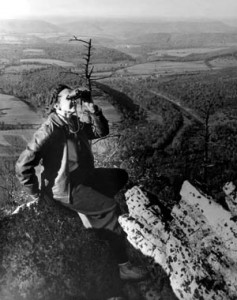
Photo below: Rachel Carson, birding, on a ridge (in Pennsylvania); photo originally found at site of Professor Catherine Lavender, The College of Staten Island of CUNY.

Rachel Carson, birding at Hawk Mountain Sanctuary

Rachel Carson, birding at Hawk Mountain Sanctuary

Read the rest of this entry »


Alma Conference statement pending: Don’t ease DDT restrictions

June 11, 2008

Here is the press release, from Alma College in Alma, Michigan:

Continued Use of DDT Is a Global Health Concern

Scholars who attended the Eugene Kenaga International DDT Conference on Health and the Environment at Alma College are drafting a consensus statement urging global policymakers to reconsider the future use of the synthetic pesticide DDT.

The scholars acknowledge that the use of DDT has prevented millions of infections and deaths from insect-borne diseases, especially malaria. Yet, substantial exposure to DDT poses serious health risks for human populations and the environment, says Edward Lorenz, director of the Public Affairs Institute at Alma College.

“The consensus of the scholars was a recognition of the serious impediments to further restricting DDT use, given that several million people die each year from malaria, most of whom are under the age of five,” says Lorenz. “However, these scholars have documented in numerous human health studies what can be called a ‘deepening understanding of the effects of DDT use on humans.’ The collective wisdom of the experts at the Kenaga Conference was that world policymakers need to use extreme caution when considering easing restrictions on DDT use.”

The March 14 conference attracted international experts in the areas of public health and the environment, including South African scholars Riana Bornman, Henk Bouwman and Christiaan de Jager; Aimin Chen of Creighton University; Barbara Cohn and Brenda Eskenazi of the University of California at Berkeley; Henry Anderson of the Wisconsin Division of Public Health; Suzanne Snedeker of Cornell University; Diane Henshel of Indiana University; Darwin Stapleton of the Rockefeller Archives; Lorenz and John Leipzig of Alma College; and Felicia Leipzig of the Pine River Superfund Citizen Task Force.

The anticipated DDT conference “consensus statement” is expected to list the following summary statements and recommendations, says Lorenz:

  • Repeated use of DDT results in serious health risks for humans.
  • Many sites of chemical-manufacturing facilities continue to be a source of DDT contamination to area residents. While clean-up efforts continue, some DDT proponents, such as John Tierney (New York Times, June 5, 2007), have claimed that, “the billions spent cleaning up Superfund sites would be better spent on more serious dangers.”

“The experts at the DDT Conference unanimously disagree with Tierney’s assessment,” says Lorenz. “Because of the known DDT impacts on human health, the experts not only support continued Superfund clean up, but also endorse assessment of health impacts on residents of communities with DDT sites, such as St. Louis, Mich.”

  • Children and pregnant women in malaria endemic areas where DDT is used are most at risk.
  • Studies have shown that DDT impedes breast milk production, the best source of infant nutrition in many parts of the world.

“Because of the negative impacts on breastfeeding, resulting in more low birth weight babies, communities potentially exposed to DDT to control malaria must be told that the short-term benefits of DDT may spawn longer-term problems,” says Felicia Leipzig.

  • New methods of malaria control should be encouraged and tested.

“Those who are lobbying for DDT use should focus on support for research into alternative chemicals and public health strategies that ultimately will allow for the full phase-out of DDT,” says John Leipzig, director of Alma’s Center for Responsible Leadership.

  • The socio-economic development of malaria-affected communities is the best solution to malaria eradication.
  • Conference experts call for “full support for the Stockholm Convention that will phase out the use of the 12 most dangerous persistent organic pollutants, including DDT,” says Lorenz.

“The Stockholm Convention mandates that each country using DDT have an implementation and management plan on controlling the use of DDT,” he says. “Ultimately it envisions eventual reliance on sustainable methods of disease vector control.”

The scholars argue that sufficient evidence exists that DDT exposure is occurring and posing significant health risks.

“Because of both DDT related Superfund sites and continued use of DDT, exposure to the pesticide is occurring around the world with significant health risks to current and future generations,” says Lorenz.

“The conference experts are challenging policy makers to provide support to further determine health risks associated with DDT exposure in both the developing world and in U.S. communities near contaminated Superfund sites,” he says. “The experts were especially critical of special interests groups and their lobbyists who negate the clear evidence of human health dangers of DDT exposure.”

-mjs-

Other coverage of the Alma DDT Conference at the Bathtub: