May 26, 2007
Here, try this brain teaser.
Girl Scouts of America can be found on the web; some of the stuff at this “Go Tech” site could be useful in the classroom. The design appears to encourage girls to pursue the use of technology, and to open them up to possibilities for careers where women are badly needed, but too seldom go. That becomes clear with this .pdf, 14-page guide for parents, It’s Her Future: Encourage a Girl in Math, Science and Technology.
I wish more organizations would put up sites for kids to use to learn. I’d love to see some interactive sites with great depth on several topics: Geography map skills, navigation, European explorers in the 15th through 20th centuries, market fluctuations for commodities and securities (for economics), Native Americans from 1500 through the 21st century, westward expansion of European colonists in America, time lines of history, great battles, etc., etc. etc.
We are missing the boat when it comes to using computers as tools for learning. Like unicorns and centaurs standing on the dock as Noah sailed away, education as a whole institution and educators individually are missing the boat (with a few notable exceptions — pitifully few).
Where is the Boy Scout site with games and material for the boys?
Spread the word; friends don't allow friends to repeat history.
 Leave a Comment » |
  Boy Scouts of America, Brain development, Brain learning, Girl Scouts, Pedagogy, Science, Teaching, Technology, Technology in the classroom, Weblogs |
  Permalink
 Posted by Ed Darrell
May 25, 2007
The museum is a monument to the failure of education.
o Bob Park, “What’s New,” May 25, 2007
[See full quote below the fold]
Read the rest of this entry »
Spread the word; friends don't allow friends to repeat history.
Leave a Comment » | Bogus history, Creationism, Natural history, Science, Science and faith, Voodoo history | Permalink
Posted by Ed Darrell
May 23, 2007

Today is the 300th birthday of Linnaeus, aka Carl Linnaeus, Carolus Linnaeus, Carl von Linné, Carl Linné, etc. etc. Oh, heck, just call him Carl. Happy birthday, Carl!
At Panda’s Thumb.
Spread the word; friends don't allow friends to repeat history.
Leave a Comment » | Evolution, Heroes, History, Natural history, Science | Permalink
Posted by Ed Darrell
May 22, 2007
European Union rules require member states to do something about indoor air pollution. European states are banning smoking in public places. Gone soon will be days when we can joke about Britons and their Player’s cigarettes, or the French and their Galois habits.
Every once in a while as I recount the great Tobacco/Health Wars, my kids remind me that they never saw a cigarette commercial on television. Once, we caught a showing of past ads, and I was truck nostalgic by Fred Flintstone’s testimony for Winston cigarettes — the kids gasped: “Fred Flintstone used to smoke!”
Everybody smoked, once upon a time, it seemed. 1940s and 1950s magazines have ads in which doctors and athletes claim cigarette smoking is either unharmful, sheer pleasure, or even health promoting. Got a cigarette cough? Switch to menthol cigarettes! Mouth burns? Try a filter cigarette.
Today, kids wonder why Virginia did so well selling tobacco to Britain — who in their right mind would have smoked? they ask.
The Internet Archive has an abundance of film material on tobacco. The films come from the University of California – San Francisco: Read the rest of this entry »
Spread the word; friends don't allow friends to repeat history.
3 Comments | Business Ethics, Current History, Dissent, Economics, First Amendment, Free market economics, Freedom - Economic, Geography - Physical, History, History Revisionism, History video sources, Hoaxes, Movies, On-line education, Politics, Public health, Science | Permalink
Posted by Ed Darrell
May 18, 2007
World Net Daily’s inaccuracies and blatant, fact-bending bias would be the source of much great humor, if so many gullible conservatives did not take the thing seriously.
Recently WND featured a story about the impossibility of changing light bulbs to save energy, alleging that doing so might turn one’s home into a toxic waste dump that costs $2,000 per bulb to clean up. Was anyone suckered in by the story?
According to Snopes.com, both Fox News and the Financial Post also got suckered, probably from the WND story.
Chiefly, that these news outlets got suckered is evidence they need better copy editors and fact checkers. Time for such news organizations to raise the pay of their “morgue” keepers and librarians, to get the facts straight. Read the rest of this entry »
Spread the word; friends don't allow friends to repeat history.
5 Comments | Accuracy, Environmental protection, Hoaxes, Journalism, Politics, Science | Tagged: CFL, Environmental protection, Gullibility, hoax, Journalism ethics, Nasty Politics, Toxic wastes | Permalink
Posted by Ed Darrell
May 17, 2007
What rational person would have thought irrationality could be in such surplus?
My post on the silly opposition to naming a post office after Rachel Carson produced a minor response. Reader Electratig took me to task at his blog.
Criticism is based on interesting claims that millions have died unnecessarily because the entire planet was driven to ban DDT, which is really not toxic to humans, and which really is the panacea that would rid the world of malaria. I’m surprised that DDT isn’t implicated as a cure for the designated hitter rule, too. The criticisms don’t hold so much water as the critics claim, I find. Read the rest of this entry »
Spread the word; friends don't allow friends to repeat history.
2 Comments | Bogus history, Environmental protection, Ethics, History, Science, Voodoo history, Voodoo science | Permalink
Posted by Ed Darrell
May 14, 2007
Some people do things that are so stupid that one wonders how they manage to shave or put make-up on the next morning, having to look at their own face.
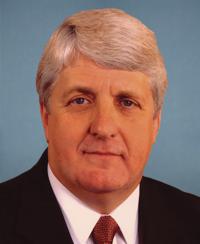
Mugshot of Utah Rep. Rob Bishop
53 Republican representatives voted against naming the post office in Springdale, Pennsylvania, after Rachel Carson, the scientist who wrote Silent Spring, generally considered one of the most important or most influential scientists of the 20th century. No kidding. Springdale is Carson’s hometown.
2007 is the centennial of Carson’s birth — her birthday was May 27. (The bill, H.R. 1434, passed, 334-53.)
Why did the Wacky 53 vote against the honor for Carson, who got the Presidential Medal of Freedom in 1980? In an earnest ritual of voodoo science, they claim that bans on DDT kill millions, and that DDT is harmless. No, I’m not making this up — here’s the story from the Salt Lake Tribune, which covers territory represented by Rep. Rob Bishop and Rep. Chris Cannon, both R-Utah:
They contend that Carson’s actions – which led to a ban on the chemical DDT used to kill pests – actually has caused more deaths because of malaria and other diseases spread by insects. DDT, Carson wrote, was detrimental to the environment and to humans. Some scientists say DDT led to the California condor’s near-extinction.
Read the rest of this entry »
Spread the word; friends don't allow friends to repeat history.
15 Comments | Accuracy, Citizenship, DDT, Environmental protection, Ethics, Malaria, Politics, Rachel Carson, Science, Voodoo science, War on Science | Tagged: DDT, Dr. John Mull, Environmental protection, Malaria, Politics, Rachel Carson, Rampant stupidity, Rep. Rob Bishop, Voodoo science, War on Science, Weber State University | Permalink
Posted by Ed Darrell
May 14, 2007
News out of Ames, Iowa, is that intelligent design advocate, physicist and astronomer Guillermo Gonzalez, was denied tenure at Iowa State University.
Advocates of intelligent design will argue this as evidence of a bias against counter ideas, part of a massive, monolithic conspiracy to hide the truth about intelligent design. Gonzalez will be more circumspect, at least until his appeal of the tenure denial is finished.
Another friend of intelligent design, Dr. Francis Beckwith, a philosopher, was originally denied tenure at Baylor last year. His appeal was successful, however, and he now has tenure at Baylor, though he is moving from the Institute for Church State Relations to the philosophy department. Beckwith also made a splash in conservative evangelical news recently when he made public his return to the Catholic church.
I can’t speak for Iowa State, but it has been my experience that professors who get tangled up in crank science projects get distracted from the work that will get them tenure. While faculty certainly have free speech rights to advocate causes, much of the backing for intelligent design is sub-standard academically, or even bogus. Such advocacy does not help a case for tenure.
Advocates argue that Gonzalez has more than enough publications to meet the standards set by Iowa State, but the numbers do not account for how many of the publications may be in suspect journals that support intelligent design, nor do they account for the publicity an ardent ID advocate brings to a department which is often unwanted. Faculty at Iowa State collected 120 signatures on a petition disowning intelligent design, in what they billed was an attempt to convince the outside world that Iowa State is not “an intelligent design school.”
ID advocates frequently miss the point that science is not a game of racking up publication points, and that the quality and accuracy of the research also plays an important role in tenure decisions.
Wailing and gnashing, and perhaps rending of garments, from the ID group should begin any moment now.
Spread the word; friends don't allow friends to repeat history.
5 Comments | Creationism, Education, Intelligent Design, Research, Science, Science and faith, Teaching, Tenure | Permalink
Posted by Ed Darrell
May 13, 2007
Odd thing happened the other day: The Philadelphia Inquirer carried an editorial that rather accurately described evolution theory. Just when I’m ready to lambaste my colleagues in print media, they come through.
The editorial’s point of departure was the Republican “debate” among presidential contenders, in which they were asked whether they support evolution or creationism. Three of the candidates confessed they don’t “believe” in evolution.
Why did these three, all of whom wish to be the leader of the most powerful country in history, say they did not believe in evolution? There might be thousands of reasons. Perhaps they misheard: “I’m just curious: Is there anyone on this stage who doesn’t believe in elocution?” But two reasons are more likely:
(1) They really don’t think evolution exists. As in, it’s not happening and never did. We got here some other way. There’s no evidence for it.
Uh, yeah, there is. Although technically a theory, Charles Darwin’s version of the evolution of species is a theory-with-the-status-of-fact, robust and vigorous, demonstrated in living color each and every day in field and laboratory everywhere. No jury is “out.” The verdict’s in and everybody’s gone home. Way home.
And,
(2) These men raised their hands because they knew it would get them votes from religious conservatives.
Tancredo, Huckabee and Brownback know they need the Christian conservative vote to win the Republican nomination. Christian conservatives don’t like Rudy Giuliani. They’re lukewarm on John McCain, perplexed by Mitt Romney.
But any candidate who would ignore science to attract conservative votes has made a lousy calculation.
The newspaper’s editorial board concluded:
So, while pundits are calling the evolution flap an embarrassment to the GOP, what it really is is a call to the Republican faithful: “We’re in trouble. If we don’t rally on the wedge issues now, by 2008, a Republican majority may seem as far away as the Planet of the Apes.”

Spread the word; friends don't allow friends to repeat history.
Leave a Comment » | Accuracy, Charles Darwin, Creationism, Darwin, Education, Evolution, Intelligent Design, Public education, Science, Science and faith, Voodoo science | Permalink
Posted by Ed Darrell
May 1, 2007
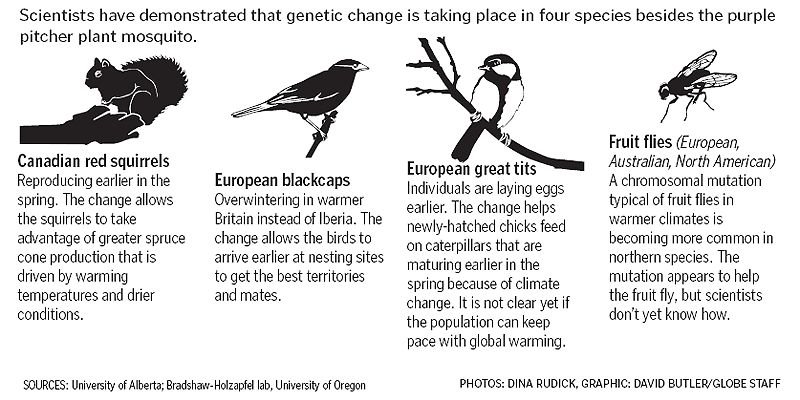
This news can fit into curricula in several ways, in several courses: Insects have already evolved in response to climate shifts due to global warming.
The Boston Globe has a series on global warming, and a recent article detailed how mosquitoes on the Maine frontier have already changed their breeding seasons in response to warming weather.
A mosquito that can barely fly is one of only five known species that scientists say have already evolved because of global warming. The unobtrusive mosquito’s story illustrates a sobering consequence of climate change: The species best suited to adapting may not be the ones people want to survive.
Such news enhances biology studies of genetics and insects, geography studies of climate, animal dispersal patterns and disease and pest ranges (a subject more technically known as biogeography), and the articles lend urgency to studies of how governments react to natural crises, a topic suitable for government classes, economics, and U.S. and world history.
 Click on the thumbnail to see four examples of genetic change credited to global warming. (Graphic by David Butler of the Boston Globe staff.) Read the rest of this entry »
Spread the word; friends don't allow friends to repeat history.
1 Comment | Current History, Disasters, Economics, Education, Environmental protection, Evolution, Geography - Physical, Geography - Political, History, Lesson plans, Natural history, Politics, Science, Teaching, Travel | Permalink
Posted by Ed Darrell
April 30, 2007
Another of the great quirks that makes Texas, Texas, is the Marfa lights. Marfa is in far west Texas — alone, a tiny city in a very arid area. It’s desolate enough that Hollywood thought it would be a great place to film much of the movie “Giant,” which needed to use part of Godforsaken* County to make a point about how desolate Texas can be.
And way out there, there is a hill where one can stop after sundown, and watch the mysterious dancing of lights coming from the not-too-distant hills. So far as I can tell, no good explanation exists for what the lights might be. Physicists have ruled out mirages, and the lights were there long before auto headlights anyway.
Marfa hosts the “Mystery Lights Festival” over Labor Day Weekend (as the story cited above notes, the same weekend as Alpine, Texas, hosts its balloon festival — two West Texas happenings in one trip, perhaps).

Do you know of a good explanation? Anybody got one?
- * No, there is not really a Godforsaken County among Texas’s 254 counties. Teachers wishing to use this in the classroom may want to be aware that there is a very short video of the Marfa lights mystery on “Texas Country Reporter’s” DVD collection commemorating 25 years of stories. Texas Country Reporter also has a DVD collection of visits to Texas State Parks, which is a good source of information about Texas geography. I suspect other DVDs from this company would offer other good geography and history supplements (Texas Country Reporter is broadcast on Channel 8 in the Dallas area, and on other television stations throughout the state).
Spread the word; friends don't allow friends to repeat history.
8 Comments | Geography - Physical, History, Movies, Science, Texas, Texas history, Travel, Video and film | Permalink
Posted by Ed Darrell
April 20, 2007
It’s almost over for this year, but the lesson plans at the site for National Environmental Education Week don’t have to be done in April only. Texas will have a new beefed up science requirement kick in, in a couple of years. Until then, however, this is a good set of ideas, even for social studies, especially if no other class is delivering the material well.
Environmental protection weaves science — biology, chemistry, geology, meteorology, and more — with applied social studies, especially history, economics and government, to make changes. For younger students studies of recycling can be a lot of fun and give students something to take with them for the rest of the life. Similarly, a study of migratory birds and the policy issues related to them (tall buildings, cellular communications towers, oil well sumps, lights in cities, hunting and the Treaty of 1948, etc., etc.) offers a lot of ways to get kids interested, if not excited, about these so-called dry topics. An advanced class in high school might analyze the Supreme Court decisions that brought down the price of shipping of recycled metals, making recycling economically feasible.
Whatever you do, don’t despair: International Migratory Bird Day is just a couple of weeks away. Birding is one of the more fun areas one can use in discussions of climate change and global warming; the Roger Tory Peterson Institute of Natural History points the way to good resources.
Spread the word; friends don't allow friends to repeat history.
Leave a Comment » | Citizenship, Economics, Geography - Physical, Geography - Political, Government, History, Lesson plans, Natural history, Science | Permalink
Posted by Ed Darrell
April 17, 2007
A few hours ago I posted a notice on satellite studies of the uplifting of a part of the Yellowstone Caldera, and I suggested some (weak) links to how to use it in the classroom. In passing I noted that the volcanic rock site southwest of Yellowstone, the Craters of the Moon National Monument, had been used to show astronauts what the Moon would be like when they landed Apollo missions there.
Yellowstone and especially its volcanic features also provided dramatic insights to the origins of life on Earth, especially the rise of life in hot water. These findings advanced the science we now call astrobiology, or the search for life on other planets.
This evening I stumbled across an interesting feature: A full text of a classic 1978 book on thermophilic life in Yellowstone, explaining in greater detail the research conducted there and its significance in astrobiology and evolution. Thomas D. Brock’s book, Thermophilic microorganisms and life at high temperatures (Springer-Verlag, New York, 1978; 465 pages) is just sitting there, online, for anyone to read. 
In this book there is more real science to this one tiny facet of the study of the evolution of life than there is in the entirety of the intelligent design political movement.
I wonder what other gems there may be in that digital collection at the University of Wisconsin.
Below the fold: The frontispiece. Read the rest of this entry »
Spread the word; friends don't allow friends to repeat history.
1 Comment | Books, Darwin, Education, Evolution, Geography - Physical, History, Intelligent Design, Natural history, On-line learning, Public libraries, Science, Space exploration | Permalink
Posted by Ed Darrell
April 16, 2007
Uh-oh. Running behind.
One of the reasons I list various carnivals is to make sure I have a note of the good ones somewhere easy to find. Busy-ness in the last week just kept me away from the keyboard.
Carnivals you ought to check out:
Oekologie 4.1: Over at Behavioral Ecology. Lots on climate change, of course, and some very nice bird photos.
Carnival of the Godless at Neural Gourmet has a good run down of the Blog Against Theocracy, and complaints about it, too.
Carnival of the Liberals #36 is up at Truth in Politics. Well, that’s an obvious pairing. Free speech, the president and the Constitution, tyranny in the Middle East, and quite a bit more.
Carnival of Education #114 is back at The Education Wonks. State legislatures may be wrapping up their sessions, but education issues are heating up.
Skeptics’ Circle #58 finds a hangout at Geek Counterpoint, with several posts that get at how we know what is true — good stuff for historians and economists to ponder.
This is as good a time as any to remind you that that Fiesta de Tejas! #2 is coming up on May 2 — deadline for post nominations April 30. You may e-mail entries to me (edarrellATsbcglobalDOTnet), or submit them at the Blog Carnival portal to the Fiesta.
Spread the word; friends don't allow friends to repeat history.
Leave a Comment » | Curricula, Economics, Education, Education blogs, Education reform, Education spending, Fiesta de Tejas!, Free market economics, Free speech, Freedom - Economic, Freedom - Political, History, History blogs, History video sources, Religious Freedom, School discipline, Science, Science and faith, Teaching, Technology in the classroom, Testing, Texas, Texas Lege, Weblogs | Permalink
Posted by Ed Darrell
April 16, 2007
This is a story about space technology and why we orbit satellites, geography, geology, the risks of living in certain places, and the fun, and perhaps life-saving value, of finding things out. 
This is the kind of science news that excites normal kids and lends outcroppings on which to hang a lesson plan or class warm up: The Yellowstone Caldera is uplifting, according to new satellite measurements. Don’t worry. Yet. Read the rest of this entry »
Spread the word; friends don't allow friends to repeat history.
5 Comments | Geography - Physical, Maps, Science, TEKS, Travel | Permalink
Posted by Ed Darrell