Constitution Day is September 17, 2007. It’s the anniversary of the day in 1787 when 39 men signed their names to the proposed Constitution of the United States of America, to send it off to the Continental Congress, who was asked to send it to specially convened meetings of citizens of the 13 states for ratification. When and if nine of the former colonies ratified it, it would become the document that created a federal government for those nine and any of the other four who joined.
For Texas, the requirement to commemorate the Constitution was changed to “Celebrate Freedom Week” effective 2003. This week is expected to coincide with the week that includes national Veterans Day, November 11. School trustees may change to a different week. (See § 74.33 of the Texas Education Code) Texas does require students to recite a section from the Declaration of Indpendence. (Recitation is highlighted below the fold.)
Knowledge of the Constitution is abysmal, according to most surveys. Students are eager to learn the material, I find, especially when it comes presented in interesting ways, in context of cases that interest the students. The trick is to find those things that make the Constitution interesting, and develop the lesson plans. Some classes will be entertained by Schoolhouse Rock segments; some classes will dive into Supreme Court cases or other serious issues, say the legality of torture of “enemy combatants” or warrantless domestic surveillance. Some classes will like both approaches, on the same day.
Texas teachers have two months to get ready for Celebrate Freedom Week. Constitution Day is just a week away for anyone who wants to do something on September 17.
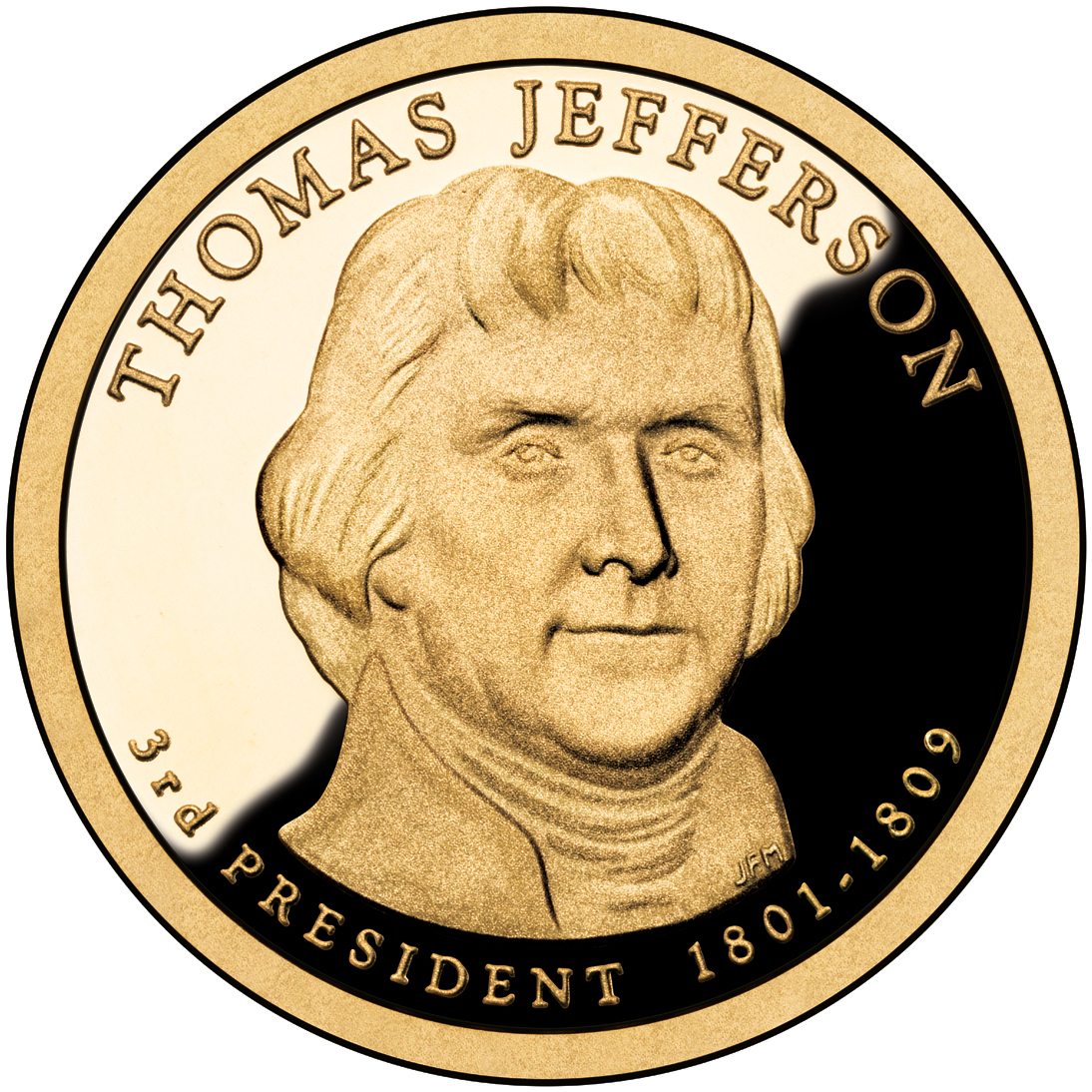
Jefferson dollars will be unveiled today in a ceremony at the Jefferson Memorial in Washington, D.C. They officially go into circulation tomorrow, August 16, 2007.
Jefferson dollars are the third in a series commemorating U.S. presidents. The series started with Washington and will proceed, three new coins a year, through all the presidents. (Quick: What’s the cheapest amount you can invest to get dollars representing all 43 administrations? Don’t forget Grover Cleveland’s anomaly . . .)
History: Fewer than a third of Americans know Jefferson was the third president. They did better with Washington as the first president. I had a few scary moments last year covering a Texas history course when kids kept answering either “George Washington” or “Abraham Lincoln” to the questions, “Who was the the Father of Texas?” (Stephen F. Austin) and “Who was the first president of the Republic of Texas?” (Sam Houston).
Economics: The vending machine industry loses about $1 billion each year when dollar bills jam in the machine’s vending mechanism. The U.S. Mint and vending machine operators hope the dollar coins catch on and help reduce those losses.
Dollar coins are unpopular: This is another in a series of efforts to “wean” people from paper dollars to coins — remember the Sacagawea dollar? The Eisenhower dollar? The Susan B. Anthony dollar? Just last week I got an Eisenhower dollar in change from our local Starbucks — they had mistakenly put it in the coin drawer for quarters. You can get dollar coins in change at the U.S. Post Office, but not at many other places. Our local post office occasionally sneaks a Euro into the dollar change mechanism. Bonus!
Good news today. The supreme court of Cassazione in Italy has ruled that the press campaign labeling “terrorists” the GAP partisans who organized the bombing of Via Rasella in nazi-occupied Rome in 1944, launched by the national newspaper “Il Giornale”, was a striking example of manipulation of historic truth for political means. The newspaper is owned by Paolo Berlusconi (brother of Silvio, formerly premier of Italy in 1994 and 2001-2006), and was directed by Vittorio Feltri . . . a journalist who never hid his sympathy for the extreme right.
The massacre of Fosse Ardeatine (Italian: Eccidio delle Fosse Ardeatine) took place in Rome, Italy during World War II. On 23 March 1944, 2 German soldiers, 31 Italian soldiers of Battaglione Bozen and a few Italian civilians passing along the road, were killed when members of the Italian Resistance set off a bomb close to a column of German soldiers who were marching on via Rasella[1]. This terrorist attack was led by the Gruppi di Azione Patriottica, of Rosario Bentivegna, Carla Capponi, Antonello Trombadori (Head of GAP in Roma) and the approval of Sandro Pertini (later President of Italian Republic), in order to provocate the reaction of SS troops.
Adolf Hitler is reported but never confirmed to have ordered that within 24 hours, one-hundred Italians were to be shot for each dead German. Commander Herbert Kappler in Rome concluded that ten Italians for each dead German would be sufficient and quickly compiled a list of 320 civilians who were to be killed. Kappler voluntarily added ten more names to the list when the 33rd German/Italian died after the Partisan attack. The total number of people murdered at the Fosse Ardeatine was 335, most Italians. The largest cohesive group among the murdered were the members of Bandiera Rossa, a Communist military Resistance group.
Texas kids test particularly badly in this part of U.S. history. Several districts ask U.S. history teachers and other social studies groups to shore up student knowledge in the area to overcome gaps pointed out in testing in the past three years, on the Texas Assessment of Knowledge and Skills (TAKS). In teacher training, I’ve noted a lot of Texas social studies teachers are a bit shaky on the history.
The Korematsu decision was drummed into my conscious working on civil rights issues at the Senate Labor and Human Resources Committee, and complemented by Constitutional Law (thank you, Mary Cheh) and other courses I was taking at the same time at George Washington University. It helped that Utah has a significant Japanese population and had “hosted” one of the internment camps; one of my tasks was to be sure committee Chairman Orrin Hatch was up on issues and concerns when he met with Japanese descendants in his constituencies in Utah. Hatch was a cosponsor of the bills to study the internment, and then to apologize to Japanese Americans affected, and pay reparations.
The internment was also a sore spot with my father, G. Paul Darrell, who witnessed the rounding up of American citizens in California. Many of those arrested were his friends, business associates and acquaintances. Those events formed a standard against which he measured almost all other claims of civil rights violations.
Because children were imprisoned with their parents, because a lot of teenagers were imprisoned, this chunk of American history strikes particular sympathetic chords with students of any conscience. Dorothea Lange’s having photographed some of the events and places, as well as Ansel Adams and others, also leaves a rich pictorial history.
New teachers, especially teachers from alternative certification programs, have all sorts of stories about people who observe and supervise their training and work.
There is the guy whose district bought laptops for every high school student and insisted teachers use the computers daily, but whose principal refused to look at the on-line courses he had developed to meet the district’s guidelines (and whom the principal subsequently rated down for not having the lesson plans the principal refused to look at). There is the drama coach whose supervisor complained the students shouldn’t have been out of school for the state competition, which they won. There is the mathematician from the telecommunications industry whose supervisor didn’t know geometry, or algebra, or calculus, and insisted the teacher should be offering multiplication table timed quizzes to advanced math classes. The guy whose principal thought history documentaries selected from the school’s libraries were just Hollywood movies, and therefore inappropriate for history classes.
More than enough horror stories to go around.
One teacher tells a few horror stories from his student teaching days, but tells us he went on to get his school’s distinguished alumnus award. And so, he shares some of his best material, here: Horace Mann Educated Financial Solutions, “Reach Every Child.”
When the elder Fillmore’s Bathtub son attended intermediate school, he complained of the discipline. So did a lot of other good kids. We got a call from a parent asking if we’d join in a meeting with the new principal, and hoping to learn things were really hunky dory and offer assurances to our son, we went.
The Texas Senate passed a bill to change the current state-mandated test for high school students. Tests are not a panacea, and the current structure seems to be doing more damage than good, in dropout rates, and especially in learning. What will take the place of the Texas Assessment of Knowledge and Skills (TAKS)? No one knows, yet. Much work to do — but there is widespread understanding that TAKS is not doing much of what was hoped.
Incentive pay for teachers: Despite a cantakerous and troubled roll-out in Houston’s schools, and despite widespread discontent with the execution of incentive pay programs that appear to miss their targets of rewarding good teachers who teach their students will, Texas has identified 1,132 schools in the state that are eligible for the next phase of the $100 million teacher incentive program. Some administrators think that, no matter how a program misfires, they can’t change it once they’ve started it. ‘Stay the course, no matter the damage,’ seems to be the battle cry. (And you wondered where Bush got the idea?)
Psychology rests out on the end of the science spectrum, closer to “social sciences” than other branches of hard, research science, and sometimes affiliated with the pseudo-scientific, even while debunking false claims, such as the studies of parapsychology. Were there scientific merit in claims of evidence for supernatural design, psychology would be a natural home for most of the claims and much of the research. If any branch of science were to endorse intelligent design as science, psychology would be a likely first branch.
But not even psychology accepts intelligent design as science.
This should be a serious blow to advocates of intelligent design who had hoped to make some recovery after the devastating loss in federal court in Pennsylvania in 2005, in the next round of textbook approvals in large states like California, Florida and Texas. There is no comment yet from the Discovery Institute, the leading organization in the assault on teaching evolution in public schools.
The site has grown into a 34,000-square-foot site featuring indoor exhibit space. Located on six acres now, the center includes the George Bush Gallery, the Admiral Nimitz Museum, the Plaza of the Presidents, the Veterans’ Walk of Honor and Memorial Wall, the Japanese Garden of Peace, the Pacific Combat Zone and the Center for Pacific War Studies.
With the conclusion of this large renovation project that began in 2004, museum coordinators are turning their attentions to another big project. An additional 40,000-square-foot expansion is planned in the future, with ground-breaking set this spring.
I can’t find, but I hope that, the renovations include space for scholars to study, and especially for high school students to learn. Austin-area high schools would be lining up to make overnight field trips — but for the restrictions put on teaching and learning by Texas’ testing system, the limiting list of Texas Essential Knowledge and Skills (TEKS), and the test, the Texas Assessment of Knowledge and Skills (TAKS) .
Advocates of using pay to improve teacher performance grow excited over the addition of federal money to supplement local district pay incentives. But maybe they shouldn’t.
Contrary to other provisions of the No Child Left Behind Act (NCLB), there is little research to demonstrate that paying a few teachers more will improve student performance. Cheapskates looking for quick solutions advocate pay incentives, though, and some districts have plunged headlong.
Houston is reaping the whirlwind at the moment. Incentive pay went out earlier this week, and disparities showed up immediately.
It would be appropriate, in a way, for Houston teachers who are upset that they didn’t get bonuses to protest by calling in sick.
Or by stamping their feet and crying.
Or by holding their breath until they turn blue.
It would be appropriate, in a way, because it would be an immature response to an immature accountability system.
I’m not being snide about HISD’s bonus formula, despite some of the anomalies that have been identified, including no bonus for a teacher whose entire class passed the TAKS test nor for a teacher who had been recognized as bilingual teacher of the year.
There are several articles available on the payout, the way the plan is structured, and the problems. I understand the Houston Chronicle also has a web site featuring details of the payouts, including teachers by name, and amounts paid.
This is a great de-motivator. Who thought this through? No one.
If you haven’t seen it, you may be in a minority that includes mostly people without internet access.
The story behind it is rather innocent and charming. Matt Harding, a young American computer programmer working in Australia, decided to spend a year touring the world. Somewhere along the line he got the idea to shoot video of himself dancing in various places. He posted in on YouTube. A chewing gum company saw the thing, and for reasons known only to public relations freaks and geniuses, called Matt to do it again, with better production quality, for a bit of publicity. So there are two videos of Matt Harding dancing, in exotic and interesting places.
Is there a lesson plan in here for history and other social studies? I think so. This can go directly to the issue of how we know what we know, and what are primary and secondary sources for history, as tested in Texas’s Assessment of Knowledge and Skills (TAKS).
There are several ways to use these videos, when I sit down to think about them for a moment, listed below the fold. Read the rest of this entry »
Spread the word; friends don't allow friends to repeat history.
This period is not well understood by Texas history students, according to the Texas Assessment of Knowledge and Skills (TAKS) tests of the past few years. Here’s a new book that should be incorporated into lesson plans for 7th grade Texas history courses, who will be coming into the Dust Bowl period sometime after the first of the year on most calendars.
It’s amazing what is not available on video for use in the classroom.
Texas kids have to study the “Grito de Dolores” in the 7th grade — the “Cry from Dolores” in one translation, or the “Cry of Pain” in another (puns in Spanish! Do kids get it?). Father Miguel Hidalgo y Castillo made the speech on September 16, 1810, upon the news that Spanish authorities had learned of his conspiracy to revolt for independence. The revolution had been planned for December 8, but Hidalgo decided it had to start early.
Hidalgo himself was captured by the Spanish in 1811, and executed.
It’s a great story. It’s a good speech, what little we have of it (Hidalgo used no text, and we work from remembered versions).
Why isn’t there a good 10- to 15-minute video on the thing for classroom use? Get a good actor to do the speech, it could be a hit. Where is the video when we need it?
Statue of Father Hidalgo in Dolores, Mexico
Spread the word; friends don't allow friends to repeat history.
Or, until that account is unsuspended by the forces supporting Donald Trump: Follow @FillmoreWhite, the account of the Millard Fillmore White House Library
We've been soaking in the Bathtub for several months, long enough that some of the links we've used have gone to the Great Internet in the Sky.
If you find a dead link, please leave a comment to that post, and tell us what link has expired.
Thanks!
Retired teacher of law, economics, history, AP government, psychology and science. Former speechwriter, press guy and legislative aide in U.S. Senate. Former Department of Education. Former airline real estate, telecom towers, Big 6 (that old!) consultant. Lab and field research in air pollution control.
My blog, Millard Fillmore's Bathtub, is a continuing experiment to test how to use blogs to improve and speed up learning processes for students, perhaps by making some of the courses actually interesting. It is a blog for teachers, to see if we can use blogs. It is for people interested in social studies and social studies education, to see if we can learn to get it right. It's a blog for science fans, to promote good science and good science policy. It's a blog for people interested in good government and how to achieve it.
BS in Mass Communication, University of Utah
Graduate study in Rhetoric and Speech Communication, University of Arizona
JD from the National Law Center, George Washington University


 Posted by Ed Darrell





 Millard Fillmore's Bathtub