January 9 – fly your flag today for Connecticut statehood

January 9, 2013

There were not states at all, yet.  But on January 9, 1788, Connecticut became the fifth of the 13 colonies to ratify the proposed Constitution for the United States of America.  Within 12 months, four more colonies ratified the document, making it effective.  When the government of the new nation started functioning in 1789, Connecticut was counted as the fifth state.

Connecticut capitol building, Hartford

Capitol building for Connecticut in Hartford; this photo is from the rear of the building, so the U.S. flag is flying correctly on its own right. The building was completed in 1878. The dome is covered in gold. Image from Wikimedia Commons

To avoid political scheming by anti-federalist colony governors, especially Patrick Henry in Virginia, in September 1787 James Madison proposed that the draft constitution be ratified not by legislatures in the colonies, but instead by a specially-called convention of the people of the colony.  Connecticut’s convention met first on January 3, 1788, and with six days of discussion and debate, passed a resolution of ratification on January 9.

So by tradition, January 9 is Connecticut’s statehood anniversary.  According to U.S. law, citizens and residents of a state should fly their flags on statehood anniversaries.

More:

Carol Highsmith photo of Connecticut's Hall of Flags

Hall of Flags in the Connecticut State Capitol Building; photo by the great photo-historian Carol Highsmith, from the Library of Congress collection; the statue is Connecticut’s Civil War Governor, William A. Buckingham (1804-1875), honored for his personal contributions to the equipping of Connecticut’s men fighting in the Civil War;.


225 years ago today, in this room

September 17, 2012

Independence Hall, Philadelphia; room where the Constitution was created and signed; Dept of Interior photo

Caption from Department of Interior’s Tumblr site: 225 years ago today, the Constitution of the United States was signed in Independence Hall. Today, you can tour the Hall and see where the Declaration of Independence and Constitution were both signed, and you can also view the Liberty Bell [close by]. This is a site not to miss while visiting Philadelphia.
Photo: National Park Service

Does this room look a little familiar?  You’ve probably seen Howard Chandler Christy’s painting of the event we celebrate today.

Howard Chandler Christy’s “Signing of the Constitution,” 1940

Howard Chandler Christy’s “Signing of the Constitution,” 1940; Architect of the Capitol image. This massive, 20′ x 30′ painting hangs in the House Wing of the U.S. Capitol, in the east stairway — a location where, alas, most people cannot get to without a guide anymore.

Click to the Architect of the Capitol’s site for the story of the painting, intended by Congress to fill a gap in the story of America told by art in the Rotunda and throughout the halls of the building.

Dr. Gordon Lloyd, Pepperdine University, creator of the interactive

Dr. Gordon Lloyd, Pepperdine University’s School of Public Policy, and expert in the Constitution and its history.  I met Lloyd almost a decade ago, in programs for history teachers, sponsored by the Bill of Rights Institute, Liberty Fund, and National Endowment for the Humanities.

My old friend Dr. Gordon Lloyd of Pepperdine University, working with the Ashbrook Center for Public Affairs, created a study tool from the Christy painting which should be used a lot more in classrooms.  Click over to the Edsitement site, and see for yourself.

Every year there are a few more tools on the internet to study the Constitution with, for teachers to use in the classroom on Constitution Day and every day.  I wonder what will be the effects in another decade.

How important is it that students learn the Constitution, what it says, and how it affects our daily lives?  How important is it that students learn the history of the creation of the Constitution, and does that history reverberate for those students as they venture out into their roles as citizens in the republic created by the document?

More:


Fly your flag today, Constitution Day 2012

September 17, 2012


Did you remember to put your flag up today?  September 17 is Constitution, one of the score of dates on which Congress recommends everyone to fly their U.S. flag.

Flag at Fort McHenry in Baltimore, with fireworks - National Park Service image

U.S. flag flying at Fort McHenry in Baltimore, with fireworks – National Park Service image. Fort McHenry is one of the sites Congress designated to fly the flag 24 hours a day, lighted or not.


Constitution Day, September 17, 2012

September 17, 2012

Happy Constitution day!  (Remember to fly your flag today.)

Have you read the U.S. Constitution lately?

First page of the U.S. Constitution, National Archives and Records Administration photo

First page of the U.S. Constitution, National Archives and Records Administration photo

Okay, maybe that’s a little tough to read.  Check out the on-line display of the National Archives and Records Administration in the Charters of Freedom section:

More:


Rotunda for the charters of Freedom at Nationa...

Rotunda for the charters of Freedom at National Archives (NARA) building in Washington, D.C. Here displayed are the Declaration of Independence, the Bill of Rights, and the U.S. Constitution. (Photo credit: Wikipedia)


First Amendment: Still engraved in stone

August 18, 2012

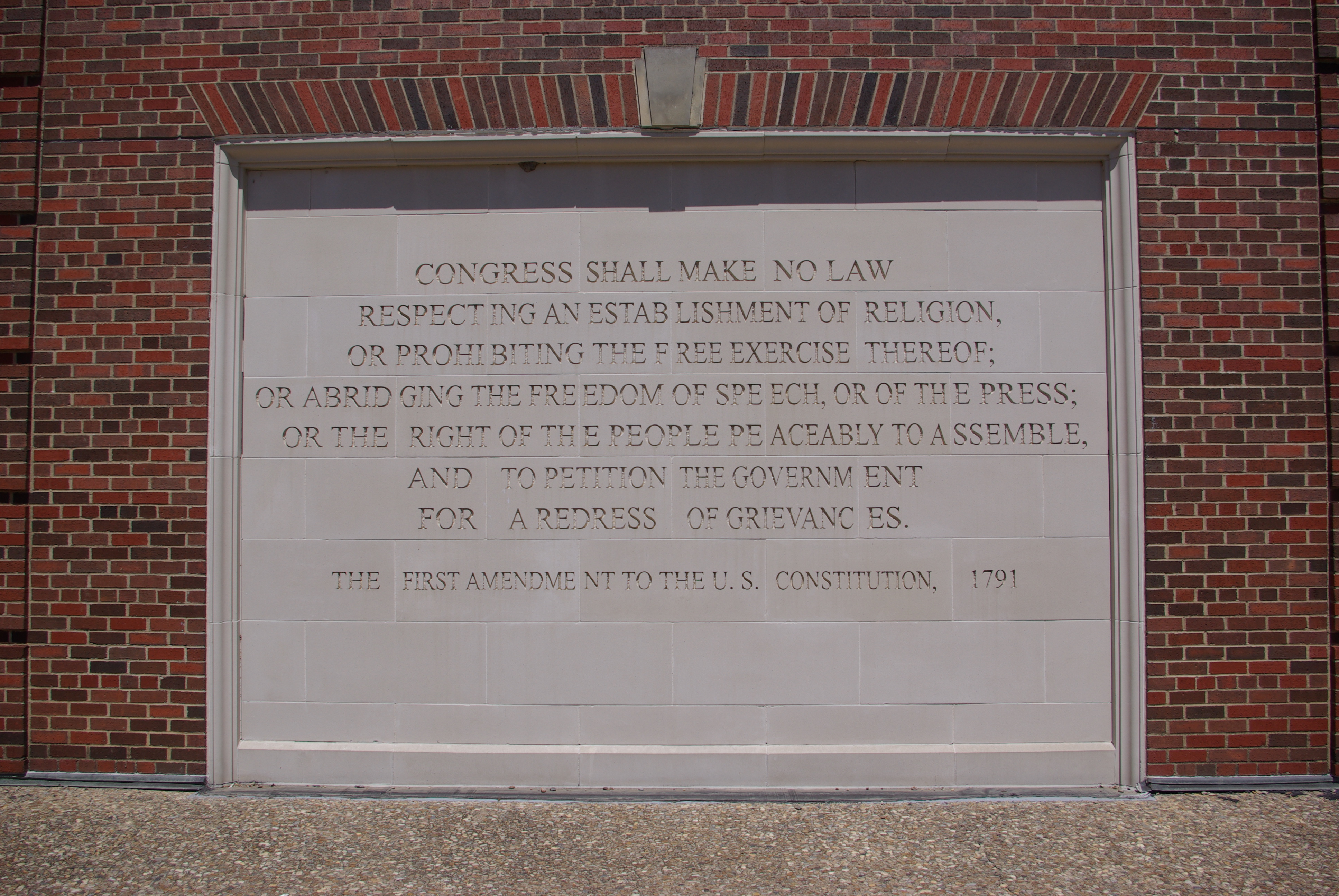
In a discussion about teaching evolution in biology classes a few years ago, I had carefully explained how and why the First Amendment does not require creationism to be taught in biology classes, and in fact is the reason that creationism isn’t taught, in the Establishment Clause. My explanation irritated the tarnation out of a creationist woman who exclaimed, “Well, it’s not like the First Amendment is engraved in stone!”

Heh. Guess what I found at Southern Methodist University. There, outside the main door of the Umphrey Lee Center, which houses the Department of Economics and the Division of Journalism of the Meadows School for the Arts:

The First Amendment, at SMU

This is an encore post from April 2008.

More:


If it’s an election year, it must be Bogus Quote Time! Patrick Henry on the Constitution

August 14, 2012

Keep your collections of Jefferson, Madison, Lincoln, and “the founders” close to you, and right next to your Bartlett’s or Yale.  It’s an election year, and that means people are pulling out all the stops to get you to act against your interests and common sense, including making up stuff that they claim famous people said.

This quote falsely attributed to Patrick Henry piqued my interest last night:

“The Constitution is not an instrument for the government to restrain the people, it is an instrument for the people to restrain the government.”  ~ Patrick Henry

Patrick Henry before the House of Burgesses, painting by Peter F. Rothermel

As the painter imagined it, Patrick Henry before the House of Burgesses, by Peter F. Rothermel. The painting was done in 1851, 52 years after Henry’s death. It commemorates his famous speech against the Stamp Act of 1775, “If this be treason, make the most of it.”  Henry was both fiery in oration and stubborn in policy; it is unlikely that he would have abandoned his staunch opposition to the U.S. Constitution, to praise its defenses of individual rights, the very thing he criticized it for failing to do.

How do we know Patrick Henry did not say it?

Recall, you students of history, that Patrick Henry bitterly opposed the Constitution and its ratification.  He considered it too much government, too much intrusions of a centralized, federal government over the states and the citizens of Virginia in particular.

Henry refused to serve when elected delegate to the convention in Philadelphia in 1787.  Henry made it clear that he opposed any new charter of government that set up a real, workable, national government. Henry held considerable sway in Virginia — he was serving one of his six terms as governor, and he had the legislature wrapped around his finger, doing his bidding.  Because of that, James Madison devised a plan for ratification that excluded governors and state legislatures, but instead asked for ratification by the people of each state, in specially-called conventions.

Henry tried to stack the Virginia convention against ratification.  He did his best scuttle Madison’s attending.  Henry thundered against the Constitution from the floor of the convention, claiming that it would forever trample the rights of citizens.  Partly as a result, and partly to get the document approved, Madison pledged that he would create a bill of rights to clarify protections of citizens.  Madison thought that rights were already protected, but he conceded for political reasons.

Madison won in the convention, and Virginia voted to ratify the Constitution.  Henry was livid.

To prevent Madison from creating a bill of rights, Henry fixed the election of the new senators in the state legislature, excluding Madison.  If Madison were to carry out his promise, he’d have to get elected to the House of Representatives — but as a popular man in his home county, that should not have been a problem.  Henry persuaded the only man in the county more popular than Madison, James Monroe, to run against Madison.  It’s a great story, but for another time — Madison eked out the win.

Henry opposed ratification of any of the twelve amendments Madison proposed, which Congress approved.  Eventually ten of the amendments won ratification; we call those ten our Bill of Rights.

President-elect George Washington asked Henry to serve in the new government, perhaps in the president’s cabinet as Secretary of State.  Henry refused.  Supreme Court?  Henry refused.

Get the picture yet?  Patrick Henry was not a fan of the U.S. Constitution.  He complained that it fettered citizens of the states, and that it fettered the states.

How likely is it that he would then turn around and praise the document as a tool for restraining the state against the citizen?  Henry was a stubborn man.  It is not likely.

On history alone, then, we should regard that quote attributed to Henry as bogus.  It’s a fake, a sham, a blot on Henry’s legacy and a warping of history.  Heck, it covers up great stories about Henry fighting the Constitution — it’s not much fun, either.

The words offered most likely never crossed Patrick Henry’s mind, let alone his lips.  Of course, this quote shows up at many so-called patriotic sites — none with good attribution.  I was interested to find this very statement at Wikiquotes, listed under quotes misattributed to Henry:

The Constitution is not an instrument for the government to restrain the people, it is an instrument for the people to restrain the government — lest it come to dominate our lives and interests.

More and Related Material:

Save


Go to the original source: Supreme Court’s decision on Obamacare

June 28, 2012

You can read the entire decision here:  http://www.supremecourt.gov/opinions/11pdf/11-393c3a2.pdf

5-4 decision, Chief Justice Roberts voting to uphold the bill, Kennedy voting against and leading the dissent.

Official 2005 photo of Chief Justice John G. R...

Official 2005 photo of Chief Justice John G. Roberts (Photo credit: Wikipedia)

Syllabus from the case (links added for your convenience, not in the original):

NATIONAL FEDERATION OF INDEPENDENT BUSINESS ET AL. v. SEBELIUS, SECRETARY OF
HEALTH AND HUMAN SERVICES, ET AL.
CERTIORARI TO THE UNITED STATES COURT OF APPEALS FOR THE ELEVENTH CIRCUIT
No. 11–393. Argued March 26, 27, 28, 2012—Decided June 28, 2012*

*Together with No. 11–398, Department of Health and Human Services et al. v. Florida et al., and No. 11–400, Florida et al. v. Department of Health and Human Services et al., also on certiorari to the same court.

In 2010, Congress enacted the Patient Protection and Affordable Care Act in order to increase the number of Americans covered by health insurance and decrease the cost of health care. One key provision is the individual mandate, which requires most Americans to maintain“minimum essential” health insurance coverage. 26 U. S. C. §5000A.For individuals who are not exempt, and who do not receive health insurance through an employer or government program, the means of satisfying the requirement is to purchase insurance from a private company. Beginning in 2014, those who do not comply with the mandate must make a “[s]hared responsibility payment” to the Federal Government. §5000A(b)(1). The Act provides that this “penalty”will be paid to the Internal Revenue Service with an individual’s taxes, and “shall be assessed and collected in the same manner” as tax penalties. §§5000A(c), (g)(1). Another key provision of the Act is the Medicaid expansion. The current Medicaid program offers federal funding to States to assist pregnant women, children, needy families, the blind, the elderly, and the disabled in obtaining medical care. 42 U. S. C. §1396d(a). The Affordable Care Act expands the scope of the Medicaid program and increases the number of individuals the States must cover. For example, the Act requires state programs to provide Medicaid coverage by 2014 to adults with incomes up to 133 percent of the federal poverty level, whereas many States now cover adults with children only if their income is considerably lower, and do not cover childless adults at all. §1396a(a)(10)(A)(i)(VIII). The Act increases federal funding to cover the States’ costs in expanding Medicaid coverage. §1396d(y)(1). But if a State does not comply with the Act’s new coverage requirements, it may lose not only the federal funding for those requirements, but all of its federal Medicaid funds. §1396c.

Twenty-six States, several individuals, and the National Federation of Independent Business brought suit in Federal District Court,challenging the constitutionality of the individual mandate and the Medicaid expansion. The Court of Appeals for the Eleventh Circuit upheld the Medicaid expansion as a valid exercise of Congress’s spending power, but concluded that Congress lacked authority to enact the individual mandate. Finding the mandate severable from the Act’s other provisions, the Eleventh Circuit left the rest of the Act intact.

Held: The judgment is affirmed in part and reversed in part.
648 F. 3d 1235, affirmed in part and reversed in part.

1. CHIEF JUSTICE ROBERTS delivered the opinion of the Court with respect to Part II, concluding that the Anti-Injunction Act does not bar this suit.
The Anti-Injunction Act provides that “no suit for the purpose of restraining the assessment or collection of any tax shall be maintained in any court by any person,” 26 U. S. C. §7421(a), so that those subject to a tax must first pay it and then sue for a refund. The present challenge seeks to restrain the collection of the shared responsibility payment from those who do not comply with the individual mandate. But Congress did not intend the payment to be treated as a “tax” for purposes of the Anti-Injunction Act. The Affordable Care Act describes the payment as a “penalty,” not a “tax.” That label cannot control whether the payment is a tax for purposes of the Constitution, but it does determine the application of the Anti-Injunction Act. The Anti-Injunction Act therefore does not bar this suit. Pp. 11–15.

2. CHIEF JUSTICE ROBERTS concluded in Part III–A that the individual mandate is not a valid exercise of Congress’s power under the Commerce Clause and the Necessary and Proper Clause. Pp. 16–30.

(a) The Constitution grants Congress the power to “regulate Commerce.” Art. I, §8, cl. 3 (emphasis added). The power to regulate commerce presupposes the existence of commercial activity to be regulated. This Court’s precedent reflects this understanding: As expansive as this Court’s cases construing the scope of the commerce power have been, they uniformly describe the power as reaching “activity.” E.g., United States v. Lopez, 514 U. S. 549, 560. The individual mandate, however, does not regulate existing commercial activity. It instead compels individuals to become active in commerce by purchasing a product, on the ground that their failure to do so  affects commerce.

Construing the Commerce Clause to permit Congress to regulate individuals precisely because they are doing nothing would open a new and potentially vast domain to congressional authority. Congress already possesses expansive power to regulate what people do. Upholding the Affordable Care Act under the Commerce Clause would give Congress the same license to regulate what people do not do. The Framers knew the difference between doing something and doing nothing. They gave Congress the power to regulate commerce, not to compel it. Ignoring that distinction would undermine the principle that the Federal Government is a government of limited and enumerated powers. The individual mandate thus cannot be sustained under Congress’s power to “regulate Commerce.” Pp. 16–27.

(b) Nor can the individual mandate be sustained under the Necessary and Proper Clause as an integral part of the Affordable Care Act’s other reforms. Each of this Court’s prior cases upholding laws under that Clause involved exercises of authority derivative of, and in service to, a granted power. E.g., United States v. Comstock, 560 U.S. ___. The individual mandate, by contrast, vests Congress with the extraordinary ability to create the necessary predicate to the exercise of an enumerated power and draw within its regulatory scope those who would otherwise be outside of it. Even if the individual mandate is “necessary” to the Affordable Care Act’s other reforms, such an expansion of federal power is not a “proper” means for making those reforms effective. Pp. 27–30.

3. CHIEF JUSTICE ROBERTS concluded in Part III–B that the individual mandate must be construed as imposing a tax on those who do not have health insurance, if such a construction is reasonable.

The most straightforward reading of the individual mandate is that it commands individuals to purchase insurance. But, for the reasons explained, the Commerce Clause does not give Congress that power.It is therefore necessary to turn to the Government’s alternative argument: that the mandate may be upheld as within Congress’s power to “lay and collect Taxes.” Art. I, §8, cl. 1. In pressing its taxing power argument, the Government asks the Court to view the mandate as imposing a tax on those who do not buy that product. Because “every reasonable construction must be resorted to, in order to save a statute from unconstitutionality,” Hooper v. California, 155 U. S. 648, 657, the question is whether it is “fairly possible” to interpret the mandate as imposing such a tax, Crowell v. Benson, 285 U. S. 22, 62. Pp. 31–32.

4. CHIEF JUSTICE ROBERTS delivered the opinion of the Court with respect to Part III–C, concluding that the individual mandate may be upheld as within Congress’s power under the Taxing Clause. Pp. 33–44.

(a) The Affordable Care Act describes the “[s]hared responsibility payment” as a “penalty,” not a “tax.” That label is fatal to the application of the Anti-Injunction Act. It does not, however, control whether an exaction is within Congress’s power to tax. In answering that constitutional question, this Court follows a functional approach,“[d]isregarding the designation of the exaction, and viewing its substance and application.” United States v. Constantine, 296 U. S. 287,
294. Pp. 33–35.

(b) Such an analysis suggests that the shared responsibility payment may for constitutional purposes be considered a tax. The payment is not so high that there is really no choice but to buy health insurance; the payment is not limited to willful violations, as penalties for unlawful acts often are; and the payment is collected solely by the IRS through the normal means of taxation. Cf. Bailey v. Drexel Furniture Co., 259 U. S. 20, 36–37. None of this is to say that payment is not intended to induce the purchase of health insurance. But the mandate need not be read to declare that failing to do so is unlawful. Neither the Affordable Care Act nor any other law attaches negative legal consequences to not buying health insurance, beyond requiring a payment to the IRS. And Congress’s choice of language—stating that individuals “shall” obtain insurance or pay a “penalty”—does not require reading §5000A as punishing unlawful conduct. It may also be read as imposing a tax on those who go without insurance. See New York v. United States, 505 U. S. 144, 169–174. Pp. 35–40.

(c) Even if the mandate may reasonably be characterized as a tax, it must still comply with the Direct Tax Clause, which provides:“No Capitation, or other direct, Tax shall be laid, unless in Proportion to the Census or Enumeration herein before directed to be taken.” Art. I, §9, cl. 4. A tax on going without health insurance is not like a capitation or other direct tax under this Court’s precedents. It therefore need not be apportioned so that each State pays in proportion to its population. Pp. 40–41.

5. CHIEF JUSTICE ROBERTS, joined by JUSTICE BREYER and JUSTICE KAGAN, concluded in Part IV that the Medicaid expansion violates the Constitution by threatening States with the loss of their existing Medicaid funding if they decline to comply with the expansion. Pp. 45–58.

(a) The Spending Clause grants Congress the power “to pay the Debts and provide for the . . . general Welfare of the United States.” Art. I, §8, cl. 1. Congress may use this power to establish cooperative state-federal Spending Clause programs. The legitimacy of Spending Clause legislation, however, depends on whether a State voluntarily and knowingly accepts the terms of such programs. Pennhurst State School and Hospital v. Halderman, 451 U. S. 1, 17. “[T]he Constitution simply does not give Congress the authority to require the States to regulate.” New York v. United States, 505 U. S. 144, 178. When Congress threatens to terminate other grants as a means of pressuring the States to accept a Spending Clause program, the legislation runs counter to this Nation’s system of federalism. Cf. South Dakota v. Dole, 483 U. S. 203, 211. Pp. 45–51.

(b) Section 1396c gives the Secretary of Health and Human Services the authority to penalize States that choose not to participate in the Medicaid expansion by taking away their existing Medicaid funding. 42 U. S. C. §1396c. The threatened loss of over 10 percent of a State’s overall budget is economic dragooning that leaves the States with no real option but to acquiesce in the Medicaid expansion. The Government claims that the expansion is properly viewed as only a modification of the existing program, and that this modification is permissible because Congress reserved the “right to alter, amend, or repeal any provision” of Medicaid. §1304. But the expansion accomplishes a shift in kind, not merely degree. The original program was designed to cover medical services for particular categories of vulnerable individuals. Under the Affordable Care Act, Medicaid is transformed into a program to meet the health care needs of the entire nonelderly population with income below 133 percent of the poverty level. A State could hardly anticipate that Congress’s reservation of the right to “alter” or “amend” the Medicaid program included the power to transform it so dramatically. The Medicaid expansion thus violates the Constitution by threatening States with the loss of their existing Medicaid funding if they decline to comply with the expansion. Pp. 51–55.

(c) The constitutional violation is fully remedied by precluding the Secretary from applying §1396c to withdraw existing Medicaid funds for failure to comply with the requirements set out in the expansion. See §1303. The other provisions of the Affordable Care Act are not affected. Congress would have wanted the rest of the Act to stand, had it known that States would have a genuine choice whether to participate in the Medicaid expansion. Pp. 55–58.

6. JUSTICE GINSBURG, joined by JUSTICE SOTOMAYOR, is of the view that the Spending Clause does not preclude the Secretary from withholding Medicaid funds based on a State’s refusal to comply with the expanded Medicaid program. But given the majority view, she agrees with THE CHIEF JUSTICE’s conclusion in Part IV–B that the Medicaid Act’s severability clause, 42 U. S. C. §1303, determines the appropriate remedy. Because THE CHIEF JUSTICE finds the withholding—not the granting—of federal funds incompatible with the Spending Clause, Congress’ extension of Medicaid remains available to any State that affirms its willingness to participate. Even absent §1303’scommand, the Court would have no warrant to invalidate the funding offered by the Medicaid expansion, and surely no basis to tear down the ACA in its entirety. When a court confronts an unconstitutional statute, its endeavor must be to conserve, not destroy, the legislation. See, e.g., Ayotte v. Planned Parenthood of Northern New Eng., 546 U. S. 320, 328–330. Pp. 60–61.

Read the entire decision, and its dissents, for the authoritative view . . .

Earlier related articles:


“Fighting to prevent this,” still – World War II poster

June 17, 2012

Think American Institute. “We’re Fighting to Prevent This.” Rochester, New York: Kelly Read, 1943. Prints and Photographs Division, Library of Congress

Think American Institute. “We’re Fighting to Prevent This.” Rochester, New York: Kelly Read, 1943. Prints and Photographs Division, Library of Congress

Both Republicans and Democrats might make a claim on this poster, today.

Propaganda for patriots, from World War II, from collections now held by the Library of Congress.


Still looking? Again, here’s how to find “separation of church and state” in the Constitution

May 16, 2012

It’s an election year. People get crazy. I’ve already heard from a dozen wacko candidates that “separation of church and state isn’t in the Constitution.”

Yes it is. Separation of church and state resides in the Constitution.  Here’s a post from 2010 to help them find it.

_____________

It’s been at least 20 years since I first heard the old canard of an argument that “there’s no separation of church and state in the Constitution.” I think I first heard it attributed to David Barton, which would make sense, since he doesn’t understand the Constitution, but neither does he fear sharing his misunderstandings.

It was an incorrect statement then, and it’s been incorrect since September 1787. Separation of state and church is woven throughout the Constitution, part of the warp and woof.

Recently, latter-day Constitution ignorami repeat the old canard.

Toles cartoon on dangers of marrying church and state

Toles cartoon on dangers of marrying church and state

I was surprised to discover I’ve not posted this before on this blog. So here’s a slightly-edited version of a response I gave many months ago to someone who made that silly claim, a basic description that I developed years ago to explain the issue, in speeches by members of the Senate Subcommittee on the Constitution:

Separation of church and state: It’s in the Constitution.

I don’t play a constitutional lawyer on television, I am one*, but it seems to me anyone can read the Constitution and see. Especially if one understands that the Constitution sets up a limited government, that is, as Madison described, one that can do only what is delegated to it. The Constitution is a short document.

Where should you look to find separation of church and state in the Constitution?

First, look in the Preamble. It is made clear that the document is a compact between citizens: “We the people . . . do ordain and establish this Constitution . . .” The usual role of God ordaining (in some western nations) is altered, intentionally. It is not God who establishes this government, but you and I, together. From the first words of the Constitution, there is separation of church and state. The power of our government grows out of a secular compact between you and me, and 308 million other residents of the nation. We have a government created by consent of the governed, as the Declaration of Independence said a just government should be. It is not a government created by the will of God directly (though some, including the Mormons, argue it is divinely inspired). We have no divine right kings or other monarchs. The government is not the grantor of rights from God, but is instead the protector of the rights of citizens, whatever the source of the rights.

Second, look in the key parts of the document itself. Start with Article 1. The legislative branch is given no role in religion; neither is any religion given any role in the legislature. In Article 2, the executive branch gets no role in religion, and religion gets no role in the executive branch. In Article 3, the judicial branch gets no role in religion, and religion gets no role in the judicial branch. In Article 4, the people get a guarantee of a republican form of government in the states, but the states get no role in religion, and religion gets no role in state government. This is, by design of the founders, a perfect separation of church and state.

Third, in Article 6, the convention wrote the hard and fast rule that no religious test can be used for any office in government, federal, state or local, means that no official will have a formal, governmental role in religion, and no religion can insist on a role in any official’s duties.

Fourth, Amendment 1 closes the door to weasling around it: Congress is prohibited from even considering any legislation that might grant a new bureaucracy or a new power to get around the other bans on state and church marriage, plus the peoples’ rights in religion are enumerated.

Fifth: In 1801 the Baptists (!) in Danbury, Connecticut, grew concerned that Connecticut would act to infringe on their church services, or teachings, or right to exist. So they wrote to President Jefferson. Jefferson responded with an official declaration of government policy on what the First Amendment and Constitution mean in such cases. Jefferson carefully constructed the form of the device as well as the content with his Attorney General, Levi Lincoln, to be sure that it would state what the law was. This “letter” is the proclamation. It’s an official statement of the U.S. government, collected in the president’s official papers and not in his personal papers. Make no mistake: Jefferson’s letter to the Danbury Baptists was an official act, an official statement of the law of the United States. Jefferson intended it to assuage the Baptists in Danbury, to inform and warn the Connecticut legislatures, and to be a touchstone to which future Americans could turn for information. It was only fitting and proper for the Supreme Court to use the letter in this capacity as it has done several times.

Sixth: The phrase, “separation of church and state” dates back another 100 years and more, to the founding of Rhode Island. It is the religion/state facet of the idea of government by consent of the governed without interference from religious entities, expressed so well in the Mayflower Compact, in the first paragraphs of the Declaration of Independence, and carried through in the Constitution (see especially the Preamble, above).

No, the phrase “separation of church and state” never appears in the Constitution. The principles of separation of church and state are part of the warp and woof, and history, of the document, however. The law is clear, the law was clear, the law has always been clear, and denying the Constitution says what it says won’t change it or make it go away. You could just as easily point out that the word “democracy” or “democratic” never appears in the document, though we rely on democratic mechanisms and institutions to make it work. You could point out that nowhere does it say that our national government is a republic, though it is. The Constitution doesn’t say “checks and balances,” nor does it say “federalism.” The Constitution doesn’t mention political parties. The Constitution was written before the advent of broadcasting, and makes no mention of radio nor television, nor of the internet — but the First Amendment freedoms apply there anyway. The Constitution doesn’t say “privacy,” though it protects your right to privacy.

You won’t find “separation of church and state” as a phrase in the Constitution. If you read it, you’ll find that the concept of the separation of state and church can’t be taken out of the document, either — it’s a fundamental principle of our government.

More, and Resources:

__________

* A non-practicing one. We have way more than 50,000 lawyers in Texas. That’s enough trouble for one lifetime. Someone has to look out for the welfare of the world.


Birthers: Lacking the sense God gave chickens

January 30, 2012

Birthers are still claiming the Earth is flat, still looking for a missing link, still claiming Judge Crater didn’t go missing, and still embarrassing America?

Yep.

Barack Obama's Long Form Birth Certificate

Barack Obama’s Long Form Birth Certificate – image from Snopes.com (available many places)

Orly Taitz was in court in Georgia, losing another case because she lacks even a whiff of a scintilla of an iota of evidence to back any of her claims that President Barack Obama was not born in Honolulu, Hawaii, as his now-released long-form birth certificate, short-form birth certificate, contemporary newspapers, eyewitnesses and all other evidence indicate.  They have no evidence, and they have clowns for lawyers:

In court filings, Obama’s legal team has called the “birther” allegations baseless and the criticisms of his birth records “patently unfounded.” The filings also noted 68 similar challenges filed have been dismissed and, during a 2009 challenge, a federal judge in Columbus fined Taitz $20,000 for “frivolous” litigation.

But I stumbled onto a wildly misnamed blog, The Constitution Club*, where the issue is given credence and way too many electrons.

(Are lobotomies legal, again?  Can people perform self-lobotomies?  Just wondering.)

I added some references to sites in the real world, so that anyone not totally insane might find an anchor in reality and follow the threads back to the light.

The post’s author, Daniella Nicole, tried to make a defense of the birthers insane, destructive antics.

I responded, but you never can tell when the birthers will plug their ears, cover their eyes and start singing “Born in the U.S.A.” at the top of their lungs to avoid information that would require them to appear sober.  My comment went straight to “moderation.”  Probably too many links, or too many high-quality links (thank you, Cornell University Law Library’s Legal Information Institute).   For the record, here’s my last reply to Daniella Nicole:

[Daniella Nicole wrote:]

I daresay any of the GOP contenders, or to use your reference, SNL’s the Church Lady, Frankie and Willie or one of the Coneheads, would all be better than the clown (or Homey D. Clown from In Living Color, if you will) currently in office.

Excuse me. I had mistaken you for an American, a patriot, and someone who bears no ill will to the American people.

Unless Obama has lied about who his father is and the birth certificate is a fraud (which would raise other legal issues), Obama is NOT a natural born citizen. Period.

“Born on American soil” means “natural born American citizen.” Obama was born on American soil. End of your argument.

BUT, had he been born on foreign soil, with one American citizen parent, he would still be a natural born citizens — as is John McCain, born in Panama (and not on a military base, but in the local Panama hospital).

Remind me never to refer any of my clients or friends to you for immigration advice.

The Supreme Court actually set the precedent of defining natural born as born of two American citizen parents in the 1875 case Minor v. Happersett. Note it was not a dicta, which is an authoritative statement by a court that is not legally binding, but an actual precedent, which is a rule of law established for the first time by a court and is referred to by other courts afterwards.

The holding in Minor was that women are not voting citizens. The case dealt with Mrs. Minor’s attempt to register to vote. Obama is not a woman, and the issue you’re talking about has nothing to do with registering to vote. So, if the case says what you claim, it MUST be in obiter dicta. [Obiter dicta means those parts of the decision in which the court explains how and why it ruled as it did, but NOT the key ruling itself.]  No offense, but you really could use some legal training. At least get a Black’s Law dictionary, will you?

Here, read excerpts from the opinion:

The question is presented in this case, whether, since the adoption of the fourteenth amendment, a woman, who is a citizen of the United States and of the State of Missouri, is a voter in that State, notwithstanding the provision of the constitution and laws of the State, which confine the right of suffrage to men alone. We might, perhaps, decide the case upon other grounds, but this question is fairly made. From the opinion we find that it was the only one decided in the court below, and it is the only one which has been argued here. The case was undoubtedly brought to this court for the sole purpose of having that question decided by us, and in view of the evident propriety there is of having it settled, so far as it can be by such a decision, we have concluded to waive all other considerations and proceed at once to its determination.

So it would be error to claim the case got to the issue of who is a “natural born citizen” at all. It did not.

And, had you read the case, you’d know that. In fact, the case says the opposite of what you claim. It says:

Additions might always be made to the citizenship of the United States in two ways: first, by birth, and second, by naturalization. This is apparent from the Constitution itself, for it provides [n6] that “no person except a natural-born citizen, or a citizen of the United States at the time of the adoption of the Constitution, shall be eligible to the office of President,” [n7] and that Congress shall have power “to establish a uniform rule of naturalization.” Thus new citizens may be born or they may be created by naturalization.

The Constitution does not, in words, say who shall be natural-born citizens. Resort must be had elsewhere to ascertain that. At common-law, with the nomenclature of which the framers of the Constitution were familiar, it was never doubted that all children born in a country of parents who were its citizens became themselves, upon their birth, citizens also. These were natives, or natural-born citizens, as distinguished from aliens or foreigners. Some authorities go further and include as citizens children born within the jurisdiction without reference to the citizenship of their [p168] parents. As to this class there have been doubts, but never as to the first. For the purposes of this case it is not necessary to solve these doubts. It is sufficient for everything we have now to consider that all children born of citizen parents within the jurisdiction are themselves citizens. The words “all children” are certainly as comprehensive, when used in this connection, as “all persons,” and if females are included in the last they must be in the first. That they are included in the last is not denied. In fact the whole argument of the plaintiffs proceeds upon that idea.

Under the power to adopt a uniform system of naturalization Congress, as early as 1790, provided “that any alien, being a free white person,” might be admitted as a citizen of the United States, and that the children of such persons so naturalized, dwelling within the United States, being under twenty-one years of age at the time of such naturalization, should also be considered citizens of the United States, and that the children of citizens of the United States that might be born beyond the sea, or out of the limits of the United States, should be considered as natural-born citizens. [n8] These provisions thus enacted have, in substance, been retained in all the naturalization laws adopted since. In 1855, however, the last provision was somewhat extended, and all persons theretofore born or thereafter to be born out of the limits of the jurisdiction of the United States, whose fathers were, or should be at the time of their birth, citizens of the United States, were declared to be citizens also. [n9]

If you’re going to opine on citizenship, you would do well to read a summary of actual citizenship law, and don’t take the odd rantings of anti-Obama people on the internet.

Dani said:

Interestingly, many refer to Vattel’s definition of natural born (which is essentially the same thing and may have influenced the founders in their work on the Constitution), but it is not Vattel that sets legal precedent. The Supreme Court can and did set the precedent in the matter in 1875.

Minor v. Happersett, 88 U.S. 162 (1875) most assuredly did not rule that a child must have two U.S. citizen parents to be a citizen, nor to be a “natural born” citizen. Read the case’s key sections above.

The precedent that is important here is the presidency of Chester Alan Arthur, a man who, like Obama, had a father born in a foreign country, and who was not a citizen of the U.S. at the time of Arthur’s birth. While opponents tried to make an issue of this in the campaign of 1880, it was a non-starter. You know the rest — Arthur was elected vice president under James Garfield, and ascended to the presidency upon Garfield’s death after being shot (no, Orly Taitz was not the shooter). So, had Hapersett had anything to do with presidential eligibility, it would have applied to Arthur. Since Arthur served out his term as president, it’s pretty clear that the actual precedent supports Obama’s eligibility 100%.

Somebody told you a tall tale about the case — it’s about whether a woman may vote, not about what is a natural born citizen. Seriously, how could anyone confuse those issues?

Congress in 2008 (including Hillary Clinton and Barack Obama) also defined natural born as having been born to two American citizen parents when a challenge to John McCain’s eligibility was issued.So, even by the standard and definition of Congress, including Obama himself, he is not legally qualified or eligible.

1. That was a non-binding resolution, stating the opinion of the U.S. Senate.
2. The resolution, S. Res. 511 in the 110th Congress, ( does NOT say “two American citizen parents,” but instead refers to children born to “Americans.” Obama’s mother was an American.
3. Obama was born on American soil, and so the resolution, covering kids born outside the U.S., is inapplicable, and off the mark.

Obama was not born to two American citizen parents, by his own admission and via the birth certificate which he has provided to America. Ergo, he is not a natural born American citizen and does not meet the Constitutional requirement for the office of President of the United States of America. As such, not only is he not legally qualified to be in the office he currently holds, but he is not legally eligible to be on any ballot in the U.S. for the upcoming election. Period.

Except, none of the laws you cite says what you’d need it to say. Obama is natural born because he was born in the U.S. He is also natural born having been a child of a U.S. citizen. He is fully legally qualified — at least, to people who know the law, and who appreciate that it’s necessary to follow the laws.

If wishes were horses, beggars would ride. Your wishes do not change the law. Your misstatements of the cases and the laws do not change the laws. Your wish to find something bad against Obama, a good man and a good president, does not give you a leg to stand on, nor a horse to ride.

And how, pray tell, is using legal means to resolve serious legal matters “polluting the courts”? That is what they are there for.

Junk lawsuits. Nuisance suits. Orly Taitz has already been fined for making these nuisance claims. The evidence needed to challenge Obama’s eligibility simply does not exist, except in the fevered and overactive imaginations of those crazies. The stuff in Georgia this last week is a supreme embarrassment to America — but thank God, the courts got it right.

But by all means, continue to stamp your foot and blather on about this. Your work on this insane and hopeless issue keeps you off the streets, and out of real politics. You can’t do damage to a school board race while you’re lost in the ozone on citizenship and Obama.

_____________

* Maybe by “Constitution Club” they mean “a club with which to beat the Constitution,” and not a group of people joining together in a noble cause, you think?

Earlier at Millard Fillmore’s Bathtub


Heart of Atlanta Motel and civil rights

December 28, 2011

PG posted this photo in one of his collections at Chamblee54:

Heart of Atlanta Motel, 1956 - Special Collections and Archives,Georgia State University Library

Heart of Atlanta Motel, 1956 - Special Collections and Archives,Georgia State University Library

I wondered whether this is the motel in the case testing the 1964 Civil Rights Act — and sure enough, it is.  The case was decided, finally, by the U.S. Supreme Court in 1964, Heart of Atlanta Motel, Inc., v. United States, 379 U.S. 241 (1964) .

This important case represented an immediate challenge to the Civil Rights Act of 1964, the landmark piece of civil rights legislation which represented the first comprehensive act by Congress on civil rights and race relations since the Civil Rights Act of 1875. For much of the 100 years preceding 1964, race relations in the United States had been dominated by segregation, a system of racial separation which, while in name providing for “separate but equal” treatment of both white and black Americans, in truth perpetuated inferior accommodation, services, and treatment for black Americans.

During the mid-20th century, partly as a result of cases such as Powell v. Alabama, 287 U.S. 45 (1932); Smith v. Allwright, 321 U.S. 649 (1944); Shelley v. Kraemer, 334 U.S. 1 (1948); Sweatt v. Painter, 339 U.S. 629 (1950); McLaurin v. Oklahoma State Regents, 339 U.S. 637 (1950); NAACP v. Alabama, 357 U.S. 449 (1958); Boynton v. Virginia, 364 U.S. 454 (1960) and probably the most famous, Brown v. Board of Education of Topeka, 347 U.S. 483 (1954), the tide against segregation began to turn. However, segregation remained in full effect into the 1960s in parts of the southern United States, where the Heart of Atlanta Motel was located, despite these decisions.

The Atlanta Time Machine, a great collection of photos in the history of Atlanta and Georgia, has more photos, and this description of the site:

The Heart of Atlanta motel, located at 255 Courtland Street NE, was owned by Atlanta attorney Moreton Rolleston Jr.  Rolleston, a committed segregationist, refused to rent rooms at his hotel to black customers.  Upon passage of the Civil Rights Act of 1964, Rolleston immediately filed suit in federal court to assert that the law was the result of an overly broad interpretation of the U.S. Constitution’s commerce clause.  Rolleston represented himself in the case, HEART OF ATLANTA MOTEL, INC. v. UNITED STATES ET AL., which  went all the way to the United States Supreme Court.  Rolleston lost when the Supreme Court ruled that Congress was well within its powers to regulate interstate commerce in such a manner.  The Hilton Hotel now stands on the former site of the Heart of Atlanta Motel.

Texts in law school rarely have illustrations.  I know the motel mostly as a citation on pages of text, great grey oceans of somnambulent text.  This case is important in civil rights, though it is mentioned almost never in history texts.  What are these cases really about?  These photos offer us insight.

The Heart of Atlanta Motel aspired to greatness in the late 1950s and 1960s — evidenced by this publicity flyer photo from the Atlanta Time Machine; notice the flag flying for the motel’s Seahorse Lounge (Atlanta is landlocked):

Heart of Atlanta Motel publicity photo - Atlanta Time Machine

Heart of Atlanta Motel publicity photo - Atlanta Time Machine; not just a podunk "motor lodge," but a "resort motel." Click for larger image.

For the 1960s, this place offered great amenities, including two swimming pools and in-room breakfast service.

Flyer for the Heart of Atlanta Motel, circa 1960 - Atlanta Time Machine image

Flyer for the Heart of Atlanta Motel, circa 1960 - Atlanta Time Machine image

This photo is amusing — I can just imagine the difficulties of launching a motor boat of this size in one of the swimming pools, obviously for a publicity stunt.  The photo is dated February 27, 1960, in the Pullen Library Collection.

Boat in the pool at the Heart of Atlanta Motel, 1960 - Atlanta Time Machine image

Boat in the pool at the Heart of Atlanta Motel, 1960 - Atlanta Time Machine image

To compare how times have changed, you may want to look at this aerial photo of the area, including the Heart of Atlanta Hotel, and compare it with modern photos which show the Hilton Hotel that replaced the property.

Rolleston appears to have had a big ego.  As noted above, he represented himself in this case, and he argued it in the Supreme Court.  Here’s a picture from about that time, from the University of Missouri-Kansas City Law School “Famous Trials” site:

Moreton Rolleston, Jr., owner of the Heart of Atlanta Motel and the attorney who argued the case at the Supreme Court - UMKC Law School image

Moreton Rolleston, Jr., owner of the Heart of Atlanta Motel and the attorney who argued the case at the Supreme Court - UMKC Law School image; photo: Wayne Wilson/Leviton-Atlanta

You may decide for yourself whether this fits the old legal aphorism that a lawyer who represents himself in a case has a fool for a client.  The Oyez site at the University of Chicago provides access to the audio of the oral arguments.  Did Rolleston argue ably?  Rolleston argued against Archibald Cox, who went on to fame in the Watergate scandals.  This appears to have been Rolleston’s only appearance before the Supreme Court; it was Cox’s ninth appearance (he argued 20 cases before the Court in his career, several well known and notable ones).

Heart of Atlanta vs. United States was argued on October 5, 1964.  The opinion was issued on December 14, 1964, a 9-0 decision against Rolleston and segregation authored by Justice Tom C. Clark (one of Dallas’s earliest Eagle Scouts).

This was a fight Mr. Rolleston picked.  He was not cited nor indicted for violation of the Civil Rights Act, but instead asked for an injunction to prevent the law’s enforcement; according to the published decision,

Appellant, the owner of a large motel in Atlanta, Georgia, which restricts its clientele to white persons, three-fourths of whom are transient interstate travelers, sued for declaratory relief and to enjoin enforcement of the Civil Rights Act of 1964, contending that the prohibition of racial discrimination in places of public accommodation affecting commerce exceeded Congress’ powers under the Commerce Clause and violated other parts of the Constitution. A three-judge District Court upheld the constitutionality of Title II, §§ 201(a), (b)(1) and (c)(1), the provisions attacked, and, on appellees’ counterclaim, permanently enjoined appellant from refusing to accommodate Negro guests for racial reasons.

Oyez summarizes the case question:

Facts of the Case 

Title II of the Civil Rights Act of 1964 forbade racial discrimination by places of public accommodation if their operations affected commerce. The Heart of Atlanta Motel in Atlanta, Georgia, refused to accept Black Americans and was charged with violating Title II.

Question 

Did Congress, in passing Title II of the 1964 Civil Rights Act, exceed its Commerce Clause powers by depriving motels, such as the Heart of Atlanta, of the right to choose their own customers?

The decision turned on the commerce clause, and the reach of Congressional power to regulate interstate commerce.

Decision: 9 votes for U.S., 0 vote(s) against
Legal provision: Civil Rights Act of 1964, Title II

The Court held that the Commerce Clause allowed Congress to regulate local incidents of commerce, and that the Civil Right Act of 1964 passed constitutional muster. The Court noted that the applicability of Title II was “carefully limited to enterprises having a direct and substantial relation to the interstate flow of goods and people. . .” The Court thus concluded that places of public accommodation had no “right” to select guests as they saw fit, free from governmental regulation.

Good decision.

Heart of Atlanta Motel is gone.  The site is occupied by the Hilton Atlanta, today.


Bill of Rights Day, Thursday, December 15, 2011

December 8, 2011

I get e-mail from friends — especially for you, teachers:

Hi Ed,

As you get ready for the holidays, I wanted to send you a few reminders to wrap up the semester.

First – Bill of Rights day in next Thursday, December 15th! Be sure to check out the variety of fun and engaging activities to help you celebrate on our website! Resources include our new SMART Board activity, Fight For Ur Rights; a classroom pledge to read the Bill of Rights; rank your rights activity; free classroom lessons; trivia questions; and a quiz about the Constitution and Bill of Rights; and more!

Second – Registration for our spring one-day seminars is underway! Locations include Albuquerque, Phoenix, Newark, New York, Boston, and more; visit our website for a complete schedule with our dates and locations this spring, and to register.  Space is limited so register today!

Third – Did you know we have stocking stuffers? Give the gift of knowledge in stocking-sized Pocket Constitutions, Bill of Rights Wallet Cards, and our newest resource, America: The Quiz Game. Hurry! Order by December 16th to receive by Christmas.

Fourth – Remember all Being an American Essay Contest submissions are due on December 15th!

Happy Holidays,

Jason

Jason Ross, Ph.D.
Vice President of Education Programs
Bill of Rights Institute


Kids Bill of Rights

November 18, 2011

Kids write and sing about the Bill of Rights — captured on video by the folks at EmergentOrder.com (the producers of the second Keynes/Hayek video).

How close to right are they?  Can you use this in class?

Can your kids improve on this, or do something like it?


Prohibition — in 6 hours, by Ken Burns

October 2, 2011

Starts tonight on KERA, our local PBS affiliate.  A key part of history, especially for the political winds of 2011.

Should I require classes to watch it?

Part 1 runs tonight at 7:00 p.m. and the repeats at about 8:30 p.m. (if I’m reading this schedule correctly, and KERA has done this before with programs they expect to be very popular).

Part 2 is scheduled for Monday at 7:00, and Part 3 for Tuesday at 7:00 — with repeats to follow both nights.


Strike a blow for freedom and the Constitution: Read a banned book!

September 26, 2011

John Maunu reminded me this week is Banned Books Week.  Details from the American Library Association:

Banned Books Week 2011

September 24−October 1, 2011

Banned Books Week (BBW) is an annual event celebrating the freedom to read and the importance of the First Amendment.  Held during the last week of September, Banned Books Week highlights the benefits of free and open access to information while drawing attention to the harms of censorship by spotlighting actual or attempted bannings of books across the United States.

Intellectual freedom—the freedom to access information and express ideas, even if the information and ideas might be considered unorthodox or unpopular—provides the foundation for Banned Books Week.  BBW stresses the importance of ensuring the availability of unorthodox or unpopular viewpoints for all who wish to read and access them.

The books featured during Banned Books Week have been targets of attempted bannings.  Fortunately, while some books were banned or restricted, in a majority of cases the books were not banned, all thanks to the efforts of librarians, teachers, booksellers, and members of the community to retain the books in the library collections.  Imagine how many more books might be challenged—and possibly banned or restricted—if librarians, teachers, and booksellers across the country did not use Banned Books Week each year to teach the importance of our First Amendment rights and the power of literature, and to draw attention to the danger that exists when restraints are imposed on the availability of information in a free society.

Banned Books Week is sponsored by the American Booksellers Association; American Booksellers Foundation for Free Expression; the American Library Association; American Society of Journalists and Authors; Association of American Publishers; and the National Association of College Stores.  It is endorsed by the Center for the Book in the Library of Congress. In 2011, the Comic Book Legal Defense Fund; National Coalition Against Censorship; National Council of Teachers of English; and PEN American Center also signed on as sponsors.

For more information on getting involved with Banned Books Week: Celebrating the Freedom to Read, please see Calendar of Events, Ideas and Resources, and the new Banned Books Week site. You can also contact the ALA Office for Intellectual Freedom at 1-800-545-2433, ext. 4220, or bbw@ala.org.