J. Russell Coffey, third to last WW I vet, 1898-2007

December 21, 2007

Who are the last two?
________________________

From the Toledo, Ohio, Blade:

J. RUSSELL COFFEY, 1898-2007

BGSU professor, 109, was among last remaining veterans of WW I

NORTH BALTIMORE, Ohio – J. Russell Coffey, 109, a former physical education professor at Bowling Green State University and one of only three remaining U.S. veterans of World War I, died of heart failure yesterday in the Briar Hill Health Campus nursing home.Born in Crawford County, Ohio, Mr. Coffey was a student at Ohio State University when the United States joined the war in 1917.

He was 20 years old when he enlisted in the Army the following year and served about a month before the end of the war. While he tried to enlist earlier, the military was hesitant to admit him because his two older brothers, Harley and Hobart Coffey, were fighting in Europe.”I remember going down and registering,” J. Russell Coffey told The Blade last year. “The recruitment man said, ‘I don’t think we need you.’ Two weeks later, it was just the opposite.”

Mr. Coffey was honorably discharged on Dec. 12, 1918, a month after the signing of the armistice.”He had a lot of friends and relatives who did serve [in Europe] and had a pretty rough time,” his great nephew, Jeff Coffey, said.

Years later, the elder Mr. Coffey told friends that he was somewhat embarrassed to be honored as a surviving veteran because he never saw combat.”He really felt that it wasn’t appropriate,” longtime friend James Miller said. “He had been willing to [fight]. But by the time he got there, it was over with.”

Mr. Coffey played baseball and was a track sprinter while in college, and went on to receive both bachelor’s and master’s degrees from OSU, and later a doctorate in education from New York University.Both athletics and teaching continued to play leading roles in Mr. Coffey’s life.

He officiated high school sports for many years, while he taught junior high and high school students in Phelps, Ky., at the former Glenwood Junior High School in Findlay, and at the former Findlay College. He also was an aquatics director for the Boy Scouts in Toledo.Mr. Coffey was at BGSU from 1948 until 1969. He primarily taught physical education, although he also taught archery, psychology, swimming, and driver’s education.

He was director of the university’s graduate studies in health and physical education from 1952 to 1968.In later years, Mr. Coffey credited physical activity and a healthy diet for his longevity.

He continued to drive a car until he was 103, about the same time he moved from his home in Bowling Green to the nursing home in nearby North Baltimore.”Most of his reminiscing was about teaching, and a lot about sports,” recalled Sarah Foster, the nursing home’s director.

Mr. Coffey was an active member of the Bowling Green Rotary Club for more than 50 years, and was named “oldest living Rotarian in the world” by the club in 2004.He was a member of the North Baltimore American Legion Post 549.

In 1921, he married the former Bernice Roseborough. She died in 1983.In his later years, Mr. Coffey sat for many newspaper, television, and radio interviews about the war, including one with a former student, Leon Bibb, a 1966 BGSU graduate and former university trustee who is now a newscaster for WEWS-TV in Cleveland.

“He was a very gentle man who told me that he did his duty as he saw fit,” Mr. Bibb said. There are no immediate survivors.Services will be at 11 a.m. tomorrow in the Smith-Crates Funeral Home, North Baltimore, with visitation an hour before the services.

The family suggests tributes to the Rotary Clubs of either North Baltimore or Bowling Green.

Tip of the old scrub brush to Jim “Sojourner” from the old AOL boards.

Also see:  Historians at Work:  The last known Brit who fought in the trenches of World War I


Human Liberty Bell: Tribute to photos of Mole & Thomas

December 12, 2007

Surely you’ve seen some of these photos; if you’re a photographer, you’ve marveled over the ability of the photographer to get all those people to their proper positions, and you’ve wondered at the sheer creative genius required to set the photos up.

Like this one, a depiction of the Liberty Bell — composed of 25,000 officers and men at Fort Dix, New Jersey. The photo was taken in 1918.

Mole & Thomas photo, Human Liberty Bell The Carl Hammer Gallery in Chicago featured an exhibit of these monumental photos in April and May, 2007:

The outbreak of World War I and its inherent violence engendered a new commitment by the world’s photographers to document every aspect of the fighting, ending an era of In A Patriotic Mole, A Living Photograph, Louis Kaplan, of Southern Illinois University, writes, “The so-called living photographs and living insignia of Arthur Mole [and John Thomas] are photo-literal attempts to recover the old image of national identity at the very moment when the United States entered the Great War in 1917.

Mole’s [and Thomas’s] photos assert, bolster, and recover the image of American national identity via photographic imaging. Moreover, these military formations serve as rallying points to support U.S. involvement in the war and to ward off any isolationist tendencies. In life during wartime, [their] patriotic images function as “nationalist propaganda” and instantiate photo cultural formations of citizenship for both the participants and the consumers of these group photographs.”

The monumentality of this project somewhat overshadows the philanthropic magnanimity of the artists themselves.Instead of prospering from the sale of the images produced, the artists donated the entire income derived to the families of the returning soldiers and to this country’s efforts to re-build their lives as a part of the re-entry process.

Eventually, other photographers, appeared on the scene, a bit later in time than the activity conducted by Mole and Thomas, but all were very clearly inspired by the creativity and monumentality of the duo’s production of the “Living” photograph.

One of the most notable of those artists was Eugene Omar Goldbeck. He specialized in the large scale group portrait and photographed important people (Albert Einstein), events, and scenes (Babe Ruth’s New York Yankees in his home town, San Antonio) both locally and around the world (Mt. McKinley). Among his military photographs, the Living Insignia projects are of particular significance as to how he is remembered.

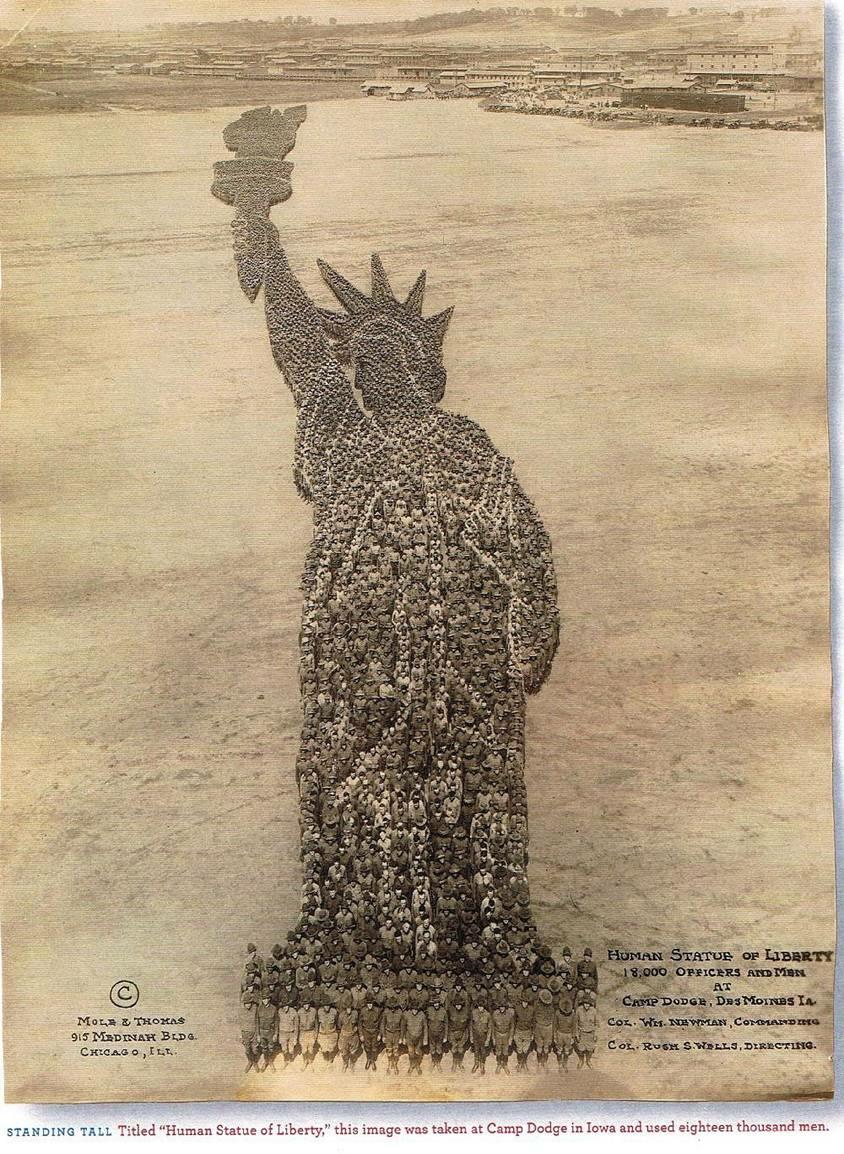
Using a camera as an artist’s tool, using a literal army as a palette, using a parade ground as a sort of canvas, these photographers made some very interesting pictures. The Human Statue of Liberty, with 18,000 men at Camp Dodge, Iowa?


statue-of-liberty-human-camp-dodge-from-snopes.jpg

Most of these pictures were taken prior to 1930. Veterans who posed as part of these photos would be between 80 and 100 years old now. Are there veterans in your town who posed for one of these photos?


Good photographic copies of some of these pictures are available from galleries. They are discussion starters, that’s for sure.

Some questions for discussion:

  1. Considering the years of the photos, do you think many of these men saw duty overseas in World War I.
  2. Look at the camps, and do an internet search for influenza outbreaks in that era. Were any of these camps focal points for influenza?
  3. Considering the toll influenza took on these men, about how many out of each photo would have survived the influenza, on average?
  4. Considering the time, assume these men were between the ages of 18 and 25. What was their fate after the Stock Market Crash of 1929? Where were they during World War II?
  5. Do a search: Do these camps still exist? Can you find their locations on a map, whether they exist or not?
  6. Why do the critics say these photos might have been used to build national unity, and to cement national identity and will in time of war?
  7. What is it about making these photos that would build patriotism? Are these photos patriotic now?

These quirky photos are true snapshots in time. They can be used for warm-ups/bell ringers, or to construct lesson plans around.

Tip of the old scrub brush to Gil Brassard, a native, patriotic and corporate historian hiding in Baton Rouge, Louisiana.


Whiskey and cigar day: Twain and Churchill

November 30, 2007

Mark Twain, afloat

November 30 is the birthday of Mark Twain (1835), and Winston Churchill (1874).

Twain had a comment on recent actions at the Texas Education Agency:

In the first place God made idiots. This was for practice. Then He made School Boards.

– Following the Equator; Pudd’nhead Wilson’s New Calendar

The Nobel literature committees were slow; Twain did not win a Nobel in Literature; he died in 1910. Churchill did win, in 1953.

Both men were aficianadoes of good whiskey and good cigars. Both men suffered from depression in old age.

Both men made a living writing, early in their careers as newspaper correspondents. One waged wars of a kind the other campaigned against. Both were sustained by their hope for the human race, against overwhelming evidence that such hope was sadly misplaced.

churchill-time-cover-man-of-the-year-1941.jpg

Both endured fantastic failures that would have killed other people, and both rebounded.

Both men are worth study.

Twain, on prisons versus education: “Every time you stop a school, you will have to build a jail. What you gain at one end you lose at the other. It’s like feeding a dog on his own tail. It won’t fatten the dog.” – Speech, November 23, 1900

Churchill on the evil men and nations do:

“No One Would Do Such Things”

“So now the Admiralty wireless whispers through the ether to the tall masts of ships, and captains pace their decks absorbed in thought. It is nothing. It is less than nothing. It is too foolish, too fantastic to be thought of in the twentieth century. Or is it fire and murder leaping out of the darkness at our throats, torpedoes ripping the bellies of half-awakened ships, a sunrise on a vanished naval supremacy, and an island well-guarded hitherto, at last defenceless? No, it is nothing. No one would do such things. Civilization has climbed above such perils. The interdependence of nations in trade and traffic, the sense of public law, the Hague Convention, Liberal principles, the Labour Party, high finance, Christian charity, common sense have rendered such nightmares impossible. Are you quite sure? It would be a pity to be wrong. Such a mistake could only be made once—once for all.”

—1923, recalling the possibility of war between France and Germany after the Agadir Crisis of 1911, in The World Crisis,vol. 1, 1911-1914, pp. 48-49.

Image of Twain aboard ship – origin unknown. Image of Winston S. Churchill, Time Magazine’s Man of the Year for 1941, copyright 1941 by Time Magazine.

More on Mark Twain

More on Winston Churchill

Orson Welles, with Dick Cavett, on Churchill, his wit, humor and grace (tip of the old scrub brush to the Churchill Centre):


Fly your flag today: Veterans Day

November 11, 2007

Fly your U.S. flag today, to honor veterans of military service. November 11 was originally celebrated as Armistice Day after World War I’s armistice.

Veterans Administration poster for 2007 Veterans Day

Add to FacebookAdd to NewsvineAdd to DiggAdd to Del.icio.usAdd to StumbleuponAdd to RedditAdd to BlinklistAdd to TwitterAdd to TechnoratiAdd to Furl


Italian WWI vet dies

October 11, 2007


From the on-line Wall Street Journal’s “Evening Wrap”:

Italian World War I Veteran Dies — The world lost one of its few remaining veterans of World War I last Friday when Justin Tuveri died in the French resort town of St. Tropez . Born Giustino Tuveri on the island of Sardinia in 1898, Mr. Tuveri was a member of the Sassari Brigade, a Sardinian infantry unit known as the “Dimonios” — alternately translated as “demons” or “red devils” — which suffered 15,000 casualties in fighting against Austro-Hungarian and German forces in mountainous northeastern Italy. According to the French daily Le Monde, Mr. Tuveri’s was shot twice in the back during a battle with German forces four months after he joined the service. And he told reporters that doctors removed the bullets from his body without anesthesia. After he recuperated from his wounds, he emigrated to France where he had an active life, including driving until the age of 98. The French Defense ministry says there are only two French veterans of the Great War alive. There are three left in the U.S., according to U.S. Department of Veterans Affairs spokesman Jim Benson. The youngest, at 106 years old, is Frank Buckles of Charles Town, W. Va., who lied his way into the army because he was underage. He served as the grand marshal of the National Memorial Day Parade in Washington, D.C. this past May.


–The Associated Press contributed to this report.


Military history carnival

August 18, 2007

American Presidents, which is a great blog for history and economics teachers and students anyway, hosts the Military History Carnival.

Got a lot of carnival catch up to do. This one should help you focus on polishing lesson plans and getting ideas for student projets.

Tenth century soap opera? It’s a true story. Great background — is this the sort of story that might interest women more?

Waterberg – the first genocide of the 20th century. “Trail of bones.” Largely forgotten — or unknown — history of war in Africa in 1904. I’ll wager you didn’t know about it. It’s not in your world history book.

What do you know about African troops fighting in Europe in World War I? This post, “Forgotten soldiers of the Great War,” is guaranteed to make World War I more relevant to your African-related students.

Are you really prepared to explain the significance of the Battle of Shiloh?

◊ The school’s network went down and took your PowerPoint presentation on the Spanish Armada. What to do? Here’s some help — the PowerPoint slides you’re missing, perhaps.

◊ History is Elementary is represented by a great post about camouflage in war, particularly World War I. This is a wonderful foundation for a lesson plan that deals with non-electronic technology — and as a sidelight, this is the sort of topic where the hunters among your students will be able to provide five or six examples of modern versions, with detailed explanations about the best places to use them. (You should read the post even if it’s out of your area; it’s a fascinating mashup of art, modern art, botany, zoology, psychology and war.)

There is a magnanimous link to the Bathtub’s post on panoramic photos of World War II sites.

And a lot more. Go see.


WSJ on oral histories: A hoax in the family line

August 6, 2007

Jay Gould told everybody he knew about his work recording the memories from the working people of Manhattan, real history. In 1942 he told The New Yorker of his work, and the phrase “oral history” leapt out of the story.

It was a great idea. But Gould made up everything about his work. At his death, friends discovered he left no oral histories behind.

It’s still a good idea, though, and it makes for good student project. Barry Weiss wrote a quick history of oral history for the Wall Street Journal last week. You can pull it off of JSTOR and use it as an introduction to the projects you assign to students.

You’ve never heard of him, but Robert Rush may be a modern-day Herodotus. Mr. Rush, who jokes that “he got his B.A. from the back of a Humvee,” is an oral historian with the U.S. Army. A retired command sergeant major who spent 30 years on active duty before getting his doctorate in history, Mr. Rush believes that recorded testimonies “can flesh out details that aren’t present in the paper histories.” In 2006, he was stationed in Iraq, where he spent seven months interviewing everyone from “engineers to bricklayers to military officers,” all with his handheld Olympus.

A century ago, historians might have laughed at Mr. Rush’s desire to spend time talking to construction workers. Today, the populist impulse is everywhere in the study of history.

Veteran interviews need to be done quickly for any veterans left from World War I, and for the few remaining veterans from World War II and Korea. There is a crying need for interviews of the women who performed the “Rosie the Riveter” work building airplanes, tanks, bombs, and other manufactured items, especially interviews of those women who worked in heavy industries and then went home to raise families when the men returned from foreign fronts. Rush got the soldiers while they were in Iraq — many of them are home now, and provide a source of oral history.

Veterans of Gulf War I, and Vietnam, have stories that need to be told and recorded. There is much to be done.

These stories would be perfect for podcasts, by the way.

Today, digital technology has allowed for every fisherman and every member of Parliament to immortalize their stories. With folks from all walks of life now making autobiographical podcasts, historians in the future will be presented with the issue of how to separate the wheat from the chaff.

Storycorps, an ambitious national oral- history project whose results can occasionally be heard on NPR, does some of this sorting, providing a more structured opportunity for such recordings than YouTube. In soundbooths across the country, Americans can come in and record their stories for 40 minutes, which then get archived in the Library of Congress. David Isay, the founder of Storycorps, describes the act of listening to the voice as “an adrenaline shot to the heart.” The physical experience of hearing another’s words can bring an understanding that reading those words on a page simply cannot.

If you go to the Library of Congress Web site you can listen to Lloyd Brown, the last U.S. Navy veteran of World War I, who died earlier this year. On the 71-minute recording, which he made at age 103, Mr. Brown offers a confession for posterity. “I lied about my age; I told them I was 18,” he recalls in a Southern drawl. At 16, he couldn’t wait two years to join the Navy. “It was a matter of patriotism.” So says the voice from history.

Weiss’s story, in the on-line version, briefly linked to this blog last week, bringing in at least two readers. Alas for the blog, but good for readers, the links at the bottom of the page change. Follow what’s there, see what you find.


BBC animation: The Western Front, World War I

July 30, 2007

Western Front of World War I, from BBC animation

Here’s another map animation from the BBC that helps people visualize the stalemate nature of the Western Front of World War I.

If this animation is available in any form for purchase from the BBC for classroom use, I haven’t found it. I do wish the BBC would do a DVD or CD compilation of these animations and make it available at very low cost to teachers (high costs mean schools buy only one copy, which teachers can’t get a chance to see, and consequently won’t integrate into their lesson plans; paradoxically, a low-priced disk would probably earn BBC more money, and certainly would contribute to much more classroom learning).

This would be a good link for individual study at home on the internet. A great lecture could be built around it, if one has internet access live in the classroom and a way to project it.


Historians at work: The last known Brit who fought in the trenches of World War I

July 29, 2007

Richard van Emden is not a well known historian in the U.S., but perhaps he should be better known (he is also a television producer). This is exactly the sort of work that we need more historians doing:

Van Emden is interviewing Harry Patch of Somerset, England. Patch is 109 years old, and is the last known surviving soldier to have fought in the trenches in Belgium for the Allies in World War I.

Harry Patch and Richard van Emden, in BelgiumHarry Patch, foreground, and Richard van Emden visit the site of the World War I Battle of Passchendaele, near Flanders, Belgium.

250,000 British soldiers died in the battle.

The 109-year-old fought in the Battle of Passchendaele when he was aged 19.

He served with the Duke of Cornwall’s light infantry and was called up for service while working as an 18-year-old apprentice plumber in Bath.

During the fighting, Mr Patch was badly wounded and three of his best friends were killed when a shell exploded just yards from where he was standing.

He made the trip with historian Richard van Emden, who helped Mr Patch write down his memories.

Mr van Emden showed him the five miles they advanced over 99 days which claimed 3,000 British casualties every day.

He was also shown a recently discovered panoramic photograph of the fields taken in 1917.

“Too many died,” said Mr Patch. “War isn’t worth one life.”

Interviews with participants in history, with the eyewitnesses, provide a good training ground for future historians. The interviews generally provide great value, even when done by amateurs, such as high school students.

Teachers, how many veterans of how many wars live in your town? How many of them have been asked to tell about their experiences?


Battle of Vimy Ridge

April 10, 2007

Canadian history?  Yeah, it’s important.  You’ve never heard of the Battle for Vimy Ridge?

Start here:  “The Easter Monday that Changed the World.”

Tip of the old scrub brush to Sigmund, Carl and Alfred.


Student project sources: Influenza in Alaska

December 21, 2006

Here’s a post with a ready-made student project in it: “Alaska and Eskimo data in 1920 British report,” at Grassroots Science (Alaska).

This would be a good AP History project, or a cross-discipline project for history and biology.

The influenza pandemic of 1918 killed millions, between 20 million and 40 million people by good estimates — it is estimated that 16 million died in India, alone. Soldiers returning from Europe and World War I carried the plague to hundreds of towns and villages where it might not have gone otherwise. The flu was a particularly deadly one for some people, striking them dead within 24 hours of the onset of symptoms.

Public health issues are largely disregarded in most U.S. and world history texts. This story, of the 1918 flu pandemic, needs to be told and studied carefully, however, because of the danger that such a thing could occur again. Small villages and towns need to be ready to deal with the effects, to try to prevent further spread, and to handle the crisis that occurs when many people in a small community die.


Fillmore’s bathtub — metaphor?

September 19, 2006

One of my searches turned up what appears to be a well-informed essay from 1999 by Wendy McLemore, “The Bathtub, Mencken, and War.” According to her curriculum vitae, the article originally appeared in a publication called Ideas on Liberty, “The Bathtub, Mencken, and War,” Vol. 49, No. 9 (September 1999).

While the article is available on the author’s website, I have not found a link from her blog to the article. So let me urge that you make a second foray, and check out her blog, too. A word of warning — while I haven’t found anything at the blog that is not suitable for viewing at work (NSVW), this is the subtitle the blog: “A site for individualist feminism and individualist anarchism.”

McLemore argues that Mencken was not merely fighting deadline, but was writing a close satire of the difficulties he had getting stories published during World War I that did not condemn Germans willy-nilly. She writes that Mencken was a great appreciator of German culture, and did not go along with propaganda that merely demonized Germany and Germans.

She also wrote that it was Andrew Jackson who introduced the bathtub to the White House, in 1834. This contrasts with the White House story I noted earlier, attributing the introduction of the tub to Fillmore’s wife in 1853. (Before my hard-drive crash, I wrote to the White House historian asking for a check of the veracity of that story. I’ve got nothing in response.) What is McLemore’s source for the Andrew Jackson tub?

We continue the search for the Truth about White House bathtubs. Go read McLemore’s essay.

Post script: Go see what Cecil says about Millard Fillmore, at the column archives for Straight Dope.