Silvestre S. Herrera, first Arizonan to win Medal of Honor

December 1, 2007

From the East Valley Tribune, November 9, 2007:

World War II veteran Silvestre S. Herrera, left, is applauded Thursday by Dr. Connie Mariano, veteran and former White House physician. Mariano gave a speech honoring veterans at a ceremony in Scottsdale.

“HEROES SALUTE: World War II veteran Silvestre S. Herrera, left, is applauded Thursday by Dr. Connie Mariano, veteran and former White House physician. Mariano gave a speech honoring veterans at a ceremony in Scottsdale.”
Photo by Bettina Hansen, For the Tribune

For Veterans Day this year, they gathered in Scottsdale, Arizona — mostly local veterans. Among them was World War II vet Silvestre Herrera, who fought in France.

One by one, veterans took their turn shaking hands and exchanging nods of respect with war hero Silvestre S. Herrera, 91, as he stood proudly wearing his Medal of Honor around his neck.

About 40 people gathered in 90-degree heat in north Scottsdale admiring a presentation of colors and listening in reverence to a high school band play in honor of the upcoming Veterans Day.

“It was very touching,” said Jackie Wolf, executive sales director for Classic Residence at Silverstone, where the event took place Thursday on a breezy patio.

It was fitting, somber and joyful all at once. A lot of veterans, paying honor to all veterans. [More below the fold]

Read the rest of this entry »


Whiskey and cigar day: Twain and Churchill

November 30, 2007

Mark Twain, afloat

November 30 is the birthday of Mark Twain (1835), and Winston Churchill (1874).

Twain had a comment on recent actions at the Texas Education Agency:

In the first place God made idiots. This was for practice. Then He made School Boards.

– Following the Equator; Pudd’nhead Wilson’s New Calendar

The Nobel literature committees were slow; Twain did not win a Nobel in Literature; he died in 1910. Churchill did win, in 1953.

Both men were aficianadoes of good whiskey and good cigars. Both men suffered from depression in old age.

Both men made a living writing, early in their careers as newspaper correspondents. One waged wars of a kind the other campaigned against. Both were sustained by their hope for the human race, against overwhelming evidence that such hope was sadly misplaced.

churchill-time-cover-man-of-the-year-1941.jpg

Both endured fantastic failures that would have killed other people, and both rebounded.

Both men are worth study.

Twain, on prisons versus education: “Every time you stop a school, you will have to build a jail. What you gain at one end you lose at the other. It’s like feeding a dog on his own tail. It won’t fatten the dog.” – Speech, November 23, 1900

Churchill on the evil men and nations do:

“No One Would Do Such Things”

“So now the Admiralty wireless whispers through the ether to the tall masts of ships, and captains pace their decks absorbed in thought. It is nothing. It is less than nothing. It is too foolish, too fantastic to be thought of in the twentieth century. Or is it fire and murder leaping out of the darkness at our throats, torpedoes ripping the bellies of half-awakened ships, a sunrise on a vanished naval supremacy, and an island well-guarded hitherto, at last defenceless? No, it is nothing. No one would do such things. Civilization has climbed above such perils. The interdependence of nations in trade and traffic, the sense of public law, the Hague Convention, Liberal principles, the Labour Party, high finance, Christian charity, common sense have rendered such nightmares impossible. Are you quite sure? It would be a pity to be wrong. Such a mistake could only be made once—once for all.”

—1923, recalling the possibility of war between France and Germany after the Agadir Crisis of 1911, in The World Crisis,vol. 1, 1911-1914, pp. 48-49.

Image of Twain aboard ship – origin unknown. Image of Winston S. Churchill, Time Magazine’s Man of the Year for 1941, copyright 1941 by Time Magazine.

More on Mark Twain

More on Winston Churchill

Orson Welles, with Dick Cavett, on Churchill, his wit, humor and grace (tip of the old scrub brush to the Churchill Centre):


Jefferson DeBlanc, teacher, Medal of Honor winner

November 28, 2007

Jefferson DeBlanc, Sr, at the WWII Memorial - Medal of Honor Winner

You can just see the kid trying to get the goat of the physics teacher:“Hey, Teach! What do you think 5Gs feel like when one of those fighter pilots pulls a real tight turn?”

And you can see the teacher at the chalkboard scribbling a formula the kid doesn’t want to know, and a smile creeping over his face.

“It’s nothing like hitting the shark-infested Pacific — salt water, and you’re wounded — and then being traded for a ten-pound sack of rice! That’ll get your gut more.”

And don’t you wonder, did the kids ever think to ask him his view of the campaign against the Japanese in the Solomon Islands, for help on their U.S. history exams? Did they ever think he might have some knowledge to share?

Jefferson DeBlanc would have shared wisdom certainly, though it’s uncertain he would have shared his war experiences as a fighter pilot. He died last Thursday in St. Martinville, Louisiana. He was 86. DeBlanc was the last surviving Medal of Honor winner from World War II in Louisiana. Col. Jefferson DeBlanc, Sr.

What a story!

The incident that earned Jefferson the nation’s highest military honor took place Jan. 31, 1943, during operations against Japanese forces off Kolombangara Island in the Solomon Islands.

A Japanese fleet was spotted headed toward Guadalcanal. U.S. dive bombers were sent to attack the fleet, with fighter aircraft deployed to protect the bombers. In a one-man Grumman Wildcat fighter, DeBlanc led a section of six planes in Marine Fighting Squadron 112, according to the citation that accompanied his Medal of Honor.

At the rendezvous point, DeBlanc discovered that his plane, which was dubbed “The Impatient Virgin,” was running out of fuel. If DeBlanc battled the Japanese Zero fighter planes, he would not have enough fuel to return to base. Two of his comrades, whose planes malfunctioned, turned back, according to a 1999 article in the New Orleans Times-Picayune.

“We needed all the guns we could get up there to escort those bombers,” DeBlanc said in the Times-Picayune article. “I figured if I run out of gas, I run out of gas. I figured I could survive a bailout. I had confidence in my will to survive. You’ve got to live with your conscience. And my conscience told me to go ahead.”

DeBlanc and the other pilots waged fierce combat until, “picking up a call for assistance from the dive bombers, under attack by enemy float planes at 1,000 feet, he broke off his engagement with the Zeros, plunged into the formation of float planes and disrupted the savage attack, enabling our dive bombers and torpedo planes to complete their runs on the Japanese surface disposition and withdraw without further incident,” the citation says.

Ultimately, DeBlanc shot down two float planes and three of the fighters. But a bullet ripped through DeBlanc’s plane and hit his instrument panel, causing it to erupt into flames. DeBlanc “was forced to bail out at a perilously low altitude,” according to the citation.

“The guy who shot me down, he saw me bail out,” DeBlanc said in a 2001 article in the State-Times/Morning Advocate of Baton Rouge, La.. “He knew I was alive. I knew they (the Japanese) were looking for me. But I’m not a pessimist. I knew I could survive. I was raised in the swamps.”

A Louisiana kid raised in the swamps, a Tuba City, Arizona, kid raised in a hogan on a reservation, a kid from Fredericksburg, Texas, a kid from Abilene, Kansas, another kid from Columbus, Ohio, a West Point graduate with a corn-cob pipe — the reality of the people who fought the war looks like a hammy line-up for one of the post-war movies about them. Maybe, in this case, there was good reason for the stereotypes.

After his plane was shot down in 1943, DeBlanc swam to an island and slept in a hut until he was discovered by islanders and placed in a bamboo cage. The man who gave a sack of rice for him was Ati, an islander whom DeBlanc later called a guardian angel, responsible for orchestrating his rescue by a U.S. Navy boat.

DeBlanc served a second tour of overseas service in Marine Fighting Squadron 22 in the Marshall Islands. By the end of his service, he had shot down nine enemy planes.

On Dec. 6, 1946, President Truman awarded DeBlanc the Medal of Honor. His other honors include the Distinguished Flying Cross, several awards of the Bronze Star and the Purple Heart. In 1972, after serving six years as commander at Belle Chasse Naval Air Station, DeBlanc retired from the Marine Corps Reserve.

Then, as if to make the model for Tom Brokaw’s later book, DeBlanc went back home to mostly-rural Louisiana, and made the world a much better place.

At home, DeBlanc earned two masters’ degrees in education from Louisiana State University in 1951 and 1963, and a doctorate in education from McNeese State University in 1973. For years, he taught in St. Martin parish and supervised teachers.

Just a normal guy to his kids, neighbors and students:

Despite the illustrious awards, [daughter] Romero [DeBlanc] remembers a loving father first and dedicated educator second.

“I was very close to my father,” she said. “I could always talk to him. He taught me to drive. He taught school. He was very friendly with his students. He would come into the classroom and say, ‘I lost the test.’ Then he would look around and find it in the trash can. Of course he placed it in the trash can. He had a great sense of humor.”

Surely DeBlanc’s passing should have been worthy of note on national television news programs, and in the larger national print media. There was a note on the obituary page of the Dallas Morning News, and the Los Angeles Times obituary cited above. But DeBlanc has not yet gotten the recognition he probably deserved. A young cornerback for the Washington Redskins also died over the weekend.

No room for heroes in the news?

Resources for Teachers:

Read the rest of this entry »


Why give Holocaust denial a platform?

November 25, 2007

lipstadt-deborah-emory-u.png

Deborah Lipstadt asks the key question at her blog: Why should any honorable, noble agency give a platform to people who don’t respect the facts and who have a track record of distorting history?

The distinguished debating group, the Oxford Union, has invited history distorter David Irving to speak. He was invited to speak with representatives of the British National Party (BNP), a group not known for tolerance on racial and immigration issues. While there is value to getting a range of views on any issue, Prof. Lipstadt and many others among us think that inviting a known distorter to speak is practicing open-mindedness past the point of letting one’s brains fall out (what is the difference between “open mind” and “hole in the head?”).

You know this story and these characters, right, teachers of history? You should, since these people play important roles in the modern art of history, and in the discussion over what we know, and how we know it. These are issues of “what is truth,” that your students badger you about (rightfully, perhaps righteously).

American teachers of history need to be particularly alert to these issues, since Holocaust deniers have been so successful at placing their material on the internet in a fashion that makes it pop up early in any search on the Holocaust. Most searches on “Holocaust” will produce a majority of sites from Holocaust deniers. It is easy for unwary students to be led astray, into paths of racist harangues well-disguised as “fairness in history and speech.”

Prof. Lipstadt practices history at Emory University in Atlanta, where she is the Dorot Professor of Modern Jewish and Holocaust Studies. She chronicled much of the modern assault on history in her book, Denying the Holocaust, The Growing Assault on Truth and Memory (1994). In that book, she documented the work of British historian David Irving, much of which consists of questionable denial of events in the Holocaust.

Cover of Lipstadt's book, Denying the Holocaust

Cover of Deborah Lipstadt’s book, Denying the Holocaust, the Growing Assault on Truth and Memory

Irving sued her for libel in Britain in 2000, where it is not enough to establish the truth of the matter to mount a defense. In a stunning and welcomed rebuke to Holocaust denial and deniers, the judge ruled in her favor, and documented Irving’s distortions in his 350-page opinion.

While his claims are legal in England, in several places in Europe his denial of Holocaust events is not protected as free speech. Traveling in Austria in 2005, he was arrested and imprisoned for an earlier conviction under a law that makes it a crime to deny the events. Prof. Lipstadt opposed the Austrian court’s decision: “I am uncomfortable with imprisoning people for speech. Let him go and let him fade from everyone’s radar screens.”

The drama plays out again. Serious questioning of what happened is the front line of history. Denying what happened, however, wastes time and misleads honest citizens and even serious students, sometimes with bad effect. Santayana’s warning about not knowing history assumes that we learn accurate history, not a parody of it.

This event will raise false questions about censorship of Holocaust deniers, and the discussion is likely to confuse a lot of people, including your students. U.S. history courses in high school probably will not get to the Holocaust until next semester. This issue, now, is an opportunity for teachers to collect news stories that illuminate the practice of history for students. At least, we hope to illuminate, rather than snuff out the candles of knowledge.

Resources:

Save


Nobelist’s biography questioned: We’re still inspired

November 7, 2007

Mario Capecchi’s story of his mother’s arrest by the Gestapo, and his life on the streets of Italy as a young boy, only piqued interest in the story of his winning a Nobel Prize in Medicine or Physiology, earlier this year.

It is such a great story, people set out to write it down in detail. Some of the details discovered, however, don’t quite square with historical records.

A group of reporters with the Associated Press uncovered the discrepancies. Realizing that the story comes from the memory of a very young child, so far the headlines and the stories have been corrective, but gently and adoringly so.

The story Capecchi has told repeatedly over the years in speeches and interviews begins when he is 3 and the Gestapo, Adolf Hitler’s secret police, snatch his mother before his very eyes and dispatch her to Dachau concentration camp. The peasant family that takes him in abandons him and he spends four years wandering about northern Italy – a street urchin, alone and begging for food.

At war’s end – on the boy’s ninth birthday – mother and son are reunited in the hospital ward where he is being treated for malnutrition and typhoid. They set sail for America where he flourishes, embarks on a brilliant research career – and goes on to win the Nobel Prize for medicine.

But The Associated Press, which set out to chronicle his extraordinary story in greater detail, has uncovered several inconsistencies and unanswered questions, chief among them whether his mother was in Dachau, and whether he really was for a long time a homeless street child.

You can read the full story at The Salt Lake Tribune.

This is a classic case. Memory differs from the facts. Human minds fill in details that would otherwise leave a mystery, and the details filled in differ from the details that can be corroborated.

This is part of what keeps history lively.

We see here also a demonstration that there is much we can never really know for sure. Historians work from imperfect records in the best of circumstances.

The director of the Dachau Memorial, Barbara Distel, said women weren’t imprisoned at Dachau until September 1943 – more than two years after Capecchi says his mother was arrested. She also said only Jewish women from eastern Europe were held in Dachau’s satellite camps.

”I do remember – I remember the Gestapo coming to the Wolfsgruben chalet,” Capecchi told AP in the interview, conducted days after his Nobel Prize was announced. ”It’s sort of like a photograph. I can tell you how many people were in the room, which ones were in uniform and which ones weren’t. Just boom. It’s there.”

Pressed to explain how he could be certain he was just 3 1/2 at the time and remember it so clearly, he stood by his account.

The big question we want answered here is this: How can we get more great people like Mario Capecchi? Can we get a few Nobelists out of the current generation of children?

No one proposes revisiting war to make kids great, so the fascination with Capecchi’s childhood is more academic, if still for inspiration.

In the end, we have a mystery. How did Capecchi get to be such a great man? There remains that great chapter near the end of the book; early chapters are missing.

Perhaps AP could put a team of reporters on a story to explain exactly how Capecchi’ s research explains what it does, and what it means down the road. That’s a story that needs to be told, too.


History text accuracy: Okinawa mass suicides

October 25, 2007

Controversy surrounds history textbooks all over the world. Texans may be a bit more sensitive to the issues while the Texas Education Agency is revising curricula, but others are even more sensitive – such as Turkey, where controversy over the Armenian Genocide threatens to derail Turkey’s 40-year project to join the European Union; Japan, where citizens and other nations protest failures to mention harms done to people by the Japanese Imperial Army during World War II; and even Europe in general, where controversy surrounds efforts to find a unifying, Europe-wide culture.

History is important in our relations with other nations. With increasing globalization, it becomes ever more important that all citizens have basic understanding of their local history, their national history, and world history, if only to avoid the social faux pas in socializing with people from other nations.

The issue is hot in Japan right now. Okinawa, a formerly independent kingdom annexed by Japan in the 19th century (did you know that?), hosted the biggest protest demonstration the island prefecture has ever seen, earlier this month – a protest over the changing of a few words in Japanese school history texts, removing the responsibility for mass suicides on Okinawa from the Japanese Imperial Army.

A story in the New York Times describes the anguish felt by Okinawans:

Brainwashed by Japanese Imperial Army soldiers into believing that victorious American troops would rape all the local women and run over the men with their tanks, Mr. Kinjo and others in his village here in Okinawa thought that suicide was their only choice. A week before American troops landed and initiated the Battle of Okinawa in March 1945, Japanese soldiers stationed in his village gave the men two hand grenades each, with instructions to hurl one at the Americans and then to kill themselves with the other.

Most of the grenades failed to explode. After watching a former district chief break off a tree branch and use it to kill his wife and children, Mr. Kinjo and his older brother followed suit.

”My older brother and I struck to death the mother who had given birth to us,” Mr. Kinjo said in an interview at the Naha Central Church, where he is the senior minister. ”I was wailing of course. We also struck to death our younger brother and sister.”

Mr. Kinjo agreed to tell his story again because the Japanese government is now denying, in new high school textbooks, that Okinawans had been coerced by Imperial troops into committing mass suicide.

The proposed changes to the school textbooks — the deletion of a subject, the change to the passive voice — amounted to just a couple of words among hundreds of pages. But the seemingly minor grammatical alterations have led to swelling anger in the Okinawa islands in Japan, cresting recently in the biggest protest here in at least 35 years and stunning the Japanese government.

How should texts deal with such issues?

China and Korea also protested the rewrite. Hot button issues involve the Japanese invasion and taking of Nanking in 1937, generally known to western historians as “the rape of Nanking;” Japanese treatment of Prisoners of War (POWs), including the Bataan Death March in the Philippines, what amounted to slave labor using POWs in Japan, and Korean women impressed into service as prostitutes to the Japanese Army, at what are euphemistically called “comfort stations.”

Texas history standards writers may benefit from taking a look at some of these other controversies, in other places. These lessons can apply to Texas and U.S. history, where Anglo and European colonist treatment of aboriginal natives is certainly an issue, but also to subjects such as biology and the treatment of evolution, health and the treatment of preventing sexually-transmitted diseases, and environmental science, and the treatment of pollution and climate change issues.


Pete Seeger: Standing taller than his critics

September 10, 2007

Some people can’t let go of the past, and like the greedy chimpanzee who grasps the rice in the jar, and then is trapped when he cannot pull out his fist nor will he give up his prize to save his freedom, they trap themselves out of a good life.

Like this fellow, whose father’s dislike of an old political position of Pete Seeger kept them both from a good concert. He appears to agree with his father, though, thinking that somehow Seeger is responsible for the evils of Stalinism, and complaining that Seeger was tardy in making note of the fact that Stalin was evil. And Instapundit’s Glenn Reynolds agrees, profanely, and inaccurately, as I’ll explain below the fold. But heed this warning: I’m explaining at length.

Get a life, people! Pete Seeger did.

Read the rest of this entry »


Military history carnival

August 18, 2007

American Presidents, which is a great blog for history and economics teachers and students anyway, hosts the Military History Carnival.

Got a lot of carnival catch up to do. This one should help you focus on polishing lesson plans and getting ideas for student projets.

Tenth century soap opera? It’s a true story. Great background — is this the sort of story that might interest women more?

Waterberg – the first genocide of the 20th century. “Trail of bones.” Largely forgotten — or unknown — history of war in Africa in 1904. I’ll wager you didn’t know about it. It’s not in your world history book.

What do you know about African troops fighting in Europe in World War I? This post, “Forgotten soldiers of the Great War,” is guaranteed to make World War I more relevant to your African-related students.

Are you really prepared to explain the significance of the Battle of Shiloh?

◊ The school’s network went down and took your PowerPoint presentation on the Spanish Armada. What to do? Here’s some help — the PowerPoint slides you’re missing, perhaps.

◊ History is Elementary is represented by a great post about camouflage in war, particularly World War I. This is a wonderful foundation for a lesson plan that deals with non-electronic technology — and as a sidelight, this is the sort of topic where the hunters among your students will be able to provide five or six examples of modern versions, with detailed explanations about the best places to use them. (You should read the post even if it’s out of your area; it’s a fascinating mashup of art, modern art, botany, zoology, psychology and war.)

There is a magnanimous link to the Bathtub’s post on panoramic photos of World War II sites.

And a lot more. Go see.


Key images for VJ Day, August 15

August 15, 2007

August 15, 1945, was VJ Day — the day that World War II ended in the Pacific Theatre. VJ is an acronym for Victory Japan. Victory in Europe, VE Day, was declared the previous April.

VJ Day is affiliated with a series of images that students of U.S. history should recognize; these images tell much of the story of the day and the events of the weeks leading up to it.

The most famous image is Alfred Eisenstadt’s photograph of an exuberant sailor kissing a swept-off-her-feet- for-the-moment nurse in Times Square, New York City. This is one of the most famous photographs from the most famous photographer from Life Magazine:

The Smack Seen 'Round the World, photo by Alfred Eisenstadt, Life Magazine, 8-15-1945 Eisenstadt coolly titled his photo “VJ Day, Times Square.” It came to be known as The Smack Seen ‘Round the World. It was fitting that the photo would be taken by Eisenstadt, since his work came to be a symbol of Henry Luce’s Life Magazine in a pre-television era when photography magazines like Life and Look were key news organs for the nation.

In a fun and continuing mystery, several people have claimed to be the sailor, or the nurse, through the years.

Before the victory celebration, there had to be a victory. Japan asked for conditional surrender discussions, but the Allied forces insisted on unconditional surrender. Japanese military officials were rather certain that, if the Soviet Union entered the Pacific War, Allied victory would be assured. Japan hoped to either get a conditional surrender agreement, according to some sources, or inflict heavy losses on Allied forces to get better surrender conditions, but before Russia entered the war. Russia and Japan had long-standing grudges against one another dating from before their earlier war in the first decade of the 20th century.

Read the rest of this entry »


Ardeatine Massacre: Bombers were soldiers, not terrorists

August 13, 2007

Our Italian physicist friend, Dorigo, at A Quantum Diaries Survivor reports that an Italian court ruled against a newspaper that started a campaign to deny the history of the Ardeatine Massacre.

Good news today. The supreme court of Cassazione in Italy has ruled that the press campaign labeling “terrorists” the GAP partisans who organized the bombing of Via Rasella in nazi-occupied Rome in 1944, launched by the national newspaper “Il Giornale”, was a striking example of manipulation of historic truth for political means. The newspaper is owned by Paolo Berlusconi (brother of Silvio, formerly premier of Italy in 1994 and 2001-2006), and was directed by Vittorio Feltri . . . a journalist who never hid his sympathy for the extreme right.

What was the Ardeatine Massacre?

Statue memorial to the victims of the Ardeatine Massacre, Italy Wikipedia:

The massacre of Fosse Ardeatine (Italian: Eccidio delle Fosse Ardeatine) took place in Rome, Italy during World War II. On 23 March 1944, 2 German soldiers, 31 Italian soldiers of Battaglione Bozen and a few Italian civilians passing along the road, were killed when members of the Italian Resistance set off a bomb close to a column of German soldiers who were marching on via Rasella[1]. This terrorist attack was led by the Gruppi di Azione Patriottica, of Rosario Bentivegna, Carla Capponi, Antonello Trombadori (Head of GAP in Roma) and the approval of Sandro Pertini (later President of Italian Republic), in order to provocate the reaction of SS troops.

Adolf Hitler is reported but never confirmed to have ordered that within 24 hours, one-hundred Italians were to be shot for each dead German. Commander Herbert Kappler in Rome concluded that ten Italians for each dead German would be sufficient and quickly compiled a list of 320 civilians who were to be killed. Kappler voluntarily added ten more names to the list when the 33rd German/Italian died after the Partisan attack. The total number of people murdered at the Fosse Ardeatine was 335, most Italians. The largest cohesive group among the murdered were the members of Bandiera Rossa, a Communist military Resistance group.

Why is there controversy 60 years later? Read the rest of this entry »


Henry F. Phillips — when do we celebrate?

August 10, 2007

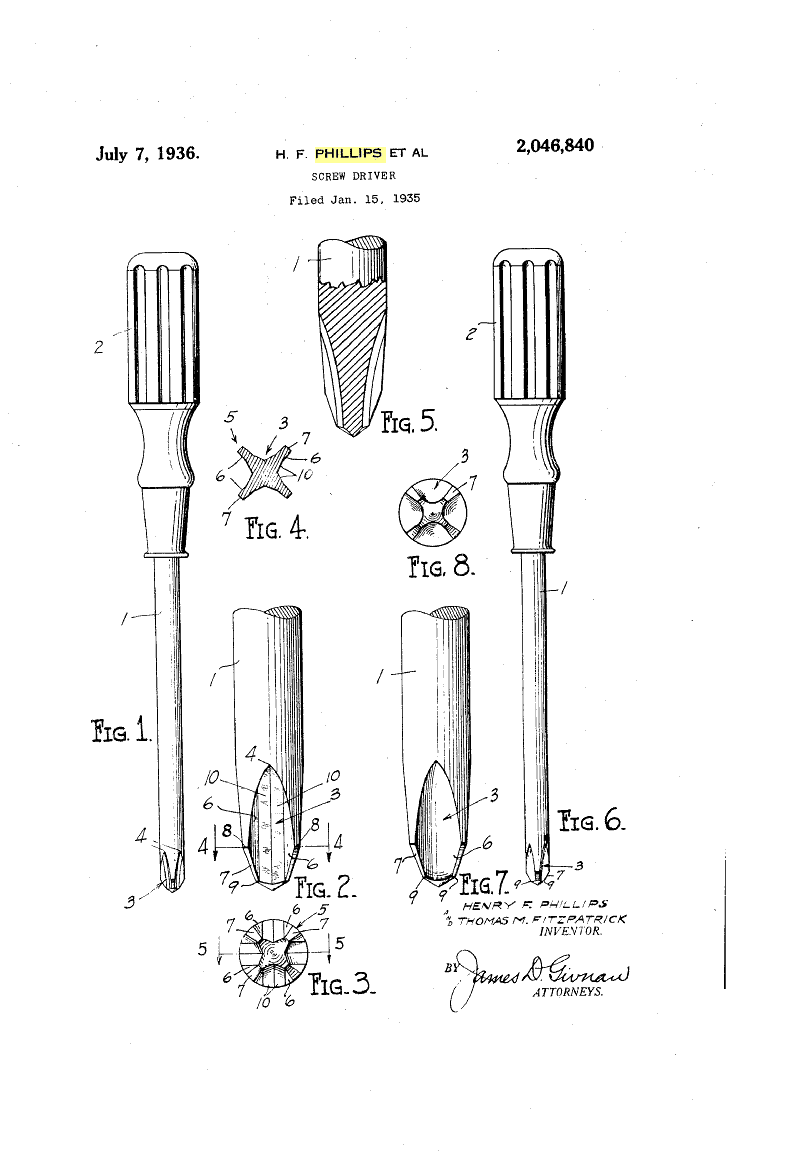
Herny Phillips' patent for the Phillips screw and screwdriver (Google Patents)

Patent drawings for the Phillips screw and screwdriver, 1936

Only Crook in Town was alerted to the work of Henry F. Phillips by an alert and helpful librarian (well — aren’t they all?). She worries –January 15 is Martin Luther King, Jr., Day, and July 7 is the middle of the summer — what day would be appropriate to celebrate the invention and patenting of the Phillips Screwdriver? (If image above does not display, click the thumbnail picture at the end of the post.)

Ah, history teachers, you noticed that the drawing comes from Google’s files of patent applications. And now you wonder: What other wonderful illustrations can we legally rip off to use in class? Wonderful question — what do you find?

The Phillips screwdriver came along in time for World War II and the mass assembly of aircraft, and aircraft instrument panels. The Phillips screw head helped aircraft assemblers keep from scratching the black metal of the rest of the panel while securing instruments into the forms.

Read the rest of this entry »


August 9, 1945: Nagasaki, Japan

August 9, 2007

Continuing the week of contemplation of atomic bombs: Remember today is the anniversary of the destruction of Nagasaki, with a U.S. atomic bomb.

Nagasaki after the atomic bomb - Infoplease.com

Japan surrendered unconditionally a short while later. See the earlier posts for more links.

Nagasaki National Peace Memorial Hall - Architectural Record

Top photo: Nagasaki after the bomb. Bottom photo, Nagasaki National Peace Memorial Hall, photo by Toshio Kaneko, Architectural Record.


Hiroshima: August 6, 1945

August 6, 2007

Today, August 6, 2007, is the 62nd anniversary of the first use of atomic weapons in war, when the United States dropped an atomic bomb on Hiroshima, Japan. August 9 marks the anniversary of the bombing of Nagasaki.

Please see my post of last year — the links all still work, and they provide significant resources for teachers and students to understand the events.

Performance of Texas students on questions about the end of the war in the Pacific, in the TAKS exit exams in 2007 showed minor improvements.

Other sources teachers may want to use:


WSJ on oral histories: A hoax in the family line

August 6, 2007

Jay Gould told everybody he knew about his work recording the memories from the working people of Manhattan, real history. In 1942 he told The New Yorker of his work, and the phrase “oral history” leapt out of the story.

It was a great idea. But Gould made up everything about his work. At his death, friends discovered he left no oral histories behind.

It’s still a good idea, though, and it makes for good student project. Barry Weiss wrote a quick history of oral history for the Wall Street Journal last week. You can pull it off of JSTOR and use it as an introduction to the projects you assign to students.

You’ve never heard of him, but Robert Rush may be a modern-day Herodotus. Mr. Rush, who jokes that “he got his B.A. from the back of a Humvee,” is an oral historian with the U.S. Army. A retired command sergeant major who spent 30 years on active duty before getting his doctorate in history, Mr. Rush believes that recorded testimonies “can flesh out details that aren’t present in the paper histories.” In 2006, he was stationed in Iraq, where he spent seven months interviewing everyone from “engineers to bricklayers to military officers,” all with his handheld Olympus.

A century ago, historians might have laughed at Mr. Rush’s desire to spend time talking to construction workers. Today, the populist impulse is everywhere in the study of history.

Veteran interviews need to be done quickly for any veterans left from World War I, and for the few remaining veterans from World War II and Korea. There is a crying need for interviews of the women who performed the “Rosie the Riveter” work building airplanes, tanks, bombs, and other manufactured items, especially interviews of those women who worked in heavy industries and then went home to raise families when the men returned from foreign fronts. Rush got the soldiers while they were in Iraq — many of them are home now, and provide a source of oral history.

Veterans of Gulf War I, and Vietnam, have stories that need to be told and recorded. There is much to be done.

These stories would be perfect for podcasts, by the way.

Today, digital technology has allowed for every fisherman and every member of Parliament to immortalize their stories. With folks from all walks of life now making autobiographical podcasts, historians in the future will be presented with the issue of how to separate the wheat from the chaff.

Storycorps, an ambitious national oral- history project whose results can occasionally be heard on NPR, does some of this sorting, providing a more structured opportunity for such recordings than YouTube. In soundbooths across the country, Americans can come in and record their stories for 40 minutes, which then get archived in the Library of Congress. David Isay, the founder of Storycorps, describes the act of listening to the voice as “an adrenaline shot to the heart.” The physical experience of hearing another’s words can bring an understanding that reading those words on a page simply cannot.

If you go to the Library of Congress Web site you can listen to Lloyd Brown, the last U.S. Navy veteran of World War I, who died earlier this year. On the 71-minute recording, which he made at age 103, Mr. Brown offers a confession for posterity. “I lied about my age; I told them I was 18,” he recalls in a Southern drawl. At 16, he couldn’t wait two years to join the Navy. “It was a matter of patriotism.” So says the voice from history.

Weiss’s story, in the on-line version, briefly linked to this blog last week, bringing in at least two readers. Alas for the blog, but good for readers, the links at the bottom of the page change. Follow what’s there, see what you find.


88-year-old man finally gets Eagle Scout rank

July 29, 2007

Joining the elite, top 5% of all Boy Scouts, Walter Hart was awarded his Eagle rank in a ceremony Saturday in Fort Myers, Florida. Walter is 88.

There was a 70+ year delay in Walter’s ceremony — he passed the requirements for the rank, but then went off to fight in World War II before the award was made.

The Associated Press story ran in the New York Times:

”I’ve been looking forward to this for a long time,” said Hart, who lives in a retirement center in nearby Lehigh Acres.

Scout officials say he may be the oldest person to ever earn the honor.

Hart joined the Cub Scouts in 1928 in Malden, Mass., and earned 23 merit badges during his years as a Boy Scout, scouting officials said. Of the 120 merit badges available, 21 must be earned to qualify for Eagle Scout rank.

It all got set aside when he joined the Navy during World War II and served two years aboard the USS Alfred A. Cunningham.

Last year, he rediscovered some of his old Boy Scout memorabilia, including documents that showed he completed the requirements for his Eagle Scout rank. He contacted the Scouts about receiving his award.

”I think this was something that was always on his mind, but every time he went to go do it, something else came up,” daughter Elizabeth Gatturna said. ”I know how hard he’s tried to get to this point.”

Congratulations, Walter.

Walter Hart, 88, rec'd Eagle Badge 7-28-2007

  • Walter Hart, 88, is shown wearing a 2007 Boy Scout uniform with the merit badge sash he used as a youth, prior to World War II. Apart from the not-quite fit, we can tell the sash is his old one because many of the merit badges are in their pre-World War II designs, and the sash shows rank badges for Star Scout and Life Scout; current uniform rules do not allow rank badges on the sash. Under Scout rules, Walter may wear this sash for his Scouting career. Associated Press photo.

Spread the news, please:

Add to FacebookAdd to NewsvineAdd to DiggAdd to Del.icio.usAdd to StumbleuponAdd to RedditAdd to BlinklistAdd to TwitterAdd to TechnoratiAdd to Furl