World War II in Texas: Japanese internment

July 23, 2007

Girl Scouts at Japanese Doll Day celebration, in Crystal City, Texas, internment center, 1943-45

“Girl Scout drama presentation for Hinamatsuri (Doll’s Festival), on Japanese Girl’s Day, at the Crystal City, Texas, internment facility operated by the Justice Department, 1943-45.

Each of us has pockets of ignorance; some of the pockets are larger than others.

How did I miss that there were Japanese-American internees in Texas? If I stumbled across that fact before, it really didn’t register. Reviewing the website for the University of Texas – San Antonio’s Institute of Texas Cultures, I came across the Spring 2007 Newsletter, which is dedicated to the Crystal City internment facility.

Crystal City is unknown to many other Texans, too, I wager. Study of a list of the War Department “Relocation” camps shows nothing in Texas. Surprise! The U.S. Justice Department also operated camps of interned Americans of Japanese descent. The War Department rounded up Japanese Americans in west coast states and their neighbors; the Bureau of Immigration and Naturalization Services, the old INS which was rolled into the Department of Homeland Security after the 2001 attacks on New York and Washington, arrested and detained Japanese-Americans from the rest of the United States. INS operated at least four such camps in Texas. Read the rest of this entry »


Encore post: Ernie Pyle’s typewriter

July 16, 2007


PBS’s series, “History Detectives,” featured a mystery involving a typewriter alleged to have belonged to World War II reporter-hero Ernie Pyle. This is an encore post from May 1, 2007, originally entitled “Typewriter of the moment: Ernie Pyle.” Extra links are posted at the end.

This typewriter, a Corona (before the merger made Smith-Corona), belonged to Ernie Pyle, the columnist famous for traveling with the the foot soldiers of all services in World War II. Pyle won a Pulitzer Prize in 1944 for his columns in 1943, published collectively in the books Here is Your War and Brave Men. Pyle was killed covering the end of World War II in the Pacific, on an island named Ie Shima, on April 18, 1945.

The typewriter rests in the Albuquerque Museum. It comes with a story.

Ernie Pyle's typewriter, rescued from a foxhole in Italy in 1944; Albuquerque Museum From the Albuquerque Museum’s exhibit, “America’s Most Loved Reporter”:

[Quote] Ernie Pyle interviewed Sergeant Don Bell, a rodeo rider, in June or July 1944 outside of St. Lo, France. Bell recalled that the foxhole they shared caved in during German shelling. Pyle said, “I have my notes, but my little portable typewriter is buried in that hole.” They hurriedly abandoned the foxhole, leaving the typewriter behind.

Sgt. Bell later salvaged it, kept it through the war, and donated it to the Museum in 1990. A photograph of Pyle in Normandy, typing on an Underwood, may have been taken after this event.

Bell recalled the interview as comforting. He wrote, “…Ernie had taken my ma’s wisdom and turned it into a soldier’s lesson: to find strength in battle you take hold of strength you’ve known at home…and of the faith that underlies it.” [End quote]


Additional on-line sources about Ernie Pyle and his typewriters, July 16, 2007:


The scary truth about Powerline

July 16, 2007

Clearly somebody at Powerline proofs the copy — I imagine spelling errors that sneak into publication get corrected. But does anyone ever bother to check the boys’ work for reality?

Today Powerline appears to be complaining about Rep. Keith Ellison, Minnesota’s and America’s first Moslem congressman. After reciting the usual Powerline diatribes claiming Ellison is probably a Marxist, certainly out of touch with America, and probably responsible in an unsavory fashion for the designated hitter rule and the movie “Gigl,” the blog details Ellison’s sins (in the eyes of Powerline).

Do they need glasses? A refresher course in history? What’s scary is that Ellison’s criticisms of the Bush administration start sounding so rational — and for that, Powerline has no response.

Powerline warns us that Ellison spoke to a group of atheists in Edina, Minnesota, in towns that suggest disaster in the next film reel, copying from the Minneapolis Star-Tribune:

“You’ll always find this Muslim standing up for your right to be atheists all you want,” Ellison, the first Muslim to serve in Congress, said in a speech to more than 100 atheists at the Southdale Library in Edina. As Minnesota’s first black member of the U.S. House ends his first six months in office, Ellison did not disappoint a crowd that seemed energized the more pointed he made his opinions.

Oh, my! Ellison takes the Jeffersonian stand on the First Amendment. Are we swooning yet? What? Oh, yeah, well — Powerline prefers to think that parts of the Bill of Rights don’t exist, not in the rude company they keep, I guess.

The truly revelatory point there is that Edina has 100 atheists. If Powerline had any sense, they’d worry about how that might limit their market.

On impeaching Cheney, which the Minneapolis DFLer supports: “[It is] beneath his dignity in order for him to answer any questions from the citizens of the United States. That is the very definition of totalitarianism, authoritarianism and dictatorship.”

So, Powerline worries that Ellison thinks the administration should be answerable to the American people? That strikes me as a pretty good idea, actually. Bully for Ellison. Unsurprisingly, even Republicans say the same thing [see the last paragraph].

The Vice President should answer to and be held accountable to the citizens of the nation. That’s one of the key points of our Constitution — the founders wrote in formal occasions for the administration to make such presentations. Do the guys at Powerline know about the Constitution and its requirement for reports to Congress?

On calling the war in Iraq an “occupation”: “It’s not controversial to call it an occupation — it is an occupation.”

Ellison calls a shovel, a shovel. What was it Powerline wanted? What does Powerline call it?

While it is possible to hope for a better future, analysts and business consultants teach that people must recognize the reality of the situation they are in before making effective and executable plans to change things for the better in the future. Powerline has other plans in Iraq than success for America?

Here’s the money quote, the one that has caused a major kerfuffle of controversy today:

On comparing Sept. 11 to the burning of the Reichstag building in Nazi Germany: “It’s almost like the Reichstag fire, kind of reminds me of that. After the Reichstag was burned, they blamed the Communists for it and it put the leader of that country [Hitler] in a position where he could basically have authority to do whatever he wanted. The fact is that I’m not saying [Sept. 11] was a [U.S.] plan, or anything like that because, you know, that’s how they put you in the nut-ball box — dismiss you.”

Powerline comments:

In promoting the disgusting conspiracy myths of radical “truthers” and extremist Muslims, Ellison is simply working his latest hustle to the growing audience in the nut-ball box. It’s an audience that includes the Minneapolis atheists who fancy themselves too intelligent to believe in God.

Here’s the problem: The Bush administration did use the events of 9/11 as an the emergency event to get things done that they needed a contingency for. What was to become the PATRIOT Act, instituting a new system of spying on Americans, was already drafted by September 1, 2001; administration officials worried that it appeared too great an over-reach. Memos show that some officials suggested waiting for an event that might galvanize opinion in favor of such a move. That event occurred on September 11, and the PATRIOT Act was before Congress within a few days.

Powerline doesn’t deny that, of course. They can’t . All they can do is throw invective at Ellison, call him a Marxist, and suggest he’s out of touch.

Which, of course, is what the National Socialist Party did to their political rivals in Germany after February 27, 1933, the day after the Reichstag building burned. President Hindenberg issued the Reichstag Fire Decree, suspending many civil liberties in Germany.

Powerline says Ellison can’t accuse them of doing what they’re doing, after they call him “Marxist” for noting the historical parallels — just as the National Socialists called their enemies Marxists (several communists were arrested and tried for starting the fire; while most were acquitted, Marinus van der Lubbe was convicted and beheaded; a German court overturned his conviction in 1981).

If you don’t want to be accused of latter-day Reichstag political fixing, don’t do the crime. The rest of us may wish Ellison weren’t so scarily close with his historic comparisons. The solution is for the government to defend civil rights, and to stop calling people communists or worse for simply disagreeing about policy.

I think I hear Santayana’s ghost giggling a bit, between sighs. If our national future weren’t at stake, it would be really funny.


Japanese-American internment: Statesman-Journal web special

June 29, 2007

Looking for good sources on Japanese internment?

Editor & Publisher highlights the web version of a special series on Japanese internment during World War II, put together by the Statesman-Journal in Salem, Oregon. The series is featured in “Pauline’s Picks,” a feature by Pauline Millard showing off the best use of the web by old-line print publications.

Beyond Barbed Wire, photo by Salem Statesman-Journal

The Statesman-Journal’s web piece is “Beyond Barbed Wire,” featuring timelines, maps of the Tule Lake internment facility (closest to Oregon), stories about Japanese Americans in Oregon, especially in Salem, photos, video interviews, and a significant collection of original documents perfectly suited for document-based studies.

Texas kids test particularly badly in this part of U.S. history. Several districts ask U.S. history teachers and other social studies groups to shore up student knowledge in the area to overcome gaps pointed out in testing in the past three years, on the Texas Assessment of Knowledge and Skills (TAKS). In teacher training, I’ve noted a lot of Texas social studies teachers are a bit shaky on the history.

The Korematsu decision was drummed into my conscious working on civil rights issues at the Senate Labor and Human Resources Committee, and complemented by Constitutional Law (thank you, Mary Cheh) and other courses I was taking at the same time at George Washington University. It helped that Utah has a significant Japanese population and had “hosted” one of the internment camps; one of my tasks was to be sure committee Chairman Orrin Hatch was up on issues and concerns when he met with Japanese descendants in his constituencies in Utah. Hatch was a cosponsor of the bills to study the internment, and then to apologize to Japanese Americans affected, and pay reparations.
The internment was also a sore spot with my father, G. Paul Darrell, who witnessed the rounding up of American citizens in California. Many of those arrested were his friends, business associates and acquaintances. Those events formed a standard against which he measured almost all other claims of civil rights violations.

Because children were imprisoned with their parents, because a lot of teenagers were imprisoned, this chunk of American history strikes particular sympathetic chords with students of any conscience.  Dorothea Lange’s having photographed some of the events and places, as well as Ansel Adams and others, also leaves a rich pictorial history.

(I found this thanks to the RSS feed of headlines from Editor & Publisher at the Scholars & Rogues site.)


Charles Lindberg, first Iwo Jima flag raising

June 26, 2007

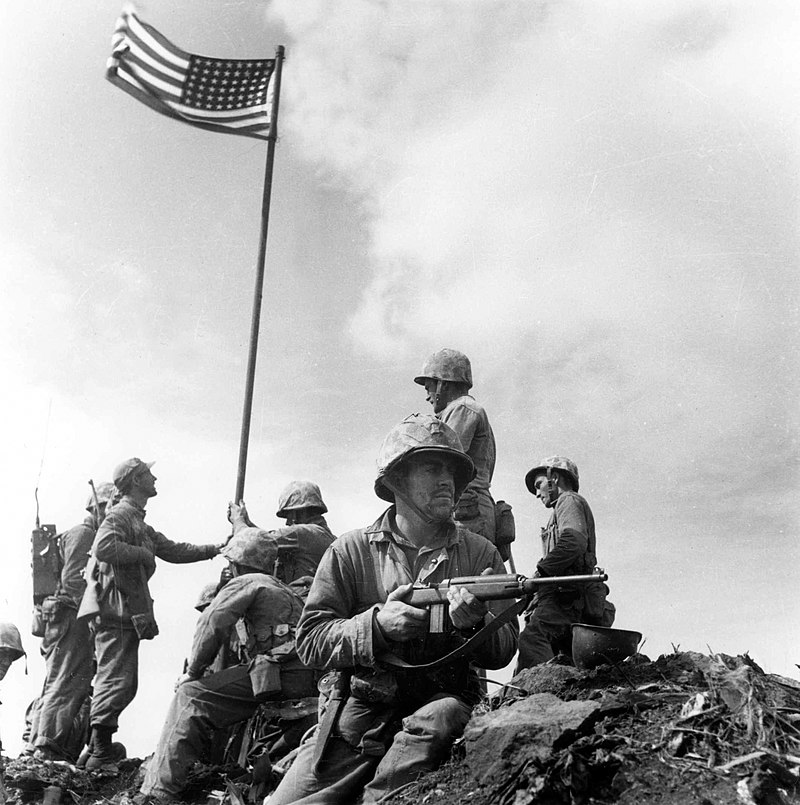
1st flag raising on Iwo Jima, photo by Sgt Lou Lowery, Leatherneck Magazine

First raising of the U.S. flag on Iwo Jima on February 23, 1945. Photo by Sgt. Lou Lowery, Leatherneck Magazine

This photo doesn’t look like the Joe Rosenthal photo that won the Pulitzer Prize, and then inspired the book and movie, Flags of Our Fathers?

It’s not the same photo. Different photographer. Different group of Marines.

This is the first flag raising on Mt. Suribachi, the highest point of the island that was known then as Iwo Jima. This shows the mean of Easy Company, including Charles Lindberg of Grand Forks, North Dakota, raising a flag they carried on a pipe they found. The photo was taken by Sgt. Lou Lowery of Leatherneck Magazine.

Charles Lindberg, one of the Marines in the photo, died this week. He was 86 years old.

In addition carrying a name made famous by that other guy, the pilot, few people believed him when he said his company raised the flag first on Iwo. He wasn’t in the Rosenthal photo. But Lindberg told the truth.

From his obituary on the Associated Press wire (in The Washington Post):

Three of the men in the first raising never saw their photos. They were among the more than 6,800 U.S. servicemen killed in the five-week battle for the island.

By Mr. Lindberg’s account, his commander ordered the first flag replaced and safeguarded because he worried someone would take it as a souvenir. Mr. Lindberg was back in combat when six men raised the second, larger flag about four hours later.

Rosenthal’s photo of the second flag-raising became one of the most enduring images of the war and the model for the U.S. Marine Corps memorial in Washington.

Rosenthal, who died last year, always denied accusations that he staged the photo, and he never claimed it depicted the first raising of a flag over the island.

Mr. Lindberg was shot through the arm March 1 and evacuated. After his discharge in 1946, Mr. Lindberg went home to Grand Forks, N.D. He moved to Richfield, Minn., in 1951 and became an electrician.

If you’re over 45, if you read James Brady’s Flags of Our Fathers, if you saw the Clint Eastwood movie version, or if you’re a fan of Johnny Cash’s Ballad of Ira Hayes, you know the stories of heroism and sorrow and tragedy that accompany Joe Rosenthal’s photo. As so often happens in history, there is a back story, a bit of a correction — and it has some of the same bittersweet flavors.

Lindberg was 24 years old when his company landed on Iwo Jima. That was 62 years ago. Those who were eyewitnesses are mostly gone. We need to seek out those few remaining, brave survivors, and let them tell what they remember, what they saw, how they felt and how they feel.  Of the twelve men who raised the two flags, Lindberg was the last survivor.  Three of the men from each group died in battle action after raising the flags.

Here’s to the memory of Charles Lindberg, a good American, a good soldier. Thank you, Mr. Lindberg.

Charles Lindberg in 1999, holding a copy of Sgt. Lou Lowery's photo of the first Iwo Jima flag raising Charles Lindberg holding the photo taken by Sgt. Lou Lowery of Leatherneck Magazine, of the first U.S. flag raising on Iwo Jima, by Easy Company. Lindberg is the soldier standing in back, on the right of the photo. Lowery’s photo was taken about four hours before the second flag raising, captured by Joe Rosenthal, which photo won the Pulitzer Prize. This photo of Lindberg, left, is from 1999, by Associated Press photographer Jackie Lorentz.

Lindberg’s citation for the Silver Star is below the fold.

Read the rest of this entry »


Applied history: Rescuing DaVinci

June 14, 2007

Ran into a website from a Dallas guy who is a practicing historian of a sort. A former oil man, he is involved in preserving and telling the story of the guys who rescued priceless works of art from the Nazis, the Monuments Men.

Monuments men, four survivors in D.C. to be honored

Robert Edsel’s blog is here; the site for his book, Rescuing DaVinci, is here.

Dallas-area world history and U.S. history teachers — have you called this guy to see if he’ll come visit your school?

  • Edsel’s caption for this photo: “Monuments Men Bernard Taper, James Reeds, Harry Ettlinger, and Horace Apgar being formally recognized for their efforts during World War II” [in Washington, D.C., on June 6, 2007]

Text of Mr. Edsel’s remarks below the fold.

Read the rest of this entry »


Quote of the Moment: Eisenhower, duty and accountability

June 13, 2007

Eisenhower's unused

This quote actually isn’t a quote. It was never said by the man who wrote it down to say it. It carries a powerful lesson because of what it is.

A few days ago I posted Gen. Dwight Eisenhower’s “order of the day” to the troops about to conduct the Allied invasion of Normandy to establish the toehold in Europe the Allies needed to march to Berlin, and to end World War II in Europe. As a charge to the troops, it was okay — Eisenhower-style words, not Churchill-style, but effective enough. One measure of its effectiveness was the success of the invasion, which established the toe-hold from which the assaults on the Third Reich were made.

When Eisenhower wrote his words of encouragement to the troops, and especially after he visited with some of the troops, he worried about the success of the operation. It was a great gamble. Many of the things the Allies needed to go right — like weather — had gone wrong. Victory was not assured. Defeat strode the beaches of Normandy waiting to drive the Allies back into the water, to die. [Photo shows Eisenhower meeting with troops of the 101st Airborne Division, 502nd Parachute Infantry Regiment, on the eve of the invasion. It was these men whose courage he lauded. Update: Someone “took hostage” the photo I linked to — a thumbnail version is appended; I leave the original link in hopes it might be liberated] eisenhower-with-paratrooper-eve-of-d-day.jpg

Eisenhower wrote a second statement, a shorter one. This one was directed to the world. It assumed the assault had failed. In a few short sentences, Eisenhower commended the courage and commitment of the troops who, he wrote, had done all they could. The invasion was a chance, a good chance based on the best intelligence the Allies had, Eisenhower wrote. But it had failed.

The failure, Eisenhower wrote, was not the fault of the troops, but was entirely Eisenhower’s.

He didn’t blame the weather, though he could have. He didn’t blame fatigue of the troops, though they were tired, some simply from drilling, many from war. He didn’t blame the superior field position of the Germans, though the Germans clearly had the upper hand. He didn’t blame the almost-bizarre attempts to use technology that look almost clownish in retrospect — the gliders that carried troops behind the lines, the flotation devices that were supposed to float tanks to the beaches to provide cover for the troops (but which failed, drowning the tank crews and leaving the foot soldiers on their own).

There may have been a plan B, but in the event of failure, Eisenhower was prepared to establish who was accountable, whose head should roll if anyone’s should.

Eisenhower took full responsibility.

Our landings in the Cherbourg-Havre area have failed to gain a satisfactory foothold and I have withdrawn the troops. My decision to attack at this time and place was based upon the best information available. The troop, the air [force] and the navy did all that bravery and devotion to duty could do. If any blame or fault attaches to the attempt, it is mine alone.

Who in the U.S. command would write such a thing today?

  • The message may also be viewed here. Yes, it’s incorrectly dated July 5 — should have been June 5.

Quote of the Moment: Eisenhower at D-Day Eve

June 9, 2007

Eisenhower talks to troops of invasion force, June 5 -- before D-Day

Soldiers, Sailors, and Airmen of the Allied Expeditionary Force: You are about to embark upon the Great Crusade, toward which we have striven these many months. The eyes of the world are upon you.

Order of the Day, 6 June, 1944 (some sources list this as issued 2 June)


D-Day – fly your flag if you wish

June 6, 2007

Normandy landing, June 6, 1944, from an LST

D-Day landing taken by Chief Photographer’s Mate (CPHOM) Robert F. Sargent of the United States Coast Guard (USCG) Greatest Generation D-day landing

June 6, 2007, is the 63rd anniversary of D-Day, the massive invasion of Normandy by the U.S., Canada and Britain, Free France and Poland, to start the push toward final defeat of Germany in World War II (more formally known as the Battle of Normandy). Germany’s defeat would come ten months later.

The day is not formally listed by law as a day to fly the U.S. flag. Citizens may fly the flag on any day. Many veterans’ groups urge flying the flag today, especially in honor of the thousands who gave their lives in the invasion.

On the Allied side, 29,000 U.S. soldiers, 5,000 Canadian soldiers, 11,000 United Kingdom soldiers,  died between June 6 and August 25, 1944, the formal end of the battle.  France lost more than 12,000 civilians in the fight for freedom, too.

  • Photo: Assault landing One of the first waves at Omaha Beach as photographed by Robert F. Sargent. The U.S. Coast Guard caption identifies the unit as Company E, 16th Infantry, 1st Infantry Division.

Historical fiction: Churchill and Fleming, and antibiotics

May 26, 2007

Is this old dead duck still circulating?

The story is that a poor farm kid in England Scotland saves a rich kid from drowning, and the rich family offers to pay for college for the poor kid. The poor kid goes to college, and later makes a great discovery, and that discovery later saves the life of a member of the rich family, who goes on to save the world.

Churchill in Tunisia, 1943, visiting New Zealand’s 2nd Division, with Bernard Freyberg, known as Tiny

Churchill in Tunisia, 1943, visiting New Zealand’s 2nd Division, with Bernard Freyberg, known as Tiny

In various forms I’ve seen this story, that a member of the Churchill family, or Winston Churchill himself, was saved by a member of the Fleming family, or Sir Alexander Fleming himself (the discoverer of penicillin). Then, years later Churchill has a deadly infection, but his life is saved by Fleming’s discovery.

It’s a great story, actually, but it is fabrication from start to finish, laced with famous names, our natural ignorance of some parts of history, and our desire for such coincidences to be true. It’s such a great story that the wrong, hoax version still circulates even after it is so easy to learn that the story is wrong.

The Churchill Centre, in England, has a denial that should be embarrassing to Americans and Christians — they point out it was distributed in the 1950s by churches here.

The story apparently originated in Worship Programs for Juniors, by Alice A. Bays and Elizabeth Jones Oakberg, published ca. 1950 by an American religious house, in a chapter entitled “The Power of Kindness.”

Here are several ways to tell the story is false: Read the rest of this entry »


Honoring heroes: Armed Forces Day 2007

May 19, 2007

1951 poster for Armed Forces Day

May 19, 2007, is Armed Forces Day. Fly your U.S. and state flags today.

Great Irony: The Defense Department website for Armed Forces Day is not exactly up to date, and suffers from lack of attention (just try to find events in your area from the page set up to do just that).

Which only makes the point: We have to support our troops — heaven knows the current government isn’t going to. Write a letter to the troops; join an event run by your local American Legion or Veterans of Foreign Wars — or an event to support the troops in a way the American Legion and VFW don’t support, but which is okay, too. Fly your flag. Do the right thing to honor those we send into harm’s way, for little pay and not enough thanks. (That site is much better maintained than the Armed Forces Day site.)

History stuff for classrooms, below the fold. Read the rest of this entry »


Radio history, historic radio

May 7, 2007

Internet connections can really boost history with sound and film presentations. History is really still in infancy stages, but some sites flash through with brilliant views of what can be done.

Old Time Radio posts a wealth of sound clips from throughout radio history, coupled with essays detailing much of the history that isn’t in the soundclips. The site seems to have almost all the episodes from Captain Midnight, for example. You can also hear Terry and the Pirates, or Fred Allen or Jack Benny.

The real gems, to me, are the newscasts and the stories of the newscasters. The 1937 broadcast of the Hindenberg Disaster is available, but so are some of the later and more important, and more rare, broadcasts of World War II: the Austrian Crisis, Neville Chamberlain with Britain’s declaration of war, news bulletins of the Pearl Harbor attack, on-the-scene accounts of the D-Day invasion of Normandy (with more accounts here), the battle for Iwo Jima now famous from two Clint Eastwood films, and V-J Day (“Victory-Japan”).

Later clips make this a standout site, and tantalize us with possibilities.  Ernest Hemingway’s suicide report, the 6-Day War between Israel and Egypt and Syria in 1967, and a report on the funeral of Robert F. Kennedy in 1968 flesh out events that the high school history texts tend to stroll quickly over, and offer possibilities of classroom enrichment beyond the texts.

Surely more radio broadcasts exist that could be used in history classrooms.  Radio and broadcast history sites like The Broadcast Archive have the history of broadcast, but few actual broadcasts.   Other sites carry a few important broadcasts, but like this one, come weighted with polemics (the politics and religion on this site make it questionable for school use, though students may not think to look at the home site from the broadcast links — where did this guy get these broadcasts, and does he have the rights correctly listed?).

Some research suggests that students learn history partially through repetition, as with any other topic.  The old “repeat it four times” rule gets boring in class, but can be kept alive by repetition in other media.  Teachers who use the actual broadcasts of news of what are now historic events can make history speak to students.  Can.

More radio broadcast history:

BBC News historic broadcast archives  (This site has broadcasts through current times, including, for example, broadcasts of Nelson Mandela’s rise to the presidency of South Africa, a much-ignored era in too many classrooms.)

Earthstation 1 CDs and DVDs for purchase

Timeline of radio, from the California Historical Radio Society

Radio broadcasts 1939-1943 from the University of San Diego’s history server

Ken Burns’ “Empire of the Air” companion site

First commercial broadcast in the U.S., KDKA-AM, Pittsburgh, Pennsylvania, with results of the Cox-Harding presidential election, November 2, 1920


Moment in history: May 6, 1937, the Hindenberg crash

May 6, 2007

May 6, 2007, is the 70th anniversary of the Hindenberg tragedy. Docking at its station in New Jersey, after crossing the Atlantic, a spark ignited the aluminum-based paint on the airship, and the entire craft exploded into flame.

35 people died on the airship, and one on the ground — did you know a few survived? The Associated Press interviewed a man who was 8-years old that day, and a passenger on the airship.

Werner Doehner, an 8-year-old passenger aboard the Hindenburg, saw chairs fall across the dining room door his father had walked through moments before the disaster. He would never see his father alive again.

“Just instantly, the whole place was on fire,” said Doehner, of Parachute, Colo., who is the last surviving passenger. “My mother threw me out the window. She threw my brother out. Then she threw me, but I hit something and bounced back. She caught me and threw me the second time out. My sister was just too heavy for her. My mother jumped out and fractured her pelvis. Regardless of that, she managed to walk.”

Hindenberg on fire

Hindenberg on fire, May 6, 1937.

The disaster erroneously condemned hydrogen in the public’s mind. Despite widespread use of hydrogen gas for cooking and some transportation during World War II (including in the U.S.), use of hydrogen as a fuel beyond that has always faced the hurdle of the “Hindenberg Syndrome,” the fear that the gas would explode. Fact is that gasoline is much more volatile, more explosive, and generally more dangerous, than hydrogen.


Typewriter of the moment: Ernie Pyle

May 1, 2007

This typewriter, a Corona (before the merger made Smith-Corona), belonged to Ernie Pyle, the columnist famous for traveling with the the foot soldiers of all services in World War II. Pyle won a Pulitzer Prize in 1944 for his columns in 1943, published collectively in the books Here is Your War and Brave Men. Pyle was killed covering the end of World War II in the Pacific, on an island named Ie Shima, on April 18, 1945.

The typewriter rests in the Albuquerque Museum. It comes with a story.

Ernie Pyle's typewriter, rescued from a foxhole in Italy in 1944; Albuquerque Museum From the Albuquerque Museum’s exhibit, “America’s Most Loved Reporter”:

[Quote] Ernie Pyle interviewed Sergeant Don Bell, a rodeo rider, in June or July 1944 outside of St. Lo, France. Bell recalled that the foxhole they shared caved in during German shelling. Pyle said, “I have my notes, but my little portable typewriter is buried in that hole.” They hurriedly abandoned the foxhole, leaving the typewriter behind.

Sgt. Bell later salvaged it, kept it through the war, and donated it to the Museum in 1990. A photograph of Pyle in Normandy, typing on an Underwood, may have been taken after this event.

Bell recalled the interview as comforting. He wrote, “…Ernie had taken my ma’s wisdom and turned it into a soldier’s lesson: to find strength in battle you take hold of strength you’ve known at home…and of the faith that underlies it.” [End quote]


PT Boat vets hold last meeting

April 30, 2007

Fading memories of World War II — In December it was the Pearl Harbor Veterans who held their last planned reunion — too many of the vets wer too old to think many could comfortably travel to another reunion. This week, it’s the PT boat veterans who held their last planned gathering, for the same reasons. Those who have the most vivid memories of the war dwindle in number to a precious few.

According to the Associated Press in the Navy Times:

The 16 elderly survivors — down from 21 last year — of Peter Tare, Inc., an organization for former officers of PT boats, lined up next to the boat Friday, taking one last sail down memory lane.

For them, World War II is really almost over now.

“It’s sort of pitiful the way the crowd has dwindled,” said William Paynter, 90, who commanded both a PT boat and a squadron in the South Pacific.

“The executive secretary is just getting over a stroke and it seemed like the best time to do it,” he said of this past week’s reunion.

The group, which began meeting in 1947, has better than $25,000 in assets, Paynter said. Originally the plan was to turn the assets over to the sole survivor, but as the years passed, that seemed impractical.

Of course, there’s a story about “Peter Tare,” too:  Read the rest of this entry »