Why conservative talk makes more money than liberal talk: No thinking (is it true?)

January 15, 2011

Some say the success of conservative radio can be traced to 1987 when the Reagan administration put an end to the Fairness Doctrine, making it easier for broadcasters to be one-sided. Others cite the Telecommunications Act of 1996, which led to mega-chains of stations and the widespread duplication of successful formats – including conservative talk radio – which gradually took over the stronger radio outlets in most markets.

Peter Funt, of Candid Camera

Peter Funt, of Candid Camera

But such arguments really overlook the simpler truths of the matter: conservative broadcasters serve an audience that is often angry and easily stirred, that wants to be reinforced more than challenged, and that doesn’t always feel compelled to slavishly adhere to the facts of a matter.

More importantly, conservative broadcasters across the dial are vastly more entertaining than their liberal counterparts. Limbaugh and Beck are polished performers, with enough shtick in the tank to keep truckers engrossed over the long haul, or to rouse tired shift workers on the drive to and from home. Indeed, the daring diatribe of the right is so compelling that it often seems as if the most dedicated listeners of conservative broadcasters are their progressive competitors.

Peter Funt of Candid Camera, at the Cagle Post (Cagle Cartoons)


Typewriter of the moment: Daniel Patrick Moynihan’s policy machine and crystal ball

January 15, 2011

Daniel Patrick Moynihan at his typewriter - photo from the American Academy of Political and Social Science

Daniel Patrick Moynihan at his typewriter – photo from the American Academy of Political and Social Science

This photo adorns the page announcing and asking for nominations to the annual Daniel Patrick Moynihan Prize, at the site of the American Academy of Political and Social Sciences.

Moynihan was the always-opinionated, rarely un-informed social scientist who caused a firestorm of criticism to rain down on Richard Nixon when Moynihan, working for Nixon, suggested that civil rights might benefit from a period of  “benign neglect” by the President.  Later he caused another firestorm, and along period of reflection, when he worried in a paper about the potential bad effects of social welfare programs that would ease suffering, but fail to achieve all of their loftier goals — the workers compensation program that could not restore a worker to full service, the program to provide food and shelter to the children of out-of-work parents if the parents could not find new jobs, etc.  He worried about the ‘culture of poverty.’

He raised hell as the U.S. Ambassador to the United Nations.
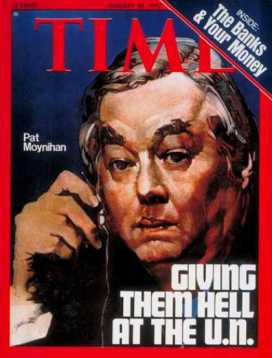
Time Magazine cover of UN Ambassador Daniel Patrick Moynihan

Time Magazine cover of UN Ambassador Daniel Patrick Moynihan

I knew him as the U.S. Senator from the State of New York, where he would shock his staff by showing up early on a Saturday morning to knock out a few letters to the editor, and op-ed pieces on his typewriter, without the bother of an in-session Senate to slow him down.  Later I worked for Checker Finn, who had worked with Moynihan when Moynihan was U.S. Ambassador to India.  Finn adopted many of his scholarly habits from Moynihan.  While working for Finn, nearly 25 years ago at the Department of Education, I got a taste of the world to come when Finn aggressively adopted e-mail messaging for himself and anyone of any executive influence under him, at the old Office of Educational Research and Improvement (OERI).  Aggressive adoption of new technologies can greatly improve organizations and organizational effectiveness.

Almost always with a bow tie.  Usually heavily editing his speeches, or writing his own op-ed pieces while other officials paid ghosts to do it for them.  Thinking thoughts Republicans would come to love, while a Democrat, but years before Republicans would come to love them.  Thinking thoughts Democrats would learn to love, but much later.

Few topics evaded his attention and careful thought.  He talked at length with David Gergen about the problem of Wikileaks, a dozen years before Wikileaks came to public attention (and years before Wikileaks even existed.)  He wrote books about international affairs, and education at home.  He pushed environmental laws to be better. Moynihan worried about the health of American families while James Dobson was still learning what a microphone and a family were.  In 1970, Moynihan warned the U.S. president that global warming is a problem.

Moynihan often appeared as the man who went everywhere, and did everything — after leaving Tulsa.  Moynihan studied everywhere.  He worked under New York Gov. Averell Harriman, and Presidents Kennedy, Johnson, Nixon and Ford, before serving a quarter century in the U.S. Senate (Is there some magic in that seat?  His predecessor was James Buckley; his successor was Hilary Rodham Clinton).   Here’s his brief Congressional biography:

MOYNIHAN, Daniel Patrick, a Senator from New York; born in Tulsa, Tulsa County, Okla., March 16, 1927; attended the public and parochial schools of New York City; attended City College of New York 1943; graduated, Tufts University, Medford, Mass., 1948; received graduate and law degrees from the Fletcher School of Law and Diplomacy 1949, 1961, 1968; studied as a Fulbright fellow, London School of Economics and Political Science 1950-1951; served in the United States Navy 1944-1947; Navy reserve 1947-1966; assistant and secretary to New York Governor W. Averell Harriman 1955-1958; member, New York State Tenure Commission 1959-1960; director, Syracuse University’s New York State Government Research Project 1959-1961; director, Joint Center for Urban Studies, Massachusetts Institute of Technology and Harvard University 1966-1969; author; held cabinet or sub-cabinet positions under Presidents John Kennedy, Lyndon Johnson, Richard Nixon, and Gerald Ford 1961-1976; Ambassador to India 1973-1975; United States Permanent Representative to the United Nations 1975-1976; elected as a Democrat to the United States Senate in 1976; reelected in 1982, 1988, and 1994 and served from January 3, 1977, to January 3, 2001; was not a candidate for reelection in 2000; chairman, Committee on the Environment and Public Works (One Hundred Second and One Hundred Third Congresses); Committee on Finance (One Hundred Third Congress); awarded the Presidential Medal of Freedom on August 9, 2000; professor at Syracuse University’s Maxwell School 2001; senior scholar, Woodrow Wilson International Center for Scholars 2001-2003; died of complications from a ruptured appendix on March 26, 2003; interment at Arlington National Cemetery.

Moynihan was a man ahead of his time.

In this photo, he’s making use of the technology of his time:  A typewriter (I think it’s an old Royal).  How much different would the world be had there been personal computers, and the internet, for Moynihan to toy with?

Moynihan was a writer, and the typewriter the chief tool of his trade.  How important was writing?  He gets his own page at Amazon.com.   Hendrik Hertzberg, in The New Yorker, last year:

Nevertheless, Pat Moynihan was, first, last, and always, a writer. “When I was five years old, I asked my mother, what does Dad do?” his daughter, Maura, recalls in a charming afterword to a splendid new book. “She replied, he’s a writer. And he was: he wrote every day—even at Christmas—articles, books, speeches, and, in great abundance, letters.” You might say he wrote his way to power. Without the writing, no foot-in-the-door job in John F. Kennedy’s Labor Department (and no influence once he was there), no high domestic-policy post in Richard Nixon’s White House, no ambassadorships to India and the United Nations, no twenty-four years in the Senate—and no Moynihan Station.

More, Resources:

Daniel Patrick Moynihan and typewriter, Harvard University

Daniel Patrick Moynihan and typewriter (Smith-Corona, I think) in his office at Harvard University – 1971. George Tames/The New York Times.


Millard Fillmore in 1848

January 15, 2011

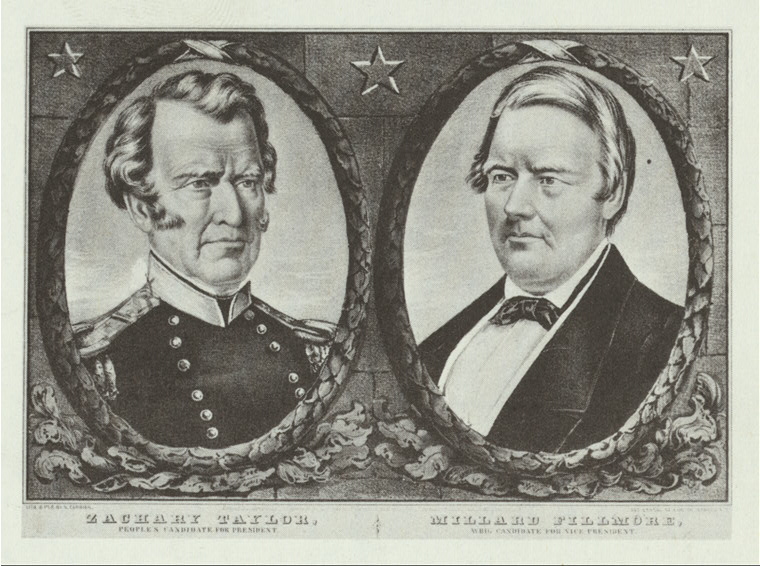
From a flyer or something published for the 1848 presidential campaign, images of the Whig Party ticket, Zachary Taylor for president and Millard Fillmore for vice president:

Campaign flyer for Taylor/Fillmore Whig ticket, 1848 - NY Public Library image

"Zachary Taylor, People's candidate for president; Millard Fillmore, Whig candidate for vice president"

We probably shouldn’t read anything into Taylor’s being identified as the “People’s Candidate” and Fillmore’s being identified as the “Whig Candidate.”  Probably just the copy writer’s way of not sounding redundant.

Found it at the massive digital image collection of the New York Public Library.  Image details from the NYPL:

Image Title:  Millard Fillmore.

Source: Print Collection portrait file. / F / Millard Fillmore. / Portraits.

Location: Stephen A. Schwarzman Building / Print Collection, Miriam and Ira D. Wallach Division of Art, Prints and Photographs

Digital ID: 1234729

Record ID: 583391

Digital Item Published: 12-8-2004; updated 6-25-2010

Image Title

:  Millard Fillmore.


Source

: Print Collection portrait file. / F / Millard Fillmore. / Portraits.


Location

: Stephen A. Schwarzman Building / Print Collection, Miriam and Ira D. Wallach Division of Art, Prints and Photographs


Digital ID

: 1234729


Record ID

: 583391


Digital Item Published

: 12-8-2004; updated 6-25-2010


Sitting Bear, and the Millard Fillmore medal

January 13, 2011

Sitting Bear, Chief of the Arikaras, wearing a medal commemorating Millard Fillmore - Photo by Edward S. Curtis, Library of Congress image

Sitting Bear, Chief of the Arikaras, wearing a medal commemorating Millard Fillmore - Photo by Edward S. Curtis, Library of Congress image

In the 19th century, the U.S. Mint struck medals with the likeness of the sitting president, for use as gifts to foreign dignitaries.  Often these medals would be given to Native Americans as tokens of friendship between the government and the tribe, or as a ceremonial gift on the striking of a treaty.

Description from the Library of Congress:

Photograph shows Sitting Bear, an Arikara chief, in full regalia, with a medallion around his neck. The medallion appears to bear the image of Millard Fillmore and the words: … President of the United States, 1851(?).

Famous photographer of American Indians Edward S. Curtis took this photo.  The photo was copyrighted on November 19, 1908.

  • Reproduction Number: LC-USZ62-136605 (b&w film copy neg.)
  • Rights Advisory: No known restrictions on publication.
  • Call Number: LOT 12321-D [item] [P&P]
  • Other Number: H118592
  • Repository: Library of Congress Prints and Photographs Division Washington, D.C. 20540 USA
  • Notes:
    • H118592 U.S. Copyright Office.
    • Title from item.
    • Curtis no. 2894-08.
    • Forms part of: Edward S. Curtis Collection (Library of Congress).
    • Published in: The North American Indian / Edward S. Curtis. [Seattle, Wash.] : Edward S. Curtis, 1907-30, Suppl. v. 5, pl. 166.

Is the medal the 1851 Indian Peace Medal, perhaps?

Without medals, any plan of operations among the Indians, be it what it may, is essentially enfeebled. This comes of the high value which the Indians set upon these tokens of Friendship. They are, besides this indication of the Government Friendship, badges of power to them, and trophies of renown. They will not consent to part from this ancient right, as they esteem it; and according to the value they set upon medals is the importance to the Government in having them to bestow.

Thomas L. McKenney, head of the Indian Office, to the secretary of the War Department, 1829

And, by the way — isn’t that a grand photo of Sitting Bear?  Even knowing that Curtis might, on occasion, take some liberties in clothing Indians he photographed, it’s a great photo in a great setting of a great man.


Medal of Honor for Staff Sergeant Salvatore Giunta

January 12, 2011

President Obama awarded Staff Sergeant Salvatore Giunta, U.S. Army, the Medal of Honor for conspicuous gallantry for his courageous actions against an armed enemy in the Korengal Valley of Afghanistan in October 2007. November 16, 2010.  The ceremony inspires.  Notice at the end of the ceremony as the president turned to past Medal of Honor winners invited in for the moment.

Vodpod videos no longer available.

Medal of Honor for Staff Sergeant Salvatore Giunta, posted with vodpod

Typewriter of the moment: Sigurd Olson, a typewriter in the wilderness

January 11, 2011


Chuck Wick with Sigurd Olson's typewriter, in Olson's Ely, Minnesota, Home.  MPR photo
Chuck Wick knew Sigurd Olson and now owns Olson’s Ely home and writing shack. Olson’s old Royal typewriter, his pipes, photos, duck decoys and rock collection are still in the shack, where they were left after Olson died more than 20 years ago. (MPR Photo/Bob Kelleher)

Sigurd Olson, in his spare time, ghosted part of the National Wilderness Act, always fighting to preserve and protect his love, the Boundary Waters Canoe Area — on this typewriter.

It’s just a small shack, really an old garage — a drab olive green with a pair of windows on each side, tucked under a few shade trees in the corner of the yard.

When you enter, you hear the spring of a weathered, wooden screen door, and the slap when it closes behind.

Inside, it’s mustiness and old pine. The faded Royal typewriter still waits on a broad oak desk. Olson’s pipes are in the shallow bowl to the right.

Sigurd Olson at Quetico

Sigurd Olson at Quetico

From this typewriter, and this shack, Sigurd Olson captured in words the spirit of wilderness. Olson’s poetic writing has been compared to Henry David Thoreau’s, or John Muir’s. Chuck Wick owns the shack now.

“There’s all kinds of stuff here,” Wick says, fumbling a metal axe head pulled from a wooden drawer. “This piece here — this is an interesting one here. This is a trader’s axe that’s back from the voyageurs era.”

As he worked in his shack, Olson worried that 20th century America was fast gobbling up the nation’s last wild places.

Read the story at Minnesota Public Radio.

Read Olson’s book, The Singing Wilderness, or visit the website for the documentary on Olson with the same title, by Peter Olsen.

Resources:

It is wonderful to have national parks and forests to go to, but they are not enough. It is not enough to make a trip once a year or to see these places occasionally over a long week end. We need to have places close at hand, breathing spaces in cities and towns, little plots of ground where things have not changed; green belts, oases among the piles of steel and stone.

Sigurd Olson, “Our Need of Breathing Space,” at a Resources for the Future, Inc., forum, Washington, D.C., early 1958.


Another Virginia district tosses out inaccurate history texts

January 10, 2011

It’s a rational decision, but I wonder:  What will teachers use other than these texts?

From NEA’s morning news update:

Virginia District To Remove Erroneous History Textbooks From Classrooms.

The Washington Post (1/8, Sieff) reported, “Fairfax [VA] school officials have decided to pull a textbook in which historians have found dozens of errors. Fairfax County Public Schools Superintendent Jack D. Dale said that fourth-grade history will be taught using supplemental materials until errors in ‘Our Virginia, Past and Present’ are corrected in a subsequent edition.” According to the Post, “A state-appointed panel of historians in December found dozens of additional errors in ‘Our Virginia’ and ‘Our America to 1865,’ both of which were published by Connecticut-based Five Ponds Press.”

McCartney: Virginia Schools Should Insist On Full Refund For Error-Filled Textbooks. Robert McCartney wrote in a column for the Washington Post (1/9), “Among Northern Virginia school systems wrestling with how to handle a wildly erroneous fourth-grade social studies textbook, Loudoun County initially received the gold star. Loudoun yanked the book, ‘Our Virginia: Past and Present,’ when the first falsehood – describing nonexistent battalions of black Confederate soldiers – was discovered in October. … By contrast, Fairfax and Arlington were content just to cover up the offending sentence with a blank sticker.” According to McCartney, “There can be only one acceptable solution. The small publishing company responsible for this fiasco, Five Ponds Press of Weston, Conn., should agree right away to cover the entire price” to replace the books.

Once more the burden of education falls on teachers, to either make sure the inaccuracies in the books do not get taught and to substitute accurate stuff, or to find alternative texts.

Teachers:  Can’t have education without ’em.

More, resources:


Would Albuquerque and Santa Fe be part of Texas, but for Millard Fillmore?

January 9, 2011

Different take on Millard Fillmore here, at Duke City Fix (“Duke City” is a nickname for Albuquerque).

Republic of Texas, from Wikipedia

Republic of Texas, showing boundaries that would have inlcuded much of New Mexico in Texas - Wikipedia


A day that will live in obscurity

January 8, 2011

Except of course for you, Dear Reader, who knew that January 7 is the anniversary of the birth of Millard Fillmore, our 13th president.

But, did Brian Crane know that when he penned this Pickles strip for January 7?

Pickles cartoon strip, for January 7, 2011

Pickles cartoon strip, for January 7, 2011 - Brian Crane, Washington Post Writers Group

Could it really be just coincidence that Crane picked Fillmore for the punchline, on Fillmore’s birthday?  Or is it really that great an inside joke?


Millard Fillmore’s 211th

January 7, 2011

Millard Fillmore was born January 7, 1800. Had he lived, Millard Fillmore would be 211 years old today, very cranky, and looking for a good book to read.

Millard Fillmore clipart from University of South Florida

Millard Fillmore clipart from University of South Florida - Free! Click image to go to USF site.

Would you blame him for being cranky? He opened Japan to trade. He got from Mexico the land necessary to make Los Angeles a great world city and the Southern Pacific a great railroad, without firing a shot. Fillmore promoted economic development of the Mississippi River. He managed to keep a fractious nation together despite itself for another three years. Fillmore let end the practice of presidents using slaves to staff the White House, then called “the President’s Mansion,” eight years before the election of Abraham Lincoln.

Then in 1852 his own party refused to nominate him for a full term, making him the last Whig to be president. And to add insult to ignominy, H. L. Mencken falsely accused him of being known only for adding a bathtub to the White House, something he didn’t do.

As Antony said of Caesar, the good was interred with his bones — but Millard Fillmore doesn’t even get credit for whatever evil he might have done: Fillmore is remembered most for being the butt of a hoax gone awry, committed years after his death. Or worse, he’s misremembered for what the hoax alleged he did.

Even beneficiaries of his help promoting the Mississippi River have taken his name off their annual celebration of the event. Fillmore has been eclipsed, even in mediocrity (is there still a Millard Fillmore Society in Washington?).

Happy birthday, Millard Fillmore.

Millard Fillmore, free clipart from University of South Florida

Millard Fillmore, free clipart from University of South Florida

Millard Fillmore was a man of great civic spirit, a man who answered the call to serve even when most others couldn’t hear it at all. He was a successful lawyer, despite having had only six months of formal education (a tribute to non-high school graduates and lifelong learning). Unable to save the Union, he established the University of Buffalo and the Buffalo and Erie County Historical Society.  During the Civil War, he led the local militia in support of the war effort, many rungs down from his role of Commander-in-Chief.  And, it is said of him that Queen Victoria said he was the most handsome man she had ever met.

A guy like that deserves a toast, don’t you think?

Resources:


Annals of DDT: 1946 warning of the dangers of DDT

January 6, 2011

Warnings from this article in Popular Science in February 1946 are almost eerie in their accuracy.

Cover of Popular Science, February 1946; Google Books and Ebay image

Experiments in Ontario by the Dept. of Lands and Forests show what happens when DDT is used out of doors.  Damage to trees was limited to burning of leaf edges.  Carnivorous water beetles and some other aquatic animals were not greatly affected but died because the insects on which they fed were destroyed.  Other aquatic insects were killed directly.  Crayfish, which feed on insects and themselves serve as fish food, were very susceptible.  Minnows were killed by contact and trout died from eating poisoned insects.  Six kinds of frogs and two kinds of snakes were killed, either by contact or by eating poisoned insects.  Any DDT field spray is likely to destroy more than half of these amphibians.  (page 72)

There is an interesting reference to a case of several human deaths due to DDT — these reports of human deaths disappeared from research reports rather quickly, and today critics of environmental protection policies often say that no human ever died from DDT.  What happened to those reports, and are there others?

A further objection to the wide use of DDT in larvae control is the dangers of contaminating the water supply.  Fear of this led us to abandon plans to use DDT extensively at Bear Mountain Park.  Heavy rains might wash the DDT into reservoirs.  We were not fully aware of the deadly effects of the chemical then, but we received word from Okinawa later than several natives had died from eating DDT, and post-mortem examination revealed nerve lesions similar to those produced by strychnine.  (p. 72)

Brownfielders working against Rachel Carson sometimes claim she manufactured controversy about DDT with the publication of her book in 1962.  Go see this article from 16 years earlier, and see the warnings offered by the author, Dr. C. H. Curran, who was Associate Curator, Department of Insects and Spiders, at the American Museum of Natural History.

Rachel Carson was right, and still is.

More history:


University of Buffalo President Simpson to speak at Millard Fillmore’s 2010 birthday observance

January 5, 2011

Baird Point at University of Buffalo's North Campus

Baird Point at University of Buffalo's North Campus; tradition holds that the university was founded by Millard Fillmore, its first chancellor

John B. Simpson, President of the University of Buffalo

John B. Simpson, President of the University of Buffalo, will speak at a ceremony honoring President Millard Fillmore on the 211th anniversary of Fillmore's birth.

Press release from the University of Buffalo:

News Release

Simpson to Speak at Ceremony Commemorating 211th Birthday of Millard Fillmore

Release Date: January 4, 2011

BUFFALO, N.Y. — The 211th anniversary of the birth of Millard Fillmore, the University at Buffalo’s first chancellor and 13th president of the United States, will be celebrated at a ceremony to be held at 10 a.m. Jan. 7 at Fillmore’s gravesite in Buffalo’s Forest Lawn Cemetery.

UB President John B. Simpson will present the memorial address at the annual observance, which honors Fillmore, who played a major role in the founding of numerous cultural, civic and community organizations in Erie County.

Hosted by UB, the Forest Lawn Group and the Buffalo Club, the event will be free and open to the public, and each year draws a wide range of community supporters.

“The annual Millard Fillmore commemoration is a time-honored tradition that celebrates the life of a man who made considerable contributions to Buffalo and the United States,” said William J. Regan, director of special events at UB.”

Col. Jim S. McCready, vice wing commander of the 107th Airlift Wing of the New York Air National Guard based at Niagara Falls Air Reserve Station, will place a wreath from the White House at the gravesite.

Officials from the Buffalo Club, the Forest Lawn Group and UB will also be on hand to present wreaths.

The Rev. Joel Miller of the Unitarian Universalist Church of Buffalo will provide an invocation. The UB Police Color Guard will present the flags. To close the ceremony, West Richter, a UB undergraduate and a member of the UB Marching Band, will play taps.

A reception will follow immediately in the Forest Lawn Chapel.

Born on Jan. 7, 1800, Fillmore was instrumental in founding the Buffalo & Erie County Historical Society, the Buffalo Club and the Buffalo General Hospital. His activities also led to the creation of the Buffalo and Erie County Public Library, the Buffalo Fine Arts Academy and the Buffalo Society of Natural Sciences.

Some historians credit the former teacher, postmaster, lawyer and member of Congress with establishing the White House Library.

This year’s commemoration marks the 46th consecutive year UB has programmed the ceremony, a tradition that dates back to 1937.

From 1937 until 1965, the anniversary ceremonies were a cooperative staging by the City of Buffalo and the Buffalo Board of Education.

The events were administered by Irving R. Templeton, a 1909 graduate of UB, who scheduled two programs annually on or near Jan. 7, one in City Hall and one in Forest Lawn. Templeton was a partner in the law offices of Templeton, Turnabull & Templeton.

Following his death in 1965, responsibility for the event shifted to UB through an agreement between Chancellor Clifford C. Furnas and Alfred E. Kirchhofer, editor of The Buffalo Evening News. While UB participated in programming prior to Templeton’s death, the 1966 event marked the start of UB’s role as official steward of the annual community event.

The vice president for university relations and the Office of Public Affairs programmed the event from 1966-87, when the Office of Special Events began managing the program.

The University at Buffalo is a premier research-intensive public university, a flagship institution in the State University of New York system and its largest and most comprehensive campus. UB’s more than 28,000 students pursue their academic interests through more than 300 undergraduate, graduate and professional degree programs. Founded in 1846, the University at Buffalo is a member of the Association of American Universities.


Just how broken is the U.S. Senate?

January 3, 2011

Important question.

George Packer asked in back in August, in an article he wrote for The New Yorker, “The Empty Chamber.”

Illustration of U.S. Senators for New Yorker, August 2010

Illustration from The New Yorker. Caption from the magazine: “Sit and watch us for seven days,” one senator says of the deadlocked chamber. “You know what you’ll see happening? Nothing.” (Is there any Republican portrayed in this illustration?)

It’s troubling to me that back in August Packer could note a list of subjects critical to our nation that the Senate had been blocked from considering, and even after a “record setting” lame-duck session, all but one of those issues remain untouched.

Packer wrote:

On July 21st, President Obama signed the completed bill. The two lasting achievements of this Senate, financial regulation and health care, required a year and a half of legislative warfare that nearly destroyed the body. They depended on a set of circumstances—a large majority of Democrats, a charismatic President with an electoral mandate, and a national crisis—that will not last long or be repeated anytime soon. Two days after financial reform became law, Harry Reid announced that the Senate would not take up comprehensive energy-reform legislation for the rest of the year. And so climate change joined immigration, job creation, food safety, pilot training, veterans’ care, campaign finance, transportation security, labor law, mine safety, wildfire management, and scores of executive and judicial appointments on the list of matters that the world’s greatest deliberative body is incapable of addressing. Already, you can feel the Senate slipping back into stagnant waters.

Read more http://www.newyorker.com/reporting/2010/08/09/100809fa_fact_packer#ixzz19wpuFk4q

Only food safety got done, though a few judicial appointments squeaked through (less than two dozen).

Depending on your perspective, the world looks pretty good

January 2, 2011

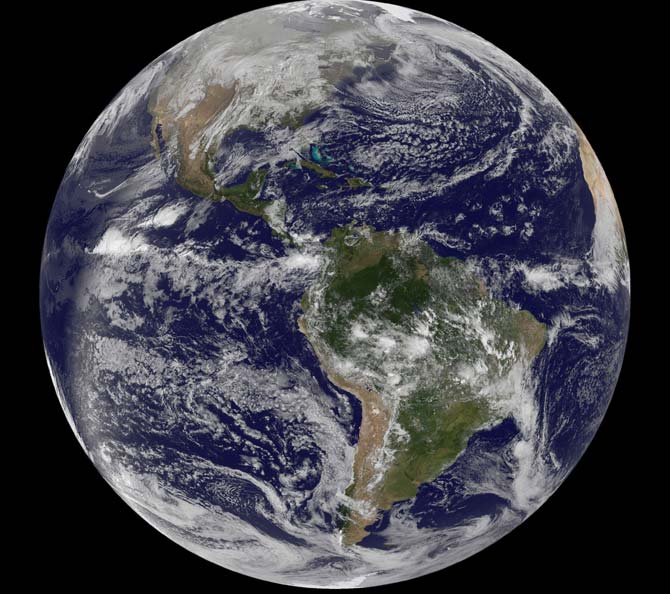
If you’re a few dozen miles from the Earth, for example:

Earth full disc, December 30, 2010 - NASA, GOES

From NASA: The GOES-13 satellite captured a "full-disk image" of North and South America in an image created December 30 at 1445 UTC (9:45 a.m. EST), as the world awaits the new year. Credit: NOAA/NASA GOES Project; click on picture for larger view

Press information from NASA:

As the World Turns to 2011 GOES Satellites Watch its Approach and Look Back at 2010

The GOES series of satellites keep an eye on the weather happening over the continental U.S. and eastern Pacific and Atlantic Oceans and had a busy time with wild weather in 2010. Today, GOES-13 captured one of the last images of North and South America in 2010 as the world continues to turn toward 2011.

The Geostationary Operational Environmental Satellite called GOES-13 satellite captured a “full-disk image” of North and South America in an image created December 30 at 1445 UTC (9:45 a.m. EST) as the world awaits the new year. The stunning image shows cloud cover associated low pressure areas over the upper Midwestern U.S. and Colorado’s Rocky Mountains.

NASA’s GOES Project, located at NASA’s Goddard Space Flight Center in Greenbelt, Md., procures and manages the development and launch of the GOES series of satellites for NOAA on a cost-reimbursable basis. NASA’s GOES Project also creates some of the GOES satellite images and GOES satellite imagery animations. NOAA manages the operational environmental satellite program and establishes requirements, provides all funding and distributes environmental satellite data for the United States.

NASA’s GOES Project was very busy this year. GOES-13 monitors the eastern continental U.S., Atlantic Ocean, Gulf of Mexico and Caribbean, while GOES-11 monitors weather conditions over the western U.S. and the Eastern Pacific Ocean.

In 2010, GOES satellites were busy providing images and animations of weather systems from nor’easters to tropical cyclones that caused blizzards, flooding and wind damage.

Most recently, the GOES project used satellite data to create an impressive animation of the great Christmas weekend blizzard that pummeled the northeastern U.S. Prior to that, GOES imagery showed travel conditions for the holiday weekend when that low was over the Colorado Rockies.

On Dec. 19, the GOES-11 satellite captured an image of the famous “Pineapple Express.” Occasionally in the winter, a large jet stream forms across the mid-Pacific, carrying a continuous flow of moisture from the vicinity of Hawaii to California, bringing heavy rain and snow to the Sierra-Nevada for several days.

On Dec. 8 GOES-13 satellite imagery revealed a snow-covered, winter-like upper Midwest, several weeks before astronomical winter. On Nov. 24, GOES satellites helped Thanksgiving travelers figure out where delays may be happening.

During the summer, on July 25, GOES-13 imagery tracked one of the most destructive storms in years to strike Washington, D.C. and the surrounding area. Strong winds downed trees and power lines, leaving hundreds of thousands of residents without power, stopping elevators, and darkening malls and movie theaters. Falling trees killed at least two people. The NASA GOES Project created a satellite animation of the storm as moved through the region.

GOES-13 was busy in the Atlantic during the 2010 hurricane season. The Atlantic season started on June 1 and ended on November 30. The Atlantic season tied for third with two other years (1995 and 1887) as having the largest number of named storms at 19, and tied with two other seasons (1969 and 1887) for the second largest number of hurricanes, with 12. GOES-13 covered all of those tropical cyclones. GOES-11 didn’t see the action in the Eastern Pacific tropics that GOES-13 did, however. Because of a La Niña event, the 2010 Pacific hurricane season (which began May 15 and ended Nov. 30) was the least active season in terms of the number of named storms and hurricanes on record. All tropical cyclones can be seen at NASA’s Hurricane page archives for 2010 at: http://www.nasa.gov/mission_pages/hurricanes/archives/index.html.

On April 14, months before hurricane season started, GOES-13 became the official GOES-EAST satellite. GOES-13 was moved from on-orbit storage and into active duty. It is perched 22,300 miles above the equator to spot potentially life-threatening weather, including tropical storm activity in the Atlantic Ocean and Gulf of Mexico..

Before GOES-13 moved into the position previously occupied by GOES-12, GOES-12 captured a parade of three large storms the flooded the upper Midwest and Northeast in the second half of March. In the first half of March, GOES-12 covered storms as they dumped heavy rainfall in the Northeastern U.S.

On March 12, GOES-12 captured a very rare event in the tropics: the second–ever known tropical cyclone called Tropical Storm 90Q formed in the South Atlantic Ocean off the coast of Argentina.

During the first two weeks of February 2010, the GOES-12 weather satellite also observed a record-setting series of “Nor’easter” snow storms which blanketed the mid-Atlantic coast in two blizzards.

Whatever and wherever the weather in 2011, the GOES series of satellites will always go.

Related Links:

› GOES-POES web site
› NOAA web site

Rob Gutro
NASA’s Goddard Space Flight Center, Greenbelt, Md.


Poem-a-Day: William Cullen Bryant, “A Song for New Year’s Eve”

December 31, 2010

Poem-a-Day from the Academy of American Poets (you don’t subscribe?):

Poet William Cullen BryantCullen

Poet William Cullen BryantCullen

A Song for New Year’s Eve

by William Cullen Bryant

Stay yet, my friends, a moment stay—
Stay till the good old year,
So long companion of our way,
Shakes hands, and leaves us here.
Oh stay, oh stay,
One little hour, and then away.

The year, whose hopes were high and strong,
Has now no hopes to wake;
Yet one hour more of jest and song
For his familiar sake.
Oh stay, oh stay,
One mirthful hour, and then away.

The kindly year, his liberal hands
Have lavished all his store.
And shall we turn from where he stands,
Because he gives no more?
Oh stay, oh stay,
One grateful hour, and then away.

Days brightly came and calmly went,
While yet he was our guest;
How cheerfully the week was spent!
How sweet the seventh day’s rest!
Oh stay, oh stay,
One golden hour, and then away.

Dear friends were with us, some who sleep
Beneath the coffin-lid:
What pleasant memories we keep
Of all they said and did!
Oh stay, oh stay,
One tender hour, and then away.

Even while we sing, he smiles his last,
And leaves our sphere behind.
The good old year is with the past;
Oh be the new as kind!
Oh stay, oh stay,
One parting strain, and then away.

More: