Congress’s flag etiquette book: Our Flag

January 14, 2007

A good guide to flag etiquette from the U.S. Congress is on-line now. Our Flag is a traditional publication Congress passes out in efforts to help education in history and patriotism (H.Doc 108-97).

Interest in proper etiquette for flag display increased recently — not enough by my calculation, but any increase is welcomed. Where is good information available?

This Congressionally-sponsored guide is basic and accurate. As a classroom resource or a piece of a Scout troop library, it’s a useful reference guide. It can be downloaded (it’s a .pdf), and printed out in color (56 pages).

The book includes many illustrations showing proper flag display.  It also covers the history of the U.S. flag in good enough detail to get through most high school reports, and it features illustrations of flags of each of the states.

Congress in the past provided many publications on such topics for general public consumption and use in classrooms, but has cut back on free distribution of printed information since the early 1980s.  One might be able to get a printed copy with a request to one’s local Member of the House of Representatives, or U.S. Senator.
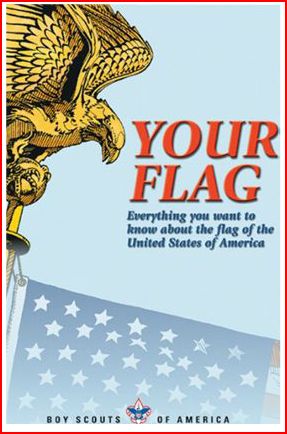
Boy Scouts of America version of the flag etiquette guide, Your Flag

Boy Scouts of America version of the flag etiquette guide, Your Flag

Another book I’ve found very useful is an official Boys Scouts of America publication of the almost the same name, Your Flag.  It’s a graphic-novel type of publication — cartoons for every point to be made.  It features deeper information on proper flag display.  The book can be purchased at any local Boy Scout Council supply shop, or any other shop that stocks Scout literature.  It can also be ordered from BSA’s national catalog, or online at Scoutstuff.org, for $7.9910.99plus shipping.  Every Scout troop should have one of these, and it is also very useful for classroom libraries, for history and civics.

In either publication, one learns that there are not many ways to display a flag properly from a vehicle — improper displays include decals on windows, bumper stickers, flying them from the radio antenna, or attaching them to a window pole to be battered in freeway-speed winds.

One might hope these books get much broader circulation.


Pentagon official calls for assault on Constitution

January 13, 2007

I used to marvel at the irony of attending Republican conventions in states and counties across the nation, where ceremonies would open with the recitation of the Pledge of Allegiance to the U.S. flag, and the nation, ideals and government it stands for, and where speaker after speaker would then assault every aspect of that same nation and government. In the Vietnam era and a decade afterward, frequently these speeches would include rhetorical questions like, “Do we really need a First Amendment?” in reference to protestors, or the speech of anyone that the speaker found disagreeable.

This is a new height: The New York Times reports this morning that a top Pentagon official is bothered that lawyers defend prisoners in the U.S., especially prisoners at Guantanamo Bay — somehow forgetting that lawyers are obligated to do such things by their ethical canons, their state laws and state licensing rules, and by the Constitution. Then he urges corporations who use those same lawyers to stop paying them.

Is this a joke, or can someone who has sworn to uphold the Constitution actually be so clueless?

The senior Pentagon official in charge of military detainees suspected of terrorism said in an interview this week that he was dismayed that lawyers at many of the nation’s top firms were representing prisoners at Guantánamo Bay, Cuba, and that the firms’ corporate clients should consider ending their business ties.

The comments by Charles D. Stimson, the deputy assistant secretary of defense for detainee affairs, produced an instant torrent of anger from lawyers, legal ethics specialists and bar association officials, who said Friday that his comments were repellent and displayed an ignorance of the duties of lawyers to represent people in legal trouble.

The Wall Street Journal joined in the assault on the Constitution in an editorial, according to the news story.

Stanley Kubrick is dead, or I’d think that this was just a review of a Stanley Kubrick follow-up to Dr. Strangelove, or: How I Stopped Worrying and Learned to Love the Bomb.

Any corporation official who fires the company’s attorneys for representing Guantanamo Bay detainees should be fired himself — he’s acting contrary to the interests of his stockholders in getting rid of the best legal team he could hire.

How do such barbarians an anti-American people get to be officials in the Pentagon, and editorial writers at the Wall Street Journal?

More information:

Blog reactions:


Odd things you find in library card catalogs

January 12, 2007

Like this:

faux-library-catalog-card.png

I went looking for mine when Myers at Pharyngula found one.

Here, you can find yours, too:  At blyberg.net.

My card must be older than P.Z.’s — it’s a lot yellower.  The call number seems just a bit off, don’t you think?  Is that right?


Applying the lessons of Vietnam in Afghanistan and Iraq, part 1

January 12, 2007

In pedagogy, the indicator that a lesson has been learned manifests in changes in actions, not in a high score on a paper test.

Did the United States really learn the lessons of Vietnam?  Can we even say, with assurance, what those lessons are?

Lesson 1:  Support of a corrupt government often leads to disaster.  One  of the continuing problems of U.S. policy in Vietnam was that the South Vietnam governments were usually corrupt.  Citizens knew that.  A people rarely loves a corrupt government, unless the corruption inures to the benefit of the people — a degree of graft may be tolerated, for example, if the garbage is picked up on time and the streets are cleared after snow storms.  People quickly lose patience with corruption that does not benefit them, however, and South Vietnam’s government simply could not get basic services to work well.

One might have hoped the U.S. learned the lesson, especially when Sen. Richard Lugar, R-Indiana, recommended to President Ronald Reagan that the U.S. not pledge military support for Philippines President Ferdinand Marcos, because of the corruption in the Marcos government.  As a result, the Philippines today has a democratic government, not one that works with great efficiency (which may be a hallmark of true democracy), but a government that the people understand is elected by them.  Similarly, governments of Eastern Bloc nations under communism frequently were corrupt.  The swift changes that occurred after Poland’s defection from communism and the fall of the Berlin Wall, and the collapse of the Soviet Union, led to massive change.  Where the new governments are not corrupt (Poland, the Czech Republic, Germany) or even just less corrupt, popular support is stronger and national recovery is a genuine hope, if not reality.

Of course, the U.S. was burned by this policy in Iran.  When Jimmy Carter’s administration refused to back the increasingly corrupt and unpopular government of the Shah of Iran, revolutionaries found other reasons to lash out at the U.S.  A wise person may contemplate that at least the U.S. has not been involved in a continuing war in Iran since the 1980s.

But the lesson stands.  One would think that the U.S. would make great effort to assure non-corrupt government in Iraq and Afghanistan, and make the strongest possible effort to make clean government manifest to the local population and the world at large. One might be unsure that is happening today.

In Vietnam, communist forces were trained along the model that Mao Zedong had used in China against the Japanese, and then against the Nationalist army:  Train in military methods, and emphasize the political aspects of the war, too.  Mao’s army had songs they were required to memorize that emphasized high moral conduct of the soldier, with verses that encouraged full payment to anyone from whom anything was taken, such as food or shelter.  Such actions would encourage civilians to support the army, Mao correctly hypothesized.  Ho Chi Minh’s forces did not practice the rules perfectly, but, for example, they were successful often in pointing out that the destruction of cropland was not their doing, but was instead the result of U.S. war efforts.  Vietnamese citizens may not have strongly supported Ho’s forces, but neither did they support the Army of the Republic of South Vietnam.  When the reason for the fighting is unclear, fighting often cannot be successful.  Corruption in a government makes reasons to support that government suspect, fogging the reasons to fight for it.

Cleaning up corruption in Iraq’s government should be a very high priority of U.S. policy. 

[This is the first of a series of posts on the Lessons of Vietnam.]


Carnival of Education 101

January 12, 2007

Postcard of Little Rock's Central High School

Little Rock’s Central High School, portrayed in a postcard (courtesy of Curt Teich Postcard Archives and the University of Arkansas Libraries)

Just a postcard to remind you that the 101st Carnival of Education is up over at I Thought a Think. There is a new Congress; many state legislatures are gearing up. It’s a good time to discuss education policy. Perhaps more to the point, if we don’t contribute to the discussion now, policy changes will go on without our contribution. Read the posts, and take action.


Song for the Alaska flag

January 12, 2007

Still looking for a comprehensive — and accurate — list of states that have official pledges. The search is occasionally illuminating (as are all genuine quests for knowledge).

For example, I knew Alaska’s flag was designed by a student, Benny Benson. I had not realized that it was adopted in the Coolidge administration, though, and not much closer to statehood in 1959.

More, Alaska has a song to its flag. I suspect the song is sung less often than Texas’s pledge is made (well, Texas requires school kids to say the pledge every day). But it’s a bit more poetic, isn’t it?

Alaska flag, Wikimedia, by Dave Johnson

Alaska’s song to the flag is below the fold. A link to an MP3 recording of the song is available here. Read the rest of this entry »


State flag pledges: Alabama, too

January 11, 2007

Ralph Luker at Cliopatria (at History News Network) adds Alabama to the list of states with an official pledge to the state flag.

Alabama’s another one, Ed: “Flag of Alabama I salute thee. To thee I pledge my allegiance, my service, and my life.” And then I wash my mouth out with soap.

Yeah, that one’s a bit over the top, rather the shark-jumper of state flag pledges.

How many more are there? Alabama state flag


Mencken’s typewriter

January 10, 2007

Mencken's Corona Typewriter, Enoch Pratt Library

Mencken's Corona Typewriter, at the Mencken Room in the Enoch Pratt Library, Baltimore, Maryland

The typewriter that belonged to H. L. Mencken. Photo by the Enoch Pratt Free Library, Baltimore, Maryland. [Update, April 15, 2007: The photo has moved, and is restricted by copyright; you may follow the links to view the original photo of the typewriter, at the site of the Enoch Pratt Free Library. E.D.]

Was this the machine upon which Mencken composed the Millard Fillmore/Bathtub hoax?  Perhaps.  It was used prior to 1930.


Millard Fillmore was no George Bush

January 10, 2007

Excerpt from Millard Fillmore’s first State of the Union Address, December 2, 1850:

Nations, like individuals in a state of nature, are equal and independent, possessing certain rights and owing certain duties to each other, arising from their necessary and unavoidable relations; which rights and duties there is no common human authority to protect and enforce. Still, they are rights and duties, binding in morals, in conscience, and in honor, although there is no tribunal to which an injured party can appeal but the disinterested judgment of mankind, and ultimately the arbitrament of the sword.

Among the acknowledged rights of nations is that which each possesses of establishing that form of government which it may deem most conducive to the happiness and prosperity of its own citizens, of changing that form as circumstances may require, and of managing its internal affairs according to its own will. The people of the United States claim this right for themselves, and they readily concede it to others. Hence it becomes an imperative duty not to interfere in the government or internal policy of other nations; and although we may sympathize with the unfortunate or the oppressed everywhere in their struggles for freedom, our principles forbid us from taking any part in such foreign contests. We make no wars to promote or to prevent successions to thrones, to maintain any theory of a balance of power, or to suppress the actual government which any country chooses to establish for itself. We instigate no revolutions, nor suffer any hostile military expeditions to be fitted out in the United States to invade the territory or provinces of a friendly nation. The great law of morality ought to have a national as well as a personal and individual application. We should act toward other nations as we wish them to act toward us, and justice and conscience should form the rule of conduct between governments, instead of mere power, self interest, or the desire of aggrandizement. To maintain a strict neutrality in foreign wars, to cultivate friendly relations, to reciprocate every noble and generous act, and to perform punctually and scrupulously every treaty obligation–these are the duties which we owe to other states, and by the performance of which we best entitle ourselves to like treatment from them; or, if that, in any case, be refused, we can enforce our own rights with justice and a clear conscience.


Hello? Are you there?

January 10, 2007

National Delurking Week badgeIt is national Delurking Week.  We all learn more in conversation, when we all listen.  The comments sections at the end of each post are there so you can add what you know.  A few people have provided great corrections and wonderful links.  Commenters are far, far less than 1% of visitors here.

Speak up!  Please.

Tip of the scrub brush to Pharyngula, and Adventures in Ethics and Science.


State flag pledges, present and accounted for

January 10, 2007

I am guilty. I made a bit of an assumption that state flag pledges are rare. There were none in Idaho, or Utah, where I attended public schools. Maryland made no fuss about one while we were there. In most conversations when the issue of a state pledge comes up, people tell their shock at discovering there was such a thing for Texas, and that Texans actually say it from time to time.

Only Georgia bothered to send in correcting information.

But a search of Google finally managed to strike something, having got just the right combination of terms. Below the fold are the state flag pledges for Arkansas, Kentucky, Louisiana, Ohio and South Dakota. I note that the years of adoption are recent — some sort of competition between state legislatures with too little to do? — which leads me to suspect that there may be more state pledges out there, but they are just showing up in the civics and history books.

How many more state pledges are out there? Got something to add? Read the rest of this entry »


Don’t forget Michigan’s pledge!

January 9, 2007

Michigan has a state pledge of allegiance, too:

 I pledge allegiance to the flag of Michigan, and to the state for which it stands, two beautiful peninsulas united by a bridge of steel, where equal opportunity and justice to all is our ideal.

Michigan’s law gives credit to the author, too:  Harold G. Coburn.  It’s in Act 175 of 1972.

Michigan State Flag, from Wikipedia


Fillmore’s writings on line

January 9, 2007

Manchester Union Democrat, Dec 8, 1852, with news of Fillmore's SOTU address

Manchester, New Hampshire, Union Democrat,
December 8, 1852 (?); with news of Fillmore’s State of the Union Address

Millard Fillmore was a grade school drop out. He took the path to a career that many in his day did — he apprenticed, and worked his way up. Legal education in his day (circa 1815 to 1825) required that one apprentice in a law office, to “read for the law.” In that way, Fillmore, who didn’t graduate elementary school, became a lawyer.

Lawyering requires words, of course, but Fillmore was no great writer than we know, especially compared to Teddy Roosevelt, who was a newspaper reporter, or John Kennedy, in whose name a Pulitzer Prize-winning book was published (controversy for another time; Profiles in Courage, (Perennial Classics Books, 2000). We might hope that some institution will undertake a collection of Fillmore’s legal arguments as they may be spread across New York court archives, much as the Lincoln Library has scoured Illinois for Lincoln’s writings and oral arguments.

We may assume that Fillmore participated heavily in the writing of his state of the union addresses, in a day when ghost writers were not listed in the staff books of the White House. So they would contain genuine Fillmore ideas and phrases. Fillmore’s three state of the union speeches are available at the Gutenberg Project.

I’ll be mining them for accurate quotes, you may rest assured. (Does he mention bathtubs in any of the speeches? No.) Read the rest of this entry »


Flags at half-staff for President Ford, interest at full peak

January 9, 2007

For many years my colleagues in Scouting and I have mused at the great lack of interest in flag etiquette. We have collected dozens of cases of improper flag display, usually by people who were trying to honor the flag and nation, but who went about it contrary to good taste or the flag code, or both.

A couple of days after President Ford’s death I posted a short reminder of what the flag code calls for, with a photo of a flag flying at half-staff over the White House — a photo taken in 2004, after the death of Ronald Reagan, but the only one I could find at the time. That post is by now, far and away the most popular post on this blog since we started it up last July. For the past few days the number of visits to that post continued to grow.

I don’t know why the post is so popular. I hope people are getting from it a touch of flag etiquette — that would be fitting an proper especially as a result of the funeral of Gerald Ford, supreme nice guy and Eagle Scout. But there it is.

Today I found that the White House had included a photo of the White House flag at half-staff on December 26, 2006, in honor of Gerald Ford. Here it is:

White House flag at half-staff in honor of Gerald Ford, after his death

A reminder again: The flag should be hoisted quickly (as always), to the peak of the pole, and then be lowered solemnly to half-mast. When the flag is retired at the end of the day, it should be raised again to the peak, quickly, and then lowered solemnly.

See also:


Correction: Georgia also has a state pledge of allegiance

January 9, 2007

David Parker at Another History Blog updates and corrects our information on state pledges of allegiance:  Texas is not alone, Georgia also has a state pledge.

Georgia does not require students to say the pledge daily, however.

These provisions are often hidden away in state laws that do not index well at the legal sites I use, Findlaw.com and the Cornell University Law Library’s Legal Information Institute.  Consequently, it’s quite possible I have missed other state pledges.  If you know of any others, please let me know.

And, in the meantime, go check out Prof. Parker’s post.  The details make the story, as always.