July 4, 2023: Fly your flag! 247th anniversary of public reading of the Declaration of Independence

July 1, 2023

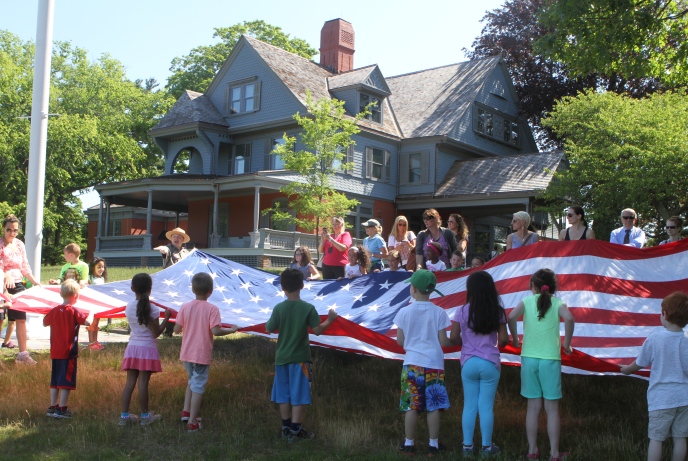
At Four Mile Historic Park in Glendale, Colorado, Abraham Lincoln actor John Voehl pauses before delivering the Gettysburg Address at a 4th of July celebration (yes, Lincoln delivered the address on November 16; it's a great statement of the meaning and history of the Declaration of Independence, and probably appropriate for July 4, remembering that the actual independence resolution passed on July 2, 1776 . . .) Denver Post file photo

At Four Mile Historic Park in Glendale, Colorado, Abraham Lincoln actor John Voehl pauses before delivering the Gettysburg Address at a 4th of July celebration (yes, Lincoln delivered the address on November 16; it’s a great statement of the meaning and history of the Declaration of Independence, and probably appropriate for July 4, remembering that the actual independence resolution passed on July 2, 1776 . . .) Denver Post file photo

It’s a day of tradition — oddly enough, since we are in reality a very new nation, and Lee’s resolution to declare independence from Britain came on July 2.

A soak in Millard Fillmore’s Bathtub is nothing if not a steeping in tradition.  Fly your flag July 4, or the whole weekend, to celebrate the independence of the American colonies of Britain.

Fourth of July: NPR has already read the Declaration of Independence (or will soon, if you’re up early), PBS is ready to broadcast the Capitol Fourth concert  (maybe a rebroadcast is available, if you’re off at your own town’s fireworks — check your local listings), your town has a parade somewhere this weekend, or a neighboring community does, and fireworks are everywhere.

At the White House, traditionally, new citizens are sworn in — often people who joined our armed forces and fought for our nation, before even getting the privileges of citizenship.  Fireworks on the Capital Mall will be grand. President Obama’s White House would host a few thousand military people and their families from some of the best views.  Traditionally, five photographers, chosen by lottery, get to shoot photos of the fireworks from the windows of the Washington Monument; will that occur, with the Monument open again after repair from the earthquake?

There will be great fireworks also in Baltimore Harbor over Fort McHenry, the fort whose siege inspired Francis Scott Key to write the “Star-spangled Banner” from his boat in the harbor, in 1814. Fireworks will frighten the bluebirds nesting at Yorktown National Battlefield.  I suspect there will be a grand display at Gettysburg, on the 154th anniversary of the end of that battle. July 4, 1863, also marked the end of the Siege of Vicksburg; tradition holds that Vicksburg did not celebrate the 4th of July for 83 years after that. I’ll wager there will be fireworks there tonight.

In Provo, Utah, the city poobahs will have done all they can to try to live up to their self-proclaimed reputation as having the biggest Independence Day celebration in the nation.  Will the celebration in Prescott, Arizona, still be muted by the tragic deaths of 19 Hot Shot firefighters a few years ago; will drought halt the fireworks, too?  There will be fireworks around the Golden Gate Bridge, in Anchorage, Alaska, reflecting on the waters of Pearl Harbor, and probably in Guam, American Samoa, and the Northern Marianas Islands.

Fireworks on the Fourth is a long tradition — a tradition that kept John Adams and Thomas Jefferson alive, until they both died on the 50th anniversary of the Declaration of Independence, in 1826, the sounds of the fireworks letting Adams know the celebration had begun (Adams erroneously celebrated that Jefferson, the Declaration’s author, still lived, unable to know Jefferson had passed just hours earlier).

Remember to put your flag up today.

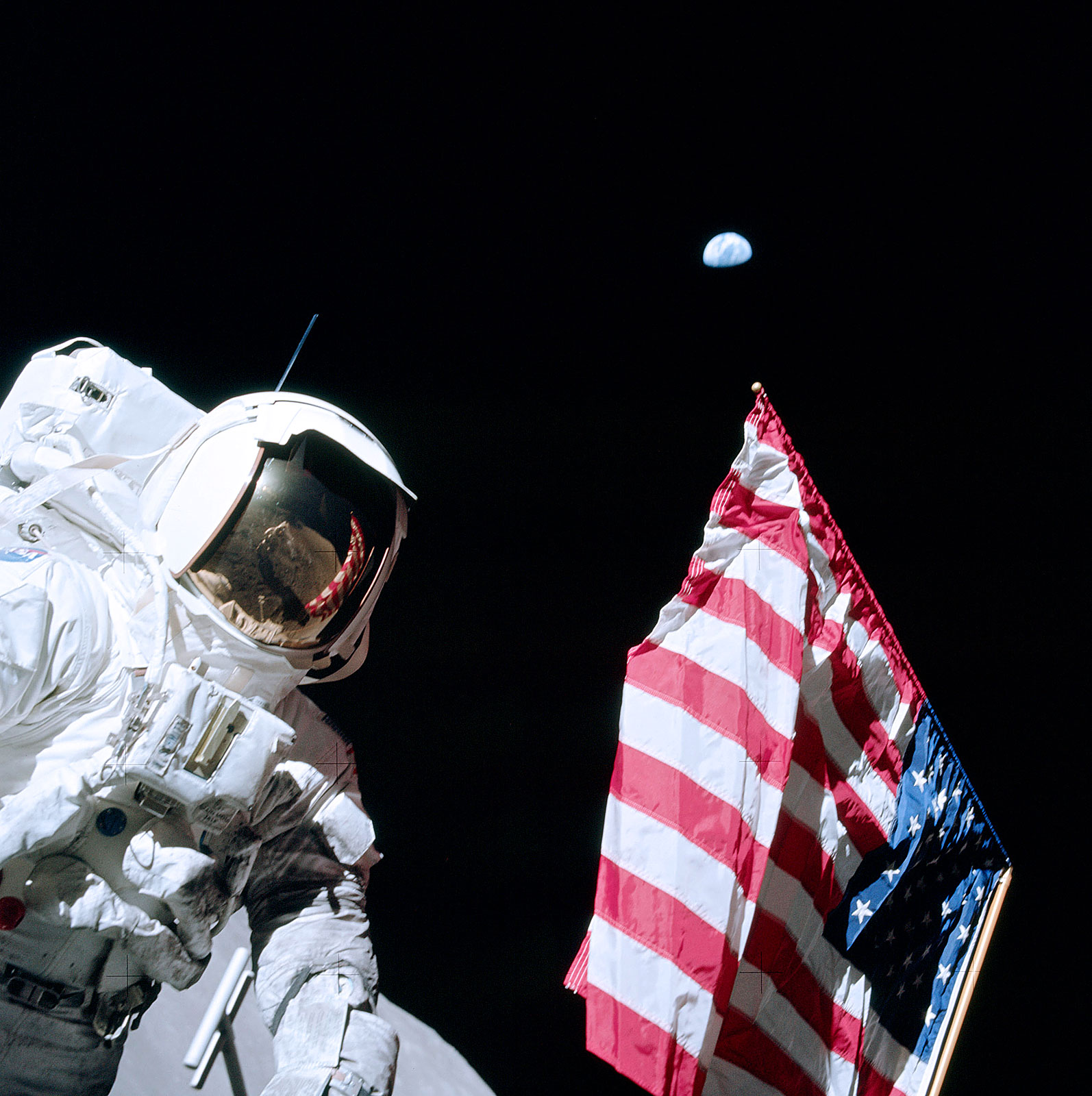
Astronaut Eugene Cernan and the U.S. Flag -- Apollo 17 on the Moon (NASA photo)

Last flag on the Moon: Astronaut Eugene Cernan and the U.S. Flag — Apollo 17 on the Moon (NASA photo)

If you’re not on the Moon, here are some tips on flag etiquette, how to appropriately fly our national standard.

Also:

Lunar Reconnaissance Orbiter photo of the Apollo 17 landing site.

Lunar Reconnaissance Orbiter photo of the Apollo 17 landing site. NASA caption: Apollo 17 Lunar Module Challenger descent stage comes into focus from the new lower 50 km mapping orbit, image width 102 meters. Credit: NASA/GSFC/Arizona State University

This is mostly an encore post, but I so love that photo of the flag with the Earth in the distance.

Happy birthday, Kathryn!

Fireworks in Duncanville, Texas, for July 4

Fireworks in Duncanville, Texas, for July 4 — Kathryn Knowles’s birthday. We’re always happy the town chimes in with the celebratory spirit.

Tip of the old scrub brush to Thomas Jefferson, Richard Henry Lee, John Adams, Benjamin Franklin, Roger Sherman, Robert Livingston, and the cast of thousands of patriots including George Washington.

Save


The Seldom Scene 1979 – Rider (Bluegrass)

June 22, 2023

I discovered the Seldom Scene within the first year I moved to Washington permanently. To me, Washington was the Bluegrass Capital of the World in those days.

At the venerable Birchmere in Alexandria, Virginia, the best bluegrass bands and performers of the day came through every week, and on Thursday nights the Seldom Scene could be seen as they seldom were.

Somebody caught this video, not at the Birchmere, but a song they often played.

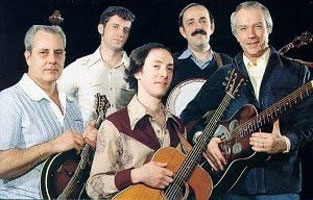
Members of the 1979 Seldom Scene: John Duffey (Mandolin), Ben Eldridge (Banjo), Mike Auldridge (Dobro), Phil Rosenthal (Guitar), & Tom Gray (Bass). I do not know the venue.

Perhaps I could blame the band for discouraging me from taking up playing again. On every instrument, they were so superior to most, playing at a level very few could ever hope to reach.

Still loved them.

From the Bluegrass Library.

Bluegrass legends Seldom Scene, c. 1979. John Duffy, Tom Gray, Phil Rosenthal, Ben Edredge and Mike Auldridge. Probably a publicity photo, via Rocky 52.

Bluegrass legends Seldom Scene, c. 1979. Left to right, John Duffey on mandolin, Tom Gray on bass, Phil Rosenthal on guitar, Ben Eldredge on banjo and Mike Auldridge on Dobro. Probably a publicity photo, via Rocky 52.


See also:


Remember to fly your flag on Father’s Day 2023!

June 18, 2023

In the video, the U.S. flag flying at Circle 10 Council’s Camp Wisdom, in Dallas County, Texas.

Perhaps when you were a child, you watched your father as he posted Old Glory near your front door, on holidays and other special occasions. Your father set an example that you follow today.

Remember to honor your father by posting the flag today, Fathers Day. Fathers Day is one of those dates set in the U.S. Flag Code for citizens to fly the U.S. flag.

“Litchfield, Minnesota veterans Roger Tipka, Don Nordlie and Stan Mortenson, pictured from left, raise the U.S. flag prior to the start of the third annual Tournament of Duty in 2015. The three men all served in the Battle of Iwo Jima during World War II.” Litchfield Independent Observer photograph.


Flag Day 2023! (Fly your flag all week) – A teacher started it

June 12, 2023

Of course you know to fly your flag on June 14 for Flag Day — but did you know that the week containing Flag Day is Flag Week, and we are encouraged to fly the flag every day?

Clifford Berryman's 1901 Flag Day cartoon, found at the National Archives:

Clifford Berryman’s 1901 Flag Day cartoon, found at the National Archives: “In this June 14, 1904, cartoon, Uncle Sam gives a lesson to schoolchildren on the meaning of Flag Day. Holding the American flag in one hand, Uncle Sam explains that the flag has great importance, unlike the Vice Presidency, which he ridicules in a kindly manner. (National Archives Identifier 6010464)”

The 105th Congress in 1998 passed a law designating the week in which Flag Day falls as Flag Week, encouraging Americans to fly the flag the entire week. In 2023 that runs from Sunday, June 11, through Saturday, June 17.

Our National Archives has a blogged history of Flag Day pointing out it was a teacher who started Flag Day celebrations.

On June 14, 1885, Bernard J. Cigrand placed a 10-inch, 38-star flag in a bottle on his desk at the Stony Hill School in Ozaukee County, Wisconsin. The 19-year-old teacher then asked his students to write essays on the flag and its significance to them. This small observance marked the beginning of a long and devoted campaign by Cigrand to bring about national recognition for Flag Day.

And so we do, today, still.

This is an encore post.

Yes, this is an encore post. Defeating ignorance takes patience and perseverance.


Past time to act against pollution that causes global warming

June 7, 2023

I am reminded of a Senate hearing during the Dust Bowl — is it an apocryphal story? An enormous windstorm picked up thousands of tons of dust from Texas, Oklahoma, New Mexico, Colorado, and sent it cross country.

A Department of Agriculture official trying to get the government to act heard of the storm, and tracked it. He asked a Senatte committee meeting on the Dust Bowl to take an early lunch break in a hearing.

When the committee hearing resumed after lunch, a senator asked the official if the Dust Bowl was really that big a deal — what would the effects be?

The Ag official got up from the table, went to the windows and opened them, so the dust could swirl into the hearing room. He said the dust had been topsoil used for farming a couple of days earlier. The dust had blown into Washington just after noon.

Congress acted. U.S. defeated the Dust Bowl and restored millions of acres of farmland.

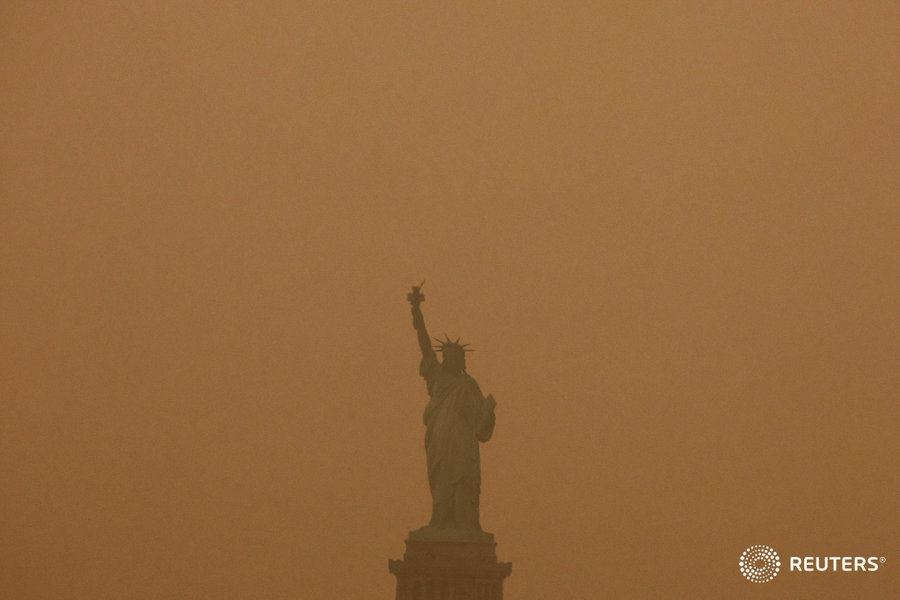
In New York and other eastern cities this week, smoke from wildfires in Canada settled in after a nearly 3,000-mile journey.

Who will act this time?

Statue of Liberty stands obscured and choked by smoke from wildfires in Western Canada. Reuters photo by Amr Alfiky | عمرو الفقي@alfiky_amr.

Global heating dries out western forests, and some effects cause trees to die, making them great tinder for fires. It’s clear to anyone who looks, to anyone who loves science, to anyone who loves Liberty.

Tip of the old scrub brush to @corinne_perkins on Twitter.


Encore: Greatest leadership example in history? Eisenhower’s astonishing D-Day plan B, “Blame . . . is mine alone”

June 6, 2023

It is a model of leadership, an example more leaders should follow — though too few do. It’s one more example of the high caliber leadership Dwight Eisenhower demonstrated throughout his life. In its imperfections, handwritten, it should take your breath away.  Eisenhower was a leader down to the bone.

So again, today, on the 79th anniversary of the D-Day invasion, we remember.

Eisenhower's unused statement on the failure of D-Day

Eisenhower’s contingency statement, in case D-Day failed – image from the National Archives

This quote actually isn’t a quote. It was never said by the man who wrote it down to say it. It carries a powerful lesson because of what it is.

In preparing for the D-Day invasion, Supreme Allied Commander Dwight Eisenhower carefully contemplated what would happen if the invasion failed.  What if the Germans repulsed the Allies, and no foothold was established to re-take the main body of Europe from the Germans?

Ike’s answer is a model of leadership:  He would take the blame.  Regardless what happened, Ike took full responsibility for the failure, giving credit to the soldiers who would have sacrificed in vain, perhaps their lives.

The Bathtub recently posted Gen. Dwight Eisenhower’s “order of the day” to the troops about to conduct the Allied invasion of Normandy — D-Day — to establish the toehold in Europe the Allies needed to march to Berlin, and to end World War II in Europe. As a charge to the troops, it was okay — Eisenhower-style words, not Churchill-style, but effective enough. One measure of its effectiveness was the success of the invasion, which established the toe-hold from which the assaults on the Third Reich were made.

eisenhower-with-paratrooper-eve-of-d-day.jpg

Photo shows Eisenhower meeting with troops of the 101st Airborne Division, 502nd Parachute Infantry Regiment, on the eve of the invasion. It was these men whose courage he lauded.

When Eisenhower wrote his words of encouragement to the troops, and especially after he visited with some of the troops, he worried about the success of the operation. It was a great gamble. Many of the things the Allies needed to go right — like weather — had gone wrong. Victory was not assured. Defeat strode the beaches of Normandy waiting to drive the Allies back into the water, to die.

Eisenhower wrote a second statement, a shorter one. This one was directed to the world. It assumed the assault had failed. In a few short sentences, Eisenhower commended the courage and commitment of the troops who, he wrote, had done all they could. The invasion was a chance, a good chance based on the best intelligence the Allies had, Eisenhower wrote. But it had failed.

The failure, Eisenhower wrote, was not the fault of the troops, but was entirely Eisenhower’s.

He didn’t blame the weather, though he could have. He didn’t blame fatigue of the troops, though they were tired, some simply from drilling, many from war. He didn’t blame the superior field position of the Germans, though the Germans clearly had the upper hand. He didn’t blame the almost-bizarre attempts to use technology that look almost clownish in retrospect — the gliders that carried troops behind the lines, sometimes too far, sometimes killing the pilots when the gliders’ cargo shifted on landing;  the flotation devices that were supposed to float tanks to the beaches to provide cover for the troops (but which failed, drowning the tank crews and leaving the foot soldiers on their own); the bombing of the forts and pillboxes on the beaches, which failed because the bombers could not see their targets through the clouds.

There may have been a plan B, but in the event of failure, Eisenhower was prepared to establish who was accountable, whose head should roll if anyone’s should.

Eisenhower took full responsibility.

Our landings in the Cherbourg-Havre area have failed to gain a satisfactory foothold and I have withdrawn the troops. My decision to attack at this time and place was based upon the best information available. The troop, the air [force] and the navy did all that bravery and devotion to duty could do. If any blame or fault attaches to the attempt, it is mine alone.

Who in the U.S. command would write such a thing today?  Who else in history would have written such a thing?  Is there any indication that Julius Caesar, Alexander the Great, Attila the Hun, Genghis Khan, or any other commander of a great army in  a world-turning invasion, considered how to save and perhaps salve the reputation of his troops, though they had failed?

Leadership is more than just positive thinking.

  • The message may also be viewed here. Yes, it’s incorrectly dated July 5 — should have been June 5.  In history, little is perfect.  We can excuse his slip of the pen, considering what else he had on his mind.


More:

General Eisenhower speaks with members of the ...

Another  angle of the meeting with the troops:  General Eisenhower speaks with members of the 101st Airborne Division on the evening of 5 June 1944.  Wikipedia image

This is an encore post.

Yes, this is an encore post. Defeating ignorance takes patience and perseverance.


June 2023: When do we fly the Old Glory?

June 1, 2023

“Flag Day, Pittsburgh, Pennsylvania.” 1942 photo by John Vachon (1914-1975) for the U.S. Farm Security Administration/Office of War Information. Image from the National Archives and Records Administration (NARA)

June holds only two days designated for flying the U.S. flag out of the specific days mentioned in the U.S. Flag Code, and six statehood days, when residents of those states should fly their flags.  Plus, there is National Flag Week. And now there is Juneteenth.

Two Flag Code-designated days:

  • Flag Day, June 14
  • Fathers Day, third Sunday in June (June 18 in 2023)

Several states celebrate statehood. New Hampshire, Virginia, Arkansas, Kentucky, Tennessee and West Virginia celebrate statehood; Kentucky and Tennessee share the same date.

  • Kentucky, June 1 (1792, 15th state)
  • Tennessee, June 1 (1796, 16th state)
  • Arkansas, June 15 (1836, 25th state)
  • West Virginia, June 20 (1863, 35th state)
  • New Hampshire, June 21 (1788, 9th state), and
  • Virginia, June 25 (1788, 10th state)

Additionally, Congress passed a resolution designating the week in which June 14th falls as National Flag Week, and urging that citizens fly the flag each day of that week.  In 2023 that will be the week of June 11, which falls on Sunday, through June 17.

The resolution naming Juneteenth National Independence Day a holiday was signed into law last year by President Joe Biden. Juneteenth is June 19 — day after Fathers Day in 2023.

Flag-flying days for June, listed chronologically:

  1. Kentucky and Tennessee statehood, June 1
  2. Flag Day, June 14; National Flag week, June 11 to 17
  3. Arkansas statehood, June 15 (duplicating a day in National Flag Week)
  4. Fathers Day, June 18
  5. Juneteenth National Independence Day, June 19
  6. West Virginia statehood, June 20
  7. New Hampshire statehood, June 21
  8. Virginia statehood, June 25

As you know, any resident may fly the flag any day of the year, under the etiquette provided in the Flag Code.

Tip of the old scrub brush to Mike’s Blog Rounds at Crooks and Liars — thanks for the plug!

National Archives caption: This illustration entitled, “Flag Day - 1900”, by cartoonist Clifford Berryman, which appeared in the Washington Post on June 14, 1900, depicts the growth of American influence in the world as the European powers watch in the background as new century is ushered in.

National Archives caption: This illustration entitled, “Flag Day – 1900”, by cartoonist Clifford Berryman, which appeared in the Washington Post on June 14, 1900, depicts the growth of American influence in the world as the European powers watch in the background as new century is ushered in.

Flag Day, 1918, at Fort Sam Houston, Texas. Photo by Miles F. Weaver (1879-1932), from the collection of the National Archives (NARA)

Flag Day, 1918, at Fort Sam Houston, Texas. Photo by Miles F. Weaver (1879-1932), from the collection of the National Archives (NARA).

Save


Regulating guns as we regulate cars

May 29, 2023

A Nextdoor member complained that autos kill people, so we should ban some autos, just like calls to ban some guns. ‘It would be fair, no?’

I responded: Auto deaths are down from past years, and are much lower than the rate 30 years ago. Consider some of the rational safety steps taken to cut auto deaths, and ask whether they would not be applicable to guns, to reduce deaths.

1. A license is required to operate a vehicle, whether one owns the vehicle or not. Proficiency in vehicle operation must be demonstrated in a written test and driving test done by the state.

2. A license is required for the vehicle. In Texas, licenses must be renewed annually. Vehicles must undergo inspections for safety, and to be sure they meet air quality standards on emissions.

3. Drivers and owners are required to carry liability insurance, to pay for medical costs and property damage, or deaths, in the event the vehicle causes damage or injury.

4. There are numerous safety devices in vehicles; brakes must be maintained, by law; tires must be kept in good working order. Seatbelts are required for drivers and all passengers. Airbags are now required on almost all vehicles, passive injury-prevention devices. Bodies of cars and trucks must be built to preserve cab integrity and reduce injury in event of collision.

5. There are many safety warning devices. Vehicles must have working headlights and taillights, turn signals, emergency signals, running lights and horns. Law requires drivers to signal their intentions to other surrounding vehicles and pedestrians.

6. In almost all cases, vehicles must give way to pedestrians.

There are not exact analogs to all those safety devices and procedures in guns, but many would improve gun safety considerably.

There are about half as many vehicles as guns in the U.S. (educated guess); most of them get used every day. Most Americans ride in a vehicle every day.

Let us say there are 150 million vehicles driven 300 times a year. That’s 45 billion uses (mileage is not calculated). Of those 45 billion uses, 40,000 lives are lost every year. One death for every 1,125,000 uses.

300 million guns (again, educated guess; it’s a bit more than that); most guns get used how often? Once a year? Twice a year?

600 million uses, and 45,000 deaths, with guns. That’s one death for every 13,333 uses. Gun deaths are about 8 times more frequent than auto deaths, per use.

Obviously, guns are [at least] 8 times as dangerous as cars. Let’s consider that, too.

How can we bring gun deaths down?

While you’re at it, how can we bring auto deaths down?

Some time after I posted my response on May 10, 2023, the original poster took his post down. BESMART has good policies for gun safety in America. Maybe check out their suggestions, and support their work, at BeSmartforkids.org.

BESMART gun safety suggestions.
Five rules of gun safety to protect children, from BeSMARTforkids.org.

Communing with Mastodons

May 3, 2023

There’s a Mastodon account linked familially to this blog, Mastodon, @EdDarrell@mastodon.social.

Drop by and say hello.


Annals of Global Heating: Karma, sort of. Pollute around, deny problems, and find out

April 14, 2023

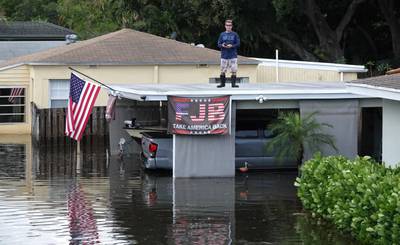
Man on roof after Ft. Lauderdale, FL, record rains, 4-14-2023
Man on roof, separated from his political rants against doing anything to stop global warming by global-warming-aggravated floods, in Ft. Lauderdale, Florida, circa April 14, 2023.

You can’t make this stuff up. Here’s a guy flooded out from his home, where he holds forth claiming climate change isn’t real, and if it is, isn’t a problem.

Will he accept federal aid to fix his home?


April 2023: When do we fly our flags?

April 7, 2023

Schooner on Chesapeake Bay flies the 15-stripe/15-star flag that flew over Fort McHenry. Image from the Maryland Secretary of State's Office

Schooner on Chesapeake Bay flies the 15-stripe/15-star flag that flew over Fort McHenry. Image from the Maryland Secretary of State’s Office

Is April the cruelest month?

It’s cruel to people who want to fly U.S. flags often, but only on designated flag-flying dates. (April is also National Poetry Month, so it’s a good time to look up poetry references we should have committed to heart).

For 2023, these are the three dates for flying the U.S. flag; Easter is a national date, the other two are dates suggested for residents of the states involved.

One date, nationally, to fly the flag. That beats March, which has none (in a year with Easter in April and not March). But March has five statehood days, to April’s two.

Take heart! You may fly your U.S. flag any day you choose, or everyday as many people do in Texas (though, too many do not retire their flags every evening . . .).

Three dates to fly Old Glory in April, by the Flag Code and other laws on memorials and commemorations.

  • Easter, April 9 in 2023
  • Maryland, April 28, 1788, 7th state
  • Louisiana, April 30, 1812, 18th state
April usually sees the opening of Major League Baseball's season -- some teams jumped into March in 2018. In this photo, U.S. Navy sailors assigned to the USS Bonhomme Richard practice for the San Diego Padres' opening day flag ceremony in San Diego on April 5, 2011. The ship sent nearly 300 volunteers to unfurl an 800-pound U.S. flag that covered the entire field. The Bonhomme Richard is in dry-dock for maintenance and upgrades. Defense Department photo via Wikimedia.

April usually sees the opening of Major League Baseball’s season — some teams jumped into March in 2018. In this photo, U.S. Navy sailors assigned to the USS Bonhomme Richard practice for the San Diego Padres’ opening day flag ceremony in San Diego on April 5, 2011. The ship sent nearly 300 volunteers to unfurl an 800-pound U.S. flag that covered the entire field. The Bonhomme Richard was in dry-dock for maintenance and upgrades. Defense Department photo via Wikimedia.

More:

This is an encore post.

Yes, this is an encore post. Defeating ignorance takes patience and perseverance.

Save

Save

Save

Save


Blinken takes down Republican complaints about foreign affairs

March 25, 2023

Sec. of State Anthony Blinken

Sec. of State Antony Blinken giving updates to the House Committee on Foreign Affairs in March 2023.

Secretary of State Antony Blinken was asked some leading questions by Democrats on the House Foreign Relations Committee, especially Rep. Gerry Connolly, D-Virginia.

Watch. The answers are good. Biden inherited a foreign affairs mess from Trump. Biden, and Blincken, have been cleaning up the messes. Connolly and Blinken take down Republican arguments against President Biden’s foreign policies.


DDT gone from Bangladesh?

January 13, 2023

Bangladesh said they have gotten rid of DDT and residuals in the nation, a singular achievement in pollution control.

Interesting claim; good news that even one site was cleaned up. Because these international sources tend to disappear from the web in my experience, here is the full text of the story, from IANS, who say they are India’s largest independent news organization.

Photo of a garbage dump in Bangladesh, probably a stock photo. From IANSLive news service.

IANSLive

Dhaka, Jan 9 (IANS) Bangladesh has been declared free from dangerous Dichlorodiphenyltrichloroethane pesticide, commonly known as DDT pesticide.

Bangladeshi Environment, Forest and Climate Change Minister, Md. Shahab Uddin made the announcement at a press conference on Sunday.

The press briefing came after Bangladesh’s successful removal of 500 tons of DDT from a medical sub-depot in Chattogram city, nearly 242 km southeast of the capital Dhaka, in December 2022.

According to the World Health Organisation, DDT is a persistent organic pollutant (POP), a chemical that can have significant negative effects on both human health and the environment, Xinhua news agency reported.

Bangladesh imported 500 metric tons (500,000 kg) of the pesticide in 1985 to control malaria-carrying mosquitos. Upon arrival, it was put into a government compound in the Agrabad district in Chattogram city. Over the years, many of the boxes and bags have disintegrated, leaving exposed piles of the white DDT powder.

In 1991, Bangladesh imposed a DDT ban, but the huge consignment remained.

Under a project titled “Pesticide Risk Reduction in Bangladesh,” the toxic substance was completely exported to France for incineration, according to the Ministry.

–IANS
int/khz/

Update: 09-January-2023


Typewriters of the rich and famous: John F. Kennedy

January 6, 2023

Young John F. Kennedy as a foreign correspondent for Hearst Newspapers, in 1945. Photo may be in Berlin. The book he appears to be consulting is his book about allied dithering about entering the war. Typewriter is an Underwood, common issue to reporters and standard equipment in many newsrooms of the time.

Michael Beschloss’s posting of historic photos on his Twitter feed turns up some real gems. Sometimes, other gems get posted in response. The photo above is a publicity photo of a young John Kennedy, perhaps in Berlin, in 1945 after the end of the war. He was hired as foreign correspondent by Hearst Newspapers, about the time his book, Why England Slept,was published.

Tip of the old scrub brush to @BeschlossDC and @keoni999 on Twitter.


We have questions in 2022: Who invented Santa Claus? Who really wrote “The Night Before Christmas?”

December 19, 2022

An encore post and Millard Fillmore’s Bathtub tradition from 2007, with modifications.

“Today in History from the Associated Press notes, for December 23:

In 1823, the poem “Account of a Visit from St. Nicholas” was published anonymously in the Troy (N.Y.) Sentinel; the verse, more popularly known as “‘Twas the Night Before Christmas,” was later attributed to Clement C. Moore.

Regardless who wrote the poem first published 199 years ago, how did the poem influence America’s view of St. Nicholas, or Santa Claus?  And how much of the Santa Claus story really was invented in America?

Thomas Nast invented Santa Claus? Clement C. Moore didn’t write the famous poem that starts out, “‘Twas the night before Christmas, and all through the house . . . ?”

The murky waters of history from Millard Fillmore’s Bathtub soak even our most cherished ideas and traditions.

Isn’t that part of the fun of history?

Santa Claus delivers to Union soldiers, "Santa Claus in Camp" - Thomas Nast, Harper's Weekly, Jan 3, 1863

In January 1863, Thomas Nast portrayed Santa Claus as he delivered gifts to Union troops a few days earlier in Washington, D.C., wearing a blue, star-spangled coat.

Yes, Virginia (and California, too)! Thomas Nast created the image of Santa Claus most of us in the U.S. know today. Perhaps even more significant than his campaign against the graft of Boss Tweed, Nast’s popularization of a fat, jolly elf who delivers good things to people for Christmas makes one of the great stories in commercial illustration. Nast’s cartoons, mostly for the popular news publication Harper’s Weekly, created many of the conventions of modern political cartooning and modeled the way in which an illustrator could campaign for good, with his campaign against the graft of Tammany Hall and Tweed. But Nast’s popular vision of Santa Claus can be said to be the foundation for the modern mercantile flurry around Christmas.

Nast is probably ensconced in a cartoonists’ hall of fame. Perhaps he should be in a business or sales hall of fame, too.  [See also Bill Casselman’s page, “The Man Who Designed Santa Claus.]

Nast’s drawings probably drew some inspiration from the poem, “Account of a Visit from St. Nicholas,” traditionally attributed to Clement C. Moore, a New York City lawyer, published in 1823. The poem is among the earliest to describe the elf dressed in fur, and magically coming down a chimney to leave toys for children; the poem invented the reindeer-pulled sleigh.

Modern analysis suggests the poem was not the work of Moore, and many critics and historians now attribute it to Major Henry Livingston, Jr. (1748-1828) following sleuthing by Vassar College Prof. Don Foster in 2000. Fortunately for us, we do not need to be partisans in such a query to enjoy the poem (a complete copy of which is below the fold).

The Library of Congress still gives Moore the credit. When disputes arise over who wrote about the night before Christmas, is it any wonder more controversial topics produce bigger and louder disputes among historians?

Moore was not known for being a poet. The popular story is that he wrote it on the spur of the moment:

Moore is thought to have composed the tale, now popularly known as “The Night Before Christmas,” on December 24, 1822, while traveling home from Greenwich Village, where he had bought a turkey for his family’s Christmas dinner.

Inspired by the plump, bearded Dutchman who took him by sleigh on his errand through the snow-covered streets of New York City, Moore penned A Visit from St. Nicholas for the amusement of his six children, with whom he shared the poem that evening. His vision of St. Nicholas draws upon Dutch-American and Norwegian traditions of a magical, gift-giving figure who appears at Christmas time, as well as the German legend of a visitor who enters homes through chimneys.

Again from the Library of Congress, we get information that suggests that Moore was a minor celebrity from a well-known family with historical ties that would make a good “connections” exercise in a high school history class, perhaps (”the link from Aaron Burr’s treason to Santa Claus?”): (read more, below the fold)

Clement Moore was born in 1779 into a prominent New York family. His father, Benjamin Moore, president of Columbia University, in his role as Episcopal Bishop of New York participated in the inauguration of George Washington as the nation’s first president. The elder Moore also administered last rites to Alexander Hamilton after he was mortally wounded in a tragic duel with Aaron Burr.

A graduate of Columbia, Clement Moore was a scholar of Hebrew and a professor of Oriental and Greek literature at the General Theological Seminary in Manhattan. [See comment from Pam Bumsted below for more on Moore.] He is said to have been embarrassed by the light-hearted verse, which was made public without his knowledge in December 1823. Moore did not publish it under his name until 1844.

Tonight, American children will be tucked in under their blankets and quilts and read this beloved poem as a last “sugarplum” before slipping into dreamland. Before they drift off, treat them to a message from Santa, recorded by the Thomas Edison Company in 1922.

Santa Claus Hides in Your Phonograph
By Arthur A. Penn, Performed by Harry E. Humphrey.
Edison, 1922.
Coupling date: 6/20/1922. Cutout date: 10/31/1929.
Inventing Entertainment: The Motion Pictures and Sound Recordings of the Edison Companies

Listen to this recording (RealAudio Format)

Listen to this recording (wav Format, 8,471 Kb)

But Henry Livingston was no less noble or historic. He hailed from the Livingstons of the Hudson Valley (one of whose farms is now occupied by Camp Rising Sun of the Louis August Jonas Foundation, a place where I spent four amazing summers teaching swimming and lifesaving). Livingston’s biography at the University of Toronto site offers another path for a connections exercise (”What connects the Declaration of Independence, the American invasion of Canada, the famous poem about a visit from St. Nick, and George W. Bush?”):

Henry Livingston Jr. was born in Poughkeepsie, New York, on Oct. 13, 1748. The Livingston family was one of the important colonial and revolutionary families of New York. The Poughkeepsie branch, descended from Gilbert, the youngest son of Robert Livingston, 1st Lord of Livingston Manor, was not as well off as the more well-known branches, descended from sons Robert and Philip. Two other descendants of Gilbert Livingston, President George Walker Herbert Bush and his son, President-Elect George W. Bush, though, have done their share to bring attention to this line. Henry’s brother, Rev. John Henry Livingston, entered Yale at the age of 12, and was able to unite the Dutch and American branches of the Dutch Reformed Church. At the time of his death, Rev. Livingston was president of Rutgers University. Henry’s father and brother Gilbert were involved in New York politics, and Henry’s granduncle was New York’s first Lt. Governor. But the law was the natural home for many of Henry’s family. His brother-in-law, Judge Jonas Platt, was an unsuccessful candidate for governor, as was his daughter Elizabeth’s husband, U.S. Supreme Court Justice Smith Thompson. Henry’s grandson, Sidney Breese, was Chief Justice of the Illinois Supreme Court.

Known for his encyclopedic knowledge and his love of literature, Henry Livingston was a farmer, surveyor and Justice of the Peace, a judicial position dealing with financially limited criminal and civil cases. One of the first New Yorkers to enlist in the Revolutionary Army in 1775, Major Henry Livingston accompanied his cousin’s husband, General Montgomery, in his campaign up the Hudson River to invade Canada, leaving behind his new wife, Sarah Welles, and their week-old baby, on his Poughkeepsie property, Locust Grove. Baby Catherine was the subject of the first poem currently known by Major Livingston. Following this campaign, Livingston was involved in the War as a Commissioner of Sequestration, appropriating lands owned by British loyalists and selling them for the revolutionary cause. It was in the period following Sarah’s early death in 1783, that Major Livingston published most of his poems and prose, anonymously or under the pseudonym of R. Ten years after the death of Sarah, Henry married Jane Patterson, the daughter of a Dutchess County politician and sister of his next-door neighbor. Between both wives, Henry fathered twelve children. He published his good-natured, often occasional verse from 1787 in many journals, including Political Barometer, Poughkeepsie Journal, and New-York Magazine. His most famous poem, “Account of a Visit from St. Nicholas,” was until 2000 thought to have been the work of Clement Clarke Moore (1779-1863), who published it with his collected poems in 1844. Livingston died Feb. 29, 1828.

More on Henry Livingston and his authorship of the Christmas poem here.

Thomas Nast’s full realization of Santa Claus, “Merry Old Santa Claus,” January 1, 1881. Harper’s Weekly, from the Ohio State University Billy Ireland Cartoon Library and Museum, via Bill Cassellman's site

Thomas Nast’s full realization of Santa Claus, “Merry Old Santa Claus,” January 1, 1881. Harper’s Weekly, from Wikimedia.

Our views of Santa Claus owe a great deal also to Coca-Cola advertising campaigns. Coca-Cola first noted Santa’s use of the drink in a 1922 campaign to suggest Coke was a year-round drink (100 years after the publication of Livingston’s poem). The company’s on-line archives gives details:

In 1930, artist Fred Mizen painted a department store Santa in a crowd drinking a bottle of Coke. The ad featured the world’s largest soda fountain, which was located in the department store of Famous Barr Co. in St. Louis, Mo. Mizen’s painting was used in print ads that Christmas season, appearing in The Saturday Evening Post in December 1930.

1936 Coca-Cola Santa cardboard store display

1936 Coca-Cola Santa cardboard store display

1942 original oil painting - 'They Remembered Me'

1942 original oil painting – ‘They Remembered Me’

Archie Lee, the D’Arcy Advertising Agency executive working with The Coca-Cola Company, wanted the next campaign to show a wholesome Santa as both realistic and symbolic. In 1931, The Coca-Cola Company commissioned Michigan-born illustrator Haddon Sundblom to develop advertising images using Santa Claus — showing Santa himself, not a man dressed as Santa, as Mizen’s work had portrayed him.

For inspiration, Sundblom turned to Clement Clark Moore’s 1822 poem “A Visit From St. Nicholas” (commonly called “‘Twas the Night Before Christmas”). Moore’s description of St. Nick led to an image of Santa that was warm, friendly, pleasantly plump and human. For the next 33 years, Sundblom painted portraits of Santa that helped to create the modern image of Santa — an interpretation that today lives on in the minds of people of all ages, all over the world.

Santa Claus is a controversial figure. Debates still rage among parents about the wisdom of allowing the elf into the family’s home, and under what conditions. Theologians worry that the celebration of Christmas is diluted by the imagery. Other faiths worry that the secular, cultural impact of Santa Claus damages their own faiths (few other faiths have such a popular figure, and even atheists generally give gifts and participate in Christmas rituals such as putting up a decorated tree).

For over 100 years, Santa Claus has been a popular part of commercial, cultural and religious life in America. Has any other icon endured so long, or so well?

Coca-Cola’s film, “The Legend of Coca-Cola and Santa Claus”:

________________________
Below:
From the University of Toronto Library’s Representative Poetry Online

Major Henry Livingston, Jr. (1748-1828)

Account of a Visit from St. Nicholas

1 ‘Twas the night before Christmas, when all thro’ the house,

2 Not a creature was stirring, not even a mouse;

3 The stockings were hung by the chimney with care,

4 In hopes that St. Nicholas soon would be there;

5 The children were nestled all snug in their beds,

6 While visions of sugar plums danc’d in their heads,

7 And Mama in her ‘kerchief, and I in my cap,

8 Had just settled our brains for a long winter’s nap –

9 When out on the lawn there arose such a clatter,

10 I sprang from the bed to see what was the matter.

11 Away to the window I flew like a flash,

12 Tore open the shutters, and threw up the sash.

13 The moon on the breast of the new fallen snow,

14 Gave the lustre of mid-day to objects below;

15 When, what to my wondering eyes should appear,

16 But a miniature sleigh, and eight tiny rein-deer,

17 With a little old driver, so lively and quick,

18 I knew in a moment it must be St. Nick.

19 More rapid than eagles his coursers they came,

20 And he whistled, and shouted, and call’d them by name:

21 “Now! Dasher, now! Dancer, now! Prancer, and Vixen,

22 “On! Comet, on! Cupid, on! Dunder and Blixem;

23 “To the top of the porch! to the top of the wall!

24 “Now dash away! dash away! dash away all!”

25 As dry leaves before the wild hurricane fly,

26 When they meet with an obstacle, mount to the sky;

27 So up to the house-top the coursers they flew,

28 With the sleigh full of Toys — and St. Nicholas too:

29 And then in a twinkling, I heard on the roof

30 The prancing and pawing of each little hoof.

31 As I drew in my head, and was turning around,

32 Down the chimney St. Nicholas came with a bound:

33 He was dress’d all in fur, from his head to his foot,

34 And his clothes were all tarnish’d with ashes and soot;

35 A bundle of toys was flung on his back,

36 And he look’d like a peddler just opening his pack:

37 His eyes — how they twinkled! his dimples how merry,

38 His cheeks were like roses, his nose like a cherry;

39 His droll little mouth was drawn up like a bow.

40 And the beard of his chin was as white as the snow;

41 The stump of a pipe he held tight in his teeth,

42 And the smoke it encircled his head like a wreath.

43 He had a broad face, and a little round belly

44 That shook when he laugh’d, like a bowl full of jelly:

45 He was chubby and plump, a right jolly old elf,

46 And I laugh’d when I saw him in spite of myself;

47 A wink of his eye and a twist of his head

48 Soon gave me to know I had nothing to dread.

49 He spoke not a word, but went straight to his work,

50 And fill’d all the stockings; then turn’d with a jerk,

51 And laying his finger aside of his nose

52 And giving a nod, up the chimney he rose.

53 He sprung to his sleigh, to his team gave a whistle,

54 And away they all flew, like the down of a thistle:

55 But I heard him exclaim, ere he drove out of sight –

56 Happy Christmas to all, and to all a good night.

Online text copyright © 2005, Ian Lancashire for the Department of English, University of Toronto. Published by the Web Development Group, Information Technology Services, University of Toronto Libraries. Be sure to visit this site for more information on this poem, on Maj. Livingston, and on poetry in general.

More: