Still working out bugs. Is this new style easily readable? Is it more readable than the old one? Please write and let me know.
Recognizing bogus history, 1
August 1, 2006Robert Park provides a short e-mail newsletter every Friday, covering news in the world of physics. It’s called “What’s New.” Park makes an art of smoking out bogus science and frauds people try to perpetrate in the name of science, or for money. He wrote an opinion column for the Chronicle of Higher Education published January 31, 2003, in which he listed the “7 warning signs of bogus science.”
Please go read Park’s entire essay, it’s good.
And it got me thinking about whether there are similar warning signs for bogus history? Are there clues that a biography of Howard Hughes is false that should pop out at any disinterested observer? Are there clues that the claimed quote from James Madison saying the U.S. government is founded on the Ten Commandments is pure buncombe? Should Oliver Stone have been able to to more readily separate fact from fantasy about the Kennedy assassination (assuming he wasn’t just going for the dramatic elements)? Can we generalize for such hoaxes, to inoculate ourselves and our history texts against error?
Perhaps some of the detection methods Park suggests would work for history. He wrote his opinion piece after the Supreme Court’s decision in Daubert v. Merrell Dow Pharmaceuticals, Inc., in which the Court laid out some rules lower courts should use to smoke out and eliminate false science. As Park described it, “The case involved Bendectin, the only morning-sickness medication ever approved by the Food and Drug Administration. It had been used by millions of women, and more than 30 published studies had found no evidence that it caused birth defects. Yet eight so-called experts were willing to testify, in exchange for a fee from the Daubert family, that Bendectin might indeed cause birth defects.” The Court said lower courts must act as gatekeepers against science buncombe — a difficult task for some judges who, in their training as attorneys, often spent little time studying science.
Some of the Daubert reasoning surfaced in another case recently, the opinion in Pennsylvania district federal court in which Federal District Judge John Jones struck down a school board’s order that intelligent design be introduced to high school biology students, Kitzmiller v. Dover Area School District.
Can we generalize to history, too? I’m going to try, below the fold. Read the rest of this entry »
 4 Comments |
  Accuracy, Bad Quotes, Bogus history, History Revisionism, Religious Freedom, Voodoo history |
  Permalink
 Posted by Ed Darrell
History is bunk – oops!
August 1, 2006In a blog post which I assume was designed to provoke comment, “The theory of “Intelligent Design” is neither intelligent nor a design,” The Opinionator at CapeCodToday takes on Florida’s new law dictating that only the “facts” of history be taught — I noted the law earlier, here. It’s an entertaining post.
He closes his post:
Some law makers are saying that their history is the best history. They fail to understand that history, like the law, changes and evolves over the decades. If they loved history more, they would understand this. Perhaps they don’t love or even understand history. Perhaps they agree with the American cultural giant Henry Ford, whose 143rd birthday we celebrate today. He once said, “History is bunk.”
Oops. Ford said something like that, but not quite that. According to Bartlett’s Familiar Quotations Sixteenth Edition, Ford gave an interview to Charles N. Wheeler, published in the Chicago Tribune on May 25, 1916. In that interview, Ford said, “History is more or less bunk.”
Nit-picky, yes. Let’s strive for accuracy.
Leave a Comment » | Bad Quotes, Good Quotes, History | Permalink
Posted by Ed Darrell
Jefferson on religious freedom
August 1, 2006
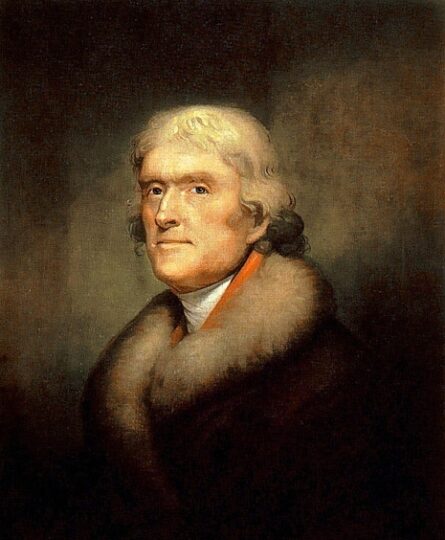
Thomas Jefferson, by Rembrandt Peale. Library of Congress image
In his Autobiography Jefferson recounted the 1786 passage of the law he proposed in 1779 to secure religious freedom in Virginia, the Statute for Religious Freedom:
The bill for establishing religious freedom, the principles of which had, to a certain degree, been enacted before, I had drawn in all the latitude of reason and right. It still met with opposition; but, with some mutilations in the preamble, it was finally passed; and a singular proposition proved that its protection of opinion was meant to be universal. Where the preamble declares, that coercion is a departure from the plan of the holy author of our religion, an amendment was proposed, by inserting the word “Jesus Christ,” so that it should read, “a departure from the plan of Jesus Christ, the holy author of our religion;” the insertion was rejected by a great majority, in proof that they meant to comprehend, within the mantle of its protection, the Jew and the Gentile, the Christian and the Mahometan, the Hindoo, and the Infidel of every denomination.
Life and Selected Writings of Thomas Jefferson, Modern Library 1993 edition, pp. 45 and 46.
* Image is a photo of detail from a painting of Jefferson by Rembrandt Peale, courtesy of the New York Historical Society by way of the Library of Congress.
2 Comments | America's founding, First Amendment, Good Quotes, Religious Freedom, Thomas Jefferson | Permalink
Posted by Ed Darrell
Applied history
July 31, 2006Here’s a profession where history reading is a critical skill:

Photo by J. G. Domke, special to Ft. Worth Star-Telegram.
Caption: Robert Young writes down the measurements recorded by state-of-the-art digital equipment held by survey party chief Barry Brown.
See excerpts of the story, about George Washington’s profession, below the fold.
6 Comments | Business, Current History, Geography - Physical, Geography - Political, George Washington, History, Texas, Texas history | Permalink
Posted by Ed Darrell
James Madison, go-to guy
July 31, 2006School starts soon. History classes will study the founding of the United States. And especially under the topical restrictions imposed by standardized testing, many kids will get a short-form version of history that leaves out some of the most interesting stuff.
James Madison gets short shrift in the current canon, in my opinion. Madison was the fourth president, sure, and many textbooks note his role in the convention at Philadelphia that wrote the Constitution in 1787. But I think Madison’s larger career, especially his advocacy for freedom from 1776 to his death, is overlooked. Madison was the “essential man” in the founding of the nation, in many ways. He was able to collaborate with people as few others in order to get things done, including his work with George Mason on the Virginia Bill of Rights, with George Washington on the Constitution and national government structure, Thomas Jefferson on the structure and preservation of freedom, Alexander Hamilton on the Constitution and national bank, and James Monroe on continuing the American Revolution.
We need to look harder at the methods and philosophy, and life, of James Madison. This is an opinion I’ve held for a long time. Below the fold I reproduce a “sermon” I delivered to the North Texas Church of Freethought in November 2001. Read the rest of this entry »
2 Comments | 1789, America's founding, Freedom - Political, History, James Madison, Religious Freedom, Thanksgiving, U.S. Constitution | Permalink
Posted by Ed Darrell
Protecting civil rights, still
July 30, 2006Journalist Diane Solis wrote in the Dallas Morning News today (free subscription may be required — and its dated, so hurry) about a continuing need for the Equal Employment Opportunity Commission (EEOC), one of the most maligned federal agencies. When I staffed the Senate Labor Committee the commission was subject to a long-term investigation of its activities.
EEOC in litigated 400 cases in 2005, but it handled 75,000 complaints. Among the incidents Solis writes about:
In May, a judge ruled that 52 Indian nationals were held in lockdown by an armed guard, subjected to food rationing and paid well below the minimum wage at the John Pickle Co. in Oklahoma. The award: $1.24 million.
In March, a court heard the case of a black man who was harassed by fellow workers and restrained as they tightened a noose around his neck at Commercial Coating Service Inc. in Texas. The award: $1 million.
The long fight for civil rights continues, too.
1 Comment | Business Ethics, Civil Rights, Current History, EEOC | Permalink
Posted by Ed Darrell
Bartonizing Jefferson
July 30, 2006Dictionaries of the future will feature “bartonizing,” after Texas mathematics teacher David Barton, with a reference to “bowdlerization.” Ed Brayton at Dispatches from the Culture Wars details a recent flurry of correcting a Barton misapprehension of history about one of Thomas Jefferson’s studies of the gospels, which resulted in a book called The Jefferson Bible.
The issue is a strange claim by Barton, repeated by Dr. D. James Kennedy at Coral Gables Ministries, that Jefferson wrote the thing in an attempt to convert Indians to Christianity. Students of Jefferson immediately recognize that claim as contrary to Jefferson’s character on several fronts.
The discussion is enlightened and enlightening; I noted the similar claim that Jefferson built a church and hired a priest for the Kaskaskias (in Illinois), with federal funds, is similarly in error. The fight against revisionist history — revising history to add errors — continues.
(One current edition of the Jefferson Bible on sale at Monticello features a forward by Rev. F. Forrester Church, minister at senior minister of the Unitarian Church of All Souls in New York City; that must frost Kennedy and Barton.)
Leave a Comment » | Accuracy, Bad Quotes, History Revisionism, Religious Freedom, Thomas Jefferson | Permalink
Posted by Ed Darrell
Mississippi teacher pay raise
July 29, 2006Mississippi proposes to raise teacher pay 3%. The Jackson Clarion-Ledger editorially supports the pay raise, but notes that Mississippi has spent so long talking about teacher pay raises that the rest of the nation has moved on — a pay raise will keep Mississippi out of last place among the states in teacher pay, but just barely. Mississippians had hoped to raise their ranking.
But salaries are a moving target; the benchmark was the average in place in 2001, not 2006, and certainly not 2007 and beyond. While Mississippi was giving incremental raises, so were other states in the Southern Regional Education Board area – some larger than Mississippi’s – so, the funding gap remains.
Five years ago, Mississippi’s average teacher salary was $31,954. For 2006-07, without a new raise this year, the average salary will be $41,413. But, among SREB states, the average for 2004-05 (the latest figure available) is $42,333. The national average salary was $47,808.
As a result, state Board of Education vice chairman Bill Jones has noted: “We’ve been talking about meeting that goal of the Southeastern average for 25 years. And we’re 47th. We’re only $150 away from being 50th.”
Woe be to any state that slips below Mississippi. The Clarion-Ledger closes with this:
Mississippi not only must catch up, it also must keep up with competitive teacher salaries in the region. Otherwise, the state will continue to fall behind.
Salary levels should not be a one-shot deal that comes around at election time.
The newspaper is right, at least if one assumes Mississippians want a solid economy, good jobs, and they love their children. Those are fair assumptions.
Especially interesting: The Clarion-Ledger’s on-line forum on teacher pay, and opinion editor Sid Salter’s blog, in which he supports teacher pay increases, but goes further to urge increases for all government employees in Mississippi. (There are no comments at the blog — if you teach, or know a teacher, why don’t you pipe in?)
1 Comment | Teacher Pay | Permalink
Posted by Ed Darrell
Textbook plagiarism
July 29, 2006Ouch! One of the major textbook publishers has a minor embarrassment over a case of self-plagiarism. According to the once-formidable, now reduced United Press International:
Textbook similarities an ‘aberration’
UPPER SADDLE RIVER, N.J., July 13 (UPI) — The makers of two textbooks published by Pearson Prentice Hall of Upper Saddle River, N.J., have said near-identical passages in the books are accidental.
A spokeswoman for the company, Wendy Spiegel, said the similarities between “A History of the United States” and “America: Pathways to the Present” are “absolutely an aberration,” The New York Times reported Thursday.
Spiegel said the relevant passages, dealing with the terrorist attacks of Sept. 11, 2001, the war in Afghanistan, and the Iraq War, were added hurriedly by editors and outside writers after the events occurred.
No serious issue, except that the addition of the passages smokes out another problem with history texts: Sometimes what the book contains is not material the authors listed on the cover wrote, or even approve of.
“They were not my words,” said “Pathways” co-author Allan Winkler, a historian at Miami University of Ohio. “It’s embarrassing. It’s inexcusable.”
Former Librarian of Congress Daniel Boorstin is the chief author listed for A History of the United States.
Worse for the publisher: The problems were caught by a major critic of the teaching of history in public schools.
The similarities were discovered by James Loewen, author of “Lies My Teacher Told Me: Everything Your American History Textbook Got Wrong,” while researching an update of his book.
Leave a Comment » | History, Plagiarism, Textbooks | Permalink
Posted by Ed Darrell
Flag ceremony update
July 29, 2006
Navy caption: SAN DIEGO (April 2, 2007) – Aviation Support Equipment Technician 3rd Class Danny Ly, Storekeeper Seaman Joe Jackson and Electronics Technician Timothy Swartz fold the American flag on the flight deck aboard nuclear-powered aircraft carrier USS Nimitz (CVN 68). Nimitz Carrier Strike Group (CSG), embarked Carrier Air Wing (CVW) 11 and Destroyer Squadron Group (DESRON) 23 are deploying to support operations in U.S. Central Command area of responsibility. U.S. Navy photo by Mass Communication Specialist 2nd Class Jeremiah Sholtis (RELEASED) – Wikimedia image
Earlier I wrote about a flag-folding ceremony that is making the internet rounds. I noted that much of the claimed mythology is, um, ahistoric.
There is no particular meaning attached to folding the flag. Comments noted that the ceremony making the internet rounds is posted at the website of the American Legion. I wrote to the Legion’s public relations department, but have heard nothing back. Generally, the information on flag etiquette at that site is solid. Only the flag-folding ceremony material is not top-notch. I would be happy were the Legion to add a note that the ceremony is a sample ceremony. Several sites mention that the ceremony comes “from the U.S. Air Force Academy.” One site even had a link, but the link was dead. I did find a few sources that explained further. The Air Force Academy web site may have featured a flag-folding ceremony at one point, perhaps even the one being passed around. One of the more popular ceremonies featured had been written by one of the chaplains at USAFA. As happens in the military, someone got concerned about the accuracy of the claims, and the ceremony was pulled. However, Air Force color guards had used the ceremony, and there was demand for something to say during the folding of the U.S. flag, at some ceremonies.
Below the fold, at some length, I reprint the “official” story.
19 Comments | Accuracy, Bad Quotes, Flag etiquette, History, Patriotism | Tagged: Accuracy, Bad Quotes, Flag etiquette, History, Patriotism, USS Nimitz | Permalink
Posted by Ed Darrell
Bad quotes, Coulter, etc. 2
July 28, 2006I noted a few of the academic offenses of Ann Coulter earlier. James Downard at Talk Reason has a three-part series fisking Coulter’s recent rants against science, especially Darwinian theories. Here is the third installment, worth a read if you’re interested in what the facts are, and just how far off the rails Coulter’s account goes.
Leave a Comment » | Accuracy, Bad Quotes, Creationism, Intelligent Design | Permalink
Posted by Ed Darrell
Dismal job market for historians
July 28, 2006Jason Kuznicki writes about the dismal job market for historians at Positive Liberty.
In contrast to the troubles that afflict elementary and secondary education, Kuznicki writes:
I’m conversant in economics, so I even know the method to the madness: State subsidies for higher education tend to produce an oversupply of educated people. A state can hardly fail to misallocate resources, and, in all likelihood, we have too many universities, too many graduates, and too many PhDs in the fields the politicians think are important — like history.
“Oversupply of educated people.” The kids in my history and economics courses, with whom we struggled to keep them in school for one more semester to get a high school diploma, will not read that, I hope. Nor will their successors.
Leave a Comment » | Education, History, Teaching | Permalink
Posted by Ed Darrell
Public education: underreported war
July 28, 2006Super teacher Paul White blogs at Arianna Huffington’s site. In a post titled “Public Education: America’s Most Under-Reported War,” he argues for radical change in the school system.
Sample comment:
While the War in Iraq will progressively require less financial support, no amount of funding for public schools will ever be enough until its inept leadership changes. Local school districts should actually be given less money and not more, until they agree to hire competent financial professionals to handle their budgets, and stop funneling all their funding increases into unwarranted administrative bloat. The only school budget item which does justify an increase – teachers’ pay – is the one area where school leaders refuse to spend a dime. This counterproductive action both drives out good teachers and prevents strong candidates from entering the profession.
“War” is an over-used metaphor, certainly — White’s background, teaching in some of the most difficult situations, gives him license to use it. The comparison between our nation’s efforts to secure legitimate peace in Iraq and our efforts to improve schools is a stretch.
But consider my view: Schools make the nation.
(Please continue below the fold) Read the rest of this entry »
Leave a Comment » | Education, State school boards, Teacher Pay | Permalink
Posted by Ed Darrell
Boston 1775
July 27, 2006I added a link to a lively blog, to the blogroll (Faucets of information) on the side: Boston 1775. The blog’s author, J. L. Bell, tends to provide the interesting details that tip the scale towards understanding, especially on the motivations of the people of Boston at in the key year of 1775.
To the great benefit of his readers he strays a bit outside of 1775 on occasion. Bell is an active, practicing historian, something a lot of high school kids never see. 1775 was a key year, with the British occupying Boston and the American rebel forces laying siege to the city — all before the Declaration of Independence.
Take a look. Especially see his recent post, Marginalizing rhetoric, in which he explores what makes people regard Sam Adams as a “radical” when he was actually a very conservative man; and George Washington’s signing statements, in which he explores the views of our first president on an issue that vexes many today.
Good historians make history come alive in our minds. Bell does that well, and you would do well to check out his site. I plan to check it out frequently.
Leave a Comment » | America's founding, History | Permalink
Posted by Ed Darrell




 Millard Fillmore's Bathtub