Utah support grows for higher pay for teachers

July 26, 2006

Earlier I noted what appears to be support from Utah State Board of Education member Tim Beagley for increasing teacher pay. Here’s an editorial from BYU.net, a feature of Brigham Young University, which tends to support the idea. When the conservative end of Utah politics pushes for more money for teachers, can teacher pay raises be far behind? It’s a situation worth watching.

Utah once led the nation in education attainment, and that lead made it an interesting candidate for a tech boom. Rapid growth in the state in the past 15 years led to entirely new problems, including a slow erosion of the strength of the public schools. Utah stumbled. Watching attempts to recover will be interesting. The demographics of the state in the past made Utah examples inapplicable to other states or cities to some policy makers, but the growth made Utah more diverse. It’s worth watching to see if we can learn from Utah’s experience and experiments.

A technology-literate state school board — I also discovered that another member of the Utah board has been blogging for much longer than Mr. Beagley: Tom Gregory has a blog, alt-tag.com. The board has 15 members. I wonder whether other states have a higher percentage of members who have taken to blogging — do you know of any in your state?

Update: Gregory responded at his blog, noting that only two of the Utah board are bloggers, that he knows of. The idea of public officials actually using the internet to discuss policy, seriously, is a bracing idea.

Update July 27:  Shut Up and Teach, a blog about education and policy in Arizona, points to a news story in the Tucson Daily Star that average teacher salary in the U.S. fell in the past year, while average superintendent salary rose.  Acerbic comments accompany the story.


Cleaning up around the edges

July 26, 2006

Several functions of WordPress did not function for me — on a hunch, I switched from Internet Express to my Mozilla browser, and most of the functions magically popped up. I’ve been cleaning up the categories of posts and tweaking a few other things to make the site easier for readers. Nothing should be deleted, but let me know if something either disappears or stops working. And I’ll be using Mozilla here a lot more.


Mayflower catechism, no.

July 26, 2006

Dispatches from the Culture Wars features a set of comments on an interview right-right-wing pundit John Lofton did with Roy Moore, the former chief justice of Alabama’s Supreme Court who lost his job when he illegally tried to force his religion on the court and on Alabama. This year Moore ran for governor of Alabama, losing in the primary election.

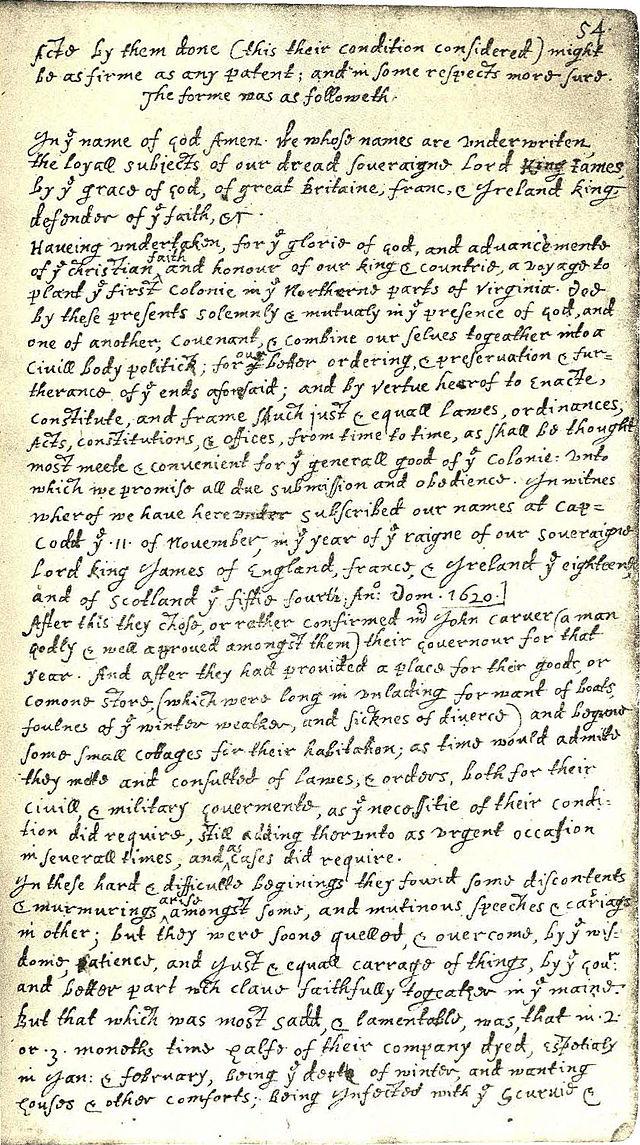
Mayflower Compact. It's a contract between people.  God is a witness, but not a party.

Mayflower Compact. It’s a contract between people. God is a witness, but not a party.

One of the grandest canards in current thought about U.S. history is that the Mayflower Compact set up a theocracy in Massachusetts. Lofton and Moore banter about it as if it were well established fact — or as if, as I suspect, neither of them has looked at the thing in a long time, and that neither of them has ever diagrammed the operative sentence in the thing.

The Mayflower Compact was an agreement between the people in two religiously disparate groups, that among them they would fairly establish a governing body to fairly make laws, and that they would abide by those laws. Quite the opposite of a theocracy, this was the first time Europeans set up in the New World a government by consent of the governed. That is something quite different from a theocracy. Read the rest of this entry »


Improve learning — speak informally

July 26, 2006

Hey, it’s a history blog, so I can refer back to stuff we missed, right?

Especially for teachers, go read this entry in Creating Passionate Users.

The author is a techie, but she’s talking about writing clearly (are you listening Texas teachers whose kids have to write well to get promoted?). She’s also discussing simple presentations, the type any business person does, the kind teachers and professors do all the time. And she has research to back her claims, that informal language improves student learning significantly. Not slang, not slouchy language — just not the formal, stilted stuff found in most textbooks.

Arrgghh! Textbooks! A subject for another rant, another day.


False Quotes Department: Jefferson, Kerry, Tim and Josh

July 26, 2006

Catching false quotes is a key goal of this enterprise.

Back in April, Josh at The Everyday Economist linked to Tim Blair with an almost snarky catch of John Kerry citing a line from Jefferson that, alas, Jefferson didn’t write or say. Tim links to The Jefferson Library. It’s short; here’s the entirety of Tim’s post:

John Kerry:

No wonder Thomas Jefferson himself said: “Dissent is the greatest form of patriotism.”

The Jefferson Library:

There are a number of quotes that we do not find in Thomas Jefferson’s correspondence or other writings; in such cases, Jefferson should not be cited as the source. Among the most common of these spurious Jefferson quotes [is]:

* “Dissent is the highest form of patriotism.”

Jefferson could have said something like that (and did — posts for another time, perhaps). I don’t find this common error nearly so irritating as those where a founder is quoted saying quite the opposite of what he or she would have said, or did say. Read the rest of this entry »


Schelling’s Nobel lecture on game theory

July 25, 2006

I can’t improve on this post, so I’ll just plagiarize it wholesale from University of Illinois College of Law Prof. Thomas S. Ulen’s post at the Law and Econ Prof Blog:

I have been returning to the Nobel website periodically to see if Professor Thomas C. Schelling’s Nobel Prize Lecture (he and Robert Aumann won last October’s Bank of Sweden Prize in Economic Sciences in Memory of Alfred Nobel) had been posted. It has not yet been, but if you have a broadband connection and RealPlayer, you can listen to and watch Professor Schelling’s marvelous address on the practical significance of game theory in deterring nuclear war. The talk is about 42 minutes long. Click here.                       TSU

I’m pretty sure I’m not the only teacher of economics who is not a master of game theory. I’ve been waiting for the lecture, too. Eventually it will be posted at the Nobel Foundation’s site on the prizes.


Fact-free letters on intelligent design, against evolution and science

July 25, 2006

History is not the sole discipline which faces trouble from screeds in which the facts are wrong. In fact, the history of the idea of biological evolution is rather rife with scientific and history hoaxes, and only a few of them are old. New hoaxes about evolution have formed a cottage industry since the science push of 1957 and 1958.

Recent news told of the research of Dr. Peter R. Grant of Princeton University. Grant and his wife, Dr. B. Rosemary Grant, have conducted groundbreaking studies on a few species of birds in the Galapagos Archipelago — long-term longitudinal studies in which they literally track every member of a species for several dozens of generations so far (the research continues). The Grants and their graduate students published more than a dozen papers on speciation, beginning in the middle 1970s.

Below the fold I reproduce an anti-evolution letter published in the Pasadena, California, Star-News on July 23. Below that I list my response, how I would respond were I a local reader of the paper with a chance of getting a letter published.

Dr. Peter R. Grant, left, and Dr. B. Rosemary Grant, right. Photos from Princeton University.

(Continued below the fold.) Read the rest of this entry »


Fillmore’s bathtub, water’s running

July 24, 2006

I got several e-mails about the mystery of just who did install the first bathtub in the White House — the first plumbed, running water bathtub, not just the first tub. The White House Historical Association provides partial answers at their website:

The first running water was plumbed into the White House in 1833 — during Andrew Jackson’s administration.

Running hot water first made it to the First Family’s quarters on the second floor in 1853 (no, it wasn’t that somebody left the water on from 1833 and it took 20 years to back up — we’re talking pipes and a water heater).

1853! There was an election held in 1852, but Fillmore’s party, the Whigs, gave the nomination to Gen. Winfield Scott. He lost the election to Democratic candidate Franklin Pierce. (Fillmore would be the last Whig president; he won the Whig nomination in 1856, and the nomination of the Know-Nothing Party, but neither party had much strength. The race was between John C. Fremont of California, who had the first-ever presidential nomination of a new party made up of Free Soilers, antislavery Democrats and Whigs, called the Republicans; and Democrat James Buchanan of Pennsylvania. Buchanan won, of course. Fillmore was actually president during part of 1853!

There are two issues of interest to me here. The first, of course, is whether the White House Historical Association has fallen victim to the Mencken hoax, or whether the first plumbed bathtub really was installed in 1853; and the second issue is related: If the tub was installed after March, it would have been in Pierce’s administration (the new president took office in March until 1933). So there were two presidents in 1853, and one of them was Millard Fillmore. Which would get the credit, if 1853 is an accurate year?

Isn’t it somewhat ironic that there is, at this date, a possibility that part of Mencken’s hoax could be verified as accurate?


9/11, opinions, and academic freedom

July 24, 2006

An opinion piece in Sunday’s papers goes to the root of a problem that plagues the teaching of history.

Stanley Fish professes law at Florida International University. In Sunday’s New York Times he offers his views on college professors who indoctrinate their students, as opposed to doctrinaire college professors who teach. Fish draws a careful and reasoned distinction between academic freedom, which he notes is the freedom to study virtually anything and try to bring value to academics with one’s analysis of the subject, and freedom of speech, which in this case includes a freedom for advocacy to indoctrinate students, and a freedom which Mr. Fish claims to be out of line in the classroom.

The article will be available free for a few days at the New York Times’ website.

The case in question involves a teacher with a one-semester contract at the University of Wisconsin at Madison. Kevin Barrett teaches “Islam: Religion and Culture.” What makes this course controversial is Mr. Barrett’s saying, on a radio talk show, that he shared with his students his view that the attack on the World Trade Center on September 11, 2001, was perpetrated by the American government, rather than terrorists.

Fish wrote:

Mr. Barrett’s critics argue that academic freedom has limits and should not be invoked to justify the dissemination of lies and fantasies. Mr. Barrett’s supporters (most of whom are not partisans of his conspiracy theory) insist that it is the very point of an academic institution to entertain all points of view, however unpopular. (This was the position taken by the university’s provost, Patrick Farrell, when he ruled on July 10 that Mr. Barrett would be retained: “We cannot allow political pressure from critics of unpopular ideas to inhibit the free exchange of ideas.”)

Both sides get it wrong. The problem is that each assumes that academic freedom is about protecting the content of a professor’s speech; one side thinks that no content should be ruled out in advance; while the other would draw the line at propositions (like the denial of the Holocaust or the flatness of the world) considered by almost everyone to be crazy or dangerous.

Read the rest of this entry »


Einstein, compound interest: Does not compute

July 22, 2006

Earlier, in the thread about bad quotes, bad scholarship and Ann Coulter, a person asked about another quote that has dogged speech writers and investment seminars for years:

I am trying to discern the author of the quote “compound interest is the greatest invention of the 20th century.” Since you mention neither Twain nor Einstein remarked this, do you know who did?? I would be very grateful.

Comment by fact checker 07.11.06 [emphasis added]

Twain’s words are well enough cataloged that, had he said it, one would be able to track it down. Think for a few minutes about Twain’s finance issues, however, and you realize it is highly unlikely that he would have said it. Twain invested heavily in a machine to mechanically set type, to publish the memoirs of former-President Ulysses Grant; the machine did not work, and Twain lost his fortune. He undertook a grueling lecture tour to make money back. Later financial setbacks forced another long lecture tour. It is not probable that Mark Twain (Samuel Clemens) would ever have said anything about simple compound interest. It was not his style to invest passively, or for long-term returns.

The line about compound interest being the “best invention” of mathematics, or of the 20th century, or whatever, is more often attributed to Albert Einstein. Google “compound interest” and “Einstein” and you get tens of thousands of hits.

It’s a good line, a snappy introduction to the Rule of 72 for a presentation to potential investment clients or for the introduction to the rule in a high school classroom. I have a short PowerPoint presentation on the Rule of 72 for economics classes, and I would have used the quote — had it checked out. My experience as a journalist and speechwriter urged caution.

I wrote to the Albert Einstein Institute, to the American Institute of Physics, and to other places where people might know obscure sources of Einstein’s sayings and writings, to try to verify the quote. It surely did not turn up in Bartlett’s Familiar Quotations, nor in the Oxford Dictionary of Quotations. Those specialists in Einstein data and history could not verify the quote (which is the careful way of phrasing it). One fellow I spoke with said if he had a nickel for every time he was asked to verify the compound interest quote, he would have no need for compound interest.

I can say with confidence that Albert Einstein never wrote or said anything about compound interest. While Einstein wrote about a wide variety of topics, compound interest is not among them.

Fatherflot at Daily Kos wrote about this quote in early 2005, after several advocates of privatizing Social Security had used the quote in one version or another to introduce their own remarks. A lot more people read that blog, but no one there could verify it, either. There are several variants on the quote illustrated there. I think that an alleged quote’s lack of veracity is often demonstrated by mutations. For real quotes from real people, generally someone knows the original work and starts writing about what it’s supposed to be — at many cocktail parties a line about “consistency being the hobgoblin of small minds” will be corrected (Emerson said it is “a foolish consistency,” and it is “little minds”), for one example.

Einstein didn't say what this poster claims he said, either.

Einstein didn’t say what this poster claims he said, either.

As I told fact checker, I think the line was invented 40 or 50 years ago. From my checking, I would bet it was a copywriter or speechwriter working for some investment house. We may hope to someday track down the origin of the quote, and if the originator is still alive, ask her or him why the line was attributed to Einstein.

Fillmore’s bathtub runneth over with bad quotes, hoaxes gone amok, and other errors. We just try to flush a few down the drain.


Other notable stuff

July 21, 2006

History Carnival #35 is up at Air Pollution.

The #7 Carnival of Bad History is up at Hiram Hover. I link there knowing that the carnival may well do better what I try to do here, and I’ll suffer by comparison. All exposure of bad history is good, in my view.


Living history – Voting Rights Act

July 21, 2006

Congress this week approved a renewal of the 1965 Voting Rights Act, the Senate voting yesterday, 98-0. The Act was a watershed in civil rights legislation, a law whose effects are clearly visible in the diversity of people who populate government in municipal, state and federal government now.

Lews & Kennedy discuss VRAct

This photo by Doug Mills of the New York Times is worth several thousand words. Its caption: Representative John Lewis, left, and Senator Edward M. Kennedy in the room where President Lyndon B. Johnson signed the Voting Rights Act.

The New York Times story (free subscription required) said:

As the Senate voted, Representative John Lewis, Democrat of Georgia, who was beaten in the 1965 voting rights march on Montgomery, Ala., came to the floor, and other lawmakers provided their memories of the era as they spoke in support of the legislation.

“I recall watching President Lyndon Baines Johnson sign the 1965 act just off the chamber of the Senate,” said Senator Edward M. Kennedy, Democrat of Massachusetts and one of three current senators serving when the law was originally passed. “We knew that day we had changed the country forever, and indeed we had.”

This event is a good lynch-pin for history lessons on the civil rights movement. Teachers may want to clip the story and photos from today’s papers to save for lesson plans through the year.

(West Virginia Sen. Robert Byrd is one of the other three senators who were there in 1965. Who is the third?)


Don’t study war no more

July 20, 2006

Wizbang complains we don’t study wars enough in public schools. That could be correct.

Wizbang links to old posts by education writer Joanne Jacobsen and North Carolina AP history teacher Betsy to support the point. Interesting posts on interesting blogs (this is not an endorsement of the political views, only a judgment that the comments are interesting).

At Betsy’s old post (2004), I put up some comments anyway:

Gravatar The story of Henry Knox carrying the cannons of Fort Ticonderoga overland — 120,000 pounds worth! — in the middle of winter, to give Washington the bluff to win the siege of Boston, is the sort of story that sticks to the intellectual ribs of kids. The story of the “midnight crossing” at Trenton, after Washington got his tail whipped in New York and things looked more dire than they did at Boston, is another turning point battle. The war doesn’t make much sense, otherwise. They can be told in ten minutes, each. If a teacher wants to expand each into an hour-long exercise, with group activities including charts and graphs, it’s difficult — but what is wrong with good old lecture from time to time — especially riveting lecture?

The social effects are parts of longer threads — the continuous and continuing increase in rights, the rise of free and important women, increasing morality, increasing technology, American communities, and the birth and growth of American-style free enterprise.

All of those threads make the whole of history more comprehensible — but they are all interwoven. The Japanese Internments are part of a larger story on xenophobia and immigration, and the growth of civil rights. To treat it as a stand-alone feature of World War II is to slight the Chinese and Irish workers who built the transcontinental railroad, Sacco and Vanzetti, the Amish, the Mormons, all Hispanics and Vietnamese.

The difficulty I find is that the kids don’t come into 11th grade with anything they should have gotten from 8th grade. But I’ve been teaching at the alternative school. Certainly in AP, you can fly, can’t you?

Why not a unit on the top ten major battles in U.S. history? It would take a day. I have a 50-minute PowerPoint on Brown v. Topeka Board of Education that spans civil rights from 1776 to 2007, and links it all.


Quick! Before this history fades away . . .

July 20, 2006

From the Westfield, Massachusetts Republican, we find a story of history teachers getting first-hand history from a World War II veteran. His story is perhaps a bit unusual because he is African American, and he told the story of the irony of defending freedom in Europe, then returning home to have to fight for his own freedom all over again.

These veterans are dying off — this fellow, Raymond Elliott, is 82. Such a presentation to classes brings back to life the events of World War II, and in this case also sets the stage for the civil rights struggles of the 1950s, 1960s and 1970s (Brown v. Board, Emmett Till, Rosa Parks, Little Rock, the rise of Martin Luther King, Jr., Selma, the March on Washington, “I Have a Dream,” the Civil Rights Act of 1964, the Voting Rights Act of 1965, etc., etc.).

The full story is below the fold — fair use copy. Do you have such veterans in your town? Do your classes get to meet with them? Are you such a veteran, and do the teachers in your area know you are available? Do you think many of these teachers got his name and address to invite him to their schools?

Read the rest of this entry »


The meaning of “Liberty”

July 19, 2006

Ed Brayton and Mark Olson have been discussing the meaning of the word “liberty” especially with regard to the Declaration of Independence and what the Americans may have thought they were fighting for in the American Revolution. The whole discussion is linked at Positive Liberty, and Jason Kuznicki carries the analysis deeper — a good addition to the discussion, since Kuznicki is actually a historian.

Kuznicki’s post is here: http://positiveliberty.com/2006/07/olson-and-brayton-on-the-meanings-of-liberty.html