Cinco de Mayo, really (encore post)

May 5, 2010

(Mostly an encore post, from 2009)

You thought Cinco de Mayo was Independence Day for Mexico?

No, it’s not.

History.com has a nice explanation, with a nice little video. Yahoo has a video this year, mostly animation with lots of advertising.

Perhaps the U.S. should celebrate the day, too, at least in those states who were not in the old Confederacy. On May 5, 1862, Mexicans under the command of 33 year old Commander General Ignacio Zaragoza Seguín stopped the quick advance of superior French forces trying to invade Mexico to take it over, at the Battle of Puebla. While France did eventually defeat Mexican forces (after getting 30,000 men in reinforcements), the spirit of May 5 inspired Mexicans to continue to fight for freedom. And ultimately, Mexican forces overpowered and captured the French forces and Emperor Maximilian, who was executed.

Thus ended a great hope for the Confederacy, that French-supported Mexican Army would lend aid to the Confederates in their struggle to secede from the Union.

It is one of the great what-ifs of history: What if France had kept Mexico, and what if French-led Mexican forces backed up the Confederate Army?

One thing is rather sure: Had that happened, and had the Confederacy been successful, we wouldn’t be celebrating Cinco de Mayo in Texas today.

Battle of Puebla, Wikimedia (artist?)

Battle of Puebla, Wikimedia (artist?)

Mexican Independence Day is September 16.

_______________________________________

Update: Sam DeBerry sends a note that Seguin was a Texan.  So the Mexican hero of the Battle of Puebla was a Texan.  You couldn’t make this stuff up — real history is always more interesting than fiction.


Making up stuff on the internet

May 3, 2010

Here’s the Dilbert cartoon Virginia Attorney General Ken Cuccinelli should have viewed before he went fishing:

Add to FacebookAdd to NewsvineAdd to DiggAdd to Del.icio.usAdd to StumbleuponAdd to RedditAdd to BlinklistAdd to TwitterAdd to TechnoratiAdd to Furl


Utah report: More false “founders’ quotes” plague American discourse

April 25, 2010

Utah has a movement out to slander education and the Constitution, with a pointless claim that the Constitution cannot be called a “democracy,” damn Lincoln, Hamilton, Madison, Washington, both Roosevelts, and Reagan.

Sadly, it started in my old school district, the one where I got the last nine years of public school education, Alpine District, in the north end of Utah County.

They even have a website, Utah’s Republic. (No, Utah was never an independent republic before it was a state — it’s not like the Texas Republic wackoes, except in their wacko interpretations of law and history, where they are indistinguishable.)

At the blog from that site, there is a silly discussion on how a republic is a much superior form of government to a democracy.  Never mind that sheer numbers in our nation have always made democracy impossible (can’t get 150 million voters in one hall), or that distance makes it impossible to work (vote tomorrow in Washington, D.C.?  Everybody call the airlines, see if you can make it.)

So, I pointed out how a republic can also suggest tyranny.  And the response?  A flurry of “quotes from the founders.”

Can you vouch for any of these “quotes?”  Is any one of them accurate?

The Jefferson “mob rule” quote isn’t in any Jefferson data base that I can find. I find it also attributed to George Washington — but almost always without any citation, so you can’t check.

That maneuver is one of the key indicators of Bogus Quotes, the lack of any citation to make it difficult to track down.  All of these quotes come without citation:

As for a moral people, Washington said there could be no morality without religion and called it the “indispensable support,” not education. Obviously Jefferson and the Founders wanted education of the constitution to take place but we are very far removed from it in our education system.

Democracy… while it lasts is more bloody than either aristocracy or monarchy. Remember, democracy never lasts long. It soon wastes, exhausts, and murders itself. There is never a democracy that did not commit suicide. – John Adams

A democracy is nothing more than mob rule, where fifty-one percent of the people may take away the rights of the other forty-nine. – Thomas Jefferson

The democracy will cease to exist when you take away from those who are willing to work and give to those who would not. – Thomas Jefferson

Democracy is two wolves and a lamb voting on what to have for lunch. Liberty is a well-armed lamb contesting the vote. – Benjamin Franklin

Democracy is the most vile form of government… democracies have ever been spectacles of turbulence and contention: have ever been found incompatible with personal security or the rights of property: and have in general been as short in their lives as they have been violent in their deaths. – James Madison

As I would not be a slave, so I would not be a master. This expresses my idea of democracy. – Abraham Lincoln

The last one is probably accurate, but irrelevant to this discussion (nice red herring, there, Oak).  Can you offer links to verify any of them?

Is this what I suspect?  The “Utah Republic” drive is not only a tempest in a teapot (though perhaps caused by other more serious maladies), but also a tempest based on false readings of history?

The website for “Utah Republic” is maintained by a guy named Oak Norton, who is obviously in thrall to the voodoo histories of David Barton and Cleon Skousen (I think Barton stole a lot of his voodoo history from Skousen, but that’s another topic for another day).

Funny:  Nowhere do these guys discuss one of the greatest drivers of the republic, over more egalitarian and more democratic forms of government.  Remember, Hamilton preferred to have an aristocracy, an elite-by-birth group, who would rule over the peasants.  He didn’t trust the peasants, the people who he saw as largely uneducated, to make critical decisions like, who should be president.  Norton doesn’t trust the peasants to get it right, and so he wants to dictate to them what they are supposed to know, in Nortonland.

Just because Oak Norton slept through high school history and government is no reason to shut down Utah’s Alpine School District or any other school; he’s not offered much evidence that everyone else missed that day in class, nor evidence that it has any significant effect.

Jefferson's advice on quotes found on the internet

Jefferson’s advice on quotes found on the internet, backdropped by his books now held by the Library of Congress.


Monckton’s global warming denialism debunked

April 12, 2010

Peter Sinclair’s Hoax-Exposing Supervision found Christopher Monckton — and this is just part one.  More hoax in Monckton than anyone really feared:

Tip of the old scrub brush to the indefatigable Tim Lambert at Deltoid.


One more way to know Apollo 11 landed on the Moon

April 4, 2010

Every year at this time . . .

In a discussion of the Cold War, the Space Race, and the Race to the Moon, we get to a photo about Apollo 11’s landing on the Moon.

Like clockwork, a hand goes up:  “Mr. Darrell, wasn’t that landing a hoax?  They didn’t really go to the Moon then, did they?”

There are a lot of ways to know that Apollo 11 landed on the Moon.  Among other things, students could talk to people alive at the time who have the slightest bit of technological savvy:  With lots of other people, I tracked part of the trip with my 6-inch reflecting telescope.  Ham radio operators listened in on the radio broadcasts.  And so on.

But I really like this chunk of evidence:  How about a photograph of the landing site?

Holy cow!  You can see the tracksof Neil Armstrong’s footprints to the lip of Little West crater (see arrow below).

Tranquility Base, from the LROC -- showing evidence of Apollo 11's landing -

Tranquility Base, shot from the Lunar Reconnaissance Orbiter Camera (LROC), showing the traces left by Apollo 11's landing on the Moon. It really happened. Credit: NASA/GSFC/Arizona State University

According to the LROC website:

The astronaut path to the TV camera is visible, and you may even be able to see the camera stand (arrow). You can identify two parts of the Early Apollo Science Experiments Package (EASEP) – the Lunar Ranging Retro Reflector (LRRR) and the Passive Seismic Experiment (PSE). Neil Armstrong’s tracks to Little West crater (33 m diameter) are also discernable (unlabeled arrow). His quick jaunt provided scientists with their first view into a lunar crater.

Check out this video made from the photos, “High Noon at Tranquility Base”:

Fox News?  What’s your story now?

More:

Tip of the old scrub brush to Collect Space forum, and the Carnival of Space #147 at Weird Sciences.  Thanks to ScienceBlips for telling us about Carnival of Space.


Education board shames Texas: Nick Anderson’s view from 2009, part C

March 31, 2010

Nick Anderson of the Houston Chronicle on Texas SBOE social studies standards, in 2009

Nick Anderson of the Houston Chronicle on Texas SBOE social studies standards, in 2009


Warming and science denialists stuck with political egg on their predictions

March 14, 2010

If they are honorable people, they wish they could take it back.

John Hinderaker at Powerline, November 23, 2009:

At the end of 2008, the scientists at East Anglia predicted that 2009 would be one of the warmest years on record:

On December 30, climate scientists from the UK Met Office and the University of East Anglia projected 2009 will be one of the top five warmest years on record. Average global temperatures for 2009 are predicted to be 0.4∞C above the 1961-1990 average of 14 ∫ C. A multiyear forecast using a Met Office climate model indicates a rapid return of global temperature to the long-term warming trend, with an increasing probability of record temperatures after 2009.

We know now that the alarmists’ prediction for 2009 didn’t come true. What’s interesting is that in January of this year, another climate alarmist named Mike MacCracken wrote to Phil Jones and another East Anglia climatologist, saying that their predicted warming may not occur . . .

Hinderaker quoting Anthony Watts’ chest thumping at Watts Up With That. In November, with cool weather in the local forecasts, they thought that 2009 would turn out to be a cold year, climate wise, and so they were demanding that climate scientists retract predictions and claims based on the data at hand.  Watts was averaging his thermometer readings before they thermometers had been read.

Oops.

Here’s what actually happened:

NASA, Goddard Institute for Space Studies, Saturday, Jan. 21, 2010

2009 was tied for the second warmest year in the modern record, a new NASA analysis of global surface temperature shows. The analysis, conducted by the Goddard Institute for Space Studies (GISS) in New York City, also shows that in the Southern Hemisphere, 2009 was the warmest year since modern records began in 1880.

Global warming map from NASA, showing the decade 2000 to 2009

From NASA: "This map shows the 10-year average (2000-2009) temperature anomaly relative to the 1951-1980 mean. The largest temperature increases are in the Arctic and the Antarctic Peninsula. (Image credit: NASA/GISS)"

I’ve been hunting for retractions from Powerline and WUWT, but haven’t found them yet.  Has anyone else seen the retractions from these guys, for accuracy’s sake, for the record?  Hinderaker blogged the issue as recently as February 2, but mistook the continued warmness as a ‘lack of additional warming.’  Really.  Hinderaker’s consistency in error is profound, with six or more posts on the issue since November 23, and not one noting his glaring error, each one assuming his error does not exist.  It is a consistency striven for only by hobgoblins of no mind.

Hinderaker said in that November post:

Climate science is in its infancy, and every proposition is controversial. What climate scientists like those at East Anglia don’t know dwarfs what they do know. They can produce a model for every occasion, but are the models any good? If so, which one? One thing we know for sure is that they don’t generate reliable predictions. In every scientific field other than global warming, a scientific hypothesis that generates false predictions is considered disproved. When it comes to global warming, however, there is no such thing as falsification. Which is the ultimate evidence that the alarmist scientists are engaged in a political enterprise, not a scientific one.

Really?  Political commentary on climate science is in its infancy, and every proposition is controversial, even those that should not be. What ill-informed and sometimes ignorant, belligerent pundits  like those at Powerline and Watts Up don’t know dwarfs what they do know. They can’t produce a model for any occasion, but they will ask as if they had anything to add other than heckling, “are the models any good? If so, which one?” One thing we know for sure is that they don’t generate accuracy in reporting or trustworthy claims. In every scientific field other than global warming, a scientific hypothesis that generates false predictions is considered disproved. When it comes to global warming’s critics and outright denialists, however, there is no such thing as falsification. There is, so far,  no such thing as an honorable confession of error, either.  In political commentary, anyone who makes a prediction in late November that is exactly wrong when the numbers are tallied two months later, should have the grace to make a concession speech.  These ravings, and failure to strive for accuracy when error is apparent, provide ultimate evidence that the contrarians and denialists are not scientists, and are engaged in a political enterprise, not a scientific one.  Hinderaker and Watts give their readers voodoo science at its most voodoo.  They could not fail to know what they post is hoax, even if they were sucked in at first.

Even if they read this and understand it’s true and accurate, I’ll wager you won’t see any errata notices from either Watts or Hinderaker.

More, I’ll wager no one would take such a wager, not even their defenders.

Do all climate contrarians all take their marching orders from the faxes and e-mails from the GOP National Committee?

Not one of the contrarian’s work could survive half the scrutiny Phil Jones or Michael Mann has had since their server was broken into.

P.S.: These guys at Powerline have a very twisted streak, you know?

Steve [Hayward] is also the author of the annual Index of Leading Environmental Indicators. The fourteenth edition of the Index was published in April by the Pacific Research Institute to coincide with Earth Day and Lenin’s birthday; it is accessible in PDF here.”

Why is the Pacific Research Institute timing a report to coincide with Lenin’s birthday?  Why would Hinderaker even joke about it?  No scientist is checking that date.  No Democrat is.  It’s like these guys study the old communists and fascists, not as a learning exercise to find mistakes to avoid as Santayana urged, but to steal the methods of the Stalinists and fascists. More snark than sense, more snark than science, at Powerline and the Pacific Research Institute.

Ask others to join the campaign for accurate science:

Add to FacebookAdd to NewsvineAdd to DiggAdd to Del.icio.usAdd to StumbleuponAdd to RedditAdd to BlinklistAdd to TwitterAdd to TechnoratiAdd to Furl


Science bloggers doing it wrong?

March 10, 2010

A new paper in the Journal of Science Communication offers a critique of the workings and effectiveness of science bloggers.

Happily for us, the paper is open access, freely available.

The article appears to be from some research for a Ph.D.:

Inna Kouper is a doctoral candidate in the School of Library and Information Science, Indiana University
Bloomington. Her current research interests lie broadly in the areas of language and information; the role
of science in society; and the evolution of information and communication technologies generally
described as social or participatory media (such as blogs, wikis, podcasts, etc.).

Several bloggers say the paper gets wrong what science bloggers do, and what they should do.

Perhaps — you can read the paper yourself and compare it with the criticism.

I do want to call your attention to a very good feature of the paper.  It analyzes postings on 11 of the top science blogs in the world.

1 Pure Pedantry scienceblogs.com/purepedantry
2 Synthesis http://www.synthesis.cc
3 MicrobiologyBytes http://www.microbiologybytes.com/blog
4 Wired Science http://www.wired.com/wiredscienc
5 BioEthics blog.bioethics.net
6 DrugMonkey scienceblogs.com/drugmonkey
7 Scientific Activist scienceblogs.com/scientificactivist
8 Pharyngula scienceblogs.com/pharyngula
9 Panda’s Thumb http://www.pandasthumb.org
10 ScienceBlog scienceblog.com
11 Cosmic Variance blogs.discovermagazine.com/cosmicvariance

How can you tell the paper’s serious?  The 11 blogs analyzed do not include any of the junk science blogs, like Uncommon Descent or Watt’s Up With That?

If you listen carefully, you can hear Bill Dembski and Anthony Watts stewing.


Wattsupgate: Denialists claim all knowledge is wrong

January 31, 2010

It really is that bad.  Climate science denialists now attack any information simply for not being what they want it to be.  Lysenko’s Ghost smiles broadly.

Anthony Watts is just the most prominent of the bloggers making hoax charges of error and worse in the fourth report from the Intergovernmental Panel on Climate Change (IPCC), because of a footnote that cites a rock climbing magazine.

Here’s the trouble for Watts:  There is no indication that the citation is in error in any way.  Watts’s move is more fitting of King George III’s campaign against Ben Franklin’s lightning rods, the prosecution of John Peter Zenger, the pre-World War II campaign against Einstein’s work because he was born a Jew, or the hoary old Red Channels campaign against Texas history told by John Henry Faulk.  It’s as bad as the Texas State Board of Education’s attack on Brown Bear, Brown Bear, What Do You See? Watts’ and others’ complaint is simply that Climbing magazine’s story on the worldwide retreat of glaciers suitable for climbing is not published in a juried science journal.

In other words, they indict the science, not because it’s wrong — they have no evidence to counter it — but because it’s too American Patriot correct Jewish left Texan mistakenly thought to be political well-known, too accessible, (small “d”) democratically-reported.

And of course, any comment that points that out at Watts’s blog goes into long-term “moderation,” keeping it from the light of day in the best tradition of the Crown’s defense of Gov. Cosby’s misadministration of New York (see “John Peter Zenger”).  Watts said in a quote that should have been attributed to the Daily Telegraph:

The IPCC’s remit is to provide an authoritative assessment of scientific evidence on climate change.

In its most recent report, it stated that observed reductions in mountain ice in the Andes, Alps and Africa was being caused by global warming, citing two papers as the source of the information.

However, it can be revealed that one of the sources quoted was a feature article published in a popular magazine for climbers which was based on anecdotal evidence from mountaineers about the changes they were witnessing on the mountainsides around them.

The other was a dissertation written by a geography student, studying for the equivalent of a master’s degree, at the University of Berne in Switzerland that quoted interviews with mountain guides in the Alps.

The revelations, uncovered by The Sunday Telegraph, have raised fresh questions about the quality of the information contained in the report, which was published in 2007.

It comes after officials for the panel were forced earlier this month to retract inaccurate claims in the IPCC’s report about the melting of Himalayan glaciers.

By those standards, Watts’s own readers should eschew his blog — it’s not peer reviewed science by any stretch, and Watts isn’t an established authority in climate science (he’s not even working for an advanced degree).  Consistency isn’t a virtue or concern among climate change denialists.  Watt’s entire modus operandi is much more anecdotal than the story in Climbing, which was written by a physicist/climber who studies climate change in the world’s mountains.

And did you notice?  They’re whining about research done by a scientist in pursuit of a degree, complaining about the second citation.  That’s the exaclty kind of research that they claim the magazine article is not.  Their complaint is, it appears, that a scientist in pursuit of education is not the right “kind” of person to do climate research. It’s the chilling sort of bigotry that we spent so much time in the 20th century fighting against.  In the 21st century, though, it appears one can still get away with demonizing knowledge, education and research, part of the campaign to indict “elitism,” the same sort of elitism aspired to by America’s founders.  Too much of the criticism against scientists involved in documenting global warming is the cheap bigotry the critics claim to find in science, falsely claimed in my view.

Topsy-turvy.

And the glaciers?  Yeah, the evidence tends to show they are in trouble.  Those Himalayan glaciers?  The IPCC report was accurate in everything except the speed at which the glaciers decline — they should be with us for another three centuries, not just 50 years, if we can reduce warming back to 1990s levels (oddly, denialists rarely deal with the facts of accelerating warming, preferring to point to a local snowstorm as a rebuttal of all knowledge about climate).

Oh, and the research?  The author of the story in Climbing magazine is Mark Bowen.  Dr. Bowen’s Ph.D. is in physics from MIT. He’s a climber, and he researches climate change on the world’s highest mountains.  His 2005 book, Thin Ice, focused tightly on what we can learn about climate from the world’s highest mountains.   Bowen is the expert Anthony Watts would like to be.

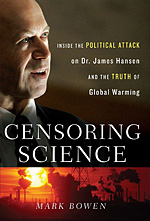
Cover of Mark Bowen's book defending climate science, "Censoring Science."

Cover of Mark Bowen’s book defending climate science, “Censoring Science.”

Bowen’s newest book:  Censoring Science:  Inside the political attack on James Hansen and the truth of global warming. Watts doesn’t want anyone to read that book.  It is easy to imagine Watt’s s attack is, he hopes, pre-emptive, against Bowen’s book.

I’ll wager Watts hasn’t read the article in Climbing, and didn’t know who Bowen was when he launched his attack, though.  The denials of bias coming out of the denialists’ camp will be interesting to watch.

Let the denialists roll out the rope far enough, they’ll inevitably hang themselves.

More:

Do something for freedom: Spread the news

Add to FacebookAdd to NewsvineAdd to DiggAdd to Del.icio.usAdd to StumbleuponAdd to RedditAdd to BlinklistAdd to TwitterAdd to TechnoratiAdd to Furl


DDT propaganda machine

January 23, 2010

Media Check carries edited excerpts from a book by Daniel Gutstein from last year, Not A Conspiracy Theory: How Business Propaganda Hijacks Democracy (Key Porter, 2009) by Donald Gutstein, Key Porter (2009).

In the excerpted chapter Gutstein details how nefarious interest groups conspired to ruin the reputation of Rachel Carson and environmental protection activists with false claims about DDT and environmentalist aims.

The problem with the coverage of the DDT issue and with the eco-imperialism charge is that they are based on falsehoods that the media did not investigate. Former CBC-TV National News anchor Knowlton Nash once said that “…our job in the media… is to… provide a searchlight probing for truth through the confusing, complicated, cascading avalanche of fact and fiction.” In this case, the media let their audiences down; fiction prevailed over fact.

Despite what the pro-DDT organizations alleged, DDT was not banned for use in mosquito control and could continue to be used in 25 countries in malarial regions. In these countries, limited amounts of DDT can be sprayed on the inside walls of houses to combat malaria-carrying mosquitoes. “The environmental community is collaborating with the World Health Organization to ensure that the phase-out of the remaining uses of DDT does not undermine the battle against malaria and the well-being of people living in malarial zones,” the United Nations Environmental Programme reported when the treaty came into force.

Has anyone read the book?  Has anyone seen it?  (So what if it’s aimed at Canada?)

More thoughts:  Years ago, when Jan Brunvand first achieved some fame cataloging urban myths, it occurred to me that his books should be required reading in the very first survey classes in journalism school.   Maybe they should be required reading in political science, rhetoric, and philosophy, too.

Gutstein’s book would be a good reader for a class on reporting, or investigative reporting, or science reporting, or political reporting.  I’m not sure where it would fit in to a science curriculum, but I wish more scientists came out of undergraduate years aware that they can get hammered by these hoax-selling, axe-grinding disinformation machines.  All those reports about how Rachel Carson is the “murderer of millions?”  They coarsen dialog, they misinform, disinform and malinform the public.  They do great disservice to citizenship and voters, and ultimately, to our democratic institutions.

It’s not enough to have a counter, good-information plan.  These people must be convinced to stop.

More:


A neglected, “Neglected Anniversary” – Mencken, Fillmore and the bathtub

December 29, 2009

Otherwise occupied, I nearly forgot:  92 years ago yesterday, on December 28, 1917, this column by H. L. Mencken was published in The New York Evening Mail:

A Neglected Anniversary

Mencken on April 7, 1933 - end of low-alcohol beer - Baltimore Sun Photo

H. L. Mencken at approximately 12:30 a.m., April 7, 1933, at the Rennert Hotel, corner of Saratoga and Liberty Streets, 17 years later, not neglecting a sudsy anniversary - Baltimore Sun photo

On December 20 there flitted past us, absolutely without public notice, one of the most important profane anniversaries in American history, to wit, the seventy-fifth anniversary of the introduction of the bathtub into These States. Not a plumber fired a salute or hung out a flag. Not a governor proclaimed a day of prayer. Not a newspaper called attention to the day.

True enough, it was not entirely forgotten. Eight or nine months ago one of the younger surgeons connected with the Public Health Service in Washington happened upon the facts while looking into the early history of public hygiene, and at his suggestion a committee was formed to celebrate the anniversary with a banquet. But before the plan was perfected Washington went dry (This was war-time Prohibition, preliminary to the main catastrophe. — HLM), and so the banquet had to be abandoned. As it was, the day passed wholly unmarked, even in the capital of the nation.

Bathtubs are so common today that it is almost impossible to imagine a world without them. They are familiar to nearly everyone in all incorporated towns; in most of the large cities it is unlawful to build a dwelling house without putting them in; even on the farm they have begun to come into use. And yet the first American bathtub was installed and dedicated so recently as December 20, 1842, and, for all I know to the contrary, it may still be in existence and in use.

Curiously enough, the scene of its setting up was Cincinnati, then a squalid frontier town, and even today surely no leader in culture. But Cincinnati, in those days as in these, contained many enterprising merchants, and one of them was a man named Adam Thompson, a dealer in cotton and grain. Thompson shipped his grain by steamboat down the Ohio and Mississippi to New Orleans, and from there sent it to England in sailing vessels. This trade frequently took him to England, and in that country, during the ’30s, he acquired the habit of bathing.

The bathtub was then still a novelty in England. It had been introduced in 1828 by Lord John Russell and its use was yet confined to a small class of enthusiasts. Moreover, the English bathtub, then as now, was a puny and inconvenient contrivance — little more, in fact, than a glorified dishpan — and filling and emptying it required the attendance of a servant. Taking a bath, indeed, was a rather heavy ceremony, and Lord John in 1835 was said to be the only man in England who had yet come to doing it every day.

Thompson, who was of inventive fancy — he later devised the machine that is still used for bagging hams and bacon — conceived the notion that the English bathtub would be much improved if it were made large enough to admit the whole body of an adult man, and if its supply of water, instead of being hauled to the scene by a maid, were admitted by pipes from a central reservoir and run off by the same means. Accordingly, early in 1842 he set about building the first modern bathroom in his Cincinnati home — a large house with Doric pillars, standing near what is now the corner of Monastery and Orleans streets.

There was then, of course, no city water supply, at least in that part of the city, but Thompson had a large well in his garden, and he installed a pump to lift its water to the house. This pump, which was operated by six Negroes, much like an old-time fire engine, was connected by a pipe with a cypress tank in the garret of the house, and here the water was stored until needed. From the tank two other pipes ran to the bathroom. One, carrying cold water, was a direct line. The other, designed to provide warm water, ran down the great chimney of the kitchen, and was coiled inside it like a giant spring.

The tub itself was of new design, and became the grandfather of all the bathtubs of today. Thompson had it made by James Cullness, the leading Cincinnati cabinetmaker of those days, and its material was Nicaragua mahogany. It was nearly seven feet long and fully four feet wide. To make it water-tight, the interior was lined with sheet lead, carefully soldered at the joints. The whole contraption weighed about 1,750 pounds, and the floor of the room in which it was placed had to be reinforced to support it. The exterior was elaborately polished.

In this luxurious tub Thompson took two baths on December 20, 1842 — a cold one at 8 a.m. and a warm one some time during the afternoon. The warm water, heated by the kitchen fire, reached a temperature of 105 degrees. On Christmas day, having a party of gentlemen to dinner, he exhibited the new marvel to them and gave an exhibition of its use, and four of them, including a French visitor, Col. Duchanel, risked plunges into it. The next day all Cincinnati — then a town of about 100,000 people — had heard of it, and the local newspapers described it at length and opened their columns to violent discussions of it.

The thing, in fact, became a public matter, and before long there was bitter and double- headed opposition to the new invention, which had been promptly imitated by several other wealthy Cincinnatians. On the one hand it was denounced as an epicurean and obnoxious toy from England, designed to corrupt the democratic simplicity of the Republic, and on the other hand it was attacked by the medical faculty as dangerous to health and a certain inviter of “phthisic, rheumatic fevers, inflammation of the lungs and the whole category of zymotic diseases.” (I quote from the Western Medical Repository of April 23, 1843.)

The noise of the controversy soon reached other cities, and in more than one place medical opposition reached such strength that it was reflected in legislation. Late in 1843, for example, the Philadelphia Common Council considered an ordinance prohibiting bathing between November 1 and March 15, and it failed of passage by but two votes. During the same year the legislature of Virginia laid a tax of $30 a year on all bathtubs that might be set up, and in Hartford, Providence, Charleston and Wilmington (Del.) special and very heavy water rates were levied upon those who had them. Boston, very early in 1845, made bathing unlawful except upon medical advice, but the ordinance was never enforced and in 1862 it was repealed.

This legislation, I suspect, had some class feeling in it, for the Thompson bathtub was plainly too expensive to be owned by any save the wealthy; indeed, the common price for installing one in New York in 1845 was $500. Thus the low caste politicians of the time made capital by fulminating against it, and there is even some suspicion of political bias in many of the early medical denunciations. But the invention of the common pine bathtub, lined with zinc, in 1847, cut off this line of attack, and thereafter the bathtub made steady progress.

The zinc tub was devised by John F. Simpson, a Brooklyn plumber, and his efforts to protect it by a patent occupied the courts until 1855. But the decisions were steadily against him, and after 1848 all the plumbers of New York were equipped for putting in bathtubs. According to a writer in the Christian Register for July 17, 1857, the first one in New York was opened for traffic on September 12, 1847, and by the beginning of 1850 there were already nearly 1,000 in use in the big town.

After this medical opposition began to collapse, and among other eminent physicians Dr. Oliver Wendell Holmes declared for the bathtub, and vigorously opposed the lingering movement against it in Boston. The American Medical Association held its annual meeting in Boston in 1849, and a poll of the members in attendance showed that nearly 55 per cent of them now regarded bathing as harmless, and that more than 20 per cent advocated it as beneficial. At its meeting in 1850 a resolution was formally passed giving the imprimatur of the faculty to the bathtub. The homeopaths followed with a like resolution in 1853.

But it was the example of President Millard Fillmore that, even more than the grudging medical approval, gave the bathtub recognition and respectability in the United States. While he was still Vice-President, in March, 1850, he visited Cincinnati on a stumping tour, and inspected the original Thompson tub. Thompson himself was now dead, but his bathroom was preserved by the gentlemen who had bought his house from the estate. Fillmore was entertained in this house and, according to Chamberlain, his biographer, took a bath in the tub. Experiencing no ill effects, he became an ardent advocate of the new invention, and on succeeding to the Presidency at Taylor’s death, July 9, 1850, he instructed his secretary of war, Gen. Charles M. Conrad, to invite tenders for the construction of a bathtub in the White House.

This action, for a moment, revived the old controversy, and its opponents made much of the fact that there was no bathtub at Mount Vernon, or at Monticello, and that all the Presidents and other magnificoes of the past had got along without any such monarchical luxuries. The elder Bennett, in the New York Herald, charged that Fillmore really aspired to buy and install in the White House a porphyry and alabaster bath that had been used by Louis Philippe at Versailles. But Conrad, disregarding all this clamor, duly called for bids, and the contract was presently awarded to Harper & Gillespie, a firm of Philadelphia engineers, who proposed to furnish a tub of thin cast iron, capable of floating the largest man.

This was installed early in 1851, and remained in service in the White House until the first Cleveland administration, when the present enameled tub was substituted. The example of the President soon broke down all that remained of the old opposition, and by 1860, according to the newspaper advertisements of the time, every hotel in New York had a bathtub, and some had two and even three. In 1862 bathing was introduced into the Army by Gen. McClellan, and in 1870 the first prison bathtub was set up at Moyamensing Prison, in Philadelphia.

So much for the history of the bathtub in America. One is astonished, on looking into it, to find that so little of it has been recorded. The literature, in fact, is almost nil. But perhaps this brief sketch will encourage other inquirers and so lay the foundation for an adequate celebration of the centennial in 1942.

(Text courtesy of Poor Mojo’s Almanac(k))

The entire history was a hoax composed by Mencken.

Even conservative wackoes appreciate the column.

Content with his private joke, Mencken remained silent about the hoax until a follow-up article, “Melancholy Reflections,” appeared in the Chicago Tribune on May 23, 1926, some eight years later. This was Mencken’s confession. It was also an appeal for reason to the American public.

His hoax was a joke gone bad. “A Neglected Anniversary” had been printed and reprinted hundreds of times in the intervening years. Mencken had been receiving letters of corroboration from some readers and requests for more details from others. His history of the bathtub had been cited repeatedly by other writers and was starting to find its way into reference works. As Mencken noted in “Melancholy Reflections,” his “facts” “began to be used by chiropractors and other such quacks as evidence of the stupidity of medical men. They began to be cited by medical men as proof of the progress of public hygiene.” And, because Fillmore’s presidency had been so uneventful, on the date of his birthday calendars often included the only interesting tidbit of information they could find: Fillmore had introduced the bathtub into the White House. (Even the later scholarly disclosure that Andrew Jackson had a bathtub installed there in 1834—years before Mencken claimed it was even invented—did not diminish America’s conviction that Fillmore was responsible.)

(No, dear reader, probably not correct; surely John Adams brought a bathtub with him when he moved into the White House, then called the President’s Mansion.  Plumbing, hot water, and finally hot water to a bathtub in the president’s residence, were installed between 1830 and 1853, as best I can determine.)

Mencken wrote an introduction to the piece in a later bookA Mencken Chrestomathy (Alfred A. Knopf, 1949):

The success of this idle hoax, done in time of war, when more serious writing was impossible, vastly astonished me. It was taken gravely by a great many other newspapers, and presently made its way into medical literature and into standard reference books. It had, of course, no truth in it whatsoever, and I more than once confessed publicly that it was only a jocosity . . .  Scarcely a month goes by that I do not find the substance of it reprinted, not as foolishness but as fact, and not only in newspapers but in official documents and other works of the highest pretensions.

There’s a moral to the story:  Strive for accuracy!

So, Dear Reader, check for accuracy, and question authority.

Resources:

Warn others of the hoax!

Add to FacebookAdd to NewsvineAdd to DiggAdd to Del.icio.usAdd to StumbleuponAdd to RedditAdd to BlinklistAdd to TwitterAdd to TechnoratiAdd to Furl


Investigative report: Climate science e-mails ugly, science is correct; “skeptics'” response even uglier

December 14, 2009

Associate Press put a team of five reporters on the e-mails purloined from the Hadley climate science group in England.  AP sought advice on interpreting the messages from other scientists involved in ethical science issues.

To the best of my knowledge, this is the only group that has gone through the entire mass to see what is really shown — more than a million words, the AP story estimated.

Veteran climate issue reporter Seth Borenstein wrote up the story:  Scientists in the heat of research and interpretation, on deadline with government policy makers, often attacked unfairly — one received death threats for his work on climate change.  Under those conditions, one might understand that the scientists were defensive and rude, in private, about their critics.  One of the critics harassed scientists with repeated FOI requests, then didn’t use the data.  In one case, a critic published a paper based on bad data — what the critics accused the scientists of doing.

But in the end, there was no pattern of data fixing.   Independent reviews today confirm that independently-generated studies confirm the warming the scientists wrote about.

Of course, that doesn’t stop the hecklers of the scientists from complaining, either about the science or the way it’s reported.  Rather than deal with the material AP reported, for example, warming blogger Anthony Watts attacked the reporter who wrote the story, complaining that he is “too close” to the story, since he seems to have been covering the story long enough that his e-mail appears in the purloined e-mails.

‘You can’t report the news because you know too much,’ is Watts’s complaint.

In the e-mail cited, Seth Borenstein wrote to some of the world’s best scientists in the field and asked their opinions about a paper making some contrary claims.

To Watts, seeking information from the experts is beyond the pale.  He calls it an ethical infraction.

Watts is unbound by such ethical rules, however, and so can make up stuff like this with abandon.  Watts’ charge is hooey, foul play, and stupid.  In the headline to his post, Watts wrote, “AP’s Seth Borenstein is just too damn cozy with the people he covers – time for AP to do something about it.”

That’s right, AP — it’s time Borenstein got a promotion for doing the legwork, honestly, that critics of the science have refused to do.  Borenstein’s reporting is important.  The story goes beyond mere repeating of press releases, beyond the mere “he-said/he-said” norm.  Borenstein, in unemotional, clear and cool terms, indicted the critics of warming, by factually reporting the events.  Give that man and his team a Pulitzer Prize.

Why shouldn’t reporters go to the experts?  Why shouldn’t they ask the opinions of all sides in a science debate?

Think about it for a moment:  Watts’s complaint is that Borenstein sought fairness in reporting on Watts’s side’s claim.  Because Borenstein refused to show the bias Watts wants, Watts went after Borenstein.

Could there be a more clear and dramatic illustration of why the scientists’ ire is raised by such silly criticism?

Watts quotes at length from the Associated Press Statement of News Values and Principles, slyly implying by doing so that Borenstein violated the rules somewhere.  Not so.

Watts worries about “getting too cozy with sources.”  Read his blog.  Watts prefers to be the source — but he also reports on the debate.

Watts would do well to read that AP ethical statement again, and take it to heart.

His charges are groundless, scurrilous in the light of the AP team’s going to great lengths to be fair to all sides.  Watts and other critics bank on people being shocked that scientists get angry.   Watts and his colleagues have campaigned across the web, on television and in print, to have these scientists tarred and feathered, and their science dismissed — though there is not handful of feathers to weigh against the mountains of evidence the scientists accumulated and published over the past 50 years.

Do not take my word for it.  Read the AP storyRead Watts’s rant.  Read the e-mails, if you wish (you can find them from my opinionated take on the flap).  Check with the scientists you know and trust on their views of the science done and reported.

I won a couple of minor investigative journalism awards in college.  I have been a member of the Society of Professional Journalists off and on since 1974 (not much since I quit doing that stuff full time).  I have worked with some of the best investigative journalists and Congressional investigators in my duties with the Senate.  I’ve been a member of the FOIA committees in Utah and Maryland.  I’ve lobbied in three states for freedom of information.  I know a little bit about investigative reporting and fairness.  And yes, IAAL.

Borenstein’s piece is solid and good.  In light of the firestorm Watts hopes to bring down on it, Borenstein’s article is a shining example of high ethics in journalism.  It deserves your reading.

If the critics had data denying warming, or denying human causation of warming, why are they hiding it so well?  If they have the data to prove the scientists are in error, why not publish it, instead of sniping at a wire service reporter who merely tells the story?

Critics don’t have the data to contest the hard work of the scientists.  They don’t have the data to make a case against either warming or human causation.  And now we all know.

Post Script:  Um, and , you know, it’s not like Borenstein hasn’t done some stuff over the years to make it look like he’s been on Watts’s side:  Stoat, Mooney’s Intersection, Island of Doubt.  Watts’ fit may put a gloss on Borenstein’s work that wasn’t there to begin with.

Help others investigate the facts:

Add to FacebookAdd to NewsvineAdd to DiggAdd to Del.icio.usAdd to StumbleuponAdd to RedditAdd to BlinklistAdd to TwitterAdd to TechnoratiAdd to Furl


The Curse of “Not Evil, Just Wrong” — still evil and wrong

December 10, 2009

At the first post on this material, the thread got a little long — not loading well in some browsers, I hear.

So the comments are closed there, and open here.

In fashion we wish were different but seems all too typical, so-called skeptics of global warming defend their position with invective and insult.  But they are vigorous about it.  What do you think?  What information can you contribute?

Here’s the post that set off the denialists, anti-science types and DDT sniffers, and a tiny few genuinely concerned but under-informed citizens:

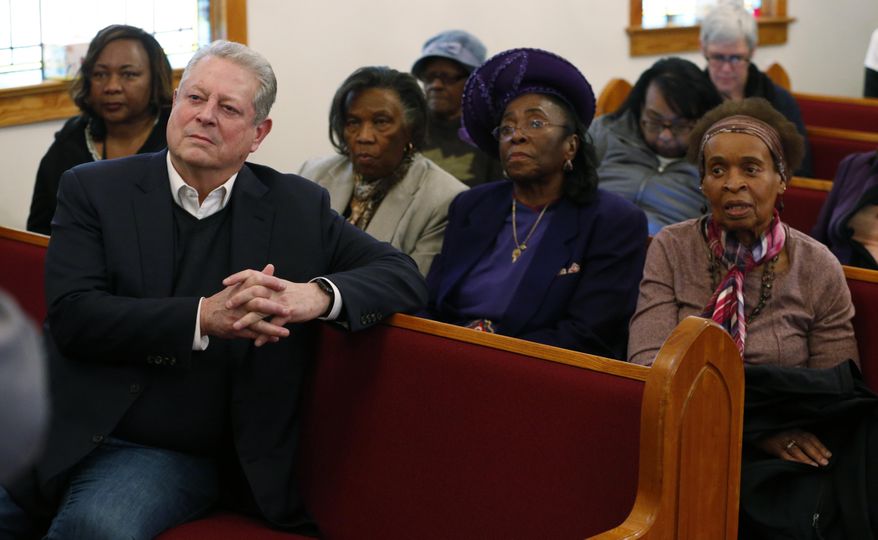
AP caption: Former Vice President Al Gore, left, listens to speakers during a meeting at the Grove Missionary Baptist Church in Buckingham, Va., Tuesday, Feb. 19, 2019. Gore visited the area that is the proposed site for a compressor station for the Atlantic Coast Pipeline. (AP Photo/Steve Helber)
Should be obviously silly for anyone to argue former divinity student Al Gore is evil, as this film implies despite the demurrer. It should also be obviously that it’s evil to call Gore wrong on these issues; but that doesn’t stop brown Earther critics of scientists and Al Gore.

I warned you about it earlier. Crank science sites across the internet feature news of another cheap hit on Rachel Carson and science in movie form.

“Not Evil, Just Wrong” is slated for release on October 18. This is the film that tried to intrude on the Rachel Carson film earlier this year, but managed to to get booked only at an elementary school in Seattle, Washington — Rachel Carson Elementary, a green school where the kids showed more sense than the film makers by voting to name the school after the famous scientist-author.

The film is both evil and wrong.

Errors just in the trailer:

  1. Claims that Al Gore said sea levels will rise catastrophically, “in the very near future.” Not in his movie, not in his writings or speeches. Not true. That’s a simple misstatement of what Gore said, and Gore had the science right.
  2. ” . . . [I]t wouldn’t be a bad thing for this Earth to warm up. In fact, ice is the enemy of life.” “Bad” in this case is a value judgment — global warming isn’t bad if you’re a weed, a zebra mussel, one of the malaria parasites, a pine bark beetle, any other tropical disease, or a sadist. But significant warming as climatologists, physicists and others project, would be disastrous to agriculture, major cities in many parts of the world, sea coasts, and most people who don’t live in the Taklamakan or Sahara, and much of the life in the ocean. Annual weather cycles within long-established ranges, is required for life much as we know it. “No ice” is also an enemy of life.
  3. “They want to raise our taxes.” No, that’s pure, uncomposted bovine excrement.
  4. “They want to close our factories.” That’s more effluent from the anus of male bovines.
  5. The trailer notes the usual claim made by Gore opponents that industry cannot exist if it is clean, that industry requires that we poison the planet. Were that true, we’d have a need to halt industry now, lest we become like the yeast in the beer vat, or the champagne bottle, manufacturing alcohol until the alcohol kills the yeast. Our experience with Rivers and Harbors Act of 1899, the Clean Air Acts and the Clean Water Act is that cleaning the environment produces economic growth, not the other way around. A city choked in pollution dies. Los Angeles didn’t suffer when the air got cleaner. Pittsburgh’s clean air became a way to attract new industries to the city, before the steel industry there collapsed. Cleaning Lake Erie didn’t hurt industry. The claim made by the film is fatuous, alarmist, and morally corrupt.

    When the human health, human welfare, and environmental effects which could be expressed in dollar terms were added up for the entire 20-year period, the total benefits of Clean Air Act programs were estimated to range from about $6 trillion to about $50 trillion, with a mean estimate of about $22 trillion. These estimated benefits represent the estimated value Americans place on avoiding the dire air quality conditions and dramatic increases in illness and premature death which would have prevailed without the 1970 and 1977 Clean Air Act and its associated state and local programs. By comparison, the actual costs of achieving the pollution reductions observed over the 20 year period were $523 billion, a small fraction of the estimated monetary benefits.

  6. “Some of the environmental activists have not come to accept that the human is also part of the environment.” Fatuous claim. Environmentalists note that humans uniquely possess the ability to change climate on a global scale, intentionally, for the good or bad; environmentalists choose to advocate for actions that reduce diseases like malaria, cholera and asthma. We don’t have to sacrifice a million people a year to malaria, in order to be industrial and productive. We don’t have to kill 700,000 kids with malaria every year just to keep cars.
  7. “They want to go back to the Dark Ages and the Black Plague.” No, that would be the film makers. Environmentalists advocate reducing filth and ignorance both. Ignorance and lack of ability to read, coupled with religious fanaticism, caused the strife known as “the Dark Ages.” It’s not environmentalists who advocate an end to cheap public schools.
  8. The trailer shows a kid playing in the surf on a beach. Of course, without the Clean Water Act and other attempts to keep the oceans clean, such play would be impossible. That we can play again on American beaches is a tribute to the environmental movement, and reason enough to grant credence to claims of smart people like Al Gore and the scientists whose work he promotes.
  9. “I cannot believe that Al Gore has great regard for people, real people.” So, this is a film promoting the views of crabby, misanthropic anal orifices who don’t know Al Gore at all? Shame on them. And, why should anyone want to see such a film? If I want to see senseless acts of stupidity, I can rent a film by Quentin Tarantino and get some art with the stupidity. [Update, November 23, 2009: This may be one of the most egregiously false charges of the film. Gore, you recall, is the guy who put his political career and presidential ambitions on hold indefinitely when his son was seriously injured in an auto-pedestrian accident; Gore was willing to sacrifice all his political capital in order to get his son healed. My first dealings directly with Gore came on the Organ Transplant bill. Gore didn’t need a transplant, didn’t have need for one in his family, and had absolutely nothing to gain from advocacy for the life-saving procedure. It was opposed by the chairman of his committee, by a majority of members of his own party in both Houses of Congress, by many in the medical establishment, by many in the pharmaceutical industry, and by President Reagan, who didn’t drop his threat to veto the bill until he signed it, as I recall. Gore is a man of deep, human-centered principles. Saying “I can’t believe Al Gore has great regard for real people” only demonstrates the vast ignorance and perhaps crippling animus of the speaker.]

That’s a whopper about every 15 seconds in the trailer — the film itself may make heads spin if it comes close to that pace of error.

Where have we seen this before? Producers of the film claim as “contributors” some of the people they try to lampoon — people like Ed Begley, Jr., and NASA’s James E. Hansen, people who don’t agree in any way with the hysterical claims of the film, and people who, I wager, would be surprised to be listed as “contributors.”

It’s easy to suppose these producers used the same ambush-the-scientist technique used earlier by the producers of the anti-science, anti-Darwin film “Expelled!

Here, see the hysteria, error and alarmism for yourself:

Ann McElhinney is one of the film’s producers. Her past work includes other films against protecting environment and films for mining companies. She appears to be affiliated with junk science purveyors at the Competitive Enterprise Institute, an astro-turf organization in Washington, D.C., for whom she flacked earlier this year (video from Desmogblog):

Remember, too, that this film is already known to have gross inaccuracies about Rachel Carson and DDT, stuff that high school kids could get right easily.

Anyone have details on McElhinney and her colleague, Phelim McAlee?

More:

Related posts, at Millard Fillmore’s Bathtub:


Yeah, it’s ironic (hacked e-mails and global warming)

November 26, 2009

James’s Empty Blog:

It is hard to miss the irony in people eagerly poring through illegally-obtained private email, looking for ethical breaches by the writers! I’m sure we can all imagine the outrage if one of the emails revealed that a scientist had hacked into one of the sceptics’ computers and was reading all their correspondence. So a bit of perspective is called for here.

James Is A Scientist (IANAS), and he has much good stuff to say (read some of the other posts about the hacked e-mails while you’re there) — but you gotta wonder about a blog that follows such a post with this:

Prawns, Jules Berry

Prawns not in their native habitat. Probably Tastimus deliciousus

Tip of the old scrub brush to Stoat.


Mau-mauing the gullibles: Sirkin on DDT (again)

November 26, 2009

The hard core uneducables who make of the hard knot at the center of the anti-science and anti-environmental movement just refuses to jettison their adored myths about science, regardless how many times those myths are shown to be false.

It’s a religious exercise with them, and their faith in error and bad applications of science won’t be shaken.

Have you ever read Tom Wolfe’s Radical Chic & Mau-mauing the Flak Catchers? Claiming Ruckelshaus an enemy of Africans and Rachel Carson a mass murderer is the new Radical Chic, and constant writing about it the new Mau-mauing.

Natalie Sirkin writes screeds for newspapers in Connecticut, I understand from an odd blog that collects these misdeeds, Don Pesci’s Connecticut Commentary:  Red Notes from a Blue State.

(Pesci has a particular fetish for DDT myths, and Sirkin’s been there, too.  He’s hard-core — no amount of information can sway him.)

Sirkin’s latest screed is “Myths for Fun and Profit,” and includes as one of the myths DDT’s ban in the U.S.  Her complaint is badly worded, but from the brief and grossly wrong explanation, we can see she thinks that DDT shouldn’t have been banned, and that map and calendar challenged, she thinks the ban on using DDT on cotton in the U.S. in 1972 somehow led to a rise in malaria in Africa in the 1980s. (Mosquitoes don’t travel that far, generally, either across the ocean from the U.S. to Africa, nor in time, from 1972 to 1980, nor the other way around.)

Sirkin wrote:

8….DDT, the most wonderful chemical ever. “It is estimated that in little more than two decades, DDT has prevented 500 million deaths that would otherwise have been inevitable,” concluded the National Academy of Sciences in 1971, the year before EPA head William Ruckelshaus banned it. Thanks to Ruckelshaus, Rachel Carson, environmentalist extremists, and the WHO, millions of Africans including children are dying or disabled today.

Why, these irrational policy errors?

So I responded:

Banning DDT from agricultural use was an extremely rational act, as vouched for by the summary judgment against the DDT manufacturers in both of the cases brought against EPA for the ban, and as vouched for by the removal of the bald eagle and brown pelican from the Endangered Species List.

Sirkin wrote:  “DDT, the most wonderful chemical ever. ‘It is estimated that in little more than two decades, DDT has prevented 500 million deaths that would otherwise have been inevitable,’ concluded the National Academy of Sciences in 1971, the year before EPA head William Ruckelshaus banned it.”

EPA relabeled DDT in 1972, not 1971, effectively banning the use of DDT on cotton.  Under that rule, DDT could be available to fight malaria in the U.S., and DDT was manufactured in the U.S. for export to anyone who wished to use it.  There has never been a ban on using DDT to fight malaria.

But DDT ceased to work well against malaria-carrying mosquitoes in the 1960s.  Africans are not stupid.  Had DDT been a panacea, I’m sure they would have used it.

But while I worry about your implicit denigration of Africans and Asians in suggesting they are somehow incapable of deciding for themselves to use an effective weapon against disease, I am more concerned at your erroneous characterization of DDT’s value.  The National Academy of Sciences made an editing error, so part of your error is understandable.  DDT was never credited with saving 500 million lives.  During the entire time DDT has been available to fight malaria, from 1946 to today, the death rate worldwide from malaria has never exceeded 4 million a year, and since the 1960s the death rate has been about a million year.  At 4 million deaths per year, to save 500 million lives, DDT would have had to have been used for 125 years prior to now.  Insecticidal properties of the stuff were discovered only in 1939, 70 years ago.

At about a million deaths per year, to save 500 million lives, DDT would have had to have been used for 500 years.

Clearly there was an error in math, or confusion in citations.  About 500 million people are afflicted with malaria annually, noted earlier in that NAS book, which is where I think the 500 million figure came from.

But let’s leave that aside for a moment.  That 1970 publication by the National Academy of Sciences was an evaluation of chemicals in the environment.  That sentence crediting DDT with saving so many lives, erroneous as it was, was in a call to ban DDT as quickly as possible, and to increase research to find alternatives to DDT in order to get DDT use completely stopped.

NAS recognized the value of DDT, but said it was too dangerous to keep using.

Don’t cite NAS’s credit to DDT without noting they said we must stop using it, because its dangers outweigh the benefits.

You can find a more thorough discussion of the NAS report at this blog. [You should go see, Dear Reader — neither Sirkin nor Pesci will likely ever bother.]

Sirkin wrote:
“Thanks to Ruckelshaus, Rachel Carson, environmentalist extremists, and the WHO, millions of Africans including children are dying or disabled today.”

With the great assistance of the Bill and Melinda Gates Foundation, and continued efforts of the World Health Organization, several African nations have cut malaria rates by 50% to 85% with the use of bednets and “integrated vector management” (IVM), usually known as integrated pest management (IPM) in the U.S.

Anyone who reads Carson’s astoundingly accurate book knows that she did not call for a ban on DDT, but instead called for the use of an integrated program of pest management.  Had we listened to Rachel Carson in 1962, we could have saved several million children from death, in Africa, from malaria alone.  It is scurrilous, calumnous, and inaccurate to the point of sin to blame Rachel Carson for deaths caused by failure to listen to her and heed her words.

Ruckelshaus acted with full knowledge of the National Academy of Science’s calling for an end to DDT use due to its harms, known and then unknown.  It is foolish to blame people for acting with hard evidence and careful, rational thought.  It’s particularly ungraceful to then accuse them of acting irrationally.

I doubt that either Pesci or Sirkin will ever change their tune.  They’d have to concede that science works, that scientists are not all evil, and that sometimes environmentalists, and even liberals, get things right.  More importantly, they’d have to concede they erred — and that would be like Baum’s Wicked Witch of the West taking a shower.