Oh, this will get some attention at the water cooler

May 15, 2009

Scouting is one of the most vulnerable victims of wedge politics and attempts to polarize voters.  Even among veteran Scouts and Scouters, lines tend to get drawn over what the program should be doing.

Today the New York Times headlines a story, “Scouts Train to Fight Terrorists, and more.

It’s Explorers, a group which has been distanced from Boy Scouts by moving it to BSA’s Learning for Life programs.  These are not traditional Boy Scouts. I suspect that distinction, small as it is, will get blurred quickly.

It will be interesting to watch discussions about Scouts pictured with semi-automatic weapons and bullet-proof vests.

Exploring used to be more closely related to Scouting.  Exploring was for kids 14 years and older.  I belonged to an Explorer Post in Utah that specialized in kayaking (I was more active at the council level at the time), and I had the grand opportunity to work with a large Explorer Post affiliated with AMR Corp. (American Airlines), where some of our Scouts got significant time in aircraft simulators (in the good old days, when such machines had downtime).  It was a great program.

That was then.  Today, 14-21-year-old Scouts can join Venture Crews, which can be co-ed.  The old Exploring program you remember survives today mostly in Venturing.


Boy Scout won’t go away

April 21, 2009

Scouting mom and columnist for the Hartford Courant Susan Campbell tells the story of David Knapp, a Boy Scout who refuses to just fade away.  He has a message, and it’s worth listening to.  See “On His Honor, this Boy Scout will do his duty.”


Boy Scouts honor Gerald Ford (from archives)

April 13, 2009

I found this photo on the archived White House website; a marvelous shot of more than 120 Boy Scouts in the National Cathedral during the state funeral of President Gerald Ford.  Ford requested that Eagle Scouts turn out to pay their respects and support him in his final journey; at every stage of his funeral journey, Eagle Scouts saluted Ford, himself an Eagle Scout and the first to serve as president.

Caption from the White House website (now archived):   Boy Scouts attending the State Funeral service for former President Gerald R. Ford at the National Cathedral in Washington, D.C., salute his casket as it leaves the cathedral, Tuesday, Jan. 2, 2007. White House photo by David Bohrer.  Photo in the public domain

Caption from the White House website (now archived): Boy Scouts attending the State Funeral service for former President Gerald R. Ford at the National Cathedral in Washington, D.C., salute his casket as it leaves the cathedral, Tuesday, Jan. 2, 2007. White House photo by David Bohrer. Photo in the public domain


Amarillo Scout: 121 merit badges, and more

January 2, 2009

Here’s a good story we missed back in September.  This is one more example of outstanding achievement by a good kid, a Scout, that slips by largely unremarked.

Amarillo Scout Coleman Carter got his 121st merit badge in his troop’s court of honor.  He had earned his Eagle Rank in September 2004.

Carter’s 121st badge?  Bugling.  He doesn’t play the trumpet or bugle, so it was difficult. Bugling was also the last badge earned by the New York Scout, Shawn Goldsmith.  Is this a trend?  My recollection is that at least one other member of 121-Merit Badge Club got bugling last.

Amarillo Eagle Scout Carter Coleman - Amarillo Globe photo

Amarillo Eagle Scout Carter Coleman - Amarillo Globe photo

Earning every merit badge in the book is just one of Carter’s achievements, however.  He’s a National Merit Scholar, ranked #1 in his class at Tascosa High School, and studentbody president.  You can read several of his acheivements here, in the Amarillo Globe-News — and remember, this was before his junior year (he’s a senior this year).

Better, go read what Globe-News columnist Jon Mark Beilue wrote on September 24, 2008, “Scout blows it out.”

Coleman is a member of Troop 87, sponsored by St. Thomas the Apostle ChurchAmarillo is in the Golden Spread Council, BSA, which serves the Texas and Oklahoma panhandles.

Mr. Coleman is not the first to accomplish this feat, nor will he be the last, I suspect.  I do wish that troops, districts and councils would do more to spread the news of such outstanding feats by Scouts.  A press release kept online, with photos, would have been nice.  (While we’re ranting, would it be so difficult for the Amarillo Globe-News to put its name on its website?  Or has the Globe-News gone out of business?)


Beyond what is required: Another Scout earns all merit badges

December 30, 2008

From Oceanside, Long Island, New York, we get brief reports of an Eagle Scout, Shawn Goldsmith, who earned all 121 merit badges offered by the Boy Scouts of America.  He finished work on his last badge, for bugling, in November.

Eagle Scout Shawn Goldsmith, Troop 240, Greater New York Council - Goldsmith earned all 121 Merit Badges - Photo from GNY Council

Eagle Scout Shawn Goldsmith, Troop 240, Greater New York Council - Goldsmith earned all 121 Merit Badges - Photo from GNY Council

From WBBH, Channel 2, an NBC affiliate television news operation on Long Island:

Goldsmith says he took about five years to earn his first 62 badges and then nearly doubled that number in a matter of months. He did it with the encouragement of his grandmother, who died shortly before he reached his goal. He was awarded his final badges on Dec. 19.

Goldsmith is a freshman at Binghamton University and hopes to become a businessman and politician.

Shawn is a member of Troop 240, Greater New York Council (Bronx), whose chartered organization is Riverdale Presbyterian Church.  Shawn was editor of his high school’s newspaper, and he served as an intern in the Long Island office of U.S. Sen. Charles Schumer.

More information:

Related posts at Millard Fillmore’s Bathtub:

Update – other mentions:


Earning every Boy Scout merit badge

July 14, 2008

Dan Bates served on the staff at Camp Maple Dell for at least the part of one summer when I was on junior staff there, in Utah’s Payson Canyon (1969? 1970?). Maple Dell is a Boy Scout camp operated by the Utah National Parks Council, B.S.A.

I remember Dan because he was one of those overachieving guys who had earned every possible merit badge — 121 at the time, if I recall correctly. By comparison, there are 21 merit badges necessary to earn Eagle Scout (which Dan is, also).

It didn’t go to his head at all. Dan was a great guy, from Heber, Utah, a small town up Provo Canyon in one of the world’s most beautiful valleys. Heber used to be separated from much of Utah by snow every year, but the roads are kept clear these days.

Once I asked Dan what possessed him to get every merit badge, and without pausing long, he said, “What else do you do in Heber in the winter?” It was a flip answer unexpected from the usually more sober Bates.

I think about Dan this time of year when the news stories start appearing about a new Scout, somewhere, who has earned every merit badge. One of the common themes of these stories: Has anyone else ever done it?

Eagle Scout Travis Cochran, California, holder of every merit badge

Eagle Scout Travis Cochran, California, holder of every merit badge

In The Press-Enterprise in San Bernardino, County, California, for example, the June 25 issue reports the achievements of Travis Cochran:

If Don Townsend was a betting man he’d put money on the fact that Travis Cochran is the only Boy Scout to have earned every merit badge and the Bronze and Silver Hornaday Medals.

Cochran, 18, of Cedarpines Park, earned 122 merit badges during his scouting career. Twenty-one merit badges must be earned to reach the rank of Eagle Scout.

There is a qualification in this story — Cochran also earned the Bronze and Silver Hornaday Conservation Medals — but you see the drift.

Alas, there is no central location for information about such achievements that I have ever found. Tracking the achievements of Boy Scouts, like the tremendous accomplishments of Scouts Dan Bates and Travis Cochran, generally falls to the local unit. Sometimes a local Boy Scout Council will have some information, but usually not.

History sneaks away so often because no one bothers to invite it to stick around.

Do you know of other Boy Scouts who earned every possible merit badge? We had one such Scout in the Circle 10 Council (Dallas) last year. How many others sneaked by without the hoopla they deserve?

Dan Bates, where are you these days?

Update, August 2009:  Dan Bates has been found!

Dan wrote in from Mesa, Arizona, and the Grand Canyon Council — see his note in comments, below.  Turns out I remembered it incorrectly — he had 100 merit badges, but not all of them.  His brother got them all.  Glad for the correction.  Happier to have found Mr. Bates.

Other resources:

[Do you like stories about good kids, like these Boy Scouts? Click the Digg button, above  — or one of the other buttons below!]


Add to FacebookAdd to NewsvineAdd to DiggAdd to Del.icio.usAdd to StumbleuponAdd to RedditAdd to BlinklistAdd to TwitterAdd to TechnoratiAdd to Furl


Hydrogen power: Still a gas after all these years

April 20, 2008

There must have been news conferences, press releases and lengthy stories, but I missed them.  It came as a quiet surprise to stumble across GM’s website talking about a fleet of 100 hydrogen fuel-cell cars, on the road now.

Chevy has launched a test fleet of hydrogen-powered fuel cell Equinox SUVs. This fleet hit the streets of New York City, Washington, D.C., and Southern California.

“Project Driveway” is the first large-scale market test of fuel cell vehicles with real drivers in the real world. Why? Because hydrogen fuel cells use zero gasoline and produce zero emissions. They’re a sustainable technology for a better environment. And they ultimately reduce our dependence on petroleum. Equinox Fuel Cell is an electric vehicle powered by the GM fourth-generation fuel cell system, our most advanced fuel cell propulsion system to date. The electric motor traction system will provide the vehicle with instantaneous torque, smooth acceleration, and quiet performance.

The Equinox Fuel Cell will go nearly 150 miles per fill-up, and reach a top speed of 100 mph. Green Car Journal has given the Chevy Equinox Fuel Cell its Green Car Vision Award. The Equinox Fuel Cell won the award over several nominees, including the Honda FCX Clarity and Toyota Prius Plug-In.

If you live in one of those cities, you may be eligible to test drive one of the vehicles.  Were I there, my application to try one would have been in before I started this piece.

It took 20 years longer than it should have to get hybrid fueled vehicles on the road; hydrogen power lags at least as far back.  To those of us who long ago gave up hoping the Detroit Big 3 might see the light on hydrogen in any form, the news GM has a fleet of fuel-cells in pre-Beta testing is most interesting.  We remember GM’s last foray into electric cars.  Hopes do not rise, at least not great hopes, and not high.

It’s been 31 years since Roger Billings drove a hydrogen-powered internal combustion car in Jimmy Carter’s inaugural parade.  Hope abides, but not forever.  Feathers cannot sustain hope that long, Emily.

Fuel cells provide significant advantages, though.  The need for something like fuel cells should drive a market to make the things work.   [More about fuel cells, hydrogen, and Roger Billings, below the fold.]

Read the rest of this entry »


Story of Lord Baden-Powell on video

February 3, 2008

Some guy made this video, a story of the life of Robert Lord Baden-Powell, the founder of Scouting, for a Cub Scout ceremony (an Arrow of Light awarding). This one features some impressive historical footage of the funeral of Baden-Powell.

First, I wonder why the National Council of Boy Scouts has not seized upon this idea, and put this video on DVD for recruiting and ceremonies.

Second, there are a lot of people out there with enough video production skill to preserve a lot of history — more people should.

I imagine the person who created this was the father of a Cub Scout. It’s a Latter-day Saint ceremony, so there are two references to Mormons, but otherwise this would be a fine video for Scout recruiting.

Here’s another video, professionally produced, from 100yearsofscouting.org:


Texas teachers: 9th Legacies Dallas History Conference, January 26

January 20, 2008

You’re not registered yet?

Students learn history best when it affects them directly, or when they can see the stuff close up. The Legacies Dallas History Conferences focus on history in and around Dallas, Texas. This is prime material for Texas and Dallas history, economics and government classes.

The 9th Annual Legacies Dallas History Conference is set for next Saturday, January 26, in the half-day from 8:30 a.m. to 1:10 p.m: “Dallas Goes to War: Life on the Homefront.” $40 for nine presentations — or $100 brings an invitation to schmooze with the presenters on Friday night, before the conference. The conference will be at the Hall of State at Fair Park. The conference was assembled by Dr. Michael V. Hazel.

If you’re teaching at a high school or middle school in the Dallas area, print this off for every social studies and English teacher at your school, and pass it out to them Tuesday (or Monday if you’re open then).

Nancy Harkness Love and Betty Huyler Gillies, first women to fly B-17, during WWII

Many of the conference presentations roll down that alley of a topic most Texas students need more of, the events around World War II. One session dives into Vietnam, one goes back to the Civil War, and World War I is remembered.

Bob Reitz, the public historian who curates the amazing Jack Harbin Museum of Scout History at Dallas’s Camp Wisdom, alerted me to the conference with a plug to his colleague’s presentation. Anita Mills-Barry will present her paper, “Homefront Scouting During World War II: Participation by Boy Scouts and Girl Scouts in the Civilian Effort in Dallas County.”

A copy of the web invitation to the conference below the fold.

Read the rest of this entry »


Science history slips away: Ralph Alpher and Big Bang

September 20, 2007

Looking for something else in an old newspaper, I came across a small obituary for Ralph Alpher. Alpher died August 12, 2007, in Austin, Texas, at the home of his son, Dr. Victor S. Alpher.

Ralph Alpher, physicist who co-hypothesized the Big Bang

Ralph Alpher, physicist who co-hypothesized the Big Bang

Ralph Alpher gave us the Big Bang. We let him slip away, almost unnoticed. Odds are you don’t recall ever hearing of Alpher. Here’s your mnemonic: The alphabet paper.

In 1948, as a graduate student under George Gamow at the George Washington University, Alpher and Robert Herman of Johns Hopkins laid the groundwork for what would become Big Bang theory, calculating how matter could arise in the Universe. Gamow, exhibiting the sense of humor for which physicists are famous, listed the authors of the paper as Alpher, Bethe, Gamow and Herman — a play on the Greek alphabet’s first three letters (alpha, beta, gamma), and a joke invoking the name of the great physicist Hans Bethe. Bethe liked the joke, consulted on the paper, and the theory of Big Bang was published.

Ralph Alpher, in Florida, 2006; Alpher home page

The name “Big Bang” was applied a few years later; Sir Frederick Hoyle and his colleagues favored a “steady state” universe, and at the time both hypotheses could accurately predict most of what was observed, and neither could be disproven. Hoyle, hoping to poke ridicule at the competing hypothesis, belittled it as “a big bang.” The name stuck. The name misleads the unwary; the theory posits a rapid expansion at the beginning of the universe and time, but not an explosion, per se.

Alpher wrote the mathematical model; the model predicted Big Bang, and specifically, it predicted the cosmic background radiation that would have been left over; it was this background radiation, the “echo” of Big Bang, that Arno Penzias and Robert Wilson stumbled across in 1965. Robert H. Dicke had invested several years in trying to discover this signature, and had to explain to Penzias and Wilson what they had found. Penzias and Wilson won the Nobel Prize for their discovery; Dicke, Alpher, Herman and Gamow, did not get Nobel Prizes. This is generally regarded as one of the great miscarriages of justice in Nobel Prize awards, not that Penzias and Wilson did not deserve an award, but that the chief theorists and the man who unveiled the discovery were overlooked.

This is another story of rejection leading to great discovery; it is also a rather sad story of a momentous achievement, mostly overlooked through the years.

Alpher was the son of Jewish émigrés from the Russian pogroms. His high school achievements merited a scholarship to the Massachusetts Institute of Technology, in 1937. MIT had a rule at the time that scholarship recipients could not work outside the school. Alpher assisted his father in building houses in the Washington, D.C. area; the family had little money, and Alpher would be unable to pay room and board without working. Discussions with MIT broke down — the offer of a scholarship was withdrawn, according to most accounts when MIT discovered he was a Jew. As so many great people of the post World War II era, he enrolled at the George Washington University.

At GWU, Alpher found Gamow as a mentor, and much of the rest is history.

The New York Times:

The paper reported Dr. Alpher’s calculations on how, as the initial universe cooled, the remaining particles combined to form all the chemical elements in the world. This elemental radiation and matter he dubbed ylem, for the Greek term defining the chaos out of which the world was born.

The research also offered an explanation for the varying abundances of the known elements. It yielded the estimate that there should be 10 atoms of hydrogen for every one atom of helium in the universe, as astronomers have observed.

Months later, Dr. Alpher collaborated with Robert Herman of the Applied Physics Laboratory at Johns Hopkins University on a paper predicting that the explosive moment of creation would have released radiation that should still be echoing through space as radio waves. Astronomers, perhaps thinking it impossible to detect any residual radiation or still doubting the Big Bang theory, did not bother to search.

The Alpher-Bethe-Gamow paper, or αβγ paper, as explained by the American Institute of Physics:

When Alpher and Gamow prepared a paper on the subject, Gamow mischievously added the name of the noted nuclear physicist Hans Bethe to the list of authors so it would be called the “Alpher-Bethe-Gamow paper,” mimicking the “alpha-beta-gamma” of the first letters of the Greek alphabet. Unknown to Gamow, Bethe was a reviewer for the journal to which Gamow submitted the article. Bethe took it in good humor, later explaining, “I felt at the time that it was rather a nice joke, and that the paper had a chance of being correct, so that I did not mind my name being added to it.” Gamow also urged Herman to change his name to Delter to match delta, the next letter in the Greek alphabet. Despite Herman’s refusal, in a paper in a major scientific journal Gamow referred to “the neutron-capture theory…developed by Alpher, Bethe, Gamow and Delter.” Not least among his notable characteristics was his sense of humor.

Alpher continued in this work for a time, but joined General Electric’s labs in the 1950s. When he retired from GE, in 1986 he joined the faculty at Union College in Schenectady, New York, and taught there until 2004.

Alpher was largely overlooked for awards even while his theory was big news in astronomy and physics for the last 40 years of the 20th century. I regret that I was wholly unaware he was in Austin; how many other great contributors to science and history live among us, unrecognized, uncelebrated, and their stories unrecorded?

Alpher, Herman and Gamow - and the famous Cointreau bottle

Photo caption from AIP: A 1949 composite picture with Robert Herman on the left, Ralph Alpher on the right, and George Gamow in the center, as the genie coming out of the bottle of “Ylem,” the initial cosmic mixture of protons, neutrons, and electrons from which the elements supposedly were formed. [The Cointreau bottle from which the three drank a toast upon the acceptance of the paper, is now in the collection of the Smithsonian Institution.]

Alpher was an Eagle Scout. I wonder whether anyone has a history of his time in Scouting?

While the Nobel Prize eluded Alpher, he collected a host of other prestigious awards and honors. Earlier this year, President Bush announced that Alpher had been awarded the National Medal of Science, which is administered by the National Science Foundation and is the highest honor for science.

. . . [T]he citation reads in part:

“For his unprecedented work in the areas of nucleosynthesis, for the prediction that universe expansion leaves behind background radiation, and for providing the model for the Big Bang theory.”

Note from George Gamow, on confirmation of Big Bang Gamow’s humor again on display — an undated note from Gamow upon the confirmation of the Big Bang, with a punny reference to Steady State backer Sir Frederick Hoyle. Image from the American Institute for Physics.

Online sources for Ralph Alpher:

More:

Help others hear the echo:

Add to FacebookAdd to NewsvineAdd to DiggAdd to Del.icio.usAdd to StumbleuponAdd to RedditAdd to BlinklistAdd to TwitterAdd to TechnoratiAdd to Furl


88-year-old man finally gets Eagle Scout rank

July 29, 2007

Joining the elite, top 5% of all Boy Scouts, Walter Hart was awarded his Eagle rank in a ceremony Saturday in Fort Myers, Florida. Walter is 88.

There was a 70+ year delay in Walter’s ceremony — he passed the requirements for the rank, but then went off to fight in World War II before the award was made.

The Associated Press story ran in the New York Times:

”I’ve been looking forward to this for a long time,” said Hart, who lives in a retirement center in nearby Lehigh Acres.

Scout officials say he may be the oldest person to ever earn the honor.

Hart joined the Cub Scouts in 1928 in Malden, Mass., and earned 23 merit badges during his years as a Boy Scout, scouting officials said. Of the 120 merit badges available, 21 must be earned to qualify for Eagle Scout rank.

It all got set aside when he joined the Navy during World War II and served two years aboard the USS Alfred A. Cunningham.

Last year, he rediscovered some of his old Boy Scout memorabilia, including documents that showed he completed the requirements for his Eagle Scout rank. He contacted the Scouts about receiving his award.

”I think this was something that was always on his mind, but every time he went to go do it, something else came up,” daughter Elizabeth Gatturna said. ”I know how hard he’s tried to get to this point.”

Congratulations, Walter.

Walter Hart, 88, rec'd Eagle Badge 7-28-2007

  • Walter Hart, 88, is shown wearing a 2007 Boy Scout uniform with the merit badge sash he used as a youth, prior to World War II. Apart from the not-quite fit, we can tell the sash is his old one because many of the merit badges are in their pre-World War II designs, and the sash shows rank badges for Star Scout and Life Scout; current uniform rules do not allow rank badges on the sash. Under Scout rules, Walter may wear this sash for his Scouting career. Associated Press photo.

Spread the news, please:

Add to FacebookAdd to NewsvineAdd to DiggAdd to Del.icio.usAdd to StumbleuponAdd to RedditAdd to BlinklistAdd to TwitterAdd to TechnoratiAdd to Furl


Congress’s flag etiquette book: Our Flag

January 14, 2007

A good guide to flag etiquette from the U.S. Congress is on-line now. Our Flag is a traditional publication Congress passes out in efforts to help education in history and patriotism (H.Doc 108-97).

Interest in proper etiquette for flag display increased recently — not enough by my calculation, but any increase is welcomed. Where is good information available?

This Congressionally-sponsored guide is basic and accurate. As a classroom resource or a piece of a Scout troop library, it’s a useful reference guide. It can be downloaded (it’s a .pdf), and printed out in color (56 pages).

The book includes many illustrations showing proper flag display.  It also covers the history of the U.S. flag in good enough detail to get through most high school reports, and it features illustrations of flags of each of the states.

Congress in the past provided many publications on such topics for general public consumption and use in classrooms, but has cut back on free distribution of printed information since the early 1980s.  One might be able to get a printed copy with a request to one’s local Member of the House of Representatives, or U.S. Senator.

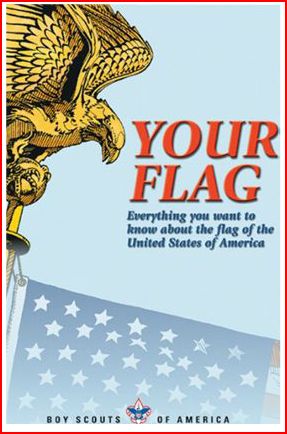
Boy Scouts of America version of the flag etiquette guide, Your Flag

Boy Scouts of America version of the flag etiquette guide, Your Flag

Another book I’ve found very useful is an official Boys Scouts of America publication of the almost the same name, Your Flag.  It’s a graphic-novel type of publication — cartoons for every point to be made.  It features deeper information on proper flag display.  The book can be purchased at any local Boy Scout Council supply shop, or any other shop that stocks Scout literature.  It can also be ordered from BSA’s national catalog, or online at Scoutstuff.org, for $7.9910.99plus shipping.  Every Scout troop should have one of these, and it is also very useful for classroom libraries, for history and civics.

In either publication, one learns that there are not many ways to display a flag properly from a vehicle — improper displays include decals on windows, bumper stickers, flying them from the radio antenna, or attaching them to a window pole to be battered in freeway-speed winds.

One might hope these books get much broader circulation.


Gerald Ford, National Park Ranger

January 1, 2007

Gerald Ford was a very likable guy.  Since his death last week, I have been impressed with the number of people who have stepped forward with different stories about how Ford was just a regular guy called to duty.

Researching the updating of the story about the sale of creationist books in the Grand Canyon, I stumbled into a press release from the National Park Service.  It turns out that Ford is the only president ever to have worked as a National Park Ranger (well, the National Park Service itself has only been around since 1901, so that lets out about half the presidents from even the possibility — though, of course, Yellowstone was established in 1862 1872).

In the summer of 1936 Ford worked in Yellowstone National Park.  He had duties that sound rather quaint and definitely antiquated today:  Ford was a guard on the bear feeding truck.  Bears have to fend for themselves in today’s National Parks.  No, it’s not due to budget cuts in bear food.  Bears do better as wild creatures, and so feeding was stopped to discourage them from becoming tame and dependent on humans.

Gerald Ford, ranger mensch.


How to fold state flags

September 20, 2006

As a lifelong Boy Scout and Scouter, I have lived with flag etiquette so long as I can remember. One of the key parts of flag etiquette with the U.S. flag is the proper folding, done to allow the flag to unfurl neatly when hoisted on a lanyard. (I have earlier discussed the meaning of folding the flag, or rather, the lack of meaning, here, here, and here.)

Several people wrote to ask about etiquette for folding state flags. Whenever I’ve been involved in ceremonies involving state flags, we have used the same fold prescribed for the U.S. flag, for the same reason — it allows the flags to neatly unfurl when they are posted. I have found several sites that urge a different fold for state flags, to preserve some uniqueness of the U.S. flag folding, but of course, that rather avoids the fact that the method used for the U.S. flag is just old ship tradition.

It seemed likely to me that some state had a special fold, however — and sure enough, I’ve found one. Ohio’s flag is not a rectangle, but is instead a tapered banner with two tails. In 2005, as an Eagle Scout project, Ohio Scout Alex Weinstock from Ohio’s Junction City Troop 260 devised a folding method for Ohio’s flag that ends with with 17 folds — appropriate to Ohio’s being the 17th state admitted to the union.

The fold is not easy — flag professionals call it “tricky.” (See a diagram here, from the Muskingumm Valley Council, BSA, in .pdf.)

Ohio’s flag is the only one of the state flags that is not a rectangle. So far as I have found, it is the only one with any suggested method of folding that differs from the method used for the U.S. flag — but my searches may have missed an odd law here or there.

If you know of other special folding methods, please leave a note in comments, or e-mail me.


Fisking a Flag-Fold Flogging

July 19, 2006

Update, March 24, 2007: Be sure to see the updated flag ceremony, which you can find through this post on the news of the its release.

Yes, the flag amendment is dead, again. Yes, the Fourth of July is past. False history continues to plague the U.S. flag, however. When my wife forwarded to me the post below, it was the fourth time I had gotten it, recently. Bad history travels fast and far. Let’s see if we can steer people in a better direction with real facts.

A flag folding at a funeral for a military person carries great weight, without any script at all.  Wikimedia image from DOD release:  Members of the U.S. Navy Ceremonial Guard fold the American flag over the casket bearing the remains of sailors killed in the Vietnam War during a graveside interment ceremony at Arlington National Cemetery on May 2, 2013. Lt. Dennis Peterson, from Huntington Park, Calif.; Ensign Donald Frye, from Los Angeles; and Petty Officers 2nd Class William Jackson, from Stockdale, Texas, and Donald McGrane, from Waverly, Iowa, were killed when their SH-3A Sea King helicopter was shot down on July 19, 1967, over Ha Nam Province, North Vietnam. All four crewmembers were assigned to Helicopter Squadron 2.

A flag folding at a funeral for a military person carries great weight, without any script at all. Wikimedia image from DOD release: Members of the U.S. Navy Ceremonial Guard fold the American flag over the casket bearing the remains of sailors killed in the Vietnam War during a graveside interment ceremony at Arlington National Cemetery on May 2, 2013. Lt. Dennis Peterson, from Huntington Park, Calif.; Ensign Donald Frye, from Los Angeles; and Petty Officers 2nd Class William Jackson, from Stockdale, Texas, and Donald McGrane, from Waverly, Iowa, were killed when their SH-3A Sea King helicopter was shot down on July 19, 1967, over Ha Nam Province, North Vietnam. All four crewmembers were assigned to Helicopter Squadron 2.

Here is the post as it came to me each time — I’ve stripped it of the sappy photos that are occasionally added; note that this is mostly whole cloth invention:

Did You Know This About Our Flag

Meaning of Flag Draped Coffin.

All Americans should be given this lesson. Those who think that America is an arrogant nation should really reconsider that thought. Our founding fathers used God’s word and teachings to establish our Great Nation and I think it’s high time Americans get re-educated about this Nation’s history. Pass it along and be proud of the country we live in and even more proud of those who serve to protect our “GOD GIVEN” rights and freedoms.

To understand what the flag draped coffin really means……

Read the rest of this entry »