Hallowed ground: Why other nations think we’re nuts

August 20, 2010

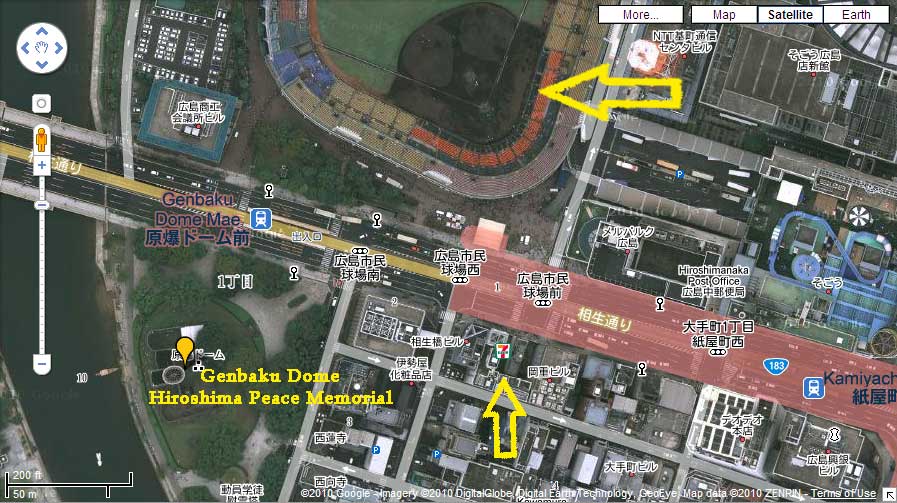
Scott Hanley at Angular Unconformities used Google Earth to see how other nations deal with the placement of potentially-offensive installations near the sites of their great national calamaties.

Charles Krauthammer pushed the argument to the shark-jumping bridge in his regular column at the Washington Post:

When we speak of Ground Zero as hallowed ground, what we mean is that it belongs to those who suffered and died there — and that such ownership obliges us, the living, to preserve the dignity and memory of the place, never allowing it to be forgotten, trivialized or misappropriated.

That’s why Disney’s 1993 proposal to build an American history theme park near Manassas Battlefield was defeated by a broad coalition that feared vulgarization of the Civil War (and that was wiser than me; at the time I obtusely saw little harm in the venture). It’s why the commercial viewing tower built right on the border of Gettysburg was taken down by the Park Service. It’s why, while no one objects to Japanese cultural centers, the idea of putting one up at Pearl Harbor would be offensive.

We noted on another thread that there is, in fact, a Japanese Cultural Center at Pearl Harbor.  Hanley wonders how the Japanese deal with reminders of the being the victims of the first atomic bomb used in warfare — a topic upon which the Japanese are understandably extremely sensitive.

Go to the photos, see what Hanley found:

Hallowed ground

Baseball and 7-Eleven, symbols of American cultural imperialism at the site of the world’s first nuclear assault. McDonald’s, by contrast, maintains a discreet 2000′ distance across the river.

This campaign against a Moslem cultural center in lower Manhattan is the prototypical example of where the “Ugly American” myth gets its roots. Hanley’s analysis is incredibly simple, no?


What would George Washington say and do about a mosque in Manhattan? (“To bigotry, no sanction”)

August 17, 2010

Double encore post.  And look at the date

August 17, 1790, found U.S. President George Washington traveling the country, in Newport, Rhode Island.

Washington met with “the Hebrew Congregation” (Jewish group), and congregation leader (Rabbi?) Moses Seixas presented Washington with an address extolling Washington’s virtues, and the virtues of the new nation. Seixas noted past persecutions of Jews, and signalled a hopeful note:

Deprived as we heretofore have been of the invaluable rights of free citizens, we now (with a deep sense of gratitude to the Almighty disposer of all events) behold a government erected by the Majesty of the People–a Government which to bigotry gives no sanction, to persecution no assistance, but generously affording to All liberty of conscience and immunities of Citizenship, deeming every one, of whatever Nation, tongue, or language, equal parts of the great governmental machine.

George Washingtons reply to the Newport, RI, Hebrew congregation, August 17, 1790 - Library of Congress image

George Washington's reply to the Newport, RI, "Hebrew congregation," August 17, 1790 - Library of Congress image

President Washington responded with what may be regarded as his most powerful statement in support of religious freedom in the U.S. — and this was prior to the ratification of the First Amendment:

It is now no more that toleration is spoken of as if it was the indulgence of one class of people that another enjoyed the exercise of their inherent natural rights. For happily, the government of the United States, which gives to bigotry no sanction, to persecution no assistance, requires only that they who live under its protection should demean themselves as good citizens, in giving it on all occasions their effectual support.

Below the fold, more history of the events and religious freedom, from the Library of Congress.

Read the rest of this entry »


Dan Valentine – Pink cigarette lighter, part 6

July 30, 2010

By Dan Valentine

THE PINK CIGARETTE LIGHTER – Part 6

When my bestest friend and I first moved into our new one-story home in Friendswood, TX, the fellow next door, who owned a nice three-story house, came over and said how happy he was to have a nice couple such as ourselves now living next door as neighbors.

The couple before us, he said, were “f**king faggots!” and used to host poolside orgies in their backyard. It disgusted him. That, he informed us, was the reason for the extra-high security fence separating his back property from ours.

I met him again while getting the mail shortly after Hurricane Ike. He asked me if I had gotten my $500 check from the government. They were handing out checks to those in need with property damage.

Hurricane Ike had missed us. There WAS no property damage. But his kind, they know how! His grandfather had developed the neighborhood and, as a result, the fellow next door was living the good life. He spent the majority of his time at his beach house on the Gulf.

Shortly afterward I read a story in the Houston Chronicle telling of how the poor were finding it almost impossible to collect that much-needed check.

A few months later, I met him for a third time walking out to get the mail. He told me: “That sure is a purty little gal you got there.”

Only a fat f**k (and I’m speaking of his head, though, his body was a monument to the god of saturated-fats) could make such a remark sound perverted as all-get-out. It made my skin crawl just to type the phrase and hear his voice again inside my brain.

Extra-tall security fence or not, he obviously had been peeping out of his third-floor window when she was sunbathing by the pool–oftentimes topless, thinking she had the privacy to do so, unaware a pervert was watching, gleefully. He may very well have been doing something else, gleefully, while watching. I picture him snacking on pork rinds.

She never felt comfortable poolside again.

We sold the home a couple of years later to a NASA project manager for a future manned-flight to Mars.

I had left a couple of things behind in the confusion and commotion of moving and one afternoon I returned to retrieve them. I knocked on the door and the new owner answered.

His male companion stood close beside him, wearing tight-fitting speedos! Not that there is anything wrong with tight-fitting speedos, as they would say on Will and Grace, but he might as well have been wearing assless chaps. They were obviously lovers.

I went off to Austin, then Provo, then Nashville, and many parts in between, and when my bested friend bought a home close by to NASA, I flew back to Texas, and I’m walking down the street one day, stop at a “Don’t Walk” sign, and a fat fellow behind the wheel of a somewhat familiar-looking SUV, waiting to make a right turn, waves me over through the darkened windshield.

I thought I must still have that look of homelessness and the fellow wanted to give me a quarter or so to help himself get into heaven when the time came to fill out the application. (List any or all good deeds: “Gave 37 cents to a homeless person once.”)

It turned out to be our former fat-f**k of a next-door neighbor in Friendswood. He rolled down his window and said, “Y’know, I think that couple you sold your home to are goddamn queers.”

It made my day. “Oh, yeaaaaah!”

And pickled pink, I went on my way, picturing him in my mind peeking out of his third-story window, cursing under his breath, while two fellas playfully in the pool next door below splashed water at each other–him, the fat-f**K, crunching on a pork rind and thinking to himself, “I sure do miss that purty little gal.”


White men gave civil rights to women, blacks and Hispanics?

July 16, 2010

It’s maybe an apocryphal story. Republicans in Texas hope so.

It was at a very large, mostly African-American church in Dallas. The social action committee, or whatever it’s name is, was meeting. The only white guy in the room was there to try to get them interested in the elections for the members of the Texas State Board of Education. Normally these races are sleepers, down ballot, and off the radars of almost all interest groups. The social action committee was just as tough an audience as any other group with limited resources and limited time to try to get good political action.

Besides, a good chunk of Dallas is represented by Mavis Knight, an African American who is a pillar of common sense on the Texas education board, and Ms. Knight’s seat isn’t being contested in 2010. Why should Dallas voters be interested in any of these races?

“Before we start talking,” the lone white guy said, “I’d like to show you some of what has been going on in the Texas State Board of Education over the last year, in their work to change social studies standards.”

And he showed the video below. The entire committee grew quiet, silent; and then they started to shout at the television image. “What’s that?” “Is he crazy?” “He said white men gave us civil rights?”  “HE SAID WHAT?”

A 58-second video clip that could greatly animate electoral politics in Texas. The comments came fast and loud.

“That was part of the debate?  What, are they crazy down there?  Don’t they know history?  Don’t they know the truth?  They aren’t going to tell our children that Martin Luther King didn’t work to get civil rights, are they?  They aren’t going to say Martin Luther King died, but some white man gave rights to African Americans — are they?”

It’s a video clip that every Republican candidate in Texas hopes will be hidden away.  The Democratic tide that has swept Dallas County in two consecutive elections threatens to stop the Republican stranglehold on statewide offices in November, if those who voted in such great numbers in 2008 turn out again.

There are other stakes, too — the Republican stranglehold allowed the state education board to gut science standards, to eliminate Hispanic literature from language arts standards, and to try to change history, to blot out Thurgood Marshall and as much of the civil rights movement as they could hide.  So Texas children get a second-rate, incorrect set of standards in social studies, in English, and in science.

Republicans have declared war on good education, war on the children who benefit most from good education.

So, according to Don McLeroy, who lost the primary election to keep his seat, this little piece of history, below, is inaccurate. Tough for McLeroy — the Schoolhouse Rock video sits in too many Texas school libraries. Sometimes, the facts sneak through, defying the best efforts of the Texas State Soviet of Education to snuff out the truth.

But don’t you wonder what every woman, African American, and Hispanic in Texas will think about the importance of the 2010 elections, when they see what Gov. Rick Perry’s appointee to chair the SBOE, thinks about how civil rights were achieved in the U.S.?

Over at Republican headquarters, they hope that story is apocryphal.

Video of the Texas State Board of Education from the Texas Freedom Network.

Here, you can make sure other voters see this video that Don McLeroy hopes you will not see:

Add to FacebookAdd to NewsvineAdd to DiggAdd to Del.icio.usAdd to StumbleuponAdd to RedditAdd to BlinklistAdd to TwitterAdd to TechnoratiAdd to Furl


Dan Valentine – The Pink Cigarette Lighter, Part 1

July 9, 2010

By Dan Valentine

THE PINK CIGARETTE LIGHTER – Part One

My bestest friend, she loves the color pink. I’ve known her to order a Pink Lady merely for its soothing and appealing color. One year, for Halloween (or some other special occasion–I forget), she paid hard-earned cash for an expensive carbon-copy of the famous pink strapless gown that Marilyn Monroe wore in Gentlemen Prefer Blondes when singing Diamonds Are a Girl’s Best Friend.

When we bought a home together in southeast Texas, one of the first things we did was have the interior walls sponge-painted. One hot-pink wall for her, one sea-green wall for me, one hot-pink wall for her, one sunshine-yellow wall for me. Very nice, very stylish, very Mexican. Who’d a thought!

Pink cigarette lighter

Pink cigarette lighter, by Bic

Yes, indeedy, she sure loves the color pink! Which is all very fine and well and good. But one late night, many years ago, her color preference came close to costing me my life.

Upon lighting a cigarette on a street corner in Washington, D.C., with a pink lighter that I had absentmindedly lifted from her earlier in the evening, I was gay-bashed and left for dead. I’m lucky to be alive. But ain’t we all?

A recent conversation or three here at the Ensenada Backpacker Hostel brought that memorable night back.

But, first, let me begin by saying, I love a hostel! Extremely affordable and you meet the most interesting folks from all around the world. If I’d been aware of hostels in my youth and middle-age, I’d still be rich. Money-wise. I’ve spent many a dollar, franc, and pound staying in hotel rooms. Oh, the interesting people I could have met!

At the Austin Hostel, I met a young man who makes a living as a Lab Rat. Austin boasts many a medical research center and drug companies pay big bucks to those willing to act as guinea pigs, having themselves inoculated with some new experimental cure-all. Some are paid as much as $3,000 a swallow. And, odds-wise, it’s not a bad way to pay-off one’s credit-card debt. You’ve got a fifty-fifty chance of receiving a placebo.

On my first or second day in Ensenada, I met a semi-retired South Korean war correspondent. He was in Somalia during the Blackhawk-Down fiasco. He saved a naked woman’s life.

He was atop a building, camera rolling, a South Korean competitor–a female–by his side, both doing their jobs, reporting the events at hand, when a naked woman down below on the street appeared, running for her life, chased by dozens of young boys, throwing stones at her. He quickly hurried down the stairs, but all had disappeared. Shortly after, the woman reappeared. He covered her with his coat and escorted her to the roof, just before the young boys returned, searching high and low for her.

The woman had been seen riding in a Jeep beside a male French soldier, representing the United Nations. In that neck of the woods, a major no-no at the time, may still be. Shortly afterward, his South Korean female competitor was recalled and replaced by a male. The young boys? Some undoubtedly grew up to be pirates, commandeering a yacht or whatnot off the Somalian coast for ransom.

He was in Afghanistan when the U.S. first did whatever we did there after 9/11, and told me what he thought we (the U.S.) always tend to do wrong after succeeding on such occasions. We replace the defunct leaders with those raised and educated in Britain or in the U.S., those English-speaking, who have long ago lost touch with their own people and their needs. Few could argue with that.

He left the hostel to travel north. He was seriously thinking of crossing the border with illegals. Once a reporter, always a reporter.

He and I would never have met but for a hostel. He covered the UN for his country while I was in New York, but we ran in different circles, back then. I just hope he didn’t get shot by some crazy American with a gun in Arizona.

Another hostel guest I met here is a retired Bronx fireman. In the ’90s, he and others were called upon to extinguish fire after fire. Neighborhood gangs were setting apartment buildings ablaze, one after another, day in and day out, so as to quickly empty the premises, so they could burgle and run off with whatever valuables were left in sight before the fire trucks arrived.

He had many a story to tell. One afternoon, he was stopped in midtown Manhattan by a cop for walking his dog unleashed. My Bronx friend said he was a fireman. Cops and firemen, they’re a fraternity. They look after each other. The cop asked for picture-ID. At the time, firemen didn’t carry ID’s with pics. So, to make sure he was, indeed, a fireman, the cop drove the offender to his reputed fire station in the Bronx. They walked in, the fireman with the dog explained to his colleagues the circumstances, and they informed the cop, “We’ve seen him around the neighborhood, but God knows what he does.”

Funny. Every morning he cooked breakfast for them, that’s what he did, among other things, like fighting fires. He told his fellow firefighters that if they wanted fresh coffee in the morning–and that went for all the cops in the Bronx who were known to often drop by–they would vouch for him. They finally did.

Sometime afterward, he severely sliced a tendon on a little finger, opening up a can of ham while fixing breakfast. To this day, he can’t wiggle or move it. He went before a medical board of three and they told him that if he had the little pinkie amputated he could go back to work. Decisions, decisions. Firemen in New York are unionized and the union has clout. He’s been retired ever since.

A young man from the mainland of Mexico–I forget exactly where now–stayed for a couple of weeks here recently. What a nice person! The nicest fellow you’d ever want to meet. Always a smile on his face, when he wasn’t laughing. He was in town substituting for a teacher on summer break at a school down the avenida a ways.

Upon checking in at the desk, he introduced himself with a big jovial smile. An hour or so later, I ran into him coming out of an Oxxo (the south-of-the-border Seven-Eleven) with an even bigger smile on his face and a bottle of wine in hand. I watched him join a woman who was behind the wheel of an SUV. A ladies’ man, I thought. Two hours in town and he was with a beautiful senorita. During his short visit, I saw him with many a pretty woman, never a fella.

Each night he would mix and fill to the brim a stainless steel pot of Margaritas and place it in the freezer to chill. “Help yourself!” And I did.

Many a morning in the kitchen, he would say, “Tonight. Margaritas. Yes?”

Si, deed!

I could have sworn he said he was going to stay the summer, but something must have come up. After just a week or two he said he was returning home.

His last night he invited one and all here to a barbecue on the back veranda. Spicy Habernero chicken wings, grilled steaks, and oh yes! Margaritas.

Shortly after he left, Salsador, who works the afternoon/night reception desk, nonchalantly informed me that the substitute teacher was not only jovial but gay. You’re kidding, I said. “What makes you think he was gay?”

“It was obvious,” he said.

Not to me. But what do I know? “How so?”

“My girlfriends and I, we take him for drinks. He told them how to give a man a good–”

Sorry I asked.

“Next day they meet for coffee-time and more instruction, how to give a man a good–”

Please! I get the gist.

Who’d have thought! But, then again, so, so what? Who cares?

A great many, very scary people do.

Like the father of Melody I wrote about a few weeks ago–the brigadier general who thought I must be gay because I’ve never learned to drive. Heterosexuals drive!

Or, the kids in the car in Houston who saw me walking along the street and swerved over to scream out a rolled-down window, “Faggot!” and screeched down the road, tee-hee-ing to themselves. Heterosexuals drive!

A good number of citizens of the U.S. are scared to death of gays. I say citizens of the U.S., and not Americans, because down here folks south the border consider themselves Americans, too. And rightly so. Though, they are a little more laid-back and not as uptight as many of their north-of-the-border fellow Americans.

Folks in the U.S. are frightened of many things: Illegals (unless they’re blowing leaves off front lawns at a cut-rate price), fellow students (Texas is seriously contemplating passing a law to allow students to bring guns to the classroom to protect themselves from fellow students), Federal troops (many want to start independent militias to protect themselves in case of invasion from ourselves).

But gays are especially frightening to many. Their inclination may rub off.

Pink cigarette lighter, by Zippo

Pink cigarette lighter, by Zippo

When I was a kid in the ’50s, one of my favorite TV shows was the Cisco Kid, the Robin Hood of the West, based on an O. Henry short story about a carefree Mexican desperado. Before it was a TV show, it was a B movie series. One, starring Cesear Romero, was The Gay Caballero (1940.)

From the press book: “The Cisco Kid rides again quicker on the draw, more gay, and gallant than ever.” It ever-so-often runs on the Fox Movie Channel. In 1946, a remake was called The Gay Cavalier.

Warner Baxter won the 1929 Best Actor award for his portrayal of the Cisco Kid in the first talkie shot outdoors, called “In Old Arizona”–though, it filmed in Utah.

I mention this because gay caballero perfectly describes–to my chagrin; I hadn’t a clue–the hostel guest I knew briefly. Mexican, charming, happy-go-lucky, and gay.

No, gay-gay! He’s banned from the place now. That’s why he left earlier than expected. He tried to sneak a male lover into his dorm for the night. Not merely once but twice. I hadn’t a clue. My bestest friend thinks my middle name should be Clueless.

Business is slow here at the hostel of late (many up north think they’ll be mowed down by members of the drug cartel if they visit), so I have a dorm room all to myself with connecting bathroom. He had a dorm room to himself as well next to mine but without a bathroom, So, I would leave my door open at night, just a smidge. I’m a light sleeper. Even though I like to think of myself as a let-live-let-live guy, two male lovers going at it within groaning-and-gasping distance would have been very perturbing, to say the least.

I told the lovely morning/mid-afternoon receptionist here, the above tale.

She looked at me, bewildered. “You couldn’t tell?”

I shook my head. Hadn’t a clue.

First tri-mester, we’re all the same sex. Or, so I read once. At birth, ten percent are born different, as some like to describe it. Some say three or four percent. Others will tell you two. Many think it’s a life-style choice, being gay being so much fun.

I didn’t tell her that I had been gay-bashed in Washington, D.C., a few years back. Though, it’s the first thing that comes to mind whenever the subject arises. Two gay men found me passed-out on the sidewalk, badly bruised and bleeding.

“I think I’ll Google my mind and write a piece about all the gay people I’ve come in contact with throughout my life,” I told her.

She raised her hand. “You can add me to the list.”

I hadn’t a clue. She’s engaged to be married to a guy.

I love a hostel!

If you’re a writer, it’s like you’ve died and gone to heaven.

TO BE CONTINUED


So, on June 2, 1924, all American Indians became citizens of the U.S.

June 2, 2010

English colonists, and then citizens of the new United States of America, regarded Native Americans as foreign groups, people of other lands. It’s part of a history of bad relations and bad faith between peoples on this continent that we gloss over with the good relations and good faith.

The whole story is important.  It’s been told, and told well, at the Library of Congress:

On June 2, 1924, Congress enacted the Indian Citizenship Act, which granted citizenship to all Native Americans born in the U.S. The right to vote, however, was governed by state law; until 1957, some states barred Native Americans from voting. In a WPA interview from the 1930s, Henry Mitchell describes the attitude toward Native Americans in Maine, one of the last states to comply with the Indian Citizenship Act:

One of the Indians went over to Old Town once to see some official in the city hall about voting. I don’t know just what position that official had over there, but he said to the Indian, ‘We don’t want you people over here. You have your own elections over on the island, and if you want to vote, go over there.

‘”The Life of Henry Mitchell,”
Old Town, Maine,
Robert Grady, interviewer,
circa 1938-1939.
American Life Histories, 1936-1940

Native Americans During Mathematics Class

Native Americans During Mathematics Class at Indian School, Carlisle, Pennsylvania

Native Americans During Mathematics Class, (detail)
Indian School, Carlisle, Pennsylvania,
Frances Benjamin Johnston, photographer, 1903.
Prints and Photographs Division

Previously, the Dawes Severalty Act (1887) had shaped U.S. policy towards Native Americans. In accordance with its terms, and hoping to turn Indians into farmers, the federal government redistributed tribal lands to heads of families in 160-acre allotments. Unclaimed or “surplus” land was sold, and the proceeds used to establish Indian schools where Native-American children learned reading, writing, and the domestic and social systems of white America. By 1932, the sale of both unclaimed land and allotted acreage resulted in the loss of two-thirds of the 138 million acres that Native Americans had held prior to the Dawes Act.

In addition to the extension of voting rights to Native Americans, the Secretary of the Interior commission created the Meriam Commission to assess the impact of the Dawes Act. Completed in 1928, the Meriam Report described how government policy oppressed Native Americans and destroyed their culture and society.

The poverty and exploitation resulting from the paternalistic Dawes Act spurred passage of the 1934 Indian Reorganization Act. This legislation promoted Native-American autonomy by prohibiting allotment of tribal lands, returning some surplus land, and urging tribes to engage in active self-government. Rather than imposing the legislation on Native Americans, individual tribes were allowed to accept or reject the Indian Reorganization Act. From 1934 to 1953, the U.S. government invested in the development of infrastructure, health care, and education, and the quality of life on Indian lands improved. With the aid of federal courts and the government, over two million acres of land were returned to various tribes.

American Indians of the Pacific Northwest

Salish man
Salish Man Named Paul Challae and Small Child,
Montana,
date unknown.

Salish couple

Salish Man and Woman Sitting on Rocks, Montana (?) (date unknown.)

Salish Man and Woman Sitting on Rocks,
Montana [?],
date unknown. 

Salish Woman and Children

Salish Woman and Children

Salish Woman and Children,
St. Ignatius Mission, Montana.
1924.

American Indians of the Pacific Northwest integrates over 2,300 photographs and 7,700 pages of text relating to Native Americans of two cultural areas of the Pacific Northwest. Many aspects of life and work — including housing, clothing, crafts, transportation, education, and employment, are illustrated in this collection drawn from the extensive holdings of the University of Washington Libraries, the Cheney Cowles Museum/Eastern Washington State Historical Society, and the Museum of History and Industry in Seattle.

And doesn’t that just frost the tar out of the birthers?  Herbert Hoover just five years later chose Charles Curtis to be  his vice presidential candidate, and Curtis served for four years.  Curtis, born in the Kansas Territory before it was a state, came from Native American ancestry.


School issued computers as spy devices

February 20, 2010

Anyone with a school-issued computer ought to check it over, now.  And maybe put a towel over the thing.  Unplug it, and take the battery out.

And, oh, do I wish I had an AP Government class to discuss this with!

Did you hear the one about Lower Merion, Pennsylvania, school officials spying on students’ bedrooms?

Good discussion at the Volokh Conspiracy:  “Big Teacher Is Watching You?

According to the Complaint in Robbins v. Lower Merion School District (filed a week ago),

2. Unbeknownst to [high school students and their parents], and without their authorization, [high school officials] have been spying on the activities of [the students] by Defendants’ indiscrimina[te] use of and ability to remotely activate the webcams incorporated into each laptop issued to students by the School District….23…. Plaintiffs were for the first time informed of [this] capability and practice by the School District when … an Assistant Principal at Harriton High School[] informed minor Plaintiff that the School District was of the belief that minor Plaintiff was engaged in improper behavior in his home, and cited as evidence a photograph from the webcam embedded in minor Plaintiff’s personal laptop issued by the School District….

24. [The minor Plaintiff’s father] thereafter verified, through [the Assistant Principal], that the School District in fact has the ability to remotely activate the webcam contained in a students’ personal laptop computer issued by the School District at any time it chose and to view and capture whatever images were in front of the webcam, all without the knowledge, permission or authorization of any persons then and there using the laptop computer.

If this was indeed done, and if it was done without adequately notifying the students and their parents, this was clearly tortious, likely a violation of the Fourth Amendment, and possibly a statutory violation as well (though I haven’t looked closely at the statutory details). It is also appalling — school officials spying on children in their parents’ homes without the children’s and parents’ permission. Who thinks up such things?

Who thinks them up, and can we get them to wear a badge so we know they’re not in our school?

Ed Brayton’s Dispatches from the Culture Wars already is on the story — a few good comments there.

A statement from the Lower Merion School District generally ignores the specifics of the allegations in the case, and claims that the monitoring of the self-contained web-cams was done only when a computer was reported stolen.  In the complaint, the plaintiffs allege that a student was reprimanded for behaviors caught on the camera, while the student was at home.  The statement is very much what we would expect from a rich district caught doing something wrong after getting better advice from their attorneys than they thought they needed before they did the wrong thing.

An Associated Press story (here in the Washington Post) said the FBI has opened an investigation into whether school officials violated anti-wiretapping laws.

The suit filed is a civil suit.  Assuming its allegations to be correct, I think the plaintiffs may want to add RICO sections to the complaint.  Under the Racketeer-Influenced and Corrupt Organizations Act a pattern of practices like illegal use of the webcams could easily be evidence to trigger RICO  penalties, which included treble damages.  Such a charge would also scare the textbooks out of school officials thinking they might want to do this in the future.

Comments at the Volokh Conspiracy, Dispatches from the Culture Wars, and in the AP story in the WaPo all raised the spectre of child pornography.  If the computers caught images of children in their bedrooms, it might automatically qualify as child porn — and this would greatly complicate the case, and ramp up the noise surrounding it.

School districts who issue laptops to students, or teachers, should review the story and their own procedures and regulations.

Also:


Encore post: Lunch and civil rights

February 1, 2010

Today is the 50th anniversary of the Greensboro sit-in.  Be sure to read Howell Raines’ criticism of news media coverage of civil rights issues in today’s New York Times:  “What I am suggesting is that the one thing the South should have learned in the past 50 years is that if we are going to hell in a handbasket, we should at least be together in a basket of common purpose.”

Four young men turned a page of history on February 1, 1960, at a lunch counter in a Woolworth’s store in Greensboro, North Carolina.

Ezell A. Blair, Jr. (now Jibreel Khazan), Franklin E. McCain, Joseph A. McNeil, and David L. Richmond, sat down at the counter to order lunch.  Because they were African Americans, they were refused service.  Patiently, they stayed in their seats, awaiting justice.

On July 25, nearly six months later, Woolworth’s agreed to desegregate the lunch counter.

Ezell A. Blair, Jr. (now Jibreel Khazan), Franklin E. McCain, Joseph A. McNeil, and David L. Richmond leave the Woolworth store after the first sit-in on February 1, 1960. (Courtesy of Greensboro News and Record)

Ezell A. Blair, Jr. (now Jibreel Khazan), Franklin E. McCain, Joseph A. McNeil, and David L. Richmond leave the Woolworth store after the first sit-in on February 1, 1960. (Courtesy of Greensboro News and Record) (Smithsonian Institution)

News of the “sit-in” demonstration spread.  Others joined in the non-violent protests from time to time, 28 students the second day, 300 the third day, and some days up to 1,000.   The protests spread geographically, too, to 15 cities in 9 states.

On the second day of the Greensboro sit-in, Joseph A. McNeil and Franklin E. McCain are joined by William Smith and Clarence Henderson at the Woolworth lunch counter in Greensboro, North Carolina. (Courtesy of Greensboro News and Record)

Smithsonian caption: "On the second day of the Greensboro sit-in, Joseph A. McNeil and Franklin E. McCain are joined by William Smith and Clarence Henderson at the Woolworth lunch counter in Greensboro, North Carolina. (Courtesy of Greensboro News and Record)"

Part of the old lunch counter was salvaged, and today is on display at the Smithsonian Institution’s Museum of American History.  The museum display was the site of celebratory parties during the week of the inauguration as president of Barack Obama.

Part of the lunchcounter from the Woolworths store in Greensboro, North Carolina, is now displayed at the Smithsonians Museum of American History, in Washington, D.C.

Part of the lunchcounter from the Woolworth's store in Greensboro, North Carolina, is now displayed at the Smithsonian's Museum of American History, in Washington, D.C.

Notes and resources:


Fly your U.S. flag today, in honor of the Rev. Dr. Martin Luther King, Jr.

January 18, 2010

King Center poster for MLK Day 2010

King Center poster for MLK Day 2010

Fly your flag today.

U.S. law encourages Americans to fly the U.S. flag on holidays and a few other occasions.  Congress set aside the third Monday in January as a holiday to commemorate the life of the Rev. Dr. Martin Luther King, Jr.

To honor Dr. King, for several years civil rights leaders and others have urged us to find some way to serve our communities on this day — Americans have done it long enough to make it a tradition.  Here’s the official find-a-way-to-serve page from the the federal government; look out your window, go spend a few minutes at your city hall, post office, or at the biggest church in town, or walk into any middle school in America, and opportunities to serve will caress you at every turn.

More, much more:

King, by photographer Ben Fernandez's "Countdown to Eternity"

King, by photographer Ben Fernandez's portfolio of photos from one year in the life of Dr. King, "Countdown to Eternity"

MLK logo from Google mlk2010

Google's logo for Martin Luther King, Jr. Day, 2010 - click for more information

Share a dream:

Add to FacebookAdd to NewsvineAdd to DiggAdd to Del.icio.usAdd to StumbleuponAdd to RedditAdd to BlinklistAdd to TwitterAdd to TechnoratiAdd to Furl


61 years old: The Universal Declaration of Human Rights

December 10, 2009

Rational Rant reminds us, December 10 is the 61st anniversary of the adoption of the Universal Declaration of Human Rights.

Our Bill of Rights is good; have you ever really read the UDHR and compared?  Go look, see what you agree with, or whether you have any disputes.

sbh explains:

10 December is Human Rights Day, commemorating the adoption of the Universal Declaration of Human Rights by the UN General Assembly on this day in 1948. And how appropriate it is to the season. Consider Article 1:

All human beings are born free and equal in dignity and rights. They are endowed with reason and conscience and should act towards one another in a spirit of brotherhood.

Damn right. In a way it’s sad that the remaining twenty-nine articles have to exist at all, spelling out that people should not be tortured (Article 4) or enslaved (Article 5), or deprived of employment (Article 23) or leisure (Article 24) or education (Article 26). Shouldn’t this all go without saying? Apparently not; when the nation that prides itself on being the city on the hill and the beacon of hope for the world descends to torture and degradation of human beings for political ends all bets are off.

Comparison of the BoR and UDHR makes a good discussion assignment, and could probably be turned into a DBQ.


Encore post: Rosa Parks, December 1, 1955

December 1, 2009

Rosa Parks being fingerprinted, Library of Congress

Rosa Parks: “Why do you push us around?”

Officer: “I don’t know but the law is the law and you’re under arrest.”

From Rosa Parks with Gregory J. Reed, Quiet Strength
(Grand Rapids, MI: Zondervan Pub. House, 1994), page 23.

Photo: Mrs. Parks being fingerprinted in Montgomery, Alabama; photo from New York World-Telegram & Sun Collection, Library of Congress

Today in History at the Library of Congress states the simple facts:

On the evening of December 1, 1955, Rosa Parks, an African American, was arrested for disobeying an Alabama law requiring black passengers to relinquish seats to white passengers when the bus was full. Blacks were also required to sit at the back of the bus. Her arrest sparked a 381-day boycott of the Montgomery bus system and led to a 1956 Supreme Court decision banning segregation on public transportation.

Rosa Parks made a nearly perfect subject for a protest on racism. College-educated, trained in peaceful protest at the famous Highlander Folk School, Parks was known as a peaceful and respected person. The sight of such a proper woman being arrested and jailed would provide a schocking image to most Americans. Americans jolted awake.

Often lost in the retelling of the story are the threads that tie together the events of the civil rights movement through the 1940s, 1950s and 1960s. As noted, Parks was a trained civil rights activist. Such training in peaceful and nonviolent protest provided a moral power to the movement probably unattainable any other way. Parks’ arrest was not planned, however. Parks wrote that as she sat on the bus, she was thinking of the tragedy of Emmet Till, the young African American man from Chicago, brutally murdered in Mississippi early in 1955. She was thinking that someone had to take a stand for civil rights, at about the time the bus driver told her to move to allow a white man to take her seat. To take a stand, she remained seated. [More below the fold]

Read the rest of this entry »


#1 hoax site on the web

July 5, 2009

This may be the #1 hoax site on the web:  Martinlutherking.org. Certainly it is a site dangerous for children, because it cleverly purports to be an accurate history site, while selling voodoo history and racism.

A racist group bought the domain name (note the “.org” suffix), and they’ve managed to keep it.  The site features a drawing of Martin Luther King, Jr., on the first page.  The racist elements are subtle enough that unwary students and teachers may not recognize it for the hoax site it is.

It is both racist and hoax:  Note the link to a racist argument on “Why the Martin Luther King, Jr., holiday should be repealed;”  note the link to a hoax page, “Black invention myths.”

Students, nothing on that site should be trusted. Teachers, warn students away from the site.  You may want to use that site as a model of what a bad site looks like, and the importance of weighing the credibility of any site found on the web.

Why do I even mention the racist, hoax site? Because it comes upi #3 on Google searches for “Martin Luther King.”  Clearly a lot of people are being hoodwinked into going to that site.  I’ve seen papers by high school students citing the site, with teachers unaware of the site’s ignoble provenance.

Update: The site is owned by Stormfront, a white supremicist organization.

Here are a few good sites on the Rev. Dr. Martin Luther King, Jr.; you can help things by clicking on each one of these sites, and by copying this list with links and posting it on your blog:

More resources:


Texas Darlin’ on Sotomayor: Still ugly

June 15, 2009

I can’t bite my tongue and let idiots rage on unfairly and inaccurately about important matters.

Earlier I noted the difficulties with reality at Texas Darlin’.  The warden of the blog dropped by and suggested I should join the discussion there if I had something to say.  It always ends badly.  Someone there says something plug ugly stupid, and I note the facts.  My posts get edited, or censored.

Some post linked there, and I looked.  I couldn’t resist.  The owner and commenters are flailing around like a bass in the boat, trying to make a case that Sonia Sotomayor shouldn’t be a justice of the Supreme Court.  They have convinced themselves that she’s a racist, she’s sexist, she got where she is solely because of affirmative action and the Great Cabal that Runs the World.  And they are stuffing tinfoil in their ears now — it makes their hats leak, but it keeps them from hearing anything that might upset them.

I expect they’ll remove my posts soon.  If you care, I’ve made some defense of Sonia Sotomayor, and I copied the posts below the fold.  Texas Darlin’ inmates correspondents repeat every canard about Sotomayor you can imagine.  And some you can’t imagine.

Texas Darlin’ is neither.

I am persuaded to do a series of posts on the nomination of Sotomayor.  In the interim, here’s my attempt to square things at Texas Darlin’, below the fold.

Read the rest of this entry »


The truth about Judge Sotomayor

June 11, 2009

Nina Totenberg of NPR wins great respect as a reporter on the Supreme Court for a reason:  She’s a great reporter.

Totenberg on Judge Sonia Sotomayor’s alleged race bias:

As a judge, Sotomayor has ruled in 100 cases that involve questions of racial discrimination of one sort or another. Tom Goldstein, Supreme Court advocate and founder of the leading Supreme Court blog, has read all of those decisions. He says that Sotomayor does not seem to put her thumb on the scale and has in fact, most of the time, ruled against those charging discrimination.

In only 1 of out 8 cases, he says, has she favored in some sense claims of discrimination.

“The fact that she so rarely upholds discrimination claims I think answers the idea that she is always angling for minorities,” he says.

Totenberg on Sotomayor’s statements about judge-made law and policy:

And if the New Haven case is a harbinger in one direction, there are other cases that point the other way too. Sotomayor, for example, dissented when her colleagues allowed the New York City Police Department to fire one of its officers for sending hate mail on his own time. While the hate mail was patently offensive, hateful and insulting, Sotomayor wrote, it did not interfere with the operations of the police department, and, she observed, under our Constitution, even a white bigot has the right to speak his mind.

In another case involving a black couple bumped from an American Airlines international flight, Sotomayor said their race discrimination claim was clearly trumped by an international treaty governing airline rules. It matters not, she said, that her ruling might mean airlines could discriminate on a wholesale basis and that there would be no legal recourse. The treaty’s language is clear and it is not for the courts to make policy, she said, adding that if policy is to be changed, Congress or federal agencies must do it.

White bigots ought to study more and flap less.


Domestic terrorism in the U.S.

June 4, 2009

This is terrorism, isn’t it?  What definition of terrorism would leave this out?