President Lyndon B. Johnson looks on as U.S. Secretary of State Dean Rusk prepares to join foreign ministers from more than 50 other nations in signing the Nuclear Nonproliferation Treaty, July 1, 1968. Photo from the LBJ Presidential Library, Austin, Texas, via the Nuclear Archive.
Another missed anniversary — but a found archive of original documents on a key issue of our time which has flared up into worldwide controversy in the past year: On July 1, 1968, nations that had nuclear weapons and nations capable of making such weapons — more than 50 nations total — joined in the Nuclear Nonproliferation Treaty (NPT) designed to discourage anyone else from getting “the bomb.” In the past 40 years, few other arms treaties, or any treaties, have worked so well, reducing by two-thirds the potential growth of “the Nuclear Club.”
Signed into law on July 1, 1968, the historic Nuclear Nonproliferation Treaty (NPT) was a major step towards creating a world that had the potential to be a bit safer from the threat of nuclear annihilation. This particular collection of documents related to the NPT was brought together through the diligence of staff members at the Archive’s Nuclear Documentation Project and released to the public in July 2008. The site starts off with a narrative essay which describes the backdrop to the signing of the NPT in 1968, along with offering a bit of additional context about the international political climate at the time. The site’s real gems are the 34 documents which include State Department cables, internal planning documents, and other items that reveal the nature of the political machinations involved with this process. [KMG]
Nuclear Archive does a good job itself — eminently readable, suitable for high school and maybe junior high:
Near the end of the protracted negotiations that produced the historic Nuclear Nonproliferation Treaty (NPT) 40 years ago, U.S. government officials warned that countries could legally reach “nuclear pregnancy” under the Treaty and then withdraw and quickly acquire nukes, according to declassified U.S. government documents published on the Web today by the National Security Archive (www.nsarchive.org).
The documents detail the well-known resistance to the NPT from countries like India (“China at her back, and Pakistan lurking on the sidelines”) but also from more unusual objectors such as Australia (concerned that the Western Pacific security situation might worsen) and Italy (unhappy about the “second-class status” of non-nuclear states). The documents suggest that the current crisis in the NPT system has deep historical roots, but also that current headlines overlook the long-term achievements of the NPT regime.
During the mid-1960s, prior to the NPT, U.S. intelligence had warned that as many as 15 countries had incentives to become nuclear weapons states but after the Treaty was signed, only five additional countries have developed such weapons (Israel, India, Pakistan, South Africa, and North Korea, while South Africa has renounced them). How much of an impact the Treaty had on keeping the numbers low can be debated, but the non-nuclear standard that it set remains a central goal of the world community to this date.
This is a fantastic source for student projects, for reports, for teachers putting together presentations, for students to read on the Cold War, on 1968, on nuclear weapons, on the Johnson administration, on foreign affairs and how treaties work and are negotiated.
Truly the lazy days of summer — I missed the anniversary of the Trinity Project, the first atomic bomb ever exploded, at White Sands, New Mexico, early on the morning of July 16, 1945. That was 63 years ago.
The Trinity atomic bomb test, culmination of the Manhattan Project, July 16, 1945
The Potsdam Conference, July 1945 – Churchill, Stalin, and Truman at the table – Photo from the Truman
Truman hoped to avoid a land invasion of Japan, which experts said would leave at least a million dead U.S. soldiers and five million dead Japanese. Truman was a soldier in World War I, who saw the trenches close up. He hoped to avoid anything similar for soldiers, and civilians. From Potsdam, Truman, Churchill and Stalin issued the Potsdam Declaration, ending with an ultimatum to Japan to surrender unconditionally or face terrible consequences.
Japan did not surrender. On August 6, 1945, the U.S. detonated the first atomic bomb used in warfare over Hiroshima, Japan, a city with large military support facilities. Within a few minutes, nearly 100,000 people were dead. When Japan failed to offer unconditional surrender even then, a second atomic device was detonated over Nagasaki, Japan, on August 9. (Had Japan not surrendered then a scramble would have been on — the U.S. had materials for about four more bombs, but they were not ready to go.)
1945 launched the world into the Atomic Age, by many accounts. The existence of atomic weaponry added to tensions on the planet played out during the Cold War. The creation of thermonuclear weapons, many times as powerful as a simple atomic bomb, only added to the tension. Perhaps we should call it the Atomic Angst Age.
Does that explain the fascination with photos of atomic blasts in recent days?
Then this post, from a blog named Picdit — “8 Insane Nuclear Explosions” rode the top of the popularity index of WordPress for the past couple of days. I’m not sure why these photos or the events they portray deserve to be called “insane.” I’m perplexed about why they are so popular.
These events around the creation, testing and use of nuclear arsenals resonate deeply with those of us who lived through any of these times. High school students have tested poorly on these issues during the past five years, however. Many of my history students do not know the significance of the classic mushroom cloud that marks an atomic blast.
I hope the curiosity is genuine curiosity for the historic events, that this curiosity leads to understanding of the destructive power of nuclear weapons, and that those tens of thousands who clicked on those images achieved an iota of understanding. I hope.
The First Bomb at Bikini, Charles Bittinger, 1946 – “Captured at the peak of formation, this painting illustrates the classic mushroom cloud shape. The pink color of the cloud is due to the oxidation of nitrogen caused by high heat and radiation from the explosion. The rapidly cooling fireball is the cause of the red glow seen deep within the cloud. The blast wave created the massive waves and steam that engulfed the target fleet at the bottom.” From the Naval Historical Center Art Collection.
Check out:
U.S. Naval Historical Center’s paintings of test events at Bikini Atoll, including the sinking of the U.S.S. Saratoga. One might get the idea from this series of paintings that military did not fully appreciate the power and potential dangers of the weapons it was testing — and that would be correct. These images may be used for classroom presentations as best I can figure the rights — give attribution, give the artists a plug.
In West Berlin, President John F. Kennedy delivers the famous speech in which he declares, “Ich bin ein Berliner.” Meaning literally “I am a citizen of Berlin,” the statement shows U.S. solidarity with democratic West Berlin, surrounded by communist territory.
Photo of President Kennedy addressing Berlin’s citizens, photographer unidentified; from American Rhetoric site.
[end of encore post]
Kennedy’s entire speech was good. It was well drafted and well delivered, taking advantage of the dramatic setting and the dramatic moment. John Kennedy well understood how to give a speech, too.
Below is most of the speech, nearly five minutes’ worth, from a YouTube file — another indication that schools need to open up their filters to allow at least some of the best YouTube material through:
We were in the worst of the Cold War in 1957. We had an enemy that, though not really formal in a declared war sense, was well known: The Soviet Union and “godless communism.” Some of the activities our nation engaged in were silly — adding “under God” to the Pledge of Allegiance smoked out no atheists or communists, but did produce renewed harassment of Jehovah’s Witnesses and anyone else opposed to such oaths — and some of the activities were destructive — Sen. Joseph McCarthy’s excessive and ultimately phony zeal in exposing communists led to detractive hearings, misplaced fears of fellow citizens and serious political discussion, and violations of Americans’ civil rights that finally prompted even conservative Republicans to censure his action. The challenges were real. As Winston Churchill pointed out, the Soviet Union had drawn an “Iron Curtain” across eastern Europe. They had maintained a large army, gained leadership in military aviation capabilities, stolen our atomic and H-bomb secrets, and on October 4, 1957, beaten the U.S. into space with a successful launch of an artificial satellite. The roots of destruction of the Soviet Empire were sown much earlier, but they had barely rooted by this time, and no one in 1957 could see that the U.S. would ultimately triumph in the Cold War.
That was important. Because though the seeds of the destruction of Soviet communism were germinating, to grow, they would need nourishment from the actions of the U.S. over the next 30 years.
Sen. John F. Kennedy and Counsel Robert F. Kennedy, McClellan Committee hearing, 1957; photo by Douglas Jones for LOOK Magazine, in Library of Congress collections
Fourteen days after the Soviet Union orbited Sputnik, a young veteran of World War II, Massachusetts Sen. John F. Kennedy, spoke at the University of Florida. Read the rest of this entry »
Spread the word; friends don't allow friends to repeat history.
The Union of Soviet Socialist Republics (USSR) launched the world’s first artificial satellite into orbit. After successfully putting the shiny ball into orbit, the Soviets trumpeted the news that Sputnik traced the skies over the entire planet, to the shock of most people in the U.S. (Photo of the model in the Smithsonian’s Air & Space Museum in Washington, D.C.)
New Scientist magazine’s website provides significant details about how awake America became, including very good coverage of the Moon landings that were nearly a direct result of Sputnik’s launch — without Sputnik, the U.S. probably wouldn’t have jump started its own space program so, with the creation of NASA and the drive for manned space flight, and without the space race President John F. Kennedy probably wouldn’t have made his dramatic 1961 proposal to put humans on the Moon inside a decade.
Texas Essential Knowledge and Skills (TEKS) lists 1957 as among the dozen dates students need to know in U.S. history, for Sputnik. It is the only date Texas officials list for U.S. history that is really an accomplishment by another nation. (The first time I encountered this requirement was in a meeting of social studies teachers gearing up for classes starting the following week. The standards mention the years, but not the events; I asked what the event was in 1957 that we were supposed to teach, noting that if it was the Little Rock school integration attempt, there were probably other more memorable events in civil rights. No one mentioned Sputnik. It was more than two weeks before I got confirmation through our district that Sputnik was the historic event intended. Ouch, ouch, ouch!)
Sputnik was big enough news to drive Elvis Presley off the radio, at least briefly, in southern Idaho. My older brothers headed out after dinner to catch a glimpse of the satellite crossing the sky. In those darker times — literally — rural skies offered a couple of meteoroids before anyone spotted Sputnik. But there it was, slowly painting a path across our skies, over the potato fields, over the Snake River, over America.
Sputnik’s launch changed our lives, mostly for the better.
Some people can’t let go of the past, and like the greedy chimpanzee who grasps the rice in the jar, and then is trapped when he cannot pull out his fist nor will he give up his prize to save his freedom, they trap themselves out of a good life.
Today is the 46th anniversary of the beginning of the Berlin Wall. The post I wrote last year on this topic continues to be popular, day in and day out, but especially when high school curricula get to the Cold War, the Berlin Airlift, the 1960s, and the collapse of the Soviet empire, best exemplified by the destruction of the Berlin Wall itself and the reunification of Germany.
Here is another photo from his collection. It comes without caption; from the barbed wire and the uniform and helmet, I would say This is cropped version of a photo of an East German soldier, Conrad Schumann , assigned to shoot people trying to breach the wall to escape to West Germany, who instead decided to leap to freedom himself, probably at Checkpoint Charlie, one of three gates between East and West Berlin. I regret I have no further credit information on the photo on August 15, 1961. The photo is by West German photographer Peter Leibing, then working for Contiepress, in Hamburg.
German authorities announced the Wall was open for travel between the two entities of divided Germany on November 9, 1989. Jubilant Germans on both sides of the wall tore down sections, poked holes in the concrete barriers, and generally vandalized the wall over the next few weeks. Negotiations then led the way for the Reunification of Germany on October 3, 1990.
In West Berlin, President John F. Kennedy delivers the famous speech in which he declares, “Ich bin ein Berliner.” Meaning literally “I am a citizen of Berlin,” the statement shows U.S. solidarity with democratic West Berlin, surrounded by communist territory.
The story could fuel jokes for years. Or it could cause tears, as indeed it did from the woman who organized the festivities around the unearthing of the 50-year-old Plymouth buried at Tulsa’s courthouse.
Now we know what 50 years in a hole does to a Plymouth Belvedere.
The tires go flat. The paint fades. Hinges and latches stiffen, upholstery disintegrates, the engine becomes a very large paperweight.
But what the heck. None of us is what we used to be.
1957? Eisenhower sent U.S. Marshalls, and then the U.S. Army, into Little Rock, Arkansas, so 9 African-Americans could register to go to Central High School. That was so long ago that the Little Rock 9 graduated, became doctors, lawyers and businessmen, and even an undersecretary of Labor, and got very gray; Central High is now a National Historic Monument (though still a high school).
How teachers should address World War II in high school history classes continues to vex me, and others, too, I suppose. First is the problem that we have more than six decades of history after the war to cover in history classes, a problem my teachers didn’t have, or ignored.
More difficult is the connecting of the war to later events. Tom Brokaw’s book, The Greatest Generation, argues a strong case that America is better because of the of work of the people who survived the war, especially the veterans. But often I’ve thought that a simple recounting of history cannot adequately cover the struggle with existence and its meaning that so changed the world after the war, especially for veterans who saw combat. Kids ask why we didn’t just negotiate with the communists to end the Cold War, and why the Marshall Plan could even exist. Why build tract homes, and get an education?
Kurt Vonnegut’s Slaughterhouse Five provided some of the best answers to those questions, which is to say that the answers themselves lack clarity, and confuse. I wish students could read it just before we cover the Battle of the Bulge in a couple of classroom sessions, both to understand and empathize with the soldiers in the battle, and to understand how much that battle and the end of the war shaped events of the 1950s and Cold War.
Billy Pilgrim came unstuck in time, but was stuck forever with history, by history, remembering history in some cases even before it happened. Billy Pilgrim knew Santayana and Santayana’s ghost at the same time. Pilgrim, and Vonnegut, appeared to understand how hopeless life can be, but found reason to plod on anyway. There is hope at the bottom of Vonnegut’s work, or the hope that hope might be found just around the corner.
Winston Churchill delivering the “Iron Curtain” speech, Westminster College, Fulton, Missouri, March 5, 1946 – Photo by George Skadding
“From Stettin in the Baltic to Trieste in the Adriatic, an iron curtain has descended across the Continent. Behind that line lie all the capitals of the ancient states of Central and Eastern Europe. Warsaw, Berlin, Prague, Vienna, Budapest, Belgrade, Bucharest and Sofia, all these famous cities and the populations around them lie in what I must call the Soviet sphere, and all are subject in one form or another, not only to Soviet influence but to a very high and, in many cases, increasing measure of control from Moscow.”
No rational person would believe Texas Republicans would call for Marxist economics to be taught in Texas high schools, not even as a part of a “teach the controversy” movement.
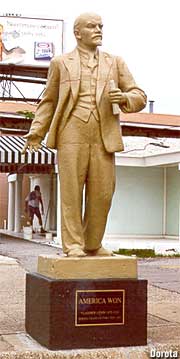
The one-semester economics class does not lend itself to giving students backgrounds in economic models that compete with the consensus, free-market view, and even if it did, Marxism would be way down the list of what most Texans would think appropriate to teach. For illustration, consider that when the Soviet Union broke up, a Soviet-produced statute of Lenin was purchased by a Dallas hamburger magnate, placed outside one of his outlets with a plaque commemorating the Cold War, and noting: “America won.” (Alas, Goff’s is gone, as is the statue.)
But why is this provision regarding social studies tucked into the platform point on “Theories of Origins”? Apparently it reflects an agenda that includes teaching from a creationist standpoint not only in science, but in social studies and other subjects as well.
Someone who’s familiar with curriculum conflicts over recent years will recognize the entire education section of the platform as coming chapter and verse from Phyllis Schlafly’s Eagle Forum. The agenda they are pushing here is not something home-grown in Texas, but an agenda that we can expect to see being advanced all over the United States.
Well, Texas politics being what it is, the likelihood that a plank from any party’s platform could make it into law is a bit remote right now. And it seems clear that the intent was to go after science and evolution, not economics. Udall’s Law of Unintended Consequences says such efforts will produce unexpected and undesired results, and here we have a good case in point.
People are gearing up for fights on history and biology texts in Texas — economics, too? Ouch.
Spread the word; friends don't allow friends to repeat history.
Cmdr. Lloyd Bucher and the Pueblo on the cover of Time Magazine, February 2, 1968 (substituted for the official portrait of Bucher, which is no longer available)
A good hoax? It could happen, right?
It did happen.
A U.S. spy ship, the U.S.S. Pueblo, under the command of Cmdr. Lloyd Bucher, was captured by North Korea on January 28, 1968 — the beginning of a very bad year in the U.S. that included Viet Cong’s Tet Offensive that revealed victory for the U.S. in Vietnam to be a long way off, the assassination of the Rev. Martin Luther King, Jr., the assassination of presidential candidate Sen. Robert F. Kennedy, riots during the Democratic National Convention in Chicago, a bitter election — and a wonderful television broadcast from astronauts orbiting the Moon on Christmas Eve.
North Korea held the crew of the Pueblo for eleven months. While holding the crew hostage — there was never any serious thought that the ship had in fact strayed into North Korean territorial waters, which might have lent some legitimacy to the seizure of the ship — North Korea (DPRK) tried to milk the event for all the publicity and propaganda possible. Such use of prisoners is generally and specifically prohibited by several international conventions. Nations make a calculated gamble when they stray from international law and general fairness.
To their credit, the crew resisted these propaganda efforts in ways that were particularly embarrassing to the North Koreans. DPRK threatened to torture the Americans, and did beat them — but then would hope to get photographs of the Americans “enjoying” a game of basketball, to show that the Americans were treated well. The crew discovered that the North Koreans were naive about American culture, especially profanity and insults. When posing for photos, the Americans showed what they told DPRK was the “Hawaiian good luck sign” — raised middle fingers. The photos were printed in newspapers around the world, except the United States, where they were considered profane. The indications were clear — the crew was dutifully resisting their captors. When the hoax was discovered, the Americans were beaten for a period of two weeks. Read the rest of this entry »
Spread the word; friends don't allow friends to repeat history.
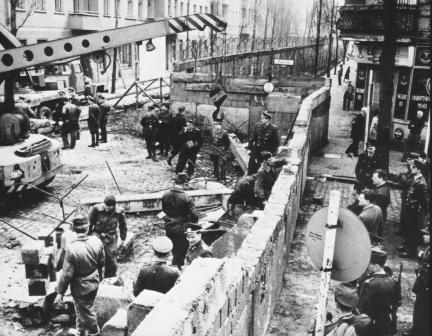
August 13, 2006, is the 45th “anniversary” of the erection of the Berlin Wall, the totem of the Cold War that came down in 1989, pushing the end of the Cold War. Residents of Berlin awoke on this day in 1961 to find the communist government of East Germany erecting what would become a 96-mile wall around the “western quarters” of the city — not so much to lay siege to the westerners (that had been tried in 1948, frustrated by the Berlin Airlift) as to keep easterners from “defecting” to the West. The Brandenburg Gate was closed on August 14, and all crossing points were closed on August 26.
From 1961 through 1991 1989, teachers could use the Berlin wall as a simple and clear symbol for the differences between the communist Eastern Bloc, the Soviet Union and her satellite states, and the free West, which included most of the land mass of Germany, England, France, Italy, the United States and other free-market nations — the North Atlantic Treaty Organization (NATO) countries. I suspect most high school kids today know very little about the Wall, why it was there, and what its destruction meant, politically.
This era of history is generally neglected in high school. Many courses fail to go past World War II; in many courses the Cold War is in the curriculum sequenced after the ACT, SAT and state graduation examinations, so students and teachers have tuned out.
But the Wall certain had a sense of drama to it that should make for good lessons. When I visited the wall, in early 1988, late at night, there were eight fresh wreaths honoring eight people who had died trying to cross the Wall in the previous few weeks (in some places it was really a series of walls with space in between to make it easier for the East German guards to shoot people trying to escape) — it’s an image I never forget. Within a year after that, East Germans could travel through Hungary to visit the West, and many “forgot” to return. Within 18 months the wall itself was breached.
The Wall was a great backdrop for speeches, too — President John F. Kennedy visited Berlin in June 1963, and expressed his solidarity with the walled-in people of both West and East Berlin, with the memorable phrase, “Ich bin ein Berliner,“ which produced astounding cheers from the tens of thousands who came to hear him. There are a few German-to-English translators who argue that some of the reaction was due to the fact that “Berliner” is also an idiomatic phrase in Berlin for a bakery confection like a jelly doughnut — so Kennedy’s words were a double entendre that could mean either “I am a citizen of Berlin,” or “I am a jelly doughnut.” [Be sure to see the comments below, from Vince Treacy (9/28/2010).] Ronald Reagan went to the same place Kennedy spoketo the Berlin Wall, too, to the Brandenburg Gate, in his famous June 1987 speech which included a plea to the Soviet Union’s Premier Mikhail Gorbachev: “Mr. Gorbachev, tear down this wall!”
Or, until that account is unsuspended by the forces supporting Donald Trump: Follow @FillmoreWhite, the account of the Millard Fillmore White House Library
We've been soaking in the Bathtub for several months, long enough that some of the links we've used have gone to the Great Internet in the Sky.
If you find a dead link, please leave a comment to that post, and tell us what link has expired.
Thanks!
Retired teacher of law, economics, history, AP government, psychology and science. Former speechwriter, press guy and legislative aide in U.S. Senate. Former Department of Education. Former airline real estate, telecom towers, Big 6 (that old!) consultant. Lab and field research in air pollution control.
My blog, Millard Fillmore's Bathtub, is a continuing experiment to test how to use blogs to improve and speed up learning processes for students, perhaps by making some of the courses actually interesting. It is a blog for teachers, to see if we can use blogs. It is for people interested in social studies and social studies education, to see if we can learn to get it right. It's a blog for science fans, to promote good science and good science policy. It's a blog for people interested in good government and how to achieve it.
BS in Mass Communication, University of Utah
Graduate study in Rhetoric and Speech Communication, University of Arizona
JD from the National Law Center, George Washington University


 Posted by Ed Darrell








 Millard Fillmore's Bathtub
