Can’t make this stuff up: Utah internet sales magnate wants Constitutional Amendment for . . . religious freedom

August 13, 2013

You know what?  The Stupid doesn’t burn, after all — if it did, this guy would have self-immolated long ago.

Utah Policy Daily is an online-newsletter of public policy stuff in the Beehive State — a very good one.  It’s done by some top Utah political consultants from both parties, and former political writers, colleauges and friends from the University of Utah and the political and culture wars in the state.

Utah Policy Daily carried this story, this morning, which I present in full only because you wouldn’t believe it otherwise:

Constitutional Amendment Would Protect ‘Religious Liberty’

By Bryan Schott

Jonathan Johnson, Executive Vice-President of Overstock.com, is leaping into the political ring with a proposed constitutional amendment to protect religious liberty.

Jonathan Johnson of OverStock.com

Jonathan Johnson of OverStock.com

The Daily Caller reports Johnson wants his proposed amendment to exempt churches from being forced to perform same-sex marriages. Johnson says the amendment wouldn’t interfere with the Supreme Court rulings in favor of same-sex marriage, but it also protects groups opposed to the practice at the same time.

Johnson and some friends hatched an idea for states to pass a constitutional amendment saying: ”A religious organization, religious association, religious society or any person acting in a role connected with such organization, association or society and shall not be required to solemnize, officiate in, or recognize any particular marriage or religious rite of marriage in violation of its constitutional right of conscience or its free exercise of religion.”

(The wording is still being fleshed out, but that’s basically what it will say.)

In some ways, this shouldn’t be controversial. The proposed amendment “doesn’t get in the way of gay marriage,” Johnson notes — “but it [also] doesn’t have gay marriage encroach into areas of religious liberty.”

Read more: Utah Policy – Constitutional Amendment Would Protect Religious Liberty

As I understand it, this amendment would be aimed at preventing the government from ordering preachers to marry people they don’t want to marry.

Maybe Johnson is so much a Mormon (I do not know his faith) that he does not know that this “right” is protected by the First Amendment, and has been practiced by far too many Catholic priests, Baptists ministers, and even Mormon Bishops, over the past 225 years.  Preachers regularly refuse to allow their churches to be used by people for any fool reason whatever, and no preacher is forced to solemnize a marriage.  In short, his proposed amendment is wholly superfluous, already covered by the First Amendment.

Unless his real purpose is to create some new way of bashing homosexuals, as I suspect.  Bigot.

Here’s the scary part:  This guy has created a lobbying group to push for the amendment, and has already raised more than $100,000 to push it.  According to the RWNJournal Daily Caller:

As conservatives work to create a firewall on the issue of religious liberty, don’t be surprised if this effort catches on nationwide. Johnson already has a Utah PAC (First Freedom PAC) and a 501 (c)(4) that he says has “raised low six digits — and we’re not really trying yet,” he says.

How many stupid people, people wholly unaware of the First Amendment, are out there with the checkbooks open willing to be suckered by confidence schemes like this?  Enough to raise “low six digits.”

Hey:  For just $10,000, I’ll come to your home and explain why the First Amendment already gives us religious freedom, and tell you why it shouldn’t be mucked with.  I’ll bring PowerPoints and patriotic music, if you want, and give it all to you in less than an hour — or take a whole day if you want.  I won’t even charge expenses.

Then you can put your remaining money into a group that really works to defend the Constitution, or the First Amendment specifically — and I’ll tell you who they are.

Next thing you know, this guy will “come up” with an idea for an amendment to recognize Jesus.

History and policy ignoramii.  Santayana’s Ghost is grumbling and going back for another cup of coffee.  Has Chris Rodda heard about this yet?  Ed Brayton? (Oh, yeah, Ed’s on it already.  Good.)

One point of light:  My old colleague at the Daily Utah Chronicle, Bob Bernick, wrote a column detailing that Utah politicians generally are not so stupidly right-wing as many in the rest of the nation, “Utah, not as crazy as we could be.”  Maybe some of those not-stupid people will take Mr. Johnson aside and explain the Constitution to him.

Update:  Point of darkness:  Johnson has a law degree from BYU.  Seriously.  I thought U.S. Sen. Mike Lee was an aberration,

More:

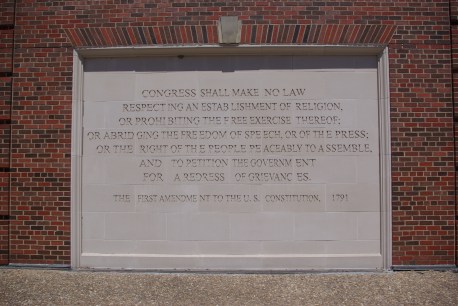
Here in Texas, we have the First Amendment engraved in stone, at Southern Methodist University.

Here in Texas, we have the First Amendment engraved in stone, at Southern Methodist University. Photo by Ed Darrell – use encouraged.
Text of the First Amendment: Amendment:
Congress shall make no law respecting an establishment of religion, or prohibiting the free exercise thereof; or abridging the freedom of speech, or of the press; or the right of the people peaceably to assemble, and to petition the Government for a redress of grievances.


June 15: Magna Carta anniversary, #798

June 15, 2013

In 2015 we’ll celebrate the 800th anniversary of the signing of the Magna Carta.  I predict that, beginning in late 2014, pseudo-historians will begin an assault on the history of the document, attempting to convince us that the document banned income taxes, banished the poor from hospitals and job finding agencies, and said children should have to work for their meals and never get food stamps. 

I hope I’m wrong.

Today, June 15, 2013, is the 798th anniversary of the signing of the Magna Carta.  The document laid a foundation for freedom, almost 800 years ago, upon which we stand today.

Runnymede, Magna Carta Isle, photo by Wyrdlight, Antony McCallum, 2008 (Wikimedia)

What event critical to western history and the development of the democratic republic in the U.S. happened here in 1215?

A teacher might use some of these photos explaining the steps to the Constitution, in English law and the heritage of U.S. laws. Other than the Magna Carta, all the events of Runnymede get overlooked in American studies of history. Antony McCallum, working under the name Wyrdlight, took these stunning shots of this historic meadow. (He photographs stuff for studies of history, it appears.)

Maybe it’s a geography story.

View of Runnymede Meadow from Engham Village -- Wyrdlight photo through Wikimedia

View of Runnymede Meadow from Engham Village — Wyrdlight photo through Wikimedia

Several monuments to different events of the past millennium populate the site. The American Bar Association dedicated a memorial to the Magna Carta there — a small thing open to the air, but with a beautiful ceiling that is probably worth the trip to see it once you get to England.

Wikipedia explains briefly, with a note that the ABA plans to meet there again in 2015, the 800th anniversary of the Great Charter:

Magna Carta Memorial


The Magna Carta Memorial & view towards the ‘medes’


Engraved stone recalling the 1985 ABA visit

Situated in a grassed enclosure on the lower slopes of Cooper’s Hill, this memorial is of a domed classical style, containing a pillar of English granite on which is inscribed “To commemorate Magna Carta, symbol of Freedom Under Law”. The memorial was created by the American Bar Association to a design by Sir Edward Maufe R.A., and was unveiled on 18 July 1957 at a ceremony attended by American and English lawyers.[5]

Since 1957 representatives of the ABA have visited and rededicated the Memorial renewing pledges to the Great Charter. In 1971 and 1985 commemorative stones were placed on the Memorial plinth. In July 2000 the ABA came:

to celebrate Magna Carta, foundation of the rule of law for ages past and for the new millennium.

In 2007 on its 50th anniversary the ABA again visited Runnymede and during the convention installed as President Charles Rhyne who devised Law Day which seeks in the USA an annual reaffirmation of faith in the forces of law for peace.

The ABA will be meeting at Runnymede in 2015 on the 800th anniversary of the sealing of the original charter.

The Magna Carta Memorial is administered by the Magna Carta Trust, which is chaired by the Master of the Rolls.[10]

In 2008, flood lights were installed to light the memorial at night, but due to vandalism they now lie smashed.

I’ll wager the lights get fixed before 2015.

Detail of the Magna Carta monument at Runnymed...

Detail of the Magna Carta monument at Runnymede. I took this photo some time in the early Eighties. (Photo credit: Wikipedia)

This is mostly an encore post.

More:


Lunch at Woolworth’s, with a side of non-violence and civility: North Carolina, February 1, 1960

February 1, 2013

Today is the 53rd anniversary of the Greensboro sit-in. Be sure to read Howell Raines‘ criticism of news media coverage of civil rights issues in a 2010 article in the New York Times: “What I am suggesting is that the one thing the South should have learned in the past 50 years is that if we are going to hell in a handbasket, we should at least be together in a basket of common purpose.”

This is mostly an encore post; please holler quickly if you find a link that does not work.

Four young men turned a page of history on February 1, 1960, at a lunch counter in a Woolworth’s store in Greensboro, North Carolina.

Ezell A. Blair, Jr. (now Jibreel Khazan), Franklin E. McCain, Joseph A. McNeil, and David L. Richmond, sat down at the counter to order lunch. Because they were African Americans, they were refused service. Patiently, they stayed in their seats, awaiting justice.

On July 25, nearly six months later, Woolworth’s agreed to desegregate the lunch counter. One more victory for non-violent protest.

Ezell A. Blair, Jr. (now Jibreel Khazan), Franklin E. McCain, Joseph A. McNeil, and David L. Richmond leave the Woolworth store after the first sit-in on February 1, 1960. (Courtesy of Greensboro News and Record)

Caption from Smithsonian Museum of American History: Ezell A. Blair, Jr. (now Jibreel Khazan), Franklin E. McCain, Joseph A. McNeil, and David L. Richmond leave the Woolworth store after the first sit-in on February 1, 1960. (Courtesy of Greensboro News and Record)

News of the “sit-in” demonstration spread. Others joined in the non-violent protests from time to time, 28 students the second day, 300 the third day, and some days up to 1,000. The protests spread geographically, too, to 15 cities in 9 states.

On the second day of the Greensboro sit-in, Joseph A. McNeil and Franklin E. McCain are joined by William Smith and Clarence Henderson at the Woolworth lunch counter in Greensboro, North Carolina. (Courtesy of Greensboro News and Record)

Smithsonian caption: “On the second day of the Greensboro sit-in, Joseph A. McNeil and Franklin E. McCain are joined by William Smith and Clarence Henderson at the Woolworth lunch counter in Greensboro, North Carolina. (Courtesy of Greensboro News and Record)”

Part of the old lunch counter was salvaged, and today is on display at the Smithsonian Institution’s Museum of American History. The museum display was the site of celebratory parties during the week of the inauguration as president of Barack Obama.

Part of the lunchcounter from the Woolworths store in Greensboro, North Carolina, is now displayed at the Smithsonians Museum of American History, in Washington, D.C.

Part of the lunch counter from the Woolworth’s store in Greensboro, North Carolina, now displayed at the Smithsonian’s Museum of American History, in Washington, D.C.- photo from Ted Eytan, who wrote: [“Ever eaten at a lunch counter in a store?”] The words . . . were said by one of the staff at the newly re-opened National Museum of American History this morning to a young visitor. What she did, very effectively, for the visitor and myself (lunch counters in stores are even before my time) was relate yesterday’s inequalities to those of today, by explaining the importance of the lunch counter in the era before fast food. This is the Greensboro, North Carolina lunch counter, and it was donated to the Smithsonian by Woolworth’s in 1993.

Notes and resources:

Student video, American History Rules, We Were There – First person story related by Georgie N. and Greg H., with pictures:

Associated Press interview with Franklin E. McCain:

More, in 2013:


One more time: No, Texas cannot secede; no, Texas can’t split itself (2012 edition)

November 13, 2012

Someone in Texas, I swear, sells do-it-yourself-at-home lobotomy kits.  Worse, about 50,000 Texans buy the kits every year, and give themselves a self-lobotomy.  Then, when something happens in national politics or something else that doesn’t please them, having put an ice pick through that part of the brain that carries reason and self-control, and scrambled it, they start spouting nonsense about “Texas ought to secede.”

Texas splits from union, trespasses on Mexico

If Texas seceded from the U.S., would it be trespassing on Mexico?

This issue heated up last just after President Barack Obama took office and stopped the national slide into recession; Texans got ticked off that Obama hadn’t let them slip down the bung hole, and the Tea Party was born to push and make sure no one stopped such a slide in the future.  Rick Perry, our peripatetic occasional governor and head coyote persecutor, threw gasoline on the fire.  I posted this explanation back then.

Comes the 2012 election, Democrats and other supporters of Obama rise up and re-elect him.  One of the previously mentioned fools found a feature President Obama’s team added to the White House website, whereby anyone can start a petition on a subject; Obama being the fair-minded man these fools claim he is not, Obama and his team said they’d answer any petition that got more than 25,000 signatures.  Several people started petitions asking for secession.

Think about that for a moment.  They’re appealing to President Obama to let them secede, because they don’t like Obama’s reelection.  Compounding the irony, they’re using a citizen-feedback system designed by Obama’s team.

But then the pro-secession, anti-Obama people threw all sense to the wind.  This process is almost outside official channels.  While Congress will accept petitions, there’s no guarantee that these petitions will go to Congress — only that the Obama White House will answer the petition in some form.

More than a few of the signers are convinced that if they hit the magic number of 25,000 signatures, the action becomes semi-official and will get real consideration.  Here’s news:  You might get a letter from President Obama.  Won’t that please them no end?

Gov. Perry already disowned the current round of zaniness.  It interferes with the zaniness in the run-up to the bi-annual Texas State Legislature meeting, for which “prefiling” of bills started this week.  Even and perhaps especially political zanies can handle only so much zaniness at one time — they’ve hit their zenith of zaniness for 2012.

But the bloggers and Facebookers still jump up and down.  Now, Dear Reader, you are a person of some intelligence:  You don’t think evolution is “from the pit of Hell,” you vaccinate your children and get an annual flu shot, you haven’t been abducted by alien spaceships recently, you worry that your home insurance will continue to climb until we act as a nation to stop air pollution that causes climate change, you understand Hawaii has been a state since 1960 and so a man born there after that, or at any time after annexation in 1898, is a U.S. citizen eligible to be U.S. president, and you don’t fear the UN is going to come take your golf course away (especially since golf-loving Barack Obama is our president); so I warn you, those yahoos who forgot entirely about the Civil War and think they might get a chance to secede from the U.S. and NASCAR just by putting their name on an internet petition, are not going to believe you, nor will they grant any credence to the facts outlined below, as to just why Texas cannot and will not secede.

But, here’s the explanation, anyway:

_________________________________________________________________________________________________

Rick Perry put his foot into something during one of the Astro-turf “tea parties” on April 15 [2009].  Someone asked him about whether Texas should secede from the United States, as a protest against high taxes, or something.

The answer to the question is “No, secession is not legal.  Did you sleep through all of your U.S. history courses?  Remember the Civil War?”

Alas, Perry didn’t say that.

Instead, Perry said it’s not in the offing this week, but ‘Washington had better watch out.’

He qualified his statement by saying the U.S. is a “great union,” but he said Texans are thinking about seceding, and he trotted out a hoary old Texas tale that Texas had reserved that right in the treaty that ceded Texas lands to the U.S. in the switch from being an independent republic after winning independence from Mexico, to statehood in the U.S.

So, rational people want to know:  Does Perry know what he’s talking about?

No, he doesn’t.  Bud Kennedy, columnist for the Fort Worth Star-Telegram (still one of America’s great newspapers despite the efforts of its corporate owners to whittle it down), noted the error and checked with Gov. Perry’s history instructors at Texas A&M and his old high school, both of which said that Perry didn’t get the tale from them.  (Score one for Texas history teachers; rethink the idea about letting people run for state office without having to pass the high school exit history exam.)

A&M professor Walter L. Buenger is a fifth-generation Texan and author of a textbook on Texas’ last secession attempt. (The federal occupation lasted eight years after the Civil War.)

“It was a mistake then, and it’s an even bigger mistake now,” Buenger said by phone from College Station, where he has taught almost since Perry was an Aggie yell leader.

“And you can put this in the paper: To even bring it up shows a profound lack of patriotism,” Buenger said.

The 1845 joint merger agreement with Congress didn’t give Texas an option clause. The idea of leaving “was settled long ago,” he said.

“This is simple rabble-rousing and political posturing,” he said. “That’s all it is.  . . .  Our governor is now identifying himself with the far-right lunatic fringe.”

Three false beliefs about Texas history keep bubbling up, and need to be debunked every time.  The first is that Texas had a right to secede; the second is that Texas can divide itself into five states; and the third is that the Texas flag gets special rights over all other state flags in the nation.

Under Abraham Lincoln’s view the Union is almost sacred, and once a state joins it, the union expands to welcome that state, but never can the state get out.  Lincoln’s view prevailed in the Civil War, and in re-admittance of the 11 Confederate states after the war.

The second idea also died with Texas’s readmission.  The original enabling act (not treaty) said Texas could be divided, but under the Constitution’s powers delegated to Congress on statehood, the admission of Texas probably vitiated that clause.  In any case, the readmission legislation left it out.  Texas will remain the Lone Star State, and not become a Five Star Federation. (We dealt with this issue in an earlier post you probably should click over to see.)

Texas’s flag also gets no special treatment.  I cannot count the number of times I’ve heard Texans explain to Boy Scouts that the Texas flag — and only the Texas flag — may fly at the same level as the U.S. flag on adjacent flag poles.  Under the flag code, any flag may fly at the same level; the requirement is that the U.S. flag be on its own right.

Gov. Perry is behind Sen. Kay Bailey Hutchison in polling of a head-to-head contest between the two to see who will be the Republican nominee for governor in 2010 — Hutchison is gunning to unseat Perry.  He was trying to throw some red meat to far-right conservative partisans who, he hopes, will stick by him in that primary election.

Alas, he came off throwing out half-baked ideas instead.  It’s going to be a long, nasty election campaign.  [Yeah, those two paragraphs are dated; they are here as historical footnote.]

_____________

Update [2009]: A commenter named Bill Brock (the Bill Brock?) found the New York Times article from 1921 detailing John Nance Garner’s proposal to split Texas into five.  Nice find!

Another update: How much fuss should be made over the occasional wild hare move for some state to secede?  Probably not much.  A few years ago Alaska actually got a referendum on the ballot to study secession.  The drive to secede got nowhere, of course.  I was tracking it at the time to see whether anyone cared.  To the best of my knowledge, the New York Times never mentioned the controversy in Alaska, and the Washington Post gave it barely three paragraphs at the bottom of an inside page.

Texas has a slightly grandiose view of itself. TM Daily Post image

Texas has a slightly grandiose view of itself. TM Daily Post image

More and Related Information:


225 years ago today, in this room

September 17, 2012

Independence Hall, Philadelphia; room where the Constitution was created and signed; Dept of Interior photo

Caption from Department of Interior’s Tumblr site: 225 years ago today, the Constitution of the United States was signed in Independence Hall. Today, you can tour the Hall and see where the Declaration of Independence and Constitution were both signed, and you can also view the Liberty Bell [close by]. This is a site not to miss while visiting Philadelphia.
Photo: National Park Service

Does this room look a little familiar?  You’ve probably seen Howard Chandler Christy’s painting of the event we celebrate today.

Howard Chandler Christy’s “Signing of the Constitution,” 1940

Howard Chandler Christy’s “Signing of the Constitution,” 1940; Architect of the Capitol image. This massive, 20′ x 30′ painting hangs in the House Wing of the U.S. Capitol, in the east stairway — a location where, alas, most people cannot get to without a guide anymore.

Click to the Architect of the Capitol’s site for the story of the painting, intended by Congress to fill a gap in the story of America told by art in the Rotunda and throughout the halls of the building.

Dr. Gordon Lloyd, Pepperdine University, creator of the interactive

Dr. Gordon Lloyd, Pepperdine University’s School of Public Policy, and expert in the Constitution and its history.  I met Lloyd almost a decade ago, in programs for history teachers, sponsored by the Bill of Rights Institute, Liberty Fund, and National Endowment for the Humanities.

My old friend Dr. Gordon Lloyd of Pepperdine University, working with the Ashbrook Center for Public Affairs, created a study tool from the Christy painting which should be used a lot more in classrooms.  Click over to the Edsitement site, and see for yourself.

Every year there are a few more tools on the internet to study the Constitution with, for teachers to use in the classroom on Constitution Day and every day.  I wonder what will be the effects in another decade.

How important is it that students learn the Constitution, what it says, and how it affects our daily lives?  How important is it that students learn the history of the creation of the Constitution, and does that history reverberate for those students as they venture out into their roles as citizens in the republic created by the document?

More:


If it’s an election year, it must be Bogus Quote Time! Patrick Henry on the Constitution

August 14, 2012

Keep your collections of Jefferson, Madison, Lincoln, and “the founders” close to you, and right next to your Bartlett’s or Yale.  It’s an election year, and that means people are pulling out all the stops to get you to act against your interests and common sense, including making up stuff that they claim famous people said.

This quote falsely attributed to Patrick Henry piqued my interest last night:

“The Constitution is not an instrument for the government to restrain the people, it is an instrument for the people to restrain the government.”  ~ Patrick Henry

Patrick Henry before the House of Burgesses, painting by Peter F. Rothermel

As the painter imagined it, Patrick Henry before the House of Burgesses, by Peter F. Rothermel. The painting was done in 1851, 52 years after Henry’s death. It commemorates his famous speech against the Stamp Act of 1775, “If this be treason, make the most of it.”  Henry was both fiery in oration and stubborn in policy; it is unlikely that he would have abandoned his staunch opposition to the U.S. Constitution, to praise its defenses of individual rights, the very thing he criticized it for failing to do.

How do we know Patrick Henry did not say it?

Recall, you students of history, that Patrick Henry bitterly opposed the Constitution and its ratification.  He considered it too much government, too much intrusions of a centralized, federal government over the states and the citizens of Virginia in particular.

Henry refused to serve when elected delegate to the convention in Philadelphia in 1787.  Henry made it clear that he opposed any new charter of government that set up a real, workable, national government. Henry held considerable sway in Virginia — he was serving one of his six terms as governor, and he had the legislature wrapped around his finger, doing his bidding.  Because of that, James Madison devised a plan for ratification that excluded governors and state legislatures, but instead asked for ratification by the people of each state, in specially-called conventions.

Henry tried to stack the Virginia convention against ratification.  He did his best scuttle Madison’s attending.  Henry thundered against the Constitution from the floor of the convention, claiming that it would forever trample the rights of citizens.  Partly as a result, and partly to get the document approved, Madison pledged that he would create a bill of rights to clarify protections of citizens.  Madison thought that rights were already protected, but he conceded for political reasons.

Madison won in the convention, and Virginia voted to ratify the Constitution.  Henry was livid.

To prevent Madison from creating a bill of rights, Henry fixed the election of the new senators in the state legislature, excluding Madison.  If Madison were to carry out his promise, he’d have to get elected to the House of Representatives — but as a popular man in his home county, that should not have been a problem.  Henry persuaded the only man in the county more popular than Madison, James Monroe, to run against Madison.  It’s a great story, but for another time — Madison eked out the win.

Henry opposed ratification of any of the twelve amendments Madison proposed, which Congress approved.  Eventually ten of the amendments won ratification; we call those ten our Bill of Rights.

President-elect George Washington asked Henry to serve in the new government, perhaps in the president’s cabinet as Secretary of State.  Henry refused.  Supreme Court?  Henry refused.

Get the picture yet?  Patrick Henry was not a fan of the U.S. Constitution.  He complained that it fettered citizens of the states, and that it fettered the states.

How likely is it that he would then turn around and praise the document as a tool for restraining the state against the citizen?  Henry was a stubborn man.  It is not likely.

On history alone, then, we should regard that quote attributed to Henry as bogus.  It’s a fake, a sham, a blot on Henry’s legacy and a warping of history.  Heck, it covers up great stories about Henry fighting the Constitution — it’s not much fun, either.

The words offered most likely never crossed Patrick Henry’s mind, let alone his lips.  Of course, this quote shows up at many so-called patriotic sites — none with good attribution.  I was interested to find this very statement at Wikiquotes, listed under quotes misattributed to Henry:

The Constitution is not an instrument for the government to restrain the people, it is an instrument for the people to restrain the government — lest it come to dominate our lives and interests.

More and Related Material:

Save


“Fighting to prevent this,” still – World War II poster

June 17, 2012

Think American Institute. “We’re Fighting to Prevent This.” Rochester, New York: Kelly Read, 1943. Prints and Photographs Division, Library of Congress

Think American Institute. “We’re Fighting to Prevent This.” Rochester, New York: Kelly Read, 1943. Prints and Photographs Division, Library of Congress

Both Republicans and Democrats might make a claim on this poster, today.

Propaganda for patriots, from World War II, from collections now held by the Library of Congress.


June 15: Magna Carta anniversary, #797

June 15, 2012

Today, June 15, 2012, is the 797th anniversary of the signing of the Magna Carta.  The document laid a foundation for freedom, almost 800 years ago, upon which we stand today.

Runnymede, Magna Carta Isle, photo by Wyrdlight, Antony McCallum, 2008 (Wikimedia)

What event critical to western history and the development of the democratic republic in the U.S. happened here in 1215?

A teacher might use some of these photos explaining the steps to the Constitution, in English law and the heritage of U.S. laws. Other than the Magna Carta, all the events of Runnymede get overlooked in American studies of history. Antony McCallum, working under the name Wyrdlight, took these stunning shots of this historic meadow. (He photographs stuff for studies of history, it appears.)

Maybe it’s a geography story.

View of Runnymede Meadow from Engham Village -- Wyrdlight photo through Wikimedia

View of Runnymede Meadow from Engham Village — Wyrdlight photo through Wikimedia

Several monuments to different events of the past millennium populate the site. The American Bar Association dedicated a memorial to the Magna Carta there — a small thing open to the air, but with a beautiful ceiling that is probably worth the trip to see it once you get to England.

Wikipedia explains briefly, with a note that the ABA plans to meet there again in 2015, the 800th anniversary of the Great Charter:

Magna Carta Memorial


The Magna Carta Memorial & view towards the ‘medes’


Engraved stone recalling the 1985 ABA visit

Situated in a grassed enclosure on the lower slopes of Cooper’s Hill, this memorial is of a domed classical style, containing a pillar of English granite on which is inscribed “To commemorate Magna Carta, symbol of Freedom Under Law”. The memorial was created by the American Bar Association to a design by Sir Edward Maufe R.A., and was unveiled on 18 July 1957 at a ceremony attended by American and English lawyers.[5]

Since 1957 representatives of the ABA have visited and rededicated the Memorial renewing pledges to the Great Charter. In 1971 and 1985 commemorative stones were placed on the Memorial plinth. In July 2000 the ABA came:

to celebrate Magna Carta, foundation of the rule of law for ages past and for the new millennium.

In 2007 on its 50th anniversary the ABA again visited Runnymede and during the convention installed as President Charles Rhyne who devised Law Day which seeks in the USA an annual reaffirmation of faith in the forces of law for peace.

The ABA will be meeting at Runnymede in 2015 on the 800th anniversary of the sealing of the original charter.

The Magna Carta Memorial is administered by the Magna Carta Trust, which is chaired by the Master of the Rolls.[10]

In 2008, flood lights were installed to light the memorial at night, but due to vandalism they now lie smashed.

I’ll wager the lights get fixed before 2015.

Detail of the Magna Carta monument at Runnymed...

Detail of ceiling of the Magna Carta Memorial detailing play of light, and star pattern, Runnymede – Wikimedia image

More, resources:

This is mostly an encore post.


Still looking? Again, here’s how to find “separation of church and state” in the Constitution

May 16, 2012

It’s an election year. People get crazy. I’ve already heard from a dozen wacko candidates that “separation of church and state isn’t in the Constitution.”

Yes it is. Separation of church and state resides in the Constitution.  Here’s a post from 2010 to help them find it.

_____________

It’s been at least 20 years since I first heard the old canard of an argument that “there’s no separation of church and state in the Constitution.” I think I first heard it attributed to David Barton, which would make sense, since he doesn’t understand the Constitution, but neither does he fear sharing his misunderstandings.

It was an incorrect statement then, and it’s been incorrect since September 1787. Separation of state and church is woven throughout the Constitution, part of the warp and woof.

Recently, latter-day Constitution ignorami repeat the old canard.

Toles cartoon on dangers of marrying church and state

Toles cartoon on dangers of marrying church and state

I was surprised to discover I’ve not posted this before on this blog. So here’s a slightly-edited version of a response I gave many months ago to someone who made that silly claim, a basic description that I developed years ago to explain the issue, in speeches by members of the Senate Subcommittee on the Constitution:

Separation of church and state: It’s in the Constitution.

I don’t play a constitutional lawyer on television, I am one*, but it seems to me anyone can read the Constitution and see. Especially if one understands that the Constitution sets up a limited government, that is, as Madison described, one that can do only what is delegated to it. The Constitution is a short document.

Where should you look to find separation of church and state in the Constitution?

First, look in the Preamble. It is made clear that the document is a compact between citizens: “We the people . . . do ordain and establish this Constitution . . .” The usual role of God ordaining (in some western nations) is altered, intentionally. It is not God who establishes this government, but you and I, together. From the first words of the Constitution, there is separation of church and state. The power of our government grows out of a secular compact between you and me, and 308 million other residents of the nation. We have a government created by consent of the governed, as the Declaration of Independence said a just government should be. It is not a government created by the will of God directly (though some, including the Mormons, argue it is divinely inspired). We have no divine right kings or other monarchs. The government is not the grantor of rights from God, but is instead the protector of the rights of citizens, whatever the source of the rights.

Second, look in the key parts of the document itself. Start with Article 1. The legislative branch is given no role in religion; neither is any religion given any role in the legislature. In Article 2, the executive branch gets no role in religion, and religion gets no role in the executive branch. In Article 3, the judicial branch gets no role in religion, and religion gets no role in the judicial branch. In Article 4, the people get a guarantee of a republican form of government in the states, but the states get no role in religion, and religion gets no role in state government. This is, by design of the founders, a perfect separation of church and state.

Third, in Article 6, the convention wrote the hard and fast rule that no religious test can be used for any office in government, federal, state or local, means that no official will have a formal, governmental role in religion, and no religion can insist on a role in any official’s duties.

Fourth, Amendment 1 closes the door to weasling around it: Congress is prohibited from even considering any legislation that might grant a new bureaucracy or a new power to get around the other bans on state and church marriage, plus the peoples’ rights in religion are enumerated.

Fifth: In 1801 the Baptists (!) in Danbury, Connecticut, grew concerned that Connecticut would act to infringe on their church services, or teachings, or right to exist. So they wrote to President Jefferson. Jefferson responded with an official declaration of government policy on what the First Amendment and Constitution mean in such cases. Jefferson carefully constructed the form of the device as well as the content with his Attorney General, Levi Lincoln, to be sure that it would state what the law was. This “letter” is the proclamation. It’s an official statement of the U.S. government, collected in the president’s official papers and not in his personal papers. Make no mistake: Jefferson’s letter to the Danbury Baptists was an official act, an official statement of the law of the United States. Jefferson intended it to assuage the Baptists in Danbury, to inform and warn the Connecticut legislatures, and to be a touchstone to which future Americans could turn for information. It was only fitting and proper for the Supreme Court to use the letter in this capacity as it has done several times.

Sixth: The phrase, “separation of church and state” dates back another 100 years and more, to the founding of Rhode Island. It is the religion/state facet of the idea of government by consent of the governed without interference from religious entities, expressed so well in the Mayflower Compact, in the first paragraphs of the Declaration of Independence, and carried through in the Constitution (see especially the Preamble, above).

No, the phrase “separation of church and state” never appears in the Constitution. The principles of separation of church and state are part of the warp and woof, and history, of the document, however. The law is clear, the law was clear, the law has always been clear, and denying the Constitution says what it says won’t change it or make it go away. You could just as easily point out that the word “democracy” or “democratic” never appears in the document, though we rely on democratic mechanisms and institutions to make it work. You could point out that nowhere does it say that our national government is a republic, though it is. The Constitution doesn’t say “checks and balances,” nor does it say “federalism.” The Constitution doesn’t mention political parties. The Constitution was written before the advent of broadcasting, and makes no mention of radio nor television, nor of the internet — but the First Amendment freedoms apply there anyway. The Constitution doesn’t say “privacy,” though it protects your right to privacy.

You won’t find “separation of church and state” as a phrase in the Constitution. If you read it, you’ll find that the concept of the separation of state and church can’t be taken out of the document, either — it’s a fundamental principle of our government.

More, and Resources:

__________

* A non-practicing one. We have way more than 50,000 lawyers in Texas. That’s enough trouble for one lifetime. Someone has to look out for the welfare of the world.


“I’ll have a cup of soup, a grilled cheese sandwich, a cup of coffee, and my civil rights, please”

February 1, 2012

Today is the 52nd anniversary of the Greensboro sit-in. Be sure to read Howell Raines’ criticism of news media coverage of civil rights issues in last year’s New York Times: “What I am suggesting is that the one thing the South should have learned in the past 50 years is that if we are going to hell in a handbasket, we should at least be together in a basket of common purpose.”

Four young men turned a page of history on February 1, 1960, at a lunch counter in a Woolworth’s store in Greensboro, North Carolina.

Ezell A. Blair, Jr. (now Jibreel Khazan), Franklin E. McCain, Joseph A. McNeil, and David L. Richmond, sat down at the counter to order lunch. Because they were African Americans, they were refused service. Patiently, they stayed in their seats, awaiting justice.

On July 25, nearly six months later, Woolworth’s agreed to desegregate the lunch counter. One more victory for non-violent protest.

Ezell A. Blair, Jr. (now Jibreel Khazan), Franklin E. McCain, Joseph A. McNeil, and David L. Richmond leave the Woolworth store after the first sit-in on February 1, 1960. (Courtesy of Greensboro News and Record)

Ezell A. Blair, Jr. (now Jibreel Khazan), Franklin E. McCain, Joseph A. McNeil, and David L. Richmond leave the Woolworth store after the first sit-in on February 1, 1960. (Courtesy of Greensboro News and Record) (Smithsonian Institution)

News of the “sit-in” demonstration spread. Others joined in the non-violent protests from time to time, 28 students the second day, 300 the third day, and some days up to 1,000. The protests spread geographically, too, to 15 cities in 9 states.

On the second day of the Greensboro sit-in, Joseph A. McNeil and Franklin E. McCain are joined by William Smith and Clarence Henderson at the Woolworth lunch counter in Greensboro, North Carolina. (Courtesy of Greensboro News and Record)

Smithsonian caption: "On the second day of the Greensboro sit-in, Joseph A. McNeil and Franklin E. McCain are joined by William Smith and Clarence Henderson at the Woolworth lunch counter in Greensboro, North Carolina. (Courtesy of Greensboro News and Record)"

Part of the old lunch counter was salvaged, and today is on display at the Smithsonian Institution’s Museum of American History. The museum display was the site of celebratory parties during the week of the inauguration as president of Barack Obama.

Part of the lunchcounter from the Woolworths store in Greensboro, North Carolina, is now displayed at the Smithsonians Museum of American History, in Washington, D.C.

Part of the lunchcounter from the Woolworth's store in Greensboro, North Carolina, is now displayed at the Smithsonian's Museum of American History, in Washington, D.C.

Notes and resources:

Student video, American History Rules, We Were There – First person story related by Georgie N. and Greg H., with pictures:

Associated Press interview with Franklin E. McCain:

This is mostly an encore post.


Birthers: Lacking the sense God gave chickens

January 30, 2012

Birthers are still claiming the Earth is flat, still looking for a missing link, still claiming Judge Crater didn’t go missing, and still embarrassing America?

Yep.

Barack Obama's Long Form Birth Certificate

Barack Obama’s Long Form Birth Certificate – image from Snopes.com (available many places)

Orly Taitz was in court in Georgia, losing another case because she lacks even a whiff of a scintilla of an iota of evidence to back any of her claims that President Barack Obama was not born in Honolulu, Hawaii, as his now-released long-form birth certificate, short-form birth certificate, contemporary newspapers, eyewitnesses and all other evidence indicate.  They have no evidence, and they have clowns for lawyers:

In court filings, Obama’s legal team has called the “birther” allegations baseless and the criticisms of his birth records “patently unfounded.” The filings also noted 68 similar challenges filed have been dismissed and, during a 2009 challenge, a federal judge in Columbus fined Taitz $20,000 for “frivolous” litigation.

But I stumbled onto a wildly misnamed blog, The Constitution Club*, where the issue is given credence and way too many electrons.

(Are lobotomies legal, again?  Can people perform self-lobotomies?  Just wondering.)

I added some references to sites in the real world, so that anyone not totally insane might find an anchor in reality and follow the threads back to the light.

The post’s author, Daniella Nicole, tried to make a defense of the birthers insane, destructive antics.

I responded, but you never can tell when the birthers will plug their ears, cover their eyes and start singing “Born in the U.S.A.” at the top of their lungs to avoid information that would require them to appear sober.  My comment went straight to “moderation.”  Probably too many links, or too many high-quality links (thank you, Cornell University Law Library’s Legal Information Institute).   For the record, here’s my last reply to Daniella Nicole:

[Daniella Nicole wrote:]

I daresay any of the GOP contenders, or to use your reference, SNL’s the Church Lady, Frankie and Willie or one of the Coneheads, would all be better than the clown (or Homey D. Clown from In Living Color, if you will) currently in office.

Excuse me. I had mistaken you for an American, a patriot, and someone who bears no ill will to the American people.

Unless Obama has lied about who his father is and the birth certificate is a fraud (which would raise other legal issues), Obama is NOT a natural born citizen. Period.

“Born on American soil” means “natural born American citizen.” Obama was born on American soil. End of your argument.

BUT, had he been born on foreign soil, with one American citizen parent, he would still be a natural born citizens — as is John McCain, born in Panama (and not on a military base, but in the local Panama hospital).

Remind me never to refer any of my clients or friends to you for immigration advice.

The Supreme Court actually set the precedent of defining natural born as born of two American citizen parents in the 1875 case Minor v. Happersett. Note it was not a dicta, which is an authoritative statement by a court that is not legally binding, but an actual precedent, which is a rule of law established for the first time by a court and is referred to by other courts afterwards.

The holding in Minor was that women are not voting citizens. The case dealt with Mrs. Minor’s attempt to register to vote. Obama is not a woman, and the issue you’re talking about has nothing to do with registering to vote. So, if the case says what you claim, it MUST be in obiter dicta. [Obiter dicta means those parts of the decision in which the court explains how and why it ruled as it did, but NOT the key ruling itself.]  No offense, but you really could use some legal training. At least get a Black’s Law dictionary, will you?

Here, read excerpts from the opinion:

The question is presented in this case, whether, since the adoption of the fourteenth amendment, a woman, who is a citizen of the United States and of the State of Missouri, is a voter in that State, notwithstanding the provision of the constitution and laws of the State, which confine the right of suffrage to men alone. We might, perhaps, decide the case upon other grounds, but this question is fairly made. From the opinion we find that it was the only one decided in the court below, and it is the only one which has been argued here. The case was undoubtedly brought to this court for the sole purpose of having that question decided by us, and in view of the evident propriety there is of having it settled, so far as it can be by such a decision, we have concluded to waive all other considerations and proceed at once to its determination.

So it would be error to claim the case got to the issue of who is a “natural born citizen” at all. It did not.

And, had you read the case, you’d know that. In fact, the case says the opposite of what you claim. It says:

Additions might always be made to the citizenship of the United States in two ways: first, by birth, and second, by naturalization. This is apparent from the Constitution itself, for it provides [n6] that “no person except a natural-born citizen, or a citizen of the United States at the time of the adoption of the Constitution, shall be eligible to the office of President,” [n7] and that Congress shall have power “to establish a uniform rule of naturalization.” Thus new citizens may be born or they may be created by naturalization.

The Constitution does not, in words, say who shall be natural-born citizens. Resort must be had elsewhere to ascertain that. At common-law, with the nomenclature of which the framers of the Constitution were familiar, it was never doubted that all children born in a country of parents who were its citizens became themselves, upon their birth, citizens also. These were natives, or natural-born citizens, as distinguished from aliens or foreigners. Some authorities go further and include as citizens children born within the jurisdiction without reference to the citizenship of their [p168] parents. As to this class there have been doubts, but never as to the first. For the purposes of this case it is not necessary to solve these doubts. It is sufficient for everything we have now to consider that all children born of citizen parents within the jurisdiction are themselves citizens. The words “all children” are certainly as comprehensive, when used in this connection, as “all persons,” and if females are included in the last they must be in the first. That they are included in the last is not denied. In fact the whole argument of the plaintiffs proceeds upon that idea.

Under the power to adopt a uniform system of naturalization Congress, as early as 1790, provided “that any alien, being a free white person,” might be admitted as a citizen of the United States, and that the children of such persons so naturalized, dwelling within the United States, being under twenty-one years of age at the time of such naturalization, should also be considered citizens of the United States, and that the children of citizens of the United States that might be born beyond the sea, or out of the limits of the United States, should be considered as natural-born citizens. [n8] These provisions thus enacted have, in substance, been retained in all the naturalization laws adopted since. In 1855, however, the last provision was somewhat extended, and all persons theretofore born or thereafter to be born out of the limits of the jurisdiction of the United States, whose fathers were, or should be at the time of their birth, citizens of the United States, were declared to be citizens also. [n9]

If you’re going to opine on citizenship, you would do well to read a summary of actual citizenship law, and don’t take the odd rantings of anti-Obama people on the internet.

Dani said:

Interestingly, many refer to Vattel’s definition of natural born (which is essentially the same thing and may have influenced the founders in their work on the Constitution), but it is not Vattel that sets legal precedent. The Supreme Court can and did set the precedent in the matter in 1875.

Minor v. Happersett, 88 U.S. 162 (1875) most assuredly did not rule that a child must have two U.S. citizen parents to be a citizen, nor to be a “natural born” citizen. Read the case’s key sections above.

The precedent that is important here is the presidency of Chester Alan Arthur, a man who, like Obama, had a father born in a foreign country, and who was not a citizen of the U.S. at the time of Arthur’s birth. While opponents tried to make an issue of this in the campaign of 1880, it was a non-starter. You know the rest — Arthur was elected vice president under James Garfield, and ascended to the presidency upon Garfield’s death after being shot (no, Orly Taitz was not the shooter). So, had Hapersett had anything to do with presidential eligibility, it would have applied to Arthur. Since Arthur served out his term as president, it’s pretty clear that the actual precedent supports Obama’s eligibility 100%.

Somebody told you a tall tale about the case — it’s about whether a woman may vote, not about what is a natural born citizen. Seriously, how could anyone confuse those issues?

Congress in 2008 (including Hillary Clinton and Barack Obama) also defined natural born as having been born to two American citizen parents when a challenge to John McCain’s eligibility was issued.So, even by the standard and definition of Congress, including Obama himself, he is not legally qualified or eligible.

1. That was a non-binding resolution, stating the opinion of the U.S. Senate.
2. The resolution, S. Res. 511 in the 110th Congress, ( does NOT say “two American citizen parents,” but instead refers to children born to “Americans.” Obama’s mother was an American.
3. Obama was born on American soil, and so the resolution, covering kids born outside the U.S., is inapplicable, and off the mark.

Obama was not born to two American citizen parents, by his own admission and via the birth certificate which he has provided to America. Ergo, he is not a natural born American citizen and does not meet the Constitutional requirement for the office of President of the United States of America. As such, not only is he not legally qualified to be in the office he currently holds, but he is not legally eligible to be on any ballot in the U.S. for the upcoming election. Period.

Except, none of the laws you cite says what you’d need it to say. Obama is natural born because he was born in the U.S. He is also natural born having been a child of a U.S. citizen. He is fully legally qualified — at least, to people who know the law, and who appreciate that it’s necessary to follow the laws.

If wishes were horses, beggars would ride. Your wishes do not change the law. Your misstatements of the cases and the laws do not change the laws. Your wish to find something bad against Obama, a good man and a good president, does not give you a leg to stand on, nor a horse to ride.

And how, pray tell, is using legal means to resolve serious legal matters “polluting the courts”? That is what they are there for.

Junk lawsuits. Nuisance suits. Orly Taitz has already been fined for making these nuisance claims. The evidence needed to challenge Obama’s eligibility simply does not exist, except in the fevered and overactive imaginations of those crazies. The stuff in Georgia this last week is a supreme embarrassment to America — but thank God, the courts got it right.

But by all means, continue to stamp your foot and blather on about this. Your work on this insane and hopeless issue keeps you off the streets, and out of real politics. You can’t do damage to a school board race while you’re lost in the ozone on citizenship and Obama.

_____________

* Maybe by “Constitution Club” they mean “a club with which to beat the Constitution,” and not a group of people joining together in a noble cause, you think?

Earlier at Millard Fillmore’s Bathtub


Heart of Atlanta Motel and civil rights

December 28, 2011

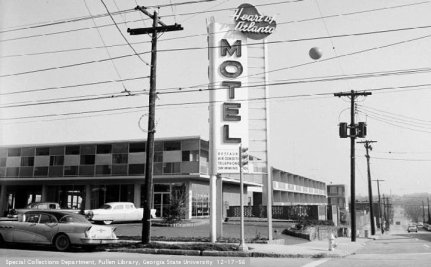
PG posted this photo in one of his collections at Chamblee54:

Heart of Atlanta Motel, 1956 - Special Collections and Archives,Georgia State University Library

Heart of Atlanta Motel, 1956 - Special Collections and Archives,Georgia State University Library

I wondered whether this is the motel in the case testing the 1964 Civil Rights Act — and sure enough, it is.  The case was decided, finally, by the U.S. Supreme Court in 1964, Heart of Atlanta Motel, Inc., v. United States, 379 U.S. 241 (1964) .

This important case represented an immediate challenge to the Civil Rights Act of 1964, the landmark piece of civil rights legislation which represented the first comprehensive act by Congress on civil rights and race relations since the Civil Rights Act of 1875. For much of the 100 years preceding 1964, race relations in the United States had been dominated by segregation, a system of racial separation which, while in name providing for “separate but equal” treatment of both white and black Americans, in truth perpetuated inferior accommodation, services, and treatment for black Americans.

During the mid-20th century, partly as a result of cases such as Powell v. Alabama, 287 U.S. 45 (1932); Smith v. Allwright, 321 U.S. 649 (1944); Shelley v. Kraemer, 334 U.S. 1 (1948); Sweatt v. Painter, 339 U.S. 629 (1950); McLaurin v. Oklahoma State Regents, 339 U.S. 637 (1950); NAACP v. Alabama, 357 U.S. 449 (1958); Boynton v. Virginia, 364 U.S. 454 (1960) and probably the most famous, Brown v. Board of Education of Topeka, 347 U.S. 483 (1954), the tide against segregation began to turn. However, segregation remained in full effect into the 1960s in parts of the southern United States, where the Heart of Atlanta Motel was located, despite these decisions.

The Atlanta Time Machine, a great collection of photos in the history of Atlanta and Georgia, has more photos, and this description of the site:

The Heart of Atlanta motel, located at 255 Courtland Street NE, was owned by Atlanta attorney Moreton Rolleston Jr.  Rolleston, a committed segregationist, refused to rent rooms at his hotel to black customers.  Upon passage of the Civil Rights Act of 1964, Rolleston immediately filed suit in federal court to assert that the law was the result of an overly broad interpretation of the U.S. Constitution’s commerce clause.  Rolleston represented himself in the case, HEART OF ATLANTA MOTEL, INC. v. UNITED STATES ET AL., which  went all the way to the United States Supreme Court.  Rolleston lost when the Supreme Court ruled that Congress was well within its powers to regulate interstate commerce in such a manner.  The Hilton Hotel now stands on the former site of the Heart of Atlanta Motel.

Texts in law school rarely have illustrations.  I know the motel mostly as a citation on pages of text, great grey oceans of somnambulent text.  This case is important in civil rights, though it is mentioned almost never in history texts.  What are these cases really about?  These photos offer us insight.

The Heart of Atlanta Motel aspired to greatness in the late 1950s and 1960s — evidenced by this publicity flyer photo from the Atlanta Time Machine; notice the flag flying for the motel’s Seahorse Lounge (Atlanta is landlocked):

Heart of Atlanta Motel publicity photo - Atlanta Time Machine

Heart of Atlanta Motel publicity photo - Atlanta Time Machine; not just a podunk "motor lodge," but a "resort motel." Click for larger image.

For the 1960s, this place offered great amenities, including two swimming pools and in-room breakfast service.

Flyer for the Heart of Atlanta Motel, circa 1960 - Atlanta Time Machine image

Flyer for the Heart of Atlanta Motel, circa 1960 - Atlanta Time Machine image

This photo is amusing — I can just imagine the difficulties of launching a motor boat of this size in one of the swimming pools, obviously for a publicity stunt.  The photo is dated February 27, 1960, in the Pullen Library Collection.

Boat in the pool at the Heart of Atlanta Motel, 1960 - Atlanta Time Machine image

Boat in the pool at the Heart of Atlanta Motel, 1960 - Atlanta Time Machine image

To compare how times have changed, you may want to look at this aerial photo of the area, including the Heart of Atlanta Hotel, and compare it with modern photos which show the Hilton Hotel that replaced the property.

Rolleston appears to have had a big ego.  As noted above, he represented himself in this case, and he argued it in the Supreme Court.  Here’s a picture from about that time, from the University of Missouri-Kansas City Law School “Famous Trials” site:

Moreton Rolleston, Jr., owner of the Heart of Atlanta Motel and the attorney who argued the case at the Supreme Court - UMKC Law School image

Moreton Rolleston, Jr., owner of the Heart of Atlanta Motel and the attorney who argued the case at the Supreme Court - UMKC Law School image; photo: Wayne Wilson/Leviton-Atlanta

You may decide for yourself whether this fits the old legal aphorism that a lawyer who represents himself in a case has a fool for a client.  The Oyez site at the University of Chicago provides access to the audio of the oral arguments.  Did Rolleston argue ably?  Rolleston argued against Archibald Cox, who went on to fame in the Watergate scandals.  This appears to have been Rolleston’s only appearance before the Supreme Court; it was Cox’s ninth appearance (he argued 20 cases before the Court in his career, several well known and notable ones).

Heart of Atlanta vs. United States was argued on October 5, 1964.  The opinion was issued on December 14, 1964, a 9-0 decision against Rolleston and segregation authored by Justice Tom C. Clark (one of Dallas’s earliest Eagle Scouts).

This was a fight Mr. Rolleston picked.  He was not cited nor indicted for violation of the Civil Rights Act, but instead asked for an injunction to prevent the law’s enforcement; according to the published decision,

Appellant, the owner of a large motel in Atlanta, Georgia, which restricts its clientele to white persons, three-fourths of whom are transient interstate travelers, sued for declaratory relief and to enjoin enforcement of the Civil Rights Act of 1964, contending that the prohibition of racial discrimination in places of public accommodation affecting commerce exceeded Congress’ powers under the Commerce Clause and violated other parts of the Constitution. A three-judge District Court upheld the constitutionality of Title II, §§ 201(a), (b)(1) and (c)(1), the provisions attacked, and, on appellees’ counterclaim, permanently enjoined appellant from refusing to accommodate Negro guests for racial reasons.

Oyez summarizes the case question:

Facts of the Case 

Title II of the Civil Rights Act of 1964 forbade racial discrimination by places of public accommodation if their operations affected commerce. The Heart of Atlanta Motel in Atlanta, Georgia, refused to accept Black Americans and was charged with violating Title II.

Question 

Did Congress, in passing Title II of the 1964 Civil Rights Act, exceed its Commerce Clause powers by depriving motels, such as the Heart of Atlanta, of the right to choose their own customers?

The decision turned on the commerce clause, and the reach of Congressional power to regulate interstate commerce.

Decision: 9 votes for U.S., 0 vote(s) against
Legal provision: Civil Rights Act of 1964, Title II

The Court held that the Commerce Clause allowed Congress to regulate local incidents of commerce, and that the Civil Right Act of 1964 passed constitutional muster. The Court noted that the applicability of Title II was “carefully limited to enterprises having a direct and substantial relation to the interstate flow of goods and people. . .” The Court thus concluded that places of public accommodation had no “right” to select guests as they saw fit, free from governmental regulation.

Good decision.

Heart of Atlanta Motel is gone.  The site is occupied by the Hilton Atlanta, today.


Kids Bill of Rights

November 18, 2011

Kids write and sing about the Bill of Rights — captured on video by the folks at EmergentOrder.com (the producers of the second Keynes/Hayek video).

How close to right are they?  Can you use this in class?

Can your kids improve on this, or do something like it?


Strike a blow for freedom and the Constitution: Read a banned book!

September 26, 2011

John Maunu reminded me this week is Banned Books Week.  Details from the American Library Association:

Banned Books Week 2011

September 24−October 1, 2011

Banned Books Week (BBW) is an annual event celebrating the freedom to read and the importance of the First Amendment.  Held during the last week of September, Banned Books Week highlights the benefits of free and open access to information while drawing attention to the harms of censorship by spotlighting actual or attempted bannings of books across the United States.

Intellectual freedom—the freedom to access information and express ideas, even if the information and ideas might be considered unorthodox or unpopular—provides the foundation for Banned Books Week.  BBW stresses the importance of ensuring the availability of unorthodox or unpopular viewpoints for all who wish to read and access them.

The books featured during Banned Books Week have been targets of attempted bannings.  Fortunately, while some books were banned or restricted, in a majority of cases the books were not banned, all thanks to the efforts of librarians, teachers, booksellers, and members of the community to retain the books in the library collections.  Imagine how many more books might be challenged—and possibly banned or restricted—if librarians, teachers, and booksellers across the country did not use Banned Books Week each year to teach the importance of our First Amendment rights and the power of literature, and to draw attention to the danger that exists when restraints are imposed on the availability of information in a free society.

Banned Books Week is sponsored by the American Booksellers Association; American Booksellers Foundation for Free Expression; the American Library Association; American Society of Journalists and Authors; Association of American Publishers; and the National Association of College Stores.  It is endorsed by the Center for the Book in the Library of Congress. In 2011, the Comic Book Legal Defense Fund; National Coalition Against Censorship; National Council of Teachers of English; and PEN American Center also signed on as sponsors.

For more information on getting involved with Banned Books Week: Celebrating the Freedom to Read, please see Calendar of Events, Ideas and Resources, and the new Banned Books Week site. You can also contact the ALA Office for Intellectual Freedom at 1-800-545-2433, ext. 4220, or bbw@ala.org.


That flag you flew yesterday — want to burn it today?

July 5, 2011

Some of the more astute students in our high school classes ask questions about everything.  For example, they ask:  “What does the Pledge of Allegiance mean, when it says, ‘ . . . and to the Republic for which it stands?'”

Is the Pledge all that important?  Is the flag all that important?

Maybe.  How would you answer that question, really?

Penn and Teller offer a demonstration:

What do you think?  Did they burn a flag?  Should that sort of performance be legal?

What if Penn and Teller burned a flag in the White House?

An exercise in ambiguity:  A fictional drama about a sleight of hand, illusionary performance.  (Best line:  The answer to the question, “Did you go to law school?”  For the record, yes, I did go to law school.  I’m an amateur clown.)

Did you fly your  flag yesterday?