Flag Day poster from 1917, remembered 96 years later

June 14, 2013

140th US Flag Day poster. 1777-1917. The birthday of the stars and stripes, June 14th, 1917. 'Tis the Star Spangled Banner, oh, long may it wave, o'er the land of the free and the home of the brave!" Library of Congress description: "Poster showing a man raising the American flag, with a minuteman cheering and an eagle flying above." - Wikipedia

140th US Flag Day poster. 1777-1917. The birthday of the stars and stripes, June 14th, 1917. ‘Tis the Star Spangled Banner, oh, long may it wave, o’er the land of the free and the home of the brave!” Library of Congress description: “Poster showing a man raising the American flag, with a Minuteman cheering and an eagle flying above.” – Wikipedia

Details about the poster, from the Library of Congress:


1777-1917: The 140th flag day. The birthday of the stars and stripes, June 14th, 1917. The text continues: ‘Tis the Star Spangled Banner, oh, long may it wave, o’er the land of the free and the home of the brave! President Woodrow Wilson remarked, “this flag, which we honor and under which we serve, is the emblem of our unity, our power, our thought and purpose as a nation. Though silent, it speaks to us of the past, of the men and women who went before us, and of the records they wrote upon it.”

MEDIUM: 1 print (poster) : lithograph, color ; 101 x 65 cm.

CREATED/PUBLISHED: 1917.

NOTES: Forms part of: Willard and Dorothy Straight Collection.

Who was the artist?  Who ordered the printing, and for what specific purpose?  Anyone know? (Still looking for the history of this poster, which has become quite popular in the past two years.)

The Library of Congress sells copies of this poster.

Additional reading in 2013:


Flag Day 2013 – Fly your flag today!

June 14, 2013

Of course, you’re already flying your Stars and Stripes, right?

I’ve been on the road, mostly without internet access; I’m tardy in my reminder.

June 14th marks the anniversary of the resolution passed by the Second Continental Congress in 1777, adopting the Stars and Stripes as the national flag.

Fly your flag today. This is one of the score of dates upon which Congress suggests we fly our flags.

Flag Day 1916, parade in Washington, D.C. - employees of National Geographic Society march - photo by Gilbert Grosvenor

Flag Day 1916, parade in Washington, D.C. – employees of National Geographic Society march – photo by Gilbert Grosvenor

The photo above drips with history. Here’s the description from the National Geographic Society site:

One hundred and fifty National Geographic Society employees march in the Preparedness Parade on Flag Day, June 14, in 1916. With WWI underway in Europe and increasing tensions along the Mexican border, President Woodrow Wilson marched alongside 60,000 participants in the parade, just one event of many around the country intended to rededicate the American people to the ideals of the nation.

Not only the anniversary of the day the flag was adopted by Congress, Flag Day is also the anniversary of President Dwight Eisenhower’s controversial addition of the words “under God” to the Pledge of Allegiance in 1954.

(Text adapted from “:Culture: Allegiance to the Pledge?” June 2006, National Geographic magazine)

The first presidential declaration of Flag Day was 1916, by President Woodrow Wilson. Wilson won re-election the following November with his pledge to keep America out of World War I, but by April of 1917 he would ask for a declaration of war after Germany resumed torpedoing of U.S. ships. The photo shows an America dedicated to peace but closer to war than anyone imagined. Because the suffragettes supported Wilson so strongly, he returned the favor, supporting an amendment to the Constitution to grant women a Constitutional right to vote. The amendment passed Congress with Wilson’s support and was ratified by the states.

The flags of 1916 should have carried 48 stars. New Mexico and Arizona were the 47th and 48th states, Arizona joining the union in 1913. No new states would be added until Alaska and Hawaii in 1959. That 46-year period marked the longest time the U.S. had gone without adding states, until today. No new states have been added since Hawaii, more than 49 years ago. (U.S. history students: Have ever heard of an essay, “Manifest destiny fulfilled?”)

150 employees of the National Geographic Society marched, and as the proud CEO of any organization, Society founder Gilbert H. Grosvenor wanted a photo of his organization’s contribution to the parade. Notice that Grosvenor himself is the photographer.

I wonder if Woodrow Wilson took any photos that day, and where they might be hidden.

History of Flag Day from a larger perspective, from the Library of Congress:

Since 1916, when President Woodrow Wilson issued a presidential proclamation establishing a national Flag Day on June 14, Americans have commemorated the adoption of the Stars and Stripes by celebrating June 14 as Flag Day. Prior to 1916, many localities and a few states had been celebrating the day for years. Congressional legislation designating that date as the national Flag Day was signed into law by President Harry Truman in 1949; the legislation also called upon the president to issue a flag day proclamation every year.

According to legend, in 1776, George Washington commissioned Philadelphia seamstress Betsy Ross to create a flag for the new nation. Scholars debate this legend, but agree that Mrs. Ross most likely knew Washington and sewed flags. To date, there have been twenty-seven official versions of the flag, but the arrangement of the stars varied according to the flag-makers’ preferences until 1912 when President Taft standardized the then-new flag’s forty-eight stars into six rows of eight. The forty-nine-star flag (1959-60), as well as the fifty-star flag, also have standardized star patterns. The current version of the flag dates to July 4, 1960, after Hawaii became the fiftieth state on August 21, 1959.

Fly your flag with pride today.

Elmhurst Flag Day 1939, DuPage County Centennial - Posters From the WPA

Elmhurst flag day, June 18, 1939, Du Page County centennial / Beauparlant.
Chicago, Ill.: WPA Federal Art Project, 1939.
By the People, For the People: Posters from the WPA, 1936-1943

This is an encore post, from June 14, 2009, and other previous Flag Days.

More, and Other Voices:


Flag day June 14? Heck! Fly it all week!

June 11, 2013

“The American Flag”, music by L.S.D. Rees and words by J.B. Dickson, 1862. Music Division, Library of Congress

President Barack Obama proclaimed the week of June 9 through 16 National Flag Week, in anticipation of Flag Day, June 14.

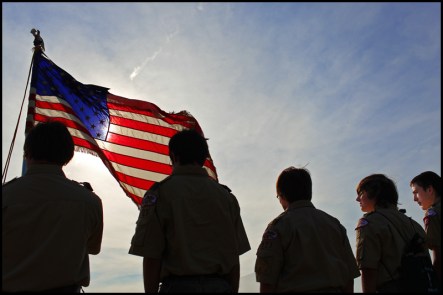
Boy Scouts from Troop 123 stand together during a Flag Day ceremony Thursday, June 14, 2012 at Veterans Memorial Park in Peru, Ill.

Boy Scouts from Troop 123 stand together during a Flag Day ceremony Thursday, June 14, 2012 at Veterans Memorial Park in Peru, Ill. Photo and caption from Reactions

Fly your U.S. flag all week!

Of course, you may fly your state and local flags, too.

June 14 commemorates the day the first resolution was passed designating the stars and stripes as the national flag of the united colonies, June 14, 1777. This is another event occurring even prior to the creation of the United States by the Constitution.

Here’s the proclamation from President Obama:

For Immediate Release

June 07, 2013

Presidential Proclamation — Flag Day and National Flag Week, 2013

FLAG DAY AND NATIONAL FLAG WEEK, 2013

– – – – – – –

BY THE PRESIDENT OF THE UNITED STATES OF AMERICA

A PROCLAMATION

Each June, our Nation lifts its sights to the flag that has watched over us since the days of our founding. In those broad stripes and bright stars, we see the arc of the American story — from a handful of colonies to 50 States, united and free.

When proud patriots took up the fight for independence, they came together under a standard that showed their common cause. When the wounds of civil war were still fresh and our country walked the long road to reconstruction, our people found hope in a banner that testified to the strength of our Union. Wherever our American journey has taken us, whether on that unending path to the mountaintop or high above into the reaches of space, Old Glory has followed, reminding us of the rights and responsibilities we share as citizens.

This week, we celebrate that legacy, and we honor the brave men and women who have secured it through centuries of service at home and abroad. Let us raise our flags high, from small-town storefronts to duty stations stretched around the globe, and let us look to them once more as we press on in the march toward a more perfect Union.

To commemorate the adoption of our flag, the Congress, by joint resolution approved August 3, 1949, as amended (63 Stat. 492), designated June 14 of each year as “Flag Day” and requested that the President issue an annual proclamation calling for its observance and for the display of the flag of the United States on all Federal Government buildings. The Congress also requested, by joint resolution approved June 9, 1966, as amended (80 Stat. 194), that the President annually issue a proclamation designating the week in which June 14 occurs as “National Flag Week” and call upon citizens of the United States to display the flag during that week.

NOW, THEREFORE, I, BARACK OBAMA, President of the United States of America, do hereby proclaim June 14, 2013, as Flag Day and the week beginning June 9, 2013, as National Flag Week. I direct the appropriate officials to display the flag on all Federal Government buildings during that week, and I urge all Americans to observe Flag Day and National Flag Week by displaying the flag. I also call upon the people of the United States to observe with pride and all due ceremony those days from Flag Day through Independence Day, also set aside by the Congress (89 Stat. 211), as a time to honor America, to celebrate our heritage in public gatherings and activities, and to publicly recite the Pledge of Allegiance to the Flag of the United States of America.

IN WITNESS WHEREOF, I have hereunto set my hand this seventh day of June, in the year of our Lord two thousand thirteen, and of the Independence of the United States of America the two hundred and thirty-seventh.

BARACK OBAMA

You may want to read further history of Flag Day and the Wisconsin-born dentist who created and promoted the campaign to commemorate it, Bernard J. CiGrand, at the National Flag Day Foundation site.


Flag Day cartoon  by Joel Mielke in the North Coast Journal, Humboldt, California

Joel Mielke cartoon in the North Coast Journal, Humboldt, California. Each of these flag uses is, technically, a violation of the flag code. Fly your flag on Flag Day; it’s a non-violative, non-offensive way to honor the flag, and our nation.

More:


Flag Day poster from 1917

June 14, 2012

140th US Flag Day poster. 1777-1917. The birthday of the stars and stripes, June 14th, 1917. 'Tis the Star Spangled Banner, oh, long may it wave, o'er the land of the free and the home of the brave!" Library of Congress description: "Poster showing a man raising the American flag, with a minuteman cheering and an eagle flying above." - Wikipedia

140th US Flag Day poster. 1777-1917. The birthday of the stars and stripes, June 14th, 1917. ‘Tis the Star Spangled Banner, oh, long may it wave, o’er the land of the free and the home of the brave!” Library of Congress description: “Poster showing a man raising the American flag, with a Minuteman cheering and an eagle flying above.” – Wikipedia

Details about the poster, from the Library of Congress:


1777-1917: The 140th flag day. The birthday of the stars and stripes, June 14th, 1917. The text continues: ‘Tis the Star Spangled Banner, oh, long may it wave, o’er the land of the free and the home of the brave! President Woodrow Wilson remarked, “this flag, which we honor and under which we serve, is the emblem of our unity, our power, our thought and purpose as a nation. Though silent, it speaks to us of the past, of the men and women who went before us, and of the records they wrote upon it.”

MEDIUM: 1 print (poster) : lithograph, color ; 101 x 65 cm.

CREATED/PUBLISHED: 1917.

NOTES: Forms part of: Willard and Dorothy Straight Collection.

Who was the artist?  Who ordered the printing, and for what specific purpose?  Anyone know?

The Library of Congress sells copies of this poster.


Flag Day 2012 – Fly your flag today!

June 14, 2012

Of course, you’re already flying your Stars and Stripes, right?

I’ve been on the road, mostly without internet access; I’m tardy in my reminder.

June 14th marks the anniversary of the resolution passed by the Second Continental Congress in 1777, adopting the Stars and Stripes as the national flag.

Fly your flag today. This is one of the score of dates upon which Congress suggests we fly our flags.

Flag Day 1916, parade in Washington, D.C. - employees of National Geographic Society march - photo by Gilbert Grosvenor

Flag Day 1916, parade in Washington, D.C. – employees of National Geographic Society march – photo by Gilbert Grosvenor

The photo above drips with history. Here’s the description from the National Geographic Society site:

One hundred and fifty National Geographic Society employees march in the Preparedness Parade on Flag Day, June 14, in 1916. With WWI underway in Europe and increasing tensions along the Mexican border, President Woodrow Wilson marched alongside 60,000 participants in the parade, just one event of many around the country intended to rededicate the American people to the ideals of the nation.

Not only the anniversary of the day the flag was adopted by Congress, Flag Day is also the anniversary of President Dwight Eisenhower’s controversial addition of the words “under God” to the Pledge of Allegiance in 1954.

(Text adapted from “:Culture: Allegiance to the Pledge?” June 2006, National Geographic magazine)

The first presidential declaration of Flag Day was 1916, by President Woodrow Wilson. Wilson won re-election the following November with his pledge to keep America out of World War I, but by April of 1917 he would ask for a declaration of war after Germany resumed torpedoing of U.S. ships. The photo shows an America dedicated to peace but closer to war than anyone imagined. Because the suffragettes supported Wilson so strongly, he returned the favor, supporting an amendment to the Constitution to grant women a Constitutional right to vote. The amendment passed Congress with Wilson’s support and was ratified by the states.

The flags of 1916 should have carried 48 stars. New Mexico and Arizona were the 47th and 48th states, Arizona joining the union in 1913. No new states would be added until Alaska and Hawaii in 1959. That 46-year period marked the longest time the U.S. had gone without adding states, until today. No new states have been added since Hawaii, more than 49 years ago. (U.S. history students: Have ever heard of an essay, “Manifest destiny fulfilled?”)

150 employees of the National Geographic Society marched, and as the proud CEO of any organization, Society founder Gilbert H. Grosvenor wanted a photo of his organization’s contribution to the parade. Notice that Grosvenor himself is the photographer.

I wonder if Woodrow Wilson took any photos that day, and where they might be hidden.

History of Flag Day from a larger perspective, from the Library of Congress:

Since 1916, when President Woodrow Wilson issued a presidential proclamation establishing a national Flag Day on June 14, Americans have commemorated the adoption of the Stars and Stripes by celebrating June 14 as Flag Day. Prior to 1916, many localities and a few states had been celebrating the day for years. Congressional legislation designating that date as the national Flag Day was signed into law by President Harry Truman in 1949; the legislation also called upon the president to issue a flag day proclamation every year.

According to legend, in 1776, George Washington commissioned Philadelphia seamstress Betsy Ross to create a flag for the new nation. Scholars debate this legend, but agree that Mrs. Ross most likely knew Washington and sewed flags. To date, there have been twenty-seven official versions of the flag, but the arrangement of the stars varied according to the flag-makers’ preferences until 1912 when President Taft standardized the then-new flag’s forty-eight stars into six rows of eight. The forty-nine-star flag (1959-60), as well as the fifty-star flag, also have standardized star patterns. The current version of the flag dates to July 4, 1960, after Hawaii became the fiftieth state on August 21, 1959.

Fly your flag with pride today.

Elmhurst Flag Day 1939, DuPage County Centennial - Posters From the WPA

Elmhurst flag day, June 18, 1939, Du Page County centennial / Beauparlant.
Chicago, Ill.: WPA Federal Art Project, 1939.
By the People, For the People: Posters from the WPA, 1936-1943

This is an encore post, from June 14, 2009

More, and Other Voices:


A good reason to send a letter on Flag Day

June 14, 2012

Forever Justice, Equality, Freedom, Liberty stamps - photo by Mary Almanza

A trip to the Post Office turned into a patriotic exercise — photo by Mary Almanza.


Flag Day, 2011: Fly your flag today

June 14, 2011

June 14th marks the anniversary of the resolution passed by the Second Continental Congress in 1777, adopting the Stars and Stripes as the national flag.

Fly your flag today. This is one of the score of dates upon which Congress suggests we fly our flags.

Flag Day 1916, parade in Washington, D.C. - employees of National Geographic Society march - photo by Gilbert Grosvenor

Flag Day 1916, parade in Washington, D.C. - employees of National Geographic Society march - photo by Gilbert Grosvenor

The photo above drips with history. Here’s the description from the National Geographic Society site:

One hundred and fifty National Geographic Society employees march in the Preparedness Parade on Flag Day, June 14, in 1916. With WWI underway in Europe and increasing tensions along the Mexican border, President Woodrow Wilson marched alongside 60,000 participants in the parade, just one event of many around the country intended to rededicate the American people to the ideals of the nation.

Not only the anniversary of the day the flag was adopted by Congress, Flag Day is also the anniversary of President Dwight Eisenhower’s controversial addition of the words “under God” to the Pledge of Allegiance in 1954.

(Text adapted from “:Culture: Allegiance to the Pledge?” June 2006, National Geographic magazine)

The first presidential declaration of Flag Day was 1916, by President Woodrow Wilson. Wilson won re-election the following November with his pledge to keep America out of World War I, but by April of 1917 he would ask for a declaration of war after Germany resumed torpedoing of U.S. ships. The photo shows an America dedicated to peace but closer to war than anyone imagined. Because the suffragettes supported Wilson so strongly, he returned the favor, supporting an amendment to the Constitution to grant women a Constitutional right to vote. The amendment passed Congress with Wilson’s support and was ratified by the states.

The flags of 1916 should have carried 48 stars. New Mexico and Arizona were the 47th and 48th states, Arizona joining the union in 1913. No new states would be added until Alaska and Hawaii in 1959. That 46-year period marked the longest time the U.S. had gone without adding states, until today. No new states have been added since Hawaii, more than 49 years ago. (U.S. history students: Have ever heard of an essay, “Manifest destiny fulfilled?”)

150 employees of the National Geographic Society marched, and as the proud CEO of any organization, Society founder Gilbert H. Grosvenor wanted a photo of his organization’s contribution to the parade. Notice that Grosvenor himself is the photographer.

I wonder if Woodrow Wilson took any photos that day, and where they might be hidden.

History of Flag Day from a larger perspective, from the Library of Congress:

Since 1916, when President Woodrow Wilson issued a presidential proclamation establishing a national Flag Day on June 14, Americans have commemorated the adoption of the Stars and Stripes by celebrating June 14 as Flag Day. Prior to 1916, many localities and a few states had been celebrating the day for years. Congressional legislation designating that date as the national Flag Day was signed into law by President Harry Truman in 1949; the legislation also called upon the president to issue a flag day proclamation every year.

According to legend, in 1776, George Washington commissioned Philadelphia seamstress Betsy Ross to create a flag for the new nation. Scholars debate this legend, but agree that Mrs. Ross most likely knew Washington and sewed flags. To date, there have been twenty-seven official versions of the flag, but the arrangement of the stars varied according to the flag-makers’ preferences until 1912 when President Taft standardized the then-new flag’s forty-eight stars into six rows of eight. The forty-nine-star flag (1959-60), as well as the fifty-star flag, also have standardized star patterns. The current version of the flag dates to July 4, 1960, after Hawaii became the fiftieth state on August 21, 1959.

Fly your flag with pride today.

Elmhurst Flag Day 1939, DuPage County Centennial - Posters From the WPA

Elmhurst Flag Day 1939, DuPage County Centennial - Posters From the WPA

Elmhurst flag day, June 18, 1939, Du Page County centennial / Beauparlant.
Chicago, Ill.: WPA Federal Art Project, 1939.
By the People, For the People: Posters from the WPA, 1936-1943

This is an encore post, from June 14, 2009


Flag Day 2010 – Wave those stars and stripes

June 14, 2010

June 14th marks the anniversary of the resolution passed by the Second Continental Congress in 1777, adopting the Stars and Stripes as the national flag.

Fly your flag today. This is one of the score of dates upon which Congress suggests we fly our flags.

Flag Day 1916, parade in Washington, D.C. - employees of National Geographic Society march - photo by Gilbert Grosvenor

Flag Day 1916, parade in Washington, D.C. - employees of National Geographic Society march - photo by Gilbert Grosvenor

The photo above drips with history. Here’s the description from the National Geographic Society site:

One hundred and fifty National Geographic Society employees march in the Preparedness Parade on Flag Day, June 14, in 1916. With WWI underway in Europe and increasing tensions along the Mexican border, President Woodrow Wilson marched alongside 60,000 participants in the parade, just one event of many around the country intended to rededicate the American people to the ideals of the nation.

Not only the anniversary of the day the flag was adopted by Congress, Flag Day is also the anniversary of President Dwight Eisenhower’s controversial addition of the words “under God” to the Pledge of Allegiance in 1954.

(Text adapted from “:Culture: Allegiance to the Pledge?” June 2006, National Geographic magazine)

The first presidential declaration of Flag Day was 1916, by President Woodrow Wilson. Wilson won re-election the following November with his pledge to keep America out of World War I, but by April of 1917 he would ask for a declaration of war after Germany resumed torpedoing of U.S. ships. The photo shows an America dedicated to peace but closer to war than anyone imagined. Because the suffragettes supported Wilson so strongly, he returned the favor, supporting an amendment to the Constitution to grant women a Constitutional right to vote. The amendment passed Congress with Wilson’s support and was ratified by the states.

The flags of 1916 should have carried 48 stars. New Mexico and Arizona were the 47th and 48th states, Arizona joining the union in 1913. No new states would be added until Alaska and Hawaii in 1959. That 46-year period marked the longest time the U.S. had gone without adding states, until today. No new states have been added since Hawaii, more than 49 years ago. (U.S. history students: Have ever heard of an essay, “Manifest destiny fulfilled?”)

150 employees of the National Geographic Society marched, and as the proud CEO of any organization, Society founder Gilbert H. Grosvenor wanted a photo of his organization’s contribution to the parade. Notice that Grosvenor himself is the photographer.

I wonder if Woodrow Wilson took any photos that day, and where they might be hidden.

History of Flag Day from a larger perspective, from the Library of Congress:

Since 1916, when President Woodrow Wilson issued a presidential proclamation establishing a national Flag Day on June 14, Americans have commemorated the adoption of the Stars and Stripes by celebrating June 14 as Flag Day. Prior to 1916, many localities and a few states had been celebrating the day for years. Congressional legislation designating that date as the national Flag Day was signed into law by President Harry Truman in 1949; the legislation also called upon the president to issue a flag day proclamation every year.

According to legend, in 1776, George Washington commissioned Philadelphia seamstress Betsy Ross to create a flag for the new nation. Scholars debate this legend, but agree that Mrs. Ross most likely knew Washington and sewed flags. To date, there have been twenty-seven official versions of the flag, but the arrangement of the stars varied according to the flag-makers’ preferences until 1912 when President Taft standardized the then-new flag’s forty-eight stars into six rows of eight. The forty-nine-star flag (1959-60), as well as the fifty-star flag, also have standardized star patterns. The current version of the flag dates to July 4, 1960, after Hawaii became the fiftieth state on August 21, 1959.

Fly your flag with pride today.

Elmhurst Flag Day 1939, DuPage County Centennial - Posters From the WPA

Elmhurst Flag Day 1939, DuPage County Centennial - Posters From the WPA

Elmhurst flag day, June 18, 1939, Du Page County centennial / Beauparlant.
Chicago, Ill.: WPA Federal Art Project, 1939.
By the People, For the People: Posters from the WPA, 1936-1943

This is an encore post, from June 14, 2009


1943 – What the First Amendment means when saluting the flag conflicts with religion

June 14, 2009

Historic irony: On Flag Day in 1943, the U.S. Supreme Court issued its decision in the case of West Virginia vs. Barnette.

Billy Gobitis explained why he would not salute the U.S. flag, November 5, 1935 - Library of Congress collection

Image 1 - Billy Gobitas explained why he would not salute the U.S. flag, November 5, 1935 - Library of Congress collection

The case started earlier, in 1935, when a 10-year-old student in West Virginia, sticking to his Jehovah’s Witness principles, refused to salute the U.S. flag in a state-required pledge of allegiance.  From the Library of Congress:

“I do not salute the flag because I have promised to do the will of God,” wrote ten-year-old Billy Gobitas (1925-1989) to the Minersville, Pennsylvania, school board in 1935. His refusal, and that of his sister Lillian (age twelve), touched off one of several constitutional legal cases delineating the tension between the state’s authority to require respect for national symbols and an individual’s right to freedom of speech and religion.

The Gobitas children attended a public school which, as did most public schools at that time, required all students to salute and pledge allegiance to the flag of the United States. The Gobitas children were members of the Jehovah’s Witnesses, a church that in 1935 believed that the ceremonial saluting of a national flag was a form of idolatry, a violation of the commandment in Exodus 20:4-6 that “thou shalt not make unto thee any graven image, nor bow down to them. . . .” and forbidden as well by John 5:21 and Matthew 22:21. On 22 October 1935, Billy Gobitas acted on this belief and refused to participate in the daily flag and pledge ceremony. The next day Lillian Gobitas did the same. In this letter Billy Gobitas in his own hand explained his reasons to the school board, but on 6 November 1935, the directors of the Minersville School District voted to expel the two children for insubordination.

The Watch Tower Society of the Jehovah’s Witnesses sued on behalf of the children. The decisions of both the United States district court and court of appeals was in favor of the right of the children to refuse to salute. But in 1940 the United States Supreme Court by an eight-to-one vote reversed these lower court decisions and ruled that the government had the authority to compel respect for the flag as a key symbol of national unity. Minersville v. Gobitis [a printer’s error has enshrined a misspelling of the Gobitas name in legal records] was not, however, the last legal word on the subject. In 1943 the Supreme Court by a six-to-three vote in West Virginia State Board of Education v. Barnette, another case involving the Jehovah’s Witnesses, reconsidered its decision in Gobitis and held that the right of free speech guaranteed in the First Amendment to the Constitution denies the government the authority to compel the saluting of the American flag or the recitation of the pledge of allegiance.

There had been strong public reaction against the Gobitis decision, which had been written by Justice Felix Frankfurter (1882-1965). In the court term immediately following the decision, Frankfurter noted in his scrapbook that Justice William O. Douglas (1898-1980) told him that Justice Hugo LaFayette Black (1886-1971) had changed his mind about the Gobitis case. Frankfurter asked, “Has Hugo been re-reading the Constitution during the summer?” Douglas replied, “No–he has been reading the papers.”1 The Library’s William Gobitas Papers showcase the perspective of a litigant, whereas the abstract legal considerations raised by Gobitis and other cases are represented in the papers of numerous Supreme Court justices held by the Manuscript Division.

1. Quoted in H. N. Hirsch, The Enigma of Felix Frankfurter (New York: Basic Books, 1981), 152.

John E. Haynes and David Wigdor, Manuscript Division

Second page, Billy Gobitiss explanation of why he will not salute the U.S. flag - Library of Congress

Second page, Billy Gobitas's explanation of why he will not salute the U.S. flag: "I do not salute the flag not because I do not love my country but I love my country and I love God more and I must obey His commandments." - Library of Congress

Supreme Court justices do not often get a chance to reconsider their decisions.  For example, overturning Plessy vs. Ferguson from 1896 took until 1954 in Brown v. Topeka Board of Education. In the flag salute/pledge of allegiance cases Justice Hugo Black had a change of mind, and when a similar case from West Virginia fell on the Court’s doorstep in 1943, the earlier Gobitis decision was reversed.

Writing for the majority, Justice Robert H. Jackson said:

If there is any fixed star in our constitutional constellation, it is that no official, high or petty, can prescribe what shall be orthodox in politics, nationalism, religion, or other matters of opinion, or force citizens to confess by word or act their faith therein. If there are any circumstances which permit an exception, they do not now occur to us.

Jehovah’s Witnesses, and all other Americans, thereby have the right to refuse to say what they and their faith consider to be a vain oath.

And that, boys and girls, is what the First Amendment means.

Resources:


Flag Day, 2009 – Fly your flag today

June 14, 2009

June 14th marks the anniversary of the resolution passed by the Second Continental Congress in 1777, adopting the Stars and Stripes as the national flag.

Fly your flag today.  This is one of the score of dates upon which Congress suggests we fly our flags.

Flag Day 1916, parade in Washington, D.C. - employees of National Geographic Society march - photo by Gilbert Grosvenor

Flag Day 1916, parade in Washington, D.C. - employees of National Geographic Society march - photo by Gilbert Grosvenor

The photo above drips with history.  Here’s the description from the National Geographic Society site:

One hundred and fifty National Geographic Society employees march in the Preparedness Parade on Flag Day, June 14, in 1916. With WWI underway in Europe and increasing tensions along the Mexican border, President Woodrow Wilson marched alongside 60,000 participants in the parade, just one event of many around the country intended to rededicate the American people to the ideals of the nation.

Not only the anniversary of the day the flag was adopted by Congress, Flag Day is also the anniversary of President Dwight Eisenhower’s controversial addition of the words “under God” to the Pledge of Allegiance in 1954.

(Text adapted from “:Culture: Allegiance to the Pledge?” June 2006, National Geographic magazine)

The first presidential declaration of Flag Day was 1916, by President Woodrow Wilson.  Wilson won re-election the following November with his pledge to keep America out of World War I, but by April of 1917 he would ask for a declaration of war after Germany resumed torpedoing of U.S. ships.  The photo shows an America dedicated to peace but closer to war than anyone imagined.  Because the suffragettes supported Wilson so strongly, he returned the favor, supporting an amendment to the Constitution to grant women a Constitutional right to vote.  The amendment passed Congress with Wilson’s support and was ratified by the states.

The flags of 1916 should have carried 48 stars.  New Mexico and Arizona were the 47th and 48th states, Arizona joining the union in 1913.  No new states would be added until Alaska and Hawaii in 1959.  That 46-year period marked the longest time the U.S. had gone without adding states, until today.  No new states have been added since Hawaii, more than 49 years ago.  (U.S. history students:  Have ever heard of an essay, “Manifest destiny fulfilled?”)

150 employees of the National Geographic Society marched, and as the proud CEO of any organization, Society founder Gilbert H. Grosvenor wanted a photo of his organization’s contribution to the parade.  Notice that Grosvenor himself is the photographer.

I wonder if Woodrow Wilson took any photos that day, and where they might be hidden.

History of Flag Day from a larger perspective, from the Library of Congress:

Since 1916, when President Woodrow Wilson issued a presidential proclamation establishing a national Flag Day on June 14, Americans have commemorated the adoption of the Stars and Stripes by celebrating June 14 as Flag Day. Prior to 1916, many localities and a few states had been celebrating the day for years. Congressional legislation designating that date as the national Flag Day was signed into law by President Harry Truman in 1949; the legislation also called upon the president to issue a flag day proclamation every year.

According to legend, in 1776, George Washington commissioned Philadelphia seamstress Betsy Ross to create a flag for the new nation. Scholars debate this legend, but agree that Mrs. Ross most likely knew Washington and sewed flags. To date, there have been twenty-seven official versions of the flag, but the arrangement of the stars varied according to the flag-makers’ preferences until 1912 when President Taft standardized the then-new flag’s forty-eight stars into six rows of eight. The forty-nine-star flag (1959-60), as well as the fifty-star flag, also have standardized star patterns. The current version of the flag dates to July 4, 1960, after Hawaii became the fiftieth state on August 21, 1959.

Fly your flag with pride today.

Elmhurst Flag Day 1939, DuPage County Centennial - Posters From the WPA

Elmhurst Flag Day 1939, DuPage County Centennial - Posters From the WPA

Elmhurst flag day, June 18, 1939, Du Page County centennial / Beauparlant.
Chicago, Ill.: WPA Federal Art Project, 1939.
By the People, For the People: Posters from the WPA, 1936-1943