The socks. Just look at the socks.

18 USC Sec. 713 , governing the use of the presidential seal, and others, and Executive Order 11649, governing use of the presidential and vice presidential seals, below the fold.
The socks. Just look at the socks.
18 USC Sec. 713 , governing the use of the presidential seal, and others, and Executive Order 11649, governing use of the presidential and vice presidential seals, below the fold.
 Leave a Comment » |
  Executive Orders, Flag etiquette, Presidents | Tagged: Executive Orders, Flag etiquette, George W. Bush, Presidential Seal |
  Permalink
 Posted by Ed Darrell
D-Day landing taken by Chief Photographer’s Mate (CPHOM) Robert F. Sargent of the United States Coast Guard (USCG) Greatest Generation D-day landing
June 6, 2007, is the 63rd anniversary of D-Day, the massive invasion of Normandy by the U.S., Canada and Britain, Free France and Poland, to start the push toward final defeat of Germany in World War II (more formally known as the Battle of Normandy). Germany’s defeat would come ten months later.
The day is not formally listed by law as a day to fly the U.S. flag. Citizens may fly the flag on any day. Many veterans’ groups urge flying the flag today, especially in honor of the thousands who gave their lives in the invasion.
On the Allied side, 29,000 U.S. soldiers, 5,000 Canadian soldiers, 11,000 United Kingdom soldiers, died between June 6 and August 25, 1944, the formal end of the battle. France lost more than 12,000 civilians in the fight for freedom, too.
2 Comments | D-Day, Flag etiquette, Heroes, History, World War II | Tagged: D-Day, Flag etiquette, Heroes, History, World War II | Permalink
Posted by Ed Darrell

I think these are the last five of the states to have official state pledges for their state flags. If I have missed any, please let me know.
The pledge to the state flag (from Miss. Code Ann., Section 37-13-7(1972)) is:
- “I salute the flag of Mississippi and the sovereign state for which it stands with pride in her history and achievements and with confidence in her future under the guidance of Almighty God.”
“I salute the flag of the State of New Mexico and the Zia symbol of perfect friendship among united cultures.”

I salute the flag of the State of Oklahoma. Its symbols of peace unite all people.
House Concurrent Resolution No. 1034 was approved by the Oklahoma House of Representatives on April 22, by the Senate on May 18, and filed with the Secretary of State on May 19, 1982.
I pledge loyalty and support to the flag and State of South Dakota, land of sunshine, land of infinite variety.
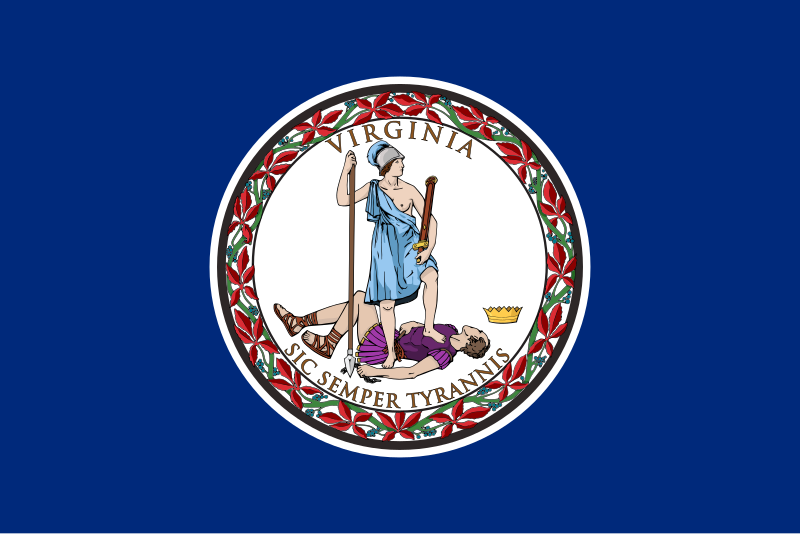
In 1954, the General Assembly adopted an official salute to the flag of Virginia which states:
“I salute the flag of Virginia, with reverence and patriotic devotion to the ‘Mother of States and Statesmen,’ which it represents—the ‘Old Dominion,’ where liberty and independence were born.”
See other related posts:
3 Comments | Flag etiquette, History, Patriotism, Pledge to the flag, State flag | Tagged: Flag etiquette, Mississippi, New Mexico, Oklahoma, Pledge to the flag, South Dakota, Virginia | Permalink
Posted by Ed Darrell
A good guide to flag etiquette from the U.S. Congress is on-line now. Our Flag is a traditional publication Congress passes out in efforts to help education in history and patriotism (H.Doc 108-97).
Interest in proper etiquette for flag display increased recently — not enough by my calculation, but any increase is welcomed. Where is good information available?
This Congressionally-sponsored guide is basic and accurate. As a classroom resource or a piece of a Scout troop library, it’s a useful reference guide. It can be downloaded (it’s a .pdf), and printed out in color (56 pages).
The book includes many illustrations showing proper flag display. It also covers the history of the U.S. flag in good enough detail to get through most high school reports, and it features illustrations of flags of each of the states.
Congress in the past provided many publications on such topics for general public consumption and use in classrooms, but has cut back on free distribution of printed information since the early 1980s. One might be able to get a printed copy with a request to one’s local Member of the House of Representatives, or U.S. Senator.
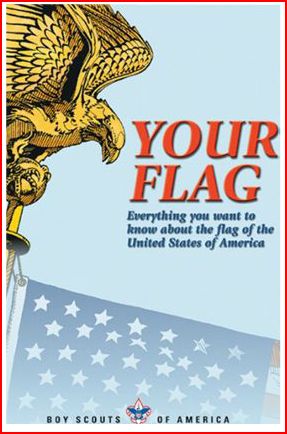
Boy Scouts of America version of the flag etiquette guide, Your Flag
Another book I’ve found very useful is an official Boys Scouts of America publication of the almost the same name, Your Flag. It’s a graphic-novel type of publication — cartoons for every point to be made. It features deeper information on proper flag display. The book can be purchased at any local Boy Scout Council supply shop, or any other shop that stocks Scout literature. It can also be ordered from BSA’s national catalog, or online at Scoutstuff.org, for $7.9910.99plus shipping. Every Scout troop should have one of these, and it is also very useful for classroom libraries, for history and civics.
In either publication, one learns that there are not many ways to display a flag properly from a vehicle — improper displays include decals on windows, bumper stickers, flying them from the radio antenna, or attaching them to a window pole to be battered in freeway-speed winds.
One might hope these books get much broader circulation.
22 Comments | Accuracy, Boy Scouts of America, Flag etiquette, Patriotism | Tagged: Accuracy, Boy Scouts of America, Flag etiquette, History, Patriotism, U.S. Flag | Permalink
Posted by Ed Darrell
I am guilty. I made a bit of an assumption that state flag pledges are rare. There were none in Idaho, or Utah, where I attended public schools. Maryland made no fuss about one while we were there. In most conversations when the issue of a state pledge comes up, people tell their shock at discovering there was such a thing for Texas, and that Texans actually say it from time to time.
Only Georgia bothered to send in correcting information.
But a search of Google finally managed to strike something, having got just the right combination of terms. Below the fold are the state flag pledges for Arkansas, Kentucky, Louisiana, Ohio and South Dakota. I note that the years of adoption are recent — some sort of competition between state legislatures with too little to do? — which leads me to suspect that there may be more state pledges out there, but they are just showing up in the civics and history books.
How many more state pledges are out there? Got something to add? Read the rest of this entry »
4 Comments | Flag etiquette, Patriotism, Pledge to the flag, State flag | Tagged: Flag etiquette, Patriotism, State flag, state pledge of allegiance | Permalink
Posted by Ed Darrell
[Sad, but the Las Vegas Review-Journal appears to have taken down this story and photo] Photo by John Gurzinski from the Las Vegas Review-Journal: Inside Thunderbirds Hangar at Nellis AFB, Airman 1st Class Michael Thayer, left, and Senior Airman David Prye demonstrate how to fold a U.S. flag.Inside the Thunderbirds Hangar at Nellis AFB, Airman 1st Class Michael Thayer, left, and Senior Airman David Prye demonstrate how to fold a U.S. flag. Photo by John Gurzinski, Las Vegas Review-Journal [Replacement photo]


Airman First Class Michael D’Ancona and Senior Airman Assad Pharr demonstrated how to properly fold an American flag during a special visit to Robbins Lane Elementary School in Syosset on May 23. (Syosset-Jericho Tribune, June 19, 2014; photo added here October 2014)
How did I miss this? The Las Vegas (Nevada) Review-Journal carried a story on July 4, 2006, on the Air Force’s efforts to replace the old, unofficial and misleading flag folding ceremony, with a new one. It has the script for the new ceremony.
The newspaper said:
Capt. Isham Barrett, Air Force action officer on Honor Guard policy, said the new script was developed because reference to the flag in the U.S. code “does not associate anything with any fold of the flag.”
“We don’t want to force a belief on somebody,” he said.
Barrett said the decision to develop a standardized script wasn’t prompted by someone complaining about religious connotations. “We can’t find anything in our files with regard to complaints,” he said.
Nevertheless, Christopher J. Andersen, an Army sergeant and member of the Military Association of Atheists and Freethinkers, wrote a letter in 2003, asking the U.S. Air Force Academy to remove the unofficial script from its Web site.
“In order to ensure this religious flag-folding ceremony is not portrayed as an official, government-sponsored flag-folding ceremony, I ask you to remove it from your .gov site,” wrote Andersen.
Andersen, who could not be reached last week, noted in his letter that the Air Force Academy removed the old script from its Web site after he complained.
Air Force leaders later set out to develop a script based on history rather than one that could be interpreted as contrary to the Establishment Clause of the First Amendment of the U.S. Constitution: “Congress shall make no law respecting an establishment of religion.”
Combined with the Free Exercise Clause — “or prohibiting the free exercise thereof” — they prohibit endorsement of a national religion or a preference for one over another. They also preclude dominance of religion over nonreligious philosophies, according to a 1994 Supreme Court majority opinion.
The new standardized script based on history was approved by Air Force leaders in July 2005 and first appeared in revised Honor Guard protocol manuals in January.
Three cheers for the Air Force (yes, I’m biased, for family reasons).
Tip of the old scrub brush to Linda Case.
Update October 22, 2014: The new, Air Force-approved script for a flag folding ceremony is at the Betsy Ross site. Use it in good patriotic spirit, and in the spirit of accurate history.
9 Comments | Accuracy, Flag etiquette, History, Patriotism | Tagged: Accuracy, Flag etiquette, History, Patriotism, US Air Force | Permalink
Posted by Ed Darrell

Archibald M. Willard, “The Spirit of ’76,” one of the best-recognized icons of American patriotism; courtesy of the American Reserve Society Sons of the American Revolution (of which Willard was a member); Library of Congress data: “Yankee doodle 1776 “/ A.M. Willard. Creator(s): Clay, Cosack & Co., lithographer. Related Names: Willard, Archibald M., 1836-1918 , artist Ryder, James F., 1826-1904 , publisher Date Created/Published: Cleveland, Ohio : Pub. by J.F. Ryder, c1876.
Archibald M. Willard, “The Spirit of ’76,” one of the best-recognized icons of American patriotism; courtesy of the American Reserve Society Sons of the American Revolution (of which Willard was a member).
Scouters discuss issues of leadership and skill, a wide-ranging group of topics that pertain to Boy Scouting, on a list-server known as Scouts-L. I subscribe to the discussion, and at times have participated frequently in it. Looking over my own archives, I was amused to see that it was more than a decade ago that I addressed the issue of how to quell any need for a Constitutional Amendment on flag desecration.
The U.S. flag fascinated me from my early childhood. It always strikes me as unique among flags of nations, and I can truly say that I find it stirring to see it in good display. In court, in schools, in the Senate and executive branch of federal government, and in local government, I have had more than my share of occasions to participate in cermonies honoring the flag, or merely sit in contemplation of it during official proceedings. I always reflect on John Peter Zenger’s trial for telling the truth about the King’s governor of New York, and how our flag now means that we can tell the truth about our own government without fear of official reprisal.
I often reflect on the story of Virginia Hewlett, who was a member of the U.S. High Commissioner’s staff in the Philippines when Gen. MacArthur’s forces retreated, and who risked her life in order to strike the U.S. flag and prevent its capture by the Japanese. For this action she and several others were captured, tortured, and endured the war in a prison camp. When she was freed, to her husband and my old friend Frank Hewlett (who was a UPI war correspondent and later a Nieman Fellow and Washington correspondent for the Salt Lake Tribune), she weighed 78 pounds. Read the rest of this entry »
5 Comments | Flag etiquette, History, Patriotism, U.S. Constitution | Tagged: Constitutional Amendment, Flag etiquette, History, Patriotism | Permalink
Posted by Ed Darrell

In times of crisis and turmoil, Americans often turn to patriotic symbols for inspiration. Caption from the National Museum of American History (Smithosonian): Elmira Cornet Band, Civil War The song’s popularity increased enormously during the Civil War. Because the song extolled the national flag—a symbol of loyalty to the Union—Northerners enthusiastically embraced it as a patriotic anthem.
The scientist, science and science fiction writer Isaac Asimov at one time held the title for the most published human being ever. There were few topics he didn’t have a learned opinion on, and there were many areas of ignorance where a well-trained scientist with a drive to get at the facts could shed a lot of light. His path lighting was not always appreciated. He wrote a guide to the Bible that has earned disdain from many a Christian conservative, thought I suspect that their disdain is really a disguise for the fear that a secular Jew could know the text so well and challenge so many unwarranted, but common, assumptions.
To the surprise of some, Asimov was quite a patriot. His short piece on the four stanzas of the “Star-spangled Banner” demonstrate his patriotism and his love of history, while offering a bit of humor to make it all stick in your mind. I post a complete copy below the fold.
I have not yet found the original publication source for Asimov’s piece; if you know it, or find it, please let me know. I suspect there is copyright attribution to be made, too. I borrowed the text from an on-line source called The Purewater Gazette. Read the rest of this entry »
11 Comments | 4th of July, Flag etiquette, History, Patriotism | Tagged: 4th of July, Accuracy, Flag etiquette, History, Isaac Asimov, Jingoism, Patriotism, Star-spangled Banner | Permalink
Posted by Ed Darrell
As a lifelong Boy Scout and Scouter, I have lived with flag etiquette so long as I can remember. One of the key parts of flag etiquette with the U.S. flag is the proper folding, done to allow the flag to unfurl neatly when hoisted on a lanyard. (I have earlier discussed the meaning of folding the flag, or rather, the lack of meaning, here, here, and here.)
Several people wrote to ask about etiquette for folding state flags. Whenever I’ve been involved in ceremonies involving state flags, we have used the same fold prescribed for the U.S. flag, for the same reason — it allows the flags to neatly unfurl when they are posted. I have found several sites that urge a different fold for state flags, to preserve some uniqueness of the U.S. flag folding, but of course, that rather avoids the fact that the method used for the U.S. flag is just old ship tradition.
It seemed likely to me that some state had a special fold, however — and sure enough, I’ve found one. Ohio’s flag is not a rectangle, but is instead a tapered banner with two tails. In 2005, as an Eagle Scout project, Ohio Scout Alex Weinstock from Ohio’s Junction City Troop 260 devised a folding method for Ohio’s flag that ends with with 17 folds — appropriate to Ohio’s being the 17th state admitted to the union.

The fold is not easy — flag professionals call it “tricky.” (See a diagram here, from the Muskingumm Valley Council, BSA, in .pdf.)
Ohio’s flag is the only one of the state flags that is not a rectangle. So far as I have found, it is the only one with any suggested method of folding that differs from the method used for the U.S. flag — but my searches may have missed an odd law here or there.
If you know of other special folding methods, please leave a note in comments, or e-mail me.
23 Comments | Boy Scouts of America, Flag etiquette, History, Patriotism | Tagged: Boy Scouts of America, Flag etiquette, Flag protocol, Folding the flag, History, Ohio, Patriotism | Permalink
Posted by Ed Darrell

Navy caption: SAN DIEGO (April 2, 2007) – Aviation Support Equipment Technician 3rd Class Danny Ly, Storekeeper Seaman Joe Jackson and Electronics Technician Timothy Swartz fold the American flag on the flight deck aboard nuclear-powered aircraft carrier USS Nimitz (CVN 68). Nimitz Carrier Strike Group (CSG), embarked Carrier Air Wing (CVW) 11 and Destroyer Squadron Group (DESRON) 23 are deploying to support operations in U.S. Central Command area of responsibility. U.S. Navy photo by Mass Communication Specialist 2nd Class Jeremiah Sholtis (RELEASED) – Wikimedia image
Earlier I wrote about a flag-folding ceremony that is making the internet rounds. I noted that much of the claimed mythology is, um, ahistoric.
There is no particular meaning attached to folding the flag. Comments noted that the ceremony making the internet rounds is posted at the website of the American Legion. I wrote to the Legion’s public relations department, but have heard nothing back. Generally, the information on flag etiquette at that site is solid. Only the flag-folding ceremony material is not top-notch. I would be happy were the Legion to add a note that the ceremony is a sample ceremony. Several sites mention that the ceremony comes “from the U.S. Air Force Academy.” One site even had a link, but the link was dead. I did find a few sources that explained further. The Air Force Academy web site may have featured a flag-folding ceremony at one point, perhaps even the one being passed around. One of the more popular ceremonies featured had been written by one of the chaplains at USAFA. As happens in the military, someone got concerned about the accuracy of the claims, and the ceremony was pulled. However, Air Force color guards had used the ceremony, and there was demand for something to say during the folding of the U.S. flag, at some ceremonies.
Below the fold, at some length, I reprint the “official” story.
19 Comments | Accuracy, Bad Quotes, Flag etiquette, History, Patriotism | Tagged: Accuracy, Bad Quotes, Flag etiquette, History, Patriotism, USS Nimitz | Permalink
Posted by Ed Darrell
Update, March 24, 2007: Be sure to see the updated flag ceremony, which you can find through this post on the news of the its release.
Yes, the flag amendment is dead, again. Yes, the Fourth of July is past. False history continues to plague the U.S. flag, however. When my wife forwarded to me the post below, it was the fourth time I had gotten it, recently. Bad history travels fast and far. Let’s see if we can steer people in a better direction with real facts.

A flag folding at a funeral for a military person carries great weight, without any script at all. Wikimedia image from DOD release: Members of the U.S. Navy Ceremonial Guard fold the American flag over the casket bearing the remains of sailors killed in the Vietnam War during a graveside interment ceremony at Arlington National Cemetery on May 2, 2013. Lt. Dennis Peterson, from Huntington Park, Calif.; Ensign Donald Frye, from Los Angeles; and Petty Officers 2nd Class William Jackson, from Stockdale, Texas, and Donald McGrane, from Waverly, Iowa, were killed when their SH-3A Sea King helicopter was shot down on July 19, 1967, over Ha Nam Province, North Vietnam. All four crewmembers were assigned to Helicopter Squadron 2.
Here is the post as it came to me each time — I’ve stripped it of the sappy photos that are occasionally added; note that this is mostly whole cloth invention:
Did You Know This About Our Flag
Meaning of Flag Draped Coffin.
All Americans should be given this lesson. Those who think that America is an arrogant nation should really reconsider that thought. Our founding fathers used God’s word and teachings to establish our Great Nation and I think it’s high time Americans get re-educated about this Nation’s history. Pass it along and be proud of the country we live in and even more proud of those who serve to protect our “GOD GIVEN” rights and freedoms.
To understand what the flag draped coffin really means……
28 Comments | 1776, 4th of July, Accuracy, Bogus history, Boy Scouts of America, Flag ceremony, Flag etiquette, Freedom - Political, History, Patriotism | Tagged: 1776, Accuracy, Bogus history, Boy Scouts of America, Flag etiquette, Flag Folding, Flage Ceremony, Fourth of July, History, Hoaxes, Patriotism, U.S. Flag | Permalink
Posted by Ed Darrell


Ed Darrell on Texas's Colorado River


Come on in, the water's fine. Come often: Cleanliness is next to godliness.


