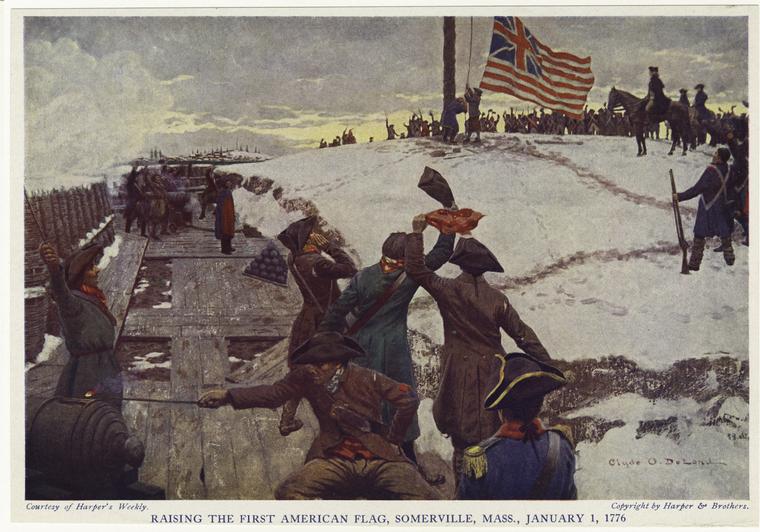
“Raising the first American flag, Somerville, Mass., January 1, 1776.” Harper’s Weekly painting by Clyde Osmer DeLand, 1897. From the digital collections of the New York Public Library; yes, MFB has used this painting before. I like it.
One problem with January’s flag flying dates is that if I snooze a little, you miss a lot. There are four flag-flying dates in the first five days of January: New Year’s Day and statehood days for Georgia, Alaska and Utah. You, Dear Reader, are alert and won’t let any of those dates pass unmarked if you’re in those states, right?
There are more dates to go in January, including New Mexico’s statehood. We’re not halfway done, yet.
President Joe Biden declared flags should fly at half-staff in honor of the late President Jimmy Carter, for 30 days, until January 28. That covers all the dates in the usual flag-flying calendar. When flying flags at half staff, the flag should be hoisted quickly to full staff, then lowered soberly (slowly) to half staff.
In January 2026, the U.S. Flag Code urges citizens to fly flags on these dates, listed chronologically:
New Year’s Day, January 1, a federal holiday
January 2, Georgia Statehood Day
January 3, Alaska Statehood Day
January 4, Utah Statehood Day
January 6, New Mexico Statehood Day
January 9, Connecticut Statehood Day
Martin Luther King’s Birthday, a federal holiday on the third Monday of January; that date is January 19, in 2026; King’s actual birthday is January 15, and you may fly your flag then, too
January 26, Michigan Statehood Day
January 29, Kansas Statehood Day
It will be interesting to some to see whether the White House issues a proclamation to fly the flag on Martin Luther King’s birthday.
You may fly your flag any other day you wish, too; flags should not be flown after sundown unless they are specially lighted, or at one of the few places designated by Congress or Presidential Proclamation for 24-hour flag flying. According to Wikipedia’s listing, those sites include:
Fort McHenry, Baltimore, Maryland (Presidential Proclamation No. 2795, July 2, 1948).
Flag House Square, Albemarle and Pratt Streets, Baltimore, Maryland (Public Law 83-319, approved March 26, 1954).
Lexington Battle Green, Lexington, Massachusetts (Public Law 89-335, approved November 8, 1965).
White House, Washington, D.C. (Presidential Proclamation No. 4000, September 4, 1970).
Washington Monument, Washington, D.C. (Presidential Proclamation No. 4064, July 6, 1971, effective July 4, 1971).
Any port of entry to the United States which is continuously open (Presidential Proclamation No. 413 1, May 5, 1972).
Grounds of the National Memorial Arch in Valley Forge State Park, Valley Forge, Pennsylvania (Public Law 94-53, approved July 4, 1975).
Flag House in 1936, where Mary Pickersgill sewed the garrison-sized, 15-star flag that flew over Fort McHenry at the Battle of Baltimore in 1814; one of the sites where the U.S. flag may be flown 24 hours. The house is at 844 East Pratt & Albemarle Streets (Baltimore, Independent City, Maryland). Cropped image courtesy of the federal HABS—Historic American Buildings Survey of Maryland.
Save
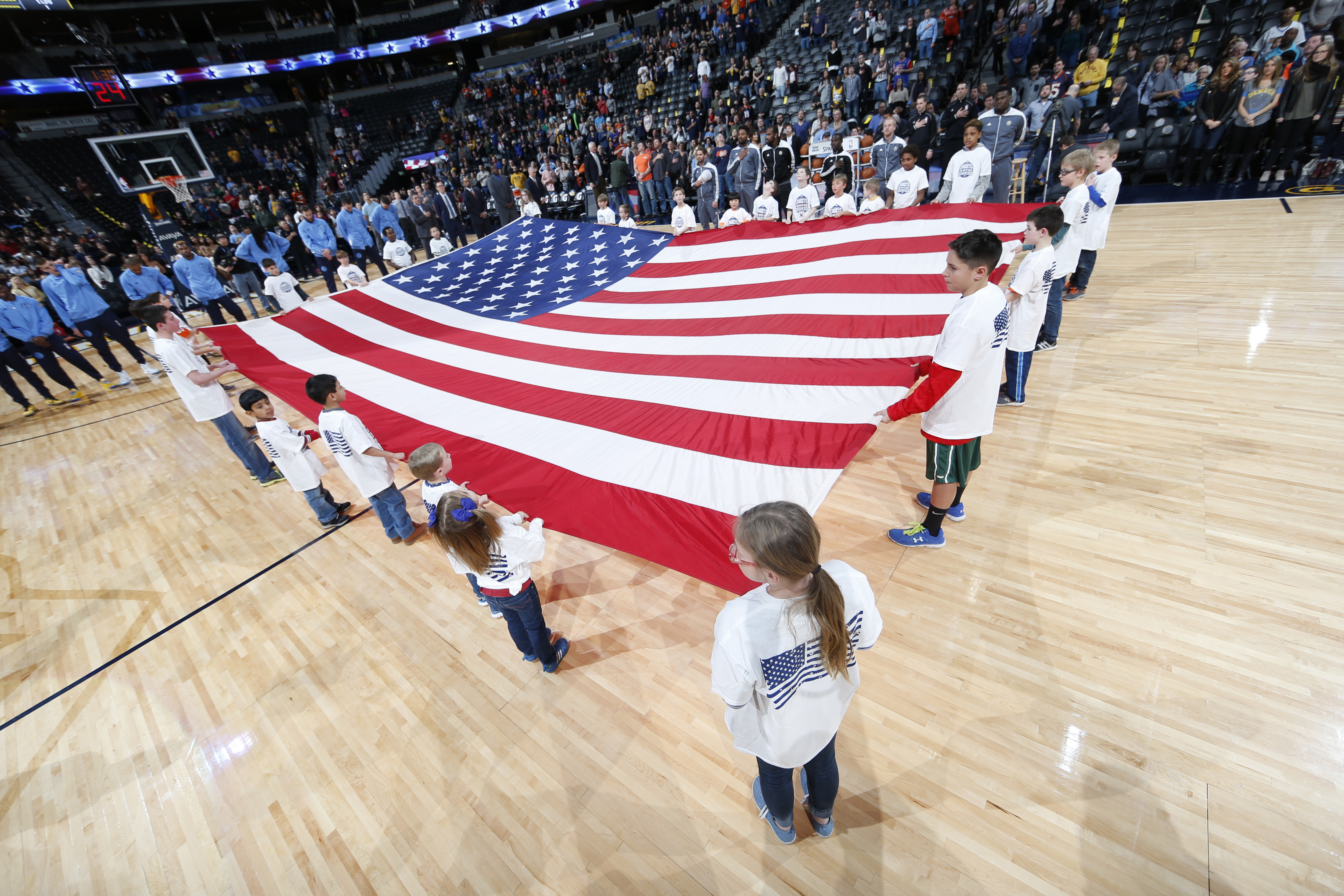
Children unfurl a large flag at a Denver Nuggets/Indiana Pacers NBA basketball game in Denver, January 2016. Colorado Public Radio image.Yes, this is an encore post. Defeating ignorance takes patience and perseverance.
Spread the word; friends don't allow friends to repeat history.
“Raising the first American flag, Somerville, Mass., January 1, 1776.” Harper’s Weekly painting by Clyde Osmer DeLand, 1897. From the digital collections of the New York Public Library; yes, MFB has used this painting before. I like it.
One problem with January’s flag flying dates is that if I snooze a little, you miss a lot. There are four flag-flying dates in the first five days of January: New Year’s Day and statehood days for Georgia, Alaska and Utah. You, Dear Reader, are alert and didn’t let any of those dates pass unmarked if you’re in those states, right?
There are more dates to go in January, including New Mexico’s statehood. We’re not halfway done, yet.
President Joe Biden declared flags should fly at half-staff in honor of the late President Jimmy Carter, for 30 days, until January 28. That covers all the dates in the usual flag-flying calendar. When flying flags at half staff, the flag should be hoisted quickly to full staff, then lowered soberly (slowly) to half staff.
In January 2025, the U.S. Flag Code urges citizens to fly flags on these dates, listed chronologically:
New Year’s Day, January 1, a federal holiday
January 2, Georgia Statehood Day
January 3, Alaska Statehood Day
January 4, Utah Statehood Day
January 6, New Mexico Statehood Day
January 9, Connecticut Statehood Day
Martin Luther King’s Birthday, a federal holiday on the third Monday of January; that date is January 19, in 2025; King’s actual birthday is January 15, and you may fly your flag then, too
Inauguration Day, January 20, the year after election years; 2025 will see an inauguration
January 26, Michigan Statehood Day
January 29, Kansas Statehood Day
You may fly your flag any other day you wish, too; flags should not be flown after sundown unless they are specially lighted, or at one of the few places designated by Congress or Presidential Proclamation for 24-hour flag flying. According to Wikipedia’s listing, those sites include:
Fort McHenry, Baltimore, Maryland (Presidential Proclamation No. 2795, July 2, 1948).
Flag House Square, Albemarle and Pratt Streets, Baltimore, Maryland (Public Law 83-319, approved March 26, 1954).
Lexington Battle Green, Lexington, Massachusetts (Public Law 89-335, approved November 8, 1965).
White House, Washington, D.C. (Presidential Proclamation No. 4000, September 4, 1970).
Washington Monument, Washington, D.C. (Presidential Proclamation No. 4064, July 6, 1971, effective July 4, 1971).
Any port of entry to the United States which is continuously open (Presidential Proclamation No. 413 1, May 5, 1972).
Grounds of the National Memorial Arch in Valley Forge State Park, Valley Forge, Pennsylvania (Public Law 94-53, approved July 4, 1975).
Flag House in 1936, where Mary Pickersgill sewed the garrison-sized, 15-star flag that flew over Fort McHenry at the Battle of Baltimore in 1814; one of the sites where the U.S. flag may be flown 24 hours. The house is at 844 East Pratt & Albemarle Streets (Baltimore, Independent City, Maryland). Cropped image courtesy of the federal HABS—Historic American Buildings Survey of Maryland.
Save
Children unfurl a large flag at a Denver Nuggets/Indiana Pacers NBA basketball game in Denver, January 2016. Colorado Public Radio image.Yes, this is an encore post. Defeating ignorance takes patience and perseverance.
Spread the word; friends don't allow friends to repeat history.
This Veterans Day, we honor the generations of women and men who have served and sacrificed — not for a person, a place, or a President — but for an idea unlike any other: the idea of the United States of America. For nearly 250 years, our veterans have defended the values that make us strong so that our Nation could stand as a citadel of liberty, a beacon of freedom, and a wellspring of possibilities.
Today, I am thinking of all our Nation’s veterans, who put their lives on the line to protect our democracy, values, and freedom around the world. We honor our wounded warriors, so many of whom the First Lady and I have met over the years, who are bound by a common sense of duty, courage, and optimism, and we remember those who are still missing in action or prisoners of war and renew my pledge to bring them home. Our military families, caregivers, and survivors also answer the call to serve. I remember so clearly the pride I felt in our son Beau during his service in Iraq as well as those mornings I saw the First Lady saying a prayer for his safe return. Our veterans and their families give so much to our Nation, and we owe them a debt we can never fully repay.
As a Nation, we have many obligations, but we only have one truly sacred obligation: to prepare and equip the brave women and men we send into harm’s way and to care for them and their loved ones when they return home. Since the beginning of my Administration, we have worked to make good on that promise, passing nearly 30 bipartisan laws to support our veterans and service members and their families, caregivers, and survivors. That includes the PACT Act — the most significant effort in our Nation’s history to help millions of veterans exposed to toxic substances during their military service. Since I signed the PACT Act into law last year, more than 478,000 veterans and survivors are already receiving benefits — ensuring that veterans exposed to burn pits and other harmful substances and their loved ones get access to the care and support they need.
My Administration is also committed to ending veteran suicide and homelessness and ensuring that our veterans have the resources they need to live full lives and thrive in their communities. We released a national strategy to reduce military and veteran suicide by improving lethal means safety and enhancing crisis care as well as by addressing the economic, legal, and mental health issues that impact veterans. The Department of Veterans Affairs is also funding community-led suicide prevention programs, which help connect veterans and their families to needed services. Every veteran deserves a roof over their head, which is why we have taken bold actions to end veteran homelessness, permanently housing more than 40,000 veterans last year and investing $1 billion to provide supportive services to help homeless and at-risk veterans and their families. My Budget also proposes tripling the number of rental-assistance vouchers for extremely low-income veterans to prevent homelessness. Further, we have taken steps to improve the economic security of veterans and their families by expanding job training programs for transitioning veterans and their spouses and issuing rules to protect them from predatory educational institutions. We are also working to ensure every veteran has access to the benefits and services they have earned.
Earlier this year, I signed an Executive Order directing more than 50 actions to improve access to child care and long-term care for Americans, including military and veteran families, and to support family caregivers, especially those who care for our veterans. Recognizing the talents and contributions of veteran and military spouses, caregivers, and survivors to our workforce, I signed an Executive Order establishing the most comprehensive set of administrative actions in our Nation’s history to support their economic security — increasing training and employment opportunities for military spouses in the workforce throughout the transition to veteran spouses status and encouraging all Federal agencies to do more to retain military and veteran spouses through flexible policies. The First Lady’s Joining Forces initiative is further supporting military and veteran families, caregivers, and survivors by improving economic opportunities and expanding resources to promote health and well-being for this community.
As we mark the 50th anniversary of an all-volunteer force and the 75th anniversary of the full integration of women in the Armed Forces and the desegregation of the troops, my Administration reaffirms our commitment to supporting everyone who serves in our Armed Forces. We have taken steps to ensure that the more than 918,000 women veterans enrolled in the Department of Veterans Affairs health care have equitable access to benefits and health services, in part by expanding access to reproductive health care. We have worked to proactively review the military records of veterans discharged under “Don’t Ask, Don’t Tell” and to modernize the process of upgrading discharges to help all veterans access their earned benefits. We will continue to support our LGBTQI+ veterans and veterans of color who have made innumerable contributions to our Nation and have truly made our military stronger, tougher, and more capable.
This Veterans Day, may we honor the incredible faith that our veterans hold, not just in our country but in all of us. They are the solid-steel backbone of our Nation, and we must endeavor to continue being worthy of their sacrifices by working toward a more perfect Union and protecting the freedoms that they have fought to defend.
In respect and recognition of the contributions our veterans and their families, caregivers, and survivors have made to the cause of peace and freedom around the world, the Congress has provided (5 U.S.C. 6103(a)) that November 11 of each year shall be set aside as a legal public holiday to honor our Nation’s veterans.
NOW, THEREFORE, I, JOSEPH R. BIDEN JR., President of the United States of America, do hereby proclaim November 11, 2023, as Veterans Day. I encourage all Americans to recognize the valor, courage, and sacrifice of these patriots through appropriate ceremonies and private prayers and by observing two minutes of silence for our Nation’s veterans. I also call upon Federal, State, and local officials to display the flag of the United States of America and to participate in patriotic activities in their communities.
IN WITNESS WHEREOF, I have hereunto set my hand this seventh day of November, in the year of our Lord two thousand twenty-three, and of the Independence of the United States of America the two hundred and forty-eighth.
JOSEPH R. BIDEN JR.
Spread the word; friends don't allow friends to repeat history.
At Four Mile Historic Park in Glendale, Colorado, Abraham Lincoln actor John Voehl pauses before delivering the Gettysburg Address at a 4th of July celebration (yes, Lincoln delivered the address on November 16; it’s a great statement of the meaning and history of the Declaration of Independence, and probably appropriate for July 4, remembering that the actual independence resolution passed on July 2, 1776 . . .) Denver Post file photo
It’s a day of tradition — oddly enough, since we are in reality a very new nation, and Lee’s resolution to declare independence from Britain came on July 2.
A soak in Millard Fillmore’s Bathtub is nothing if not a steeping in tradition. Fly your flag July 4, or the whole weekend, to celebrate the independence of the American colonies of Britain.
At the White House, traditionally, new citizens are sworn in — often people who joined our armed forces and fought for our nation, before even getting the privileges of citizenship. Fireworks on the Capital Mall will be grand. President Obama’s White House would host a few thousand military people and their families from some of the best views. Traditionally, five photographers, chosen by lottery, get to shoot photos of the fireworks from the windows of the Washington Monument; will that occur, with the Monument open again after repair from the earthquake?
There will be great fireworks also in Baltimore Harbor over Fort McHenry, the fort whose siege inspired Francis Scott Key to write the “Star-spangled Banner” from his boat in the harbor, in 1814. Fireworks will frighten the bluebirds nesting at Yorktown National Battlefield. I suspect there will be a grand display at Gettysburg, on the 154th anniversary of the end of that battle. July 4, 1863, also marked the end of the Siege of Vicksburg; tradition holds that Vicksburg did not celebrate the 4th of July for 83 years after that. I’ll wager there will be fireworks there tonight.
In Provo, Utah, the city poobahs will have done all they can to try to live up to their self-proclaimed reputation as having the biggest Independence Day celebration in the nation. Will the celebration in Prescott, Arizona, still be muted by the tragic deaths of 19 Hot Shot firefighters a few years ago; will drought halt the fireworks, too? There will be fireworks around the Golden Gate Bridge, in Anchorage, Alaska, reflecting on the waters of Pearl Harbor, and probably in Guam, American Samoa, and the Northern Marianas Islands.
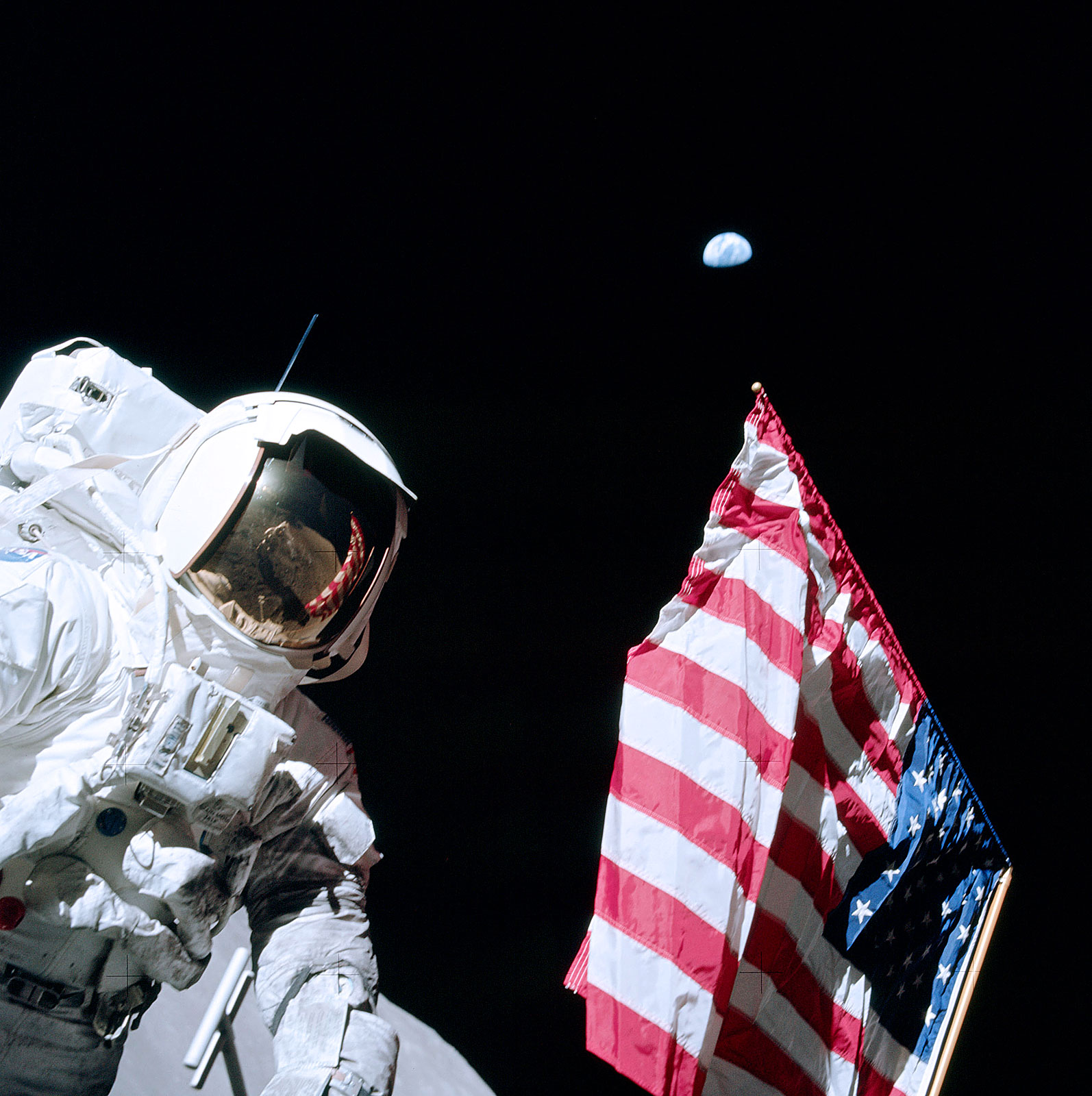
One more way we know the Moon landings were real — the photo below shows the flag from the photo above, still on the Moon.
Lunar Reconnaissance Orbiter photo of the Apollo 17 landing site. NASA caption: Apollo 17 Lunar Module Challenger descent stage comes into focus from the new lower 50 km mapping orbit, image width 102 meters. Credit: NASA/GSFC/Arizona State University
This is mostly an encore post, but I so love that photo of the flag with the Earth in the distance.
Happy birthday, Kathryn!
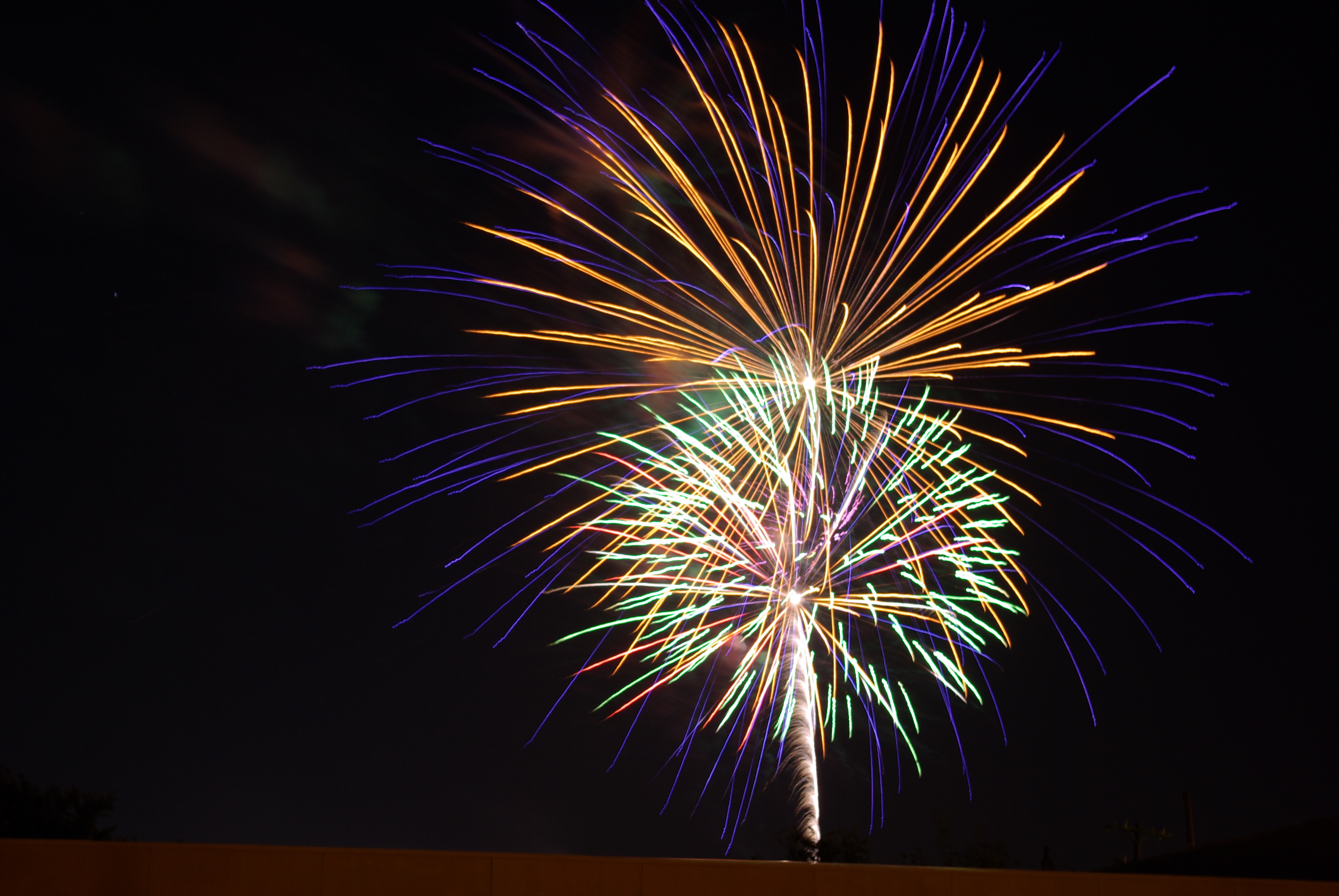
Fireworks in Duncanville, Texas, for July 4 — Kathryn Knowles’s birthday. We’re always happy the town chimes in with the celebratory spirit.
Tip of the old scrub brush to Thomas Jefferson, Richard Henry Lee, John Adams, Benjamin Franklin, Roger Sherman, Robert Livingston, and the cast of thousands of patriots including George Washington.
Save
Spread the word; friends don't allow friends to repeat history.
“Raising the first American flag, Somerville, Mass., January 1, 1776.” Harper’s Weekly painting by Clyde Osmer DeLand, 1897. From the digital collections of the New York Public Library; yes, MFB has used this painting before. I like it.
One problem with January’s flag flying dates is that if I snooze a little, you miss a lot. There are four flag-flying dates in the first five days of January: New Year’s Day and statehood days for Georgia, Alaska and Utah. You, Dear Reader, are alert and didn’t let any of those dates pass unmarked if you’re in those states, right?
There are six more dates to go in January 2021, including New Mexico’s statehood today. We’re not halfway done, yet.
In January 2020, the U.S. Flag Code urges citizens to fly flags on these dates, listed chronologically:
New Year’s Day, January 1, a federal holiday
January 2, Georgia Statehood Day
January 3, Alaska Statehood Day
January 4, Utah Statehood Day
January 6, New Mexico Statehood Day
January 9, Connecticut Statehood Day
Martin Luther King’s Birthday, a federal holiday on the third Monday of January; that date is January 18, in 2021; King’s actual birthday is January 15, and you may fly your flag then, too
Inauguration Day, January 20, the year after election years; 2021 will see the inauguration of President Joseph R. Biden (first President named Joe; what took so long?)
January 26, Michigan Statehood Day
January 29, Kansas Statehood Day
You may fly your flag any other day you wish, too; flags should not be flown after sundown unless they are specially lighted, or at one of the few places designated by Congress or Presidential Proclamation for 24-hour flag flying. According to Wikipedia’s listing, those sites include:
Fort McHenry, Baltimore, Maryland (Presidential Proclamation No. 2795, July 2, 1948).
Flag House Square, Albemarle and Pratt Streets, Baltimore, Maryland (Public Law 83-319, approved March 26, 1954).
Lexington Battle Green, Lexington, Massachusetts (Public Law 89-335, approved November 8, 1965).
White House, Washington, D.C. (Presidential Proclamation No. 4000, September 4, 1970).
Washington Monument, Washington, D.C. (Presidential Proclamation No. 4064, July 6, 1971, effective July 4, 1971).
Any port of entry to the United States which is continuously open (Presidential Proclamation No. 413 1, May 5, 1972).
Grounds of the National Memorial Arch in Valley Forge State Park, Valley Forge, Pennsylvania (Public Law 94-53, approved July 4, 1975).
Flag House in 1936, where Mary Pickersgill sewed the garrison-sized, 15-star flag that flew over Fort McHenry at the Battle of Baltimore in 1814; one of the sites where the U.S. flag may be flown 24 hours. The house is at 844 East Pratt & Albemarle Streets (Baltimore, Independent City, Maryland). Cropped image courtesy of the federal HABS—Historic American Buildings Survey of Maryland.
Save
Children unfurl a large flag at a Denver Nuggets/Indiana Pacers NBA basketball game in Denver, January 2016. Colorado Public Radio image.Yes, this is an encore post. Defeating ignorance takes patience and perseverance.
Spread the word; friends don't allow friends to repeat history.
“Raising the first American flag, Somerville, Mass., January 1, 1776.” Harper’s Weekly painting by Clyde Osmer DeLand, 1897. From the digital collections of the New York Public Library
January is loaded with flag flying dates, when we add in statehood days, dates those states are invited to fly their U.S. flags.
In January 2020, the U.S. Flag Code urges citizens to fly flags on these dates, listed chronologically:
New Year’s Day, January 1, a federal holiday
January 2, Georgia Statehood Day
January 3, Alaska Statehood Day
January 4, Utah Statehood Day
January 6, New Mexico Statehood Day
January 9, Connecticut Statehood Day
Martin Luther King’s Birthday, a federal holiday on the third Monday of January; that date is January 20, in 2020; King’s actual birthday is January 15, and you may fly your flag then, too
Inauguration Day, January 20, the year after election years; 2020 is not an inauguration year; 2021 will be
January 26, Michigan Statehood Day
January 29, Kansas Statehood Day
You may fly your flag any other day you wish, too; flags should not be flown after sundown unless they are specially lighted, or at one of the few places designated by Congress or Presidential Proclamation for 24-hour flag flying. According to Wikipedia’s listing, those sites include:
Fort McHenry, Baltimore, Maryland (Presidential Proclamation No. 2795, July 2, 1948).
Flag House Square, Albemarle and Pratt Streets, Baltimore, Maryland (Public Law 83-319, approved March 26, 1954).
Lexington Battle Green, Lexington, Massachusetts (Public Law 89-335, approved November 8, 1965).
White House, Washington, D.C. (Presidential Proclamation No. 4000, September 4, 1970).
Washington Monument, Washington, D.C. (Presidential Proclamation No. 4064, July 6, 1971, effective July 4, 1971).
Any port of entry to the United States which is continuously open (Presidential Proclamation No. 413 1, May 5, 1972).
Grounds of the National Memorial Arch in Valley Forge State Park, Valley Forge, Pennsylvania (Public Law 94-53, approved July 4, 1975).
Flag House in 1936, where Mary Pickersgill sewed the garrison-sized, 15-star flag that flew over Fort McHenry at the Battle of Baltimore in 1814; one of the sites where the U.S. flag may be flown 24 hours. The house is at 844 East Pratt & Albemarle Streets (Baltimore, Independent City, Maryland). Cropped image courtesy of the federal HABS—Historic American Buildings Survey of Maryland.
Save
Children unfurl a large flag at a Denver Nuggets/Indiana Pacers NBA basketball game in Denver, January 2016. Colorado Public Radio image.Yes, this is an encore post. Defeating ignorance takes patience and perseverance.
Spread the word; friends don't allow friends to repeat history.
Note from the American Flagpole and Flag Company: Congress added another date to fly U.S. flags. From the e-mail:
Fly the United States Flag at Half-Staff on Sunday, October 6, 2019 in Honor of National Fallen Firefighters Memorial Service
The United States Congress created the National Fallen Firefighters Foundation to lead a nationwide effort to remember America’s fallen firefighters. Since 1992, the tax-exempt, nonprofit Foundation has developed and expanded programs to honor our fallen fire heroes and assist their families and coworkers. The 38th National Fallen Firefighters Memorial Service will be held Sunday, October 6, 2019, to honor 92 firefighters who died in the line of duty in 2018 and 27 firefighters who died in the line of duty in previous years.
In accordance to Public Law 107-51, the American flag should be lowered to half-staff on Sunday, October 6, 2019 from sunrise to sunset in observance of National Fallen Firefighters Memorial Service.
The date was added in October 2001, just over a month after the 9/11 attacks on the U.S. President George Bush signed the law. Maybe oddly, the resolution does not specify a fixed or floating date, but instead refers to a National Fallen Firefighters Memorial Service.
Citizens may fly their flags, as government buildings do.
U.S. flag flying from the U.S.S. Constitution: CHARLESTOWN, Mass. (July 4, 2009) USS Constitution, the world’s oldest commissioned warship afloat, returns to her berthing at the Charlestown Navy Yard after firing 21-gun and 19-gun salutes in Boston Harbor during 4th of July celebrations. (U.S. Navy photo by Mass Communication Specialist 1st Class Mark O’Donald/Released)
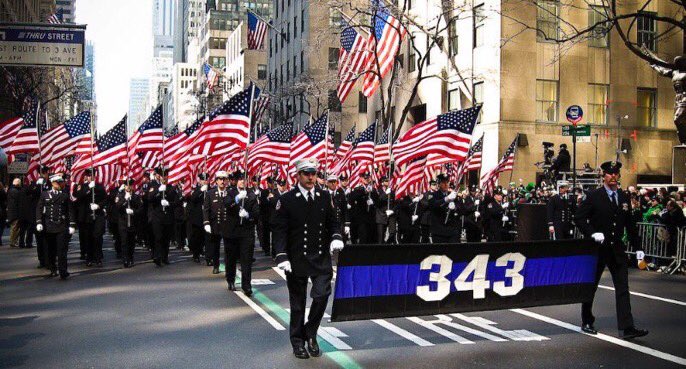
There has been no proclamation from the White House yet, but Sen. Edward Kennedy’s law on remembering the attacks on the U.S. on September 11, 2001, calls for flying the flag at half staff, as well as for acts of service to the community. Both are remembrances of the victims and heroes of 9/11.
From the Twitter feed of Prof. Frank McDonough: A total of 343 New York fire service personnel died trying to save lives on 9/11. (photo uncredited, undated)
Spread the word; friends don't allow friends to repeat history.
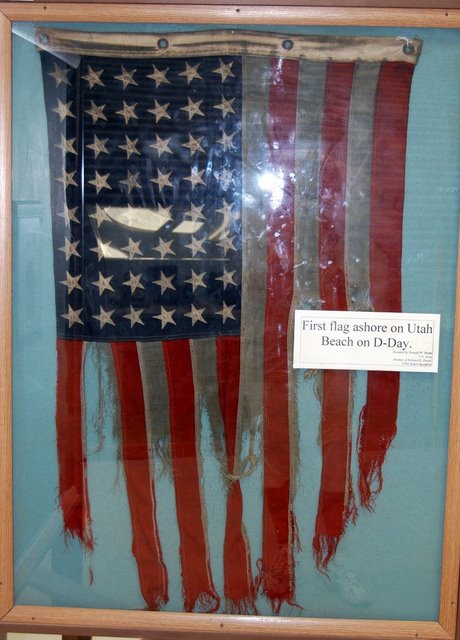
First Flag on Utah Beach, June 6, 1944 – Photo by Mark Wainwright
Today is the 74th anniversary of the Invasion of Normandy in World War II, a date called D-Day. I usually get at least one e-mail request: No, you don’t have to fly your flag. This is not one of the days designated by Congress for flag-flying.
But you may fly your flag, and probably, you should. If there are any D-Day veterans in your town, they’ll appreciate it.
New meaning to “flying the flag”: (Wikipedia caption) A pair of specially painted F-117 Nighthawks fly off from their last refueling by the Ohio National Guard’s 121st Air Refueling Wing. The F-117s were retired March 11 [2008] in a farewell ceremony at Wright-Patterson Air Force Base, Ohio. U.S. Air Force photo/Senior Master Sgt. Kim Frey. This is just a great photo.
Armed Forces Day is the third Saturday in May. This year it falls on May 19.
The U.S. Flag Code designates Armed Forces Day as one day for all Americans to fly their flags, in honor of those men and women presently serving in any of the Armed Forces.
Activities to honor active duty and active reserve forces occur in hundreds of communities across the nation. Check your local papers.
On August 31, 1949, Secretary of Defense Louis Johnson announced the creation of an Armed Forces Day to replace separate Army, Navy and Air Force Days. The single-day celebration stemmed from the unification of the Armed Forces under one department — the Department of Defense. Each of the military leagues and orders was asked to drop sponsorship of its specific service day in order to celebrate the newly announced Armed Forces Day. The Army, Navy and Air Force leagues adopted the newly formed day. The Marine Corps League declined to drop support for Marine Corps Day but supports Armed Forces Day, too.
In a speech announcing the formation of the day, President Truman “praised the work of the military services at home and across the seas” and said, “it is vital to the security of the nation and to the establishment of a desirable peace.” In an excerpt from the Presidential Proclamation of Feb. 27, 1950, Mr. Truman stated:
Armed Forces Day, Saturday, May 20, 1950, marks the first combined demonstration by America’s defense team of its progress, under the National Security Act, towards the goal of readiness for any eventuality. It is the first parade of preparedness by the unified forces of our land, sea, and air defense.
Celebrations like Armed Forces Day offer good opportunities to promote history. I suspect that the day’s coming always in the middle of May suppresses some of the teaching moment value, as teachers make a final push for end of course tests, finals, and in high schools, for graduation — and as many colleges are already out for the summer. Good materials are available that can be sprinkled throughout a course.
President Truman and other dignitaries on the reviewing stand during an Armed Forces Day parade, (left… – NARA – 200222 (Photo credit: Wikipedia) (Is that Eisenhower on the left?) (Update: Yep! From Wikimedia: Left to right, Gen. Dwight D. Eisenhower, Secretary of Defense Louis Johnson, President Truman, Adm. William Leahy.
The first Armed Forces Day came at a time of increased world tensions, political volatility and communist aggression. Some notable events that marked America’s first Armed Forces Week were as follows:
Bolivian police broke up “alleged” revolutionary communist-led general strike in LaPaz.
Two U. S. government buildings in Canton, China were taken over by the Chinese Communist Government. The buildings were U. S. property acquired prior to the Communist takeover.
The Burmese Army recaptured the city of Prome, a strategic communist-rebel stronghold.
Nicaraguans elect General Anastasio Somoza to a regular six-year term as president.
French and West German governments expected to talk shortly on the merger of the coal and steel industries of the two countries.
Communist China lifted the ban on daylight shipping along the Yangtze River due to the decline of Nationalist air activity.
Norway receives first US military aid in the form of two Dakota planes.
U. N. Secretary General Trygive Lie seeks West’s acceptance of Red China in the U. N.
Iran announced close range news broadcasts to the Soviet Union with $56,000 worth of Voice of America equipment.
Cuba celebrated the 48th anniversary of the establishment of its republic.
The Red Cross celebrated its 69th birthday.
Britain ended rationing of all foods except meats, butter, margarine, and cooking fat.
The U. S. Congress voted to extend the draft. “A Bill to extend registration and classification for the Draft until June 24, 1952 passed the House 216-11.”
The Allied Command announced it would “ease” the burden of occupation on Austria and would name civilian high commissioners to replace present military high commissioners.
Soviet authorities in Berlin withdrew travel passes of the U.S. and British military missions stationed at Potsdam in the Soviet zone of occupation.
The Soviets returned 23 East German industrial plants to East German authorities. The plants had been producing exclusively for the benefit of reparations to the USSR.
Twenty-eight Soviet vessels, consisting of tugs, trawlers, and supply ships remained in the English Channel as the Western Alliance prepared for air and naval maneuvers. Observers noted that many of them carried rollers at their sterns for trawling nets although no nets were visible.
Pravda denounced Armed Forces Day, calling it the militarization of the United States. “The hysterical speeches of the warmongers again show the timeliness of the appeal of the Permanent Committee of Peace Partisans that atomic weapons be forbidden.”
Western Powers renewed their promise to help Mid-Eastern states resist communism. They also announced an agreement to sell arms to Israel as well as to the Arabs.
Veterans Day honors veterans of wars, and those who served in the past; Memorial Day honors people who died defending the nation; Armed Forces Day honors those men and women serving today. Service with two wars, in an “all volunteer” military, is a rough go, especially in times of federal budget cuts. Say a good word about active duty military on Saturday, will you?
Baltimore Sun caption: The U.S. flag is reflected in the window of a police car as a police man stands guard in Times Square ahead of New Year’s Eve celebrations in New York, December 31, 2013. Security has been stepped up in the area around where the celebrations will take place. (REUTERS/Carlo Allegri)
Of course you’re flying your flag today, as the U.S. Flag Code recommends.
Is every holiday going to be taken over by flag-waving?
Spread the word; friends don't allow friends to repeat history.
At Four Mile Historic Park in Glendale, Colorado, Abraham Lincoln actor John Voehl pauses before delivering the Gettysburg Address at a 4th of July celebration (yes, Lincoln delivered the address on November 16; it’s a great statement of the meaning and history of the Declaration of Independence, and probably appropriate for July 4, remembering that the actual independence resolution passed on July 2, 1776 . . .) Denver Post file photo
It’s a day of tradition — oddly enough, since we are in reality a very new nation, and Lee’s resolution to declare independence from Britain came on July 2.
A soak in Millard Fillmore’s Bathtub is nothing if not a steeping in tradition. Fly your flag today, to celebrate the independence of the American colonies of Britain.
At the White House, traditionally, new citizens are sworn in — often people who joined our armed forces and fought for our nation, before even getting the privileges of citizenship. Fireworks on the Capital Mall will be grand. President Obama’s White House would host a few thousand military people and their families from some of the best views. Traditionally, five photographers, chosen by lottery, get to shoot photos of the fireworks from the windows of the Washington Monument; will that occur, with the Monument open again after repair from the earthquake?
There will be great fireworks also in Baltimore Harbor over Fort McHenry, the fort whose siege inspired Francis Scott Key to write the “Star-spangled Banner” from his boat in the harbor, in 1814. Fireworks will frighten the bluebirds nesting at Yorktown National Battlefield. I suspect there will be a grand display at Gettysburg, on the 154th anniversary of the end of that battle. July 4, 1863, also marked the end of the Siege of Vicksburg; tradition holds that Vicksburg did not celebrate the 4th of July for 83 years after that. I’ll wager there will be fireworks there tonight.
In Provo, Utah, the city poobahs will have done all they can to try to live up to their self-proclaimed reputation as having the biggest Independence Day celebration in the nation. Will the celebration in Prescott, Arizona, still be muted by the tragic deaths of 19 Hot Shot firefighters a few years ago; will drought halt the fireworks, too? There will be fireworks around the Golden Gate Bridge, in Anchorage, Alaska, reflecting on the waters of Pearl Harbor, and probably in Guam, American Samoa, and the Northern Marianas Islands.
One more way we know the Moon landings were real — the photo below shows the flag from the photo above, still on the Moon.
Lunar Reconnaissance Orbiter photo of the Apollo 17 landing site. NASA caption: Apollo 17 Lunar Module Challenger descent stage comes into focus from the new lower 50 km mapping orbit, image width 102 meters. Credit: NASA/GSFC/Arizona State University
This is mostly an encore post, but I so love that photo of the flag with the Earth in the distance.
Happy birthday, Kathryn!
Fireworks in Duncanville, Texas, for July 4 — Kathryn Knowles’s birthday. We’re always happy the town chimes in with the celebratory spirit.
Tip of the old scrub brush to Thomas Jefferson, Richard Henry Lee, John Adams, Benjamin Franklin, Roger Sherman, Robert Livingston, and the cast of thousands of patriots including George Washington.
New meaning to “flying the flag”: (Wikipedia caption) A pair of specially painted F-117 Nighthawks fly off from their last refueling by the Ohio National Guard’s 121st Air Refueling Wing. The F-117s were retired March 11 [2008] in a farewell ceremony at Wright-Patterson Air Force Base, Ohio. U.S. Air Force photo/Senior Master Sgt. Kim Frey
Armed Forces Day is the third Saturday in May. This year it falls on May 20.
The U.S. Flag Code designates Armed Forces Day as one day for all Americans to fly their flags, in honor of those men and women presently serving in any of the Armed Forces.
Activities to honor active duty and active reserve forces occur in hundreds of communities across the nation. Check your local papers.
On August 31, 1949, Secretary of Defense Louis Johnson announced the creation of an Armed Forces Day to replace separate Army, Navy and Air Force Days. The single-day celebration stemmed from the unification of the Armed Forces under one department — the Department of Defense. Each of the military leagues and orders was asked to drop sponsorship of its specific service day in order to celebrate the newly announced Armed Forces Day. The Army, Navy and Air Force leagues adopted the newly formed day. The Marine Corps League declined to drop support for Marine Corps Day but supports Armed Forces Day, too.
In a speech announcing the formation of the day, President Truman “praised the work of the military services at home and across the seas” and said, “it is vital to the security of the nation and to the establishment of a desirable peace.” In an excerpt from the Presidential Proclamation of Feb. 27, 1950, Mr. Truman stated:
Armed Forces Day, Saturday, May 20, 1950, marks the first combined demonstration by America’s defense team of its progress, under the National Security Act, towards the goal of readiness for any eventuality. It is the first parade of preparedness by the unified forces of our land, sea, and air defense.
Celebrations like Armed Forces Day offer good opportunities to promote history. I suspect that the day’s coming always in the middle of May suppresses some of the teaching moment value, as teachers make a final push for end of course tests, finals, and in high schools, for graduation — and as many colleges are already out for the summer. Good materials are available that can be sprinkled throughout a course.
President Truman and other dignitaries on the reviewing stand during an Armed Forces Day parade, (left… – NARA – 200222 (Photo credit: Wikipedia) (Is that Eisenhower on the left?) (Update: Yep! From Wikimedia: Left to right, Gen. Dwight D. Eisenhower, Secretary of Defense Louis Johnson, President Truman, Adm. William Leahy.
The first Armed Forces Day came at a time of increased world tensions, political volatility and communist aggression. Some notable events that marked America’s first Armed Forces Week were as follows:
Bolivian police broke up “alleged” revolutionary communist-led general strike in LaPaz.
Two U. S. government buildings in Canton, China were taken over by the Chinese Communist Government. The buildings were U. S. property acquired prior to the Communist takeover.
The Burmese Army recaptured the city of Prome, a strategic communist-rebel stronghold.
Nicaraguans elect General Anastasio Somoza to a regular six-year term as president.
French and West German governments expected to talk shortly on the merger of the coal and steel industries of the two countries.
Communist China lifted the ban on daylight shipping along the Yangtze River due to the decline of Nationalist air activity.
Norway receives first US military aid in the form of two Dakota planes.
U. N. Secretary General Trygive Lie seeks West’s acceptance of Red China in the U. N.
Iran announced close range news broadcasts to the Soviet Union with $56,000 worth of Voice of America equipment.
Cuba celebrated the 48th anniversary of the establishment of its republic.
The Red Cross celebrated its 69th birthday.
Britain ended rationing of all foods except meats, butter, margarine, and cooking fat.
The U. S. Congress voted to extend the draft. “A Bill to extend registration and classification for the Draft until June 24, 1952 passed the House 216-11.”
The Allied Command announced it would “ease” the burden of occupation on Austria and would name civilian high commissioners to replace present military high commissioners.
Soviet authorities in Berlin withdrew travel passes of the U.S. and British military missions stationed at Potsdam in the Soviet zone of occupation.
The Soviets returned 23 East German industrial plants to East German authorities. The plants had been producing exclusively for the benefit of reparations to the USSR.
Twenty-eight Soviet vessels, consisting of tugs, trawlers, and supply ships remained in the English Channel as the Western Alliance prepared for air and naval maneuvers. Observers noted that many of them carried rollers at their sterns for trawling nets although no nets were visible.
Pravda denounced Armed Forces Day, calling it the militarization of the United States. “The hysterical speeches of the warmongers again show the timeliness of the appeal of the Permanent Committee of Peace Partisans that atomic weapons be forbidden.”
Western Powers renewed their promise to help Mid-Eastern states resist communism. They also announced an agreement to sell arms to Israel as well as to the Arabs.
Veterans Day honors veterans of wars, and those who served in the past; Memorial Day honors people who died defending the nation; Armed Forces Day honors those men and women serving today. Service with two wars, in an “all volunteer” military, is a rough go, especially in times of federal budget cuts. Say a good word about active duty military on Saturday, will you?
Or, until that account is unsuspended by the forces supporting Donald Trump: Follow @FillmoreWhite, the account of the Millard Fillmore White House Library
We've been soaking in the Bathtub for several months, long enough that some of the links we've used have gone to the Great Internet in the Sky.
If you find a dead link, please leave a comment to that post, and tell us what link has expired.
Thanks!
Retired teacher of law, economics, history, AP government, psychology and science. Former speechwriter, press guy and legislative aide in U.S. Senate. Former Department of Education. Former airline real estate, telecom towers, Big 6 (that old!) consultant. Lab and field research in air pollution control.
My blog, Millard Fillmore's Bathtub, is a continuing experiment to test how to use blogs to improve and speed up learning processes for students, perhaps by making some of the courses actually interesting. It is a blog for teachers, to see if we can use blogs. It is for people interested in social studies and social studies education, to see if we can learn to get it right. It's a blog for science fans, to promote good science and good science policy. It's a blog for people interested in good government and how to achieve it.
BS in Mass Communication, University of Utah
Graduate study in Rhetoric and Speech Communication, University of Arizona
JD from the National Law Center, George Washington University




 Posted by Ed Darrell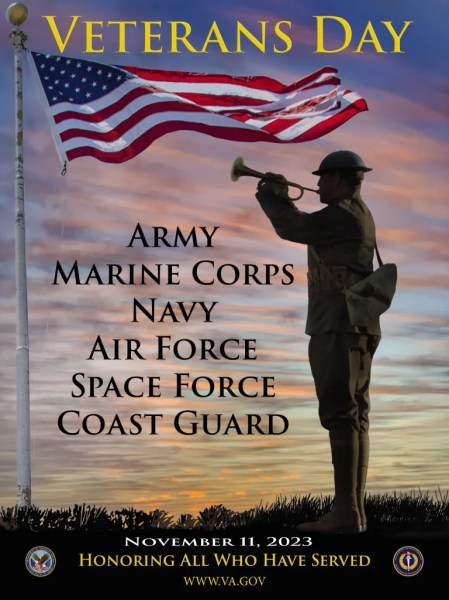









 Millard Fillmore's Bathtub